
Ship stability and stowage · Level P4 · 5 parts · about 17 min
Cargo planning, hull stresses and stability management
5 short parts: Voyage plan · Bulk carriers · Containers · Parametric roll · Managing stability. Each part explains the idea, then gives the points to remember, the common mistakes, a worked case and a practice question; the Academy unit adds all 30 check questions.
1 · Voyage plan
Planning the voyage condition: departure, arrival and the worst point
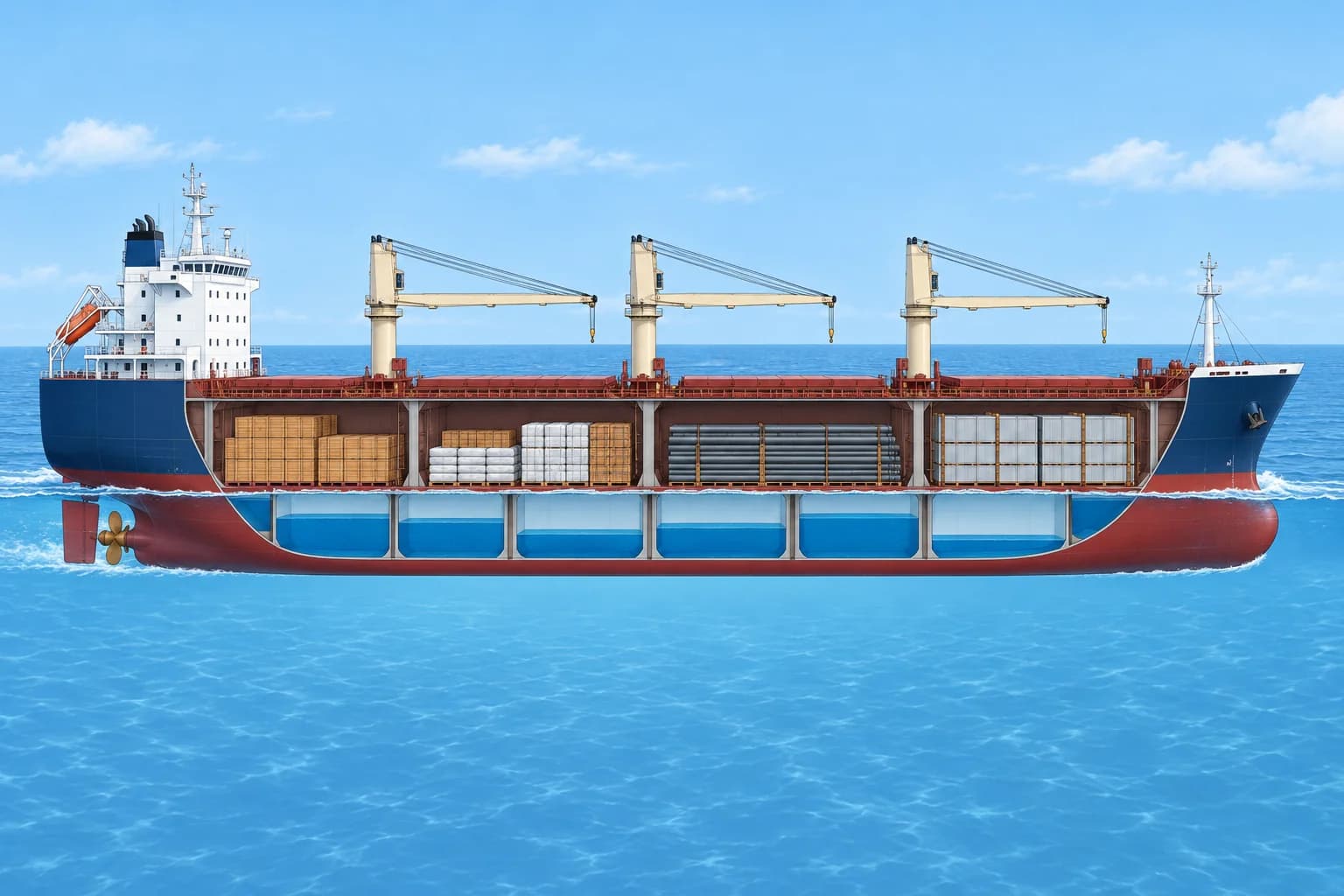
Plan departure, intermediate and arrival conditions: stability and hull stresses must stay within limits throughout the voyage.
Plan the voyage, not the berth
As chief mate you plan the cargo with stability and strength for every stage: departure, any intermediate point and arrival. Fuel, water and stores are used up on passage. Most of that weight sits low, so using it raises G, while part-empty tanks add free surface moments (FSM). The booklet’s criteria apply to every one of these conditions.
The worst condition
The arrival condition is often the worst: least fuel, most slack tanks, perhaps ice or water-soaked deck cargo. On some ships an intermediate point is worse, for example when a group of tanks is half full. The 2008 IS Code’s standard conditions include arrival with 10 % stores and fuel. At every stage, compare GM or KG with the approved limit on the booklet’s stated free-surface basis.
Consumables plan
Estimate daily consumption and the tanks it will come from, in the order the engineers will use them. Include fresh water production and any ballast changes. A fuel-consumption plan that empties tanks in an agreed sequence keeps free surface small; drawing from many tanks at once makes it large. Agree the order with the chief engineer.
Margins
Leave margins for weather delays, extra fuel and water absorbed by deck cargo. Plan any ballast you may need to take on passage, and check that it doesn’t overstress the hull. The seagoing shear force (SF) and bending moment (BM) limits apply at arrival too. Record each calculated condition.
Key figures
- Worked free surface corrections
- Departure FSC 0.050 m; arrival FSC 0.090 m
- GM fluid
- KM − KG − FSC
- IS Code standard condition
- Arrival with 10 % stores and fuel
- Worked example
- GM fluid 1.05 m at departure → 0.89 m at arrival
Worked example: from departure to arrival
- Departure: Δ 24,000 t, KG 8.20 m, KM 9.30 m; the checked free surface correction (FSC) is 0.050 m. — GM fluid = 9.30 − 8.20 − 0.050 = 1.05 m.
- Passage of 12 days at 38 t/day: 456 t of fuel and 120 t of fresh water used from low tanks. — Removing low weights raises G.
- Arrival Δ = 24,000 − 456 − 120 = 23,424 t. The checked weight-change calculation gives KG 8.380 m. — The arrival condition has less displacement and a higher KG.
- The checked arrival tank calculation gives FSC 0.090 m. — More tanks are slack at arrival, so the correction has increased.
- Read arrival KM 9.36 m from the hydrostatic tables at 23,424 t. — Use the arrival draught and trim, with their applicable booklet limits.
- Arrival GM fluid = 9.36 − 8.380 − 0.090 = 0.890 m. — Compare it with the booklet minimum at this draught.
Remember
- Check every stage of the voyage, not only departure.
- Using low fuel and water raises G; slack tanks add free surface.
- Arrival is often the worst condition; sometimes an intermediate point is.
- Agree the fuel-consumption and water order with the chief engineer.
Common mistakes
Wrong: If she leaves with good GM, she will arrive with good GM.
Right: Here GM fluid falls from 1.05 m to 0.89 m. Calculate the arrival and any worse intermediate condition.
Wrong: Use the departure free surface correction at arrival.
Right: Here the checked correction rises from 0.050 m to 0.090 m. Reusing the departure value would overstate arrival GM by 0.040 m.
Worked case
The booklet minimum free-surface-corrected GM at the arrival draught is 0.95 m. Your plan gives 0.89 m GM fluid at arrival. What can you change before sailing?
Show the answer
Don’t sail on this plan. Consider changing the fuel-tank order, keeping fewer tanks slack, keeping double bottom tanks full, adding low ballast before the margin is lost, or lowering heavy cargo. Check each change. Recalculate every stage against its own approved minimum GM or maximum KG at that draught and trim, and recheck strength limits.
Practice question
Which weight change raises the ship’s centre of gravity, G?
- Using fuel stored below G
- Using fuel stored above G
- Adding fresh water below G
- Loading provisions below G
Show the answer
Answer: A. Removing weight below G raises G. To find the resulting GM fluid, recalculate KM, KG and the tank corrections.
2 · Bulk carriers
Bulk carriers: the BLU Code, the loading plan and SOLAS XII
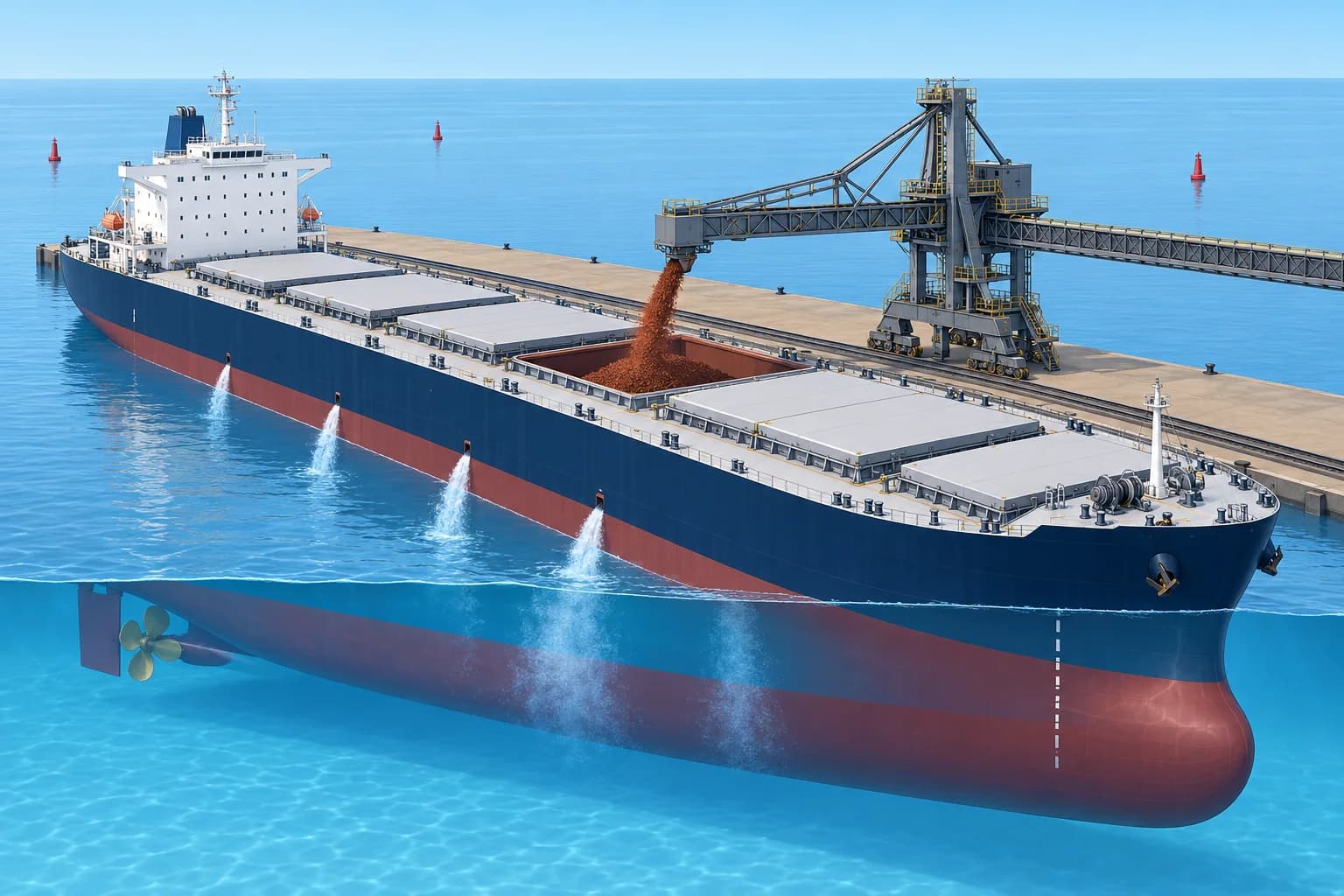
Bulk carriers load fast and heavy. The BLU Code and SOLAS chapters VI and XII make master and terminal agree a plan that keeps the hull within limits.
Why bulk carriers are different
Terminals can load thousands of tonnes an hour. Dense cargoes such as iron ore fill only part of a hold but put large local loads on the tank top. Past losses of bulk carriers, some so sudden that no distress message was sent, led to SOLAS chapter XII, the BLU Code and stricter class rules.
The BLU Code
The BLU Code, the Code of Practice for the Safe Loading and Unloading of Bulk Carriers (IMO resolution A.862(20)), sets out the duties of the master and the terminal representative. Under SOLAS VI/7, before loading they agree a loading or unloading plan: the order of holds, the weight of each pour (one step of loading into a hold) and the ballast stages. The BLU Manual guides terminal staff.
Ship/shore safety checklist
Before operations start, the master and terminal representative complete the ship/shore safety checklist (BLU Code appendix 3): berth depth and air draught, moorings, communications, the agreed plan, ballast rates and the emergency stop procedure. The master may stop loading if the plan is not followed or safety is at risk. Keep the ship upright, or with only the list operations need.
SOLAS XII
Bulk carriers of 150 m and over must have a loading instrument that gives hull-girder shear forces (SF) and bending moments (BM) (XII/11). Every bulk carrier has water level detectors in each hold (XII/12): one alarm at 0.5 m above the inner bottom and a second at 15 % of the hold depth, but not more than 2 m. Ballast tanks forward of the collision bulkhead also alarm at no more than 10 % of tank capacity.
Loading in practice
The last pours trim the ship to the planned departure draughts and trim, so keep some cargo back as trimming pours. Keep each pour within the plan’s tonnage; shore scale figures can be uncertain. Stop if deballasting falls behind.
Key figures
- BLU Code
- IMO resolution A.862(20); duties of master and terminal
- SOLAS VI/7
- Master and terminal agree the loading/unloading plan
- Checklist
- Ship/shore safety checklist, BLU Code appendix 3
- SOLAS XII/11
- Loading instrument on bulk carriers ≥ 150 m
- SOLAS XII/12
- Hold alarms at 0.5 m and 15 % of hold depth (≤ 2 m)
Agreeing and running a loading plan
- Send the terminal your cargo plan early, with the loading instrument output. — SOLAS VI/7 and the BLU Code require the information in advance.
- Agree the loading plan: order of holds, pour sizes, ballast stages and rates. — Each stage has been checked for SF, BM and tank top loads.
- Complete the ship/shore safety checklist with the terminal representative. — Confirms communications, berth depth, air draught and the stop procedure.
- After each pour, get the tonnage, read the draughts and compare with the plan. — Finds scale errors and drift from the plan early.
- Keep deballasting in step; stop loading if it falls behind. — Cargo ahead of ballast can overstress the hull.
- Finish with the agreed trimming pours; confirm final draughts, trim and tonnage against the plan. — Confirms that the completed condition matches the checked plan.
Remember
- Master and terminal agree a written loading plan: holds, pours and ballast.
- Complete the ship/shore safety checklist before operations start.
- The master can stop loading if the plan is not followed.
- Keep cargo and ballast rates in the agreed ratio, within the checked loading sequence.
Common mistakes
Wrong: The terminal’s plan is the terminal’s responsibility.
Right: The master is responsible for the ship’s stability and strength. Check every pour with the loading instrument before agreeing.
Wrong: Pour sizes don’t matter if the hold total is right.
Right: One large pour can exceed local or hull girder limits at an intermediate stage. Keep to the agreed pour sizes.
Worked case
Iron ore: 12,000 t is planned for No. 4 hold in three pours. The terminal loads at 4,500 t/h and wants one continuous pour to save time. Your plan was checked only for 4,000 t pours. What do you say?
Show the answer
Not until it has been checked. A 12,000 t pour, about 2 h 40 min at 4,500 t/h, may exceed SF or BM limits at an intermediate stage, and deballasting may fall behind. Keep the agreed 4,000 t pours (about 53 minutes each), or re-run the loading instrument for the new sequence and amend the plan in writing first.
Practice question
The loading plan is signed, but the ship and terminal have not agreed how to order an emergency stop. What should you do?
- Start at half rate and agree the stop signal later
- Use the agent as a relay for any stop instruction
- Agree and test stop communications before starting
- Wait until the first pour ends to agree a signal
Show the answer
Answer: C. The completed ship/shore safety checklist must establish effective communications and the emergency stop procedure before operations start.
3 · Containers
Container ships: stack weights, lashing loads and GM
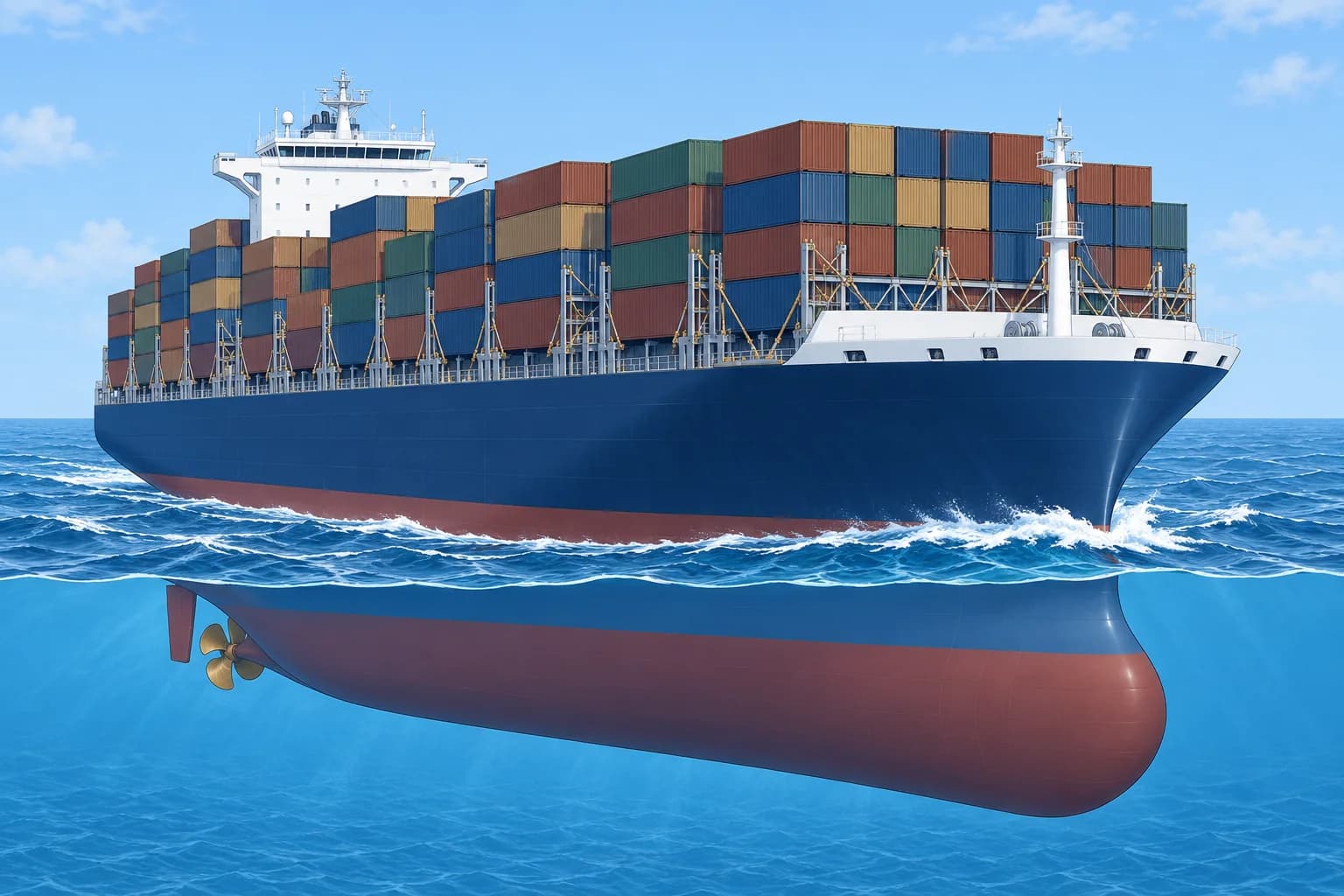
On a container ship, stability, lashing strength and visibility pull against each other. Plan the stacks, the GM and the lashing check together.
Stack weights
Each container stack sits on fittings with a maximum stack weight, on deck and in the hold. The Cargo Securing Manual and the ship’s loading program give the limits. Five 20 t boxes make 100 t: too much for a 90 t stack limit. Put heavy boxes low and light boxes high, for GM and for lashing loads alike.
The lashing computer
The lashing computer, usually a module of the loading program, calculates the forces on lashings, twistlocks and corner posts bay by bay. It uses the ship’s GM, roll period and the class rules for accelerations. Change the GM or the stack heights and the forces change: a stack that passes at one GM can fail at another.
GM and roll
For the same roll amplitude, higher GM shortens the natural roll period and increases accelerations. Low GM does not guarantee gentle rolling or adequate large-angle stability. Estimate T ≈ 2CB/√GM, with T in seconds and GM corrected for free surface. B is moulded breadth, d mean moulded draught and LWL waterline length, all in metres; calculate C below. With B = 32.2 m and C = 0.333 for this example, GM 0.8 m gives about 24 s; GM 3.2 m about 12 s.
Visibility
SOLAS V/22 limits how much deck cargo may block the view ahead. From the conning position, the sea surface must not be hidden for more than two ship lengths or 500 m, whichever is less, ahead of the bow and 10° on each side. Check it when planning high stacks forward, for every draught and trim.
Losing containers
Heavy rolling can overload stacks near their limits. Keep lashing forces within the computer’s limits for expected conditions and check lashings before bad weather.
Key figures
- Roll period (IS Code)
- T ≈ 2CB ÷ √GM
- C (B: moulded breadth; d: mean moulded draught; LWL: waterline length, m)
- 0.373 + 0.023(B/d) − 0.043(LWL/100)
- Example (B 32.2 m)
- GM 0.8 m → 24 s; 2.0 m → 15 s; 3.2 m → 12 s
- SOLAS V/22
- Hidden sea ahead ≤ 2 ship lengths or 500 m, if less
- Stack check
- Sum of box weights ≤ maximum stack weight
Remember
- Keep each stack within its maximum stack weight; heavy boxes low.
- Lashing forces depend on GM: re-run the check when GM changes.
- Too much GM means a violent roll and high lashing forces.
- Check the SOLAS V/22 blind zone for every draught and trim.
Common mistakes
Wrong: More GM is always safer for a container ship.
Right: Large GM shortens the roll and raises accelerations, so lashings can fail. Aim for adequate, not maximum, GM.
Wrong: The lashing check done at the first port covers the voyage.
Right: Re-run it whenever GM, stack weights or the expected weather change.
Worked case
A container ship with waterline length 250 m (moulded breadth 32.2 m, mean moulded draught 11 m) has free-surface-corrected GM 3.2 m after a late change. The lashing computer shows several deck bays at 105 %. The plan at GM 2.0 m passed. Why, and what do you do?
Show the answer
With C ≈ 0.333, the roll period falls from about 15 s to 12 s, raising lashing forces for the same roll amplitude. Reduce GM only within approved stability and strength limits, or reduce upper-tier weights. Lowering heavy boxes raises GM, so accept any restow only after both stability and lashing checks pass.
Practice question
Five boxes of 20 t form a stack with a 90 t stack weight limit. What is wrong?
- It is 10 t under the limit
- It is 10 t over the limit
- It is fine if fully lashed
- Only the top box is too heavy
Show the answer
Answer: B. 5 × 20 = 100 t, 10 t over the 90 t limit. Lashing does not raise the stack weight limit.
4 · Parametric roll
Parametric rolling and dangerous following seas
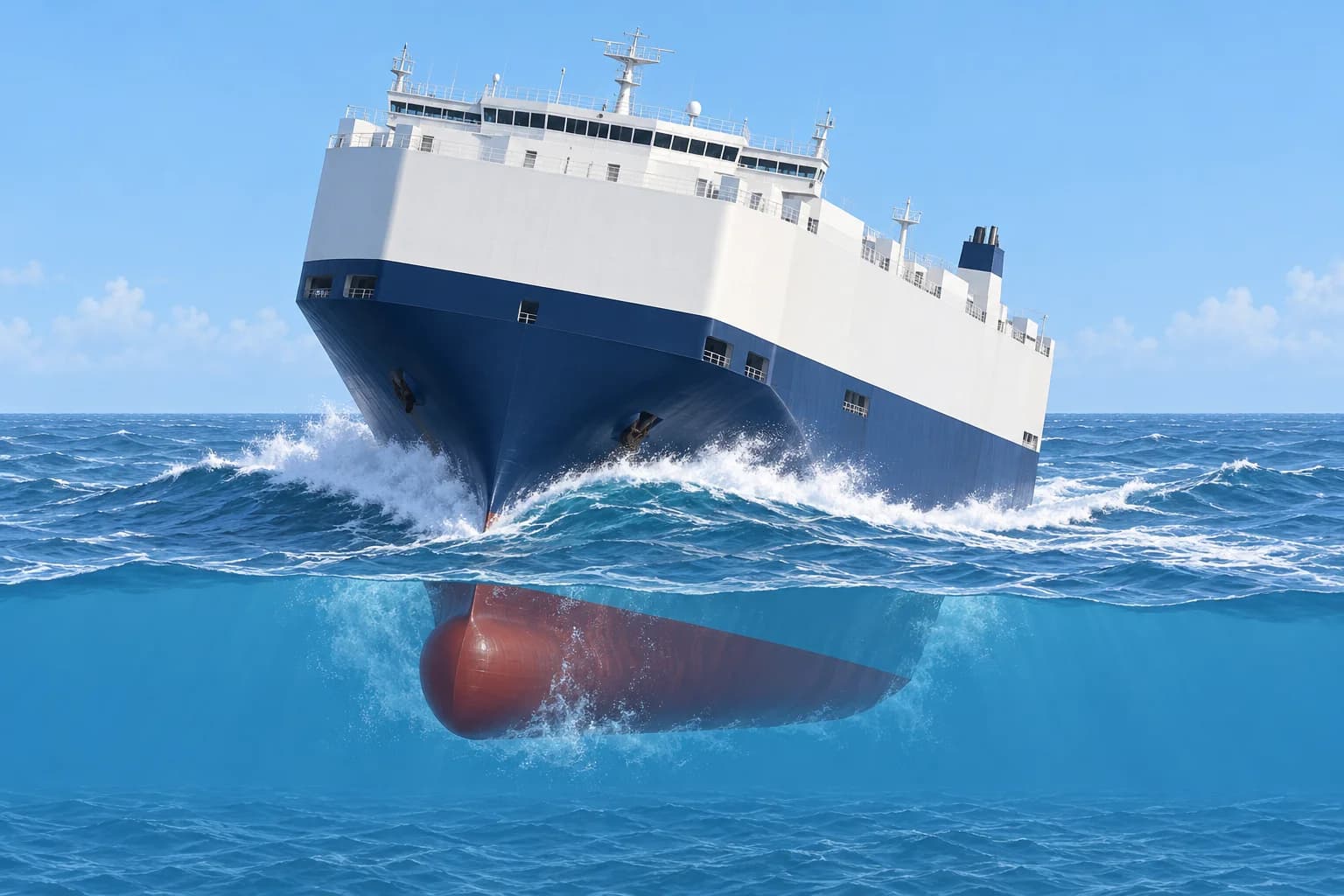
In some waves a ship’s stability rises and falls with each wave, and the roll can build to 30° or more in a few cycles. Know the conditions and how to break them.
What it is
When a wave crest is amidships, the waterplane narrows at the ends and GM falls. With the trough amidships, the flared bow and stern are deeply immersed and GM rises. This regular change of stability is parametric excitation. If this stability change repeats once or twice per natural roll, rolling can grow rapidly. Container ships and car carriers, with fine hulls and wide flare, are most at risk.
The danger window
MSC.1/Circ.1228 warns of parametric rolling when the encounter period TE, the time between waves meeting the ship, is close to the ship’s roll period TR, or close to half of it: TE ≈ TR or TE ≈ 0.5 TR. Wavelengths close to the ship’s length are the worst. It can happen in head, following, bow or quartering seas, even in moderate weather.
Finding the encounter period
For deep-water wavelength λ in metres, wave speed c ≈ 1.25√λ m/s and period TW ≈ 0.8√λ s. Use ship speed through the water V in m/s; convert knots by multiplying by 0.5144. Use TE = λ/(c + V) for seas directly ahead and TE = λ/|c − V| for seas directly astern. At equal following speeds, there is no finite encounter period. For oblique seas, use the Circ.1228 diagram.
Breaking the resonance
Change course, speed or both to move TE well away from TR and from 0.5 TR, then recompute. A small speed change may not be enough; a course change also alters the encounter angle. In synchronous rolling, successive waves push in time with the ship’s natural roll (TE ≈ TR). This is direct wave forcing; parametric rolling comes from changing restoring stability.
Surf-riding and new criteria
Surf-riding means a following wave accelerates and carries the ship. Broaching is a sudden loss of heading control, often with dangerous heel. For seas directly astern, Circ.1228 gives an indicative danger boundary of about 1.8√L knots, with L the length between perpendiculars in metres. Ships can be unsafe outside this zone. MSC.1/Circ.1627 gives interim, non-mandatory second-generation intact stability guidelines and operational guidance.
Key figures
- Danger (Circ.1228)
- TE ≈ TR or TE ≈ 0.5 TR
- Wave period
- TW ≈ 0.8 √λ s (λ in m)
- Wave speed
- ≈ 1.25 √λ m/s in deep water
- Directly ahead (c and V in m/s; λ in m)
- TE = λ/(c + V)
- Surf-riding guidance (L: length between perpendiculars, m)
- Indicative dead-astern boundary: V > 1.8√L knots
- MSC.1/Circ.1627
- Interim intact-stability guidelines; operational guidance
Worked example: is she in the danger window?
- Roll period TR 22 s. Head sea with a wavelength of 300 m; speed 12 knots (6.17 m/s). — Take TR from a roll test or the loading program.
- Wave speed ≈ 1.25 × √300 = 21.6 m/s; wave period ≈ 0.8 × √300 = 13.9 s. — Deep-water wave relations.
- Head seas: TE = 300 ÷ (21.6 + 6.2) = 10.8 s. — Ship and waves approach each other, so their speeds add.
- Compare: 0.5 TR = 11 s, so TE ≈ 0.5 TR. — Danger: parametric rolling can build within a few cycles.
- Alter course and, if needed, speed, then recompute TE. — Move TE well away from 11 s and from 22 s.
Remember
- Parametric rolling comes from stability rising and falling with each wave.
- Danger when TE ≈ TR or TE ≈ 0.5 TR, with wavelength near the ship’s length.
- Change course and speed to move TE away from both, then recompute.
- Circ.1627 gives interim intact-stability guidelines and operational guidance; it is not mandatory.
Common mistakes
Wrong: Parametric rolling only happens in beam seas.
Right: It is typical of head and following seas, where the waterplane changes most along the hull.
Wrong: It needs very big seas.
Right: Moderate waves of the right length and period can trigger it when TE is in the danger window.
Worked case
A ship of length 200 m between perpendiculars runs at 18 knots with waves dead astern. Wavelength is 200 m and natural roll period TR is 24 s. What does the surf-riding guidance tell you, and is she in the parametric-roll danger window?
Show the answer
The general Circ.1228 dead-astern boundary is 1.8 × √200 = 25.5 knots. At 18 knots you are outside that zone; this does not rule out surf-riding or broaching. Wave speed ≈ 1.25 × √200 = 17.68 m/s, ship speed 9.26 m/s, so TE = 200 ÷ |17.68 − 9.26| ≈ 23.8 s. This is close to TR = 24 s: alter course or speed and recompute to move away from TR and 0.5 TR.
Practice question
Which condition does MSC.1/Circ.1228 give for a risk of parametric rolling?
- TE close to TR or to half of TR
- TE close to twice the wave period only
- TE equal to the pitch period only
- TW greater than the roll period
Show the answer
Answer: A. Parametric rolling can build when the encounter period is about equal to the roll period or about half of it.
5 · Managing stability
Managing stability and stresses at sea: GM, timber, ice and heavy weather
Stability is managed, not just calculated. Keep GM in the right band, watch what changes on passage, and record your decisions.
Too little, too much
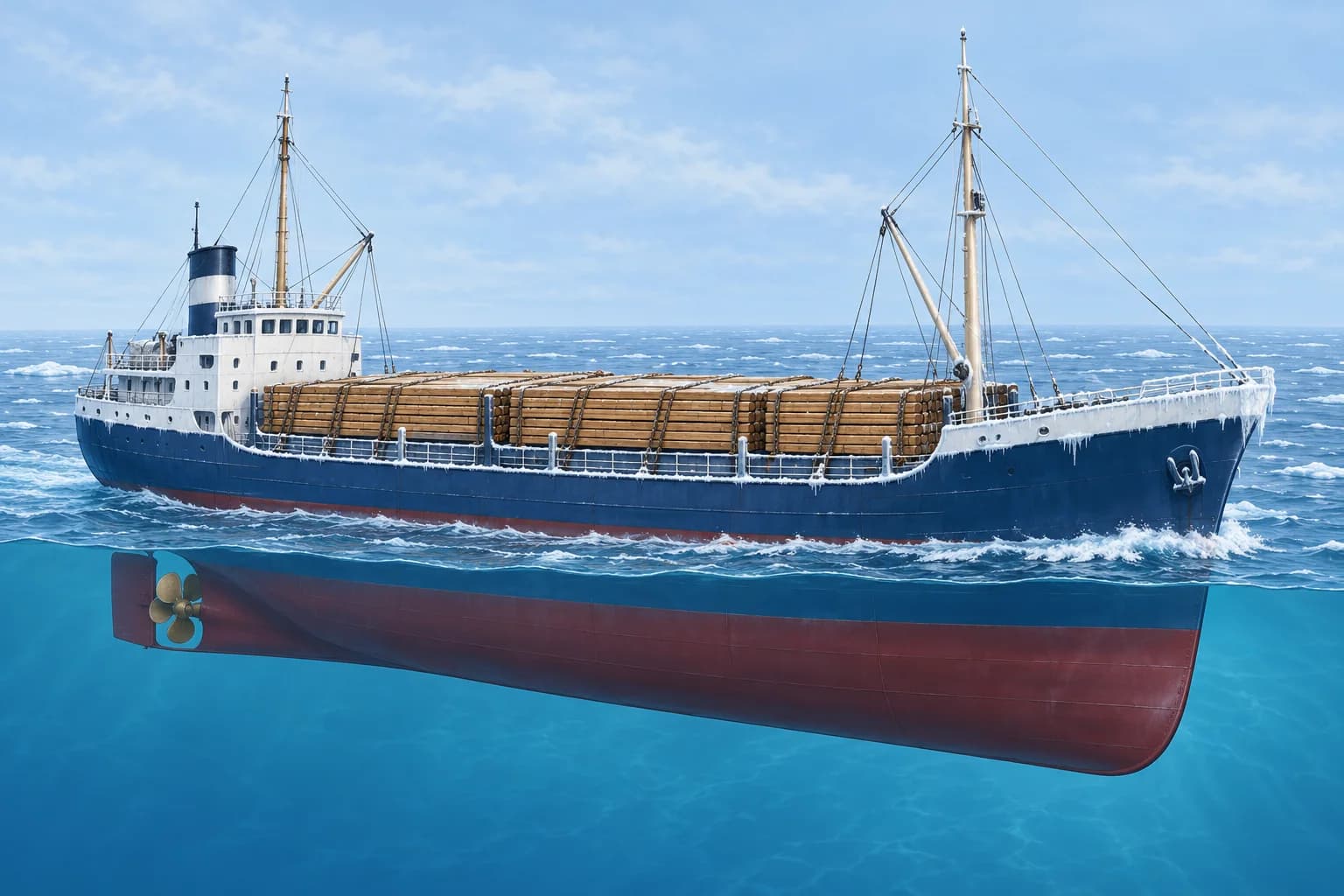
Small positive GM makes the ship tender, with weak initial righting ability. Negative initial GM can produce an angle of loll, a heel caused by unstable upright equilibrium. Too much GM makes her stiff: a quick, jerky roll that strains lashings, shifts cargo and injures crew. Aim for a GM comfortably above the booklet minimum and not far beyond what the cargo and lashings need.
Timber deck cargo
Use Part A 3.3.2 only with flag State approval for qualifying stowage specified in your approved stability booklet. Require GZ area ≥ 0.08 m·rad to 40° or the downflooding angle, whichever is less; GZmax ≥ 0.25 m; free-surface-corrected GM ≥ 0.10 m throughout. Other applicable criteria, including the weather criterion with its timber modification, still apply. At standard arrival, add 10 % to deck timber weight for water absorption; allow for ice.
Icing
Ice raises G and adds windage. For fishing vessels, IS Code B 6.3.1 gives 30 kg/m² on exposed weather decks and gangways and 7.5 kg/m² on projected lateral area above the waterline, per side: the side-on silhouette. For other ships, use the approved icing assumptions for the vessel and operating area. Remove ice early where safe, starting high up, and reduce speed or alter course to cut spray.
Heavy weather
Before bad weather, press up or empty slack tanks where possible, secure cargo, check lashings, close weathertight openings and review GM and roll period. In heavy head seas, reduce speed to limit slamming and bending loads. A noticeably slower roll or lingering near maximum heel may warn of reduced GM; check the loading condition promptly. Observed rolling also depends on the waves.
Records and the ISM Code
The International Safety Management (ISM) Code requires documented procedures for cargo and stability work. Keep each calculated condition, the loading instrument printouts, soundings, draught readings and ballast changes with their reasons. Report damage, unusual behaviour and near misses through the safety management system.
Key figures
- Timber: area to 40° or earlier downflooding
- ≥ 0.08 m·rad; GZmax ≥ 0.25 m; corrected GM ≥ 0.10 m
- Water absorption
- Deck timber weight +10 % in the arrival condition
- Fishing-vessel icing (IS Code B 6.3.1)
- Decks 30 kg/m²; projected lateral area 7.5 kg/m² per side
- Stiff ship
- Large GM: short, violent roll
- Tender ship
- Small positive GM: weak initial righting and a long natural period
Remember
- Keep GM in a band: above the minimum, but not excessive.
- Allow for water absorption and ice on timber deck cargo.
- Ice raises G and windage: remove it early.
- Record conditions and decisions as the ISM Code expects.
Common mistakes
Wrong: A long, easy roll means she is safe.
Right: A longer natural roll period may indicate lower GM; observed rolling also depends on waves. Investigate changes and verify the complete stability condition.
Wrong: Ice removal can wait until the weather improves.
Right: Ice can build quickly and raise G. Start removing it early where safe, high up first, and reduce spray.
Worked case
Your approved arrival condition includes an icing allowance. Freezing spray continues, ice is growing high up and the roll has slowed. The watch proposes waiting for calmer weather before removing ice. What do you do?
Show the answer
Do not treat the allowance as a cap on actual ice growth or proof of safety. Reassess the complete stability condition using the best available ice estimate. Reduce spray by adjusting course or speed, and remove ice early where safe, starting high up. Protect the crew during removal. Keep monitoring ice and rolling, and record conditions, decisions and actions.
Practice question
Your booklet permits the alternative timber criteria. Corrected GM is 0.12 m, but maximum GZ is 0.22 m. What follows?
- Accept because corrected GM exceeds 0.10 m
- Reject because maximum GZ is below 0.25 m
- Accept because maximum GZ exceeds 0.10 m
- Reject because corrected GM must reach 0.25 m
Show the answer
Answer: B. The criteria apply together. GM passes its 0.10 m minimum, but maximum GZ fails its 0.25 m minimum. Rework and recheck the condition.