
Ship stability and stowage · Level P3 · 5 parts · about 16 min
Cargo securing and dangerous goods basics (CSS and IMDG Codes)
5 short parts: CSS Code · Lashing forces · Lashing at sea · IMDG Code · Bulk and grain. Each part explains the idea, then gives the points to remember, the common mistakes, a worked case and a practice question; the Academy unit adds all 30 check questions.
1 · CSS Code
The CSS Code and the Cargo Securing Manual
Cargo that shifts can list, damage or sink a ship. The CSS Code sets the principles; the ship’s approved Cargo Securing Manual tells you exactly how to secure.
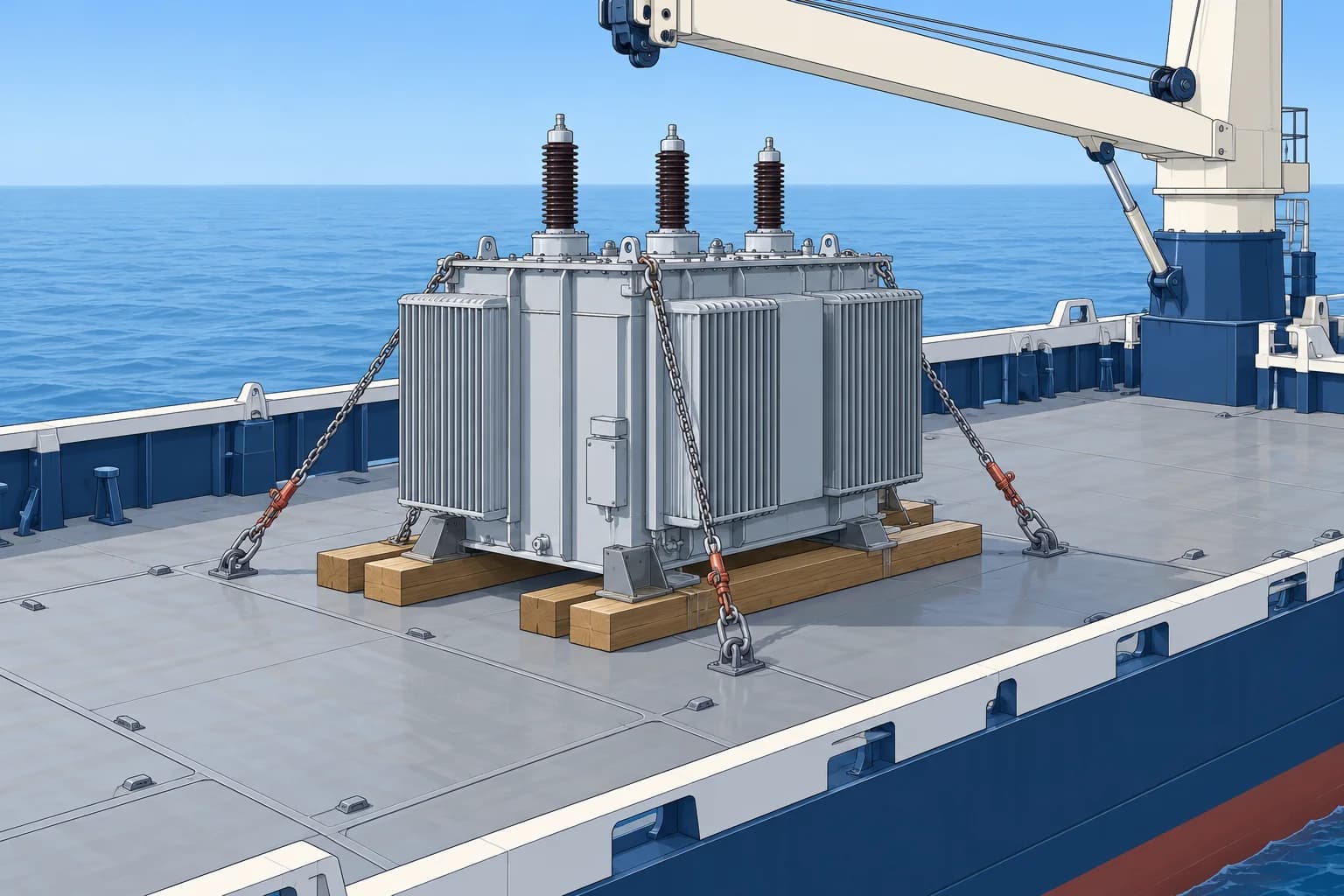
Why cargo shifts
At sea your ship rolls from side to side, pitches bow up and down, and heaves vertically. A cargo item feels sideways forces that can approach its own weight in heavy weather, plus wind and sea on deck. Friction alone will not hold it. Shifted cargo can cause a list, hole the ship, crush people and go overboard. SOLAS chapters VI and VII require cargo units to be loaded, stowed and secured throughout the voyage to an approved Cargo Securing Manual.
The CSS Code
IMO’s Code of Safe Practice for Cargo Stowage and Securing (CSS Code, consolidated 2021 edition) gives general principles and annexes for problem cargoes: containers on ships not designed for them, portable tanks, wheeled cargo, heavy items, steel coils, heavy metal products, anchor chains, scrap, logs, unit loads. Annex 13 gives methods to assess securing; Annex 14 covers safe access for lashing containers.
Three kinds of cargo
Standardized cargo travels in a system designed for it, such as containers on a cellular container ship. Semi-standardized cargo comes in a limited range of types, such as vehicles and trailers on a roll-on/roll-off (ro-ro) deck. Non-standardized cargo needs individual stowage and securing: machinery, steel coils, project cargo. For non-standardized cargo, ask the chief mate to verify the securing arrangement against the approved manual.
The Cargo Securing Manual
It is written to IMO’s guidelines, MSC.1/Circ.1353/Rev.2, and approved by the flag State. It lists the ship’s fixed securing points and portable gear with their strength, gives stowage and securing instructions for the cargoes the ship carries, and sets the inspection and maintenance of the gear. Record lashing gear in it and replace worn or damaged items.
Principles
Stow tight and block where you can. Use dunnage, packing such as timber beneath or between cargo, to spread loads and add friction. Keep lashings short, direct and at good angles, and use gear of similar stretch on one item so it shares the load. Inspect before sailing, during the voyage and before and after heavy weather. If cargo starts to move, report to the master and control deck access; inspect only when conditions permit.
Key figures
- Legal basis
- SOLAS VI and VII: secure cargo to the approved manual
- CSS Code
- IMO guidance; consolidated 2021 edition
- Manual guidelines
- MSC.1/Circ.1353/Rev.2
- Annex 13
- Methods to assess securing arrangements
- Annex 14
- Safe access for lashing containers
Remember
- SOLAS VI and VII require cargo to be secured to the ship’s approved Cargo Securing Manual.
- The CSS Code gives principles and annexes for problem cargoes; Annex 13 assesses securing.
- Cargo is standardized, semi-standardized or non-standardized.
- The manual lists securing points and gear, their strength and how to maintain them.
- Stow tight, block, use dunnage, lash short and direct; inspect before and after heavy weather.
Common mistakes
Wrong: The CSS Code is only advice, so securing is up to the stevedores.
Right: The Code is guidance, but SOLAS makes securing to the approved Cargo Securing Manual mandatory, and the ship stays responsible.
Wrong: A heavy item will not slide: friction holds it.
Right: Rolling and wet steel can reduce friction to almost nothing. Secure every item against sliding and tipping in all directions.
Worked case
Stevedores have secured a 30 t generator on deck with lashings of mixed wire, web straps and chain, all at different angles and some very long. They say it is the way they always do it. What do you do?
Show the answer
Check the arrangement against the Cargo Securing Manual. Mixed gear of different stretch does not share the load: the stiffest lashings take it first and may part one by one. Ask for similar gear, short and direct, at proper angles, with blocking or dunnage against sliding. Report to the chief mate and do not accept it until it meets the manual.
Practice question
Which document must cargo be secured to on board, under SOLAS chapters VI and VII?
- The approved Cargo Securing Manual
- The stevedores’ own lashing guide
- The ship’s stability booklet
- The shipper’s packing certificate
Show the answer
Answer: A. SOLAS requires securing to the ship’s approved Cargo Securing Manual, prepared to IMO guidelines.
2 · Lashing forces
Lashing strength: MSL, the rule of thumb and calculated strength
Compare securing loads with cargo weight. The rule of thumb needs reasonably even load sharing, similar lashing stretch and a separate tipping check.
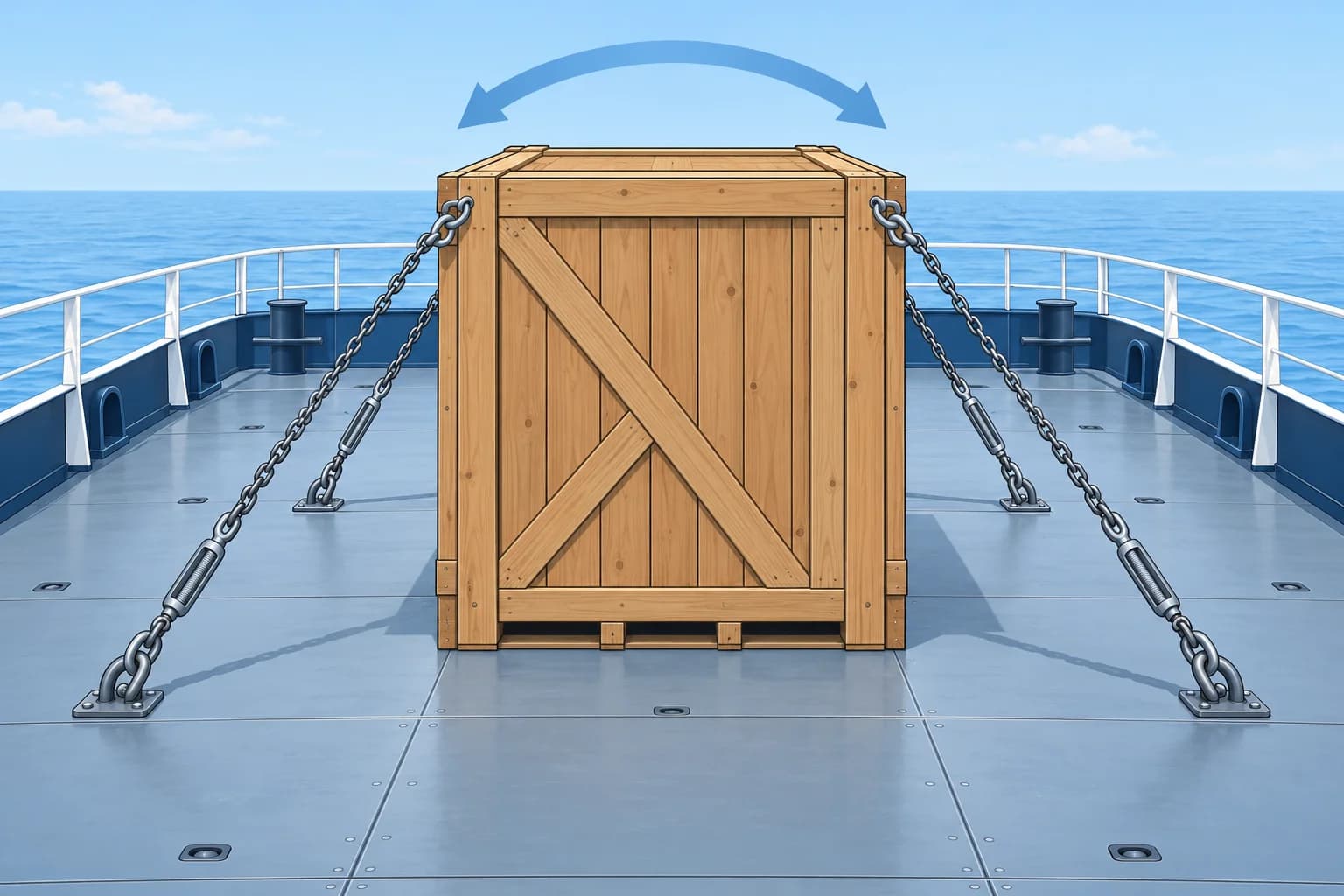
MSL
Maximum securing load (MSL) is the maximum permitted securing force, in kilonewtons (kN). Compare forces: 1 t weighs 9.81 kN; 1 kN is roughly the weight of 102 kg. Without a marked MSL, use these percentages of breaking strength (force at failure): mild-steel shackles, rings, deck eyes and turnbuckles 50 %, chains 50 %, web lashings 50 %, fibre rope 33 %, wire rope 80 % single use or 30 % re-usable, steel band 70 % single use.
Weakest link
A lashing is a chain of parts: deck eye, shackle, wire or chain, tensioner, cargo lug. The lashing’s MSL is the smallest MSL in the series. A chain of 80 kN MSL on a shackle of 60 kN MSL is a 60 kN lashing.
Rule of thumb
Annex 13’s quick check: the total MSL of lashings on each side must be at least the item’s weight in kN. It corresponds to 1 g sideways and disregards friction. Use it only when the arrangement distributes loads reasonably evenly between lashings with similar stretch. Do not count lashings steeper than 60° to the deck against sliding; they may help against tipping. Follow the approved manual and check other directions and tipping separately.
Calculated strength
The full Annex 13 method checks sliding and tipping using friction and lashings. Each lashing counts at calculated strength, CS = MSL ÷ 1.5, allowing for uneven loading: 60 kN MSL gives 40 kN CS. The friction coefficient μ describes grip: 0 means no friction; larger values mean more resistance to sliding for the same contact load. Typical values: timber–timber 0.4; steel–timber or steel–rubber 0.3; dry steel–steel 0.1; wet steel–steel 0. Use the manual’s approved method.
When the rule is not enough
Use the full method, or the manual’s tables, for heavy items, items stowed high or near the ends, ships with a large GM that roll violently, and whenever the rule gives a borderline answer. The rule of thumb is a check, not a design.
Key figures
- Weight force
- 1 t weighs 9.81 kN; 1 kN ≈ weight of 102 kg
- MSL at 50 % of breaking
- Shackles, rings, deck eyes, turnbuckles, chains, web lashings
- Other MSL values
- Fibre rope 33 %; wire 80 % single use, 30 % re-usable; band 70 %
- Rule of thumb
- Σ MSL each side ≥ weight (kN); sliding: lashings ≤ 60° to deck
- Calculated strength
- CS = MSL ÷ 1.5
- Friction μ
- Timber–timber 0.4; steel–timber 0.3; steel–steel 0.1 dry, 0 wet
Worked example: a 24 t item with reasonably even load sharing and similar lashing stretch
- Weight = 24 t × 9.81 = 235 kN. — The rule compares forces, so convert the mass to kN.
- Chain breaking strength 160 kN: MSL = 50 % = 80 kN. — Chains count at 50 % of breaking strength when no MSL is marked.
- Shackle breaking strength 120 kN: MSL = 50 % = 60 kN. Each lashing = 60 kN. — The weakest part of the series sets the lashing’s MSL.
- Lashings per side = 235 ÷ 60 = 3.9: fit 4 each side (240 kN). — For this arrangement, each side’s total MSL must at least reach the weight; check other directions and tipping separately.
- Count only lashings at 60° or less to the deck. — Steeper lashings add little against sliding; any extras are a bonus against tipping.
- For the full Annex 13 method, each lashing counts as CS = 60 ÷ 1.5 = 40 kN. — The calculated strength allows for uneven sharing and imperfect fitting.
Remember
- MSL is the maximum permitted securing force in kN; weight of 1 t: 9.81 kN.
- A lashing is as strong as its weakest part: the smallest MSL in the series.
- Rule: MSL each side ≥ weight; similar stretch, reasonably even sharing; ≤ 60° for sliding. Check tipping separately.
- In the full method each lashing counts at CS = MSL ÷ 1.5.
- Heavy, high or end-stowed items and stiff ships need the full calculation.
Common mistakes
Wrong: A 24 t item needs 24 kN of lashings each side.
Right: Convert mass to force: 24 t × 9.81 = 235 kN. Tonnes and kilonewtons differ by almost ten times.
Wrong: The chain is rated 80 kN, so the lashing is 80 kN.
Right: Take the weakest part. With a 60 kN shackle in the series, the lashing is a 60 kN lashing.
Wrong: Count every lashing, however steep.
Right: Under the rule of thumb, lashings steeper than 60° to the deck do not count against sliding.
Worked case
An 18 t machine is to be secured on deck with web lashings marked MSL 25 kN, at about 45° to the deck. The stevedores fit 6 a side. Does it pass the rule of thumb? What would you ask for?
Show the answer
Weight = 18 × 9.81 = 177 kN a side. Six webs give 150 kN: not enough. Eight a side give 200 kN and meet the sideways check if they have similar stretch and share loads reasonably evenly. Check the manual, other directions and tipping separately. Block against sliding and add dunnage for friction. Ask the chief mate whether the full Annex 13 calculation is needed.
Practice question
A 24 t item has 60 kN lashings at 45°, with similar stretch and reasonably even load sharing. What is the minimum number needed per side under the rule of thumb?
- 1
- 2
- 4
- 6
Show the answer
Answer: C. Weight = 24 × 9.81 = 235 kN; 235 ÷ 60 = 3.9, so 4 each side (240 kN). This meets the sideways rule-of-thumb check; check tipping and other directions separately.
3 · Lashing at sea
Lashing practice: containers, ro-ro, heavy items and checks at sea
Know the gear, fit it as the manual shows, and check it before sailing, during the voyage and around heavy weather.
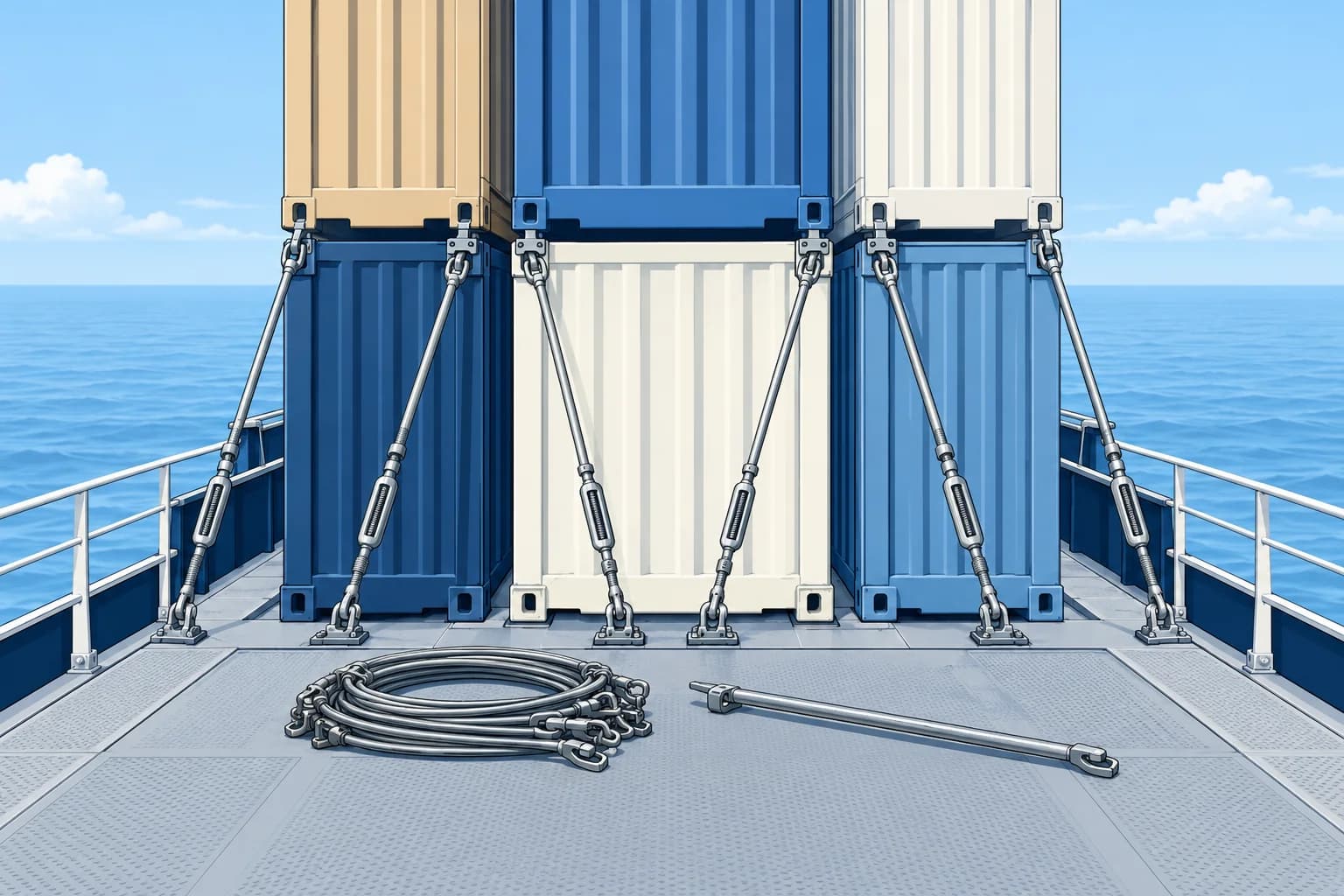
Container gear
Twistlocks secure container corner fittings together or to deck fittings. Semi-automatic twistlocks are often called SATLs. On deck, lashing rods (steel braces) run diagonally to turnbuckles (screw tensioners) on the hatch cover or lashing bridge (a raised working platform). Bridge fittings join the tops of neighbouring stacks. In holds, cell guides (vertical steel rails) restrain the containers. Follow the approved manual’s lashing plan.
Stack weights
Follow the maximum stack weight and individual container-weight limits in the approved stowage plan. Put heavy containers low in the stack. Container lashing loads and GM are covered in Cargo planning.
Ro-ro cargo
Vehicles and trailers are secured with chains or web lashings from the deck’s securing points to the vehicle’s own points, with parking brakes on. Unaccompanied trailers rest on trestles under the front end. IMO’s guidelines for road vehicles (resolution MSC.479(102)) call for deck points of at least 100 kN MSL for each lashing, and two to six points each side of a vehicle.
Heavy and steel items
Heavy items sit on timber dunnage over load-bearing structure, are blocked against sliding, and lashed with short, direct chains or wires to strong points. Steel coils are stowed in rows, axis fore and aft (along the ship), wedged and lashed together; one loose coil can set a row moving. Welded stoppers may be used where the manual allows.
Checks at sea
Inspect lashings before sailing, regularly on passage when conditions allow, and before and after heavy weather. Tighten slack turnbuckles, check that twistlocks are locked, look for chafe, stretched wires and crushed dunnage. Go in pairs with a light and a radio, and only when it is safe; use designated access routes and keep clear of cargo pinch points and suspended loads. Log what you checked and did.
Key figures
- Twistlock / SATL
- Locks container corners to each other and to the deck
- Lashing rod + turnbuckle
- Diagonal from corner castings to the deck or lashing bridge
- Ro-ro deck securing point
- MSL ≥ 100 kN for each lashing (MSC.479(102))
- Points per vehicle side
- 2 to 6, depending on the vehicle
- Steel coils
- Rows with the axis fore and aft, wedged and lashed
Remember
- Containers: twistlocks, lashing rods, turnbuckles, bridge fittings; heavy boxes low in the stack.
- Ro-ro: deck points ≥ 100 kN MSL/lashing; 2–6 points per vehicle side; brakes on; trailers supported on trestles.
- Heavy items: dunnage, blocking, short direct lashings; coils fore and aft, wedged.
- Check before sailing and around heavy weather, in pairs, only when safe; log it.
Common mistakes
Wrong: Put the heaviest containers on top where the crane can reach them.
Right: Follow the approved stowage plan and stack-weight limits; put heavy containers low.
Wrong: Check the lashings when the weather is at its worst.
Right: Check before heavy weather arrives and after it. Report concerns to the master, control deck access and inspect only when conditions permit safe work.
Worked case
Heavy weather is forecast for tonight on a ship carrying containers on deck and a few trailers on the weather deck. It is now 14:00, wind force 5. What do you do on your watch?
Show the answer
Tell the master and assess deck safety before sending anyone out; wind force alone does not establish safe access. If conditions permit, work with the bosun and crew in pairs: tighten turnbuckles, check twistlocks and secure trailers as the manual allows. Secure the deck, control access and log the checks. Report concerns during the weather; inspect again only when conditions permit safe work.
Practice question
What does a twistlock do?
- Tensions a lashing rod against the deck
- Locks container corners together or to deck
- Joins the tops of two neighbouring stacks
- Supports the front end of a parked trailer
Show the answer
Answer: B. Twistlocks lock corner castings together. Turnbuckles tension rods, bridge fittings join stack tops, trestles support trailers.
4 · IMDG Code
Dangerous goods on board: the IMDG Code for the watch officer
The IMDG Code tells you where dangerous goods may go, what they must be kept away from, and which papers and emergency schedules come with them.
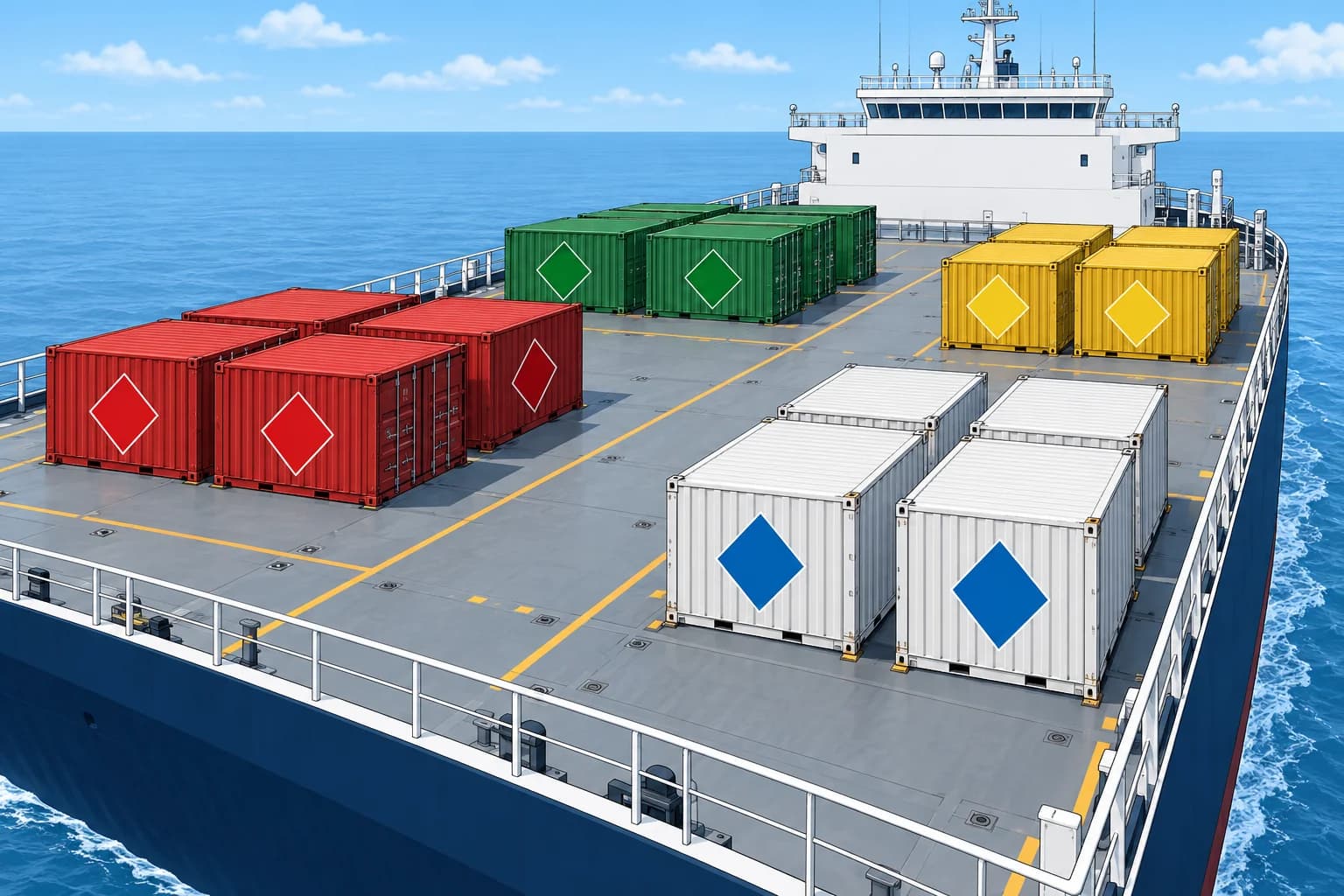
The Code
The International Maritime Dangerous Goods (IMDG) Code is mandatory under SOLAS chapter VII for dangerous goods carried in packaged form. It is amended every two years: Amendment 42-24 could be used voluntarily from 1 January 2025 and has been mandatory since 1 January 2026. The nine classes, labels and placards are covered in Ship stores and maintenance; here you meet the stowage and segregation side.
The Dangerous Goods List
Chapter 3.2’s Dangerous Goods List gives, for each UN number: proper shipping name, class, packing group, where assigned (I high, II medium, III low danger), the EmS emergency schedules, the stowage category, which says whether the goods may go on deck, under deck or both for the ship type, and special stowage and segregation codes. Always check the entry: it can override the general rules.
Segregation
For conventional packages: 1, away from, at least 3 m horizontally. 2, separated from, separate compartments/holds, or 6 m on deck. 3, separated by a complete compartment or hold from, an intervening compartment/hold, or 12 m on deck. 4, separated longitudinally by an intervening complete compartment or hold from, longitudinal separation, or 24 m on deck. Qualifying fire- and liquid-resistant decks permit certain vertical alternatives under the Code.
Which provisions apply?
Containers and roll-on/roll-off (ro-ro) units have separate segregation tables; do not apply conventional-package distances to them. Check both Dangerous Goods List entries, subsidiary risks (additional hazards) and the provisions for the actual stowage. An X in the general segregation table means you must consult the relevant Dangerous Goods List entries. Follow any special segregation instructions.
Documents
The shipper gives a dangerous goods declaration; a container packing certificate confirms the container was packed correctly. The ship keeps a dangerous goods manifest or a detailed stowage plan showing the class and position of all dangerous goods (SOLAS VII), and shore authorities get a copy. Where SOLAS II-2/19 applies, check the Document of Compliance for both the dangerous-goods classes and the cargo spaces approved for them.
Emergencies
The EmS Guide gives a fire schedule (F-A to F-J) and a spillage schedule (S-A to S-Z) for each entry; the Medical First Aid Guide (MFAG) covers exposure. On watch, know where the dangerous goods stowage plan, the EmS Guide and the firefighting gear are, and which units sit near heat, accommodation or work areas.
Key figures
- In force
- Amendment 42-24, mandatory since 1 January 2026
- Packing groups
- Where assigned: I high danger, II medium, III low
- Conventional packages: terms 1–4
- On deck: 3/6/12/24 m respectively; term 4 longitudinal
- “Away from”
- Conventional packages: ≥ 3 m horizontally; check the Code
- EmS schedules
- Fire F-A to F-J; spillage S-A to S-Z
Remember
- The IMDG Code is mandatory under SOLAS VII; Amendment 42-24 has been mandatory since 1 January 2026.
- The list entry gives class, packing group where assigned, EmS and stowage category.
- Conventional-package terms 1–4: on deck 3/6/12/24 m; term 4 longitudinal. Containers and ro-ro use separate tables.
- Check DG papers and the Document of Compliance: both the classes and cargo spaces must be approved where required.
- Know where the EmS Guide, MFAG and the DG stowage plan are.
Common mistakes
Wrong: Two dangerous goods of different classes can always share a hold.
Right: Check both list entries, subsidiary risks and the segregation provisions for the actual stowage. Containers and ro-ro use separate tables.
Wrong: Packing group I is the least dangerous.
Right: Packing group I is high danger, II medium and III low.
Worked case
On rounds you find a container placarded class 3 stowed on deck right next to one placarded class 5.1, oxidizer. The stowage plan shows them two bays apart. What do you do?
Show the answer
Report to the chief mate and master. Check both UN entries and the container segregation table against the actual stow. If alongside, arrange a safe restow and update the plan and manifest. At sea, do not attempt to shift containers: follow the master’s risk assessment, apply suitable precautions, check EmS and arrange safe restow at a suitable port.
Practice question
A proposed dangerous-goods position is not approved in the ship’s Document of Compliance. What should you do?
- Load because the declaration is signed
- Load because the packing certificate is valid
- Stop and refer the position to the chief mate
- Load because the manifest names the position
Show the answer
Answer: C. Where SOLAS II-2/19 applies, the Document of Compliance must approve both the dangerous-goods class and the cargo space. Other cargo papers do not authorize an unapproved position.
5 · Bulk and grain
Solid bulk and grain: IMSBC groups, TML and the Grain Code
Bulk cargo can liquefy, react or shift. The IMSBC Code sorts it into groups A, B and C; the Grain Code sets the stability a grain ship must keep.
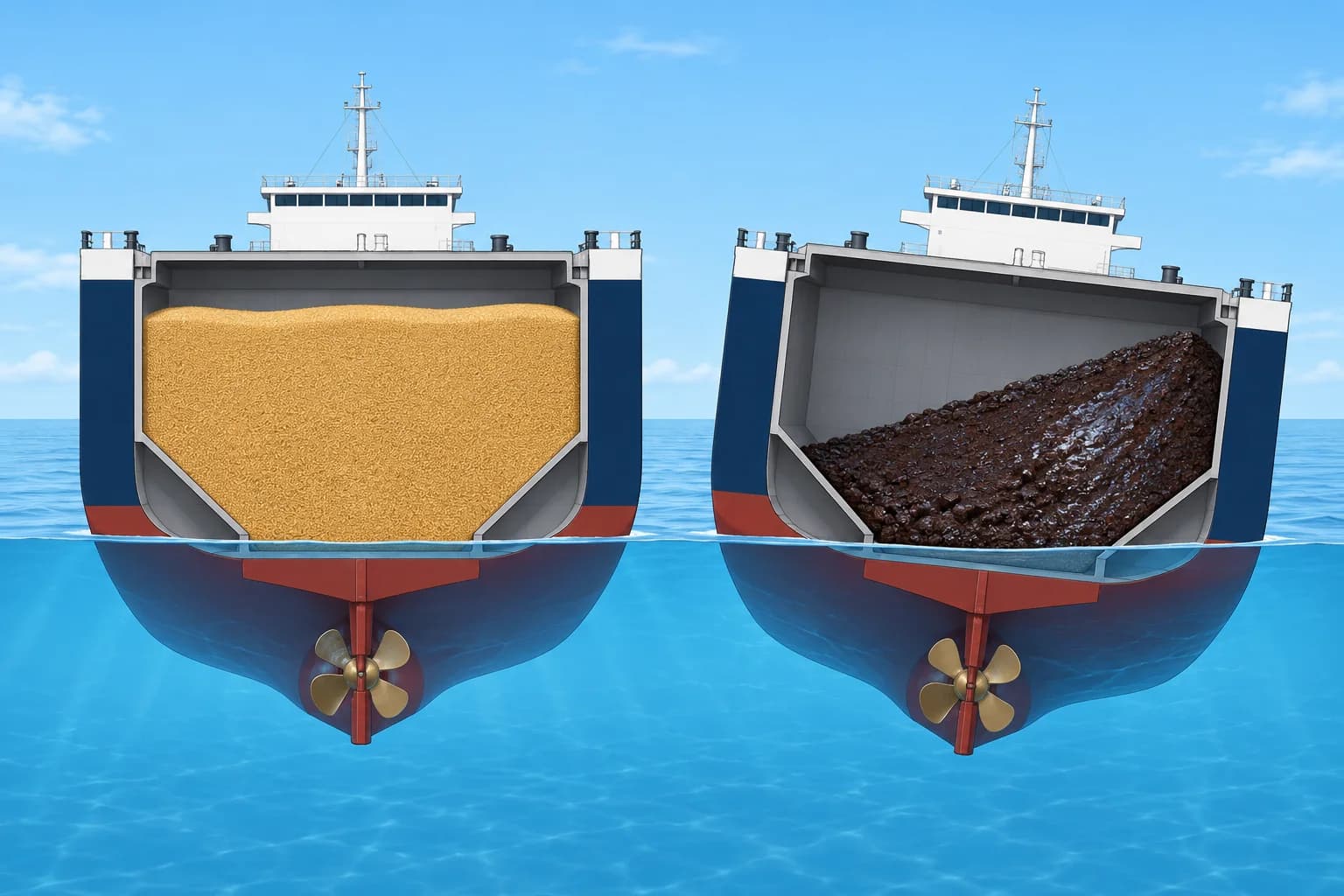
The IMSBC Code
The International Maritime Solid Bulk Cargoes (IMSBC) Code, mandatory under SOLAS, gives a schedule for each named bulk cargo: hazards, stowage, segregation and loading precautions. Before loading, the shipper must give the master the cargo information in writing, including moisture content and transportable moisture limit (TML) where they apply.
Groups A, B and C
Group A cargoes may liquefy or undergo dynamic separation above their TML. In dynamic separation, water and fine particles form a slurry above denser cargo; its movement can destabilize the ship. Examples include some mineral fines. Group B cargoes have chemical hazards, such as self-heating or gas release. Group C cargoes are neither A nor B, but may still be dense or shift. Some cargoes are both A and B.
Liquefaction
Motion can raise water pressure between wet cargo grains until the cargo loses strength and flows, risking capsize. Flow moisture point (FMP) is the moisture content at which flow occurs in a prescribed laboratory test. TML is the maximum moisture permitted for ordinary carriage; for flow-table and penetration tests it is 90 % of FMP. Require certified moisture below TML. A can test jars a sample to check for free moisture or flow: a warning check, never proof of safe moisture content.
Grain
Grain can shift even in a filled hold. The International Grain Code normally requires a document of authorization and approved grain loading information. Throughout the voyage, GM (metacentric height) must be at least 0.30 m after allowing for liquids shifting in partly filled tanks (free surface). Heel from assumed grain shift must not exceed 12°; for ships built from 1 January 1994, use the deck-edge immersion angle if smaller.
Residual stability
The residual area between the righting-arm (GZ) and grain heeling-arm curves must be at least 0.075 m·rad. Measure from equilibrium heel to the least of 40°, the downflooding angle (when water enters unprotected openings), or the angle of maximum difference between the curves. Apply this criterion throughout the voyage using the approved grain loading information.
Key figures
- Group A
- May liquefy or undergo dynamic separation above TML
- Group B
- Chemical hazard
- Group C
- Neither Group A nor Group B
- TML
- Flow-table/penetration tests: TML = 90 % of FMP
- Grain: heel from shift
- ≤ 12°; built from 1 Jan 1994: deck-edge immersion if smaller
- Grain: area and GM
- Area to Code limit ≥ 0.075 m·rad; corrected GM ≥ 0.30 m
Remember
- Use the applicable IMSBC schedule and shipper’s cargo information; require moisture/TML certificates where applicable.
- A: liquefaction or dynamic separation; B: chemical hazards; C: neither A nor B. Some cargoes are both A and B.
- Liquefaction can cause a severe list or capsize; a can test cannot certify safe cargo.
- Grain: corrected GM ≥ 0.30 m; heel ≤ 12° (ships built from 1 Jan 1994: deck-edge immersion if smaller).
- Grain: area ≥ 0.075 m·rad to the Code’s limiting angle; carry authorization and approved loading information.
Common mistakes
Wrong: The cargo looks dry on top, so it cannot liquefy.
Right: Group A cargo can look dry and still be above its TML. Rely on the certified moisture content, and treat a failed can test as a stop signal.
Wrong: A full grain hold cannot shift.
Right: Grain settles and leaves a void under the hatch and deck. The Grain Code assumes a shift even in filled compartments.
Worked case
You are loading nickel ore, a Group A cargo. It has rained hard at the stockpile since the shipper’s moisture test, and a can test on deck leaves a wet, shiny surface with water on top. What do you do?
Show the answer
Stop loading and tell the master. Free moisture is a warning; the can test cannot measure FMP or TML. Request representative sampling and fresh laboratory moisture testing after the rain. The master can refuse the cargo. Do not resume until the certified moisture content is below the TML; keep holds closed in rain.
Practice question
Which IMSBC group covers cargo that may liquefy or undergo dynamic separation above its TML?
- Group A
- Group B
- Group C
- Group D
Show the answer
Answer: A. Group A may liquefy or undergo dynamic separation above its TML. Dynamic separation forms a moving water-and-fines slurry above denser cargo. Group B has chemical hazards; C is neither A nor B.