
Ship stability and stowage · Level P2 · 5 parts · about 19 min
Working stability on small ships: loading, free surface and trim
5 short parts: Stability booklet · Loading · Free surface · Trim & draughts · Warning signs. Each part explains the idea, then gives the points to remember, the common mistakes, a worked case and a practice question; the Academy unit adds all 29 check questions.
1 · Stability booklet
The stability booklet and approved loading conditions
Your ship's approved stability booklet tells you how she may be loaded. Know what is in it, and check every departure against it.
What it is
The stability booklet, or stability information, is approved by the flag Administration or by a recognised organization (RO), usually a classification society, acting for it. SOLAS II-1/5-1 requires it on ships under SOLAS; national rules require similar information on smaller ships. It must let the master judge stability quickly and simply, and it is written in the ship's working language.
What it holds
Expect instructions; plans of watertight spaces, closures, vents and downflooding openings (where water enters as she heels); hydrostatic tables linking draught to displacement (total weight); cross curves used to find righting levers; tank tables with capacities, weight centres and free surface data for liquids that can shift; worked loading conditions; and loading limits. The inclining-test report gives the lightship weight and centre of gravity, before voyage loads are added.
The limit curve
The approved maximum KG/minimum GM curve gives your limit at the actual draught and trim. KG is the height of G, the centre of gravity, above the keel; GM measures initial stability. Fluid KG = solid KG + FSC; fluid GM = solid GM − FSC, where FSC is the free surface correction. For limits expressed as fluid values, fluid KG must not exceed maximum KG; fluid GM must not fall below minimum GM. Follow the booklet's correction convention to avoid double-counting FSC. Keep required closures secured.
Using the conditions
The booklet shows standard conditions, such as full-load departure, arrival with 10 % of stores and fuel, and ballast. If your loading really matches one, use it. If not, calculate a new condition by the booklet's method or with an approved loading computer. Check the worst point of the voyage, usually arrival, when tanks are low and slack.
Which rules apply
The 2008 IS Code (Intact Stability Code) gives general criteria for cargo and passenger ships of 24 m and over. Part A is mandatory where SOLAS or Load Line provisions require it; applicability depends on convention coverage, construction date and flag rules. Part B gives recommendations. For fishing vessels of 24 m and over, it recommends these criteria with GM at least 0.35 m for single-deck vessels. Smaller vessels follow national rules. Use your approved booklet.
Key figures
- Required by
- SOLAS II-1/5-1; national codes for small ships
- General Part A ship categories
- Cargo and passenger ships of 24 m and over
- Fishing vessels ≥ 24 m
- GM ≥ 0.35 m single-deck (IS Code Part B 2.1)
- Limit curve
- Maximum KG or minimum GM against draught
- Standard arrival condition
- 10 % of stores and fuel remaining
Checking a departure against the booklet
- List every weight aboard: cargo, fuel, water, stores, ballast, catch and gear. — Lightship is the start; everything else is added to it.
- Work out displacement, KG, draught and trim by moments, or with the approved computer. — Check the approved curve at your actual draught and trim.
- Apply the booklet's free-surface correction convention for every slack tank. — Compare values using the same convention as the approved limit.
- Compare corrected KG with the applicable maximum KG at your draught and trim; secure required closures. — The comparison is valid only within the curve's approved operating conditions.
- Repeat for arrival, with consumables low. — Stability usually gets worse as tanks empty.
- Record the result before sailing. — It shows the check was made, and on which data.
Remember
- The approved stability booklet is the basis for loading your ship.
- Use the applicable KG / GM limit at your draught and trim, with the booklet's free-surface convention.
- Check departure and arrival: low consumables and slack tanks can reduce stability.
- Use the IS Code requirements or national rules applicable to your ship, as recorded in the approved booklet.
Common mistakes
Wrong: If she sits upright and steady, the booklet check can wait.
Right: A ship can float upright with too little stability. Calculate before sailing; heel and roll show the problem late.
Wrong: Any loading close to a booklet condition is fine.
Right: Only if the weights, their heights and the slack tanks really match. Otherwise calculate a new condition.
Worked case
Your 60 m coaster's booklet has a full-load departure condition with nothing on deck. Today the charterer wants 25 t of steel pipes on the hatch covers, with the holds full as usual. What do you do?
Show the answer
The standard condition no longer applies: deck cargo raises KG. Calculate a new condition with the pipes at their real height and the booklet's free-surface convention. Use the applicable KG limit at the new draught and trim, within its operating conditions. Check arrival stability, the hatch-cover structural limit and required closures. If the margin is too small, reduce deck cargo or lower other weights.
Practice question
Who approves a ship's stability booklet?
- The shipowner's superintendent
- Flag Administration or its RO
- The master before each voyage
- The port State control officer
Show the answer
Answer: B. The flag Administration approves it, directly or through a recognised organization acting for it.
2 · Loading
Loading a small ship: deck cargo, gear and ice
On a small ship a few tonnes high up matter. Keep heavy weights low, secure them, keep freeing ports clear and allow for ice.
Why small ships are sensitive
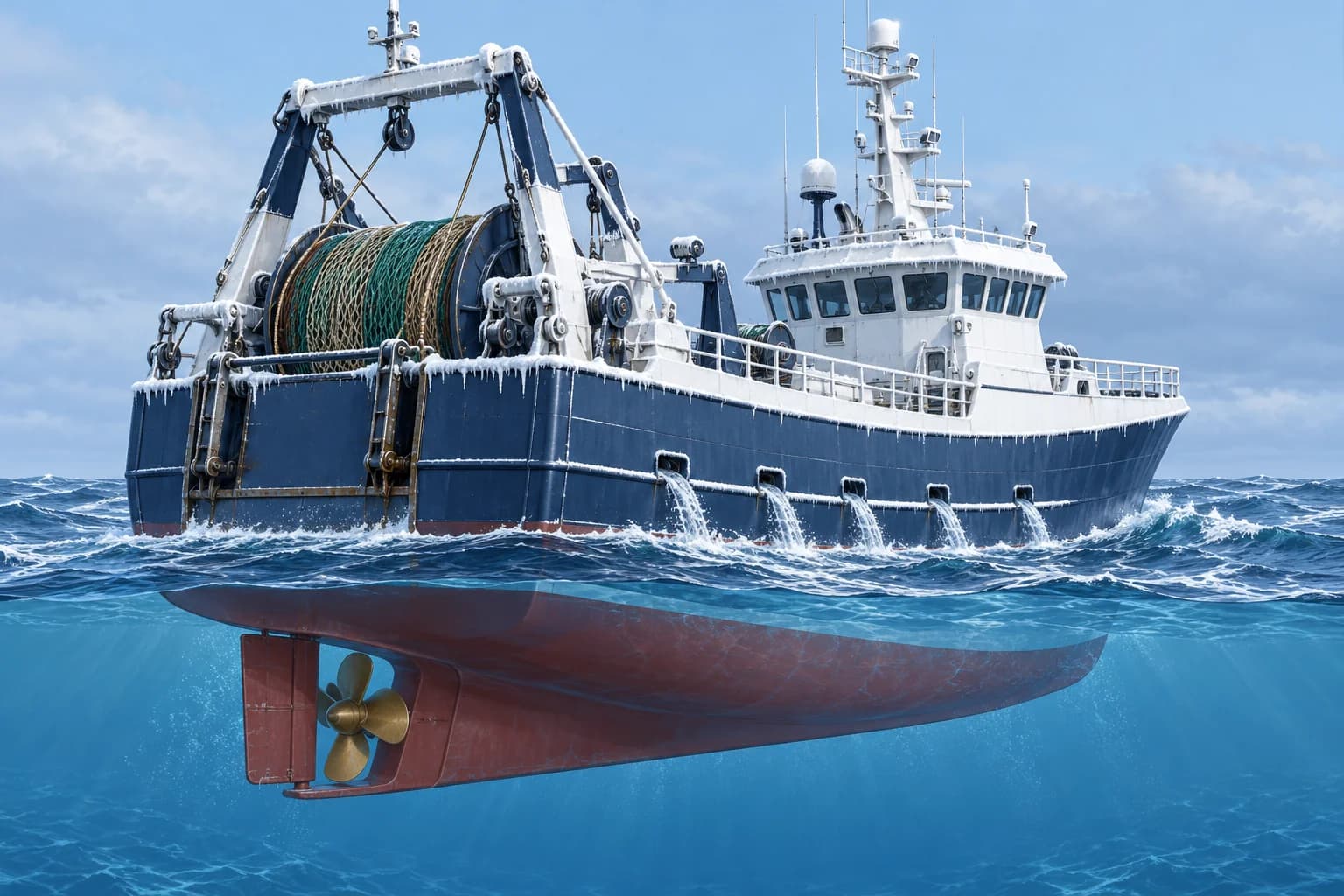
Loading a weight w at a height Kg above the keel moves G towards it: new KG = (Δ × KG + w × Kg) ÷ (Δ + w), where Δ is displacement. When Δ is a few hundred tonnes, a few tonnes of deck cargo, a full net drum or a loaded crane can use up much of the GM. On a large ship the same weight hardly shows.
Deck cargo and gear
Stow heavy items low and on the centreline; put light, bulky ones on deck. Secure everything: cargo that slides across moves G sideways and gives a list just when you need full stability. Respect the structural deck load limit in t/m². Separately check the total deck-cargo weight and height against the approved stability limits.
Lifting and hauling
A load hanging freely from a crane or derrick acts at the point of suspension. Gear resting on a net drum acts at its own centre of gravity; fishing-gear tension acts where the line leaves the ship. Keep that point low, deal with slack tanks before lifting, and know where the load will land. A trawl snagged on the seabed can heel a small ship dangerously: keep the release gear working.
Water on deck
Bulwarks turn the deck into a well that can hold tonnes of water high up. Freeing ports, openings in the bulwarks that drain water overboard, must be clear and working. Never lock their flaps or block them with gear or fish boards. If the well does not drain, reduce speed or change course.
Ice
Spray ice on decks, rails and rigging adds weight high up and increases the area exposed to wind. For fishing vessels in icing areas, IS Code Part B 6.3 gives 30 kg/m² on exposed decks and gangways and 7.5 kg/m² on each side's projected lateral area above water: its outline seen from the side. Use your booklet's allowance for the operating area. Remove ice early where safe. A noticeably longer roll is a warning: act promptly.
Key figures
- Adding weight w at Kg
- New KG = (Δ × KG + w × Kg) ÷ (Δ + w)
- Ice on exposed decks
- 30 kg/m² (IS Code, fishing vessels)
- Ice on projected lateral area
- 7.5 kg/m², each side
- Suspended load or gear pull
- Acts at the point of suspension or lead
Worked example: deck gear and ice
- Data: Δ 800 t, KG 3.80 m. Load 20 t of gear on deck at Kg 6.00 m. — Kg is the weight's own height above the keel.
- New KG = (800 × 3.80 + 20 × 6.00) ÷ 820 = 3,160 ÷ 820 = 3.854 m. — Moments about the keel, divided by the new displacement.
- G has risen 0.054 m; with KM about the same, GM falls by about 0.05 m. — Check KM at the new draught in the booklet.
- Ice: 200 m² of deck × 30 kg/m² = 6.0 t; 150 m² projected lateral area per side × 7.5 kg/m² × 2 = 2.25 t. — 8.25 t in all, high up.
- Add 8.25 t of ice at Kg 6.50 m to the loaded 820 t ship: KG = (3,160 + 53.625) ÷ 828.25 = 3.880 m. — Gear and ice together raise KG by 0.080 m from the original condition; ice also increases wind area.
Remember
- A few tonnes high up use a large share of a small ship's GM.
- Stow heavy low and central, secure it, and respect the deck load limit.
- Suspended loads and gear pull act at the point of suspension or lead.
- Keep freeing ports clear and working; never lock them.
- Ice adds weight high up: remove it early where safe and watch the roll period.
Common mistakes
Wrong: Deck cargo only matters if it is heavy compared with the hold cargo.
Right: What counts is weight × height above G against displacement. Light deck cargo high up can still cost much of a small ship's GM.
Wrong: Closing freeing ports keeps the deck drier in bad weather.
Right: Closed or blocked ports trap water on deck, high up and free to move. Keep them clear and working.
Worked case
Your 28 m stern trawler is hauling. The warp snags on a wreck and she heels to 15° towards the warp, with water reaching the deck edge.
Show the answer
Take the load off at once: ease the winch brake or use the release so the pull stops. The pull acts high up and off the centreline, at the block where the warp leaves the ship, so removing it is the cure. Close weathertight doors and hatches. Do not try to correct the heel with ballast while the warp is fast: when it parts she heels the other way.
Practice question
An 800 t ship with KG 3.80 m loads 20 t at Kg 6.00 m. What is the new KG?
- 3.950 m
- 3.946 m
- 3.854 m
- 3.800 m
Show the answer
Answer: C. (800 × 3.80 + 20 × 6.00) ÷ 820 = 3.854 m. Dividing by 800 instead of 820 gives 3.950 m.
3 · Free surface
Free surface on a small ship: tanks, fish holds and water on deck
Slack liquid acts like a rise of G. On a small ship one wide slack tank or a flooded deck can take away much of the GM.
Recall
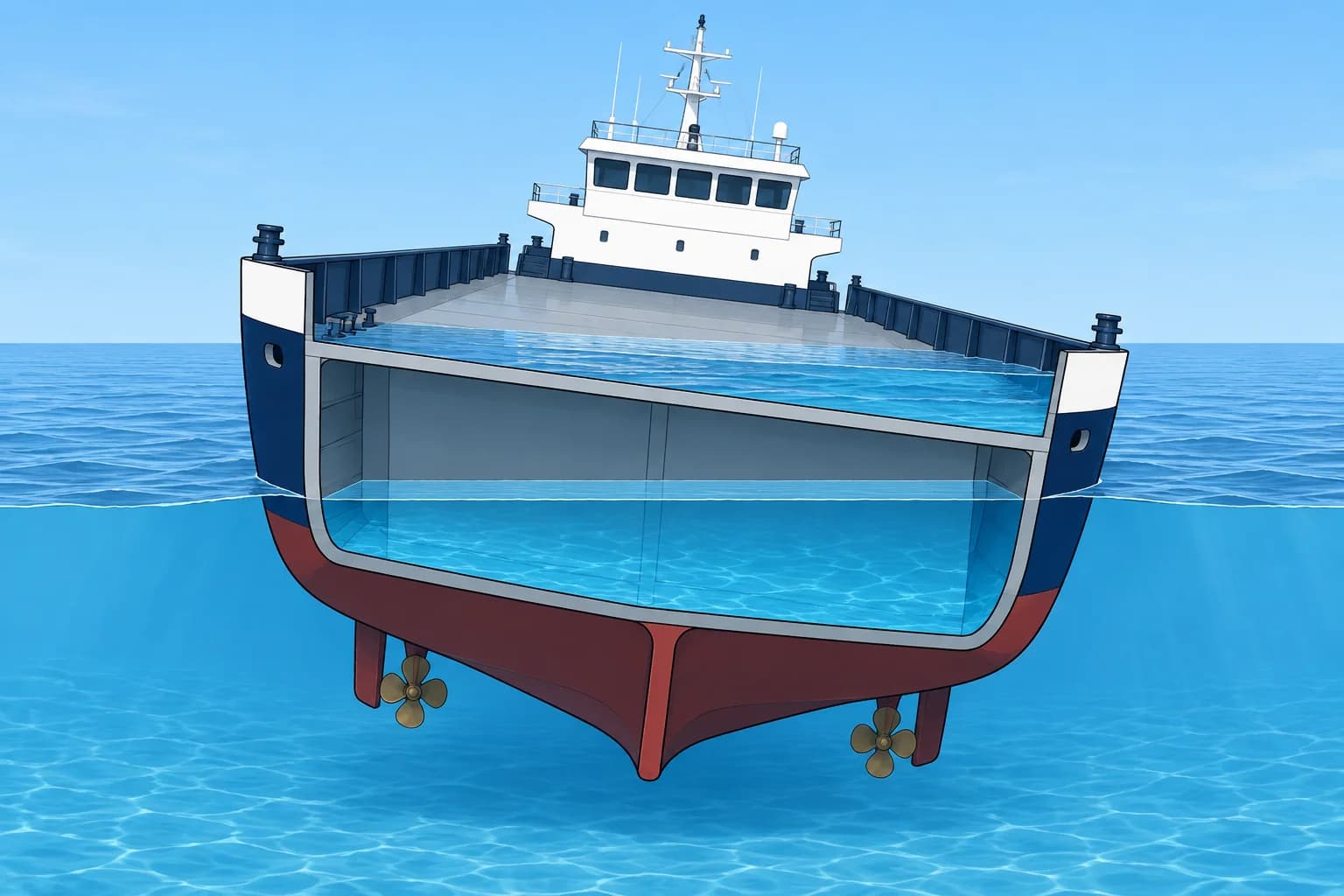
Liquid that can move in a part-filled space flows to the low side when she heels. The effect is a virtual rise of G, the free surface correction (FSC). Solid GM is GM before this correction. Fluid GM = solid GM − FSC. For a rectangular tank with vertical sides at small heel, the free surface moment (FSM) depends on breadth cubed, not liquid depth, while the surface spans its full breadth. For shaped tanks, use the tank tables.
The numbers
Tank tables give each tank's FSM in t·m. Add them and divide by displacement: FSC = ΣFSM ÷ Δ. For a full-width rectangular surface at small heel, FSM = l × b³ ÷ 12 × ρ, with length l and breadth b in metres and density ρ in t/m³. On a ship of a few hundred tonnes one wide tank can cost tens of centimetres.
Where it hides
Slack tanks: fuel and fresh water in use, ballast being changed. Fish holds and tanks: catch in bulk, refrigerated sea water, melting ice. Water on deck in a well, or in a hold or engine room after a leak or firefighting. None of the last group is in any table, so treat them seriously.
Keeping it small
Keep tanks pressed up, completely full, or empty. Follow the booklet's filling and transfer sequence, limiting both slack tanks and list. Keep portable divisions, boards that split a fish hold, in place so catch cannot shift. Fish boards restrain catch; they do not isolate liquid unless liquid-tight. Pump bilges and clear deck water early. Never let several wide tanks go slack together when GM is small.
Firefighting water
Hose water can collect in holds and on decks. Its free surface reduces stability; water trapped high up also raises G. Arrange safe drainage or pumping while fighting the fire, and monitor heel and freeboard.
Key figures
- Free surface correction
- FSC = ΣFSM ÷ Δ (m)
- Rectangular surface, small heel
- FSM = l × b³ ÷ 12 × ρ (t·m)
- Fluid GM
- Solid GM − FSC
- Two isolated lengthwise halves
- Rectangular FSM ÷ 4 (liquid-tight division)
Worked example: small-angle deck-water estimate
- Data: After adding the deck water and allowing for its height, Δ is 800 t and solid GM is 0.60 m. Model the water surface as a 10 m × 6 m rectangle (ρ 1.025 t/m³). — Small-angle estimate while water spans the full breadth.
- FSM = 10 × 6³ ÷ 12 × 1.025 = 184.5 t·m. — Breadth cubed: 216.
- FSC = 184.5 ÷ 800 = 0.23 m. — The water's added-weight effect is already included; FSC accounts for its movement.
- Fluid GM ≈ 0.60 − 0.23 = 0.37 m: more than a third of the solid GM lost to free surface. — An estimate at small heel while water spans the full breadth.
- With a liquid-tight centreline division: FSM = 2 × 10 × 3³ ÷ 12 × 1.025 = 46.1 t·m; FSC 0.06 m. — Two isolated lengthwise halves give one quarter of the original rectangular FSM.
Remember
- Free surface is a virtual rise of G: FSC = ΣFSM ÷ Δ.
- Rectangular free surfaces at small heel: breadth cubed matters while the full breadth stays covered.
- Follow the booklet's tank sequence; limit free surface and avoid an excessive list.
- Fish holds need their divisions; deck and firefighting water must go overboard early.
Common mistakes
Wrong: A nearly empty tank has hardly any free surface.
Right: A nearly empty tank can still have a large FSM. A shallow layer may span its full breadth. Use the tank tables; surface shape and filling level matter.
Wrong: Water on deck drains by itself, so ignore it.
Right: Water trapped in a well adds weight high up and a wide free surface. Clear the freeing ports, and reduce speed or alter course.
Worked case
Your 35 m ship has GM 0.45 m. At sea you plan to fill two empty double-bottom wing tanks and change the fresh water in a wide centre tank, all at the same time.
Show the answer
Check the booklet's sequence and stability at each stage before starting. Keep the wide fresh-water tank out of the operation until ballasting is complete. Use the approved sequence for the wing tanks so you limit free surface without creating an excessive list. Recheck fluid GM and freeboard before changing the centre tank.
Practice question
What does the free surface correction represent?
- A real lowering of G
- A rise in KM alone
- A loss of buoyancy
- A virtual rise of G
Show the answer
Answer: D. The liquid really shifts as she heels. FSC represents its destabilising effect as an equivalent rise of G; it is not a fixed upward shift of the upright ship's actual G.
4 · Trim & draughts
Trim and draughts on a small ship
Read your draughts and check trim before sailing. Stay within the permitted draught, using only the certified fresh/dock-water allowance where applicable.
Reading the marks
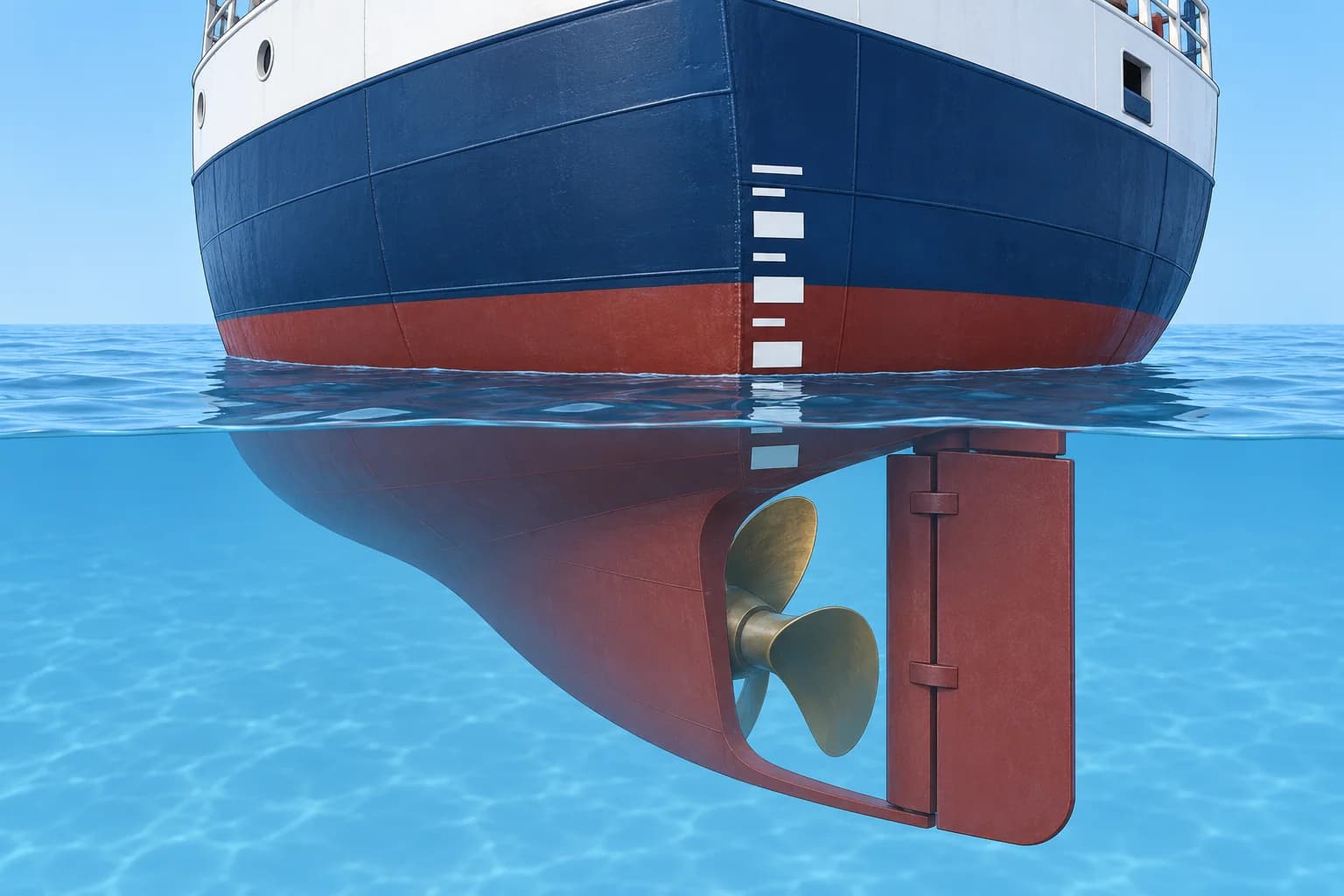
Draught marks at bow, stern and often amidships show how deep the ship's keel, or her lowest reference point, lies below the waterline. Metric figures are 10 cm high and the bottom of each figure is its draught. Read both sides and average them if she lists; in a swell, average several readings. Freeboard is measured from the deck line down to the water.
Trim
Trim is the draught aft minus the draught forward. Most small ships handle best slightly by the stern: propeller and rudder are deep and the bow lifts to the sea. Excessive trim by the head can make her wet forward and harder to steer, increasing the risk of broaching, swinging beam-on to the waves, in following seas. Keep trim within the booklet's limits.
How loading trims her
The centre of flotation (LCF) is the point she trims about. MCTC is the moment needed to change trim by 1 cm, in t·m/cm. Change of trim (cm) = w × d ÷ MCTC. Here w is weight in tonnes. For a transfer, d is the distance moved fore and aft. For weight added or removed, d is its distance from the LCF. Use metres. Adding weight also changes mean draught. The Trim unit covers the full calculation.
Catch, fuel and ice
On many fishing vessels the fish hold lies forward of the engine room, so she trims by the head as the hold fills. Fuel used from aft tanks does the same. Ice builds up forward first, where spray hits. Plan the order of filling holds and using tanks so the trim stays within the booklet's limits.
Freeboard and the load line
The load line marks the permitted loading level. Check the applicable load line on both sides. Do not exceed the permitted draught or go below the required freeboard; use only the certified fresh/dock-water allowance where applicable. Fresh or brackish water makes her float deeper. Check your certificate and booklet before sailing.
Key figures
- Trim
- Draught aft − draught forward
- Change of trim (cm)
- w × d ÷ MCTC
- Metric figures
- 10 cm high; bottom of the figure = draught
- Best trim
- Usually slightly by the stern: check the booklet
Worked example: moving catch aft
- Data: MCTC 9 t·m/cm. 10 t of boxed fish moves 20 m aft, from the forward hold to the after hold. — Use the booklet's MCTC at your draught.
- Trimming moment = 10 × 20 = 200 t·m by the stern. — Weight times distance moved.
- Change of trim = 200 ÷ 9 = 22 cm by the stern. — This is the change in the difference between aft and forward draughts; recheck the actual marks.
Remember
- Read draughts on both sides, fore, aft and amidships, before sailing.
- Trim = aft − forward; slightly by the stern is usually best.
- Change of trim (cm) = w × d ÷ MCTC.
- Stay within permitted draught and freeboard limits; use only the certified fresh/dock-water allowance where applicable.
Common mistakes
Wrong: Trim by the head is harmless while the draughts are within limits.
Right: Excessive head trim can impair steering and increase broaching risk. Keep trim within the booklet's limits and assess the following-sea passage.
Wrong: Reading one side is enough.
Right: With a list one side reads deeper. Read both and average them.
Worked case
After a good trip your 24 m trawler sits 0.40 m by the head. Fuel has come from the aft tanks. A following sea is forecast for the run home.
Show the answer
Check the booklet before correcting the head trim. Prefer a permitted transfer or shift aft; for a shift, use the distance moved in w × d ÷ MCTC. If adding aft ballast, use its distance from the LCF and check the added draught, freeboard and free surface. Follow the approved tank sequence, then reassess trim, stability and the following-sea passage.
Practice question
Draught forward 2.60 m, aft 3.10 m. What is the trim?
- 0.50 m by the stern
- 0.50 m by the head
- 2.85 m by the stern
- 5.70 m by the stern
Show the answer
Answer: A. Trim = 3.10 − 2.60 = 0.50 m. Aft is deeper, so by the stern.
5 · Warning signs
Is she stable enough? Criteria, roll period and warning signs
Use the approved booklet to check stability. At sea, a slow, hanging roll or an unexplained heel means investigate and act promptly.
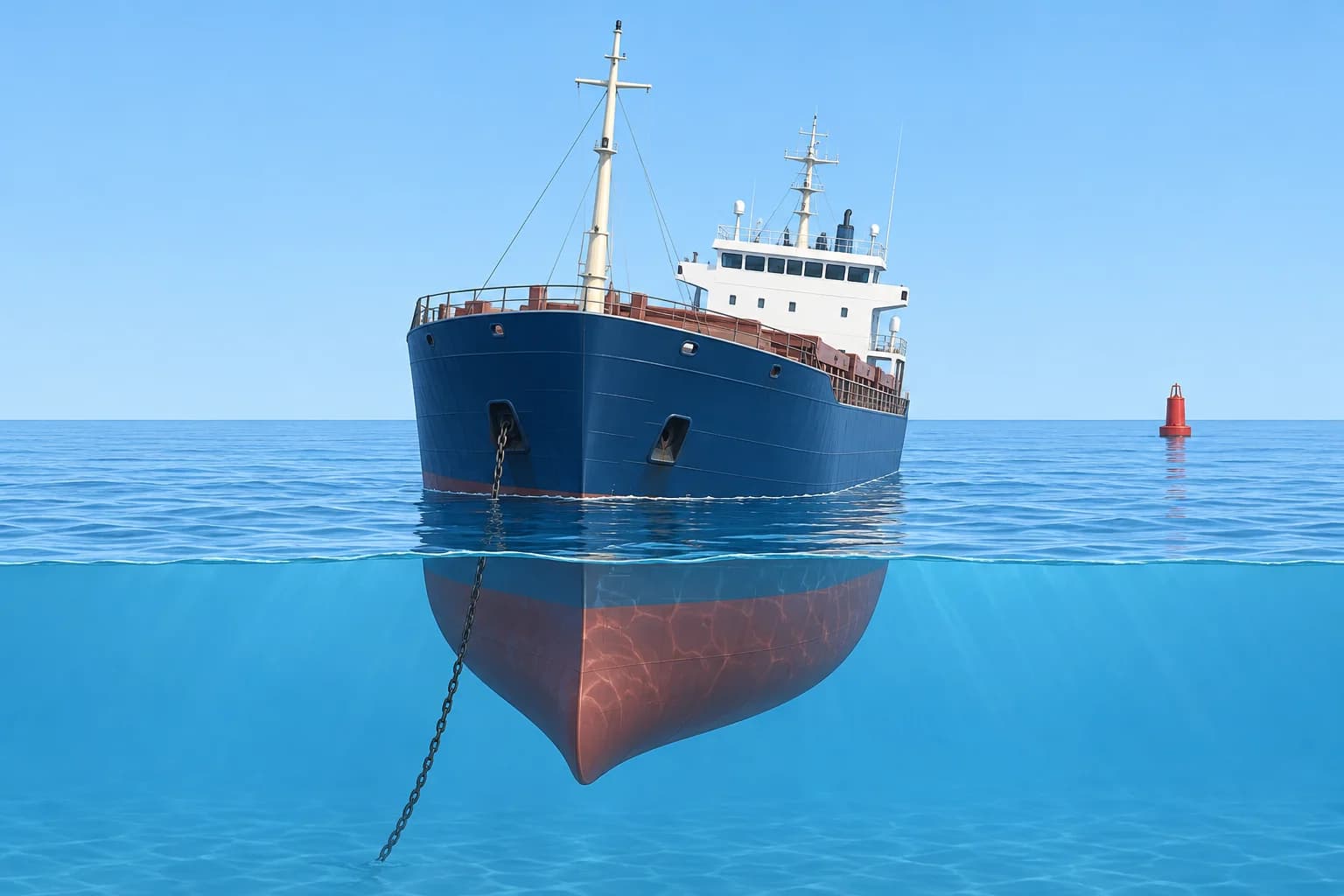
What the criteria protect
The approved conditions meet a minimum GM, a minimum GZ (righting lever) at 30° or more, a maximum lever at 25° or more, and minimum areas under the GZ curve, which measure the energy she can absorb. A weather criterion checks a gust while she rolls. You don't recompute these at sea: you use the applicable booklet limits within their approved conditions.
Roll period as a check
With high GM she is stiff and tends to roll quickly. With low positive GM she is tender and tends to roll slowly. The IS Code estimates a full roll as T = 2CB ÷ √GM, in seconds. Use B (breadth), d (mean draught), L (waterline length) and GM in metres. Use free-surface-corrected GM, called fluid GM. The coefficient is C = 0.373 + 0.023(B/d) − 0.043(L/100). Rearranging gives GM ≈ (2CB/T)².
Use it with care
Time several full natural rolls, from one side to the other and back, in calm water, and average them. This is a rough check: waves, slack tanks and moorings disturb it; loading changes can alter mass distribution and C. Under comparable calm-water conditions, a longer natural roll can indicate lower GM. Investigate changed loading and conditions; the estimate cannot establish compliance.
Signs of low GM
She may heel strongly to a small wind or rudder angle, roll slowly or hang at the roll ends. A list is a steady heel from off-centre weight with positive GM. Loll occurs with negative upright GM: she may rest at an angle or flop between sides.
What to do
Stop lifting or hauling, reduce speed and avoid sharp turns. Report and seek help. Follow the booklet's recovery plan; lower or remove high weights, ice or deck water only where safe. If ballasting is permitted, follow its low-tank sequence. Heel may initially increase; check the downflooding margin, the remaining heel before water enters openings, and monitor heel and free surface. Fill the partner tank only as directed. Never transfer ballast to the high side of a lolling ship.
Key figures
- IS Code roll period
- T = 2 × C × B ÷ √GM (s)
- Coefficient C
- 0.373 + 0.023 (B ÷ d) − 0.043 (L ÷ 100)
- GM from a timed roll
- GM ≈ (2 × C × B ÷ T)²
- Trend
- Longer comparable natural rolls may indicate lower GM
Worked example: timing the roll
- Data: B 9.0 m, d 3.2 m, L 48 m. C = 0.373 + 0.023 × 2.81 − 0.043 × 0.48 = 0.417. — Use waterline length and mean draught.
- In calm harbour water, ten full natural rolls take 70 s, so T = 7.0 s. — Average many rolls; one is not enough.
- GM ≈ (2 × 0.417 × 9.0 ÷ 7.0)² = 1.07² = 1.15 m. — A rough estimate; compare with the applicable approved limit.
- For comparison, assuming C and B remain unchanged in comparable calm-water conditions, T = 10.0 s gives GM ≈ (2 × 0.417 × 9.0 ÷ 10.0)² = 0.56 m. — The estimated GM is about half; investigate loading and conditions, then check the booklet.
Remember
- Use the applicable booklet limits within their approved draught, trim and operating conditions.
- Roll period: T = 2CB ÷ √GM; compare natural rolls under comparable conditions, allowing for changes in C.
- Slow, hanging rolls or flopping warn of low or negative GM; distinguish list from loll.
- Follow the approved loll-recovery plan; monitor heel and downflooding margin. Never transfer ballast to the high side.
Common mistakes
Wrong: A slow, gentle roll means a comfortable, safe ship.
Right: A longer natural roll may indicate lower GM. Compare calm-water conditions and loading, investigate changes and use the approved booklet.
Wrong: Correct a list with no off-centre weight by pumping ballast to the high side.
Right: It may be loll from negative GM. Follow the approved recovery plan; transferring ballast to the high side can make her flop further the other way.
Wrong: A timed roll proves the criteria are met.
Right: It only estimates GM roughly. The criteria come from the booklet calculation.
Worked case
Late in a winter trip your small cargo ship has burned most of her double-bottom fuel and carries ice on deck. In calm water she lies 6° to starboard, then flops to 6° to port after a turn. No cargo has shifted.
Show the answer
Suspect loll. Stop heeling operations, reduce speed, avoid sharp turns and seek help. Follow the approved recovery plan: remove high weight only where safe. If ballasting is permitted, fill a narrow, divided low-side double-bottom tank first. Heel may initially increase; check the downflooding margin. Fill its partner only as the plan directs. Do not transfer ballast to the high side. Monitor heel and reassess stability throughout.
Practice question
With C and B unchanged, comparable calm-water roll tests give T = 7 s, then 10 s. What change in GM does the formula estimate?
- It has risen to about double
- It has fallen to about half
- It has hardly changed at all
- It has fallen by about 30 %
Show the answer
Answer: B. With C and B unchanged, estimated GM varies with 1 ÷ T²: (7 ÷ 10)² = 0.49, so about half. This estimate does not prove compliance.