
Ship stability and stowage · Level P3 · 5 parts · about 15 min
Displacement, draught and hydrostatics
5 short parts: Displacement · Draught marks · TPC · FWA and DWA · Hydrostatic tables. Each part explains the idea, then gives the points to remember, the common mistakes, a worked case and a practice question; the Academy unit adds all 28 check questions.
1 · Displacement
Displacement, lightship and deadweight
A floating ship weighs what the water she displaces weighs. From that one fact come displacement, lightship, deadweight and the block coefficient.
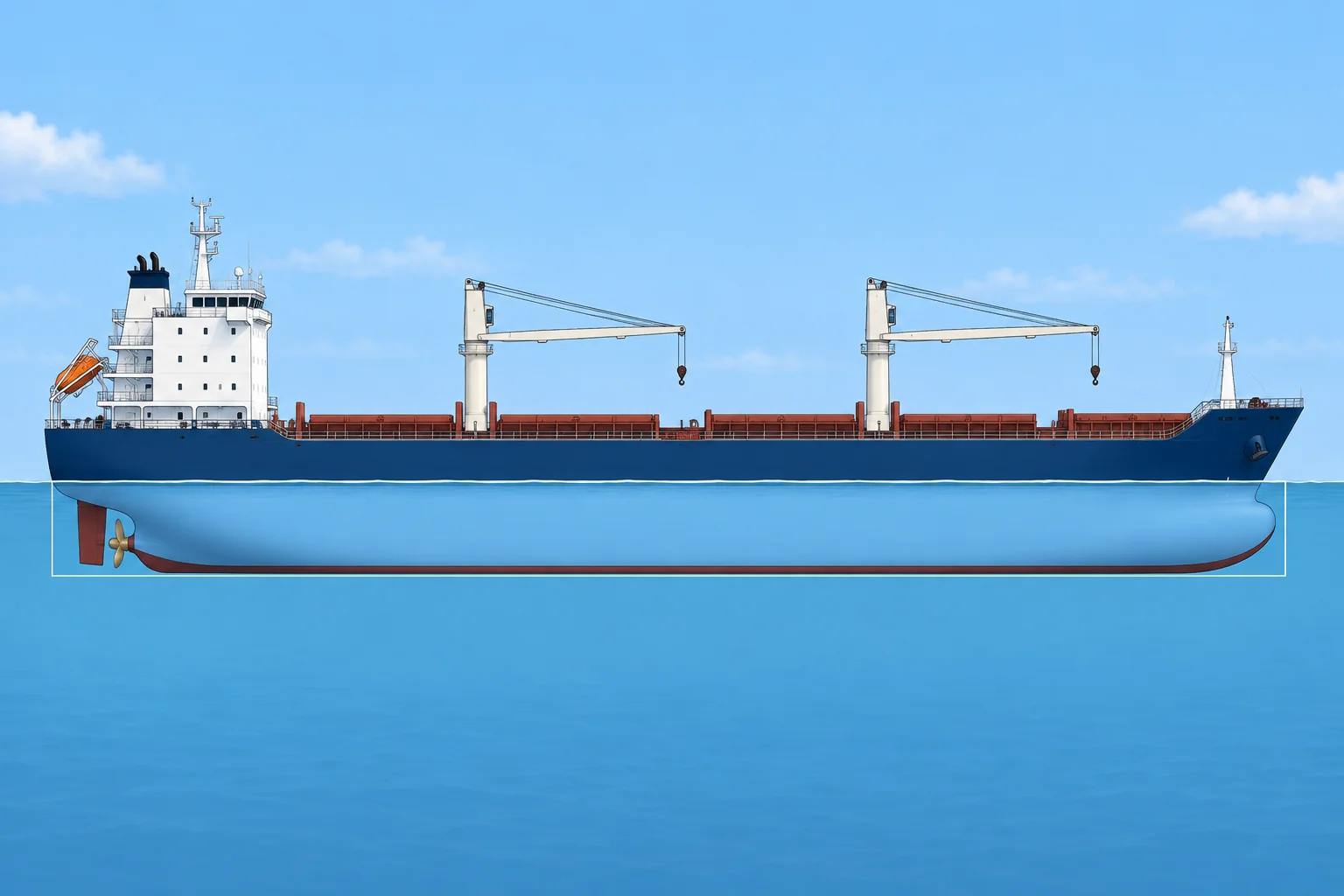
Displacement
Displacement (Δ) is the ship's total weight in tonnes. Afloat, she displaces her own weight of water: Δ = V × ρ, where V is the underwater volume in m³ and ρ the water density in t/m³, about 1.025 for sea water and 1.000 for fresh. The same ship has the same Δ in any water; only V and the draught change.
Lightship and deadweight
Lightship is the fully equipped ship without cargo, fuel, lubricating oil, ballast, fresh water and feed water in tanks, consumable stores, passengers, crew or their effects. Deadweight (DWT) is the difference: DWT = Δ − lightship. Summer deadweight is measured at the summer load line.
Cargo capacity
Deadweight is not all cargo. Take away fuel, oil, water, ballast, stores, crew and the constant: weights that build up aboard unnoticed, such as sediment in tanks and old spares, found by draught surveys. What remains is the cargo. The Loading unit works this out for a voyage.
Form coefficients
The block coefficient Cb = V ÷ (L × B × d) compares underwater volume with a box of length L, breadth B and draught d. Tankers and bulk carriers are fuller (0.80–0.85) than container ships (0.60–0.70). The waterplane area Aw is the horizontal area enclosed by the hull at the waterline. Cw = Aw ÷ (L × B), the waterplane coefficient, compares it with its enclosing rectangle.
Weight, not volume
Hydrostatic tables give displacement in sea water for each draught. Stability, deadweight and strength all work in tonnes, so turn volumes from tank and hold tables into weight with the right density first. Mixing up m³ and t is one of the commonest errors.
Key figures
- Displacement
- Δ = V × ρ (t = m³ × t/m³)
- Sea water / fresh water
- 1.025 / 1.000 t/m³
- Deadweight
- DWT = Δ − lightship
- Block coefficient
- Cb = V ÷ (L × B × d)
- Typical Cb
- Tanker or bulk carrier 0.80–0.85; container ship 0.60–0.70
Worked example: displacement from dimensions
- Data: length between perpendiculars (LBP) 140 m, breadth 20 m, draught 8.00 m, Cb 0.653, sea water. — Use the dimensions specified for Cb. Breadth and draught are moulded dimensions, measured inside the shell plating. Even keel means equal forward and aft draughts.
- V = 140 × 20 × 8.00 × 0.653 = 14,627 m³. — The box volume times the block coefficient.
- Δ = 14,627 × 1.025 = 14,993 t, about 15,000 t. — It agrees with the hydrostatic table at 8.00 m.
- Lightship 4,500 t: DWT = 15,000 − 4,500 = 10,500 t. — Everything aboard that is not the ship herself.
- At the summer draught Δ is 16,500 t: summer DWT = 12,000 t. — The summer deadweight is 1,500 t above the current deadweight.
Remember
- Δ = V × ρ: the ship weighs what she displaces.
- DWT = Δ − lightship; cargo is DWT minus consumables, ballast and the constant.
- Cb = V ÷ (L × B × d) shows how full the hull is.
- Turn volumes into tonnes with the right density before any moment calculation.
Common mistakes
Wrong: In fresh water the ship weighs less, so her displacement falls.
Right: Δ is unchanged. Fresh water is lighter, so she displaces more volume and floats deeper.
Wrong: Deadweight is the cargo the ship can carry.
Right: Deadweight includes fuel, water, stores, ballast and the constant. Cargo is what remains.
Worked case
Δ is 15,000 t and lightship 4,500 t. Known non-cargo deadweight is 830 t, excluding a separate 120 t constant. The mate reports 10,500 t of cargo aboard. Do you accept?
Show the answer
No. 10,500 t is total deadweight. Cargo = 10,500 − 830 − 120 = 9,550 t. The constant is part of deadweight and must be included once.
Practice question
Underwater volume is 20,000 m³ in sea water of 1.025 t/m³. What is the displacement?
- 19,512 t
- 20,500 t
- 20,000 t
- 21,025 t
Show the answer
Answer: B. Δ = 20,000 × 1.025 = 20,500 t. Dividing by 1.025 gives 19,512 t.
2 · Draught marks
Reading draught marks and the mean draught
Six readings reveal trim (aft minus forward draught), list (a steady lean to one side), and hull deflection (bending).
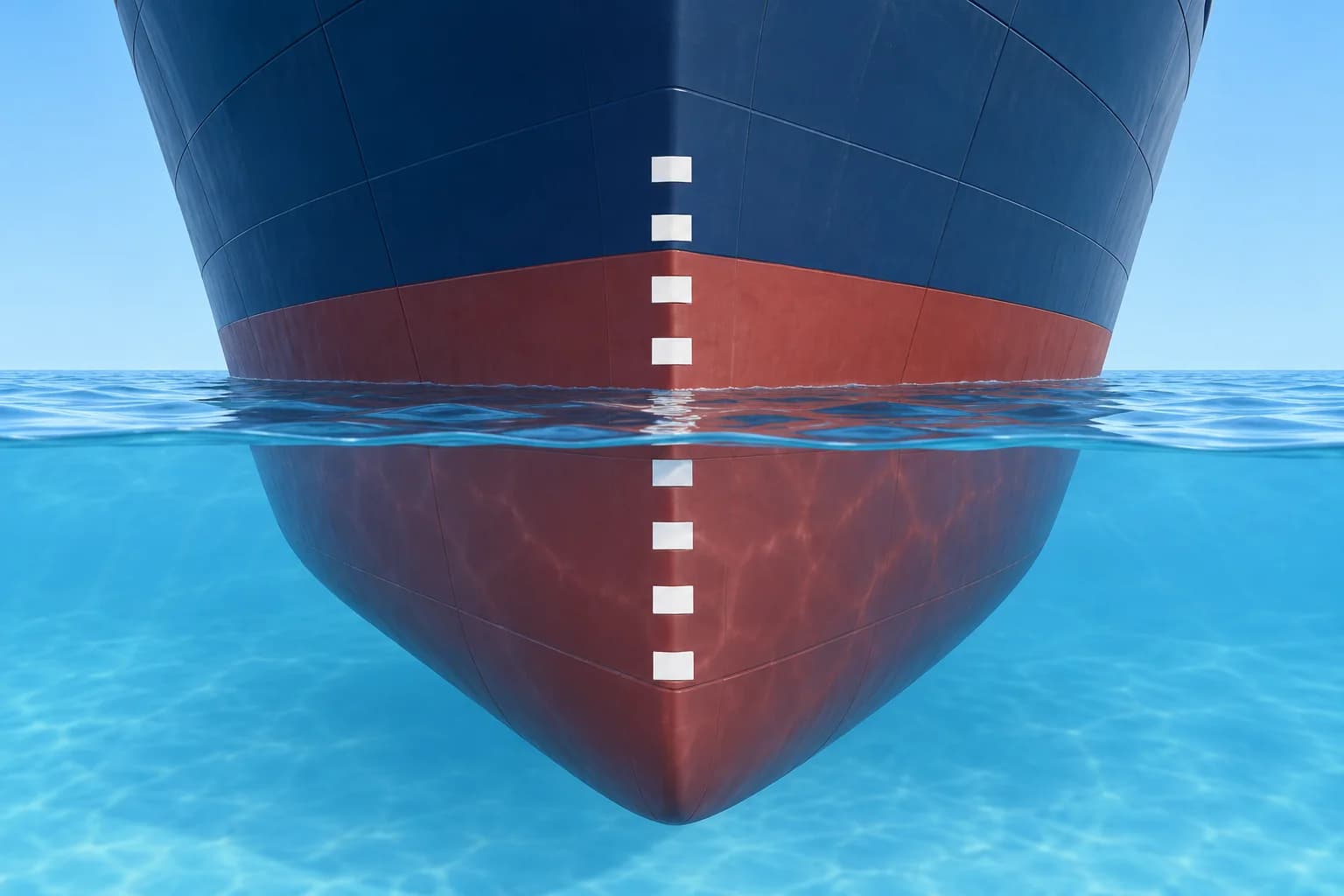
The marks
Draught marks show draught above the stated reference, usually the keel. Metric figures are 10 cm high, spaced every 20 cm; their bottom edge gives the marked draught. Whole metres carry M. Imperial figures are 6 inches high, with a 6-inch gap; their bottom edge gives the marked number of feet. At the top of an imperial 8 (or VIII), read 8 ft 6 in = 8.5 ft, not 8.6 ft. One foot is 12 inches. Check the ship's plans for the reference.
Reading them
Read from a boat or the quay, close to water level. In a swell, watch several waves and average the highest and lowest readings. Read both port and starboard at each position. A list is a steady lean to one side; averaging both sides gives the centreline draught.
Not at the perpendiculars
The bow and stern marks are seldom exactly at the forward and aft perpendiculars, the end points of the length between perpendiculars (LBP). For routine stability work the difference is often small; for a draught survey each reading is corrected to its perpendicular. That method is taught at management level.
Mean draught and deflection
The mean draught is (forward + aft) ÷ 2. Compare it with the midships draught. Use end draughts at the perpendiculars and a midships draught halfway between them. Deeper midships means the hull is sagging, bent down in the middle; shallower midships means hogging. Deflection affects displacement and indicates hull bending.
Which draught for the tables
Follow the booklet's draught reference. For small trim, the draught at the centre of flotation (LCF), the waterplane's area centre, approximates the entry to even-keel tables. The Trim unit explains the correction; larger trim may need different data.
Key figures
- Metric figures
- 10 cm high, every 20 cm; bottom edge = draught
- Pair of readings
- (Port + starboard) ÷ 2
- Mean draught
- (Forward + aft) ÷ 2
- Deflection
- Midships − mean of ends: + sag, − hog
Worked example: six readings
- Forward: port 7.58 m, starboard 7.62 m, mean 7.60 m. Aft: 8.38 and 8.42 m, mean 8.40 m. — End readings are at the perpendiculars; midships is halfway between. Averaging each pair removes the list.
- Midships: port 8.02 m, starboard 8.06 m, mean 8.04 m. — Starboard reads 4 cm deeper at all three positions, consistent with a small starboard list. Average each pair.
- Trim, the difference between aft and forward draughts, = 8.40 − 7.60 = 0.80 m by the stern. — Aft is deeper.
- Mean of forward and aft = (7.60 + 8.40) ÷ 2 = 8.00 m. — The straight line between the ends.
- Deflection = 8.04 − 8.00 = 0.04 m: she sags 4 cm. — Midships is deeper than the mean of the ends.
Remember
- The bottom of a metric figure is its draught; figures come every 20 cm.
- Read both sides at each mark and average for the centreline draught.
- Midships deeper than the mean of the ends = sag; shallower = hog.
- Follow the booklet's draught reference; the LCF entry is a small-trim approximation.
Common mistakes
Wrong: Water at the top of the 6 figure above the 7 M mark means 7.60 m.
Right: The bottom of that figure is 7.60 m; its top is 7.70 m.
Wrong: Reading from the deck is accurate enough.
Right: Looking down at an angle gives errors of several centimetres. Read close to the water, from a boat or the quay.
Worked case
At the perpendiculars and halfway between, port/starboard draughts are: forward 5.12/5.18 m, aft 6.40/6.46 m, midships 5.86/5.92 m. A colleague uses only starboard readings as centreline draughts. Do you accept? Is the hull hogging or sagging?
Show the answer
No. Average both sides: forward 5.15 m, aft 6.43 m and midships 5.89 m. The end mean is 5.79 m, so midships is 0.10 m deeper: sagging. Starboard-only readings overstate each centreline draught by 0.03 m.
Practice question
The waterline is at the top of the figure 4 just above the 6 M mark. What is the draught?
- 6.40 m
- 6.04 m
- 6.50 m
- 6.45 m
Show the answer
Answer: C. The bottom of the 4 is 6.40 m and the figure is 10 cm high, so its top is 6.50 m.
3 · TPC
Tonnes per centimetre immersion (TPC)
TPC turns a weight into a change of draught: load 250 t on a ship with TPC 25 and she sinks 10 cm, if the weight goes over the centre of flotation.
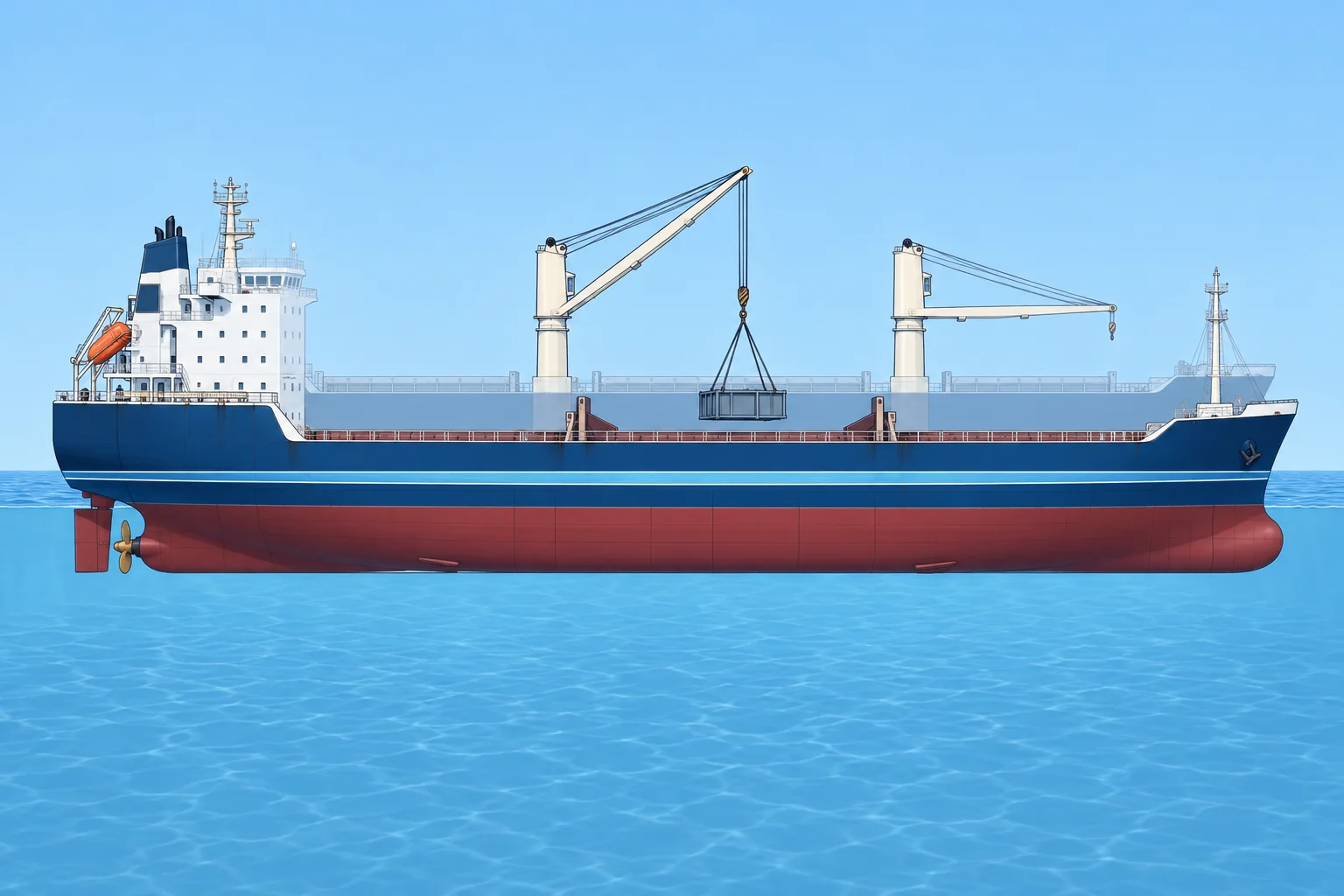
What TPC is
TPC, tonnes per centimetre immersion, is the weight needed for a small, parallel increase of draught of 1 cm. A 1 cm layer at the waterline has a volume of Aw ÷ 100 m³, so TPC = Aw × ρ ÷ 100, with Aw the waterplane area in m² and ρ the density in t/m³.
Using it
Sinkage or rise (cm) = w ÷ TPC. Loading sinks her, discharging lets her rise. The ship goes down evenly, called bodily sinkage, only if the weight's centre is over the LCF, the centre of the waterplane. Anywhere else she trims as well; the Trim unit combines the two.
Limits
TPC varies with draught as waterplane area changes. It usually increases on flared hulls, where the sides widen upwards, but can stay constant or decrease. For small changes, use the current TPC. For larger changes, use a suitable average TPC or the displacement difference from the table.
Density
Tables give TPC for sea water of 1.025 t/m³. In dock or river water, TPC = TPC(sea) × ρ ÷ 1.025: the same weight sinks her a little more. That matters when you finish loading against a mark in dock water.
In practice
TPC lets you plan the last tonnes: how much more cargo before she reaches a mark, how much ballast for a draught limit, how far she rises as fuel is used. The deadweight scale, a chart that lines up draught, displacement, deadweight and TPC, gives quick answers.
Key figures
- TPC
- Aw × ρ ÷ 100 (t/cm)
- Sinkage or rise
- w ÷ TPC (cm)
- TPC in dock water
- TPC(sea) × ρ ÷ 1.025
- Even sinkage
- Only if the weight's centre is over the LCF
Worked example: TPC and sinkage
- Data: Aw 2,440 m², sea water. TPC = 2,440 × 1.025 ÷ 100 = 25.0 t/cm. — Assume TPC stays constant and each weight is loaded or discharged over the LCF.
- Load 300 t over the LCF: sinkage = 300 ÷ 25.0 = 12 cm. — Mean draught 8.00 m becomes 8.12 m.
- Discharge 450 t: rise = 450 ÷ 25.0 = 18 cm. — She comes up by the same rule.
- In dock water of 1.010: TPC = 2,440 × 1.010 ÷ 100 = 24.6 t/cm. — Lighter water, slightly smaller TPC.
- There 300 t sinks her 300 ÷ 24.6 = 12.2 cm. — A little more than in sea water.
Remember
- TPC = Aw × ρ ÷ 100; sinkage (cm) = w ÷ TPC.
- Even sinkage needs the weight over the LCF; elsewhere she also trims.
- TPC varies with draught: for larger changes use a suitable average or the displacement column.
- Correct TPC for density in dock water.
Common mistakes
Wrong: TPC is the same at every draught.
Right: TPC follows waterplane area and need not always increase. Read it at the relevant draught.
Wrong: w ÷ TPC gives the new draughts forward and aft.
Right: It gives bodily sinkage or rise. It gives the changes at both ends only when trim is unchanged; otherwise use the Trim unit.
Worked case
Your ship is on even keel at 7.94 m in dock water of 1.010 t/m³. The draught limit is 8.10 m. Sea-water TPC is 25.0 t/cm. The mate proposes loading 400 t over the LCF. Accept? Treat TPC as constant.
Show the answer
No. Dock-water TPC = 25.0 × 1.010 ÷ 1.025 = 24.63 t/cm. The 16 cm margin represents about 394 t. Loading 400 t would slightly exceed the stated limit. The sea-water TPC overstates the tonnes available.
Practice question
Waterplane area 3,000 m² in sea water. What is the TPC?
- 30.00 t/cm
- 29.27 t/cm
- 307.5 t/cm
- 30.75 t/cm
Show the answer
Answer: D. TPC = 3,000 × 1.025 ÷ 100 = 30.75 t/cm.
4 · FWA and DWA
Fresh water allowance and dock water allowance
A ship floats deeper in fresher water. FWA and DWA tell you by how much, so you can load in a river port and still float at your mark at sea.
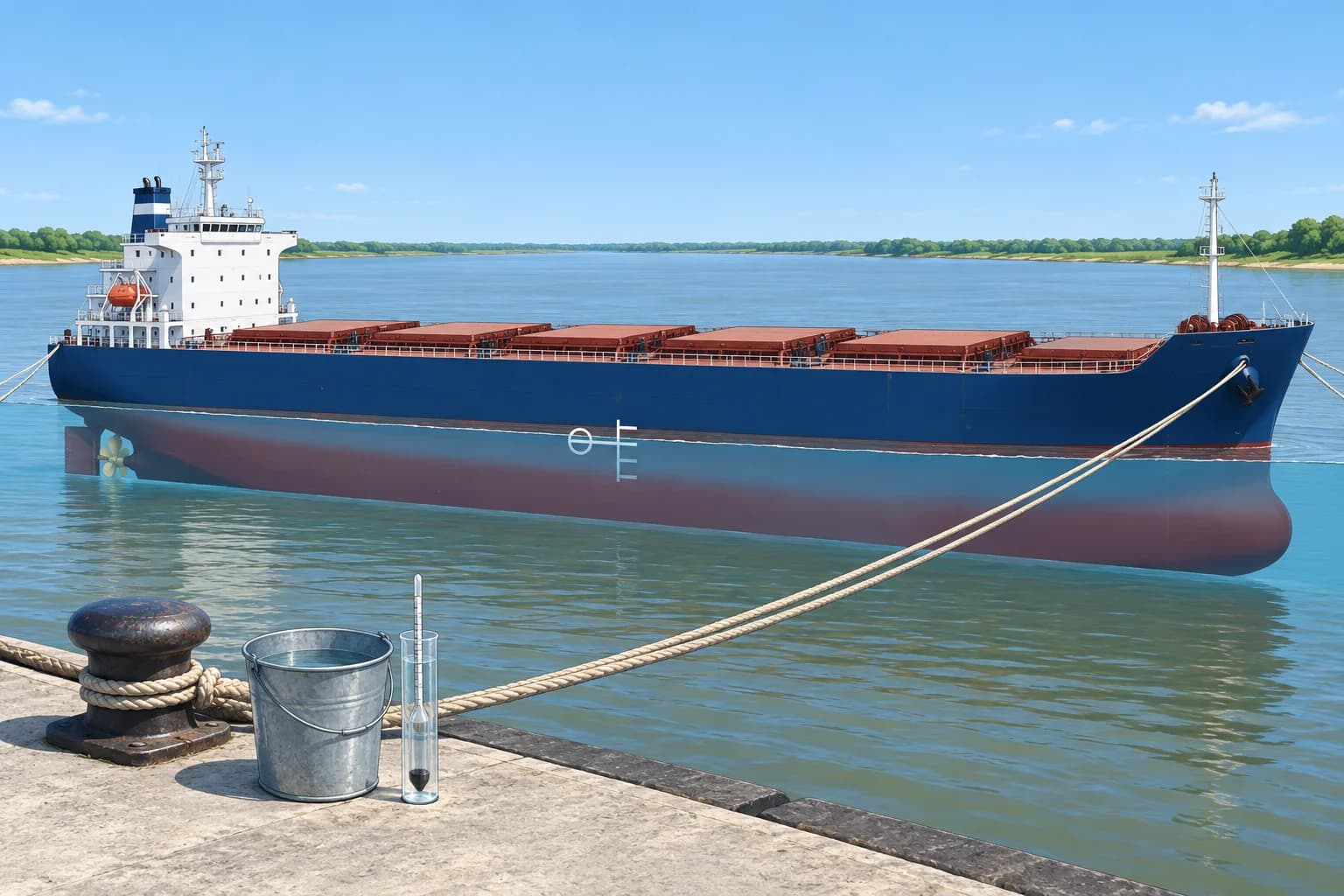
Why she sinks
Displacement is the same in any water, but fresher water is lighter, so she must displace more volume. Going from sea water (1.025 t/m³) into fresh water (1.000 t/m³) at her summer draught, she sinks by the fresh water allowance (FWA). Going back out, she rises by the same amount.
The formula
At summer displacement Δ, fresh water needs extra volume Δ × (1/1.000 − 1/1.025) = Δ × 0.025/1.025 m³. Since Aw = 100 × TPC/1.025 m², extra volume ÷ Aw = Δ/(4000 × TPC) m. Multiply by 1000: FWA (mm) = Δ/(4 × TPC). Use Δ in tonnes and sea-water TPC in t/cm at summer draught. The Convention gives Δ/(40 × TPC) cm.
Dock water
Docks and rivers are often brackish, between 1.000 and 1.025. The dock water allowance (DWA) is the share of FWA for that density: DWA = FWA × (1.025 − ρ) ÷ 0.025. Measure ρ with a hydrometer, a floating density gauge, in water sampled alongside.
Using it
In dock water you may load until the load line mark for the zone is submerged by the DWA. At unchanged displacement in sea water of 1.025 t/m³, she rises by that amount and floats at the mark. The Load Lines unit covers the marks, the allowance for fuel used on the way down a river, and the checks before sailing.
Limits
The formula assumes nearly vertical sides at the waterline and a small change, which holds near the summer draught. Your ship's FWA is stated on her International Load Line Certificate; use that value.
Key figures
- FWA
- Δ ÷ (4 × TPC) mm, summer values in sea water
- DWA
- FWA × (1.025 − ρ) ÷ 0.025
- Sea / fresh water
- 1.025 / 1.000 t/m³
- Ship's own FWA
- Stated on the International Load Line Certificate
Worked example: FWA and DWA
- Data: summer displacement 16,500 t, TPC 25.3 t/cm in sea water. Summer mark applies. — Summer values, as the formula requires.
- FWA = 16,500 ÷ (4 × 25.3) = 163 mm. — Sinkage from sea water into fresh water.
- Dock water 1.012 t/m³: DWA = 163 × (1.025 − 1.012) ÷ 0.025 = 85 mm. — 0.013 ÷ 0.025 = 0.52 of the FWA.
- She may load until the summer mark is 85 mm under water in the dock. — At unchanged weight in sea water of 1.025 t/m³, she rises about 85 mm to the mark.
- In fresh water of 1.000 the full FWA, 163 mm, applies. — DWA equals FWA when ρ = 1.000.
Remember
- Same Δ, lighter water, more volume: she floats deeper.
- FWA (mm) = Δ ÷ (4 × TPC), with summer values in sea water.
- DWA = FWA × (1.025 − ρ) ÷ 0.025 for brackish water.
- Load to the mark plus the DWA; she rises to the mark at sea.
Common mistakes
Wrong: In fresh water the ship floats higher because she weighs less.
Right: Her weight is unchanged. Fresh water is lighter, so she floats deeper.
Wrong: Use the full FWA in any dock water.
Right: Use the DWA for the measured density. The full FWA applies only in fresh water of 1.000.
Worked case
Your ship has an FWA of 163 mm. In a river berth the hydrometer reads 1.018 t/m³ and the summer mark applies. The mate proposes submerging the summer mark by the full 163 mm. Do you agree?
Show the answer
No. Full FWA applies at density 1.000. Here DWA = 163 × (1.025 − 1.018) ÷ 0.025 = 45.64 mm, about 46 mm. Use the measured density again near completion.
Practice question
Summer Δ 20,000 t, TPC 25 t/cm. What is the FWA?
- 200 mm
- 20 mm
- 800 mm
- 2,000 mm
Show the answer
Answer: A. 20,000 ÷ (4 × 25) = 200 mm. Forgetting the 4 gives 800.
5 · Hydrostatic tables
Hydrostatic tables and curves
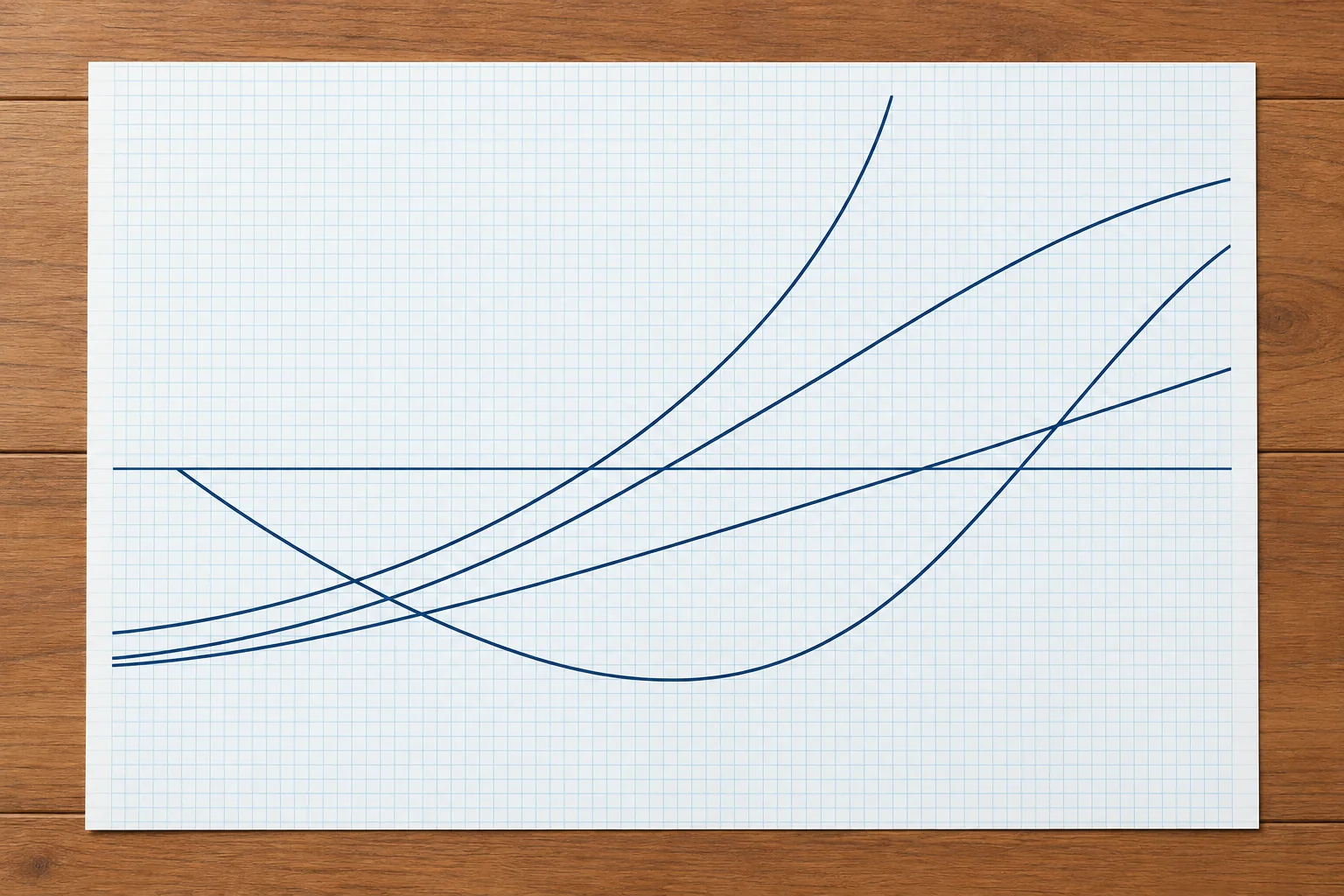
Enter the hydrostatic table with the draught and read displacement, TPC, MCTC, LCB, LCF, KB and KM. Interpolate, and correct for density.
What's in them
The hydrostatic table lists values against draught, usually for sea water on even keel. Columns include Δ, TPC and MCTC, the moment to change trim by 1 cm.
Centres and heights
The centre of buoyancy is the displaced volume's centre; the centre of flotation is the waterplane's area centre. LCB and LCF give their fore-and-aft positions. KB is buoyancy-centre height above keel datum K; KM is metacentre height above K. The metacentre is a reference point for initial stability.
Interpolating
Draughts rarely fall on a table line. Use linear interpolation: find what fraction of the step your draught is, and apply that fraction to each value. Where a value curves sharply, such as KM near its minimum, or the steps are large, check the curves.
Density
At a given draught and trim, KB, KM, LCB and LCF depend on immersed hull geometry; displacement, TPC and MCTC also depend on water density. Tables normally use sea water of 1.025 t/m³. At the same draught in water of density ρ, Δ = Δ(table) × ρ ÷ 1.025. For a known Δ in dock water, first convert: Δ(table) = Δ × 1.025 ÷ ρ, then enter the table. Also, TPC = TPC(table) × ρ ÷ 1.025.
Trim
Follow the booklet's method and draught reference. Using the draught at the LCF with even-keel tables is a small-trim approximation. For larger trim, use approved trim-corrected data or the approved loading computer.
Curves
Hydrostatic curves plot the same values against draught on one sheet, each with its own scale. They show how values change with draught: displacement increases, while TPC follows waterplane area. KB generally rises; KM often falls to a minimum before rising again. The deadweight scale puts the main values side by side for quick use.
Key figures
- Interpolation
- Lower + fraction × (upper − lower)
- Δ in dock water
- Δ(table) × ρ ÷ 1.025
- Draught for a Δ in dock water
- Enter the table with Δ × 1.025 ÷ ρ
- Shape-only values
- KB, KM, LCB, LCF: read at the draught
Worked example: interpolating the table
- Table: 8.00 m: Δ 15,000 t, TPC 25.0, KM 8.40 m, LCF 66.0 m. 8.20 m: Δ 15,501 t, TPC 25.1, KM 8.38 m, LCF 65.6 m. — LCF measured forward of the aft perpendicular.
- Draught 8.12 m: fraction = (8.12 − 8.00) ÷ 0.20 = 0.6. — The same fraction for every column.
- Δ = 15,000 + 0.6 × 501 = 15,301 t; KM = 8.40 − 0.6 × 0.02 = 8.388 m. — KM falls slightly here.
- TPC = 25.06 t/cm; LCF = 66.0 − 0.6 × 0.4 = 65.76 m. — Every column is treated the same way.
- In dock water of 1.010 at 8.12 m: Δ = 15,301 × 1.010 ÷ 1.025 = 15,077 t. — KM and LCF stay as read: they depend on shape only.
Remember
- Use the booklet's method and draught reference; interpolate between table rows.
- Δ and TPC are for sea water: correct them by ρ ÷ 1.025.
- At a given draught and trim, KB, KM, LCB and LCF depend on immersed hull geometry.
- With a large trim, use the booklet's trim-corrected data or the approved computer.
Common mistakes
Wrong: In dock water, read Δ straight off the table at the observed draught.
Right: That is the sea-water displacement. Multiply by ρ ÷ 1.025 for the true one.
Wrong: KM must be corrected for density, like displacement.
Right: KM depends on the shape at that draught, so read it directly.
Worked case
On even keel in dock water of 1.015 t/m³, Δ is 15,200 t. A colleague multiplies it by 1.015 ÷ 1.025 before entering the sea-water table. Do you accept? Find draught and KM using the table above.
Show the answer
No. Convert actual weight to its sea-water table equivalent by multiplying by 1.025 ÷ 1.015: 15,200 × 1.025 ÷ 1.015 = 15,350 t. The fraction between 15,000 t at 8.00 m and 15,501 t at 8.20 m is 350 ÷ 501 = 0.70. Draught = 8.00 + 0.70 × 0.20 = 8.14 m. KM = 8.40 − 0.70 × 0.02 = 8.386 m, about 8.39 m.
Practice question
At 7.80 m Δ = 14,501 t; at 8.00 m Δ = 15,000 t. What is Δ at 7.90 m?
- 14,900 t
- 14,751 t
- 15,250 t
- 14,601 t
Show the answer
Answer: B. Halfway: 14,501 + 0.5 × 499 = 14,751 t.