
Ship stability and stowage · Level R4 · 6 parts · about 18 min
Yacht stability: metacentre, types of equilibrium, shifting weights, the GZ curve and AVS
6 short parts: Metacentre · Shifting weights · Free surface · GZ curve · STIX & categories · In practice. Each part explains the idea, then gives the points to remember, the common mistakes, a worked case and a practice question; the Academy unit adds all 37 check questions.
1 · Metacentre
The metacentre M, GM and the three kinds of equilibrium
At small angles of heel, buoyancy acts through a point called the metacentre. Its height above G, GM, measures initial stability.
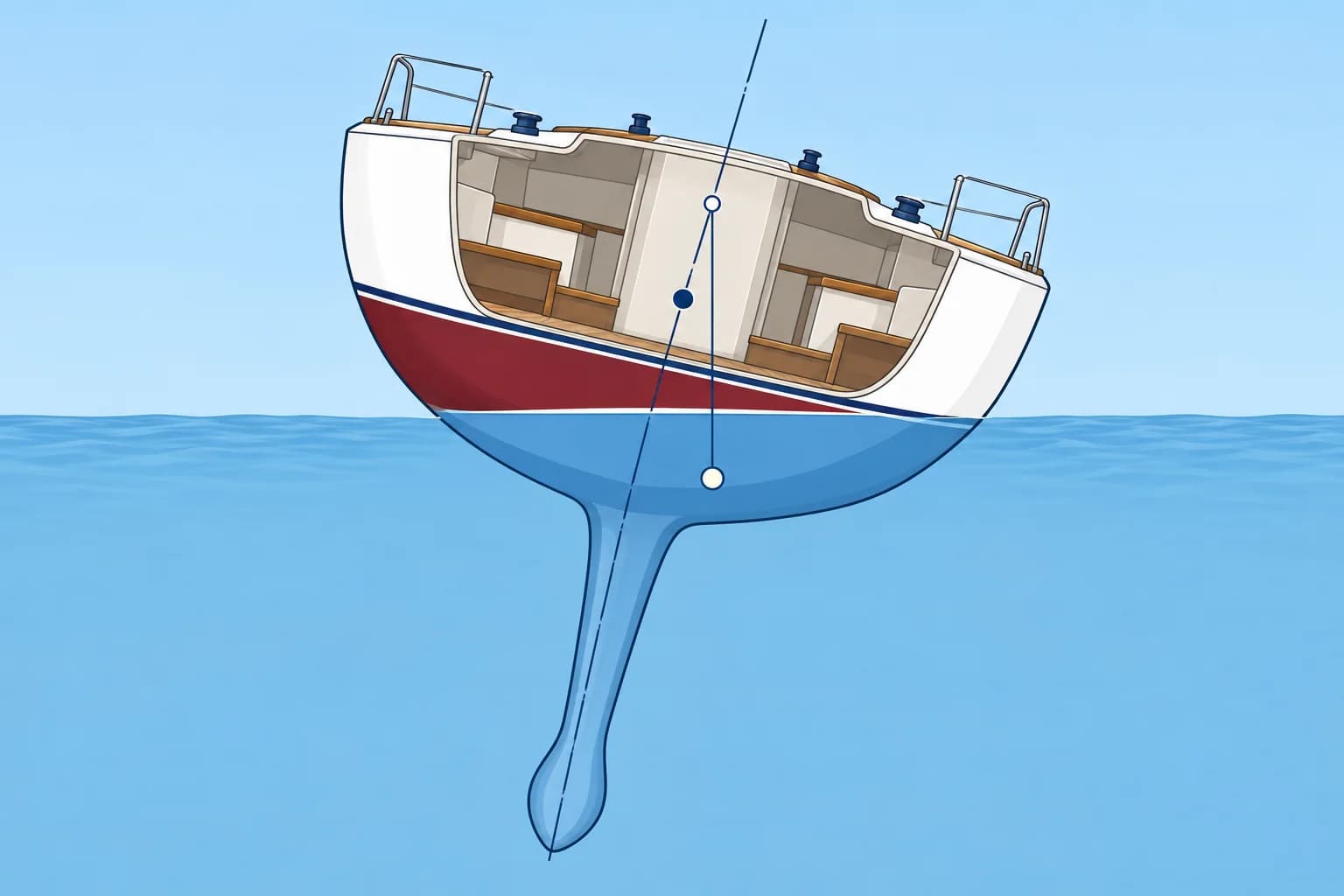
The metacentre
When your boat heels a few degrees, B, the centre of buoyancy, moves out along an arc. The vertical line of buoyancy through the new B crosses the centreline at the metacentre, M. For small angles, up to about 10°, M stays almost fixed.
Heights from the keel
Measure heights from the keel reference K. KB is the height of B, KG the height of G, your yacht’s centre of gravity, and KM the height of M. The metacentric height is GM = KM − KG. Hull shape and draught determine KM; weight position determines KG.
Three kinds of equilibrium
With M above G, GM is positive: stable, with an initial righting tendency. If M and G coincide, GM is zero: neutral initially, with no initial restoring tendency. At finite heel, check the GZ curve. With G above M, GM is negative: upright equilibrium is unstable. She may settle at an angle of loll, a heel caused by negative initial GM, or capsize. A list from off-centre weight can occur with positive GM.
GM and the lever
The righting lever, GZ, is the horizontal separation between the weight and buoyancy forces. At small angles GZ ≈ GM × sin θ, where θ is heel angle. GM tells you how quickly the lever grows near upright. Beyond about 10°, use the full GZ curve.
Stiff and tender
A large GM makes a stiff boat: hard to heel, with a short, quick roll that can be uncomfortable. A small GM makes a tender boat: she heels easily and rolls slowly. A very slow, lazy roll in harbour can warn you that GM is small.
Key figures
- Metacentric height
- GM = KM − KG
- Small-angle lever
- GZ ≈ GM × sin θ (up to about 10°)
- Stable
- M above G: GM positive
- Neutral
- M at G: GM zero
- Unstable
- GM negative: upright unstable; possible angle of loll
Remember
- M is where the buoyancy line crosses the centreline at small heel.
- GM = KM − KG: positive, zero or negative describes initial stability.
- At small angles GZ ≈ GM × sin θ.
- Large GM: stiff, quick roll. Small GM: tender, slow roll.
- Weight position controls KG; hull shape and draught determine KM.
Common mistakes
Wrong: M is a fixed point at every angle of heel.
Right: M is nearly fixed only at small angles. At large angles use the GZ curve.
Wrong: A bigger GM is always better.
Right: Too much GM gives a violent roll that strains gear and crew. Enough GM with a good GZ curve is the aim.
Worked case
You move heavy stores from low lockers to an arch above the original G. Displacement and draught stay unchanged. Your yacht now rolls more slowly and heels further in gusts. What changed, and what should you check before sailing?
Show the answer
Moving stores upward raises KG. At unchanged draught, KM stays the same, so GM falls and she becomes more tender. Move suitable stores back to secured low stowage. Check the builder’s stability information for the new loading; GM alone does not describe the whole GZ curve.
Practice question
KM is 2.0 m and KG is 1.2 m. Stores move upward, raising KG by 0.2 m at unchanged draught. What is the new GM?
- 0.8 m
- 1.0 m
- 0.6 m
- 1.2 m
Show the answer
Answer: C. New KG = 1.2 + 0.2 = 1.4 m. KM stays 2.0 m at unchanged draught, so GM = 2.0 − 1.4 = 0.6 m.
2 · Shifting weights
Moving, adding and lifting weights
Moving a weight moves G parallel to the move. One formula covers it: GG′ = w × d ÷ Δ.
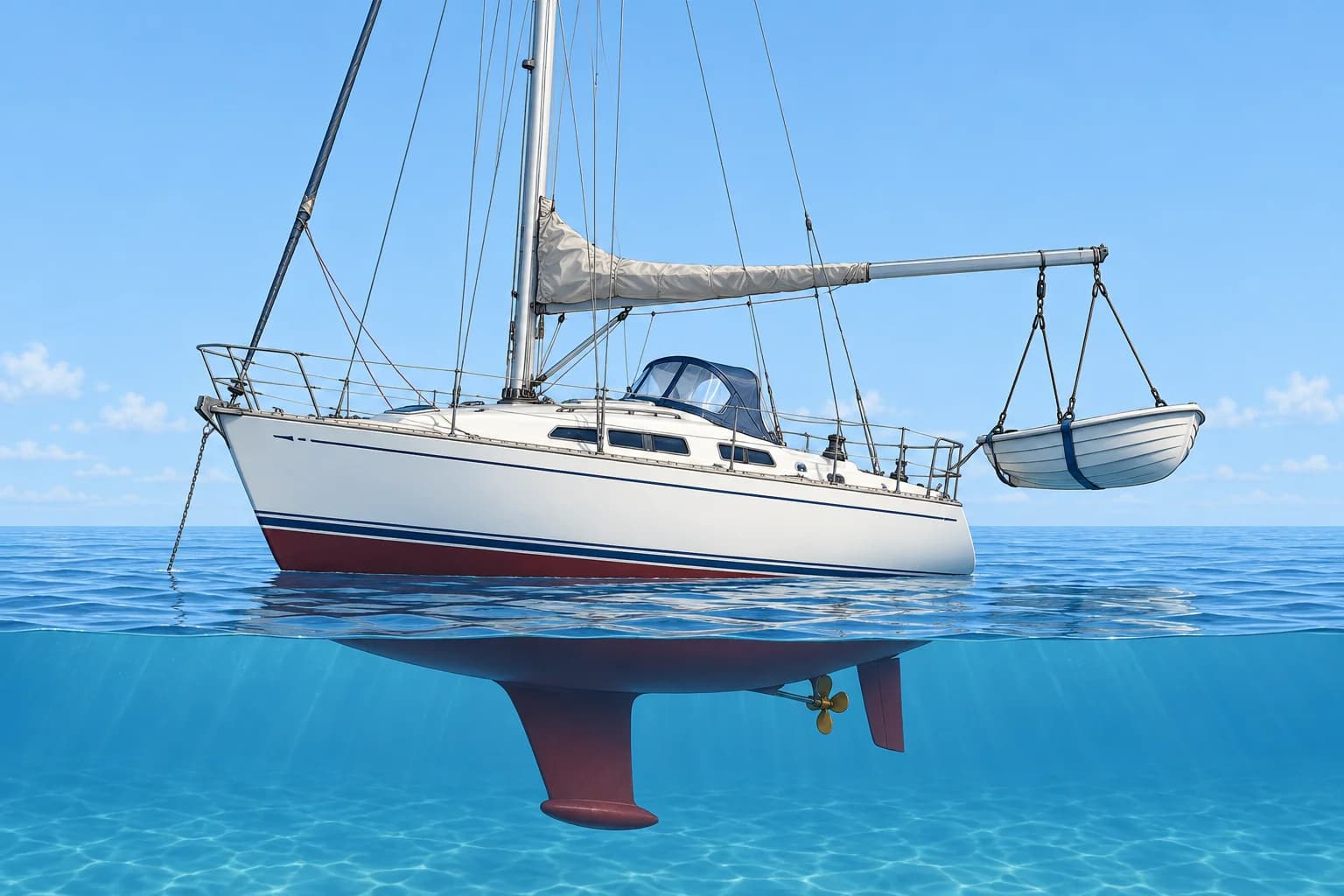
The rule
When a weight w moves a distance d aboard a boat of displacement Δ, G moves parallel to the move by GG′ = w × d ÷ Δ. Use the same units for w and Δ, for example tonnes. Move weight up and G rises; move it sideways and G moves sideways.
Vertical moves
Moving an existing weight upward raises KG by w × d ÷ Δ. At unchanged displacement and draught, GM falls by the same amount. Lowering it does the opposite. High lockers, the coachroof and an outboard boom can put weight above your yacht’s original G.
Sideways moves and list
Moving weight to one side moves G off the centreline. With positive GM, she heels until B is under the new G. For small angles tan θ = GG′ ÷ GM. A small GM turns a small shift into a big angle.
Adding or removing weight
Adding weight moves G towards the new weight; removing it moves G away. With the new total: GG′ = w × d ÷ (Δ ± w), where d is the distance from the old G to the weight. Displacement and draught change too, so check KM before estimating the new GM.
Suspended weights
Once a load hangs freely from a halyard, boom or davit, treat its weight as acting at the point of suspension, not where it hangs. Your yacht’s G moves towards that point by the weighted proportion; it does not move all the way there. An outboard suspension point also shifts G sideways.
Key figures
- Shift of G
- GG′ = w × d ÷ Δ (parallel to the weight’s move)
- Heel from a shift
- tan θ = GG′ ÷ GM (small angles)
- Add or remove
- GG′ = w × d ÷ (Δ ± w), d from old G
- Suspended weight
- Acts at the point of suspension
Worked example: crew moving to one side
- Data: Δ = 6.0 t, GM = 1.2 m. Four crew, 0.30 t in all, move 2.0 m to port. — Use tonnes for both weights and metres for distances.
- GG′ = w × d ÷ Δ = 0.30 × 2.0 ÷ 6.0 = 0.10 m. — G moves 0.10 m to port, parallel to the crew’s move.
- tan θ = GG′ ÷ GM = 0.10 ÷ 1.2 = 0.083. — The boat heels until B lies under the new G.
- θ ≈ 4.8° to port. — This result lies within the small-angle range used by the formula.
Remember
- GG′ = w × d ÷ Δ, parallel to the weight’s move.
- Moving existing weight up raises G and cuts GM equally at unchanged displacement and draught.
- Sideways shift: tan θ = GG′ ÷ GM; small GM, big list.
- Hanging weights act at the point of suspension.
Common mistakes
Wrong: A dinghy hanging from the boom acts at the dinghy’s own height.
Right: It acts at the boom end where it hangs from. Lift slowly with the boat level, and lower it to the deck soon.
Wrong: A shift of G of a few centimetres cannot matter.
Right: Compare it with GM. On a tender boat a few centimetres give a large heel and less reserve.
Worked case
You lift a dinghy from the deck on a vertical main halyard. Why does stability decrease as soon as the dinghy leaves the deck, even while it is still low?
Show the answer
Once clear of the deck, the dinghy acts at the masthead suspension point. The yacht’s G rises by the dinghy’s weight times the vertical distance from the dinghy’s original centre of gravity to the masthead, divided by total displacement. Displacement is unchanged, so GM falls by the same amount. G does not rise all the way to the masthead. A centreline suspension adds no transverse shift of G.
Practice question
A 0.2 t weight is moved 3 m upward on a 6 t yacht. How far does G rise?
- 0.01 m
- 0.10 m
- 0.03 m
- 0.18 m
Show the answer
Answer: B. GG′ = 0.2 × 3 ÷ 6 = 0.10 m. GM falls by the same 0.10 m.
3 · Free surface
The free surface effect
Liquid that can slosh moves to the low side as you heel. It acts like a rise of G and can wipe out a small boat’s GM.
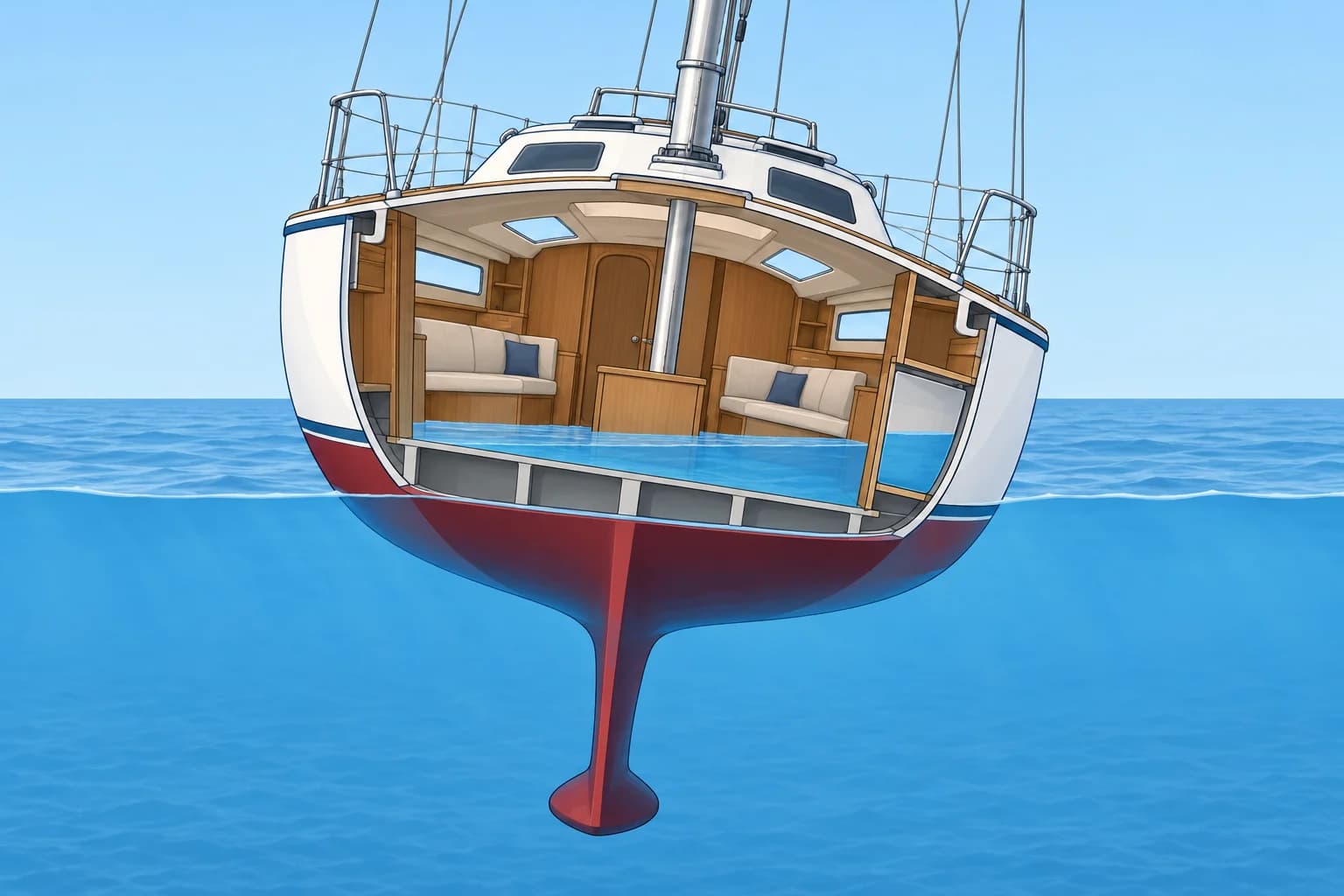
What happens
A tank partly full, bilge water or a flooded cabin has a free surface. When she heels, the liquid flows to the low side. Its weight moves sideways and adds to the heel. The effect is the same as if G had risen: a virtual rise of G, so the effective GM is smaller.
Width matters most
For a rectangular free surface at small heel, the correction depends on width cubed, length, liquid density and boat displacement. Depth does not enter this approximation while the surface spans the full width. Double the width alone and the correction increases eightfold. Very shallow water may uncover the floor as heel increases, changing that surface.
Dividing tanks
A liquid-tight longitudinal division, running lengthwise, creates separate narrow surfaces. Two equal isolated compartments reduce the small-angle correction to one quarter. Ordinary perforated baffles, plates with holes, reduce liquid surge but do not provide this static reduction if liquid can flow between compartments.
Keeping it small
Keep tanks full (pressed up) or empty where the maker’s instructions and tank layout allow, while maintaining transverse balance. Minimise slack tanks, meaning partly filled tanks. Keep the bilge pumped dry and cockpit drains clear. Water over a wide saloon floor after flooding or a knockdown can make your yacht very tender. Pump it out early.
Key figures
- Effect
- Virtual rise of G: effective GM = GM − free surface loss
- Width³ rule
- Rectangular surface; small heel; other factors unchanged
- Width doubled
- 8 times the small-angle correction, other factors unchanged
- Two isolated compartments
- Equal liquid-tight lengthwise halves: one quarter at small heel
Remember
- Sloshing liquid acts as a virtual rise of G.
- For a rectangular surface at small heel, loss grows with width cubed; unchanged geometry makes depth irrelevant.
- Two equal liquid-tight lengthwise compartments cut the small-angle correction to one quarter.
- Minimise slack tanks within the maker’s balanced-use plan; keep the bilge dry.
Common mistakes
Wrong: A few centimetres of water across the saloon floor are harmless because they weigh little.
Right: A little water can still form a dangerous wide surface. For unchanged rectangular surface geometry at small heel, depth does not reduce the correction. Pump it out.
Wrong: Always use one tank at a time, whatever the layout.
Right: Limit partly filled tanks where the maker’s instructions and tank layout allow, while keeping the yacht balanced. Paired side tanks may need balanced use.
Worked case
After a knockdown, water covers the saloon floor of your yacht from side to side, and two half-full water tanks are slopping. The boat now feels sluggish and hangs at each roll. What is happening and what do you do first?
Show the answer
The wide free surface and slack tanks act as a virtual rise of G, reducing effective GM. First stop more water coming in, then pump and bail the saloon water. Keep crew low and central. Follow the maker’s tank-use plan: minimise slack surfaces while maintaining transverse balance.
Practice question
What does the free surface effect do to stability?
- It lowers G by the tank depth
- It acts like a rise of G
- It raises the metacentre M
- It increases the freeboard
Show the answer
Answer: B. The moving liquid reduces the effective GM as if G had risen.
4 · GZ curve
The GZ curve: maximum lever, AVS and area
The GZ curve shows the righting lever at every heel angle. Read four things: the start slope, the peak, the AVS and the area.
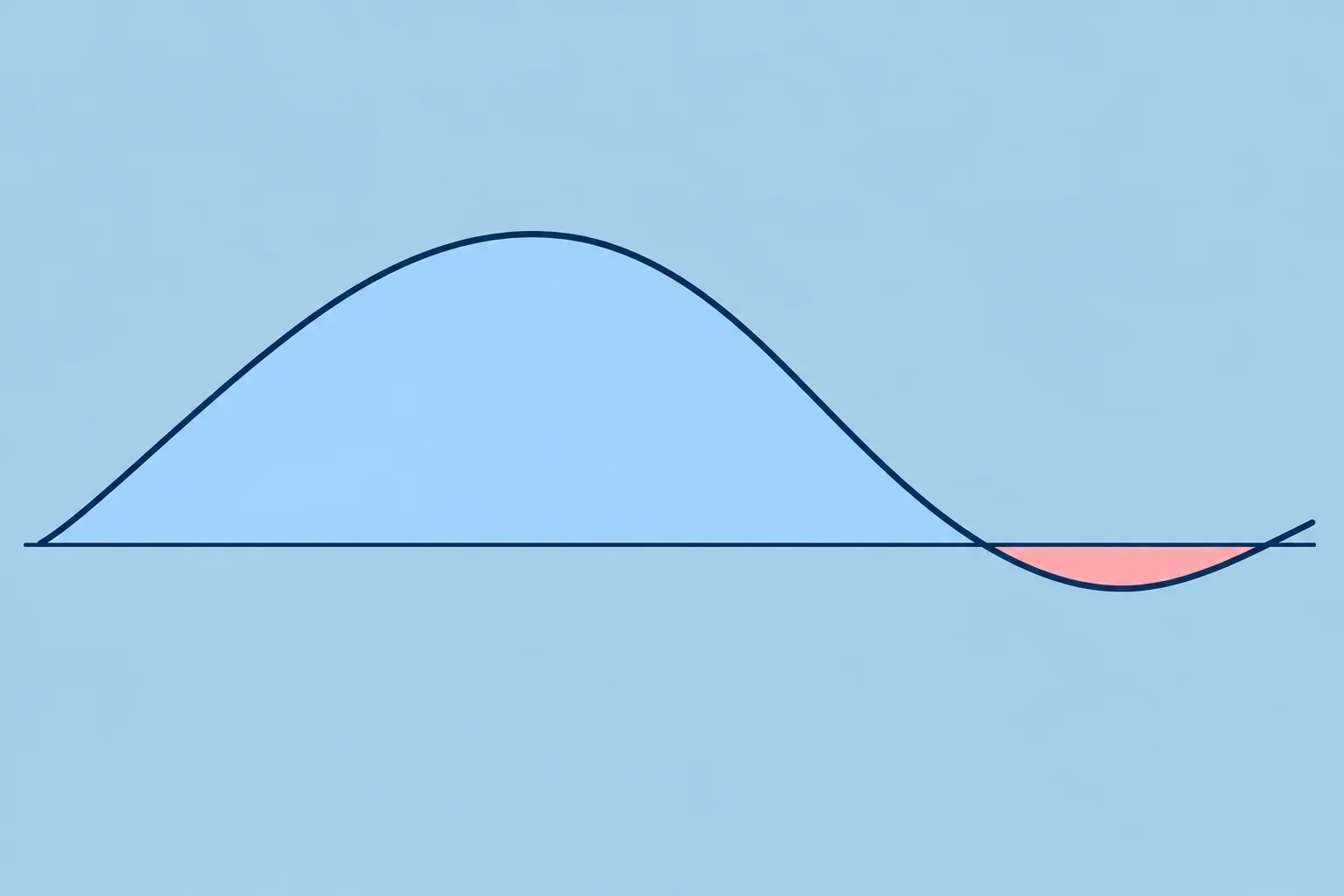
Reading the curve
The GZ curve, or curve of statical stability, plots GZ against heel angle for one loading. Near upright its slope matches GM: a line from the origin to GM at 57.3° touches the start of the curve. Then GZ grows, reaches a maximum and falls again.
Maximum GZ
The peak is the biggest righting lever your boat has, and you read its angle there. A ballasted monohull usually peaks beyond normal sailing heel. A catamaran usually peaks at small heel, near windward hull lift. The angle depends on the design: read that yacht’s curve.
AVS
Where GZ returns to zero after the positive range is the angle of vanishing stability, AVS. Beyond it, the intact yacht’s static lever acts towards inversion. That tendency does not guarantee capsize. Many cruising monohulls have an AVS around 110–130°, but use your yacht’s actual curve.
Area and energy
Positive GZ area measures an idealised restoring-energy barrier. Multiply area, with heel in radians, by your boat’s weight force to obtain restoring work. Starting heel and wind loading affect the remaining barrier; this does not predict a safe wave size. The downflooding angle is the heel at which an opening that is not effectively watertight admits water. Flooding can invalidate the intact curve before AVS.
Inverted stability
Past AVS, negative GZ acts towards inversion. The negative area measures the idealised barrier to recovery from inversion per unit weight. For a given boat, a smaller negative area means less work is needed to leave the inverted position. It guarantees neither recovery nor a recovery time; waves, loading, flooding and the yacht’s condition matter.
Key figures
- Initial slope
- Tangent at 0° reaches GM at 57.3° (1 radian)
- AVS
- Angle where GZ returns to zero (limit of positive stability)
- Positive area
- GZ area × boat weight force = restoring work (heel in radians)
- Negative area
- Inverted energy barrier per unit weight; no recovery guarantee
- Maximum GZ
- Read the largest lever and its angle at that yacht’s curve peak
Remember
- The start slope of the GZ curve equals GM.
- Maximum GZ is the biggest lever; note its angle.
- AVS ends the positive-stability range; check downflooding too.
- GZ area × boat weight force = restoring work, with heel in radians; negative area measures inverted stability.
- A low downflooding angle can cut the useful curve short.
Common mistakes
Wrong: A high GM means a high AVS.
Right: GM only sets the start of the curve. A wide, shallow boat can have a big GM and a low AVS.
Wrong: The AVS is reached only in hurricanes, so it does not matter.
Right: A steep breaking wave can roll a yacht in a gale. Compare the complete curve, loading and downflooding limits; AVS alone does not establish safety.
Worked case
Two yachts have equal GM. A has AVS 125°, a small negative area and an unprotected opening that floods at 60°. B has AVS 105°, a large negative area and downflooding at 100°. Can you choose A for offshore work from AVS alone?
Show the answer
No. A has a wider intact positive-stability range and a smaller inverted barrier per unit weight, but flooding at 60° can invalidate its curve well before AVS. Equal GM and higher AVS do not prove greater positive area or capsize energy. Compare the full curves, displacement, actual loading and downflooding limits. Neither yacht is guaranteed to self-right.
Practice question
What does the AVS mark on a GZ curve?
- The angle where GZ reaches its peak
- The angle where downflooding begins
- The angle where GZ returns to zero
- The angle of normal sailing heel
Show the answer
Answer: C. AVS ends the intact positive-stability range. Beyond it, the static lever acts towards inversion; the dynamic outcome is not guaranteed.
5 · STIX & categories
STIX, design categories and capsize screening
Design categories describe assessed conditions. STIX summarises stability factors for monohulls; neither alone guarantees seaworthiness.
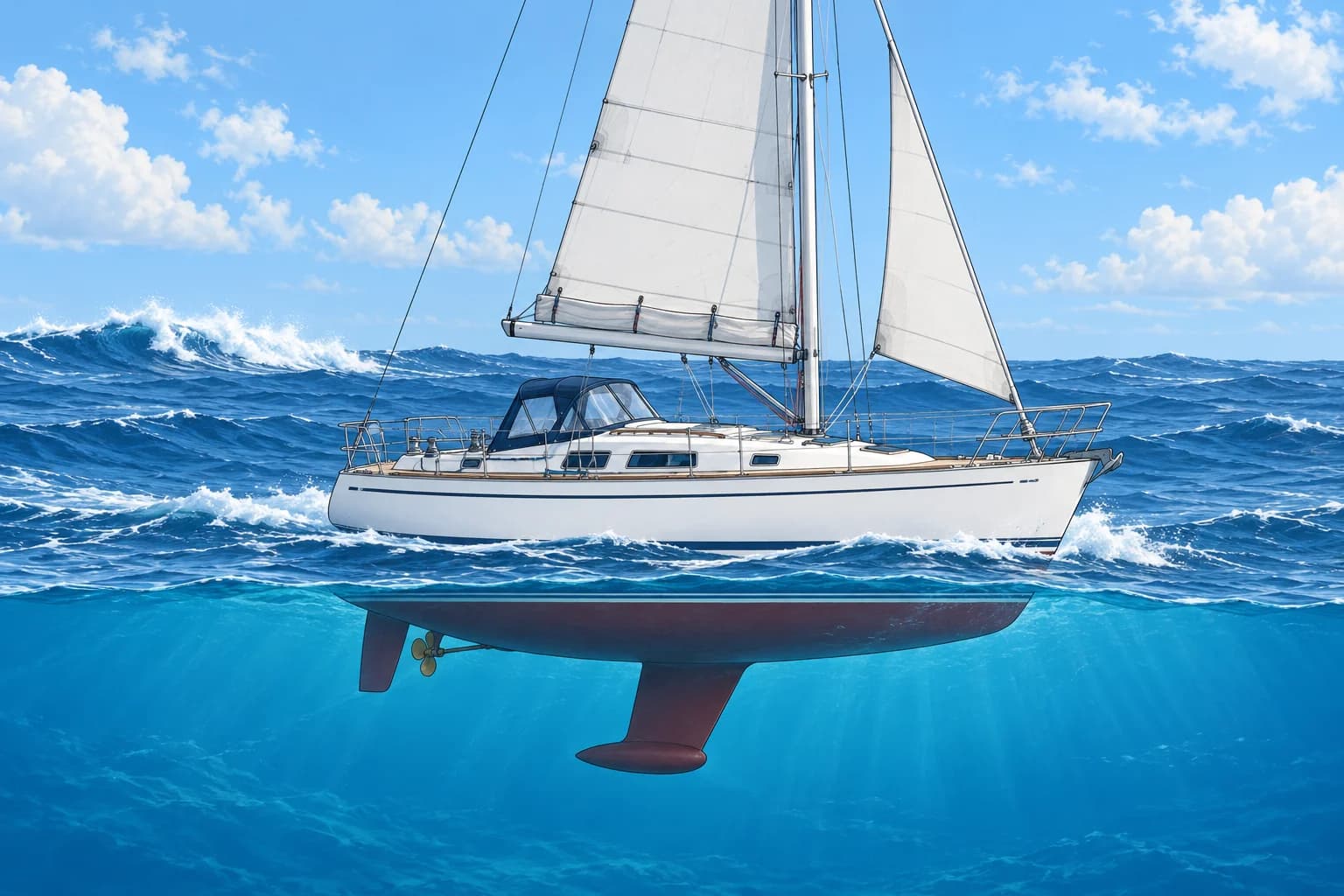
Design categories
The RCD, or Recreational Craft Directive, categories describe wind and significant wave height, the mean height of the highest third of waves: A, above Force 8 and 4 m, excluding abnormal conditions; B, up to Force 8 and 4 m; C, up to Force 6 and 2 m; D, up to Force 4 and 0.3 m, with occasional waves up to 0.5 m. ISO 12217-2 assesses sailing boats 6–24 m. Follow the assessed loading limits in your owner’s manual.
STIX
The stability index, STIX, combines length, righting energy, AVS, knockdown and inversion recovery, displacement–length, beam–displacement, wind moment and downflooding. In this monohull assessment route, the minimums are A 32, B 23, C 14, D 5. A higher value indicates more favourable assessed stability factors; it does not establish overall seaworthiness or guarantee safety.
AVS minimums
In the monohull assessment route, each category also needs a minimum AVS. For A it is 130° − 0.002 × m (m in kg), but not below 100°; for B, 130° − 0.005 × m, not below 95°. C needs 90°, D 75°. A also needs at least 3,000 kg loaded mass, B 1,500 kg.
Capsize screening
The capsize screening formula, CSF, is a rough monohull screen: CSF = beam (ft) ÷ (displacement (lb) ÷ 64)^⅓. A value below 2 is traditionally favoured for offshore work. It uses only beam and displacement, ignoring ballast position and AVS. Use assessed stability information and the full GZ curve before judging suitability.
Multihulls
ISO 12217-2 treats habitable multihulls differently: it assesses how likely they are to invert, and asks for inverted flotation and a means of escape for boats that could. Their safety comes from staying upright and floating if not.
Key figures
- Monohull STIX minimums
- A 32 · B 23 · C 14 · D 5
- AVS, category A
- 130° − 0.002 m (kg), at least 100°
- AVS, category B
- 130° − 0.005 m (kg), at least 95°
- AVS, C and D
- C 90° · D 75°
- Capsize screening
- Monohull screen: B(ft) ÷ (Δ(lb) ÷ 64)^⅓; rough guide only
Remember
- ISO 12217-2 assigns A–D to sailing yachts of 6–24 m.
- Monohull STIX minimums: A 32, B 23, C 14, D 5; no seaworthiness guarantee.
- Monohull assessment also uses minimum AVS and, for A and B, minimum mass.
- The capsize screening formula is only a rough monohull beam–weight screen.
- Multihulls are judged on inversion risk, inverted flotation and escape.
Common mistakes
Wrong: A category B yacht is unsuitable for any ocean passage.
Right: Categories describe design conditions, not routes. B covers up to Force 8 and 4 m significant wave height. Check expected conditions, assessed loading and present condition before planning a passage.
Wrong: A CSF under 2 proves a yacht is safe offshore.
Right: This rough monohull screen ignores ballast position, KG and AVS. Check assessed stability, the GZ curve, loading and condition.
Worked case
You compare two used 12 m cruisers for an Atlantic crossing. One is category A with STIX 38; the other is category B with STIX 27 and has since been fitted with in-mast furling, a heavy arch and a generator. What must you check before choosing?
Show the answer
Check both yachts’ condition, assessed loading and current equipment positions. The A-rated boat has the higher recorded index, but that alone does not decide suitability. Additions above G raise KG; a generator below G may lower it. Obtain updated stability advice after substantial modifications and confirm the information matches each yacht’s present configuration.
Practice question
In the monohull assessment route, what is the minimum STIX for category A?
- 14
- 23
- 32
- 50
Show the answer
Answer: C. A needs 32, B 23, C 14 and D 5.
6 · In practice
Reefing, ballast, furling and weight on deck
Stability is decided at sea by how you load and rig the boat. Reef early, keep weight low and think before adding gear aloft.
Reefing
Wind on the sails creates a heeling moment, a turning effect that heels your boat. Reefing, reducing sail area, usually lowers the centre of effort, where the sail force effectively acts. This reduces the heeling moment and leaves more reserve for gusts.
Ballast
Ballast is weight carried to improve stability. Lowering existing ballast lowers G and generally improves righting ability. On the same yacht, raising a ballasted lifting keel raises G and can reduce AVS; follow its keel-position stability data. Different designs need their own data. Windward water ballast can add righting moment, but slack tanks introduce free-surface loss. Use only the loading configurations specified by the maker.
Furling and gear aloft
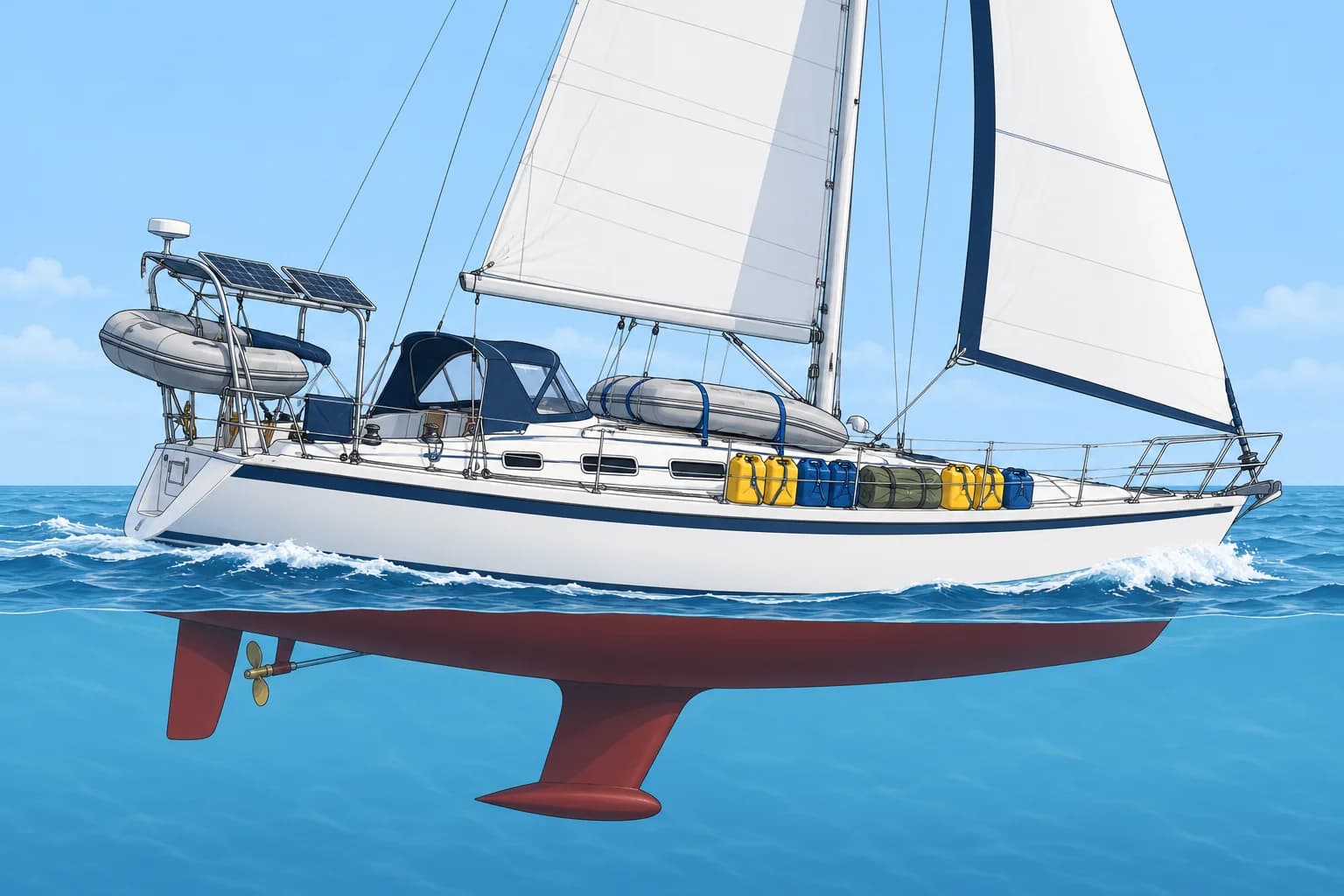
In-mast and roller furling store sail around a spar or stay. They put sail weight high; a furled genoa adds windage, area exposed to wind, at the bow. Radar, wind generators, a solar arch, extra poles and heavy rigging above the existing G raise KG. Together these additions can reduce stability; the size of any AVS change needs yacht-specific data.
Deck loads
A dinghy on the coachroof, a liferaft on the pushpit, cans on the rail and water tanks on deck add windage. Any load above the existing G raises KG; a load below G lowers it. Secure suitable heavy stores low, on the centreline and amidships, near the boat’s middle. Bow chain also affects pitching, but its KG effect depends on its height relative to G.
Heavy weather
Before bad weather, lower suitable gear where the layout allows. Deflate only an inflatable dinghy. Use designated, secure, ventilated stowage for fuel cans and outboards, isolated from accommodation. Pump the bilge dry, close hatches and fit washboards, the boards closing the companionway entrance. Keep crew low and reef early. Breaking waves can capsize your yacht; strong gusts or excessive sail can also overwhelm her righting moment.
Remember
- Reefing reduces heeling moment and keeps a reserve for gusts.
- Low ballast improves righting ability; raising a ballasted keel can reduce AVS. Check the yacht’s data.
- Furling gear, arches and other weight above G raise KG; check the effect on AVS.
- Stow heavy items low, central and amidships.
- Before heavy weather: weight down, bilge dry, hatches shut.
Common mistakes
Wrong: If she sails well at 25° heel, she has plenty of stability left.
Right: Normal heel says little about reserve. Gusts and waves need margin: reef early.
Wrong: Upgrades like an arch and davits do not affect stability.
Right: Additions above the existing G raise KG. Several additions can reduce stability; check their combined effect using yacht-specific data.
Worked case
Before a forecast Force 7, your yacht carries an inflatable dinghy on the coachroof, four water jerry cans on the rail and an outboard on the pushpit. The bilge has 20 litres of water. What do you do?
Show the answer
Deflate and secure the dinghy below if space permits. Secure the water cans low and central. Put the outboard in suitable secure, ventilated stowage that prevents fuel leakage or vapour entering accommodation. Pump the bilge dry, close hatches and fit washboards. Reef before the wind rises and keep the crew low and clipped on.
Practice question
How does reefing help stability?
- It raises the boat’s GM value
- It reduces the heeling moment
- It lowers the boat’s KM value
- It increases the boat’s AVS value
Show the answer
Answer: B. Reefing reduces sail area and usually lowers the centre of effort, reducing heeling moment for the same wind.