
Ship stability and stowage · Level R2 · 5 parts · about 14 min
Why a boat stays upright: weight, buoyancy and righting lever
5 short parts: Floating · Righting lever · Small boats · Boat types · Design categories. Each part explains the idea, then gives the points to remember, the common mistakes, a worked case and a practice question; the Academy unit adds all 29 check questions.
1 · Floating
Weight and buoyancy: why a boat floats
A boat floats because the water it pushes aside weighs as much as the boat. Two points, G and B, tell the whole story.
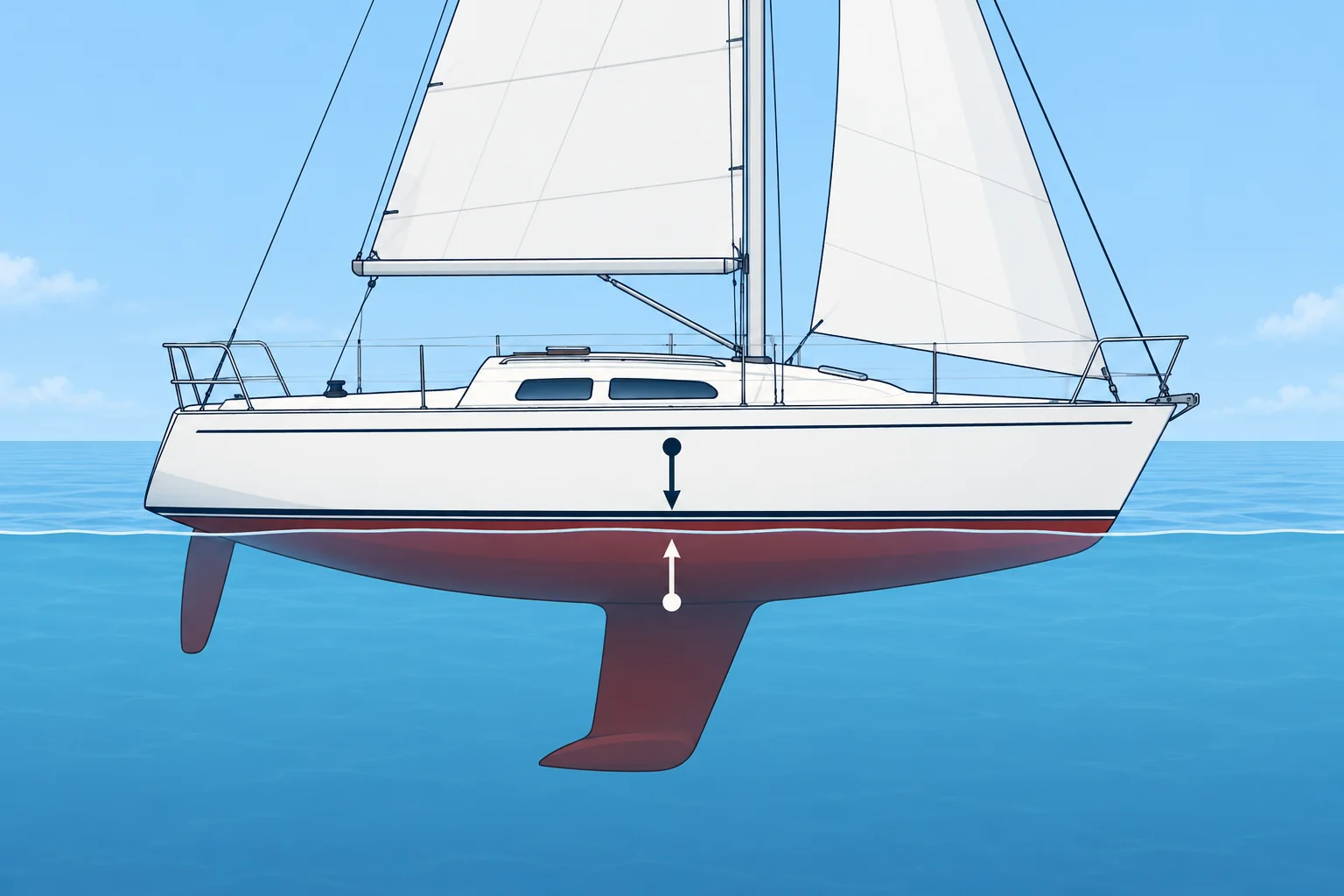
Weight down
Everything aboard has weight: hull, engine, keel, water, fuel, crew. All that weight acts as if it pulled down through one point, the centre of gravity, called G. When you move, add or remove weight, G moves too. Weight low down keeps G low.
Buoyancy up
The water pushes up on the underwater hull. This push is buoyancy. Archimedes’ principle says the push equals the weight of the water the hull pushes aside. The boat sinks until that water weighs exactly as much as the boat. The boat’s weight is called its displacement.
The centre of buoyancy
Buoyancy acts as if it pushed up through one point, the centre of buoyancy, called B. B is the centre of the underwater shape of the hull. When the shape of the underwater hull changes, B moves.
Upright and at rest
A boat at rest floats with G and B on the same vertical line. Weight pulls down, buoyancy pushes up, and they cancel. If you add weight, the boat sinks a little until buoyancy matches again. That is why a loaded boat sits lower and has less freeboard, the height of the deck edge above the water.
Salt and fresh water
Salt water is denser than fresh water. A boat needs to push aside less salt water to float. So she floats a little deeper when she motors from the sea into a river or lake, roughly 2–3 % more volume under water.
Key figures
- Archimedes
- Buoyancy = weight of water displaced
- Floating
- Displacement (boat’s weight) = buoyancy
- Sea water
- About 1.025 t per m³
- Fresh water
- About 1.000 t per m³: the boat floats slightly deeper
Remember
- G is where all the weight acts; it moves when weight moves.
- B is the centre of the underwater shape; buoyancy acts up through it.
- Afloat at rest, the boat’s weight equals the weight of water displaced.
- Upright and still, G and B lie on the same vertical line.
- Extra load means a deeper boat and less freeboard.
Common mistakes
Wrong: A heavy boat floats because it is made of light materials.
Right: Steel ships float too. Any boat floats while her hull pushes aside water weighing as much as she does.
Wrong: G and B are fixed points marked by the builder.
Right: G moves whenever weight moves aboard; B moves whenever the underwater shape changes, for example when the boat tilts (heels).
Worked case
After loading friends and stores, your yacht’s waterline stripe is submerged and freeboard is much lower. A friend suggests moving everything onto the coachroof. Is that a good fix?
Show the answer
No. The extra weight requires more displaced water, so the boat floats deeper. Moving stores onto the coachroof, the cabin roof, does not remove weight; it raises G. B is the centre of the new underwater shape. Keep heavy stores low and central, check the load limit, and remove excess load.
Practice question
What does Archimedes’ principle say about a floating boat?
- Buoyancy equals the weight of water displaced
- Buoyancy equals the volume of the whole hull
- Buoyancy equals the weight of the keel alone
- Buoyancy equals the weight of the crew alone
Show the answer
Answer: A. The upward push equals the weight of the water the hull pushes aside, so a floating boat displaces her own weight.
2 · Righting lever
Heeling and the righting lever GZ
When a stable boat heels slightly, B moves to the low side. Weight and buoyancy create GZ, a lever that pushes her upright.
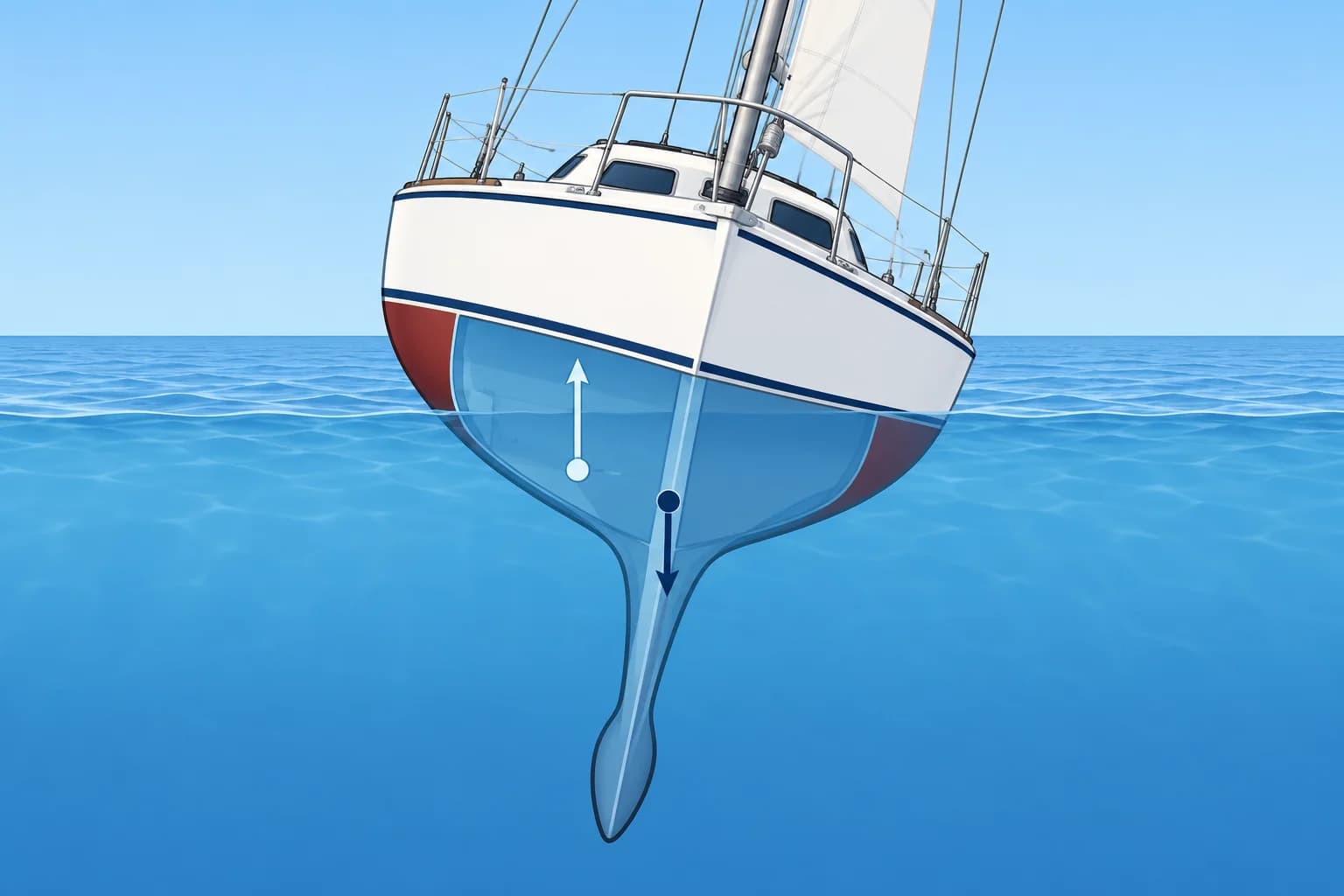
B moves when she heels
Wind or a wave tips the boat. This is heel. More of the hull goes under on the low side and some comes out on the high side. The underwater shape changes, so B moves towards the low side. If nothing shifts aboard, G stays fixed within the boat.
The righting lever
Now weight pulls down through G and buoyancy pushes up through B, but they are no longer in line. The horizontal distance between the two lines is the righting lever, called GZ. Z is the point on the buoyancy line level with G. The bigger GZ is, the harder the boat pushes back upright.
Righting moment
The turning effect is the righting moment: displacement × GZ. A heavy boat with a small lever can still have a large moment. A light dinghy has a small moment, which is why one person moving changes things so much.
Two sources of stability
A wide hull moves B towards the low side as the boat heels. This is form stability. Beam means hull width. Low ballast lowers G and increases GZ at the same heel angle. This is weight stability. Most boats use both.
When the lever runs out
At large heel, the positions of G and B can bring their vertical force lines closer together. GZ shrinks and may reach zero. Beyond this large-angle zero, the moment tends to overturn the boat. Lowering G generally extends the range of positive stability.
Key figures
- Righting lever
- GZ: horizontal distance between weight and buoyancy lines
- Righting moment
- Displacement × GZ
- Form stability
- Beam moves B out to the low side
- Weight stability
- Low G increases GZ at the same heel
Remember
- Heeling moves B to the low side; if nothing shifts aboard, G stays fixed within the boat.
- A positive GZ gives a righting moment; a negative GZ gives an overturning moment.
- Righting moment = displacement × GZ.
- Beam gives form stability; low ballast gives weight stability.
- For the same load and heel between 0° and 180°, raising G reduces GZ.
Common mistakes
Wrong: When the boat heels, G moves to the low side.
Right: If nothing shifts aboard, G stays fixed within the boat. Heel moves B because the underwater shape changes.
Wrong: A wide boat can never capsize.
Right: Beam gives strong early stability, but at large angles the lever can shrink fast. Wide, light boats can capsize and may stay upside down.
Worked case
After a gust, your keelboat returns upright. A crewmate says this proves that heavy stores can safely go on the coachroof. Do you agree?
Show the answer
No. Recovery shows that the righting moment overcame the remaining heeling moment in that gust. It does not prove that every loading arrangement is safe. Moving stores higher raises G and reduces GZ at the same heel. Keep heavy stores low.
Practice question
A boat heels without any load shifting. Which centre changes position within the boat?
- G moves to the low side
- B moves to the low side
- G and B both rise up
- Neither G nor B moves
Show the answer
Answer: B. The underwater shape changes, so B moves towards the low side. If nothing shifts aboard, G stays fixed within the boat.
3 · Small boats
Weight high up, water aboard and people on one side
In a small boat, the crew is a big part of the weight. Where people sit, and any water sloshing aboard, decide whether she stays upright.
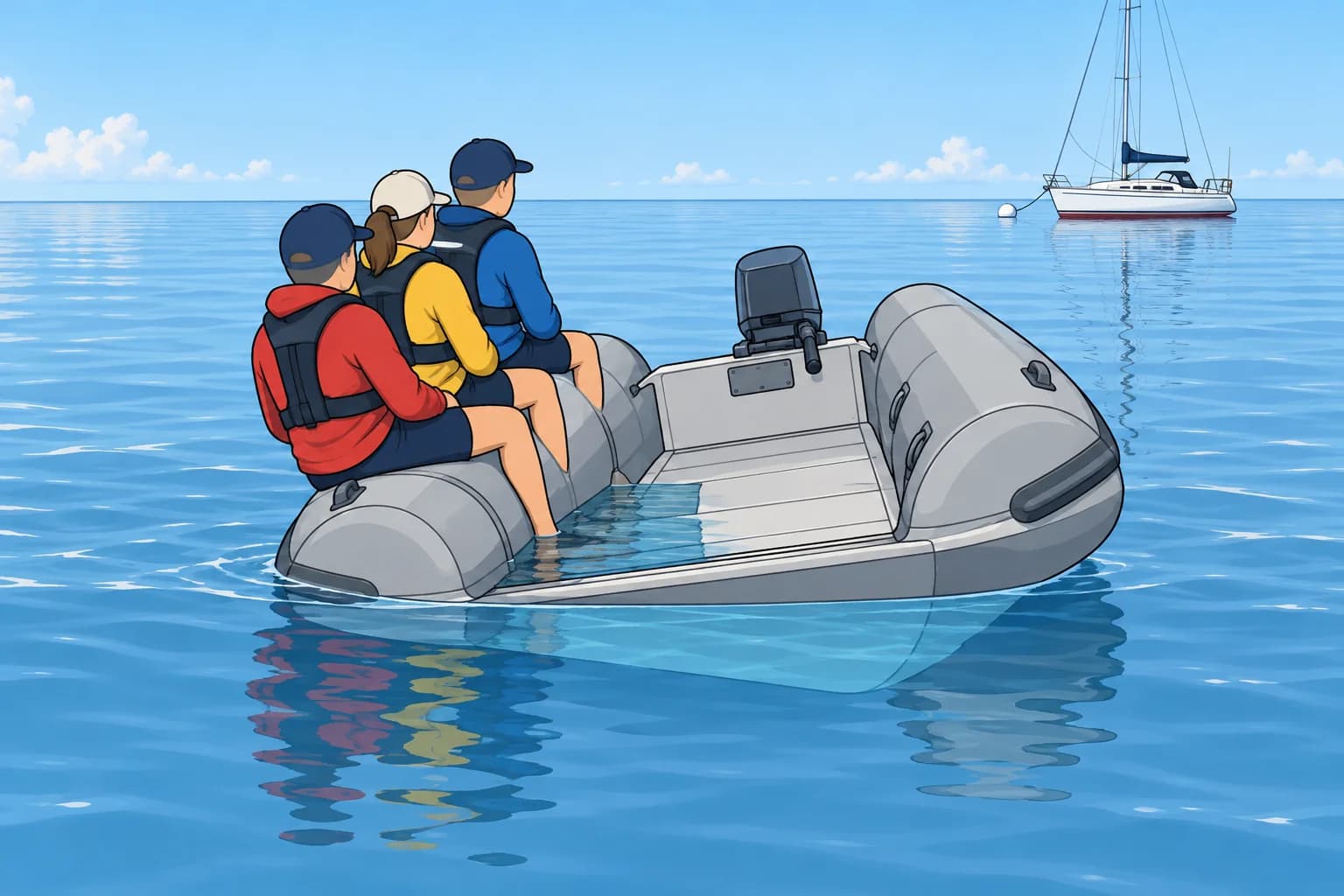
People are heavy ballast
In a 4 m dinghy or tender, three adults can weigh more than the boat. When they stand up, G rises a long way and the lever shrinks. Get in at the centre, step onto the middle of the floor, keep low and sit down. Hand gear in; do not jump in carrying it.
People on one side
When everyone sits on one side, G moves to that side. If enough stability remains, she settles at a heel with G and B vertically aligned. Otherwise, she may swamp or capsize. With little freeboard, the low side may reach the water. Spread the crew evenly side to side, and keep the bow and stern loads balanced.
Water on the floor
Loose water aboard runs to the low side when she heels. It moves G to the low side and makes her heel more, so more water runs over. This is the free surface effect, and it can capsize a swamped boat. Bail early: scoop the water out. Keep cockpit drains clear.
Swamping
A boat is swamped when she fills with water. Waves from behind can wash over a low transom, the stern panel. A heavy load leaves less height above the water. A swamped boat with built-in buoyancy should still float. Stay with it: it is easier to see than a swimmer.
The builder’s plate
Small boats sold in the EU carry a builder’s plate showing the maximum number of people and the maximum load. Stay within both. The numbers assume people sit normally, not all on one side or standing.
Key figures
- Standing up
- Raises G: the boat becomes much less stable
- Sitting to one side
- Moves G sideways: the boat heels
- Loose water
- Runs to the low side and adds to the heel
- Builder’s plate
- Maximum persons and maximum load: never exceed
Remember
- In small boats the crew’s weight can exceed the boat’s: sit low and central.
- Crew on one side moves G sideways and heels the boat.
- Loose water runs downhill and makes heel worse: bail early.
- Respect the maximum persons and load on the builder’s plate.
- If swamped or capsized, stay with the boat.
Common mistakes
Wrong: Step onto the side of the tender to get in quickly.
Right: Step into the middle of the floor, keep low and sit down at once. Weight on the edge can tip a small boat over.
Wrong: A little water slopping on the floor does not matter.
Right: Loose water moves to the low side and increases heel. Bail it out before more comes in.
Wrong: The plate limit is for calm days; one extra person is fine in a hurry.
Right: The plate limits apply always. Make two trips.
Worked case
Five people want to ride the 3 m tender back to the yacht in a short chop. The plate says 3 persons. Two crew stand at the bow to grab the yacht’s ladder as you arrive.
Show the answer
Make two trips: five people exceed the plate limit and leave very little freeboard. Keep everyone seated low and spread out. Standing at the bow raises G and moves it forward, so the bow may dip and take water. Approach slowly, let one person at a time move to the ladder, and keep the others still. Everyone wears a lifejacket.
Practice question
Why does standing up in a small dinghy make it unstable?
- It lowers B within the hull
- It raises G a long way
- It moves B towards the bow
- It increases the freeboard
Show the answer
Answer: B. The crew is a big part of the weight. Standing lifts G and shrinks the righting lever.
4 · Boat types
Monohulls, multihulls, dinghies and planing boats
Ballasted keelboats, catamarans and light dinghies stay upright in very different ways. Know which kind you are on.
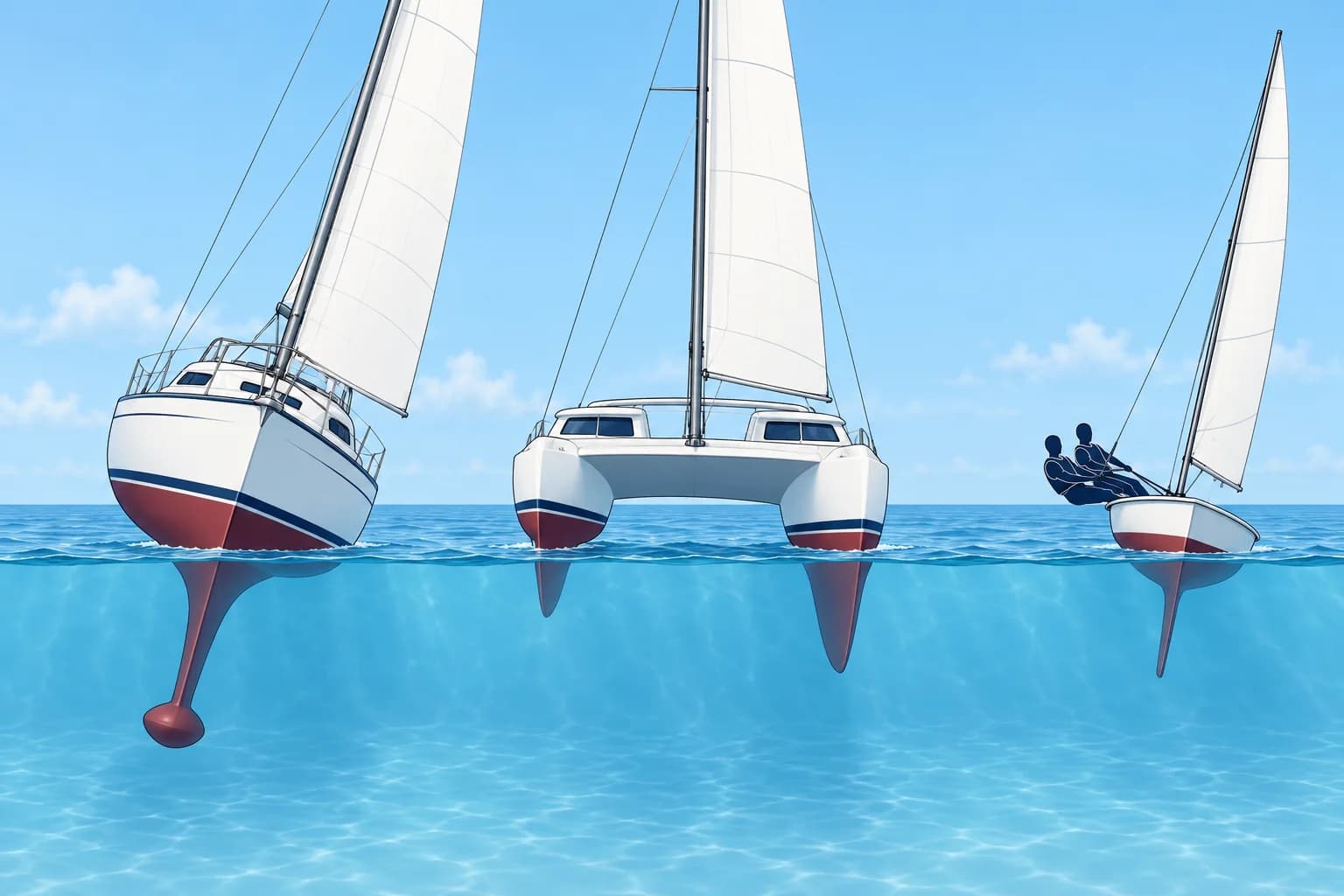
Ballasted monohull
A keelboat is a monohull: a boat with one hull. It carries ballast, weight placed low for stability, in its keel. Low ballast helps preserve a righting lever at large heel, within the boat’s range of positive stability. Most recover from a knockdown, when the mast is in the water. A big breaking wave can still roll her over.
Multihull
Catamarans have two hulls; trimarans have three. Their wide hull spacing provides stability. Cruising multihulls may give little warning through heel. They can remain stable upside down after capsize and normally cannot self-right. Reef early: reduce the sail area using the builder’s wind-speed guidance.
Dinghies and planing boats
A sailing dinghy has little ballast. Hull shape and crew weight help keep it upright. Sitting out means leaning your weight over the side. Most sailing dinghies are designed to be righted after capsize. Planing boats have hulls that lift partly out of the water at speed. Small planing motorboats rely mainly on hull shape and width. Rigid inflatable boats (RIBs) also have buoyant tubes. Crew and load position matter in both.
Heel tells you different things
On a keelboat 20° of heel is normal sailing. On a cruising catamaran, a hull lifting clear of the water is a serious warning. In a dinghy, heel is controlled by the crew’s weight moment to moment. Learn what is normal for your boat.
Key figures
- Keelboat
- Ballast low in the keel: usually self-rights from a knockdown
- Catamaran
- Hull spacing gives stability; can remain stable inverted
- Sailing dinghy
- Crew weight and hull shape; most are designed to be righted
Remember
- Keelboats rely on low ballast; most recover from a knockdown.
- Cruising multihulls rely on hull spacing and can remain stable inverted.
- Sailing dinghies rely on shape and crew weight; most are designed to be righted after capsize.
- Reef a multihull early; she gives little warning by heeling.
Common mistakes
Wrong: A catamaran does not heel, so she cannot capsize.
Right: Little heel does not guarantee a safe margin. Cruising multihulls can remain stable inverted. Follow the builder’s wind-speed guidance.
Wrong: A keelboat cannot roll over.
Right: Most recover from a knockdown, but a large breaking wave can roll any boat. Keep G low and avoid breaking seas.
Worked case
You usually sail a 10 m keelboat. A friend asks you to sail her 12 m catamaran in a freshening Force 5. She is barely heeling. Do you carry full sail as long as she stays flat?
Show the answer
No. Heel gives little warning on a cruising catamaran. Cruising multihulls can remain stable inverted after capsize. Follow the builder’s reefing guide, using true or apparent wind as specified.
Practice question
Where does a ballasted keelboat get most of her stability at large angles?
- Her wide cockpit
- Her low ballast keel
- Her tall heavy mast
- Her full fuel tank
Show the answer
Answer: B. Low ballast keeps G low and helps retain a restoring lever within the boat’s positive-stability range.
5 · Design categories
Capsize, swamping and design categories
The CE design category on the builder’s plate tells you what wind and waves the boat was built for. Take it seriously.
Design categories
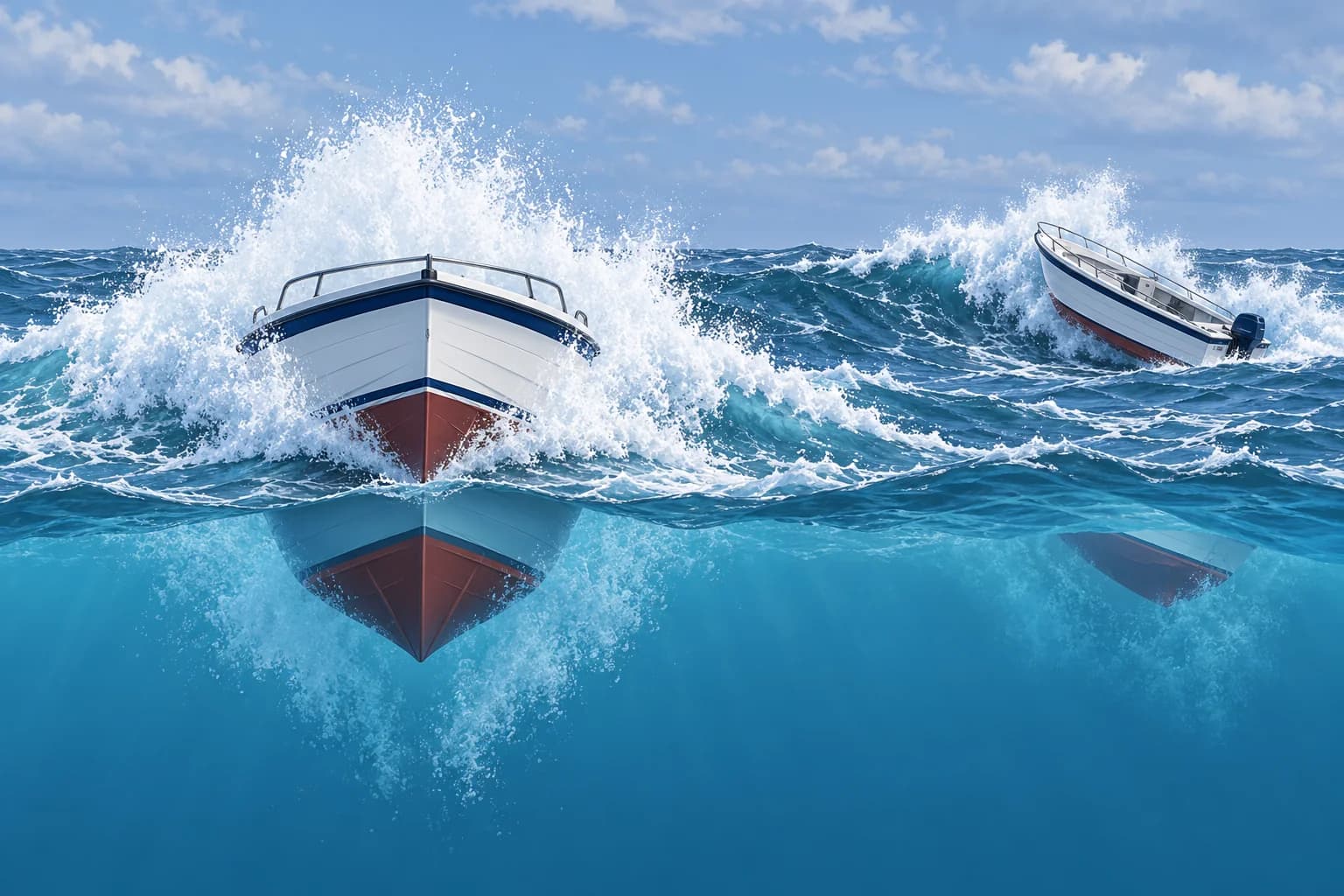
The Recreational Craft Directive (2013/53/EU) sets categories A–D. ISO 12217 assesses stability and buoyancy. Significant wave height is the average height of the highest third of waves. Individual waves can be much higher. A: above Force 8 and 4 m, excluding abnormal conditions such as severe storms and rogue waves. B: up to Force 8 and 4 m. C: up to Force 6 and 2 m. D: up to Force 4 and 0.3 m significant height, with occasional waves up to 0.5 m. Other heights here are significant.
What the category means
The category describes assessed design conditions, not a safe target or distance limit. Category C covers up to Force 6 and 2 m significant wave height; individual waves can be much higher. Decide by crew, loading, forecast and sea state.
Small open boats
ISO 12217-3 assesses stability and buoyancy for boats under 6 m. The applicable tests depend on the design and include people moving to one side and, where required, flotation when swamped. Check the builder’s load and flotation information.
How small boats get into trouble
Overloading, sudden crew movement, waves over a low stern and sharp turns in waves can capsize or swamp an open boat. Extra load reduces freeboard, so waves enter more easily. Keep weight low and centred, avoid overload and sudden movements, and wear lifejackets. Avoid breaking waves: they can roll the boat or flood it over a low bow or stern.
Key figures
- Category A
- Above Force 8 and 4 m significant height; excludes abnormal conditions
- Category B
- Wind up to Force 8; significant wave height up to 4 m
- Category C
- Wind up to Force 6; significant wave height up to 2 m
- Category D
- Up to Force 4; significant height 0.3 m, occasional waves 0.5 m
- Standard
- ISO 12217-1 motor, -2 sail (6 m+), -3 boats under 6 m
Remember
- The design category (A–D) is on the builder’s plate.
- C: up to Force 6 / 2 m significant wave height; D: Force 4 / 0.3 m significant height, occasional waves 0.5 m.
- The category is a design limit for the loaded boat, not a target.
- Overload, sudden crew movement and breaking waves can capsize a small boat.
Common mistakes
Wrong: Category C means the boat may only sail within a certain distance of the coast.
Right: The category is about wind and wave conditions, not distance. Local law may set separate distance limits.
Wrong: If the forecast is within the category, it is safe to go.
Right: The category is a design limit for a fully loaded boat. Crew skill, sea state and how conditions may change still decide.
Worked case
Your 5.5 m open motorboat’s plate says category C, 6 persons. The forecast is Force 5 gusting 6, with 1.5 m significant wave height outside the harbour. Six of you plan a picnic run along the coast.
Show the answer
Six people reach the persons limit; check their combined weight and all counted gear against the separate load limit. Force 5–6 and 1.5 m significant wave height may be unsuitable for an open 5.5 m boat even within category C. Individual waves can be higher. Choose another day or a genuinely sheltered route; fewer people do not make breaking seas safe.
Practice question
Which design category has upper design values of Force 6 and 2 m significant wave height?
- Category A
- Category B
- Category C
- Category D
Show the answer
Answer: C. C covers up to Force 6 and 2 m significant wave height. Individual waves can be much higher.