
The ship: hull, engines and systems · Level R3 · 5 parts · about 14 min
Batteries, charging and electrics
5 short parts: 12 V basics · Batteries · Charging · Fuses & wiring · Shore power. Each part explains the idea, then gives the points to remember, the common mistakes, a worked case and a practice question; the Academy unit adds all 28 check questions.
1 · 12 V basics
The 12 V DC system
Most boats run on 12 volts DC from batteries. Volts, amps, watts and amp-hours are all you need to plan your power.
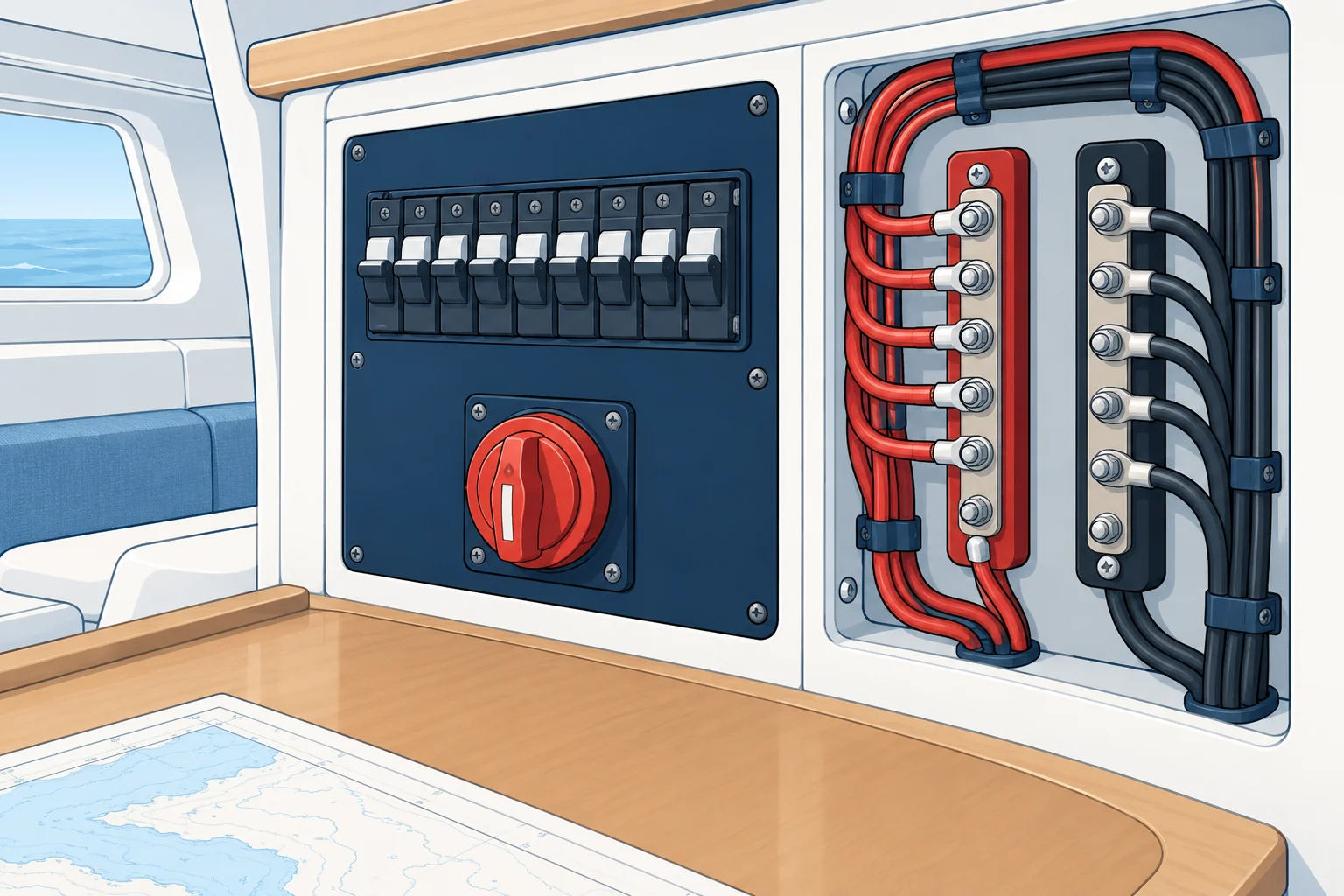
Volts, amps, watts
Voltage (V) is the electrical pressure; current (A, amps) is the flow. Power in watts is volts × amps: a 60 W fridge on 12 V draws 5 A. Most yachts use 12 V DC (direct current, one direction); larger boats often 24 V, which halves the current for the same power.
Amp-hours
Battery capacity is in amp-hours (Ah). A load of 5 A for 10 hours uses 50 Ah. Add up every load over 24 hours to get your daily use: fridge, lights, instruments, autopilot, phone charging. This power budget tells you how much battery and charging you need.
The circuit
Current flows from the battery’s positive terminal through a fuse or breaker, the switch and the load, and back through the negative to the battery. A boat’s DC negative is a wire back to the battery, not the hull. The engine block is usually connected to it.
The layout
A battery isolator switch disconnects circuits wired through it. Separately fused bilge pumps and alarms may bypass it; charging sources can also leave wiring live. The distribution panel has breakers or fuses for each circuit. Bus bars, metal connection strips, gather positive or negative wires. Label every circuit.
Resistance
Resistance, measured in ohms (Ω), opposes current. Ohm’s law is V = I × R: voltage drop (V) equals current (I, in amps) times resistance (R, in ohms). Loose or corroded joints add resistance, causing voltage loss and heating. Check connections early when tracing a fault.
Key figures
- Power
- Watts = volts × amps
- Ohm’s law
- Voltage drop (V) = current (A) × resistance (Ω)
- Charge used
- Amp-hours = amps × hours
- Example
- 60 W fridge at 12 V = 5 A; 12 h running = 60 Ah
Remember
- Watts = volts × amps; on 12 V, 60 W is 5 A.
- Plan with a daily amp-hour power budget.
- Current returns through a negative wire, not the hull.
- Most faults are loose or corroded connections.
Common mistakes
Wrong: A 24 V system needs thicker wire than 12 V for the same equipment.
Right: For the same power, 24 V carries half the current. A smaller cable may be suitable, but check current capacity and voltage drop.
Wrong: Turning off the panel breakers isolates the battery.
Right: Panel breakers do not isolate battery cables. The isolator may leave bypass circuits live. Before electrical work, identify and isolate every supply to the circuit and verify it is dead. Keep automatic bilge protection powered when leaving the boat.
Worked case
Your daily loads use: fridge 48 Ah, anchor light 10 Ah, instruments 12 Ah and phones 6 Ah. Charging replaces only 60 Ah a day. Can you keep this routine for several days?
Show the answer
You use 76 Ah but replace only 60 Ah, leaving a 16 Ah daily shortfall. Reduce optional use or arrange more charging. Keep essential lights and instruments supplied. The battery will steadily discharge if you continue unchanged. Plan charging to replace use plus charging losses.
Practice question
A 36 W light runs on 12 V. What current does it draw?
- 0.3 A
- 12 A
- 3.0 A
- 36 A
Show the answer
Answer: C. Amps = watts ÷ volts = 36 ÷ 12 = 3 A.
2 · Batteries
Battery types, state of charge and battery banks
Lead-acid batteries like to stay full; lithium batteries need their own management. Keep a separate battery for starting the engine.
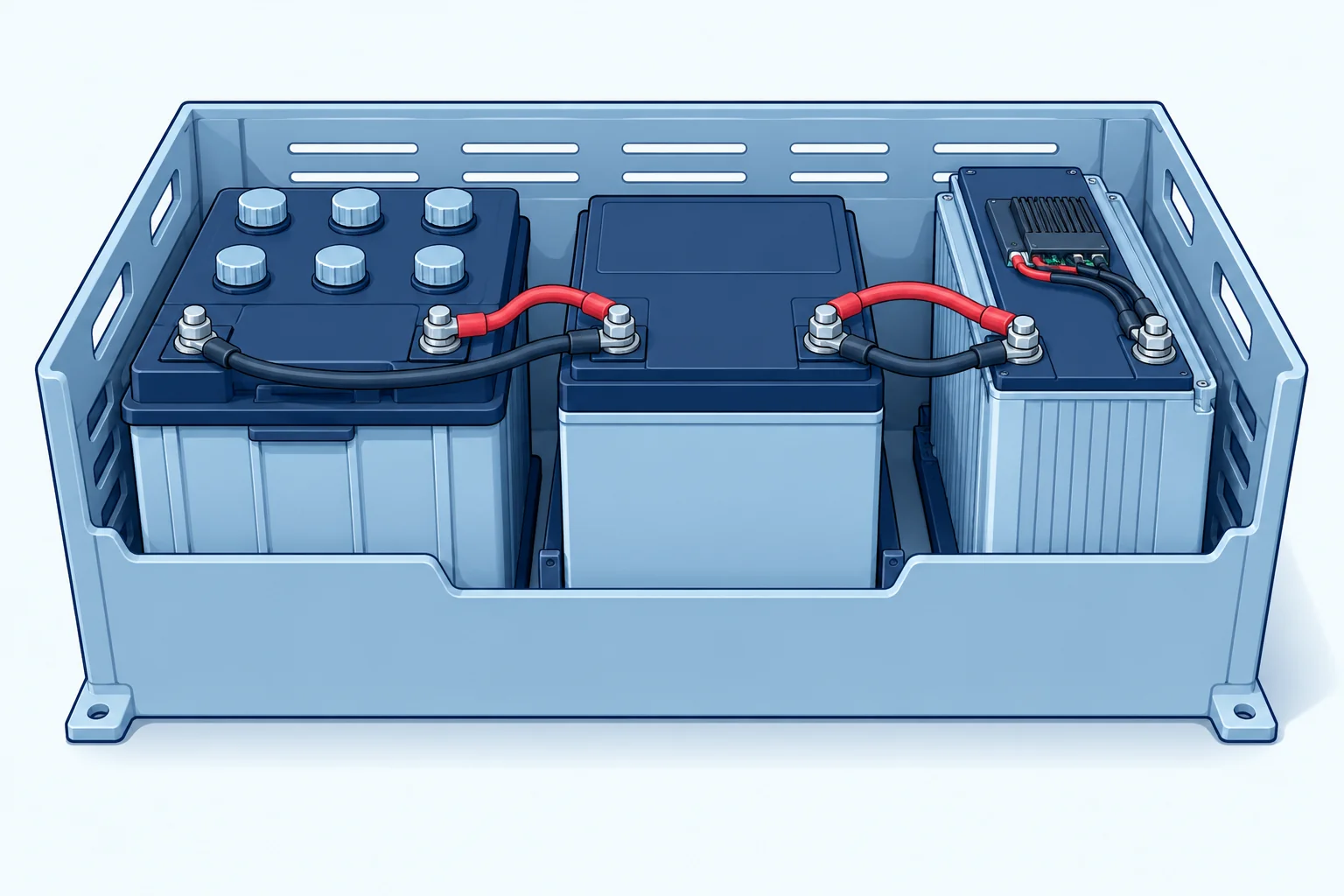
Lead-acid types
Flooded batteries need distilled-water top-ups and release hydrogen during charging. AGM (absorbed glass mat) and gel are valve-regulated types: they need no water top-ups but can still vent gas. Ventilate every lead-acid battery compartment. Use the maker’s charging settings. Avoid routinely taking lead-acid batteries below about half charge.
Lithium (LiFePO₄)
Lithium iron phosphate batteries are about a third of the weight, accept fast charging and can use most of their capacity. A battery management system (BMS) protects the cells and disconnects the battery if voltage or temperature goes out of range. Most makers block charging near or below freezing. Have a marine electrician check the installation against the maker’s instructions and applicable marine standards.
State of charge
After resting without charging or loads for the maker’s recommended time, a 12 V lead-acid battery reads about 12.7 V full and 12.2–12.4 V at half charge; check its chart. A shunt, a current-measuring sensor, lets a monitor count amp-hours in and out. Set it up correctly, capture all battery current and synchronise as instructed; estimates can drift. Lithium’s flat voltage makes voltage-only estimates unreliable.
Separate banks
Keep a start battery for the engine, separate from the house bank for domestic equipment. This preserves starting capacity when house loads run the house bank down. A voltage-sensitive relay can link compatible lead-acid banks automatically for charging. A lithium house bank needs a compatible DC-DC charger, which controls charging between direct-current circuits, or a managed charging system.
Key figures
- Lead-acid, rested
- About 12.7 V full; about 12.2–12.4 V at half
- Lead-acid use
- Rarely below about 50 % for long life
- LiFePO₄
- 12.8 V nominal; most capacity usable; BMS required
- Flooded charging
- Gives off hydrogen: ventilate the battery box
Remember
- Flooded: water top-ups. AGM/gel: no top-ups. All need ventilation.
- Lead-acid lasts longest kept above about half charge.
- LiFePO₄ needs a BMS and compatible charging; no charging below its cold limit.
- Read rested lead-acid voltage or use a correctly set and synchronised battery monitor.
- Keep a separate start battery.
Common mistakes
Wrong: Swap lead-acid batteries for lithium and keep the same charging gear.
Right: Lithium needs compatible charge settings and usually a DC-DC charger or managed alternator. The BMS can cut off charging suddenly.
Wrong: 12.4 V while the engine is charging shows a full battery.
Right: Voltage under charge or load is misleading. Read it after resting, or use a battery monitor.
Worked case
Your monitor shows the shared start/house bank is nearly flat after two days at anchor. You plan to run the fridge overnight before leaving at dawn. What should you change now and for future trips?
Show the answer
Reduce optional loads and arrange charging before departure. House loads can leave too little charge to start the engine. For future trips, keep a separate start battery isolated from house loads, with charging suited to both banks. Monitor house-bank charge.
Practice question
Which battery type gives off hydrogen when charging and needs topping up?
- Gel lead-acid battery
- AGM lead-acid battery
- Flooded lead-acid
- Lithium iron phosphate
Show the answer
Answer: C. Flooded batteries vent gas and lose water; ventilate and top up with distilled water.
3 · Charging
Charging sources: alternator, shore, solar and wind
Every amp-hour you use must go back in. Alternator, shore charger, solar and wind each need the right regulator for your batteries.

Alternator
The engine’s alternator charges while you motor. Its built-in regulator usually charges at a fixed voltage and fills a lead-acid bank slowly. An external smart regulator adjusts charging in stages. A DC-DC charger controls charging between DC circuits. For lithium, have a marine electrician specify a suitable charger or managed alternator, limiting demand to what the alternator can safely supply and providing for BMS disconnection.
Charge stages
A typical lead-acid smart charger uses bulk (full current), absorption (held voltage while current falls) and float (a lower voltage to keep the battery full). Use the maker’s profile for each battery type; lithium may not need float.
Shore charger
On shore power, a battery charger fed from 230 V or 120 V AC (alternating current, which reverses direction) charges the banks. Many boats have an inverter-charger that also makes AC from the batteries at sea.
Solar
Solar panels charge in daylight through a charge controller. MPPT (maximum power point tracking) finds the panel’s best operating point and converts its output to battery-charging voltage. PWM (pulse-width modulation) switches the panel connection on and off; the panel operates near battery voltage while connected. MPPT can improve charging, depending on conditions. Partial shade can sharply reduce output; avoid boom and rigging shadows.
Wind and water
A wind generator charges in sufficient wind. Its controller uses a dump load to absorb surplus power or a brake to slow the rotor, as the maker specifies. A hydrogenerator turns a propeller in the water as you sail, useful on long passages.
Remember
- Set every charger to the battery type.
- Typical lead-acid stages: bulk, absorption, float.
- Lithium: compatible charging, safe alternator current and temperature, and BMS disconnect protection.
- Solar needs a controller; avoid shade. MPPT can improve charging.
- Wind needs a controller with a dump load or brake.
Common mistakes
Wrong: Charge a gel battery with the flooded setting; they are both lead-acid.
Right: Use the gel maker’s profile. Some flooded settings, especially equalisation (a deliberate higher-voltage charge), can damage gel batteries.
Wrong: A little shade on one corner of a panel hardly matters.
Right: Partial shade can cut a panel’s output by much more than its shaded area. Mount panels clear of shadows.
Worked case
You replace the house bank with LiFePO₄ batteries. The engine has a standard alternator wired directly to the house bank. During the first engine run, the alternator gets very hot, and later the BMS cuts out while charging.
Show the answer
When safe for navigation, stop the engine; do not open the battery isolator while the alternator is running. Have the installation checked before reuse. Lithium can overload an alternator, and a BMS disconnect can cause a damaging voltage surge. A marine electrician must confirm compatible charging, safe current and temperature limits, and protection against sudden battery disconnection.
Practice question
A lead-acid charger holds the higher charging voltage while current tapers, before dropping to its lower maintenance voltage. Which stage is this?
- Bulk stage
- Absorption
- Float stage
- Charge stopped
Show the answer
Answer: B. Absorption holds the higher charging voltage as current tapers. Float maintains charge at a lower voltage.
4 · Fuses & wiring
Fuses, breakers, wire size and voltage drop
A supply fuse primarily protects its cable. Size wire for current and circuit length, then check voltage drop.
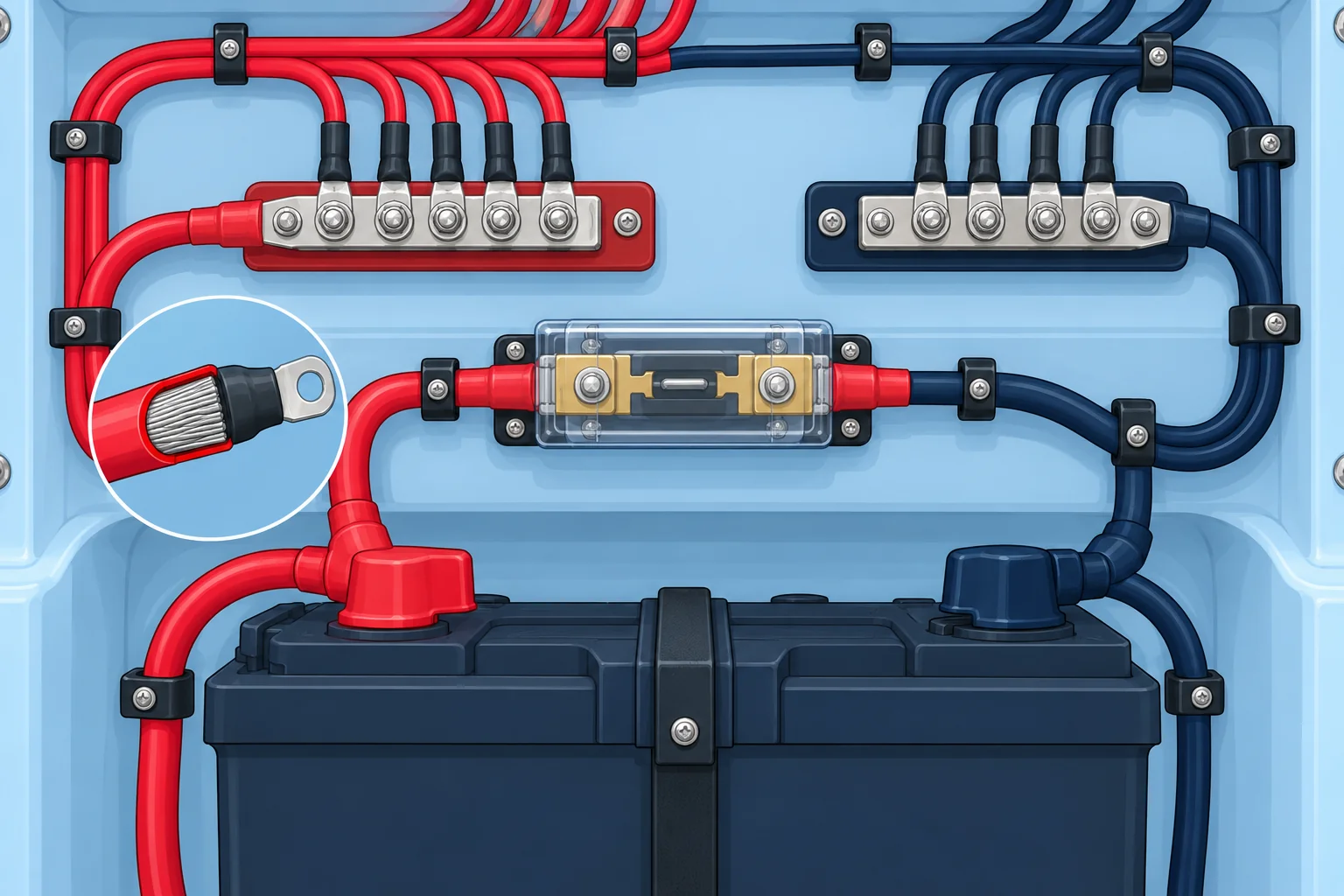
Fuses protect wires
A fuse or circuit breaker stops a short circuit from overheating a wire and starting a fire. Its rating must suit the wire, so the wire cannot overheat. Fit it close to the power source: the main battery fuse within a short distance of the battery. Never replace a fuse with a bigger one.
Main battery fuse
Batteries can deliver thousands of amps into a short circuit. The fuse’s current rating must protect the cable. Its breaking capacity, the fault current it can safely interrupt, must suit the battery bank, especially lithium. Have a marine electrician select a suitable fuse, fitted in the positive cable close to the battery.
Marine wire
Use tinned, finely stranded marine cable: its copper strands have a tin coating to resist corrosion and are flexible enough to tolerate vibration. Crimp terminals by compressing them onto the wire with the correct tool. Seal joints with heat-shrink tubing, support cables and route them clear of bilge water.
Voltage drop
Wire has resistance, so long, thin cables lose volts. The usual limits (ABYC) are 3 % for critical circuits such as navigation lights, electronics, bilge blowers and panel feeders, and 10 % for less critical loads. Count the length out and back.
Sizing the wire
For copper at 20 °C, estimate A (mm²) = 2 × L × I × 0.0175 ÷ ΔV. L is one-way length (m), I is current (A), and ΔV is allowed drop (V). Round up to a standard size. Check voltage drop at operating temperature, current capacity with heat and cable grouping, and losses through connections and switches.
Key figures
- Voltage drop limits
- 3 % critical loads; 10 % non-critical (ABYC)
- 3 % of 12 V
- 0.36 V
- Copper resistivity
- About 0.0175 Ω·mm²/m at 20 °C
- Wire size
- A = 2 × L × I × 0.0175 ÷ ΔV
Worked example: wire for a 10 A load 8 m away
- Allowed drop for a critical load: 3 % of 12 V = 0.36 V. — Navigation lights and electronics need nearly full voltage.
- A = 2 × 8 × 10 × 0.0175 ÷ 0.36 = 7.8 mm². — The 2 counts the cable out and back.
- Choose the next standard size: 10 mm². — Then verify operating-temperature drop and allow for connections.
- Fuse it for the cable, near the source. — The fuse must blow before the cable overheats.
Remember
- The fuse protects the wire: rate it for the cable.
- Main battery fuse close to the battery.
- Tinned, stranded marine cable; proper crimps.
- Voltage drop: 3 % critical, 10 % non-critical; length out and back.
Common mistakes
Wrong: The fuse keeps blowing, so fit a bigger one.
Right: A blowing fuse means a fault or overload. Find it; a bigger fuse lets the wire overheat.
Wrong: Measure only the length from the battery to the device.
Right: Include both conductors once: use one-way length with a formula containing 2 × L, or total loop length with a formula that does not.
Worked case
A new anchor windlass draws 80 A at the bow, 9 m from the batteries. The installer used the thin cable left over from a light circuit, and the windlass is weak and the cable warm.
Show the answer
Stop using the windlass and isolate its circuit safely. The thin cable is dropping voltage and overheating. Have it replaced with marine cable sized for 80 A, the 18 m total circuit and the maker’s voltage-drop limit. Check current-carrying capacity, connections and suitable fuse or breaker protection near the source before reuse.
Practice question
Why is a fuse rated above the cable’s safe current capacity dangerous?
- The cable may overheat before the fuse opens
- The cable voltage rises above battery voltage
- The fuse opens below the normal load current
- The battery stops supplying current to any load
Show the answer
Answer: A. The fuse may allow more current than the cable can safely carry.
5 · Shore power
Shore power, electric shock drowning and corrosion
Shore power can kill. Use a marine lead and leakage protection. Follow the connection sequence, and never swim in a marina.
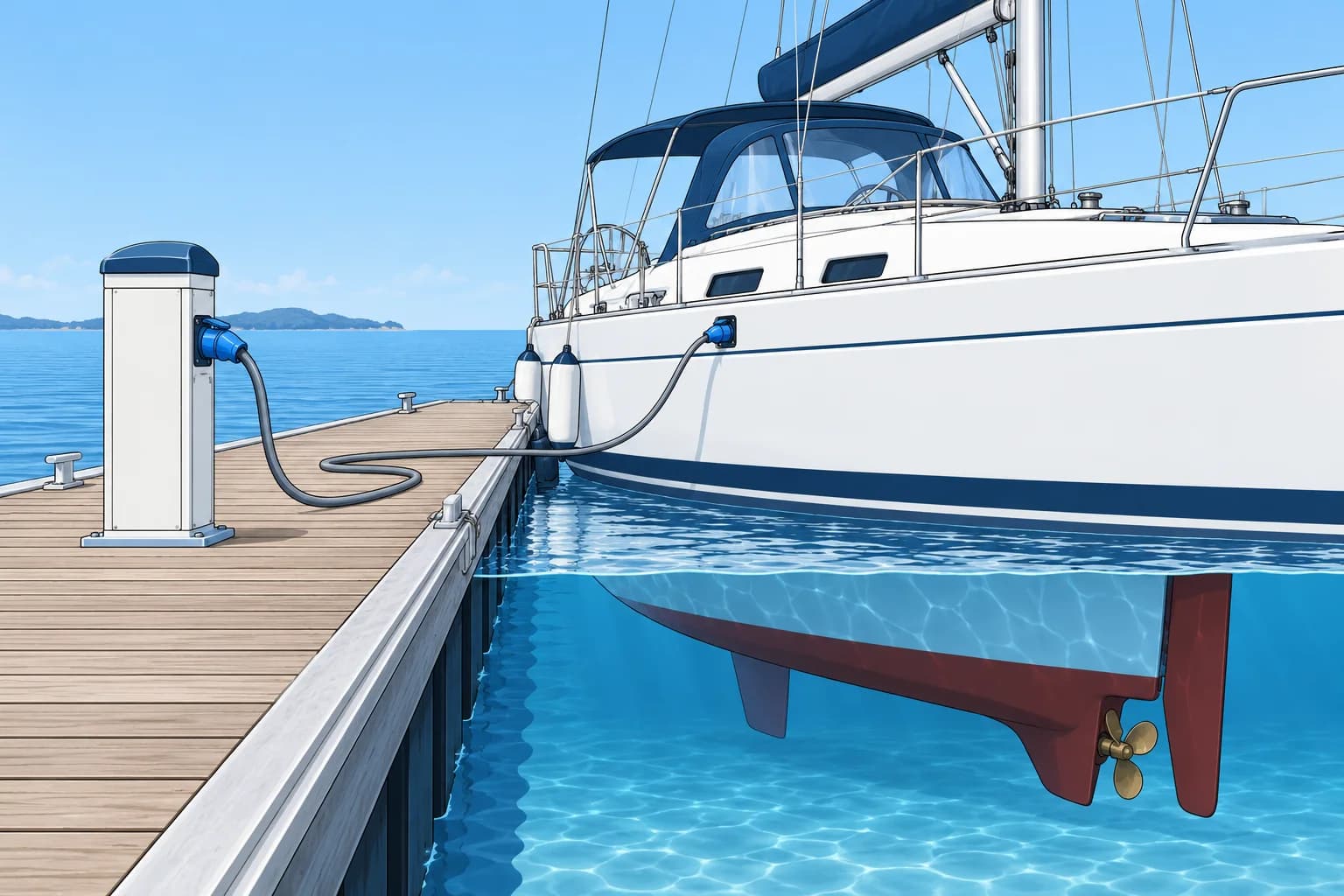
Mains aboard
Shore power is 230 V (or 120 V) AC (alternating current): it can kill. The shore supply point is called a pedestal. Use a proper marine lead and connectors, never a household extension. Keep the lead out of the water and clear of the gap between boat and pontoon. Check plugs for burning or corrosion.
Protection on board
An RCD (residual current device) trips when outgoing and returning currents differ. A US ELCI (equipment leakage circuit interrupter) provides whole-boat leakage protection, typically at 30 mA; it does not replace required personal protection at outlets. A reverse-polarity indicator warns of incorrect wiring. A galvanic isolator blocks small corrosion-causing DC currents in the shore earth connection while passing fault current.
Electric shock drowning
A boat or pontoon fault can leak AC into the water, especially fresh or brackish water. It can paralyse a swimmer and cause drowning: electric shock drowning. Never swim in a marina. If someone is in trouble, keep rescuers out. Call emergency services and alert the marina to isolate electrical supplies. Throw a flotation aid or reach from a safe position. Other boats may still supply current; leave water entry to emergency responders.
Corrosion in one line
Galvanic corrosion occurs between electrically connected dissimilar metals in water; stray-current corrosion results from unwanted electrical current and can destroy fittings rapidly. See Propulsion basics for anodes.
Connecting and disconnecting shore power
- Switch off the boat’s shore-power breaker and the pedestal supply. — Never make or break a live connection.
- Check the lead and plugs for damage, burning or corrosion. — Damaged connectors overheat and can start fires.
- Plug in at the boat first, then at the pedestal. — A dropped boat end is never live if the shore end goes in last.
- Switch on the pedestal. With the boat’s main shore-power breaker still off, check the fitted polarity indicator as instructed. Switch on aboard only if the supply is correct. — A polarity warning means leave the boat breaker off, switch off the pedestal and tell the marina. Do not use the supply.
- Test the fitted RCD/ELCI with its test button as instructed. If it fails to trip, switch off and report it. Reset only after a successful test. — Do not rely on protection that fails its prescribed test.
- To disconnect: switch off both, unplug at the pedestal first, then at the boat. — The loose end you handle is never live.
Remember
- Shore power can kill: marine lead, RCD, polarity check.
- Connect boat end first, then shore; disconnect shore end first.
- A galvanic isolator reduces corrosion caused by small DC currents through the shore earth connection.
- Never swim in a marina: electric shock drowning.
- Rescue: keep out, call emergency services, ask the marina to isolate supplies, throw or reach safely.
Common mistakes
Wrong: Plug the lead into the pedestal first so it is ready, then walk it to the boat.
Right: You would be carrying a live plug. Switch off, plug in at the boat first, then the pedestal.
Wrong: A swimmer is in trouble near a pontoon: jump in at once.
Right: Keep out: current may be in the water. Call emergency services and alert the marina to isolate supplies. Throw a float or reach safely; leave water entry to emergency responders.
Worked case
In a freshwater marina, a child swimming between boats screams and goes limp. A crew member starts to take off his shoes to jump in.
Show the answer
Stop the crew member: suspect electric shock drowning. Keep rescuers out. Call emergency services and alert the marina to isolate power. Throw a lifebuoy or reach from a safe position with a non-conducting aid. Other boats may still supply current. Leave water entry to emergency responders and follow the dispatcher’s instructions.
Practice question
When connecting shore power, which end do you plug in first?
- The pedestal end
- Either cable end
- The boat end
- Both ends at once
Show the answer
Answer: C. With the shore end last, the plug you carry is never live.