
The ship: hull, engines and systems · Level R3 · 11 parts · about 28 min
Types of propulsion, one by one
11 short parts: Shaft drive · Saildrive · Outboard · Sterndrive · Pods and azimuth · Pitch and ducts · Waterjet · Cycloidal · Thrusters · Electric & hybrid · Compare. Each part explains the idea, then gives the points to remember, the common mistakes, a worked case and a practice question; the Academy unit adds all 60 check questions.
1 · Shaft drive
Inboard engine with shaft drive (and V-drive)
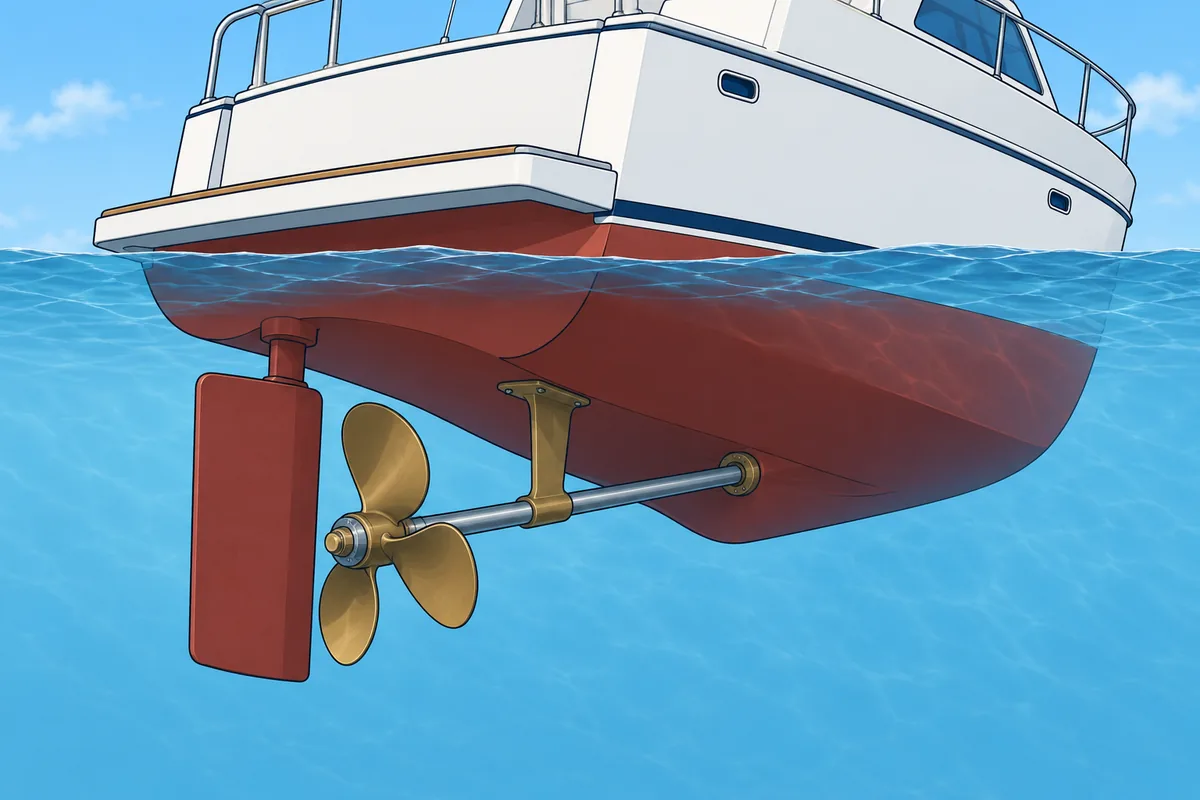
An engine inside the hull turns a shaft and propeller. A separate rudder steers; expect a sideways stern kick when you reverse.
Layout
An inboard engine sits inside the hull. On a typical yacht, a gearbox drives a long shaft through a sealed tube to the propeller below the hull. A separate rudder, the underwater steering blade, sits behind the propeller. The layout is rugged and suits cruising yachts, workboats and ships. Its underwater propeller is exposed to grounding damage.
Steering and walk
Going ahead, propeller wash, the water accelerated by the propeller, flows over the rudder. This helps steering even at low boat speed. Going astern, that wash flows away from the rudder, so steering is weak until you move backwards. Propeller walk is the sideways kick of the stern. A conventional right-handed propeller, clockwise viewed from astern when driving ahead, usually kicks the stern to port (left) astern. See Manoeuvring: forces for handling it.
V-drive
A V-drive puts the engine aft, near the back of the boat, with its output facing forward. A special gearbox turns the drive back towards the propeller. This frees cabin space in the middle. You still steer with a separate rudder, and propeller walk remains.
Direct-drive ships
Many large ships couple a slow-speed diesel directly to a fixed-pitch propeller, whose blade angle cannot change. With no reversing gearbox, the engine must stop and restart in the opposite direction for astern. Compressed air starts it; the available starts are limited. Allow for the delay.
Main check
Know the shaft seal where the shaft passes through the hull: a failed seal can let the sea in. Check for abnormal leakage before departure. Shift a yacht gearbox through neutral at idle; the full drive-line check belongs in Propulsion basics.
Remember
- A shaft drive has an inboard engine, shaft, propeller and separate rudder.
- Propeller wash helps the rudder ahead; initial steering astern is weaker.
- Expect propeller walk astern; confirm its direction on your boat.
- A V-drive puts the engine aft and turns its output back towards the propeller.
- A direct-drive fixed-pitch ship goes astern by stopping and reversing the engine.
Common mistakes
Wrong: The rudder responds equally well ahead and astern.
Right: Astern wash does not flow over it. You need movement through the water for a useful rudder response.
Wrong: A direct-drive ship reverses instantly.
Right: The engine must stop and restart in reverse. Starting air is limited, so repeated changes need care.
Worked case
Your unfamiliar V-drive yacht is stopped in clear water. Before trying a tight berth, what should you establish about its first movement astern?
Show the answer
Test at low power with ample clearance. A V-drive still uses a shaft and separate rudder. Expect sideways walk before useful rudder response develops with backward movement. Confirm the actual kick and response on this boat.
Practice question
What normally steers a conventional inboard shaft-drive yacht?
- A separate rudder behind the propeller
- A turning nozzle enclosing the propeller
- A swivelling leg carrying the propeller
- A movable bucket above the propeller
Show the answer
Answer: A. The propeller stays aligned with the shaft. Its wash flows over a separate rudder when driving ahead.
2 · Saildrive
Saildrive
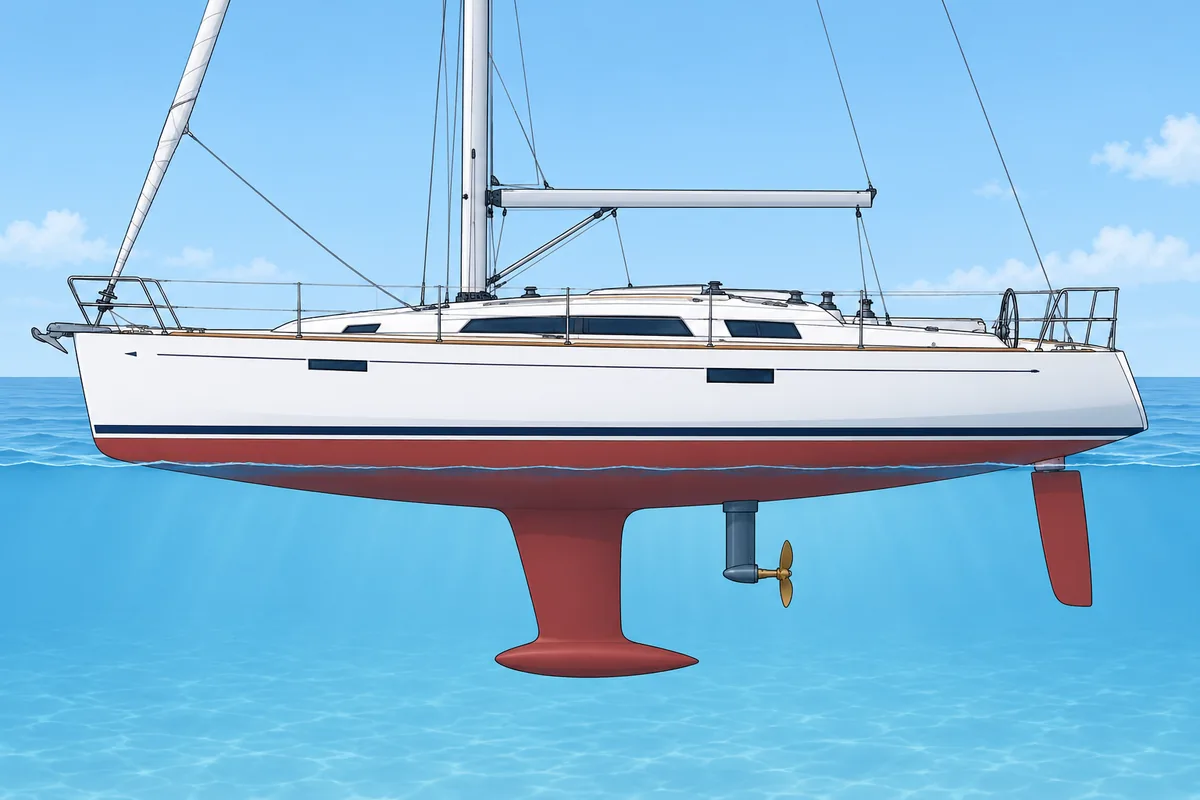
A saildrive has a leg through the hull and a horizontal propeller shaft. Its rubber hull seal and aluminium leg need special care.
Layout
The engine is inside the boat. A short leg, the underwater drive housing, goes down through the hull. Gears turn the drive through 90°, putting the propeller on a horizontal shaft. A separate rudder steers. This compact layout is common on cruising sailing yachts and catamarans.
Handling
The horizontal shaft gives more even blade loading than an inclined shaft. You usually get less propeller walk, the sideways push on the stern, but not none. A saildrive avoids a long shaft needing alignment and often runs smoothly. It still needs water flowing over its rudder to steer; it does not point its thrust like an outboard.
Diaphragm
A rubber diaphragm seals the large opening where the leg passes through the hull. Failure can flood the boat. Inspect it whenever the boat is lifted out, and replace it at the maker’s interval. Some designs have two layers with a water sensor between them. Know what its alarm means.
Aluminium protection
A sacrificial anode is a more reactive metal that corrodes instead of the aluminium leg. Replace it before it is used up, and never paint it. Antifouling is paint that limits weed and barnacle growth. Use a product approved for aluminium drives; ordinary copper antifouling can accelerate corrosion.
Remember
- Vertical leg through the hull; horizontal propeller shaft and separate rudder.
- Expect less propeller walk, rather than no walk.
- The diaphragm keeps the sea out: inspect and renew on schedule.
- Protect the aluminium with a bare, serviceable anode and suitable antifouling.
Common mistakes
Wrong: A saildrive has no sideways kick astern.
Right: It usually has less walk than an inclined shaft. Check your own boat’s response.
Wrong: Any antifouling will protect the aluminium leg.
Right: Use a coating approved for aluminium drives. Copper antifouling can promote corrosion; leave the anode bare.
Worked case
At a haul-out, someone offers to coat your saildrive leg and its anode with ordinary copper antifouling.
Show the answer
Decline. Use antifouling approved for aluminium drives and leave the anode unpainted. Check its remaining metal. Also inspect the diaphragm and confirm its replacement date before launching.
Practice question
Which layout describes a saildrive?
- Vertical leg with a horizontal propeller shaft
- Inclined shaft running from engine to stern tube
- Horizontal tunnel carrying water across the bow
- Steerable leg mounted outside the boat’s transom
Show the answer
Answer: A. Gears in the leg turn the drive through 90°. The propeller shaft is horizontal and a separate rudder steers.
3 · Outboard
Outboard engine
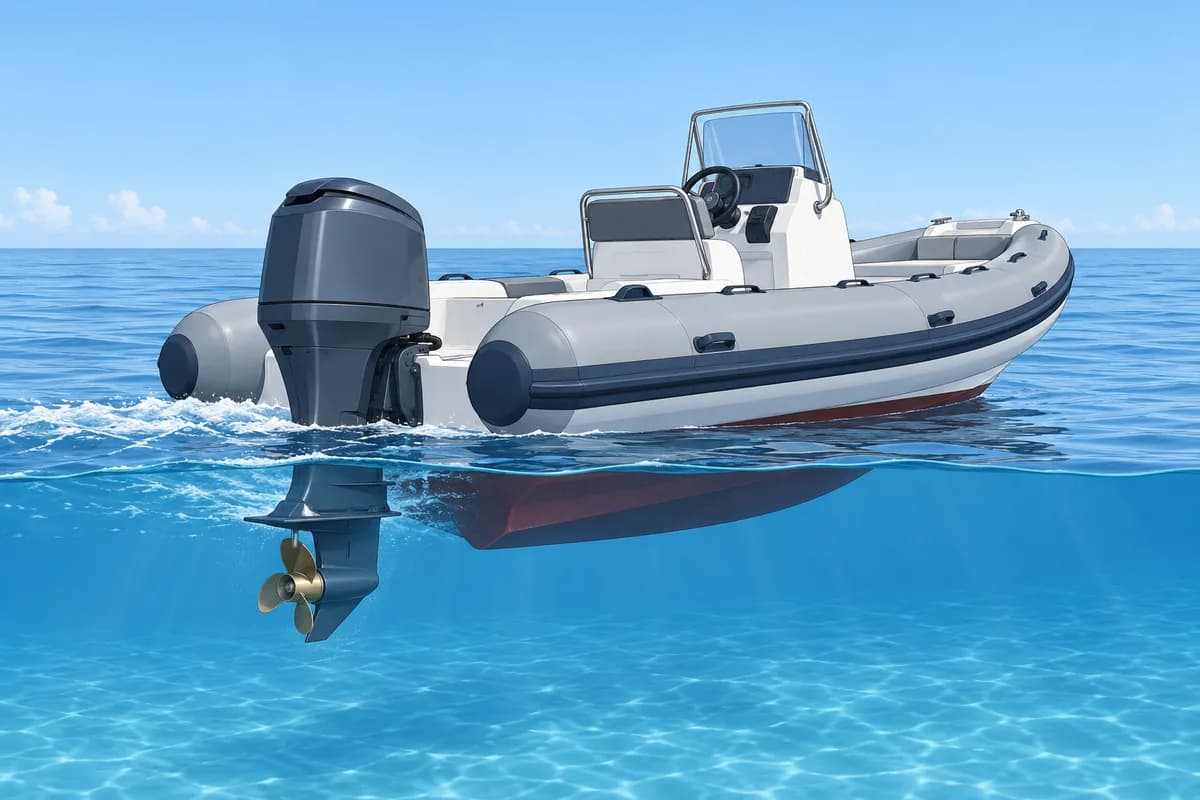
An outboard combines engine, gears and propeller in one unit. You steer by pointing its thrust; protect people from the propeller.
Layout and steering
An outboard mounts outside the stern, the back of the boat. The engine sits above a vertical driveshaft and lower gears that turn the propeller. Turning the unit points its thrust, the push it produces. There is no separate rudder. It suits tenders, rigid inflatable boats (RIBs) and fast motor boats. It is accessible for servicing, but its exposed leg can strike the bottom.
Trim
Trim adjusts the leg’s running angle. Trim in, towards the transom (the stern’s flat end), brings the bow down and helps the hull rise onto the plane, skimming over the water. Trim out raises the bow and may improve speed in flat water. Too much can draw air to the propeller: ventilation, which reduces its grip. Adjust gradually for the boat and conditions.
Tilt
Tilt raises the leg for shallow water or storage. Fully tilt it only with the engine stopped. Any permitted shallow-water running must follow the maker’s limits and keep the cooling-water intake submerged. Otherwise the engine can overheat. In neutral, with no thrust, steering is very weak; anticipate that when slowing down.
Kill cord and cooling
Clip the kill cord, the engine-stop lanyard, to yourself while driving. Leaving the helm pulls it out and stops the engine; the boat still coasts. After starting, check the tell-tale, the small cooling-water jet. If it stops, stop the engine and check by the maker’s method: the outlet may be blocked or cooling flow may have failed.
People in the water
A turning propeller can cause severe injury. Stop the engine and prevent restart before anyone is close enough to reach it. Neutral alone is not a safe isolation method. Keep swimmers away from the propeller; recovery manoeuvres belong in Emergencies.
Remember
- An outboard steers by pointing thrust; neutral gives little steering.
- Trim adjusts the running angle; tilt lifts the leg.
- Keep the cooling intake submerged whenever the engine runs.
- Wear the kill cord and check the tell-tale after starting.
- Stop and secure the engine before a person can reach the propeller.
Common mistakes
Wrong: The kill cord can stay clipped to the console.
Right: It must be attached to you so leaving the helm stops the engine.
Wrong: Neutral makes the propeller safe for swimmers.
Right: Stop the engine and prevent restart. Neutral does not provide secure isolation.
Wrong: No tell-tale is harmless if the engine still sounds normal.
Right: Stop and check it. You may have lost cooling water; do not wait for overheating.
Worked case
You tilt the outboard for shallow water. Its cooling intake is now above the surface. Can you idle forward?
Show the answer
No. Stop the engine. Lower the leg enough to submerge the intake before any permitted running, following the maker’s limits. Check the tell-tale after restarting. A tilted engine still needs cooling water.
Practice question
How does an outboard steer the boat?
- By varying blade pitch while the leg stays fixed
- By moving a separate rudder behind a fixed shaft
- By turning the unit to direct propeller thrust
- By sending water through a tunnel across the bow
Show the answer
Answer: C. The unit turns with the helm, directing the propeller’s thrust. With no thrust, steering is weak.
4 · Sterndrive
Sterndrive (inboard-outboard)
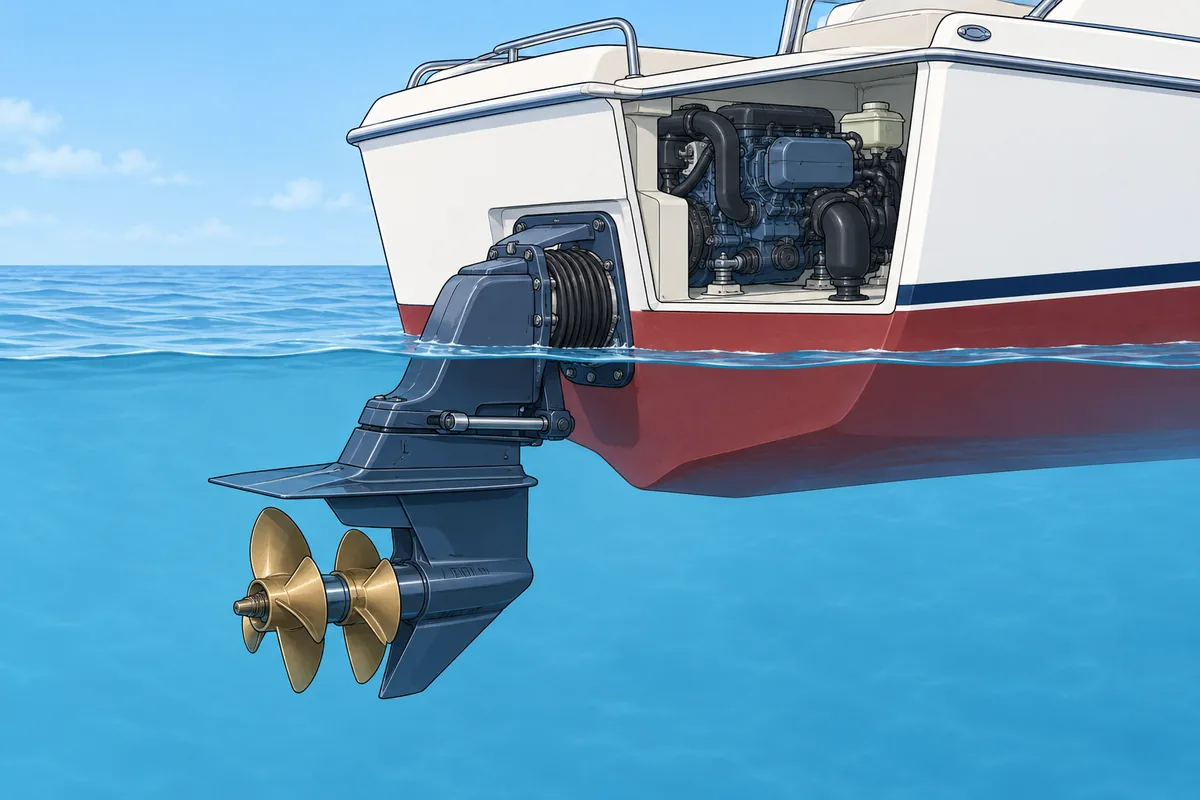
A sterndrive combines an engine inside the hull with a steerable leg outside. Check its bellows and ventilate petrol engine spaces.
Layout
A sterndrive, also called an inboard-outboard, has an engine inside the boat near the transom, the flat stern end. It drives a leg outside the transom. The leg turns to steer and can adjust its running angle (trim) or lift (tilt). This compact layout is common on motor boats about 5 to 12 metres long.
Steering and duoprop
The leg points the propeller thrust, so at low speed steering is strong under power and much weaker in neutral. With appreciable way, the immersed leg and skeg can still steer without thrust. A duoprop has two propellers on one leg turning in opposite directions: counter-rotating. Their sideways forces largely cancel, giving very little propeller walk and good grip. A single-propeller leg may still give a sideways kick.
Bellows
Flexible rubber bellows protect and seal connections through the transom, including the drive joint and shift cable on many designs. Failure of a watertight bellows can admit water into the boat or damage the drive. Inspect for cracking at each lift-out and renew at the maker’s interval. Bellows arrangements vary; an exhaust bellows is not the same flooding barrier on every model.
Petrol safety
Petrol vapour is heavier than air and can collect in the bilge, the lowest space inside the hull. Before starting a petrol inboard, run the bilge blower, a ventilation fan, for the maker’s specified time, often several minutes. Check for petrol vapour. Do not start if you smell petrol. Find and fix the cause first.
Benefits and limits
You get an inboard engine with outboard-like steering and trim. The exposed leg and its seals need care. Lift it fully only with the engine stopped, and keep the cooling intake submerged during permitted running. Follow the maker’s limits rather than treating tilt as permission to run anywhere.
Remember
- Engine inside; steerable leg outside the transom.
- A duoprop uses counter-rotation to largely cancel propeller walk.
- Watertight bellows can be flooding points: inspect and renew on schedule.
- Petrol inboard: blower before start; never start with a petrol smell.
Common mistakes
Wrong: Duoprop means one propeller drives ahead and the other astern.
Right: Both produce thrust together. They rotate oppositely so their sideways forces largely cancel.
Wrong: All bellows are just protective covers.
Right: Some seal openings below the waterline. Their failure can flood the boat; check your drive’s arrangement.
Worked case
You have run the blower before starting a petrol sterndrive, but you still smell petrol near the engine space.
Show the answer
Do not start. Running the blower does not make a continuing fuel leak safe. Keep ignition sources away and have the cause found and corrected before using the engine.
Practice question
Which layout is a sterndrive?
- Internal pump with a steerable jet at the stern
- Inboard engine with a fixed shaft and rudder
- External engine with a fixed shaft under the hull
- Inboard engine with a steerable external leg
Show the answer
Answer: D. The engine stays inside; the external drive leg steers like the lower part of an outboard.
5 · Pods and azimuth
Pod drives and azimuth thrusters
Pods and azimuth thrusters point their thrust to steer. Know their turning limits and how to control the boat after a fault.
Yacht pods
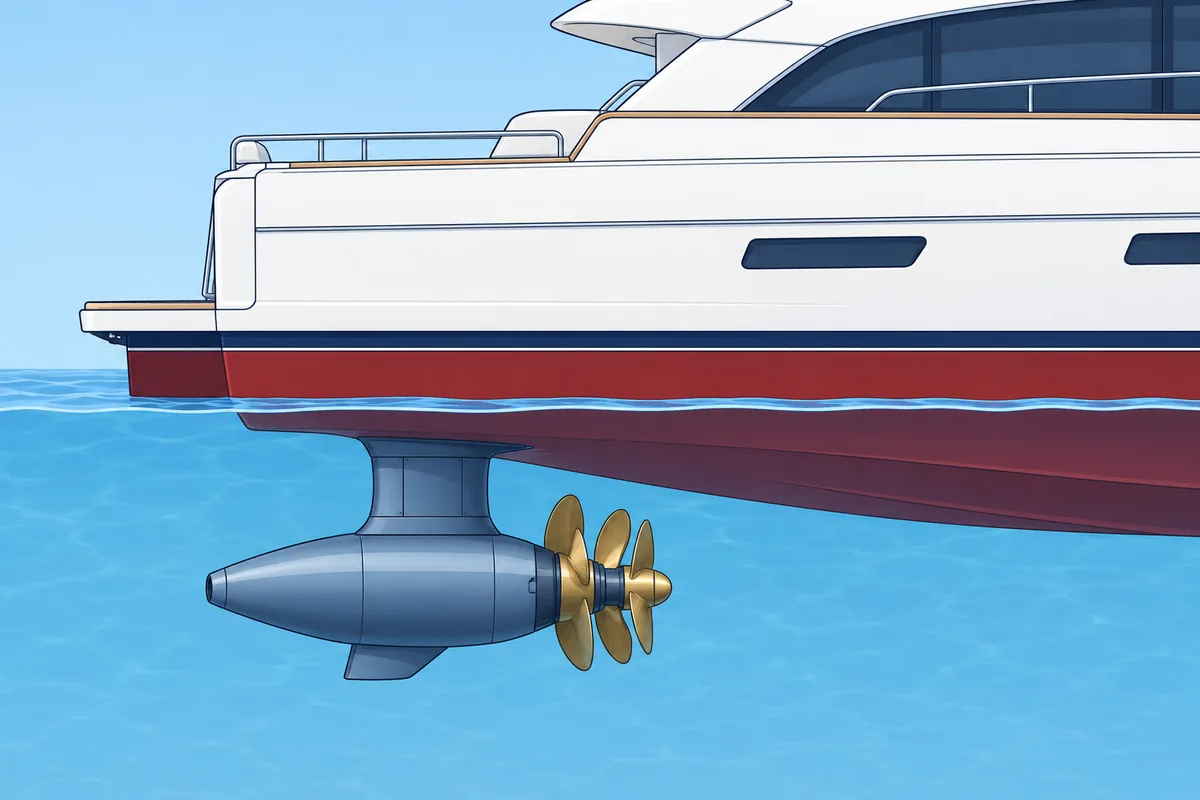
Many motor yachts have twin pods below the hull, driven by engines inside. Some use forward-facing, counter-rotating propellers that pull the boat. Each pod swivels through a limited angle. A joystick combines their angles and thrust to move sideways or turn nearly on the spot. This makes close handling easier, but the underwater units are exposed to grounding damage.
Electric ship pods
Large ship pods contain an electric motor directly on the propeller shaft. Generators in the hull supply electricity. Many can turn through 360°, giving thrust in any direction without a separate rudder. Cruise ships, icebreakers and ferries use them. Do not assume a yacht pod has the same turning range.
Azimuth thrusters
An azimuth thruster turns its underwater propeller unit to point the thrust. A mechanical Z-drive transmits power from a motor inside the hull through shafts and gears; electric variants also exist. An azimuth stern drive (ASD) tug has units aft. A tractor tug has its propulsion units forward. Tractor tugs may use azimuth or cycloidal drives.
Turning limits
Pods take time to rotate. Large units may need several seconds to reach an ordered angle. Follow the maker’s limits on angle, speed and power: a large sideways thrust at speed can make the ship heel, or lean. Anticipate the delay instead of making repeated large corrections.
Faults and backup
A failed pod may stay at its last angle; do not assume it centres or stops thrusting. Learn the backup wheel-and-lever controls or alternative control station before departure. A control backup cannot cure every mechanical fault. Follow the maker’s fault procedure; stop an uncontrollable unit as instructed. One working unit gives reduced capability, not normal handling.
Remember
- Pods steer by pointing thrust; twin yacht pods can combine forces for sideways moves.
- Yacht pods usually have limited angles; many ship pods turn 360°.
- ASD tug units are aft; tractor-tug units are forward.
- Pods rotate at a limited rate; respect angle and power limits.
- A faulty unit may hold its last angle: know the backup controls.
Common mistakes
Wrong: Every pod turns instantly through 360°.
Right: Yacht pods often have limited angles. Large ship pods rotate at a limited rate.
Wrong: A failed pod automatically centres itself.
Right: It may hold its last angle. Know the fault procedure and how to stop an uncontrollable unit.
Worked case
A yacht’s joystick reports a fault near a marina entrance. One pod is still angled.
Show the answer
Stay in clear water and reduce the demand for thrust. Follow the maker’s fault procedure and use the backup controls if available. Do not assume the angled pod has centred. Delay a tight approach until you have confirmed what control remains.
Practice question
How can twin yacht pods move a boat sideways?
- By combining separately directed thrust from each pod
- By keeping both pods straight and using equal astern power
- By locking both pods straight and using equal ahead power
- By centring both pods and putting only one engine ahead
Show the answer
Answer: A. The control system combines angles and thrust. Yacht pods do not need full 360° rotation to achieve this.
6 · Pitch and ducts
Controllable-pitch and ducted propellers
A controllable-pitch propeller changes blade angle for ahead or astern. A Kort nozzle adds low-speed pull around a propeller.
Fixed and controllable pitch
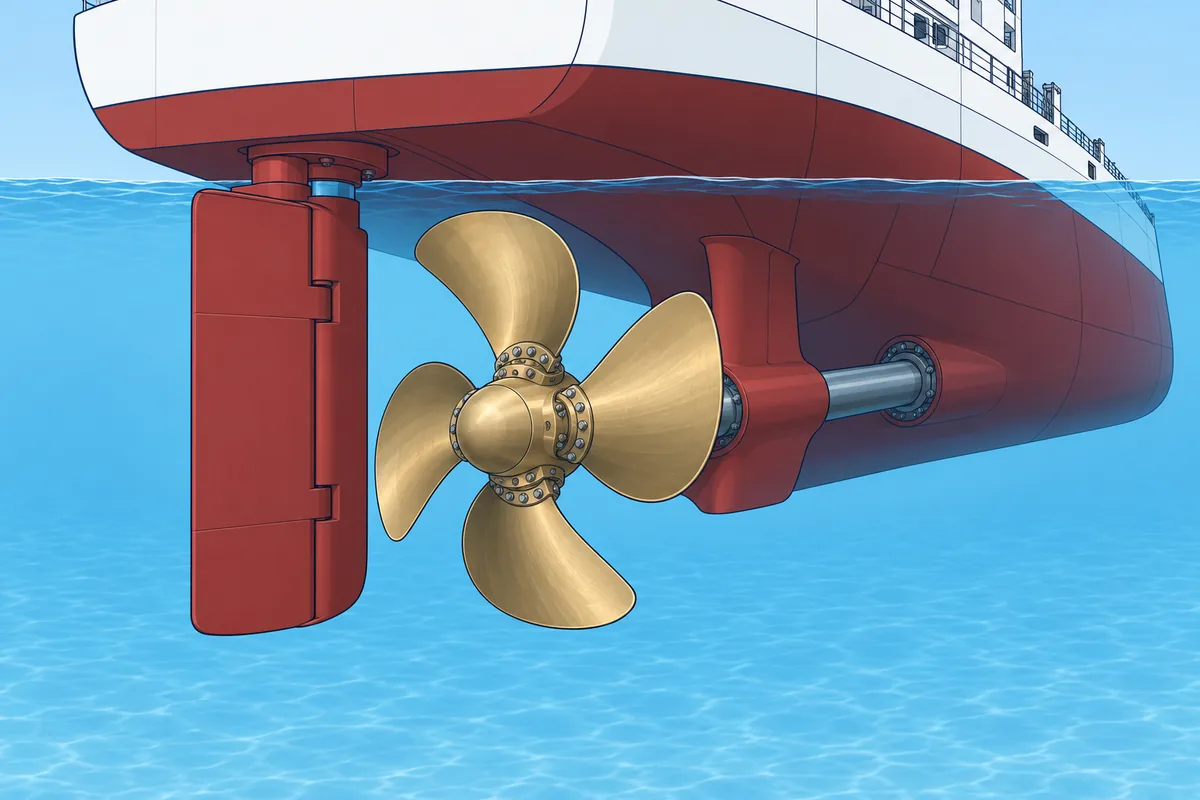
Pitch describes a blade’s theoretical advance in one revolution; it is linked to blade angle. A fixed-pitch propeller (FPP) cannot change that angle. Change shaft speed for thrust and reverse shaft rotation for astern. A controllable-pitch propeller (CPP) twists its blades in the hub, usually using hydraulic oil pressure. Ahead, zero and astern pitch are available without reversing shaft rotation, often at constant shaft speed.
Zero is not stopped
Zero pitch gives little net thrust but leaves the propeller turning. Do not select zero pitch to slow down while you need the rudder: it breaks the rudder flow. Keep people and lines clear. Before work near the propeller, stop the shaft and secure controls against restart; zero pitch is not isolation.
Handling and limits
CPP is less effective astern. CPPs are usually left-turning, so astern their lateral force takes the stern to port, like a conventional right-handed FPP. A right-turning CPP astern would take the stern to starboard. With a fixed shaft, a separate rudder steers. Hydraulic failure may leave the last pitch or a preset pitch; know the installation.
Kort nozzle
A duct, often called a Kort nozzle, is a shaped ring around a propeller. It adds thrust when working hard at low speed. Tugs use it for bollard pull, the pulling force measured while secured to a fixed bollard. At high speed the ring adds drag. A fixed nozzle does not steer; a steering nozzle turns the ring to direct thrust and can replace a rudder.
Remember
- FPP reverses shaft rotation; CPP changes blade angle for astern.
- Zero pitch does not stop rotation and may still allow slow movement.
- CPP is weaker astern; usual left-turning CPP walks stern to port, right-turning to starboard.
- A Kort nozzle improves heavily loaded low-speed thrust but adds high-speed drag.
- A steering nozzle turns to direct thrust; a fixed nozzle does not.
Common mistakes
Wrong: Zero pitch makes the stern safe for a diver.
Right: The propeller still turns. Stop the shaft and lock out propulsion under the vessel’s procedure.
Wrong: A Kort nozzle improves efficiency at every speed.
Right: It helps at high load and low speed. Its drag becomes a disadvantage at high speed.
Worked case
Your CPP vessel is alongside at zero pitch. Someone wants to inspect a line near the propeller.
Show the answer
Keep them clear. Zero pitch can leave the propeller rotating and may allow slow movement. Stop the shaft and secure the controls against restart before anyone goes near it, following the vessel’s isolation procedure.
Practice question
How does a CPP normally change from ahead to astern thrust?
- Lower a bucket over the propeller while the shaft stops
- Reverse shaft rotation while blade angle stays the same
- Change blade angle while shaft rotation stays the same
- Turn the whole shaft sideways while blade angle stays fixed
Show the answer
Answer: C. The blades rotate in the hub to negative, or astern, pitch. Shaft reversal is unnecessary.
7 · Waterjet
Waterjets and surface drives
A waterjet pumps water through a steerable nozzle. A bucket redirects it for astern; little jet flow means little steering.
Flow path
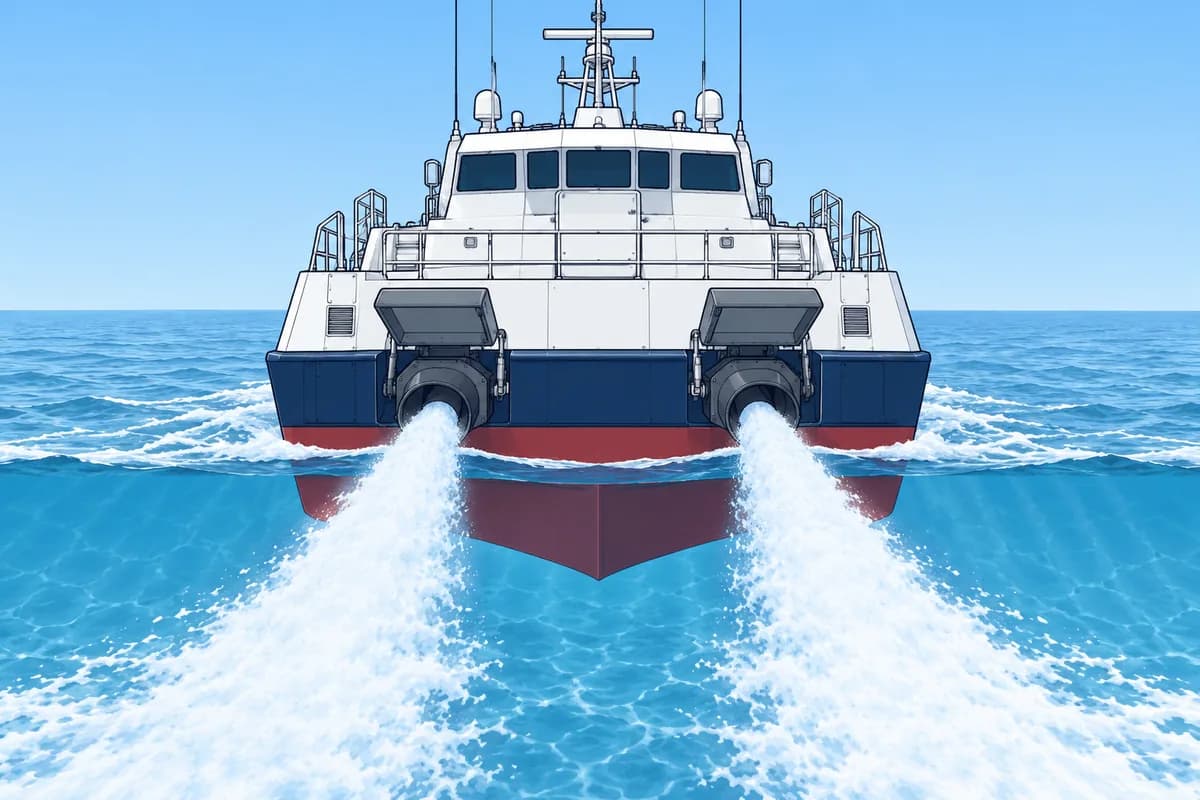
Water enters an intake beneath the hull. An impeller, a rotating pump, accelerates it through a nozzle at the stern. The nozzle points the jet to steer. A reversing bucket lowers into the jet and deflects water forward to produce astern thrust. The impeller need not reverse. An intermediate bucket position can balance ahead and astern forces, but water is still moving.
Where it fits
Waterjets suit fast ferries, patrol boats, rescue craft and personal watercraft. They can be efficient at high speed, often from about 25 knots. There is no exposed propeller, and draught can be shallow. At low speed a conventional propeller is often more efficient. The intake and jet still endanger people: stop propulsion near them.
Steering
Little jet flow means little steering. Reducing pump speed weakens steering; closing the throttle on some personal watercraft can remove it. A neutral bucket setting can balance ahead and astern forces while jet flow and steering remain available. Learn your craft’s controls and any steering assistance. Bucket position changes the thrust pattern; practise low-speed and astern responses in open water.
Blocked intake
Weed, plastic, rope or bottom debris can restrict the intake and reduce both thrust and steering. Engine speed may rise while boat speed falls. Follow the maker’s clearing procedure. A reversing bucket redirects the outlet jet; it does not itself reverse flow through the intake. Stop the engine and prevent restart before opening an inspection hatch or reaching near the impeller.
Surface drives
A surface drive is different: it uses a surface-piercing propeller, commonly on a shaft leaving the transom. At speed, roughly half the propeller is above water, reducing underwater drag. Some very fast boats use it. Low-speed and astern handling are generally weaker. Steerable versions swivel the shaft; fixed-shaft versions use rudders.
Remember
- Waterjet: intake, impeller, nozzle and reversing bucket.
- The bucket redirects the outlet jet for astern; it does not reverse the pump.
- Little jet flow means little steering; bucket neutral can retain steering.
- An intake blockage reduces thrust; isolate propulsion before reaching inside.
- Surface drives use partly immersed propellers for very high speed.
Common mistakes
Wrong: A waterjet has no exposed propeller, so it cannot injure a swimmer.
Right: The intake and high-speed jet remain dangerous. Stop propulsion near people.
Wrong: Lowering the reversing bucket always flushes debris backwards through the intake.
Right: The bucket redirects the outlet jet. Use only the maker’s documented clearing method.
Worked case
In floating weed, your jet boat slows while engine speed rises. Steering also becomes weak.
Show the answer
Suspect an intake blockage. Move clear of danger if you can and follow the maker’s clearing procedure. Do not assume lowering the bucket reverse-flushes the intake. Stop and secure the engine before opening access or reaching near the impeller.
Practice question
Which sequence describes the waterjet flow path?
- Intake, steering nozzle, then enclosed outlet impeller
- Intake, reversing bucket, then fixed outlet nozzle
- Intake, impeller, then steerable outlet nozzle
- Impeller, reversing bucket, then underwater intake
Show the answer
Answer: C. The intake supplies the impeller, which accelerates water through the steerable nozzle.
8 · Cycloidal
Cycloidal (Voith Schneider) propellers
A cycloidal propeller uses vertical blades on a rotating disc. Changing blade angles gives precise thrust in any direction.
Layout
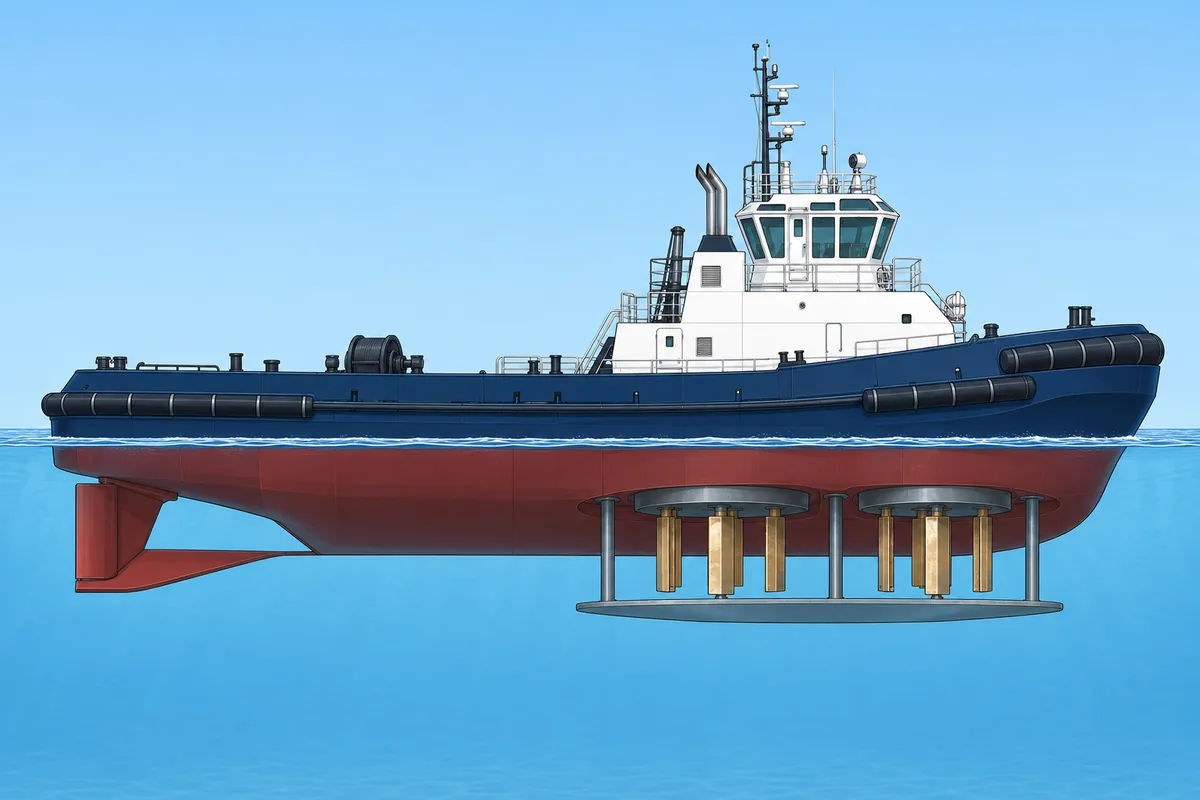
A rotor, a flat rotating disc under the hull, carries vertical blades around its edge. As it turns, a mechanism continually changes each blade’s angle. The pattern of angles sets the direction and strength of the combined thrust. This is the principle of a cycloidal, or Voith Schneider, propeller.
Steering
The rotor can keep turning the same way while blade-angle control changes thrust from ahead to astern or sideways. There is no separate rudder and no need to swivel the whole unit. The quick, precise response helps a tug hold position or change its pull without first turning the hull.
Where it fits
Cycloidal drives suit some tractor tugs, whose propulsion units are forward, and double-ended ferries, which can work in either direction without turning round. They also serve vessels needing precise low-speed control. They are generally less attractive for long, fast passages than conventional propellers.
Trade-offs and care
The blade-control mechanism is complex and costly. The units need room and depth below the hull, and their exposed blades risk impact damage. Some have a guard plate beneath the blades, but that does not make grounding harmless. Follow the maker’s inspection schedule for blades and pitch-control linkages.
Remember
- Vertical blades hang from a rotor under the hull.
- Blade angles set thrust direction and strength while the rotor keeps turning.
- No separate rudder or whole-unit rotation is needed to change thrust direction.
- Useful for tractor tugs and double-ended ferries.
- Precise control comes with complexity, cost and underwater clearance needs.
Common mistakes
Wrong: The rotor must reverse to produce astern thrust.
Right: The rotor can keep turning the same way. Changing the blade-angle pattern reverses the thrust.
Wrong: A guard plate means the blades are safe from any grounding.
Right: It offers some protection, not immunity. Maintain clearance and inspect after an impact.
Worked case
At a shallow ferry landing, a colleague says the guard plate makes checking clearance beneath the cycloidal blades unnecessary. Do you proceed?
Show the answer
Do not rely on the guard plate. Confirm adequate clearance for the blades and plate under the vessel’s operating limits before committing. Precise thrust control does not remove grounding risk. If you cannot establish safe clearance, change the plan.
Practice question
Which layout identifies a cycloidal propeller?
- Two counter-rotating propellers behind a drive leg
- Horizontal blades fixed around a shaft-mounted hub
- Vertical blades hanging from a rotating disc
- An enclosed impeller feeding a steerable stern nozzle
Show the answer
Answer: C. The rotor lies under the hull, with vertical blades around its edge.
9 · Thrusters
Bow and stern thrusters
Tunnel thrusters push the bow or stern sideways at low speed. Respect their running limits and keep a plan that does not rely on them.
Layout
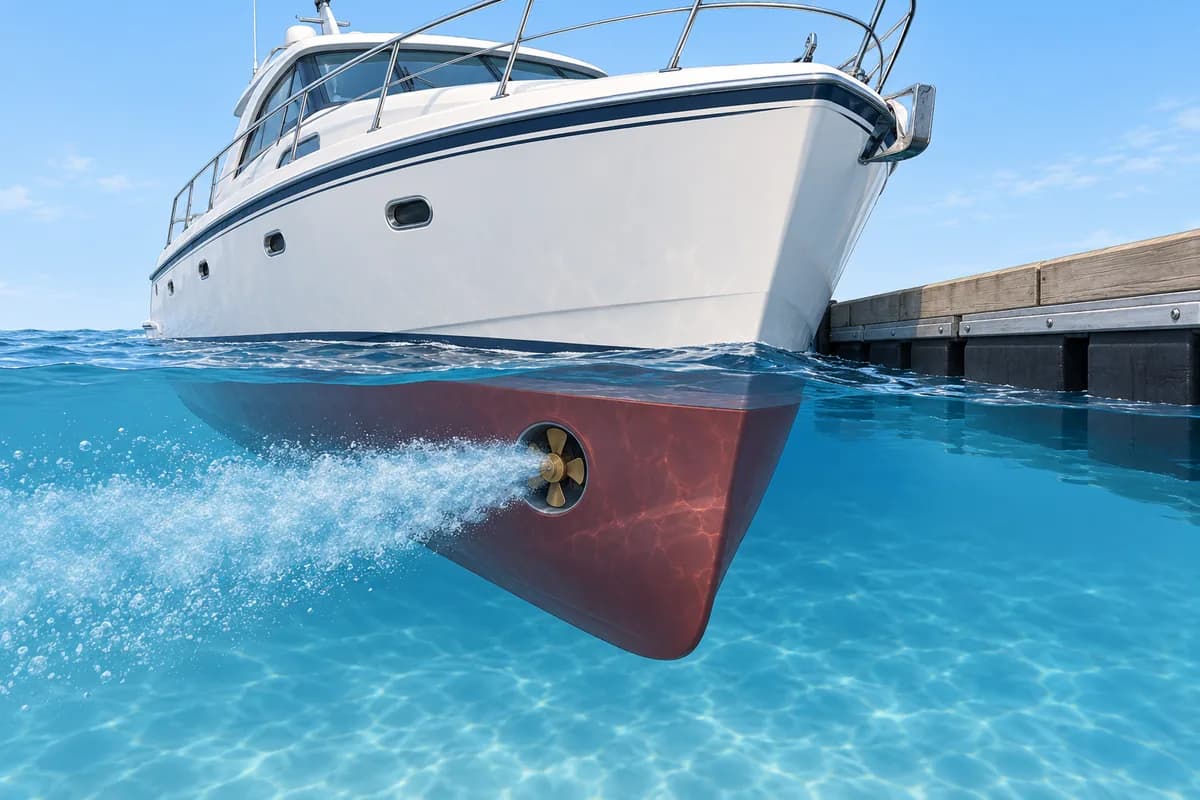
A bow thruster has a propeller in a tunnel across the hull near the bow, the front of the boat. Pushing water out one side moves the bow the other way. A stern thruster does the same at the back. These are auxiliary controls for close handling, not the boat’s main propulsion. Small units are often battery-electric; larger ones may be electric or hydraulic.
Low-speed tool
A bow tunnel thruster can lose about 50 % of its lateral thrust at only 2 knots ahead (Marí Sagarra). Flow past the tunnel weakens it; actual performance varies by installation. It works best nearly stopped. Use the main drive and steering at passage speed. Shallow immersion or strong wind can also reduce its useful effect.
Duty cycle
Duty cycle is the permitted running time and cooling time. Small electric thrusters draw high current and may be rated for only a few minutes of running. A thermal cut-out switches off an overheated motor. Use short bursts within the maker’s limits and allow cooling; repeated bursts can still exceed the total limit.
Berthing plan
A thruster makes small corrections easier, but it can overheat, lose battery power or be overpowered by wind. Plan your berth with the main drive, available lines and room to stop or abort. If you cannot complete the approach safely without the thruster, change the plan or arrange help before committing.
Remember
- Tunnel thrusters move the bow or stern sideways.
- They work best nearly stopped, not at cruising speed.
- Duty cycle includes running and cooling time; short bursts still count.
- A thermal cut-out can remove thrust until the unit cools.
- Plan to berth safely without relying on the thruster.
Common mistakes
Wrong: A bow thruster is a steering aid at cruising speed.
Right: Flow past the tunnel reduces its effect. Use the main steering system at speed.
Wrong: Short bursts mean the thruster can run indefinitely.
Right: The total running time still heats the motor. Follow the stated running and cooling limits.
Worked case
You need continuous bow-thruster power to hold an approach against the wind. The small electric unit is already hot.
Show the answer
Do not commit to a berth that depends on one more push. Abort while there is room. Let the unit cool and choose a plan using the main drive, lines or assistance, within your boat’s capability.
Practice question
What does a bow tunnel thruster primarily do?
- Pushes the whole boat ahead at passage speed
- Turns a separate rudder through the steering cable
- Changes the pitch of the main shaft propeller
- Pushes the bow sideways for close handling
Show the answer
Answer: D. The tunnel runs across the hull. Water pushed one way moves the bow the other way.
10 · Electric & hybrid
Electric, hybrid and diesel-electric propulsion
Electric propulsion is quiet and responsive, but battery range is limited. Diesel-electric ships also depend on their electrical network.
Electric motors
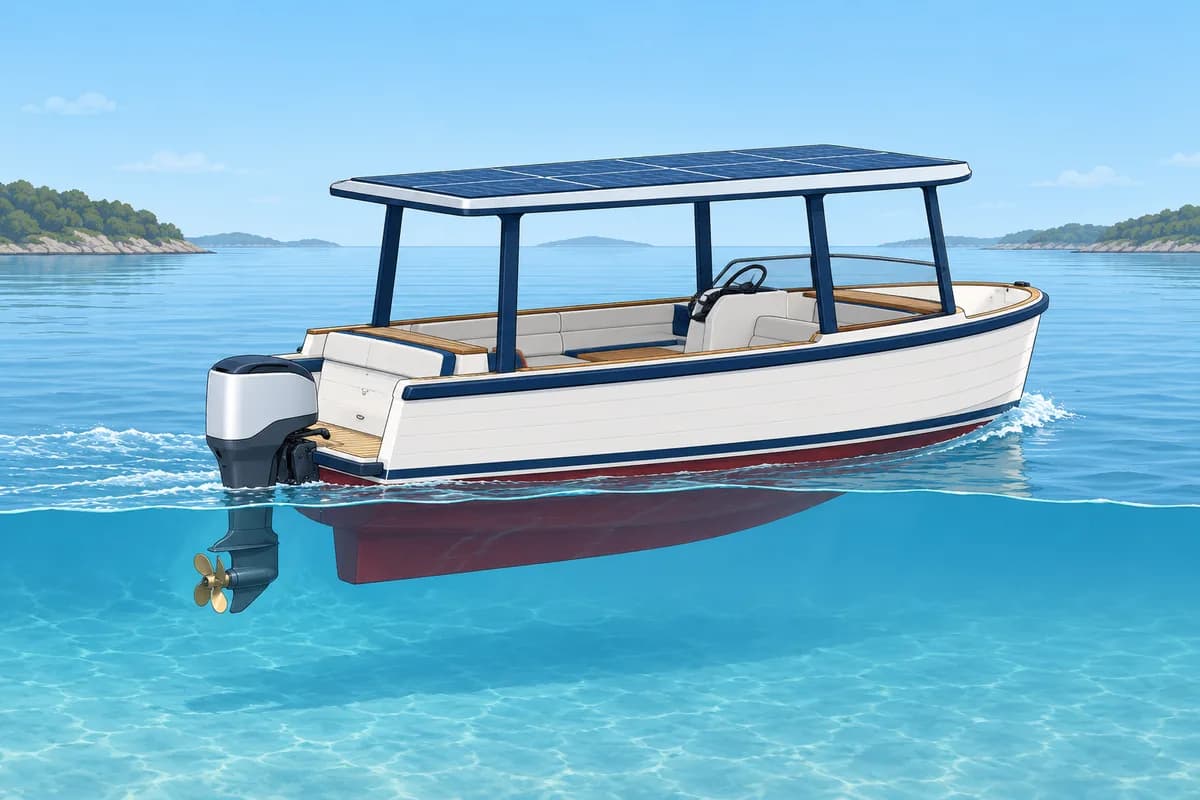
An electric motor can give high torque, the turning force on its shaft, from a standstill. This gives responsive low-speed drive. It is quiet and needs relatively little motor maintenance. The motor may drive a shaft, outboard or pod; that layout decides how you steer. Quiet operation means other people may not hear you coming.
Range
Range is the distance you can travel with the available energy. Batteries usually store much less usable energy than a fuel tank. Range falls sharply as speed and power demand rise. Use the maker’s data for the boat, conditions and battery state, and retain a reserve. Know the battery isolator and approved charging arrangements.
Hybrids and regeneration
A hybrid combines a fuel engine, electric drive and batteries. It can use battery power for quiet harbour running and the engine for longer passages. Some sailing installations permit regeneration: water turns the propeller under sail to drive the motor as a generator and recharge the battery. It adds drag and is allowed only on a compatible installation.
Diesel-electric ships
Diesels drive generators, which supply electric propulsion motors through the ship’s electrical network. The diesels do not directly turn the propeller shafts. Several generator sets let the crew match supply to demand. Redundancy means spare capacity or alternative equipment: after one set fails, healthy sets may keep the ship moving if enough capacity remains.
Blackout
A blackout is a loss of electrical supply. It can stop propulsion and disable powered steering or controls, depending on the system. Several generators do not prevent every common electrical fault. Crews practise recovery and test standby supplies. An emergency generator normally supplies essential services; do not assume it can run the main propulsion motors. Learn the recovery arrangements for your vessel.
Remember
- Electric motors give high torque at low speed and run quietly.
- Battery range falls as speed rises; use real data and keep a reserve.
- Hybrids combine engine and electric drive; compatible systems can regenerate under sail.
- Diesel-electric means generators supply propulsion motors.
- Redundancy helps with individual faults; a blackout can still stop propulsion.
Common mistakes
Wrong: An electric boat has the same range at every speed.
Right: Higher speed needs much more power. Check the range data at your planned speed.
Wrong: Several generators guarantee continuous propulsion.
Right: Spare sets help with individual failures. A shared-network fault can still cause a blackout.
Wrong: The emergency generator automatically restores full propulsion.
Right: It usually supplies essential services. Main propulsion recovery depends on the ship’s design.
Worked case
One generator trips. The healthy sets can support reduced propulsion, but not your present propulsion demand plus other loads. Can you keep the same demand because the ship has redundancy?
Show the answer
No. Reduce demand within the remaining capacity under the ship’s procedure. Redundancy provides alternatives within their limits, not unlimited replacement power. A common-network fault could still stop propulsion; emergency power is not a promise of main propulsion.
Practice question
What does high starting torque give an electric drive?
- The same turning force regardless of the motor’s current
- Strong shaft-turning force from a standstill or low speed
- Full rudder response while the boat is stopped in neutral
- Greater passage range without needing more battery energy
Show the answer
Answer: B. Torque is turning force on the shaft. Electric motors can provide high torque from a standstill.
11 · Compare
Comparing the systems
Start with how the boat steers, then its sideways kick and operating limits. Learn your own installation before you leave the berth.
Steering families
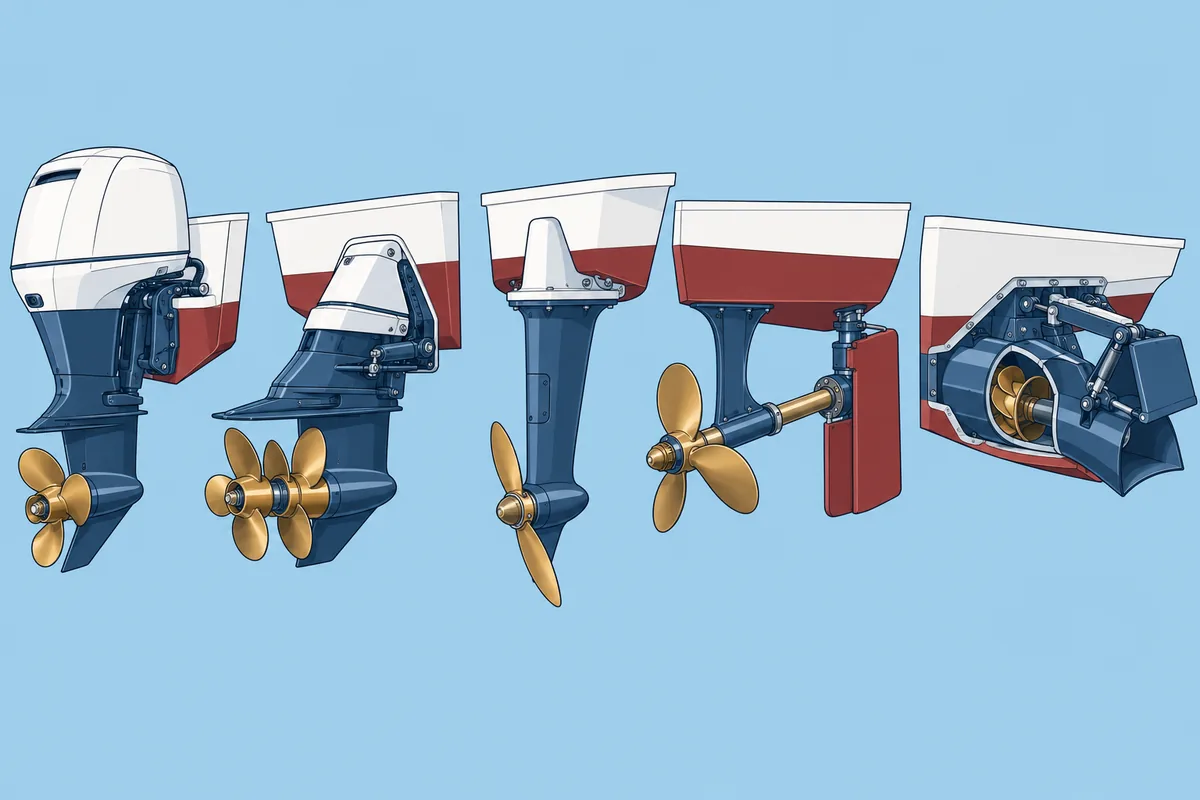
Conventional shaft drives and saildrives use a separate rudder, which needs flow from boat movement or propeller wash. Outboards, sterndrives and steerable pods point propeller thrust. Cycloidal drives direct thrust by blade angle. Waterjets steer by directing pump flow. A moving rudder boat may steer in neutral. A waterjet can also steer at a balanced neutral bucket setting if pump flow continues; this differs from stopping the pump.
Propeller walk
Propeller walk is the sideways kick from the propeller. It is usually strongest astern on a single inclined shaft. A saildrive generally has less. Outboards can also have side force, but pointing thrust dominates their handling. Counter-rotating pairs, turning in opposite directions, largely cancel walk. Waterjets have no propeller walk, but bucket and nozzle settings can create sideways forces. Do not treat every pod as a counter-rotating pair.
Match the boat
Shaft drives suit robust cruising and long-range work. Saildrives suit many cruising sailing yachts. Outboards suit tenders, rigid inflatable boats and small fast craft. Sterndrives and yacht pods suit motor cruisers. Waterjets suit fast ferries and rescue craft; shallow draught, the depth needed below the waterline, is an advantage, but intakes need clearance from debris.
Specialist choices
Azimuth and cycloidal drives suit tugs and ferries needing precise low-speed control. CPP and ducted propellers suit varied loads or strong low-speed pull. Battery-electric drive suits short trips with suitable charging and reserves; diesel-electric suits ships needing flexible power distribution. The best choice depends on the work, not one claim of maximum efficiency.
Day one
Find out the drive layout, steering method and actual astern walk. Ask about thruster duty limits, pod backup controls and any delay in reversing. Locate underwater seals, intakes and anodes. Learn the engine stop, fuel shut-off or battery isolator. Check the maker’s limits and practise at low power in clear water before attempting a tight berth.
Remember
- Rudders need water flow; waterjets need pump flow, which can continue at a neutral bucket setting.
- Walk varies by installation: single inclined shafts usually have the strongest astern kick.
- Choose a drive for the boat’s work, depth, range and maintenance needs.
- On day one, learn the controls, limits, backup and stop, then practise in clear water.
Common mistakes
Wrong: All boats respond to the wheel the same way in neutral.
Right: A moving rudder boat may steer in neutral. A jet can retain steering at bucket neutral while its pump supplies sufficient flow.
Wrong: A familiar joystick means there is nothing new to learn.
Right: Check the drive’s limits and backup controls. A different installation can behave very differently.
Worked case
You charter a pod-drive motor cruiser after years on a single-shaft yacht. What should you establish before leaving?
Show the answer
Learn the joystick and backup controls, pod-angle limits and fault response. Check the stop controls and underwater drive risks. Practise low-power moves in clear water; do not assume the shaft yacht’s astern walk or rudder response applies.
Practice question
Which pair normally uses a separate rudder?
- Steerable yacht pod and steerable waterjet
- Cycloidal rotor and steerable azimuth unit
- Conventional shaft drive and saildrive
- Outboard drive and steerable sterndrive
Show the answer
Answer: C. Conventional shafts and saildrives keep the propeller direction fixed. A separate rudder steers.