
The ship: hull, engines and systems · Level P3 · 6 parts · about 19 min
Ship construction: structure, watertight integrity and dry-docking
6 short parts: Framing · Bottom and ends · Watertight · Hull stresses · Corrosion · Dry-docking. Each part explains the idea, then gives the points to remember, the common mistakes, a worked case and a practice question; the Academy unit adds all 36 check questions.
1 · Framing
The hull girder, framing systems and the main members
A ship's hull is a long hollow beam of plating supported by stiffeners. Their direction, across or along the hull, defines its framing system.
The hull as a girder
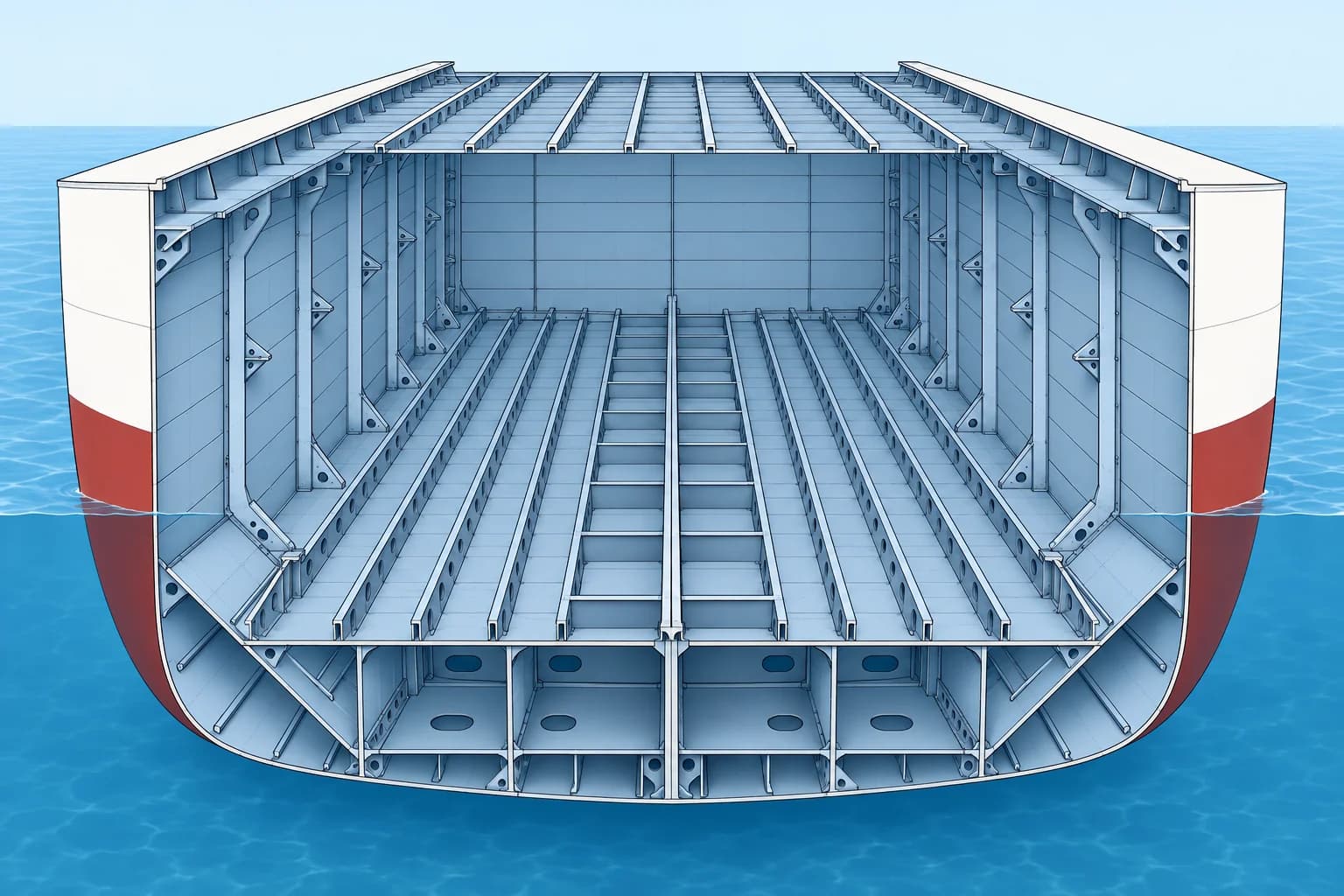
Think of the hull as one long hollow beam, the hull girder. Bottom, sides and strength deck are its walls. Plating keeps the sea out and carries load. Stiffeners welded to it stop the thin plates from buckling. Plates are laid in long rows called strakes: the keel plate on the centreline, the garboard strake next to it, the bilge strake at the turn of the bilge and the sheer strake at the top of the side.
Transverse framing
In transverse framing the main stiffeners run across the ship. Floors stiffen the bottom, frames the sides and beams the deck. They are closely spaced and joined by brackets (triangular plates at the corners). It suits shorter ships and holds that need few deep members. For long hulls, transverse framing alone is less efficient at supporting plating against longitudinal compression.
Longitudinal framing
In longitudinal framing many light stiffeners called longitudinals run fore and aft along the bottom, the deck and often the sides. Deep web frames spaced a few metres apart support them. Longitudinals share longitudinal loads and support plating against buckling, making the arrangement efficient for long hulls. Large tankers use it throughout. The price is deep webs that take space and are harder to clean and inspect.
Combined framing
Combined framing puts longitudinals in the bottom and deck, where bending stress is highest, and transverse frames in the sides. Many bulk carriers and general cargo ships are built this way. Container ships have a double skin and a heavy box-shaped structure along the top of each side, because their wide hatch openings leave little deck to carry the load.
Girders, pillars and frame numbers
Fore-and-aft girders support beams and floors. The centre girder in the double bottom is the ship's backbone. Pillars carry deck loads down to the structure below. Use these names to report damage exactly: compartment, side, frame number and member. Frame numbers usually start near the rudder and count forward, and they are marked on the plans and in the structure.
Key figures
- Transverse framing
- Floors, frames and beams across the ship, closely spaced
- Longitudinal framing
- Longitudinals fore and aft, carried by deep web frames
- Combined framing
- Longitudinal bottom and deck, transverse side frames
- Strakes, keel upwards
- Keel plate, garboard, bottom, bilge, side, sheer strake
Remember
- The hull is a hull girder: plating carries load, stiffeners stop it buckling.
- Transverse framing suits shorter ships; longitudinal framing gives strength along long hulls.
- Combined framing: longitudinals in bottom and deck, transverse frames in the sides.
- Report damage by compartment, side, frame number and the member's name.
Common mistakes
Wrong: Plating only keeps the water out; the frames carry all the load.
Right: Plating is part of the hull girder and carries much of the bending load. The stiffeners keep it from buckling.
Wrong: Longitudinal framing has no transverse members at all.
Right: The longitudinals are supported by deep transverse web frames and by the bulkheads.
Worked case
During a routine hold inspection on a bulk carrier you find a 20 cm crack at the lower end of a side frame, where its bracket meets the hopper tank plating. How do you report it?
Show the answer
Give the exact position: hold number, port or starboard, frame number and member (lower bracket of the side frame, hopper plating). Note the crack's length, direction and whether it goes through the plate, and take photos with a scale. Mark the crack ends. Tell the master and chief engineer, and through them the company, which informs class, the classification society. Do not weld it without class approval. Follow their assessment and monitoring instructions.
Practice question
Which framing system do large crude oil tankers mainly use?
- Transverse system
- Combined system
- Longitudinal system
- Unframed plate system
Show the answer
Answer: C. Long hulls need strength along their length. Longitudinals add to the hull girder, so tankers are framed longitudinally.
2 · Bottom and ends
The double bottom, the collision bulkhead and the strengthened ends
The double bottom and collision bulkhead limit flooding when their boundaries remain intact. Extra strengthening helps the ends resist panting and pounding.
The double bottom
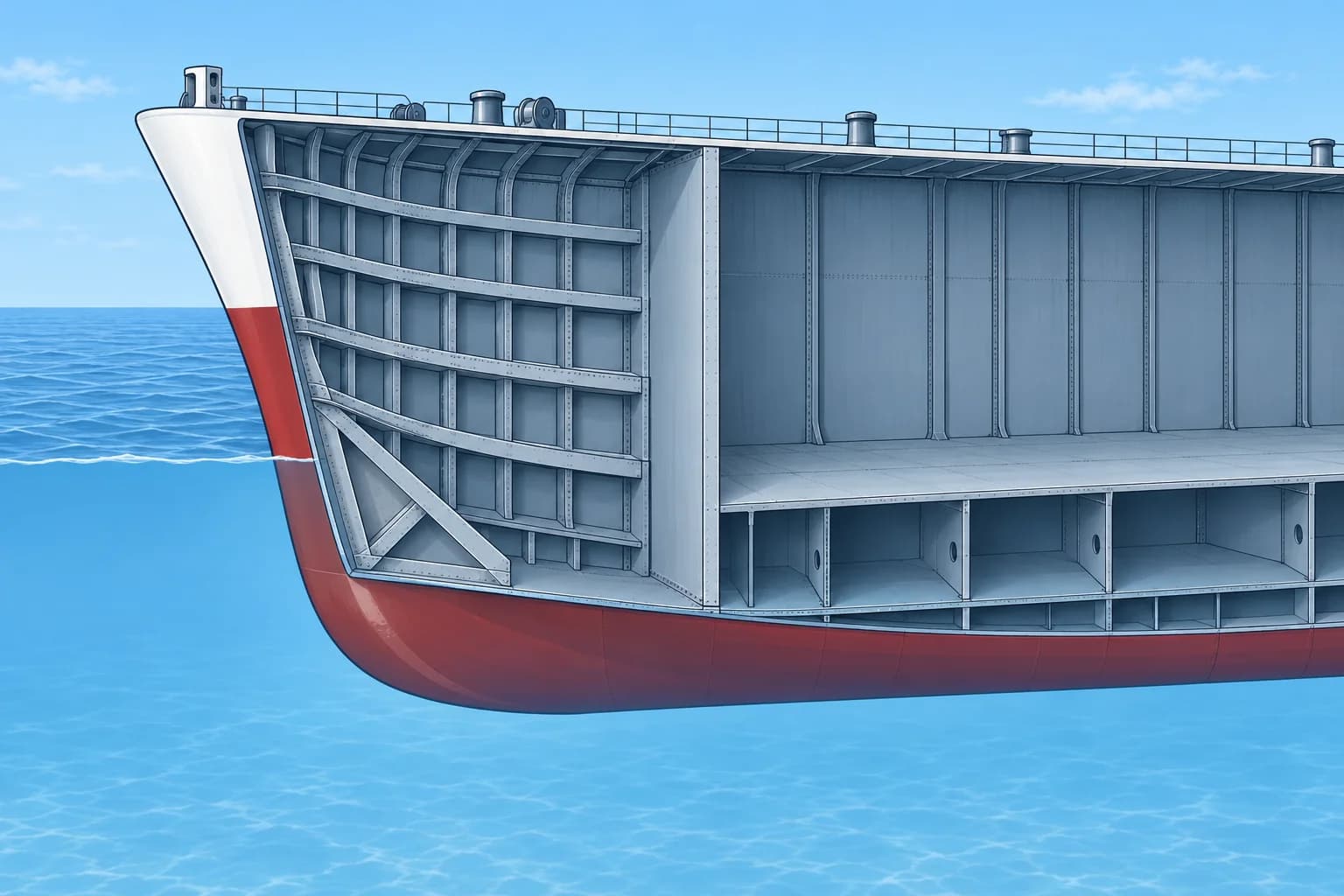
A double bottom is a second watertight skin, the inner bottom or tank top, above the bottom shell. If the inner bottom remains intact, grounding damage can leave flooding confined between the skins. Its tanks hold ballast, fuel or fresh water. SOLAS II-1/9 sets requirements for passenger ships and cargo ships other than tankers. Its height is at least B/20, where B is the breadth, and never less than 760 mm, but it need not exceed 2 m.
Inside the double bottom
The space between the skins is divided by floors (transverse plates) and fore-and-aft girders, with the centre girder on the centreline. Solid floors have holes for access and to save weight. Watertight floors close the ends of tanks. Some ships have a duct keel, a centreline tunnel for pipes. These tanks are enclosed spaces: enter only with a permit.
The collision bulkhead
The collision bulkhead is the foremost watertight bulkhead. In cargo ships it reaches the freeboard deck, from which freeboard is measured; in passenger ships, the bulkhead deck. In cargo ships, its standard position is between 0.05L or 10 m (whichever is less) and 0.08L or 0.05L + 3 m (whichever is greater) aft of the forward perpendicular. L is the SOLAS-defined length. Projecting bows have special reference rules: check the approved plan. An intact bulkhead limits flooding from bow damage.
Collision-bulkhead openings
No doors, manholes or ventilation openings are permitted below the relevant deck. Normally one forepeak-liquid pipe may pass through, with the prescribed shut-off valve operable from above that deck. Two pipes may be approved for a divided forepeak carrying different liquids. Passenger- and cargo-ship requirements differ; follow SOLAS II-1/12 and the approved arrangement.
Panting and pounding
As the ship pitches, changing water pressure makes the bow plating flex in and out: panting. Panting beams, side stringers and breasthooks (horizontal plates in the bow) stiffen the fore peak against it. When the bow lifts clear and slams down, the flat forward bottom takes pounding or slamming, so it gets thicker plate and closer stiffening. If she slams, slow down or alter course: the damage builds up blow by blow.
The stern
The aft peak bulkhead forms a watertight boundary near the stern. The stern tube, where the propeller shaft leaves the hull, has a watertight enclosure, not necessarily the aft peak tank: check the approved plan. The stern frame or a cast rudder horn supports the rudder and resists propeller vibration. The aft peak is usually a ballast tank, stiffened against panting.
Key figures
- Double-bottom height (SOLAS II-1/9)
- B/20, at least 760 mm, need not exceed 2,000 mm
- Collision bulkhead, cargo ship (SOLAS length L)
- 0.05L or 10 m (lesser) to 0.08L or 0.05L + 3 m (greater)
- Measured from
- Normally the forward perpendicular; special bow rules apply
- Openings below required deck
- Normally one forepeak-liquid pipe; approved exceptions apply
Remember
- An intact inner bottom can confine flooding after grounding; double-bottom tanks hold ballast and fuel.
- An intact collision bulkhead limits bow flooding; no doors or manholes below its required watertight deck.
- Panting beams, stringers and breasthooks resist panting; thicker forward bottom resists pounding.
- Slow down or alter course when she slams; pounding damage accumulates.
Common mistakes
Wrong: A manhole in the collision bulkhead is fine if it is bolted tight.
Right: Doors, manholes and ventilation openings are prohibited below the relevant deck. Forepeak piping must follow the approved SOLAS arrangement.
Wrong: Slamming is only uncomfortable; the structure is designed for it.
Right: Repeated slamming can buckle the forward bottom. Reduce speed or change heading until it stops.
Worked case
Your loaded general cargo ship is heading into a short, steep head sea at full speed. The bow lifts clear and lands with heavy shudders every few waves. The master asks what is happening to the structure.
Show the answer
This is pounding, or slamming. Each blow loads the flat forward bottom and the plating can dent or the stiffeners buckle, while the shudder (whipping) also stresses the hull girder. Reduce speed and, if needed, alter course so the bow stops leaving the water. Later, inspect the fore peak and forward double-bottom tanks for dents, cracks and leaks, and report any damage.
Practice question
A cargo ship has a breadth of 24 m. What is the minimum double-bottom height under SOLAS II-1/9?
- 760 mm
- 1,000 mm
- 1,200 mm
- 2,000 mm
Show the answer
Answer: C. B/20 = 24/20 = 1.2 m. That is more than 760 mm and less than the 2 m cap, so 1,200 mm applies.
3 · Watertight
Bulkheads, watertight integrity and closing openings
Bulkheads only save the ship if every opening and penetration in them is closed and tight. Most of that is kept, or lost, by the crew.
Watertight and weathertight
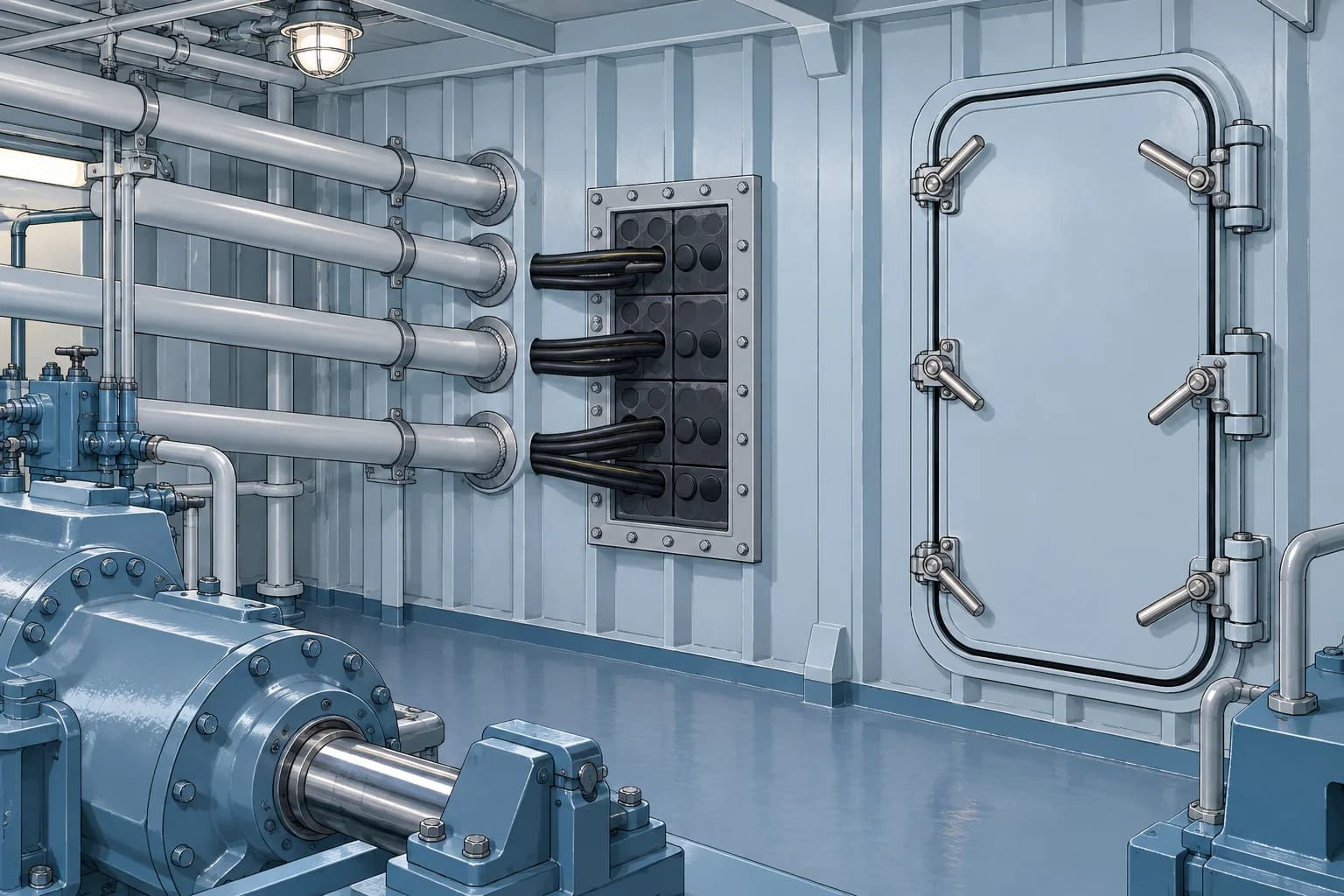
Watertight means water cannot pass in either direction under the specified design head. A head of water is the depth producing that pressure. Weathertight means water cannot enter in any sea conditions; it does not certify resistance to a damage-water head. Subdivision bulkheads and decks must be watertight. Exposed hatch covers and superstructure access doors normally need weathertight closures, as the applicable rules require.
Bulkheads
Transverse watertight bulkheads limit the spread of flooding; they cannot guarantee survival of every flooded compartment. Required boundaries include the collision bulkhead, aft peak bulkhead and machinery-space boundaries. Some boundaries may coincide, so these names do not always mean four separate bulkheads. Flat bulkheads use stiffeners. Corrugated bulkheads use folded plating for stiffness and have fewer exposed stiffeners, making them easier to clean. Follow the approved structural plan.
Penetrations
Every pipe, cable or duct through a watertight bulkhead or deck must pass through an approved penetration: a welded sleeve, a gland or a cable transit. A cable pulled through after a repair and left unsealed is a hole between two compartments. Check penetrations after any work, insist that contractors restore the seal and the fire insulation, and report anything missing.
Openings and fittings
Air pipes let tanks breathe in and out; their approved closing arrangements keep seawater out. Sounding pipes let you measure tank contents and have approved closures, such as screw caps or self-closing devices. Scuppers, which drain decks, and overboard discharges need closing arrangements appropriate to their position and service. Non-return valves prevent reverse flow. Check the approved arrangement and maintain seals, valves and closures. Deck machinery covers watertight-door operation.
Testing
Class specifies the test for each new or repaired boundary. A hydrostatic test uses a water head to test strength and tightness. Approved low-pressure air tests check leakage; they are not automatically substitutes for structural tests. A hose test directs water at seams and closures. Ultrasonic leak testing checks seals without water. A leaking hose test can wet the hold or cargo. Record defects and restore the required integrity before sailing.
Key figures
- Watertight
- No water passes in either direction under the specified design head
- Weathertight
- No water enters in any sea conditions
- Required boundary functions
- Collision, aft peak and machinery-space boundaries; some may coincide
- Tightness tests
- Specified structural tests and approved leakage tests
Remember
- Watertight withstands its specified water head; weathertight prevents ingress in any sea conditions.
- Every unsealed penetration is a hole between two compartments.
- Maintain approved air-pipe closures, sounding-pipe closures, non-return valves and hatch seals.
- A failed tightness test is a defect to fix before sailing.
Common mistakes
Wrong: A weathertight door is good enough in a watertight bulkhead.
Right: Weathertight approval does not certify resistance to a damage-water head. Subdivision boundaries need closures approved for their specified water pressure.
Wrong: Contractors will restore the cable seals after their work.
Right: Check every penetration yourself after any work. Unsealed transits destroy the subdivision and the fire boundary.
Worked case
After an electrician's visit in port you inspect the steering gear room. A new cable passes through the watertight bulkhead to the engine room through an open hole with no transit. The ship sails in four hours.
Show the answer
The bulkhead is no longer watertight: flooding of one space could spread to the other, and fire and smoke could too. Report it to the chief engineer and the master at once. The penetration must be closed with an approved transit and tested before sailing, or the ship's sailing is at risk. Record the defect and the repair, and inform class if the repair needs approval.
Practice question
What is the difference between watertight and weathertight?
- Weathertight closures are fitted only below the waterline
- Watertight withstands its specified design water head
- Watertight closures need no testing after they are fitted
- Weathertight is the stronger standard of the two closures
Show the answer
Answer: B. Weathertight prevents water entering in any sea conditions. Watertight withstands the specified design water head; weathertight approval does not certify that pressure resistance.
4 · Hull stresses
Hull stresses: bending, racking, torsion, local loads and fatigue
The hull bends along its length, distorts across it and twists in quartering seas. Know where each load acts and where the cracks will start.
Bending along the hull
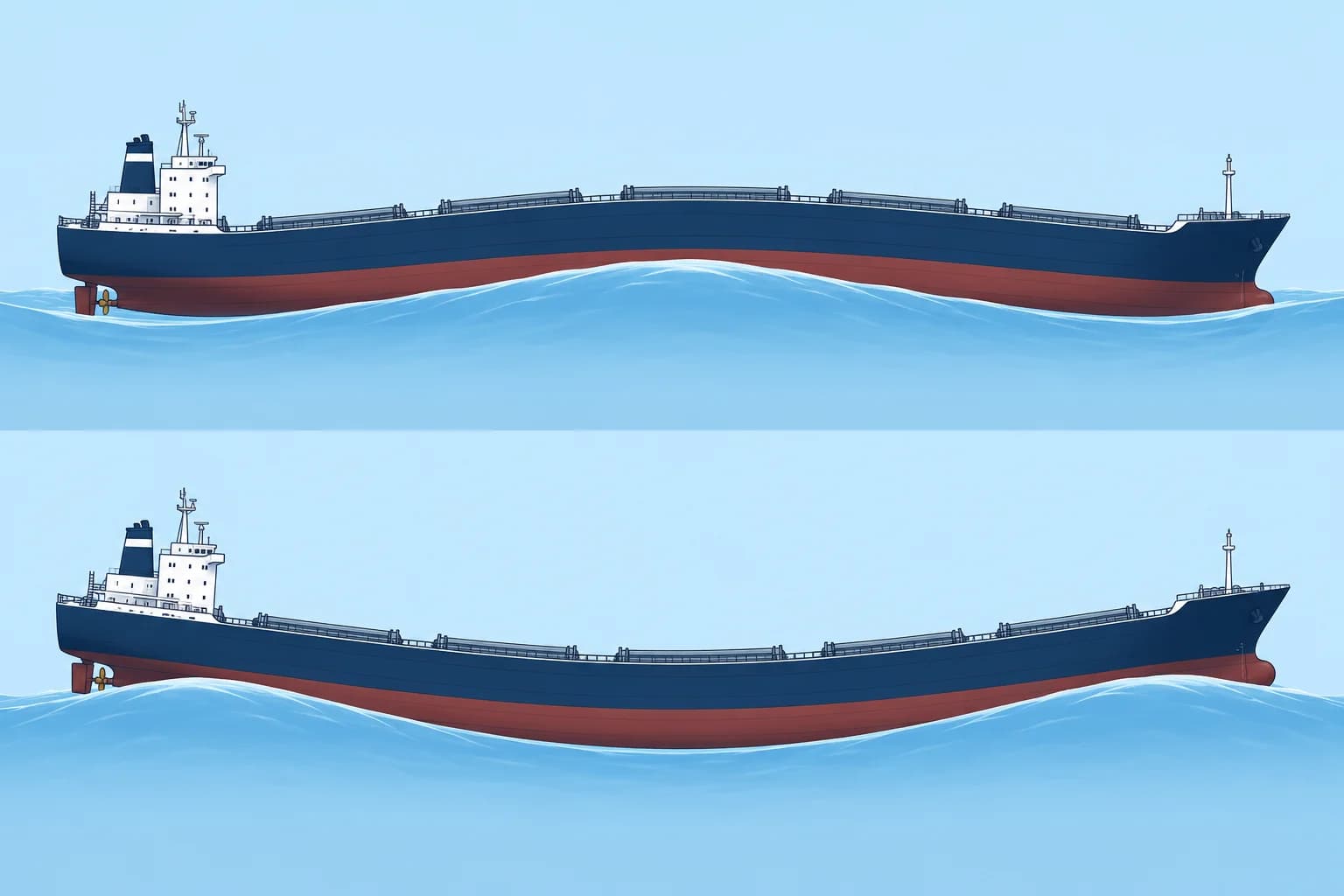
Weight and buoyancy are never spread the same way along the ship, so the hull girder bends. In hogging the middle rises and the ends droop: the deck is stretched and the bottom compressed. Sagging is the opposite. Waves add to it. The numbers, the loading manual and the loading instrument are taught in Stability: stress tables and partial loss of buoyancy.
Racking
When a ship rolls, the mass of her structure and cargo pushes each cross-section sideways, trying to turn the rectangle into a parallelogram. This is racking. Transverse bulkheads, web frames and the brackets joining frames to beams resist it. It is worst in heavy rolling and in ships with few transverse bulkheads, such as car carriers.
Torsion
In oblique seas the bow and the stern meet the waves differently, so the hull twists: torsion. Ships with very wide hatches, above all container ships, are weak in torsion because their deck is mostly openings. They get torsion boxes along the deck edges. Hatch corners are rounded and thickened, because cracks start there.
Local loads
Some loads act on a small area: heavy cargo on the tank top, water pressure in a full tank, grabs and bulldozers in a bulk hold, ice, and machinery vibration. The loading manual gives the limits, such as tonnes per square metre on the tank top and the maximum cargo per hold. Keep within them, and keep tanks full or empty where the manual asks, because liquid sloshing in a slack tank can damage it.
Fatigue
Every wave loads the steel a little. After millions of cycles, small cracks grow at stress concentrations, places where local stress is higher: hatch corners, bracket toes, holes cut in the structure and poor welds. This is fatigue. Cracks can remain hidden or grow quickly. Inspect known hot spots and report every crack promptly; inspection does not guarantee early detection.
Remember
- Hogging stretches the deck; sagging compresses it. Waves add to the still-water bending.
- Racking distorts the cross-section when rolling; bulkheads and brackets resist it.
- Wide-hatch ships are weak in torsion; hatch corners are crack hot spots.
- Keep within tank-top and hold limits; look for fatigue cracks at stress concentrations.
Common mistakes
Wrong: If total cargo weight is within the hold limit, the tank top cannot be overloaded.
Right: A concentrated load can exceed the tank-top limit even when total hold weight is acceptable. Check the load per square metre.
Wrong: Hairline cracks in brackets are cosmetic.
Right: Fatigue cracks grow with every wave cycle. Record, mark and report them so class can decide on repair.
Worked case
A container ship meets a long swell on the quarter and rolls and pitches together. On the next inspection the bosun reports a crack starting from a hatch corner on the upper deck. Why there, and what do you do?
Show the answer
The quartering sea twists the hull. Stress concentrates at hatch corners, where fatigue cracks can start. Report the crack immediately to the master with hatch, side, frame number, length and photos. Mark its ends. The master must obtain company and class assessment and follow any operating restrictions. Monitor as directed; monitoring alone does not establish that continued service is safe.
Practice question
A ship is hogging. Which part of the hull girder is in tension?
- The bottom plating
- The strength deck
- The side frames
- The tank top only
Show the answer
Answer: B. In hogging the middle rises and the ends droop, stretching the deck and compressing the bottom.
5 · Corrosion
Corrosion, coatings and cathodic protection
Metal loss can weaken plating and stiffeners. Coatings and cathodic protection slow corrosion; your inspections find damage that needs assessment.
Why steel corrodes
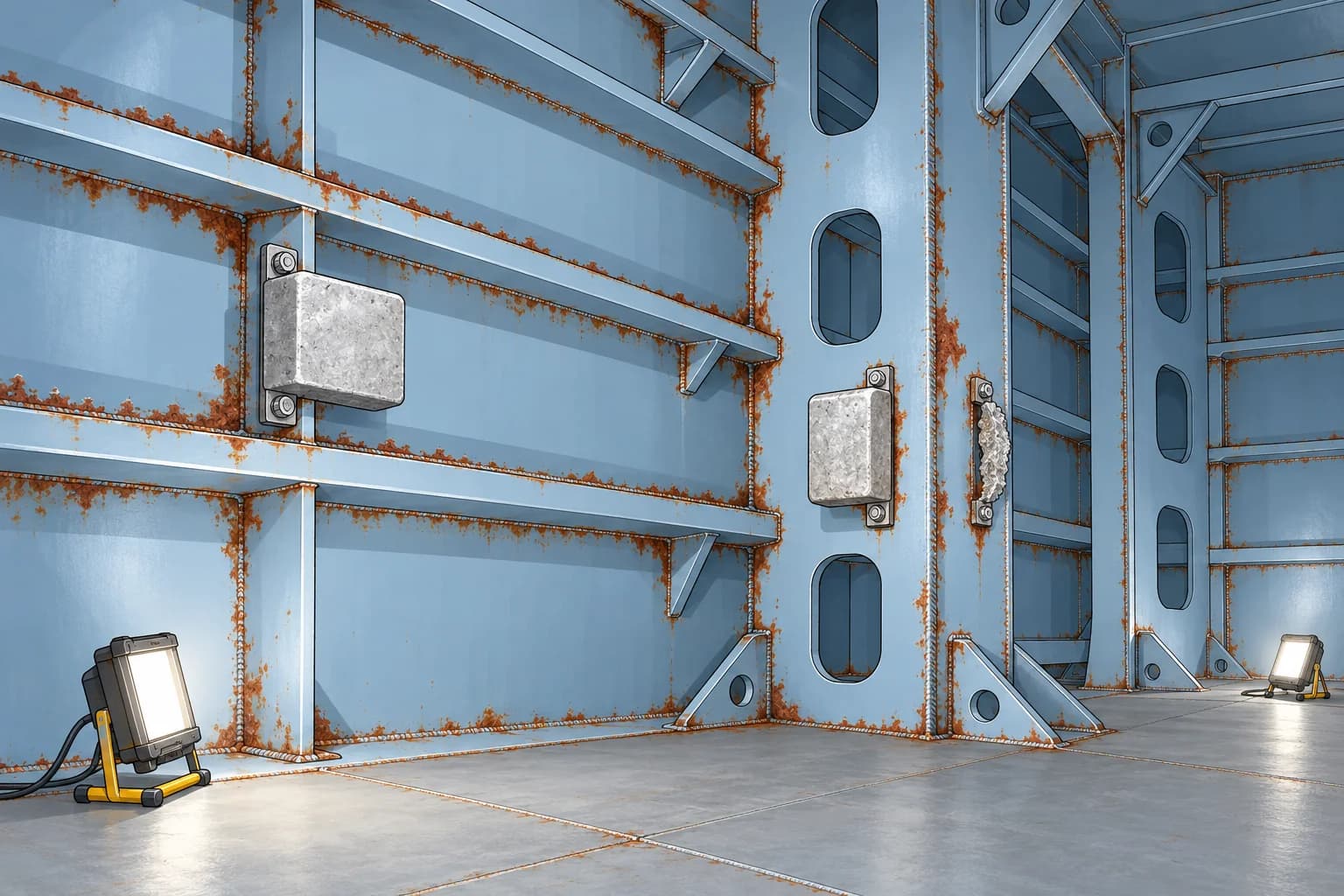
Steel in seawater works like a battery. Some areas become anodes and lose metal; others act as cathodes and are protected. Warmth, oxygen, salt and repeated wetting and drying speed it up. Ballast tanks, deckheads under a sun-heated deck, and holds that carry wet or acidic cargoes such as some coals and sulphur suffer most.
Forms of corrosion
General corrosion thins plating evenly under loose scale. Pitting makes deep local holes, often on tank and hold bottoms, and can perforate a plate that looks sound. Grooving runs along welds and stiffener edges. Galvanic corrosion attacks the less noble metal where two metals touch in seawater, such as steel near a bronze propeller. Erosion-corrosion occurs when flowing water removes protective films and accelerates corrosion. Microbial corrosion involves microorganisms and can occur in stagnant tanks.
Coatings
Paint is the first defence. Under the PSPC (IMO Performance Standard for Protective Coatings), dedicated seawater ballast tanks of new ships of 500 GT and above get a coating system with a target useful life of 15 years. Surveyors rate coatings GOOD (minor spot rusting), FAIR (local breakdown, edges and welds) or POOR (general breakdown over 20 % or more of the area, or hard scale on 10 % or more). On ESP bulk carriers and tankers, a ballast-tank coating below GOOD brings annual examination of that tank.
Cathodic protection
Cathodic protection makes the steel the cathode. Sacrificial anodes of zinc or aluminium, welded or bolted to the hull and in ballast tanks, corrode instead of the steel; they are renewed when worn to the limit in the maintenance plan. Impressed current cathodic protection (ICCP) drives a small direct current from anodes on the hull; check its readings and report alarms. Never paint over an anode.
Measuring wastage
Class-approved ultrasonic thickness gauging measures remaining steel. Compare it with the applicable renewal limits. In the traditional definition, substantial corrosion exceeds 75 % of allowable wastage but remains within acceptance limits. This is not automatically 75 % of a design corrosion addition. Ships under Common Structural Rules use their rule-specific thickness criteria. Ask class which criteria apply. Report photos, member names and frame positions.
Key figures
- PSPC ballast-tank coating target
- 15 years useful life (new ships of 500 GT and above)
- Coating POOR
- Breakdown over ≥ 20 % of area or hard scale on ≥ 10 %
- Substantial corrosion
- Traditional definition: >75 % of allowable wastage, within limits
- Sacrificial anode metals
- Zinc or aluminium alloy
Remember
- Ballast tanks, hot deckheads and holds with acidic cargo corrode fastest.
- Pitting can perforate a plate that looks sound; look at tank and hold bottoms.
- Coating rated GOOD, FAIR or POOR; below GOOD in an ESP ballast tank means annual examination.
- Anodes and ICCP protect the steel; never paint over an anode.
Common mistakes
Wrong: A plate with only light scale is in good condition.
Right: Scale can hide deep pits. Record suspect areas and request ultrasonic gauging.
Wrong: Painting over the hull anodes protects them for longer.
Right: A painted anode cannot supply its designed protective current. Report painted or heavily consumed anodes for corrective action.
Worked case
Inspecting a topside ballast tank on a 14-year-old bulk carrier, you find the coating broken down over roughly a quarter of the tank's internal surface area, with hard scale in places, and two anodes almost gone. What do you report?
Show the answer
Rate the coating POOR: breakdown covers over 20 % of the tank assessment area. Give the tank, frame positions, affected members, extent in per cent and photos. Report hard scale and almost-consumed anodes. Recommend thickness gauging of affected members and anode renewal. Send findings to the company for class assessment of coating repairs and any further thickness measurements. Unless restored to GOOD, this tank will be examined at each annual survey.
Practice question
Why is pitting dangerous?
- It spreads evenly and shows clearly as loose scale
- It can perforate a plate that looks sound overall
- It affects only the paint and not the steel below
- It happens only on aluminium and never on steel
Show the answer
Answer: B. Pits are deep and local. A plate can leak through a pit while the average thickness is still fine.
6 · Dry-docking
Dry-docking: docks, blocks and the critical instant
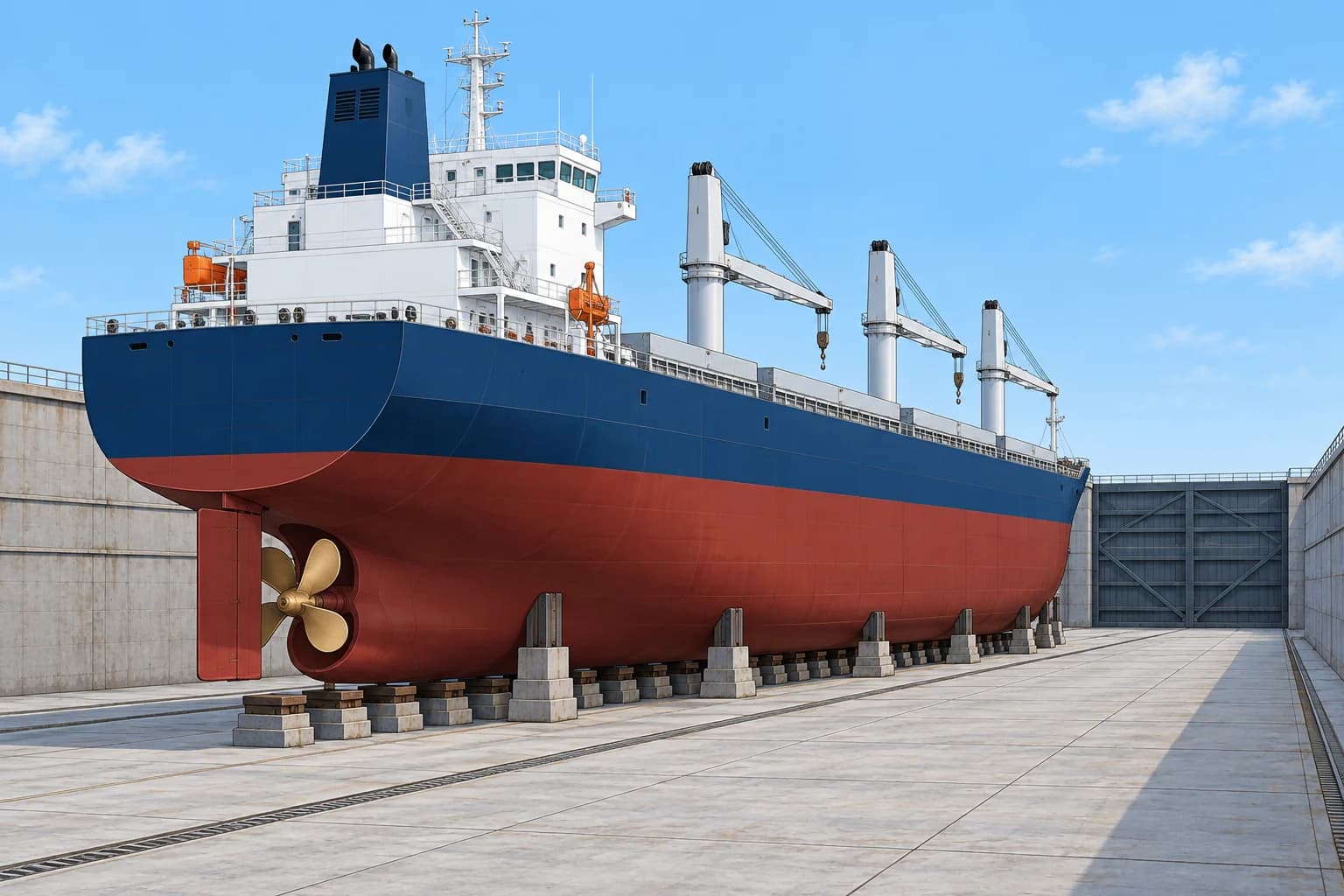
A docked ship rests on a row of blocks under her keel. Getting her onto them safely needs the right plan, the right trim and enough stability.
Types of dock
A graving dock is a gated shore basin pumped dry around the ship. A floating dock sinks by ballasting, receives the ship, then pumps out ballast to rise. A ship lift raises a supporting platform vertically. A slipway hauls the ship ashore on a cradle along an inclined track. Keel blocks and side supports must match the approved docking plan; support layouts differ between facilities.
The docking plan
The yard sets the blocks from the ship's docking plan. It shows the keel line, the bottom shape and every fitting that must not land on a block: drain plugs, sea chests, echo-sounder and log transducers. Send it early and check it matches the ship, including any changes since she was built. A block under a transducer or a plug means damage and extra docking time.
Arriving at the dock
Bring the ship upright, with the small stern trim agreed with the dockmaster, enough stability and as few slack tanks, partly filled tanks, as possible. Record every tank sounding, a measurement of liquid depth, and track all weight changes for the refloating stability check. Close tank valves and secure loose weights. Agree any movement while on the blocks with the dockmaster.
The critical instant
With agreed stern trim, the aft keel touches first. During the critical period, buoyancy and the stern-block reaction P share the weight. P reduces effective metacentric height (GM), a measure of initial stability, as though the centre of gravity rose. The critical instant is just before full keel landing, while support is concentrated aft. Effective GM must meet the approved docking requirement then. Total block reaction continues increasing as buoyancy is lost. Surveys and dry-docking covers the calculation.
Remember
- Graving docks pump out; floating docks lift the ship by pumping out ballast.
- The docking plan shows plugs and transducers that must not land on a block.
- Arrive upright, slightly trimmed by the stern, with few slack tanks and every sounding recorded.
- Before full keel landing, stern-block reaction reduces effective GM; check the approved margin at the critical instant.
Common mistakes
Wrong: Bring the ship in with a big stern trim so she settles gently.
Right: A large trim makes P larger and the loss of GM greater. Use the small trim the dockmaster agrees.
Wrong: Transfer ballast in the dock to correct a small list.
Right: Do not move liquids while she is on the blocks. Agree any change with the dockmaster and keep the soundings record.
Worked case
Your ship is due in a floating dock tomorrow. The dockmaster asks for a trim of no more than 0.5 m by the stern, upright. At present she trims 1.8 m by the stern and two double-bottom tanks are half full. What do you plan?
Show the answer
Before arrival, agree ballast changes that give the requested trim and keep the ship upright. Fill completely or empty partly filled tanks as the approved docking condition requires. Confirm the required stability margin at the critical instant. Record tank soundings, secure valves and weights, and provide the docking plan and arrival condition to the dockmaster.
Practice question
How does a floating dock lift a ship?
- It closes a gate and pumps the basin dry
- It hauls the ship up an inclined ramp to the shore
- It lifts the ship with cranes on its walls
- It sinks by ballasting, then pumps out to rise
Show the answer
Answer: D. The dock floods its pontoon tanks to sink, the ship floats in, then the dock pumps out and rises.