
The ship: hull, engines and systems · Level R2 · 4 parts · about 14 min
Propulsion basics: how a boat is pushed
4 short parts: Thrust · The propeller · Drive line · Efficiency. Each part explains the idea, then gives the points to remember, the common mistakes, a worked case and a practice question; the Academy unit adds all 28 check questions.
1 · Thrust
Thrust: how a propeller pushes a boat
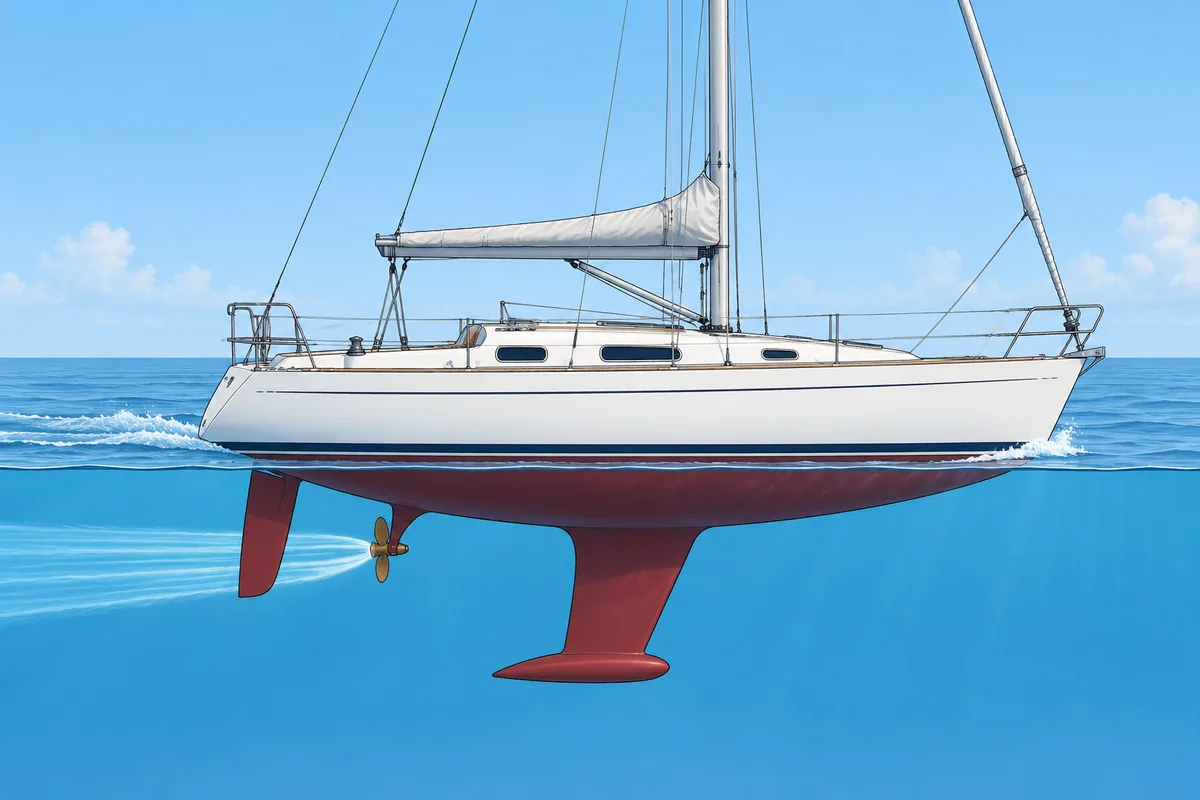
A propeller accelerates water aft. The water pushes the boat ahead. This force is thrust; removing it does not stop a moving boat.
Action and reaction
A propeller accelerates water aft, towards the back of the boat. The water exerts an equal force in the opposite direction, pushing the boat ahead, forwards. This push is thrust. It is an example of action and reaction: pushing water one way pushes the boat the other way.
Thrust and resistance
Resistance is the force opposing your boat’s movement. It comes mainly from water friction, wave-making and swirling water, with wind also contributing. If thrust exceeds resistance, you speed up. At a steady speed through the water, thrust equals resistance. More thrust can give a higher steady speed, but resistance also rises as you go faster.
Astern thrust
Astern means backwards. Reversing a fixed-pitch propeller’s rotation makes it push water forwards, giving astern thrust. Most such propellers work better ahead than astern. Astern thrust is often about half to two thirds of ahead thrust, though the amount depends on the propeller and installation. Do not expect equal stopping power from the same engine setting.
Carrying way
In neutral, the engine no longer drives the propeller. It does not cancel your boat’s motion. The boat carries her way: she keeps moving until resistance or opposing thrust slows her. While you are still moving ahead, astern thrust first slows you; only after stopping can you move astern. Allow stopping room and begin slowing early. Learn your boat’s response in clear water.
Key figures
- Steady speed
- Thrust = resistance
- Typical astern thrust
- About half to two thirds of ahead thrust; installation-dependent
- Neutral
- Removes engine drive, not the boat’s movement
Remember
- A propeller accelerates water aft; the reaction pushes your boat ahead.
- At a steady speed through the water, thrust equals resistance.
- Astern thrust is generally weaker than ahead thrust.
- In neutral your boat carries her way. Allow room and time to stop.
Common mistakes
Wrong: Neutral stops the boat.
Right: Neutral removes engine drive. Your boat keeps moving until resistance or opposing thrust slows her.
Wrong: Selecting astern makes the boat move backwards immediately.
Right: While you still have forward way, astern thrust slows you first. Backwards movement begins only after you stop.
Wrong: The same engine setting gives equal thrust ahead and astern.
Right: A typical fixed-pitch propeller is less effective astern. Begin slowing early rather than relying on a late burst.
Worked case
You select neutral while moving towards a landing place. The engine idles, but the boat keeps moving ahead. Why, and what should you allow for?
Show the answer
Neutral removes engine drive, not your forward motion. Your boat is carrying her way. Astern thrust can slow her, but it is usually weaker than ahead thrust and needs distance to work. Allow stopping room and start slowing earlier on your next approach.
Practice question
When a propeller accelerates water aft, what pushes the boat ahead?
- The friction force along the underwater hull
- The weight force acting through the engine
- The reaction force exerted by the water
- The sideways force from the rotating shaft
Show the answer
Answer: C. The propeller pushes water aft. The water exerts an equal and opposite force on the propeller and boat.
2 · The propeller
The propeller: parts, size and hand
Read a propeller as diameter × pitch. Its size, hand, blades and material must suit your engine and the way you use your boat.
Parts
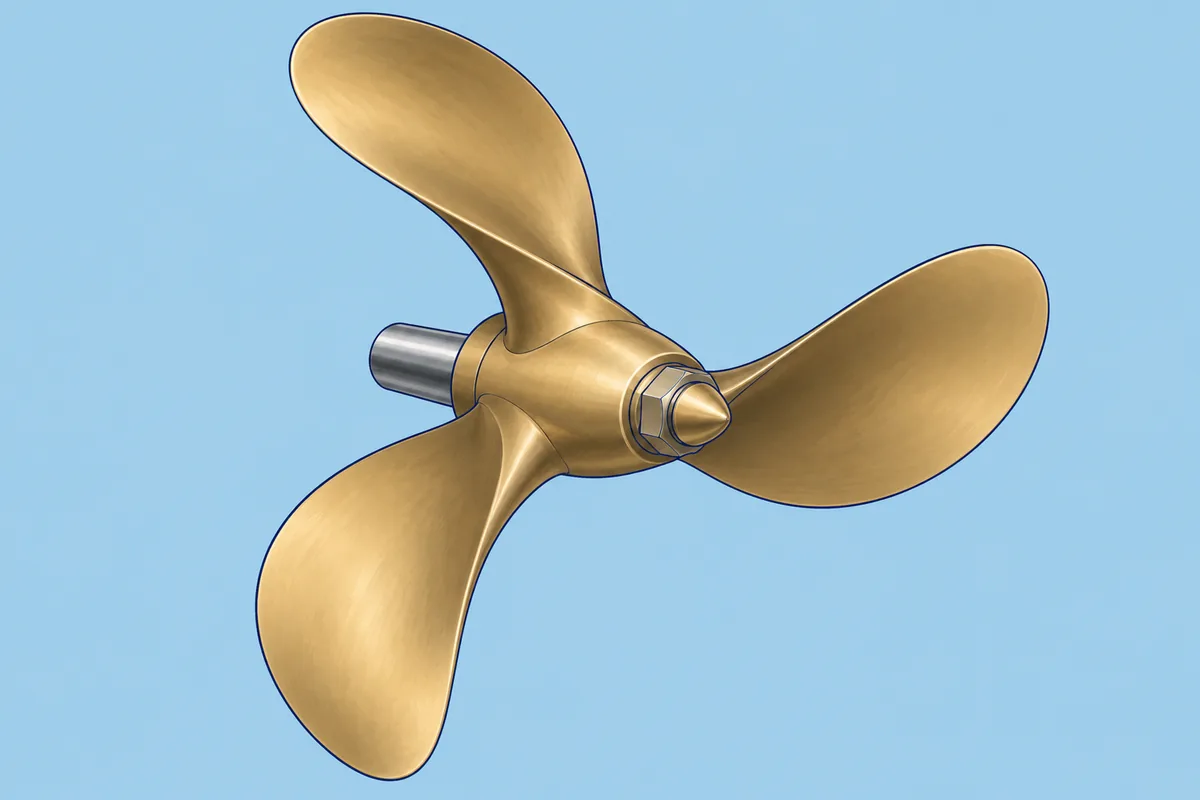
The hub is the centre fitted to the shaft, the rod transmitting engine rotation. On a typical shaft drive, a key and nut secure it. Each blade has a root at the hub, an outer tip, a leading edge that meets the water first and a trailing edge where water leaves. In ahead operation, the face is the aft-facing pressure side pushing water back. The back is the forward-facing, lower-pressure side.
Diameter and pitch
Diameter is the width of the circle swept by the blade tips. Pitch is the theoretical forward advance in one revolution, with no slip. A 15 × 11 propeller has a 15-inch diameter and an 11-inch pitch; diameter comes first. One inch = 2.54 cm. rpm means revolutions per minute. Propeller rpm = engine rpm ÷ gear ratio. At 2,600 engine rpm with 2:1 reduction, the propeller turns at 1,300 rpm.
Speed and apparent slip
Theoretical knots = pitch in inches × propeller rpm ÷ 1,215. With 10-inch pitch at 1,300 rpm: 10 × 1,300 ÷ 1,215 ≈ 10.7 knots. Apparent slip compares this with ship speed through the water: apparent slip (%) = (theoretical − through-water speed) ÷ theoretical × 100. Typical values are 10–40 %, depending on hull and conditions. At 20 %, 10.7 knots becomes about 8.6 knots. Hull wake changes the water speed reaching the propeller, so real slip differs.
Right or left hand
Judge hand from astern: stand behind the boat, looking forwards, with the propeller driving ahead. Clockwise means right-handed; anticlockwise means left-handed. Looking from the other end reverses what you see. Check the marking or handbook rather than assuming the hand.
Matching the load
An overpropped boat has too much pitch or diameter for its engine: the load prevents it reaching the maker’s full-throttle rpm range. An underpropped boat has too little: the engine may exceed that range because the load is too light. Check with a clean hull and propeller and normal loading. More pitch only helps if the engine can turn it properly.
Blades and materials
More blades, commonly 3, 4 or 5, generally give smoother running and better low-speed grip; fewer can be more efficient. Aluminium is inexpensive but soft; stainless steel and bronze are stronger. Sailing yachts use folding blades that fold back, or feathering blades that turn edge-on, to reduce drag under sail. Folding propellers often give weaker astern thrust and may open late; test astern response before a tight manoeuvre.
Key figures
- 15 × 11
- Diameter 15 in, pitch 11 in
- Propeller rpm
- Engine rpm ÷ gear ratio
- Theoretical speed (knots)
- Pitch (in) × propeller rpm ÷ 1,215
- Apparent slip (%)
- (Theoretical − actual through-water speed) ÷ theoretical × 100
- Right-handed
- Clockwise seen from astern, driving ahead
- Typical apparent slip
- 10–40 %, depending on hull and conditions
Remember
- Read size as diameter × pitch. Pitch is advance per turn with no slip.
- Use propeller rpm, not engine rpm, in the speed formula.
- Judge hand from astern, driving ahead: clockwise means right-handed.
- Overpropped: too much load, low rpm. Underpropped: too little load, possible over-revving.
- Folding and feathering reduce sailing drag; folding propellers often give weaker astern thrust.
Common mistakes
Wrong: You can judge hand from either end.
Right: Always look from astern with the propeller driving ahead. Clockwise is right-handed; anticlockwise is left-handed.
Wrong: More pitch always means more speed.
Right: Too much pitch overloads the engine. Match pitch and diameter to the maker’s full-throttle rpm range.
Wrong: The theoretical speed is the speed you will actually get.
Right: The formula assumes no slip. Calculate apparent slip from ship speed through the water; speed over ground includes current.
Worked case
Your propeller is 14 × 10. The engine turns at 2,600 rpm through 2:1 reduction. Your speed through the water is 7.5 knots. Find theoretical speed and apparent slip.
Show the answer
Propeller rpm = 2,600 ÷ 2 = 1,300. Use the 10-inch pitch: theoretical speed = 10 × 1,300 ÷ 1,215 ≈ 10.7 knots. Apparent slip = (10.7 − 7.5) ÷ 10.7 × 100 ≈ 30 %. Use speed through the water, since current changes speed over the ground.
Practice question
Which propeller part is the aft-facing pressure side during ahead operation?
- The back of the blade
- The face of the blade
- The root of the blade
- The tip of the blade
Show the answer
Answer: B. The face is the aft-facing pressure side. The back faces forwards and is the lower-pressure side during ahead operation.
3 · Drive line
From engine to propeller: gears, shaft and seals
The gearbox, shaft, bearings and seal pass engine power to the propeller and keep water out. Check them before you leave.
Gearbox and reduction
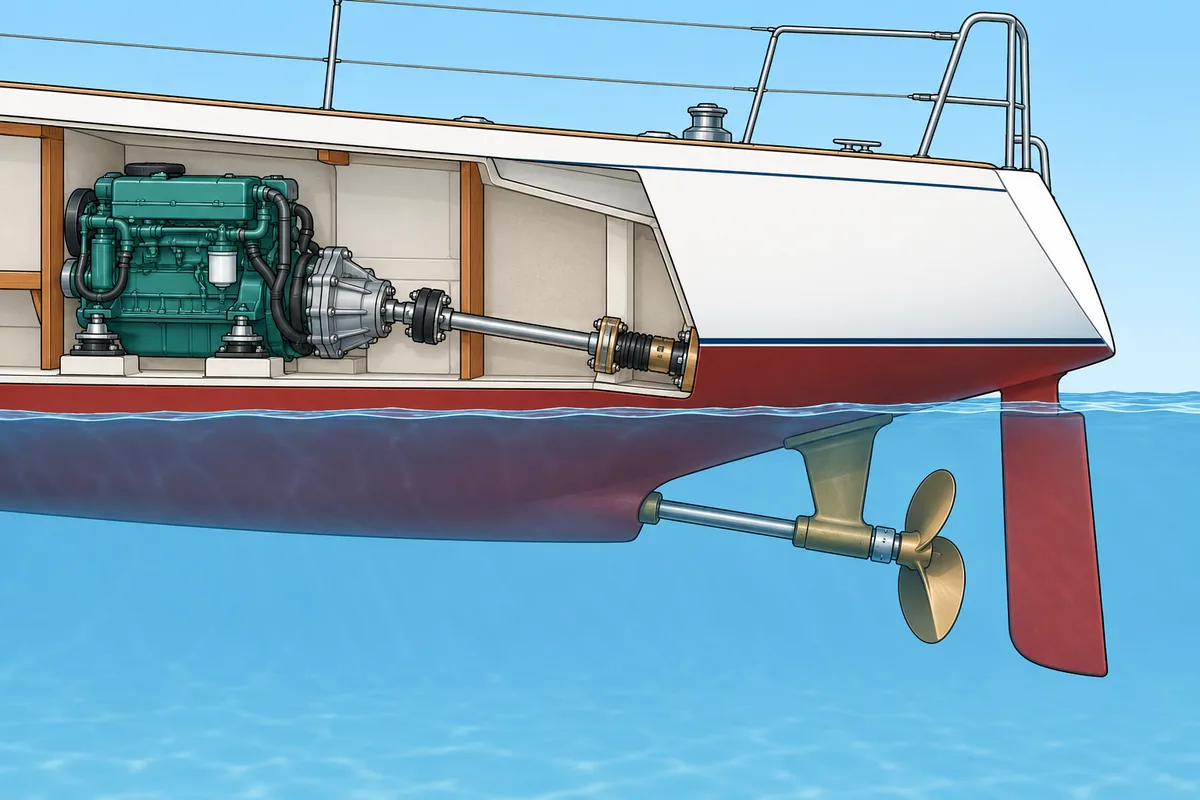
The gearbox selects ahead, neutral or astern without reversing the engine itself. It usually reduces shaft speed, often by 2:1 to 3:1. With 2:1 reduction, two engine turns give one propeller turn. This lets the engine drive a larger, slower propeller efficiently. Neutral disconnects engine drive; it does not stop the boat.
Shaft and bearings
A coupling joins the gearbox to the shaft, which carries rotation to the propeller. The thrust bearing transfers the propeller’s push to the hull, often through the gearbox and engine mounts. The shaft passes through a stern tube, a tube through the hull. A cutless bearing, usually rubber-lined and lubricated by seawater, supports the shaft near the propeller. Alignment means keeping engine and shaft correctly in line; poor alignment causes vibration and wear.
Keeping water out
A stuffing box, or stern gland, compresses soft packing rings around the shaft. Conventional water-lubricated packing needs a slight drip while the shaft turns, often a few drops a minute; follow its instructions. A dripless seal uses sealing faces or a lip and should not leak. Either seal’s failure can let seawater in. Inspect without touching rotating parts. Stop and secure the shaft before any adjustment.
Galvanic corrosion
Dissimilar metals electrically connected in water can act like a battery. The more reactive metal corrodes: this is galvanic corrosion. A sacrificial anode is a deliberately more reactive metal that corrodes instead of protected parts. Replace it when about half worn. It needs clean electrical contact; never paint it. Unexpectedly rapid loss needs investigation. Keep copper-based antifouling paint off aluminium underwater parts, because it can cause severe corrosion.
Choosing anodes
Zinc suits salt water but protects poorly in fresh water, where a coating can form. Aluminium suits salt and brackish water, meaning partly salty water; many makers also approve it for fresh water. It is the usual choice for boats moving between them. Magnesium is for fresh water only. Follow the maker’s anode chart for your installation.
Changing gear
Idle is the engine’s lowest running speed. Reduce to idle, move through neutral, pause as the gearbox maker specifies, then select the opposite gear and increase power gradually. A pause of about a second is common. Slamming from full ahead to full astern can damage the gearbox or stall the engine just when you need it.
Drive-line check before you go
- Check gearbox oil by the maker’s specified method. — The correct level and oil condition help the gearbox engage and stay lubricated.
- Look for water or oil beneath the gearbox, coupling and shaft seal. — A new leak needs attention before you leave.
- With the engine stopped and secured, inspect accessible coupling fastenings, mounts and seal hose clips. — Loose or damaged parts can cause vibration, loss of drive or water entry.
- Start in neutral at idle, with the boat secured and the area clear. — The propeller must not drive the boat unexpectedly.
- If safe at the berth, test ahead and astern gently at idle, pausing in neutral. — Confirm both directions engage before you need them.
- Observe the seal from a safe distance while the shaft turns; listen for new vibration as you leave. — Conventional packing should drip slightly; a dripless seal should stay dry. Keep hands, hair and clothing clear.
Remember
- The gearbox selects ahead, neutral and astern and reduces shaft speed.
- The thrust bearing carries push to the hull; the cutless bearing supports the shaft in seawater.
- Conventional packing drips slightly while running; a dripless seal should stay dry.
- Keep anodes unpainted and electrically connected. Replace them when about half worn.
- Shift through neutral at idle. Check oil, leaks, fastenings and engagement before leaving.
Common mistakes
Wrong: Tighten a conventional stuffing box until it is dry while running.
Right: Water cools and lubricates conventional packing. A dry, hot gland may be too tight. Stop and secure the shaft before adjustment.
Wrong: You can change directly from full ahead to full astern.
Right: Reduce to idle, pass through neutral and pause as specified before reversing. Then add power gradually.
Wrong: Paint the anode so it lasts longer.
Right: Paint prevents protection. Keep clean electrical contact, choose the specified material and replace the anode when about half worn.
Worked case
Before departure, you see a few drops a minute from a conventional packed stern gland while the shaft turns. Another boat’s dripless seal is dry. Does either observation alone show a fault?
Show the answer
Both can be normal. Conventional water-lubricated packing needs a slight running drip; a dripless seal should stay dry. Compare with the maker’s specified rate and your usual observations. A steady stream, new leakage or overheating needs attention. Keep clear of rotating parts and stop and secure the shaft before any adjustment.
Practice question
With a 2:1 reduction gearbox, how do engine and propeller revolutions compare?
- One engine turn gives two propeller turns
- Two engine turns give two propeller turns
- Three engine turns give one propeller turn
- Two engine turns give one propeller turn
Show the answer
Answer: D. Reduction slows the propeller: at 2:1, the engine turns twice for each propeller turn.
4 · Efficiency
Cavitation, ventilation, fouling and speed
Bubbles, growth and a poor propeller match waste thrust. Hull shape also limits how much speed you gain from extra power.
Cavitation
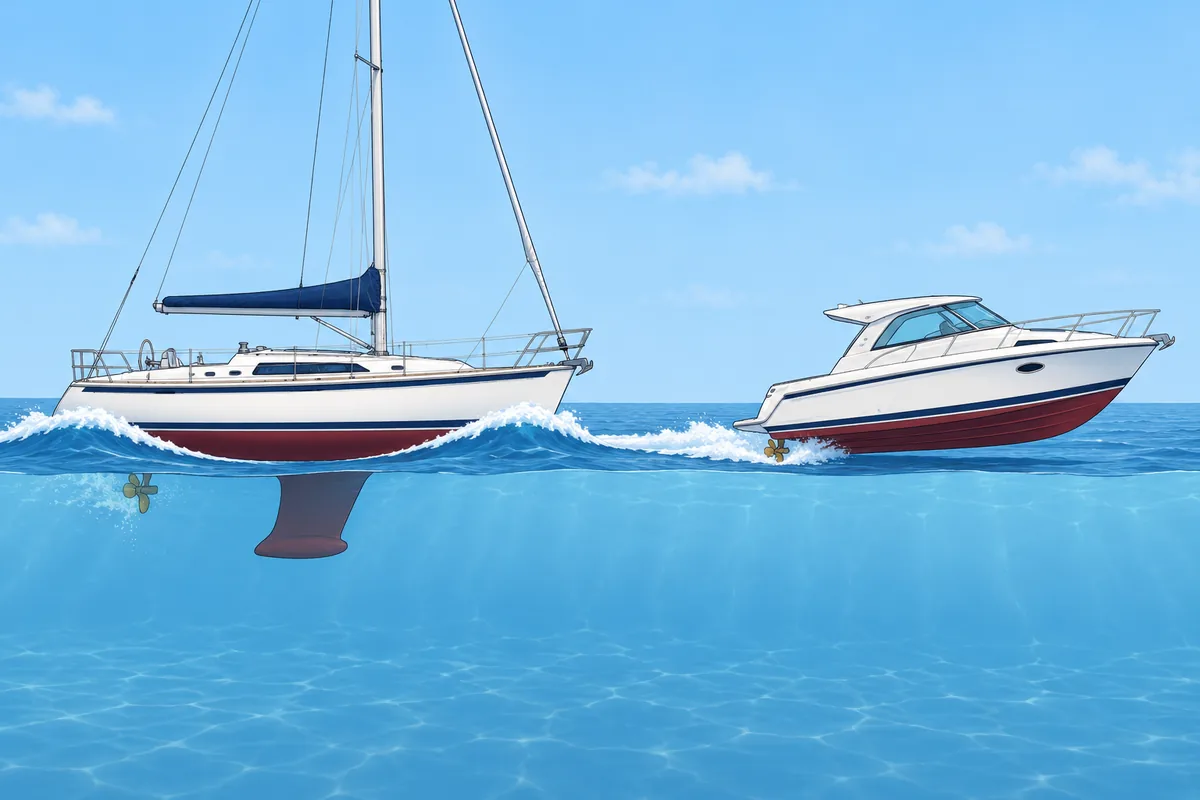
Cavitation forms when pressure on a blade falls low enough for water to become vapour. The bubbles collapse, causing noise, lost thrust and pitting, tiny holes eroded in the metal. Excessive propeller speed, damaged edges or too little blade area for the load can contribute. The bubbles form from water itself, not air drawn from above.
Ventilation
Ventilation draws surface air, or sometimes exhaust gas, onto the blades. They lose grip, engine rpm rises and thrust falls. It can happen in tight turns, waves or when an outboard leg is trimmed too high. Trim is the leg’s running angle. Ease power, straighten the turn if safe and lower the leg’s trim as appropriate. The anti-ventilation plate above the propeller helps keep surface air away; it is often misleadingly called an anti-cavitation plate.
Fouling
Fouling is weed, barnacles and other growth on the hull or propeller. It increases resistance and spoils blade shape, costing speed and fuel. A fouled hull, heavy load or damaged blade can make the engine struggle, like too much propeller pitch. Clean and inspect before deciding that the propeller size is wrong.
Displacement and hull speed
A displacement hull pushes water aside. Near hull speed, wave-making resistance rises steeply, so extra power buys little speed. Hull speed in knots ≈ 2.43 × √LWL with LWL in metres, or 1.34 × √LWL with LWL in feet. LWL is waterline length; √ means square root. At LWL 9 m: 2.43 × √9 = 2.43 × 3 ≈ 7.3 knots. This is a guide, not a hard limit; light, slender hulls can exceed it.
Planing
A planing hull gains lift from water flowing beneath it. With suitable shape and enough power, it rises and skims over the water, allowing much higher speeds than an ordinary displacement hull. Adding a bigger engine to a displacement boat does not turn it into a planing boat.
Matching engine and propeller
Check the maker’s full-throttle rpm range with a clean hull, sound propeller and normal load. Too much pitch or diameter can prevent reaching the range; too little can let the engine over-rev. First check fouling, loading and damage. A sudden rpm surge during a turn suggests ventilation, while steadily excessive rpm in normal straight running can suggest too little propeller load. Symptoms guide checks; they do not prove the cause.
Key figures
- Cavitation
- Water vapour bubbles; collapse can pit the blades
- Ventilation
- Air or exhaust gas on blades; rpm rises, thrust falls
- Hull speed (knots), LWL in metres
- ≈ 2.43 × √LWL
- Hull speed (knots), LWL in feet
- ≈ 1.34 × √LWL
- Example: LWL 9 m
- 2.43 × √9 ≈ 7.3 knots
Remember
- Cavitation forms vapour in low-pressure water; collapsing bubbles can pit blades.
- Ventilation brings air or exhaust gas onto the blades, causing lost grip and an rpm surge.
- Fouling increases resistance and can mimic too much propeller load. Clean before changing size.
- Hull speed ≈ 2.43 × √LWL (m) knots. It is a guide for displacement hulls, not a hard limit.
- Match the propeller to the maker’s full-throttle rpm range with a clean hull and normal load.
Common mistakes
Wrong: Cavitation and ventilation are the same.
Right: Cavitation forms water vapour at low pressure and can pit blades. Ventilation draws air or exhaust gas onto them.
Wrong: A bigger engine will make any hull plane.
Right: Planing needs a suitable hull. Near hull speed, an ordinary displacement hull gains little speed from extra power.
Wrong: Low full-throttle rpm always means the propeller pitch is wrong.
Right: Growth, excess load or blade damage can give similar symptoms. Check those before changing pitch or diameter.
Worked case
Your boat is slower than in spring and now cannot reach its specified full-throttle rpm. There is weed on the hull and propeller. Should you immediately fit a lower-pitch propeller?
Show the answer
Clean the hull and propeller and inspect the blades first. Growth adds resistance and can overload the engine, mimicking too much pitch. Retest with normal loading against the maker’s rpm range. If rpm is still too low, investigate the engine and propeller match before changing the propeller.
Practice question
Vapour bubbles form on low-pressure blade surfaces, then collapse and pit the metal. What is this?
- Propeller cavitation
- Propeller ventilation
- Marine-growth fouling
- Engine over-revving
Show the answer
Answer: A. Cavitation forms water vapour at low pressure. Collapsing bubbles can erode the blade surface.