
The ship: hull, engines and systems · Level R4 · 5 parts · about 16 min
Engine trouble at sea: fuel, cooling and air
5 short parts: First moves · Won't start · Stops, loses power · Overheating · Smoke, fouled prop. Each part explains the idea, then gives the points to remember, the common mistakes, a worked case and a practice question; the Academy unit adds all 31 check questions.
1 · First moves
When the engine fails: the boat first, then the engine
An engine failure is a seamanship problem before it is a mechanical one. Make the boat safe, then find the fault calmly and in order.
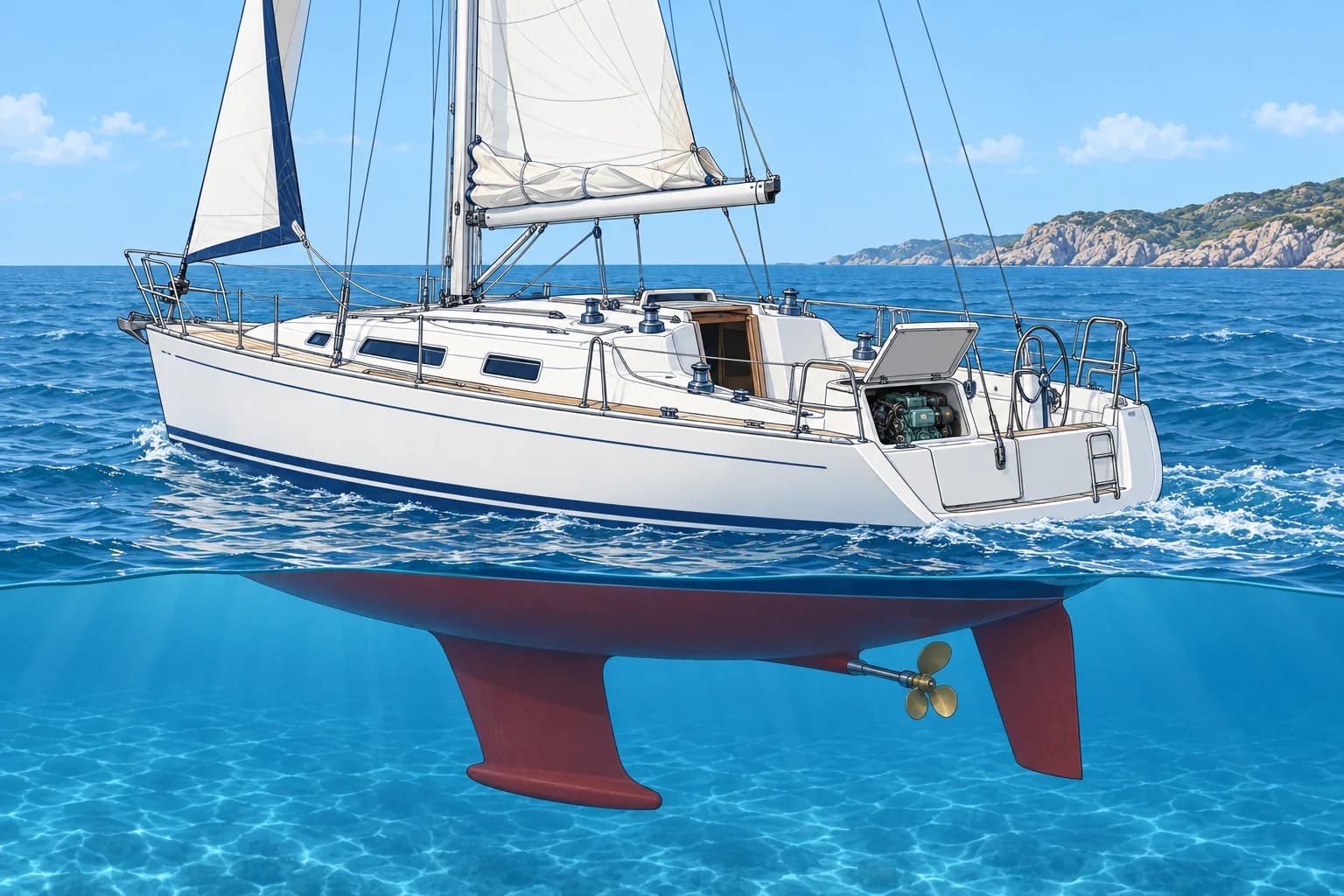
The boat first
When the engine stops or must be stopped, ask: where will wind and tide take you, and how fast? A lee shore is land towards which the wind drives you. Near a lee shore, channel or rocks, act at once: sail if you can, or anchor if suitable. Offshore with sea room, you have time to think.
Tell people
Warn the crew and keep a lookout: someone watching traffic and drift. Call the coastguard early if you may need help. Use PAN-PAN for an urgent safety concern without distress. Use MAYDAY for grave and imminent danger requiring immediate assistance. Routine assistance can use an ordinary call. An early call gives rescuers time.
Diagnose in order
Check four areas: fuel supply, intake air, cooling and electrics. Under fuel supply, check for unwanted air as well as water, dirt and restrictions. Ask what changed just before: rough sea, a refill, a new filter, a noise, an alarm. Read the gauges and alarms, then check the simplest causes first.
Work safely
Stop the engine and prevent restarting before reaching near belts. Water flow can turn the propeller shaft even with the engine stopped; secure it against rotation before working near it. Let hot parts cool; never open a hot coolant cap. Brace yourself securely, use a torch, secure loose tools, and watch for fumes. Share the work if you are tired or seasick.
Write it down
Note the time, symptoms, checks, changes and results. This fault log helps you, the next crew member, the mechanic and any rescuer continue without repeating failed checks.
Key figures
- Four usual causes
- Fuel, air, cooling, electrics
- Urgency call
- PAN-PAN: urgent safety concern without distress
Engine failure at sea
- Judge the drift: lee shore, traffic, rocks? Sail, or anchor if suitable. — Keeping the boat out of danger matters more than the engine.
- Brief the crew and post a lookout to watch traffic and drift. — Someone must manage the boat while others investigate.
- Call the coastguard early. Use PAN-PAN for an urgent safety concern; MAYDAY for grave and imminent danger requiring immediate assistance. — Rescuers need time. Routine assistance can use an ordinary call.
- Log the time, symptoms, alarms, checks, changes and results. Note what happened just before. — The clue to the fault is usually in the minutes before.
- Stop the engine and prevent restarting. Keep clear of any turning shaft; secure it against rotation before working near it. Check fuel, air, cooling and electrics, simplest first. — Simple faults are the common ones; safety first near moving parts.
- Fix only what you understand; otherwise get a tow. — A wrong repair can turn a small fault into a wrecked engine.
Remember
- Make the boat safe first: sail, anchor or keep sea room.
- Call early: PAN-PAN for urgent safety concerns; MAYDAY for grave, imminent danger requiring immediate assistance.
- Check fuel, air, cooling, electrics, simplest causes first.
- Stop and prevent restarting before work near belts; secure the shaft against water-driven rotation before working near it.
Common mistakes
Wrong: Everyone goes below to look at the engine.
Right: Someone stays on deck to keep a lookout, watch the drift and steer or sail.
Wrong: Wait until you are sure you cannot fix it before calling.
Right: Call the coastguard early. Use PAN-PAN for an urgent safety concern; MAYDAY for grave and imminent danger requiring immediate assistance. Routine assistance can use an ordinary call.
Worked case
Your motorboat stops off a rocky lee shore. Wind and tide will carry you onto the rocks in ten minutes. You cannot sail or anchor effectively. What comes first?
Show the answer
Send MAYDAY now: grounding is imminent and you need immediate help. Keep someone on deck watching drift and traffic. Brief the crew and prepare for rescue. Attempt simple engine checks only if someone can do them safely without delaying the distress call or the boat’s safety.
Practice question
The engine stops near a lee shore. What is your first priority?
- Bleeding the fuel system straight away
- Keeping the boat off the shore
- Reading the engine manual below
- Changing the fuel filter at once
Show the answer
Answer: B. Drift towards a lee shore is the danger. Sail or anchor if suitable, and call for help early. Manage the boat before engine checks.
2 · Won't start
The engine won't start
Won’t crank: check the starting circuit first. Cranks but won’t fire: check fuel, intake air and stop control. Stop if the engine seems locked.
Does it crank?
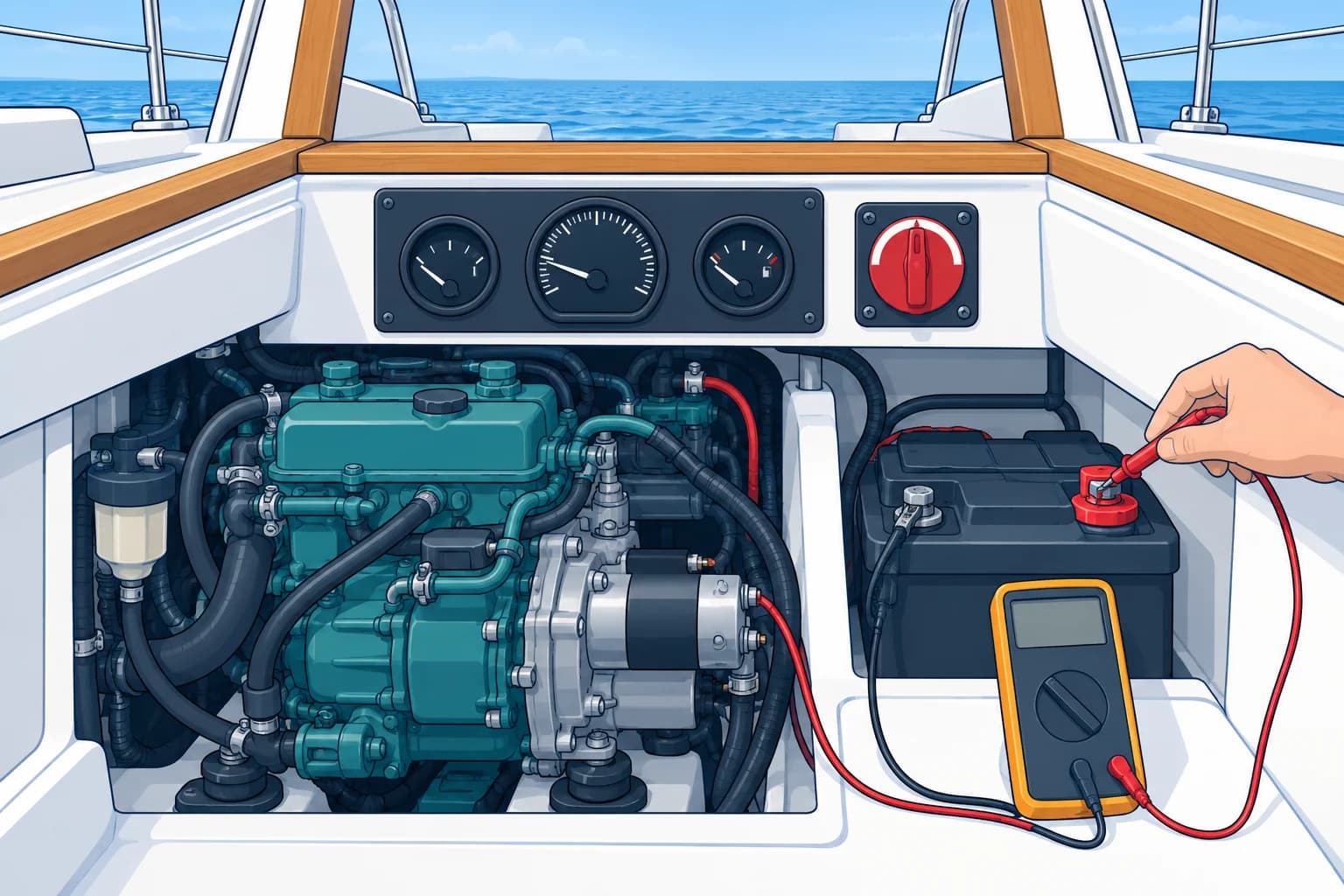
Cranking means the starter turns the engine. If nothing happens, or you hear only a click, check the starting circuit first. Select neutral: a neutral-start interlock prevents starting in gear, but not every boat has one. Check the battery switch, main fuse or breaker, and battery voltage. A rested 12 V lead-acid battery at about 12.0 V is close to flat. If the engine seems mechanically locked, stop attempts and get qualified help.
Electrical clues
Voltage collapsing or lights dimming badly can suggest a weak battery or poor connection. Stop repeated attempts if a connection overheats. With the starting circuit isolated, check for loose or corroded terminals; avoid hot metal. A click with voltage holding at the starter can suggest a faulty starter solenoid (the starter’s heavy-duty switch) or jammed starter. Use a battery-link switch, which connects the house and start batteries, only as the boat’s instructions allow.
Cranks but won't fire
A diesel needs fuel, air and enough heat of compression. Check there is fuel in the tank and the valve is open. Look for water or dirt in the separator bowl. Air in the fuel after a filter change or running dry needs bleeding (Ship: diesel shows how). Check the air intake is not blocked, and that the stop control has returned fully: a stuck stop solenoid or cable cuts the fuel.
Cold engines
Use the glow plugs (cold-start heaters) for the time specified in the manual. If they fail, follow the maker’s alternative starting instructions or repair the fault. Keep cranking attempts and cooling rests within the maker’s limits; do not compensate by cranking longer. Never use ether starting fluid with glow plugs or an intake heater: premature ignition can cause severe engine damage.
Stop cranking when
Stop repeated failed starts: cooling water can collect in a wet exhaust and reach the cylinders. Follow the maker’s wet-exhaust starting procedure. Close the raw-water intake only if that procedure requires it; reopen immediately when the engine fires. Do not prolong cranking with it shut: the impeller, the pump’s flexible rotor, can run dry. If water may have entered the cylinders, do not crank again; get qualified help.
Key figures
- No crank / click
- Check starting circuit first; mechanical locking is possible
- Cranks, won't fire
- Fuel, air in fuel, intake, stop control, glow plugs
- 12 V lead-acid at rest
- About 12.6–12.7 V full; about 12.0 V nearly flat
- Long cranking risk
- Wet exhaust floods; water can reach the cylinders
Remember
- No cranking: check the starting circuit first; stop if the engine seems locked.
- Cranks but no fire: fuel, air, intake, stop control, glow plugs.
- Local overheating at a terminal suggests excessive resistance.
- Stop long cranking: a wet exhaust can flood the engine.
Common mistakes
Wrong: Spray starting fluid to help a cold diesel.
Right: Ether can ignite prematurely with glow plugs or an intake heater and damage the engine. Use the maker’s cold-start method.
Wrong: Keep cranking; it will catch eventually.
Right: Find the cause. Long cranking flattens the battery and can flood the cylinders through a wet exhaust.
Worked case
You turn the key and hear one click. The panel shows 12.5 V. The lights do not dim. The gear lever is in neutral. What next?
Show the answer
A click and 12.5 V do not prove the battery can supply starting current. Check voltage during the attempt and inspect the starting circuit for poor connections. Switch off and isolate the battery before tightening terminals; avoid hot metal. If voltage holds at the starter but it will not turn, suspect the solenoid or starter. Use a battery-link switch only as the boat’s instructions allow. Do not bridge starter terminals.
Practice question
The engine does not turn over at all when you press start. Where do you look first?
- At the fuel filter and the fuel lift pump
- At the electrics: switch, neutral, battery
- At the raw-water strainer and the impeller
- At the air filter and the exhaust outlet pipe
Show the answer
Answer: B. Check the starting circuit and neutral interlock, if fitted, first. If the engine appears locked, stop attempts and get qualified help.
3 · Stops, loses power
The engine stops or loses power: fuel and air
Faltering or stopping often points to fuel starvation or air entering the supply. Rough weather can stir tank sediment; loose fittings can admit air.
Starvation
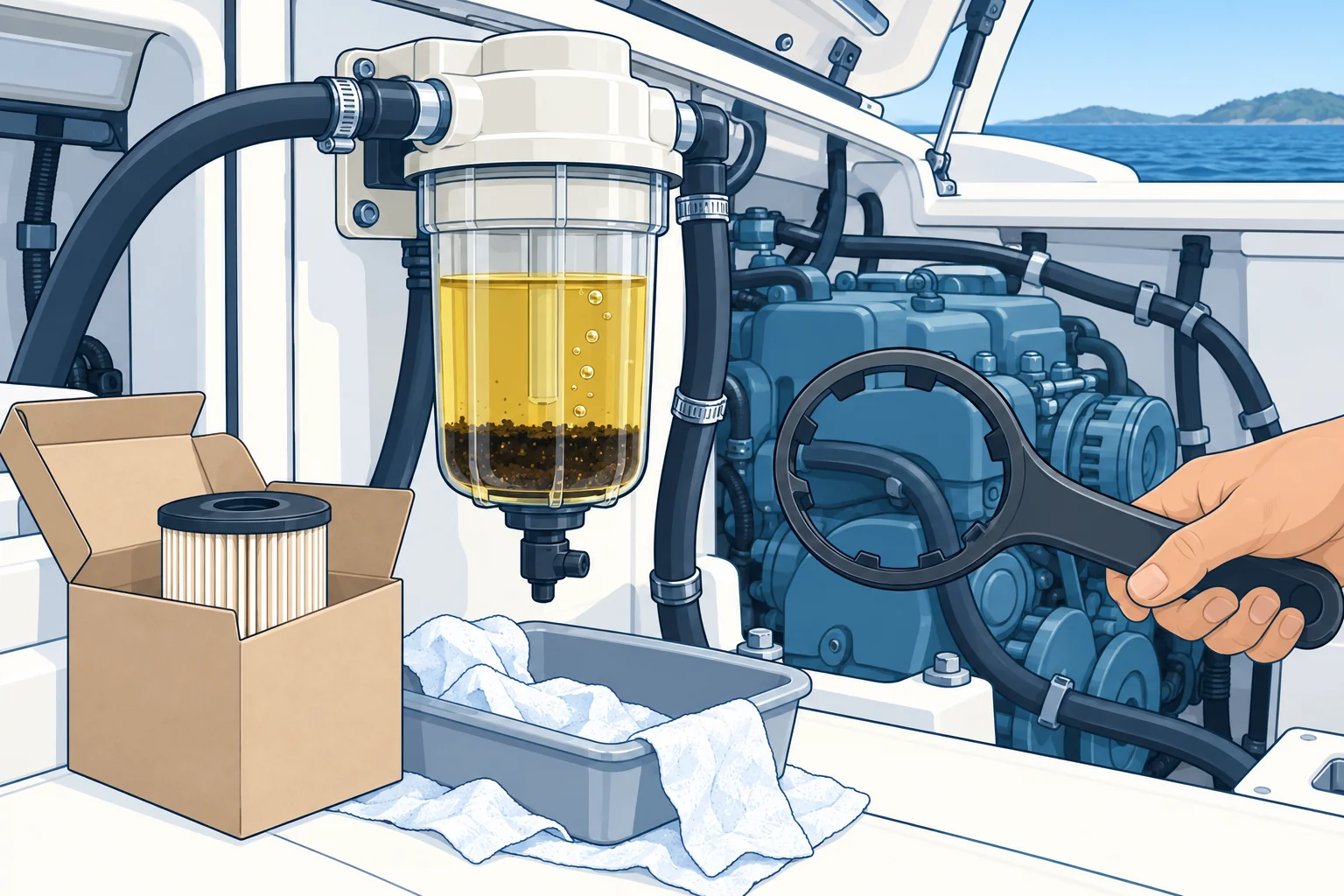
A diesel that loses power slowly, hunts (revs rise and fall) or stops after rough weather may be starved of fuel. Motion stirs up dirt and diesel bug (slime from microbes) from the tank bottom; both can block filters. A clogged filter often shows first at high revs, when flow is greatest.
Where to look
Is there fuel? Gauges lie: dip the tank. Is the tank vent, which lets air into the tank, clear? A blocked vent makes a vacuum and starves the engine. Look into the separator bowl for water or black sludge. Some boats have a vacuum gauge measuring fuel suction. At the same engine speed, rising suction vacuum suggests a restriction in the filter or upstream supply, including the tank vent.
Air in the fuel
Bubbles in the separator bowl or a sudden stop suggest air or gas in the fuel. Air can enter on the suction side, between tank and lift pump: through loose hose clips, cracked bowls or bad seals. A low tank can uncover the pickup when the boat rolls. Excessive suction from a restriction can also produce bubbles. Check fuel level, restrictions, seals and fittings; correct the cause, then bleed as the manual directs.
Water in the fuel
Water in the bowl shows that the separator has trapped water. Stop the engine and drain it into a container as the maker directs. If water returns, keep the engine stopped and isolate the contaminated supply: water reaching the injection equipment can cause serious damage. Use a known-clean tank if fitted; otherwise seek help. Do not restart until the supply is clear of water.
Not fuel?
Check for a blocked air intake or closed engine-space vent, as in ‘The engine won’t start’. Overload means the engine is working too hard. A fouled propeller or hull can cause it, with falling revs and black smoke. See ‘Smoke, vibration and a fouled propeller’.
Changing a primary fuel filter at sea
- Make the boat safe and stable, stop the engine and close the fuel valve. — Limits fuel spillage. Opening the filter still admits air, which must be bled out afterwards.
- Put rags and a container under the filter; drain the bowl. — Keeps diesel out of the bilge and shows you water or dirt.
- Remove the old element and seals. Clean the bowl, housing and seal seats as the manual directs; keep dirt out of the clean-fuel side. Fit the new element and specified seals, lubricated as directed. — Correctly seated seals prevent fuel leaks and air entry.
- Tighten using the maker’s method and torque, then reopen the fuel valve. — Overtightening cracks bowls; undertightening lets air in.
- Bleed the low-pressure system as the manual shows (Ship: diesel). — The engine will not run with air in the fuel.
- Run the engine and look for leaks and bubbles. — Confirms the repair before you rely on it.
Remember
- Loss of power or stopping after rough weather: think dirty fuel and blocked filters.
- Check fuel quantity, tank vent, separator bowl and vacuum gauge.
- Air enters on the suction side: hose clips, seals, low tank.
- Change the filter with new seals, then bleed.
Common mistakes
Wrong: The engine stopped, so the injectors must be bad.
Right: Injector faults are rare. Fuel supply and air are far more common: check them first.
Wrong: Reuse the old filter seal; it looks fine.
Right: Fit the specified replacement seals. An old seal is a common air leak; kits may include alternatives for other filter assemblies.
Wrong: Run the tank low; it saves weight.
Right: A low tank lets the pickup suck air and sludge in a seaway. Keep it well filled.
Worked case
After six hours of motoring into a rough sea, the diesel starts hunting and then stops. The tank is half full. The separator bowl looks dark, with a black layer at the bottom.
Show the answer
Suspect disturbed tank sludge restricting fuel; black material alone does not prove diesel bug. Make the boat safe, stop the engine and close the fuel valve. Drain the bowl into a container and check for water. If water or sludge returns, isolate that supply and seek help. Replace blocked filters with the specified new seals, reopen the valve and bleed as the manual directs. Restart only with a clean supply; check for leaks and confirm power under load when safe.
Practice question
Why do diesels often stop after hours in a rough sea?
- The motion overloads the starter motor
- Dirt stirred from the tank clogs filters
- The oil level drops too low in the sump
- The batteries discharge from all the shaking
Show the answer
Answer: B. Rough motion lifts sediment and diesel bug from the tank bottom into the filters.
4 · Overheating
Overheating: find the missing water
Overheat alarm: reduce load and check exhaust water. Weak or no flow: stop. Some flow does not prove adequate cooling; check coolant, belts and overload too.
First reaction
Bring the throttle back and check water at the exhaust. If flow is weak or absent, or a wet-exhaust alarm sounds, stop the engine. If flow appears normal, reduce load and follow the manual; stop if temperature stays high. Some visible water does not prove that the raw-water supply is adequate.
Weak or no exhaust water
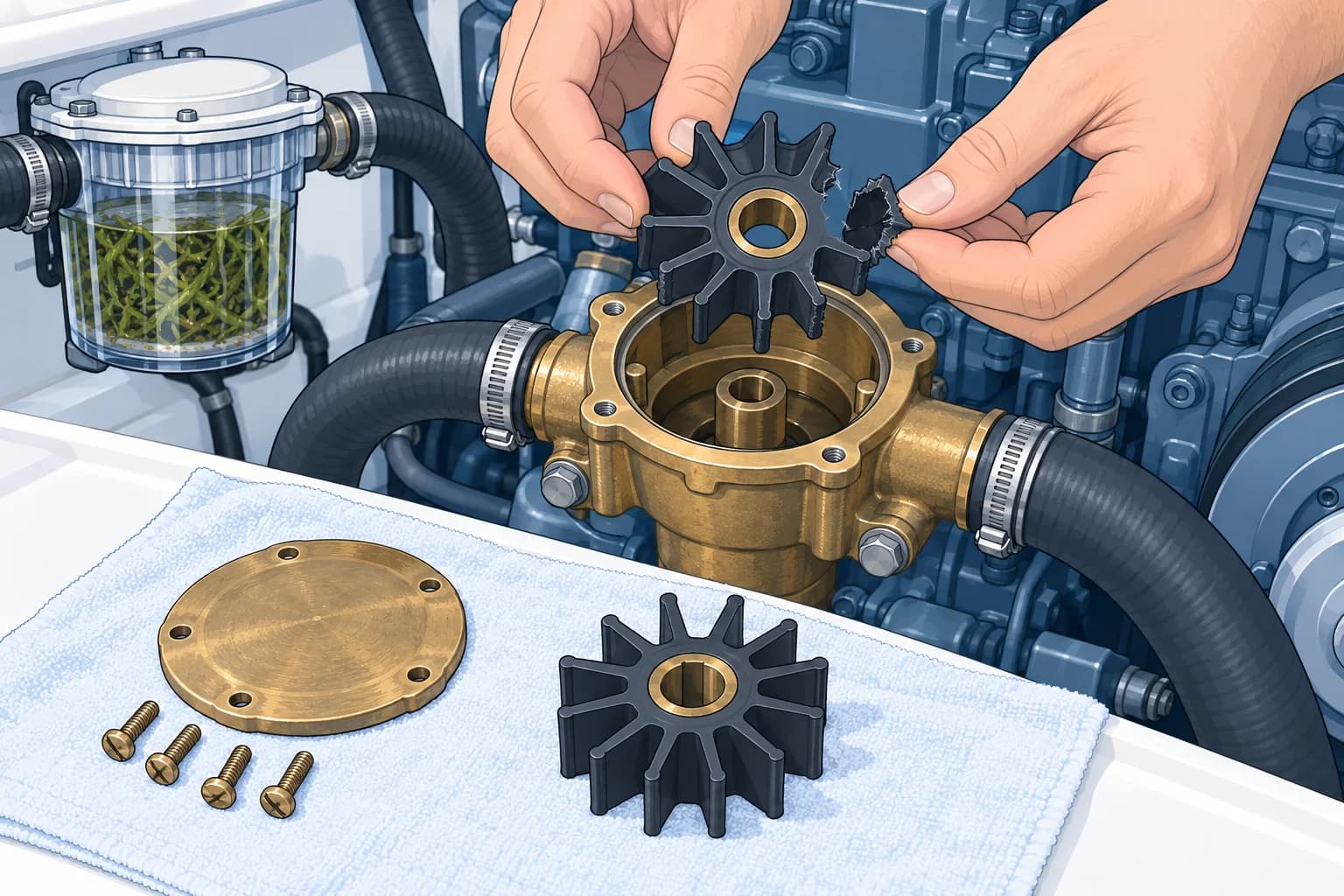
Raw water is water drawn from outside the boat for cooling. Stop and prevent restarting. Check the seacock (intake valve), strainer (debris filter), hull intake, impeller (flexible pump rotor) and hoses. Close the seacock before opening the strainer or pump; reassemble and reopen it before restarting. Check from deck where possible. Get qualified help if underwater access is needed.
Normal flow, still hot
Check for partial restrictions too. Let the engine cool before checking coolant, its cooling liquid; never open a hot cap. Check the belt if it drives the coolant pump. A stuck thermostat (temperature-control valve) or blocked heat exchanger (which transfers coolant heat to raw water) can also cause overheating. So can overload: a fouled propeller or hull makes the engine work harder.
Impeller pieces
Broken vanes can lodge downstream, often at the heat exchanger inlet. Account for every missing piece: fragments left behind can restrict cooling. Follow the maker’s instructions for inspection and removal; an exchanger end cap may provide access.
Continuing the passage
Resume motoring only if cooling-water flow is restored, temperature returns to the maker’s safe range and the manual permits operation. Monitor both closely. Low revs do not make an unresolved overheat safe. If overheating persists or water flow is lost, stop. Sail, anchor if suitable, or arrange assistance.
Key figures
- Alarm: weak/no water
- Stop; check the raw-water path
- Alarm: flow looks normal
- Check restrictions, coolant, pump belt, thermostat and overload
- Broken impeller
- Recover missing vanes; check downstream, often at the heat exchanger
Changing a raw-water pump impeller
- Stop the engine, prevent restarting and close the raw-water seacock. — Stops flooding when the pump opens, and an accidental start.
- Remove the cover; retain the screws and identify the specified gasket or O-ring. — The replacement seal must match the pump.
- Pull out the old impeller with pliers or a puller; count its vanes. — Missing vanes must be found downstream.
- Use the lubricant and fitting method specified by the maker. Follow any instructions for vane direction. — The correct fitting method avoids damaging the vanes.
- Refit the cover with the maker’s specified seal, reopen the seacock and check for leaks. — A leaking cover lets air in and the pump loses suction.
- Start and check exhaust-water flow at once; confirm temperature returns to the maker’s safe range. — Stop if flow stays weak or temperature remains high; restored flow alone does not prove the fault is fixed.
Remember
- Temperature alarm: cut the load and look at the exhaust water.
- Weak or no water: stop; check seacock, strainer, intake, impeller and hoses.
- Some water does not prove adequate flow: check restrictions, coolant when cool, pump belt, thermostat, exchanger and overload.
- A broken impeller can leave vanes downstream, often at the heat exchanger: recover the missing pieces.
Common mistakes
Wrong: Open the coolant cap to see if it is low.
Right: Never open a hot cap: scalding coolant sprays out. Wait until the engine is cool.
Wrong: Fit a new impeller and forget the broken one.
Right: Recover missing pieces: fragments left downstream can block cooling passages.
Worked case
Motoring through weed, the temperature alarm sounds and exhaust-water flow is weak. You stop and prevent restarting, close the seacock, clear the strainer, reassemble and reopen it. Flow stays weak on a test start. What next?
Show the answer
Stop and prevent restarting. Check for a remaining intake or hose restriction. Close the seacock before opening the strainer or pump. Inspect the impeller; replace it if damaged and recover missing vanes downstream. Reassemble, reopen the seacock and check for leaks. Restart only after correcting the fault; confirm normal exhaust flow and temperature before proceeding.
Practice question
The temperature alarm sounds and no water comes from the exhaust. What do you do?
- Raise revs to push water through
- Stop the engine at once
- Open the coolant cap to look
- Keep going and watch the gauge
Show the answer
Answer: B. With no water, the exhaust and impeller are damaged fast. Stop, then find the blockage.
5 · Smoke, fouled prop
Smoke, vibration and a fouled propeller
Sudden black smoke, falling revs or new vibration are clues. Suspect a fouled propeller, but check other causes. Stop and secure the shaft before working near it.
Smoke as a clue
The colours are in Ship: diesel. At sea, what matters is the change. Sudden black smoke with falling revs can indicate overload, including a fouled propeller, or restricted intake air. White steam with a rising temperature means cooling trouble. Blue smoke that appears suddenly, with oil loss, needs the engine stopped.
Vibration and noise
For violent vibration or heavy knocking, stop the engine and prevent restarting; do not run a comparison test. For mild vibration without other warning signs, reduce revs and select neutral. If vibration eases in neutral at comparable safe revs, suspect the propeller, shaft or another load-related fault; engine mounts can also be involved. Neutral does not guarantee a stationary shaft: water flow can make it turn. If vibration continues, stop the engine and check the mounts and engine.
A fouled propeller
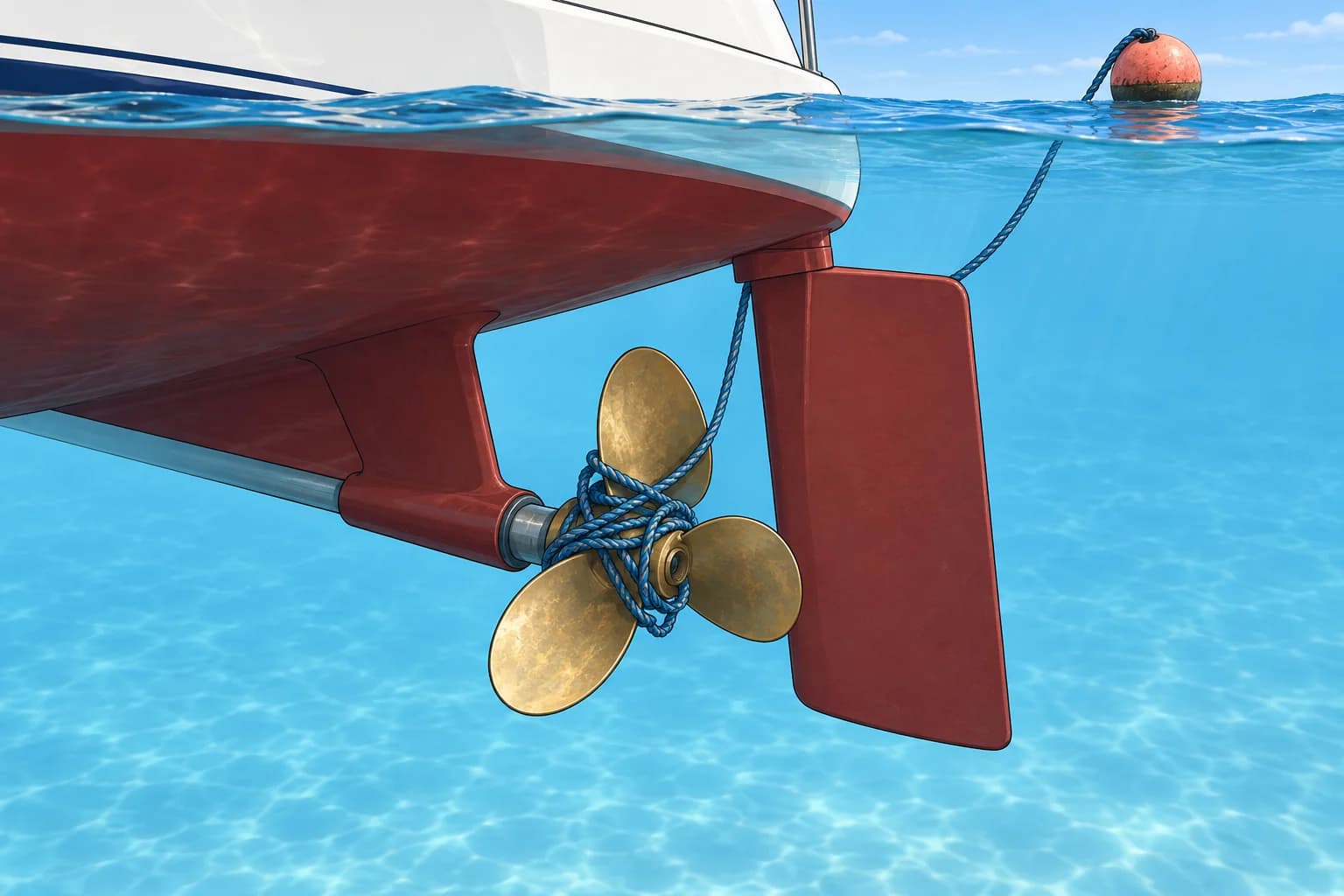
Rope, nets and plastic often wrap the propeller, especially near fishing gear. Signs include a bang, falling revs, vibration or stalling. Go to neutral at once, stop the engine and prevent restarting. A turning shaft can tighten the wrap and damage the drive or its seals, letting water in. Check for leaks.
Clearing it
Do not try to power an unidentified wrap clear: reversing can tighten it. Stop the engine and prevent restarting; secure the shaft against turning. Clear from deck only if you can reach safely with a boathook or pole cutter, keeping clear of tensioned line. Enter the water only as a last resort, in calm seas and warm water with no current. Prevent restarting and secure the shaft. Have someone watch you and provide a safe way back aboard.
Get help instead
A pitching stern can strike a swimmer's head. If the wrap is tight, the sea rough or the water cold, sail, anchor or call for a tow. Mark the fishing gear's position for others.
Key figures
- Black smoke + falling revs
- Possible overload or restricted intake air; check for fouling
- White steam + high temp
- Cooling problem
- Vibration stops in neutral
- Suggests a drive-line or load-related fault; check mounts too
Remember
- A sudden change of smoke, revs or sound is the clue.
- Fouled propeller: neutral at once, stop, prevent restarting and check for leaks.
- Keep the engine stopped while clearing a wrap; reversing can tighten it.
- Water entry: last resort, calm, warm, no current, restart prevented, shaft secured, lookout and safe recovery.
Common mistakes
Wrong: Give it full throttle to cut through the rope.
Right: It only wraps tighter and can damage the shaft, bearing or seal. Go to neutral and stop.
Wrong: Dive straight in to clear it, whatever the sea.
Right: A pitching hull can knock out a swimmer. Clear it from deck, or get a tow.
Worked case
Motoring at 6 knots past lobster pots, you hear a thump. The revs fall, black smoke appears and the boat vibrates. The sea is moderate, the water 15 °C.
Show the answer
Go to neutral, stop the engine and prevent restarting. Check the bilge and shaft seal or saildrive for leaks. A pot line is likely round the propeller; reversing may tighten it. Secure the shaft against turning. If you can reach safely, clear it from deck with a boathook or pole cutter, keeping clear of tensioned line. In moderate seas and 15 °C water, stay aboard. Sail, anchor if suitable, or call for a tow.
Practice question
Sudden black smoke and falling revs while motoring past fishing gear suggest:
- A blocked raw-water intake
- A rope round the propeller
- Water in the fuel tank
- A broken coolant pump belt
Show the answer
Answer: B. A fouled propeller overloads the engine: it slows and smokes black.