
The ship: hull, engines and systems · Level P1 · 5 parts · about 15 min
Cargo and stores (IMDG labels), painting, lubrication and routine maintenance
5 short parts: Stores · IMDG labels · Painting · Lubrication · Maintenance. Each part explains the idea, then gives the points to remember, the common mistakes, a worked case and a practice question; the Academy unit adds all 31 check questions.
1 · Stores
Taking and securing stores, and your part in cargo work
Stores come aboard by crane or by hand. Lift safely, stow them so nothing moves at sea, and report damaged cargo or leaks at once.

Stores by crane
Stores arrive on pallets or in cargo nets, lifted by the stores crane. Use one signaller, who directs the crane operator. Keep everyone clear of the suspended load. Use tag lines, ropes used from a safe position to control swing. Land the load on a clear, flat spot. Check nets and pallets before lifting: torn netting or a broken pallet can drop everything. Crane machinery and SWL: see Ship: deck equipment and machinery.
Manual handling
Manual handling means lifting, carrying, pushing or pulling by hand. Before you lift, look at the load, the route and yourself: is it too heavy, awkward or slippery? Use a trolley, a chain block (a hand-operated lifting device), or help from another person. Lift with a straight back and bent knees, keep the load close, and do not twist. Wear gloves and safety shoes; keep the route clear and dry.
Securing for sea
Before the ship sails, everything must be stowed so it cannot move in a seaway. Put heavy items low, lash drums and gas bottles upright, use shelves with lips or bars, and close and latch locker doors. A loose drum or crate can crush a person, break a pipe or start a fire.
Chemicals and cold rooms
Paints, thinners, cleaning chemicals and gas bottles go to their own lockers, as the ship directs. Each chemical comes with a safety data sheet (SDS) explaining its hazards, the personal protective equipment (PPE) to wear and first aid; read it before use. Refrigerated provision rooms have an inside door release and an alarm button for anyone shut in: know where they are.
Cargo work
During cargo operations a rating may watch hatches, tend moorings, read draught marks (markings showing how deep the hull sits in water) or check lashings. Report at once any damaged or leaking package, a container with a damaged door, an unusual smell or a loose lashing. Keep away from the leak until an officer has decided what to do.
Remember
- Stores lifts follow crane rules: one signaller, tag lines, nobody under the load.
- Before lifting by hand, assess load, route and yourself; use aids or help.
- Stow for sea: heavy items low, drums and gas bottles upright and lashed, lockers latched.
- Read the safety data sheet before using a chemical; know the cold room’s inside release.
- Report damaged or leaking cargo, a damaged container or loose lashings at once, and keep clear.
Common mistakes
Wrong: Store paint drums on the top shelf so they do not get in the way.
Right: Heavy items go low and lashed. A heavy drum high up is a falling hazard in a seaway.
Wrong: A small leak from a drum in the hold is easier to stop yourself than to report.
Right: Keep clear and report it. The officer checks what it is, its hazards and the right response first.
Worked case
Two hours before sailing, provisions arrive on pallets on the quay. One pallet carries a heavy box of tinned food on top of eggs and a 25 kg drum of cleaning chemical that is not lashed. The crane is ready.
Show the answer
Do not lift it as it is. Separate the cleaning chemical from the food and secure it for a separate lift. Restack the food with heavy boxes low and protect the eggs. Check pallets and secure each load. Use one signaller and tag lines from safe positions; keep everyone clear. Aboard, put the chemical upright and lashed in its designated locker, with its SDS available. Secure provisions with heavy items low.
Practice question
You need to carry a bulky box along a route blocked by stores. What should you do first?
- Get a helper and carry it over the stores
- Move the stores while balancing the box
- Clear the route, then assess aids or help
- Use a trolley and push the stores aside
Show the answer
Answer: C. A helper or trolley cannot make an obstructed route safe. Clear the route first, then assess the load and choose suitable aids or help.
2 · IMDG labels
Dangerous goods: the IMDG classes, labels, placards and marks
The IMDG Code sorts dangerous cargo into nine classes. Labels, placards and marks tell you the hazard at a glance.
The IMDG Code
The International Maritime Dangerous Goods (IMDG) Code sets how dangerous goods are packed, marked, stowed and documented when carried as cargo by sea. It is mandatory under SOLAS chapter VII. It is updated every two years; Amendment 42-24 became mandatory on 1 January 2026. The ship’s own paints and gases are ship’s stores, not IMDG cargo, but their labels still warn of the hazard.
Explosives
Class 1 has six divisions: 1.1, mass explosion; 1.2, flying fragments without mass explosion; 1.3, fire with minor blast or fragments, without mass explosion; 1.4, small hazard, mainly confined to the package; 1.5, very insensitive substances with mass-explosion hazard; 1.6, extremely insensitive articles without mass-explosion hazard.
Other classes
2 gases: 2.1 flammable, 2.2 non-flammable/non-toxic, 2.3 toxic. 3 flammable liquids. 4.1 flammable solids, self-reactive substances, solid desensitized explosives and polymerizing substances; 4.2 liable to spontaneous combustion; 4.3 release flammable gas when wet. 5.1 oxidizers, which make fires burn more fiercely; 5.2 organic peroxides, which can burn or decompose violently. 6.1 toxic; 6.2 infectious, carrying disease-causing organisms. 7 radioactive. 8 corrosive, damaging skin and materials. 9 miscellaneous, including lithium batteries.
Labels and placards
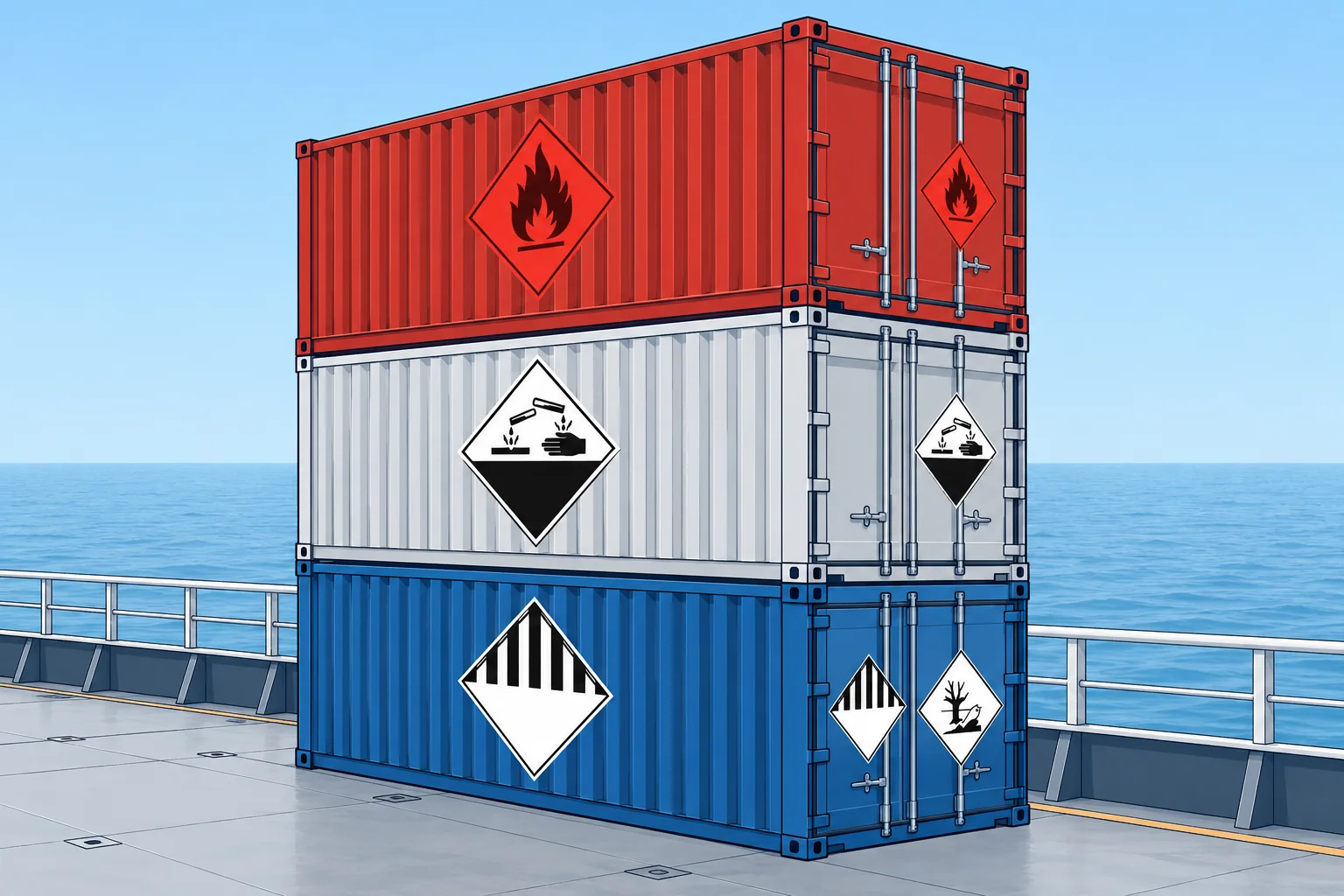
Where diamond-shaped hazard labels are required on packages, their normal minimum size is 100 mm × 100 mm. Reduced labels are permitted on some small packages under the Code. A placard is a large diamond-shaped hazard sign, at least 250 mm × 250 mm, on a cargo transport unit such as a container or tank. Where required, containers carry placards on both sides and both ends, often with the four-digit UN number that identifies the substance.
Special marks
The marine pollutant mark is a diamond showing a dead fish and a tree: the goods harm the sea. The limited quantity mark is a diamond with black top and bottom and a white middle: dangerous goods in small inner packagings, carried under relaxed rules.
What you do
Report any leaking or damaged package or container, missing placards or a strange smell, and keep upwind and clear. Never smoke near dangerous cargo. The officer uses the EmS Guide, the IMDG emergency schedules, coded F for fire and S for spillage, to decide the response.
Key figures
- Current IMDG Code
- Amendment 42-24, mandatory from 1 January 2026
- Package label
- Diamond, normally at least 100 mm × 100 mm
- Placard
- At least 250 mm × 250 mm, on containers, tanks and vehicles
- UN number
- Four digits identifying the substance
- EmS schedules
- F-codes for fire, S-codes for spillage
Remember
- The IMDG Code covers dangerous goods as cargo; Amendment 42-24 is mandatory from 1 January 2026.
- Recognise the nine classes and their divisions; classes 1, 2, 4, 5 and 6 have numbered divisions.
- Package labels are normally ≥ 100 mm; placards ≥ 250 mm go on containers and tanks.
- Marine pollutant: dead fish and tree. Limited quantity: black top and bottom, white middle.
- Report leaks or damage, keep upwind and clear; the officer uses the EmS Guide.
Common mistakes
Wrong: The number in the bottom corner of a label is the UN number.
Right: The bottom corner shows the class or division. The UN number is a separate four-digit number identifying the substance.
Wrong: A limited quantity mark means the goods are not dangerous at all.
Right: They are dangerous goods in small packagings, carried under relaxed rules. Handle them with care and report damage.
Worked case
On a container round you see a container with a class 8 placard. Liquid is dripping from the bottom of its door and there is a sharp smell. A marine pollutant mark is fitted beside the placard.
Show the answer
Keep clear, move upwind and warn others away; do not touch the liquid. Report to the officer of the watch the container position, the class 8 corrosive placard, the marine pollutant mark and any UN number you can read from a distance. The officer uses the EmS spillage schedule to decide the response. Stay clear until instructed that it is safe.
Practice question
Water is leaking onto a package labelled 4.3. Why must you keep clear and report it?
- The contents are a highly flammable liquid
- The contents are a strong oxidizing substance
- Contact with water may release flammable gas
- The contents carry disease-causing organisms
Show the answer
Answer: C. Division 4.3 substances release flammable gas on contact with water. Keep clear and report the leak and label; do not attempt a clean-up.
3 · Painting
Painting: rust grades, surface preparation, coats and safety
Paint lasts only as long as the surface under it is prepared. Follow the data sheet, watch the weather, and treat solvents as a fire and health hazard.
Why prepare
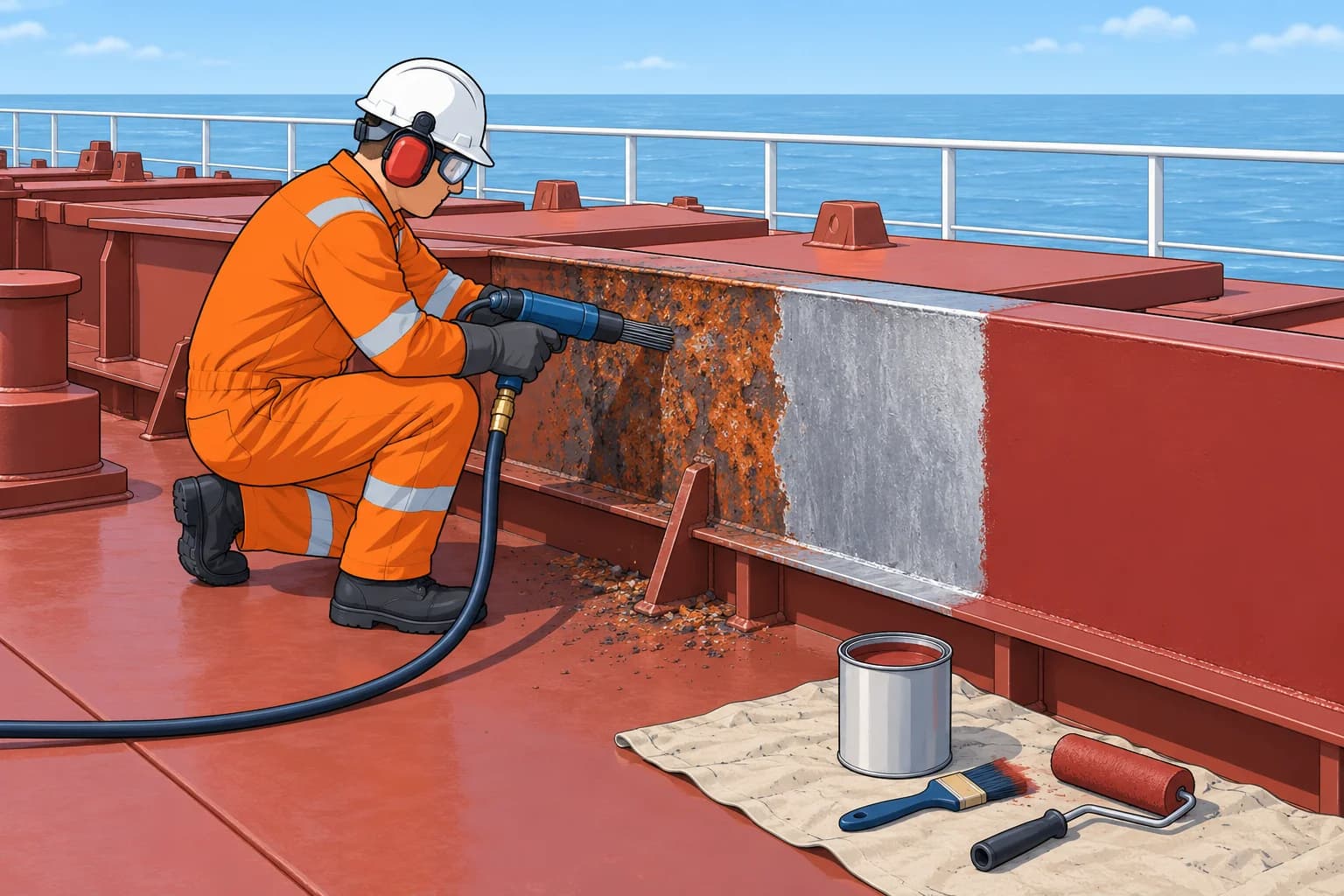
Paint protects steel only if it sticks to clean, dry, sound metal. Most failures come from poor surface preparation: rust, salt, grease or loose old paint left underneath. Wash off salt with fresh water and remove grease with a degreaser before you start.
Rust grades
ISO 8501-1 describes uncoated steel. Mill scale is the hard oxide layer left by hot rolling. Pitting means small hollows caused by corrosion. A: mostly intact mill scale, little rust. B: rust starts and scale begins flaking. C: scale rusted away or removable, slight pitting visible. D: scale gone, general pitting.
Preparation grades
St 2 means thorough hand or power-tool cleaning; St 3 is very thorough, leaving a metallic sheen. Sa 1 is light blasting; Sa 2, thorough; Sa 2½, very thorough, with only slight stains remaining; Sa 3, visually clean steel. Follow the coating’s technical data sheet.
Tools
A wire brush or scraper removes loose rust. A needle gun, many steel needles driven by air, chips heavy rust and scale. Power discs and grinders clean smaller areas. Abrasive blasting gives the best surface, usually done by contractors. Needle guns and grinders cause hand-arm vibration; take breaks and follow the ship’s limits.
Coats and timing
Apply the primer, the first protective coat, before rust returns. Follow with the specified coats. The technical data sheet (TDS) gives minimum and maximum overcoating intervals between coats: too soon traps solvent; too late may weaken bonding. The dew point is the temperature at which moisture condenses. Keep dry steel at least 3 °C above it, with humidity within the TDS limit, often 85 %.
Health and fire
Wear goggles, gloves, overalls and hearing protection for noisy tools. Use the safety data sheet (SDS) and task assessment to choose breathing protection for dust and solvent vapour. Solvent vapour is toxic and flammable: ventilate; keep smoking and hot work away. Store paints and thinners in the paint locker, which has fire protection. For aloft, overside and enclosed-space work, see Ropes: deck safety.
Key figures
- Rust grades (ISO 8501-1)
- A (little rust) to D (general pitting)
- Preparation grades
- St 2, St 3 by hand or power tool; Sa 2½ near-white blast
- Weather limit
- Steel ≥ 3 °C above dew point; humidity often ≤ 85 %
- Overcoating
- Within the data sheet’s minimum–maximum interval
Remember
- Most paint failures come from poor surface preparation: salt, grease, rust or loose paint left under.
- Rust grades A–D; preparation St 2/St 3 by tool, Sa 2½ by blasting.
- Prime soon after preparation; respect the overcoating window on the data sheet.
- Paint only on dry steel at least 3 °C above the dew point.
- Solvents are toxic and flammable: ventilate, PPE, no hot work nearby; paint locker for storage.
Common mistakes
Wrong: Paint straight over rust scale; the new coat will seal it in.
Right: Remove loose rust and scale and clean to the grade the data sheet asks for. Paint over rust soon flakes off.
Wrong: The deck looks dry at dawn, so it is fine to start painting.
Right: Check steel temperature and dew point. Require the data sheet’s margin, usually at least 3 °C, and a dry surface.
Wrong: Leave the second coat for a week to let the first coat harden well.
Right: Follow the data sheet’s maximum overcoating interval; past it, the next coat may not bond without extra preparation.
Worked case
The bosun asks you to touch up rust spots on a raised steel rim around a hatch at 0700. Overnight the air was humid; the steel is cold and the dew point is 14 °C. A surface thermometer reads 15 °C on the steel.
Show the answer
The 1 °C margin is too small. At the current 14 °C dew point, wait for steel at least 17 °C and check all other TDS conditions. Prepare the spots: wash off salt and remove loose rust with a wire brush or needle gun, using the eye, hearing, skin and dust protection selected for the task. Apply primer once conditions meet the TDS.
Practice question
Which ISO 8501-1 grade means blast cleaning to near-white metal?
- St 2
- St 3
- Sa 2½
- Grade D
Show the answer
Answer: C. Sa grades are blast cleaning; Sa 2½ is very thorough, near-white. St 2 and St 3 are hand and power tool cleaning; A–D are rust grades.
4 · Lubrication
Lubrication: grease points, wire dressing and keeping oil off the sea
Grease the right points with the right grease at the right interval, dress wires, and keep every drop of oil on board.
Grease points
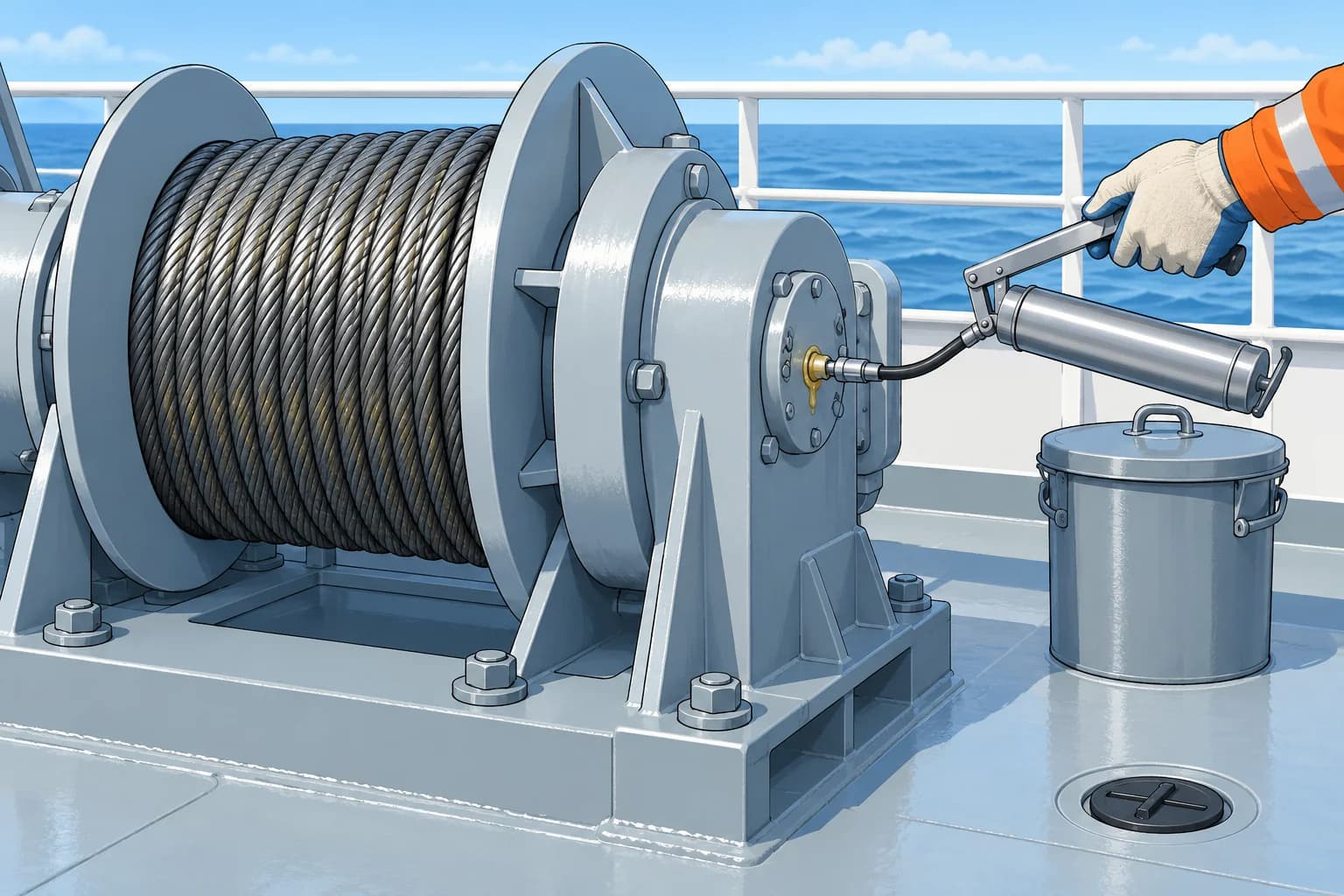
Deck machinery has grease nipples, small valves where a grease gun pushes grease into a bearing. The lubrication chart lists every point, the grease, quantity and interval. Wipe the nipple clean first so dirt is not pumped in. Apply the quantity specified by the maker; do not keep pumping to force grease out. Too much can damage seals.
The right grease
Use the grease named on the chart. Greases contain oil and a thickener, which gives grease its consistency. Some do not mix: incompatible greases can soften and run out, leaving the bearing dry. If the type changes, the old grease is purged as the maker describes. Keep containers closed and labelled so grease stays clean.
Wire rope dressing
Wire dressing is the maker’s approved lubricant for a steel rope. It reduces wear and internal and external corrosion. Stop and isolate the machinery and secure the rope against movement before cleaning or touching it. Use the maker’s cleaning method and apply dressing with a brush or purpose-made applicator. Never clean or dress a moving rope by hand.
Oil on deck
Oil and grease cause falls. Fit scupper plugs, which block deck drains, before oil work. Save-alls are trays that catch leaks around vents and machinery. Keep their drains shut during oil work and transfer collected oil to the designated oily-waste container. Wipe up spills with absorbent from the spill kit. Oily rags can self-heat and catch fire: keep them in a closed metal bin. Pollution rules are in Ocean: pollution.
Greasing a deck machinery bearing
- Isolate the machine if any part can move while you work. — Grease points sit near drums, gears and wires that can trap hands.
- Check the lubrication chart for grease type, quantity and interval. — The wrong grease can mix badly and leave the bearing dry.
- Wipe the nipple clean before connecting the grease gun. — Dirt pumped into a bearing wears it fast.
- Apply the quantity specified by the maker; do not keep pumping to force grease out. — Too much grease can burst seals and overheat the bearing.
- Wipe off excess, refit caps and record the job. — Records show the job was done and when it is next due.
Remember
- The lubrication chart gives every grease point, grease type, quantity and interval.
- Clean the nipple; apply the maker’s specified quantity. Do not over-grease.
- Use the specified grease; incompatible greases can soften and run out.
- Stop and isolate machinery before hand cleaning or dressing wire ropes; secure the rope and use the maker’s method.
- Scupper plugs and save-alls keep oil on board; oily rags go in a closed metal bin.
Common mistakes
Wrong: Any grease will do; use what is in the gun already.
Right: Use the grease on the lubrication chart. Mixing incompatible greases can make them soften and leave the bearing dry.
Wrong: Leave oily rags in a heap in the deck store to use later.
Right: Oily rags can heat up and ignite on their own. Keep them in a closed metal bin and land them as the ship’s garbage plan says.
Worked case
You are greasing the windlass. Grease is not reaching a bearing, and grease is oozing from the joint between the gun and the nipple. The chart says lithium-complex grease; the gun is loaded with a calcium-based grease from another job.
Show the answer
Stop; do not increase pressure. Report that grease is not reaching the bearing and is leaking at the coupling. Leakage does not prove the nipple is blocked. Use a clean gun containing the specified grease. If wrong grease entered the bearing, tell the officer so the maker’s changeover procedure can be followed. Clean up and record the job.
Practice question
Why wipe a grease nipple clean before connecting the gun?
- So the gun delivers a larger measured charge
- So dirt is not pumped into the bearing
- So the nipple vents excess grease more easily
- So old and new greases mix more thoroughly
Show the answer
Answer: B. Dirt on the nipple is forced into the bearing with the grease and wears it fast.
5 · Maintenance
Planned maintenance, defect reports, tools and waste on board
The planned maintenance system says what is due; you do the job safely, record it and report defects. Sort waste as the ship’s plan says.
Planned maintenance
The ship’s planned maintenance system (PMS), paper or software, lists each job, its interval in days or running hours, and how to do it. You do the job you are given, safely, and the officer records it. Spare parts used are recorded too.
Report defects
Report anything broken, leaking, worn or missing to the officer or bosun, even if you think someone already knows: a defect not reported is not fixed. Say what, where and since when. Defects in safety equipment, steering, mooring gear, watertight doors or lifting gear are reported at once.
Hand and power tools
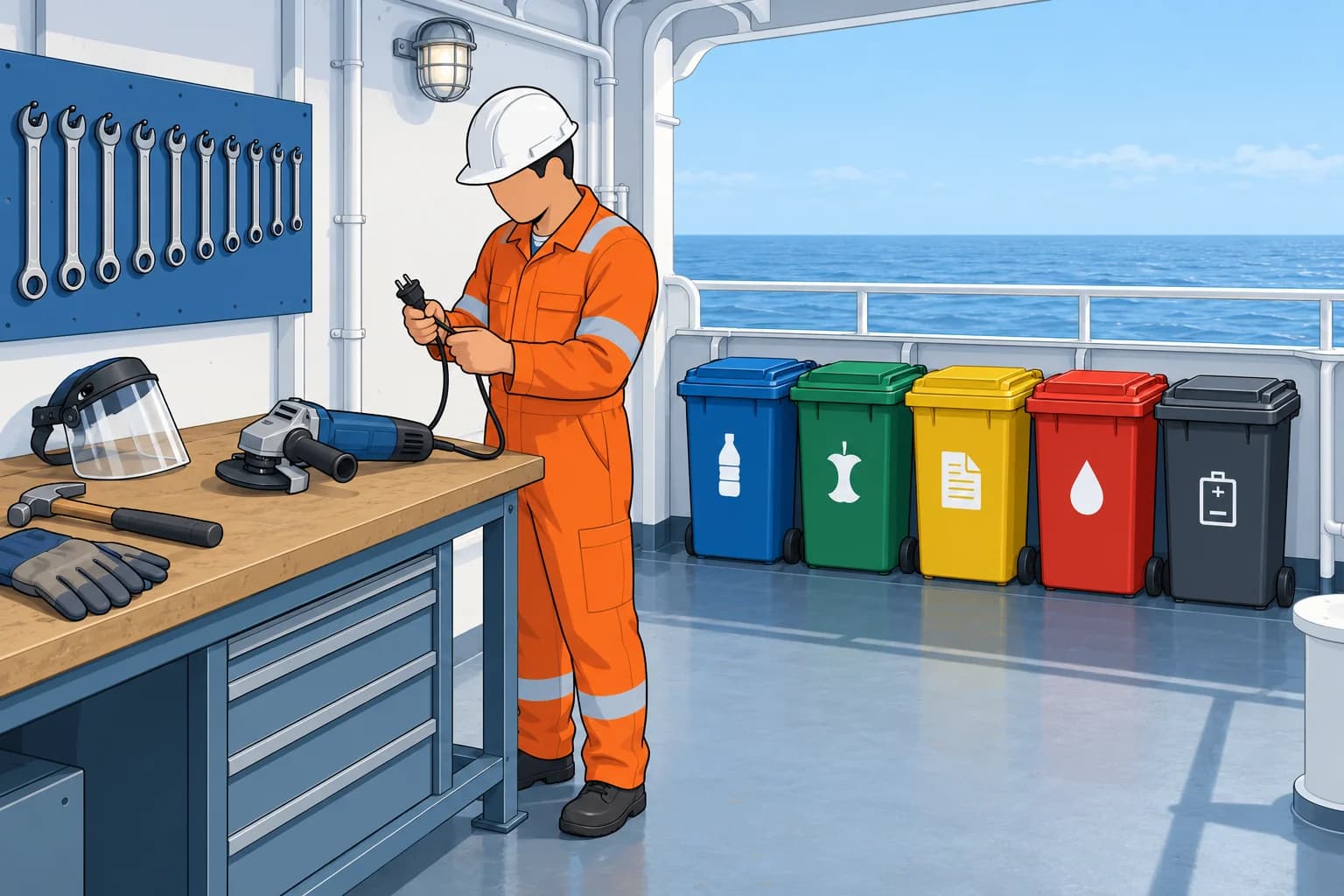
Check for cracked handles, loose heads or damaged cables. Keep grinder guards on. Use the correct disc type and size, rated for at least the grinder’s maximum speed. Only trained, authorised people should fit discs. Wear impact-rated goggles and a face shield for grinding, plus suitable gloves and hearing protection. Disconnect power before changing discs or bits. Never point compressed air at a person.
Waste on board
MARPOL Annex V is the ship-garbage part of the international pollution convention. Sort waste at source using the ship’s bins. Keep plastics, food, domestic waste, cooking oil, incinerator ash, operational waste, animal carcasses, fishing gear and e-waste separate where applicable. Cargo residues harmful to the marine environment are separate from other cargo residues. Put paint waste, thinners, oily rags and batteries in designated separate containers for shore disposal. Discharge rules are in Ocean: pollution.
Remember
- The PMS lists jobs, intervals and methods; work done and parts used are recorded.
- Report every defect: what, where, since when. Safety-critical defects at once.
- Check tools and guards; use the correct disc type and size, rated for at least the grinder’s maximum speed.
- Disconnect power before changing discs or bits; never aim compressed air at anyone.
- Sort garbage by the ship’s MARPOL Annex V categories; paints, oily rags and batteries separate.
Common mistakes
Wrong: Take the guard off the grinder to reach a tight corner.
Right: Never remove the guard. Use a smaller tool or another method, and wear eye and face protection.
Wrong: Do not report a small defect; someone else will have seen it.
Right: Report it. Defects not reported are not fixed, and small ones grow.
Wrong: Plastic food wrappers can go in the food waste bin with the leftovers.
Right: Plastics go in their own bin. Food waste mixed with plastic cannot be treated as food waste.
Worked case
You are given a grinder to clean a rusty bracket. The disc fitted is marked for a lower speed than the grinder’s rating, the cable has tape round a cut, and the guard is loose.
Show the answer
Do not use it. An underrated disc can burst, a taped cable can give a shock, and a loose guard will not protect you. Report all three faults to the bosun or officer. Use a sound grinder with a compatible disc of the correct type, size and speed rating. Only trained, authorised people should fit discs, with power disconnected. Wear impact-rated goggles and a face shield, plus suitable gloves and hearing protection.
Practice question
After completing a scheduled job, what should you give the officer for the maintenance record?
- Work done, completion date and parts used
- Work done and date, leaving out parts used
- Parts used and date, leaving out work done
- Work planned and parts ordered for next time
Show the answer
Answer: A. The record needs what you actually did, when you completed it and any parts used. A planned job or parts order does not prove the work was completed.