
The ship: hull, engines and systems · Level R3 · 5 parts · about 15 min
Steering, fuel, water and bilge systems
5 short parts: Steering · Fuel and water · Heads · Bilge · Seacocks. Each part explains the idea, then gives the points to remember, the common mistakes, a worked case and a practice question; the Academy unit adds all 30 check questions.
1 · Steering
Steering systems and the emergency tiller
Tiller, cable, hydraulic or push-pull: know how your steering works, what fails first and how to fit the emergency tiller.
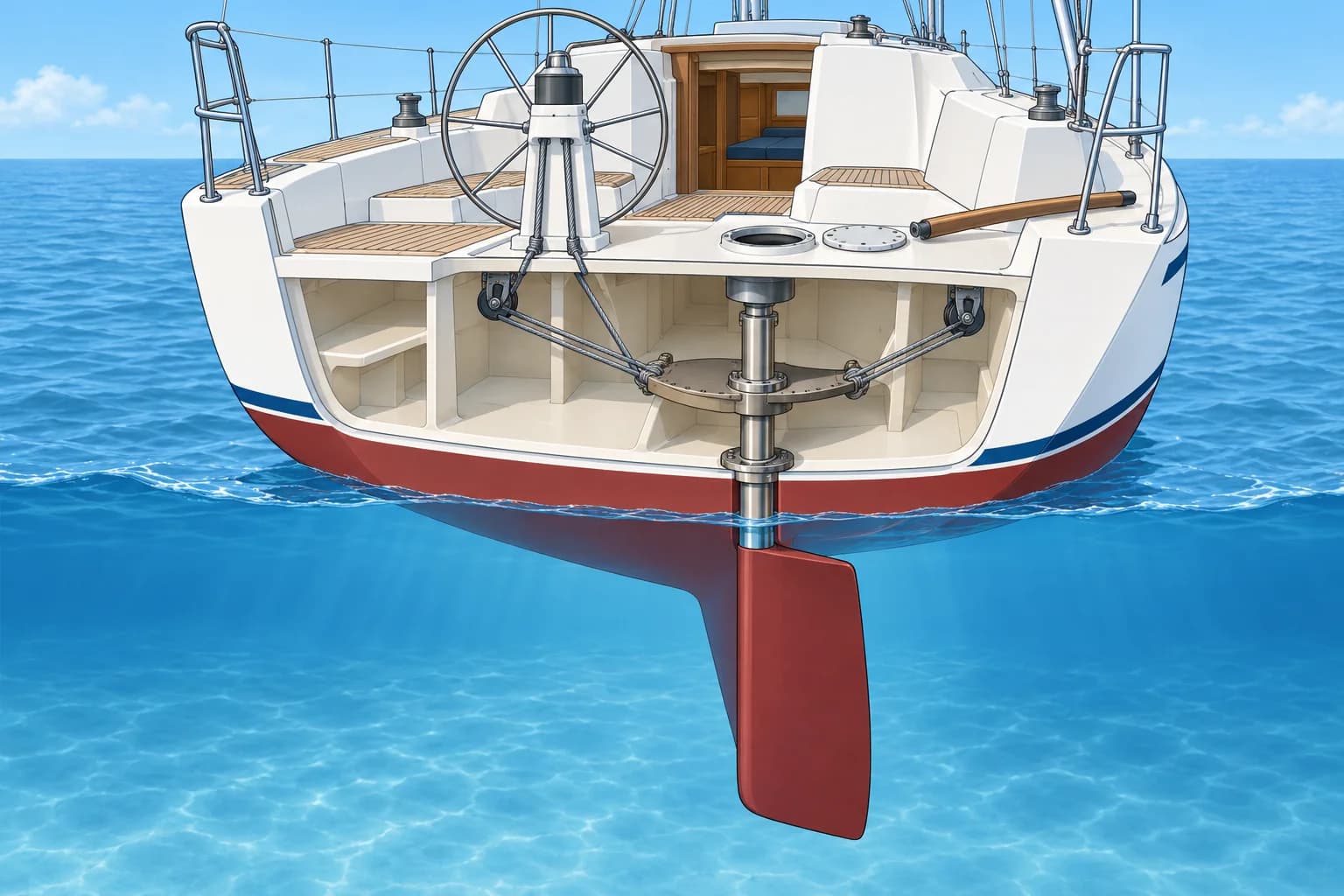
Tiller
A tiller is a lever fixed straight to the top of the rudder stock (the shaft that turns the rudder). It is simple, gives direct feel and rarely fails.
Wheel with cables
The steering wheel turns a sprocket (a toothed wheel) and chain, which pull wire cables. These run over sheaves (pulleys) to a quadrant (a curved arm fixed to the stock). Cables stretch and sheaves wear. Check tension, the clamp bolts and the rudder stops that stop the rudder turning too far.
Hydraulic and push-pull
In hydraulic steering the wheel is a pump that sends oil through pipes to a ram (a hydraulic cylinder) that moves an arm on the rudder stock. A leak or air in the oil makes the wheel feel soft. Check the oil level and look for leaks. Small motorboats often use a single push-pull cable to turn an outboard or sterndrive (a drive unit outside the stern). Follow the maker’s servicing instructions and avoid kinks.
Emergency tiller
An emergency tiller fits on the top of the rudder stock, usually through a deck plate. Know where it is stowed, what opens the plate, and practise fitting it in calm water. Use it only if the rudder and stock are intact and free to turn. Follow the maker’s instructions for disconnecting failed steering. An autopilot that drives the quadrant directly may work after cable failure only if its linkage is intact and nothing obstructs rudder movement.
Rudder checks
At each lift-out, check the rudder bearings for looseness, and the blade for cracks or signs of trapped water. If steering fails, reduce speed and sail load as conditions allow. Check whether the rudder and stock move freely before choosing a backup. Seek help if you cannot restore control.
Remember
- Tiller: direct and reliable.
- Cable steering: check tension, sheaves, quadrant bolts and stops.
- Hydraulic: oil level, leaks; soft wheel means air or a leak.
- Know and practise the emergency tiller.
- Check rudder bearings and blade at each lift-out.
Common mistakes
Wrong: The emergency tiller is in a locker somewhere; we will find it if needed.
Right: Stow it where you can reach it quickly, keep the deck-plate key with it and practise fitting it.
Wrong: A slightly spongy hydraulic wheel is normal with age.
Right: It usually means air or a leak. Check the oil level and bleed the system as the maker says.
Worked case
Sailing upwind in a fresh breeze (Force 5), the wheel suddenly spins freely and the boat turns towards the wind. You hear a clunk from the aft cabin.
Show the answer
Reduce speed and sail load as conditions allow. Check whether the rudder and stock are intact and move freely. Use the emergency tiller only if they do; follow the maker’s instructions for disconnecting failed steering. A direct-drive autopilot is an option only if its linkage is intact and free, and failed steering does not obstruct movement. Seek help if you cannot restore control.
Practice question
On wheel steering with cables, what is clamped to the rudder stock?
- A hydraulic pump
- A rudder quadrant
- A push-pull cable
- A sheave block
Show the answer
Answer: B. The cables pull on a quadrant fixed to the rudder stock.
2 · Fuel and water
Fuel system safety and fresh water
A safe fuel system keeps fuel in and fire out. A fresh-water system keeps you supplied, if you look after the pump and tanks.
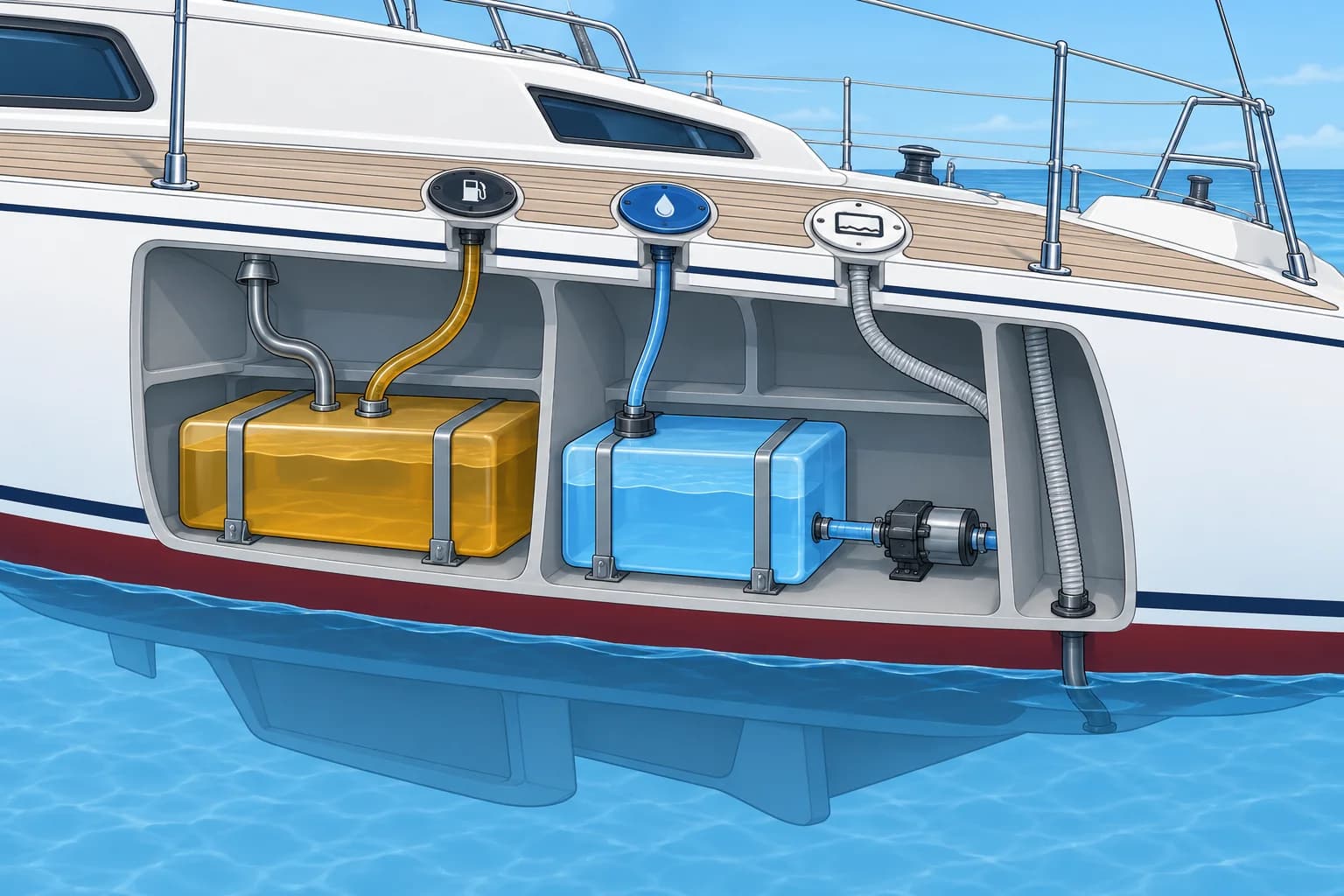
Fuel tank and fittings
Identify the labelled deck filler, vent, fuel outlet and shut-off valve. The vent lets the tank breathe and must stay clear and resist water entry. Flame-arresting screens, fitted where required, stop an outside flame travelling into the tank. Many diesel systems also return unused fuel to the tank. Know how to operate the shut-off from outside the engine space.
Hoses and joints
Fuel hoses must be marine fuel hose to the right standard; in the engine space, a fire-resistant type. Check hoses for cracks and soft spots, and clips for corrosion. Any smell of fuel inside the boat needs finding.
Clean fuel
Use the fuel grade specified by the engine maker. Water and dirt can block filters. Check the water separator (which collects water from the fuel) and drain collected water as instructed. Follow the maker’s storage advice and leave expansion space in the tank. The refuelling procedure is in Gas and petrol safety.
Fresh water
Water tanks feed a pressure pump that switches on when you open a tap. An accumulator stores water under pressure to smooth the flow. A calorifier stores domestic hot water heated by engine coolant or a shore-power element. Switch the pump off when leaving the boat: a burst pipe can empty the tank into the bilge.
Fillers and hygiene
Deck fittings are marked FUEL (or DIESEL/PETROL), WATER or WASTE. FUEL and WATER are fillers; WASTE is the sewage pump-out. Check twice before filling; diesel in the water tank is a costly mistake. Flush and sanitise water tanks each season, and drain or winterise the system in frost.
Remember
- Fuel tank: filler, vent, shut-off valve reachable from outside the engine space.
- Fire-resistant fuel hose in the engine space.
- Check the water separator; follow the maker’s fuel-storage advice.
- Switch off the water pump when leaving the boat.
- Read the deck filler label twice.
Common mistakes
Wrong: The fuel shut-off is under the engine; that is fine.
Right: You must be able to close it without entering a burning engine space. Know where it is.
Wrong: Leave the water pump on when you go ashore.
Right: If a pipe fails, the pump empties the tank into the bilge and runs dry. Switch it off.
Worked case
Back from a day ashore, you hear the water pump running in short bursts, and the bilge pump has been cycling. The water tank is half empty although nobody was aboard.
Show the answer
Switch off the water pump. The falling tank level and repeated pump starts suggest a leak after the pressure pump. Inspect the pressurised pipes and fittings to confirm the source, and check for other sources of bilge water. Never taste bilge water: it may contain fuel, sewage or chemicals. Switch the water pump off when leaving the boat.
Practice question
Where should the fuel shut-off valve be operable from?
- Only from inside the engine space
- From outside the engine space
- From the deck filler cap
- From the fuel vent outlet
Show the answer
Answer: B. In an engine fire you must stop the fuel without opening the space.
3 · Heads
Heads, holding tanks and discharge rules
Know your toilet’s plumbing, use it correctly and retain sewage wherever discharge is banned.
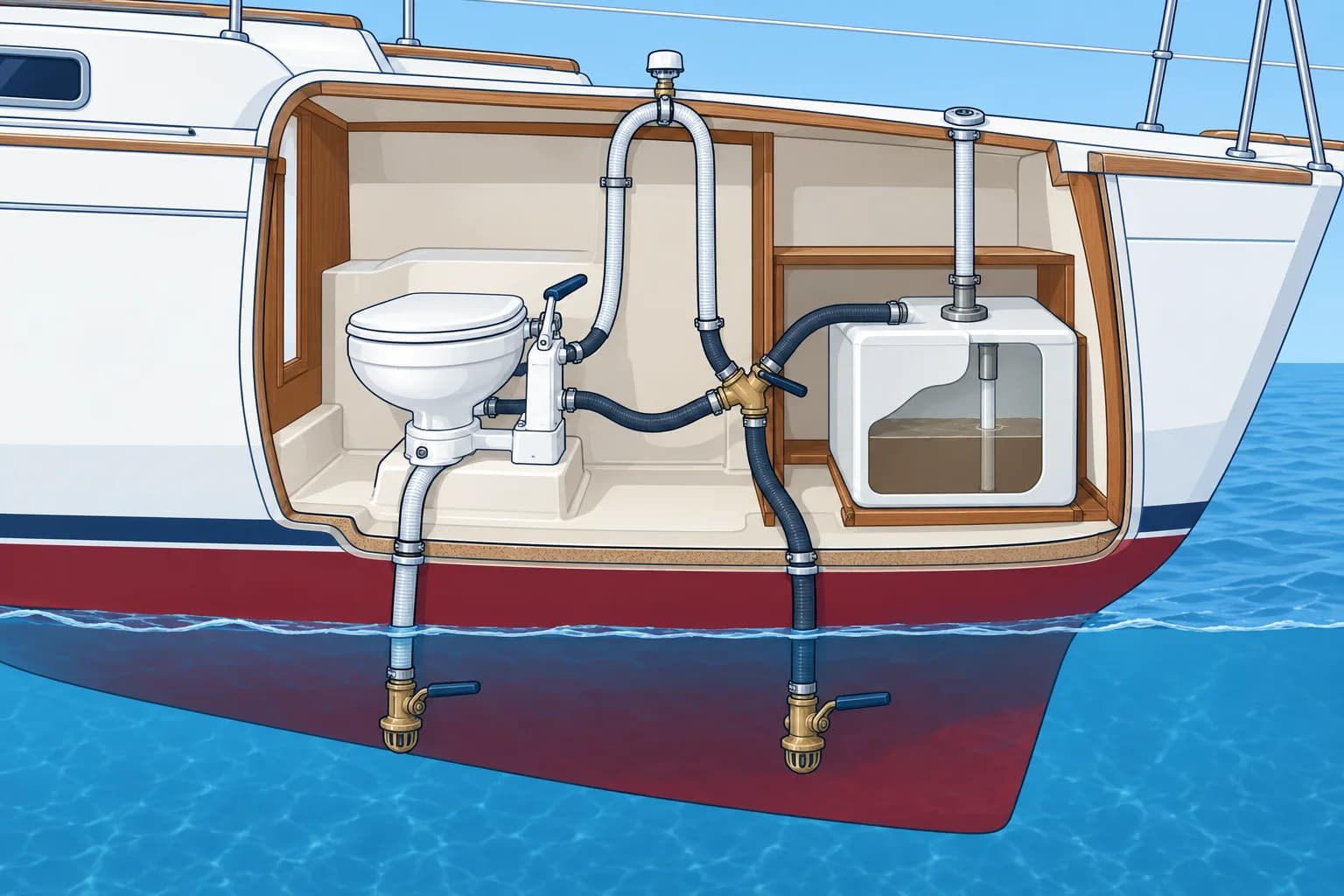
The marine toilet
A head is a marine toilet. On a seawater-flushed manual model, an inlet seacock (sea-water shut-off valve) supplies flushing water. A pump and wet/dry lever flush the bowl; waste goes to a holding tank or a permitted overboard outlet. Only human waste and a little suitable toilet paper belong in it. Follow the maker’s pumping instructions.
Siphoning
A siphon can keep sea water flowing into the toilet after flushing. A vented loop is a raised hose bend whose valve admits air to break that flow. Height alone is not enough: keep the valve clear. Follow the maker’s hose layout and minimum height above the waterline when heeled (leaning over). On a manual head, the inlet loop normally goes between pump and bowl, not before the pump; discharge may need a separate loop. Close sea-connected toilet seacocks when unused and before leaving.
Holding tanks
A holding tank stores waste. A Y-valve sends it to the tank or overboard; where discharge is banned, lock it to the tank. Empty the tank through the deck fitting marked WASTE at a pump-out station, or overboard where allowed. A clear tank vent lets air escape during filling and enter during pump-out; an optional filter reduces smells. On craft covered by the current EU Recreational Craft Directive, toilets must connect solely to a holding tank or water-treatment system.
The rules
MARPOL Annex IV generally covers ships on international voyages of at least 400 GT (gross tonnage, a measure of internal volume), or certified for more than 15 people. Approved comminuted (broken up) and disinfected sewage: over 3 nautical miles (nm) from nearest land; untreated sewage: over 12 nm. Stored sewage must also be discharged en route at ≥4 knots, at an approved rate. Approved treatment plants have different conditions. Check national and local rules for your yacht; use pump-out where discharge is banned.
Key figures
- MARPOL Annex IV
- International voyages: ≥400 GT or certified for >15 people
- Comminuted + disinfected
- Approved system: over 3 nm from nearest land; other conditions apply
- Stored sewage
- Treatment sets distance; under way ≥4 knots; approved rate
- Yachts
- National and regional rules: check before you go
Remember
- Close the toilet’s sea-connected seacocks when not in use.
- A correctly positioned, working vented loop admits air to break a siphon.
- Y-valve to holding tank where discharge is banned.
- MARPOL conditions depend on treatment; check local rules and discharge bans.
Common mistakes
Wrong: Wet wipes and kitchen roll can go down the marine toilet.
Right: Use only human waste and a little suitable toilet paper, following the maker’s guidance. Wipes and kitchen roll can block the pump or pipe.
Wrong: MARPOL distances apply to every yacht.
Right: Annex IV generally covers ships on international voyages of at least 400 GT or certified for more than 15 people. Check national and local rules for your yacht.
Worked case
Returning from a weekend, you find the forward heads bowl full to the rim with sea water and the cabin sole damp. Both seacocks were left open.
Show the answer
Water may be entering through the toilet plumbing; these symptoms do not prove siphoning. Close both toilet seacocks. Inspect hoses and connections as well as the required vented loops, their valves and the maker-specified layout. Keep the toilet out of use until the fault is corrected and the system tested. Close sea-connected toilet seacocks when unused.
Practice question
What stops sea water siphoning into a heads below the waterline?
- A waste Y-valve
- A holding tank
- A vented loop
- A deck pump-out
Show the answer
Answer: C. A correctly positioned and working vented loop admits air to break the siphon. Follow the maker’s hose layout and height above the heeled waterline.
4 · Bilge
Bilge system and pumps
Bilge pumps remove collected water. A float switch starts the electric pump; a separate high-water alarm warns you when the water rises.
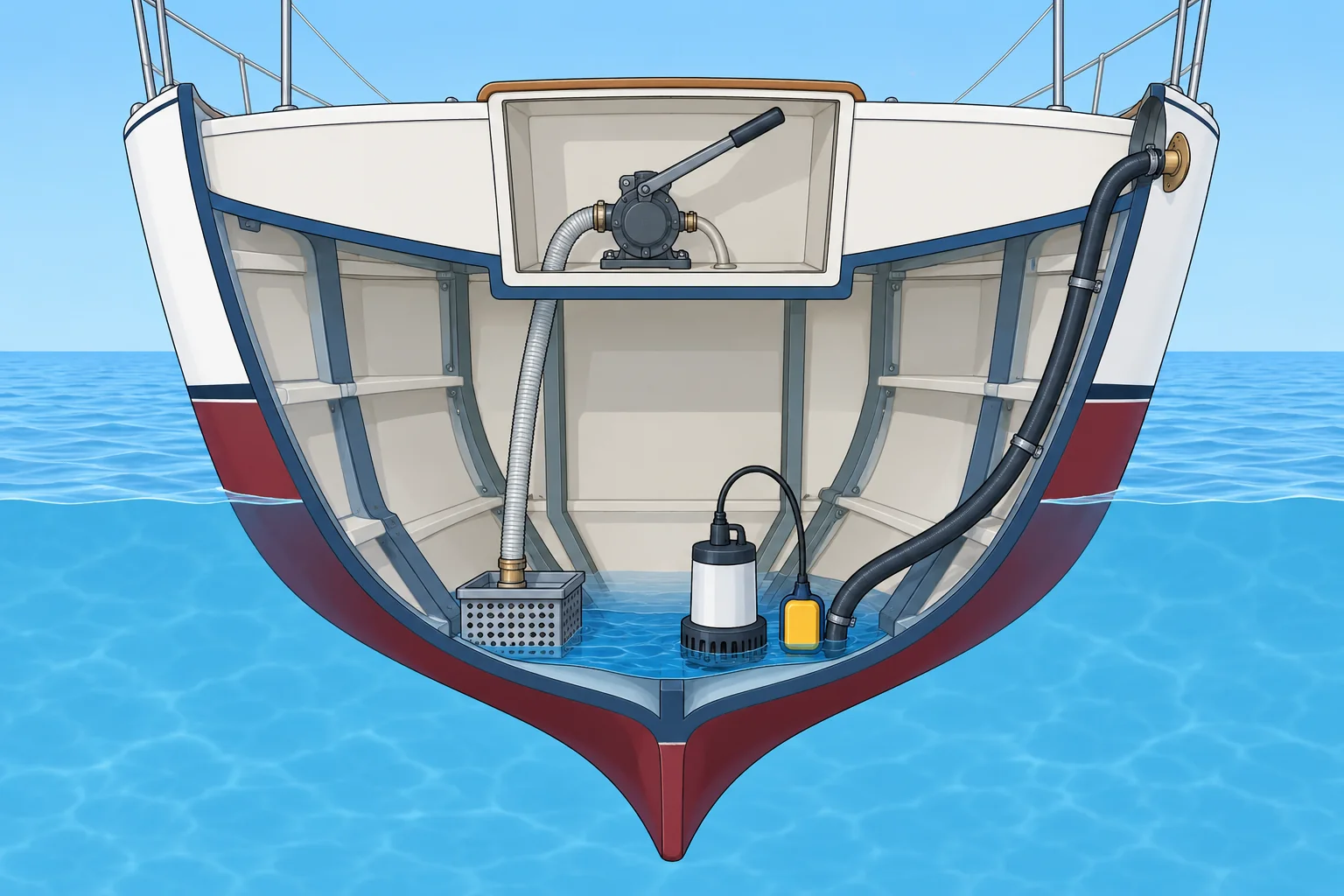
The bilge
Water collects at the lowest point: the bilge or sump. Limber holes in the frames let it run there; keep them clear. A strum box (strainer) on each pump intake stops debris blocking the pump.
Manual pump
A manual bilge pump works without electricity. On a yacht it should be operable from the cockpit with hatches and lockers closed, with its handle stowed nearby. Many boats also have a second one below decks.
Electric pump
An electric pump sits in the sump with a float switch that starts it automatically, plus a manual switch at the panel. The automatic circuit needs a correctly rated fuse and must remain powered when the main battery switch is off. Advertised maximum flow often assumes zero lift: no height gained by the water. Actual flow falls with discharge height, resistance in the hose and low supply voltage. Use the maker’s flow curve, a chart of flow at different heights.
Alarms and checks
A high-water alarm warns of rising water independently of pump operation. A pump-cycle counter records pump starts; it does not replace the alarm. Test pumps, floats and alarms monthly: lift the float by hand, add clean water and confirm discharge. Where the outlet can become submerged, follow the maker’s discharge layout and use suitable anti-siphon protection (to stop seawater flowing back) above the heeled waterline. A non-return valve alone is not protection.
Oil and pollution
Never pump oily or fuel-stained bilge water overboard; it is illegal and harmful. Use absorbent pads, keep the engine drip tray clean and take oily waste ashore.
Remember
- Keep limber holes and strum boxes clear.
- A manual pump works without power; operate it from the cockpit.
- Keep the fused automatic bilge-pump supply powered when the main battery switch is off.
- High-water alarm: test pumps and alarms monthly.
- Never pump oily water overboard.
Common mistakes
Wrong: Our electric pump is rated at 2,000 litres an hour, so it will cope with any leak.
Right: Installed flow depends on lift, hose losses and supply voltage. Use the maker’s flow curve for your installation. A broken hose below the waterline can let in far more.
Wrong: A pump that runs often is doing its job.
Right: Frequent cycling needs investigation: it may mean more water entering, discharge water returning, or a switching fault.
Worked case
During a routine test at the berth, the electric bilge pump runs but delivers little water. Its advertised flow is much higher. What should you check?
Show the answer
Switch off the pump before inspecting its intake strainer. Check for debris, hose restrictions, discharge height and low supply voltage against the maker’s instructions. Retest with clean water and confirm flow at the outlet: a running motor does not prove water is moving. Test the float switch and separate high-water alarm. Confirm the manual pump works from the cockpit with hatches closed. Never taste bilge water.
Practice question
What is a strum box?
- A counter of pump starts
- A strainer on the pump intake
- A housing for the float switch
- A valve in the discharge hose
Show the answer
Answer: B. It stops debris from blocking the pump.
5 · Seacocks
Seacocks and through-hull fittings
Every hole below the waterline is a way for the sea to get in. Know where each seacock is, keep them working and follow the boat’s safe leaving checklist.
What they are
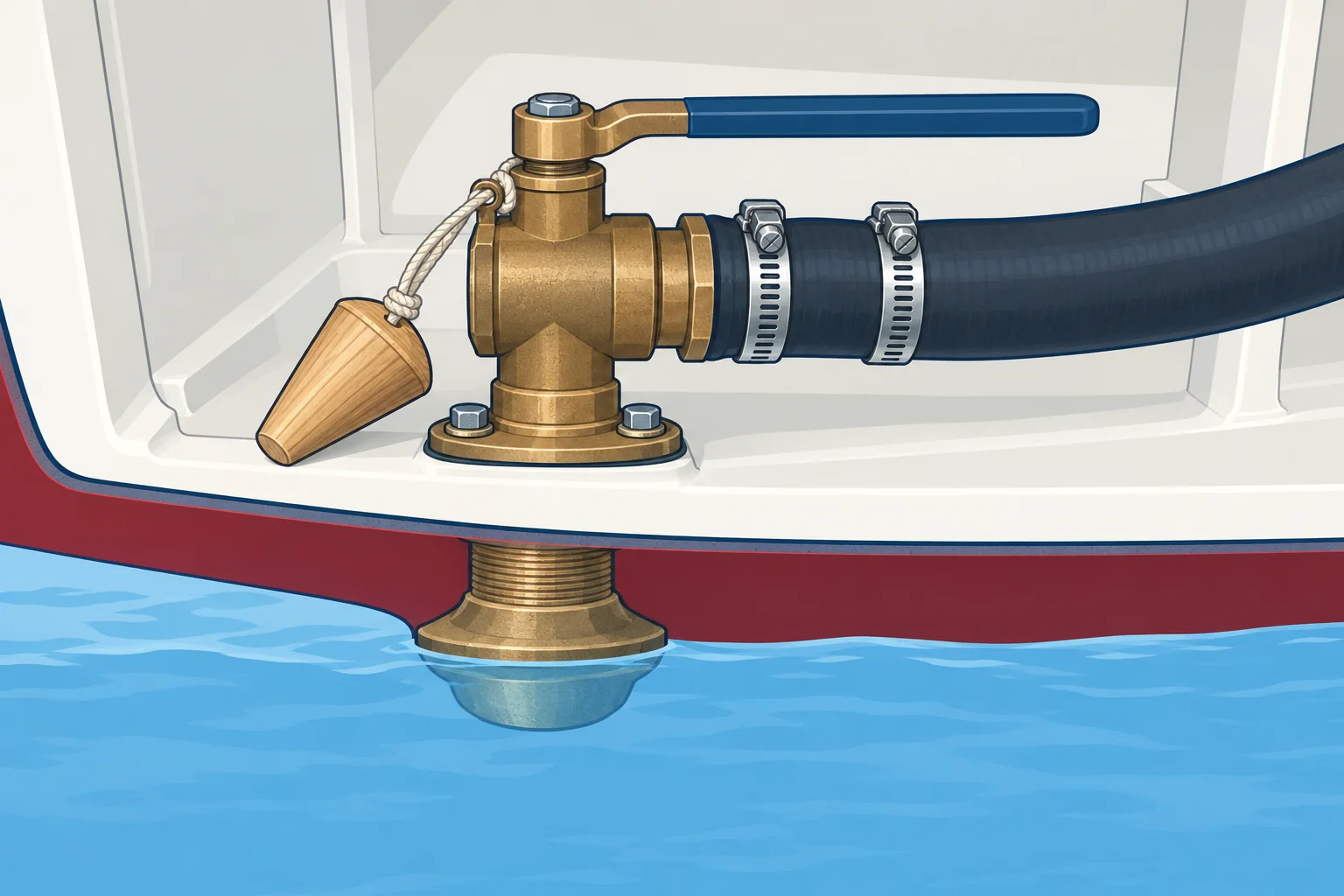
A through-hull fitting passes through the hull. A seacock closes a sea-water plumbing connection, such as an engine intake or sink outlet, where flooding is possible. Sealed transducers (sensors) and instrument housings use different arrangements; follow the maker’s instructions.
Types
Most modern seacocks are ball valves: a lever turned a quarter turn. In line with the pipe = open; across = closed. Older boats may have tapered plug seacocks that need greasing. Gate valves are not suitable: you cannot see if they are closed, and they jam or break.
Materials
Use bronze, DZR (dezincification-resistant) brass or approved composite. Ordinary brass loses its zinc in sea water, turns pink and crumbles: this is dezincification. A fitting that looks fine can snap when you lean on it.
Hoses and bungs
Use two marine-grade, all-stainless hose clips where the ribbed connector (hose tail) supports both fully. Never fit a clip beyond the supported tail; use suitable fittings and follow the maker’s instructions. Check for corrosion. Tie a correctly sized softwood bung (a tapered wooden plug for a failed opening) beside each seacock.
Exercise them
Open and close every seacock regularly, for example monthly, so it does not seize. Make a plan showing each one. Close unused sea connections when leaving. Keep valves needed for cockpit drainage and automatic bilge pumping open, following the boat’s instructions. Check them at every lift-out.
Seacock check at lift-out
- Work each seacock fully open and closed. — A seized seacock cannot be closed in an emergency.
- Inspect metal fittings for pink colouring, flaking or cracks; replace suspect fittings before relaunch. — Corrosion can weaken a fitting even when its outside looks sound.
- Check hoses for cracks and softness; check clips for corrosion and full support on the hose tail. — Both clips must sit fully on the tail; an unsupported clip can damage the hose.
- Check the bung is tied on and the right size. — You need it in seconds if a fitting fails.
- Grease or service as the maker says; renew anything doubtful. — Seacocks are cheap compared with a sinking.
Remember
- Ball valve: lever in line = open, across = closed.
- No gate valves below the waterline.
- Watch for dezincification in brass fittings.
- Two fully supported clips where suitable; a softwood bung at each seacock.
- Exercise seacocks regularly; keep a seacock plan.
Common mistakes
Wrong: Leave seacocks open all season so they never seize.
Right: Exercise them regularly and close unused sea connections when leaving. Keep valves needed for cockpit drainage and automatic bilge pumping open, following the boat’s instructions. Open valves do seize.
Wrong: A household brass ball valve is fine as a seacock.
Right: Ordinary brass dezincifies in sea water. Use bronze, DZR brass or approved composite.
Worked case
At lift-out, a sink hose is cracked and its seacock is stiff. What must you check before relaunch?
Show the answer
Service or replace the stiff seacock as the maker directs; do not force it. Replace the damaged hose and inspect the fitting for corrosion and secure mounting. Check that both clips are fully supported by the hose tail. Confirm access and the correct bung size, then check for leaks after relaunch.
Practice question
On a ball-valve seacock, what does a lever across the pipe mean?
- Fully open
- Half open
- Fully closed
- Under repair
Show the answer
Answer: C. In line with the pipe is open; across it is closed.