
The ship: hull, engines and systems · Level R3 · 5 parts · about 15 min
Gas and petrol safety aboard: LPG, fuel vapour and ventilation
5 short parts: LPG system · Using gas · Petrol vapour · Refuelling · Carbon monoxide. Each part explains the idea, then gives the points to remember, the common mistakes, a worked case and a practice question; the Academy unit adds all 29 check questions.
1 · LPG system
LPG: the gas and the installation
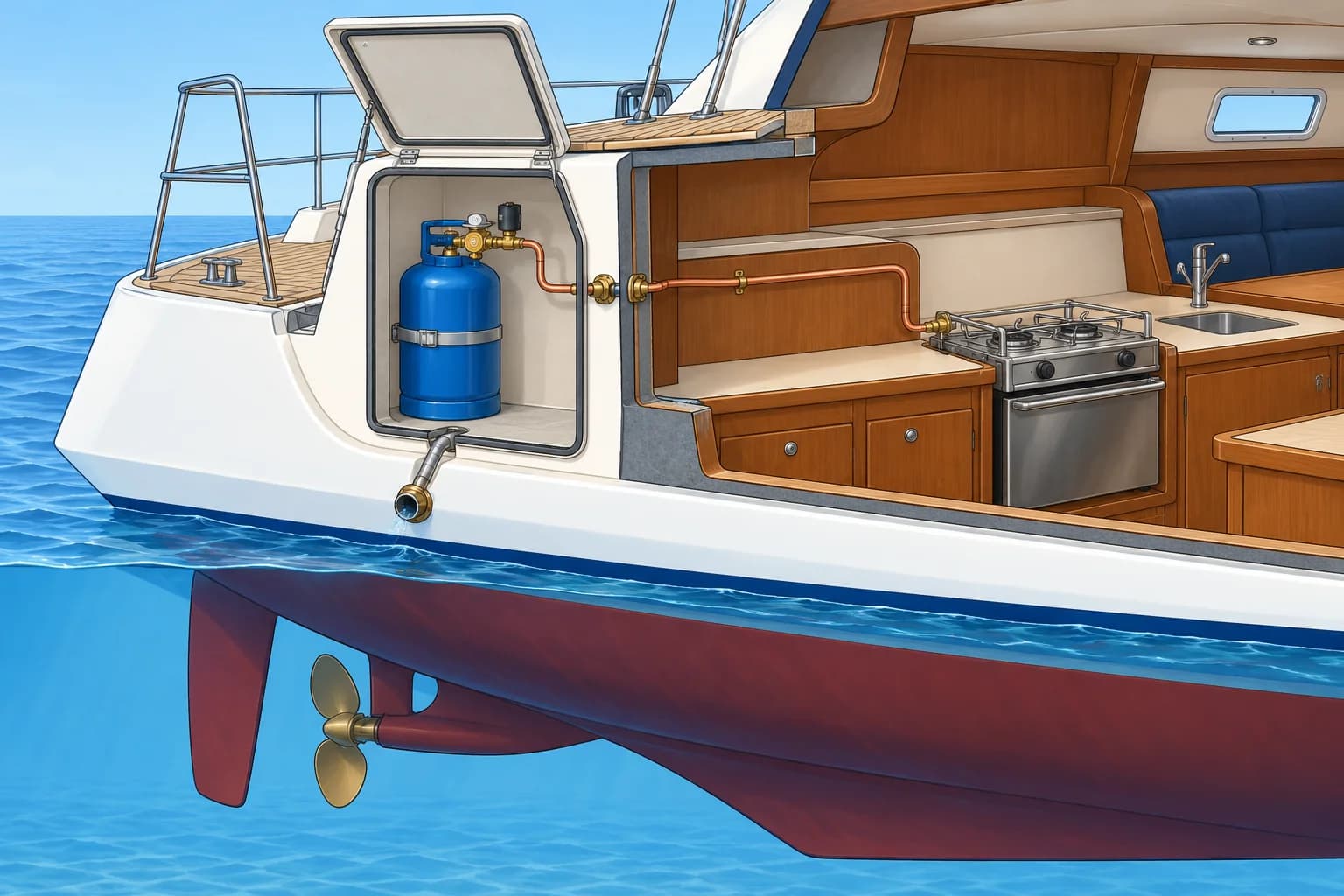
Bottled gas is heavier than air. Leaks collect in low spaces and can ignite. A safe installation keeps cylinders outside the cabin.
The gas
LPG (liquefied petroleum gas) is butane or propane, stored as liquid under pressure. Both gases are heavier than air. A leak collects in the bilge, the lowest space inside the hull. Mixed with air at only about 2–10 %, it can explode if ignited. A smell is added so you can detect it.
Butane or propane
Propane keeps working in the cold, down to about −40 °C. Butane stops giving gas near 0 °C, so it suits warm climates. Use a marine regulator (pressure reducer) approved for your gas and matched to the appliance’s rated pressure.
The gas locker
Secure cylinders upright in a gas locker, on deck or opening only to the deck, sealed from the inside of the boat. A drain at the bottom of the locker runs overboard and exits above the waterline, so leaking gas falls out of the boat. Never stow anything that blocks the drain.
From cylinder to stove
A typical installation has a regulator to lower cylinder pressure, a bubble tester after the regulator to check for downstream leaks and a solenoid valve in the locker to shut gas off remotely. Approved pipe or hose carries gas to the galley, the cooking area. A gimballed stove, which pivots as the boat tilts, needs an approved flexible connection. Each burner has a flame failure device that shuts off its gas if the flame goes out.
Standards and checks
Small-craft LPG systems are built to ISO 10239 (current edition 2025) and local rules. Flexible hoses carry a date: replace them as the maker says. Have the system checked by a qualified fitter.
Key figures
- Density
- Propane ≈ 1.5 × air; butane ≈ 2 × air: both sink
- Explosive range
- Roughly 2–10 % gas in air
- Butane
- Little gas below about 0 °C
- Propane
- Works down to about −40 °C
- Standard
- ISO 10239 small-craft LPG systems
Remember
- LPG is heavier than air: leaks collect in the bilge.
- Cylinders in a sealed deck locker draining overboard above the waterline.
- Regulator, bubble tester, solenoid valve, flame failure devices.
- Use approved LPG pipe and hose; inspect and replace hose as its maker specifies.
- Installed and checked to ISO 10239 and local rules.
Common mistakes
Wrong: Store the spare gas cylinder in a cockpit locker that opens into the cabin.
Right: All cylinders, full or empty, go in a sealed locker that drains overboard. Gas leaking inside the boat sinks into the bilge.
Wrong: Gas rises and escapes through the hatch, like at home.
Right: LPG is heavier than air. It flows down and collects in the lowest part of the boat.
Worked case
A boat you are inspecting has its gas cylinder in a locker under the cockpit seat. The locker has a drain hole, but the drain hose is kinked under a bag of mooring lines and its outlet is below the waterline.
Show the answer
Unsafe. Leaking gas cannot drain away, and with an outlet below the waterline sea water can come in and gas stays trapped. The drain must run down clear of obstructions to an outlet above the waterline, and the locker must be sealed from the inside of the boat. Keep it clear of other gear and have the installation checked.
Practice question
Where does leaking LPG collect inside a boat?
- Near the deckhead
- In the low bilge
- Around the mast
- At the open hatch
Show the answer
Answer: B. LPG is heavier than air and flows down to the lowest point.
2 · Using gas
Using gas safely, and what to do on a gas smell
Turn gas off after cooking; close the cylinder valve at night or when leaving. Gas smell or alarm: no sparks, everyone out, gas off if safe, ventilate, get help.
Before cooking
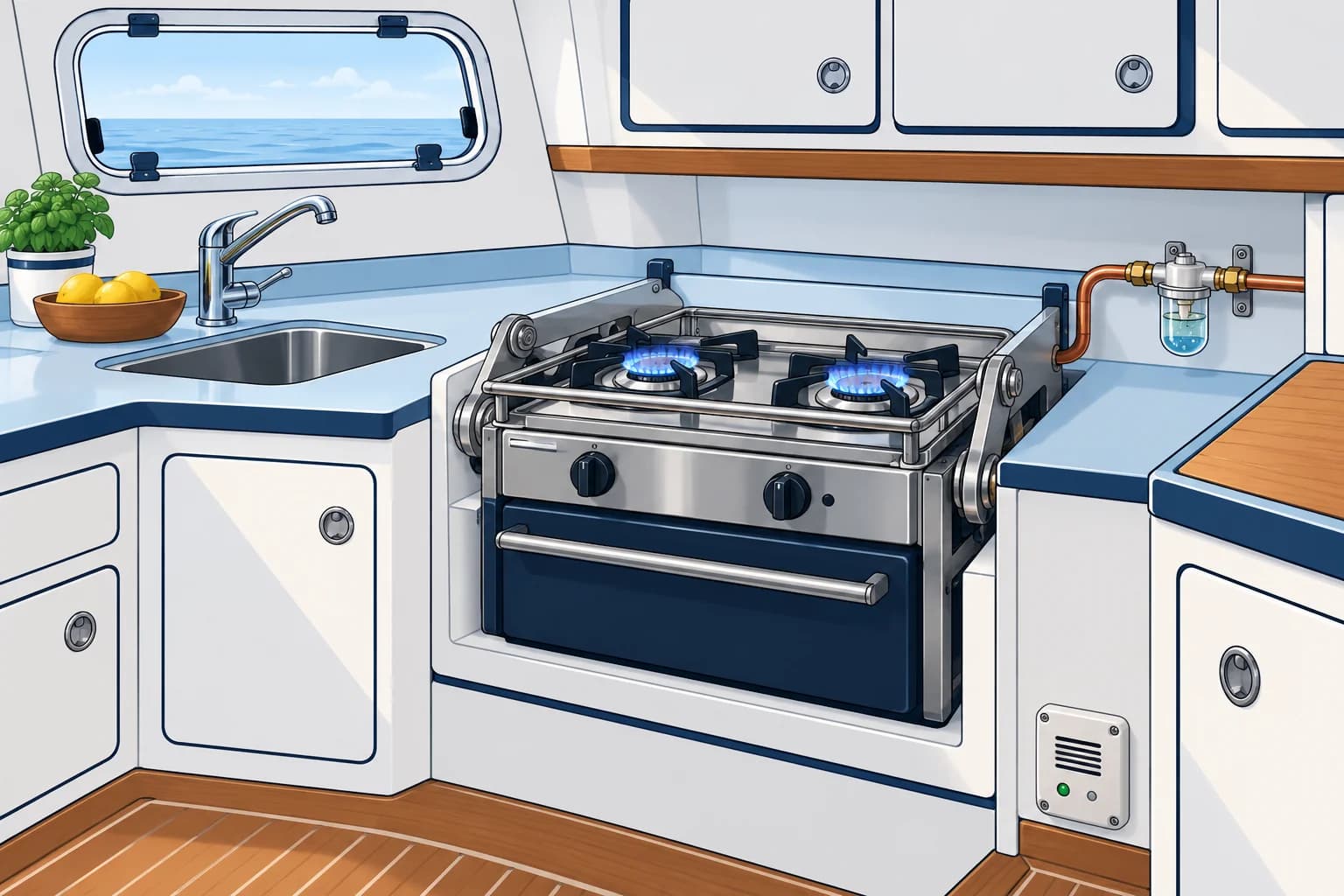
Open the cylinder valve and solenoid. With all burners off, follow the bubble tester’s instructions, including settling and observation times. Bubbles continuing during the prescribed test indicate a leak downstream of the tester. Close the cylinder valve and do not use gas until repaired.
After cooking
Switch off the solenoid or cylinder valve first and let the flame burn the gas left in the pipe; then turn off the burner. At night and when leaving the boat, close the cylinder valve.
Gas alarm
Fit LPG sensors low down in the positions the maker specifies, clear of bilge water. Test the alarm as instructed. Treat an alarm or gas smell as a leak; follow the no-sparks procedure.
Finding leaks
Test joints with leak-detection spray or soapy water, never with a flame. Do not use the stove to heat the cabin: it uses oxygen, makes carbon monoxide and lots of condensation. Never leave a lit burner unattended.
On a gas alarm or gas smell aboard
- Get everyone onto deck. No flames or smoking. Leave electrical switches alone, including lights, pumps and fans. — Operating a switch may cause a spark and ignite gas.
- Close the cylinder valve at the locker if you can reach it safely. — This stops more gas entering without exposing you to it.
- Open hatches from outside to ventilate naturally. Stay out of the cabin. — Fresh air dilutes gas, but some may remain trapped low down.
- Have trapped gas cleared safely and the bilge checked by a competent person. — Bailing water or using a bilge pump cannot establish that the space is safe.
- Keep engines and electrical equipment off until a competent person has repaired and checked the system and confirmed affected spaces gas-free. — Clearing gas does not repair the leak.
Remember
- Bubble test with burners off: follow the maker’s full test; continuing bubbles mean a downstream leak.
- Turn off at the solenoid or cylinder first, burner last.
- Gas alarm sensors low down; test them.
- Alarm or gas smell: no sparks, everyone out, gas off if safe, ventilate, get help; confirm gas-free before use.
Common mistakes
Wrong: Switch on the electric bilge pump to clear the gas.
Right: Do not operate electrical switches. Get everyone out and ventilate without switching equipment on. Have trapped gas cleared safely by a competent person.
Wrong: Check for a leak with a lighter.
Right: Use leak-detection spray or soapy water. A flame can ignite the leak.
Worked case
Coming aboard in the morning, you smell gas in the saloon. The gas alarm is silent. A crew member reaches for the light switch to look in the bilge.
Show the answer
Stop the crew member: no switches or flames. Get everyone on deck. Close the cylinder valve if safe and open hatches from outside. Stay out of the cabin. Have trapped gas cleared safely and the bilge checked by a competent person. Keep the system shut off. Have the leak repaired and spaces confirmed gas-free before operating equipment. Have the alarm checked too.
Practice question
Burners are off. Bubbles continue during the bubble tester’s prescribed test interval. What does this mean?
- The gas cylinder is nearly empty
- Gas is leaking after the tester
- The solenoid valve is shut off
- The system is working normally
Show the answer
Answer: B. After the maker’s settling period, continuing bubbles during the prescribed test indicate a leak downstream of the tester. Close the cylinder valve and do not use gas until repaired.
3 · Petrol vapour
Petrol vapour and engine-space blowers
Petrol vapour sinks. Before starting a petrol inboard: check for fuel or vapour; if clear, run the blower, then check again. Do not start if either is found.
The danger
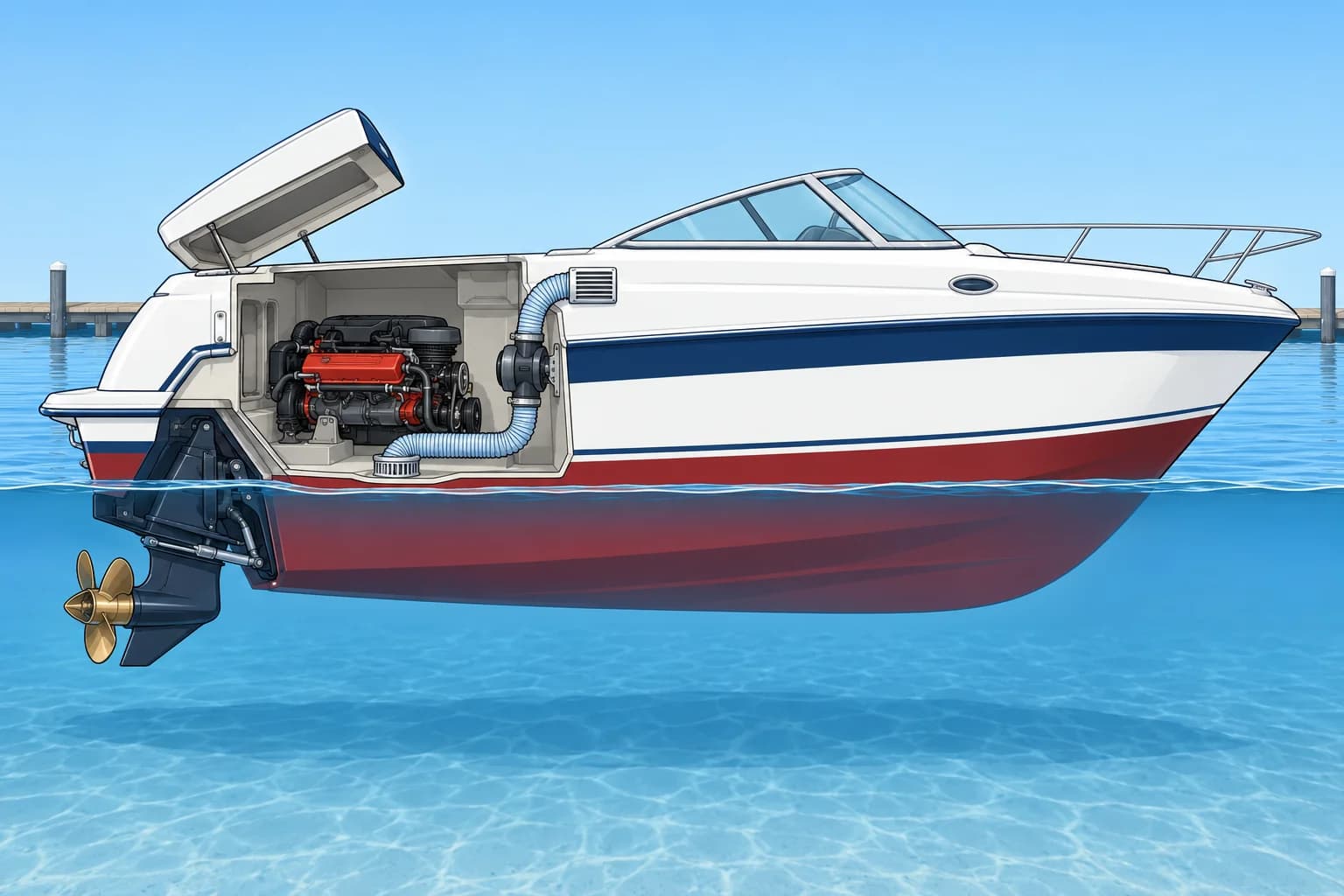
Petrol (gasoline) evaporates easily, even in the cold. Its vapour is heavier than air and explosive at only about 1.4–7.6 % in air. In a closed engine space or bilge, a cup of spilt petrol can make enough vapour for an explosion.
Petrol inboards
Boats with petrol inboards or sterndrives have an engine-space blower (extractor fan) and electrical parts that are ignition-protected: designed not to ignite surrounding petrol vapour during normal operation. Before starting, check for fuel or vapour. If either is present, do not operate switches or start; have the cause corrected. Otherwise run the blower for its labelled time: in the USA this is 4 minutes. Then check the engine space again. Any petrol smell: do not start.
Portable tanks
Outboard portable tanks are safest filled ashore or on the pontoon. Store them on deck or in a locker sealed from the cabin and drained overboard. Operate the tank vent as its maker instructs, and keep spare petrol out of the cabin.
Static and sparks
Flowing petrol builds static. Keep the nozzle in contact with the filler, and put a portable tank on the ground, not in the boat, to fill it. Mobile phones, switches and engines are all spark sources near vapour.
Starting a petrol inboard
- Check the bilge and engine space for a petrol smell or liquid. — If you find either, do not start or operate switches; have the cause corrected.
- Run the engine-space blower for the time on its label (4 minutes in the USA). — It replaces vapour-laden air with fresh air.
- Sniff the engine space again before starting. — If you find fuel or smell vapour, do not start; have the cause corrected.
- Start the engine only if checks are clear. Keep the blower running while idling or motoring slowly, as the maker directs. — It keeps clearing vapour while you motor slowly.
Remember
- Petrol vapour is heavier than air and explosive at about 1.4–7.6 %.
- Petrol inboards: check, blower, check again. Fuel or vapour found: do not start; have the cause corrected.
- Fill portable tanks off the boat; store them on deck.
- Ignition-protected parts in petrol engine spaces.
Common mistakes
Wrong: The blower has run, so a petrol smell is safe to start through.
Right: A petrol smell means vapour remains. Do not start or operate switches; stay clear and get competent help to correct the cause.
Wrong: Store spare petrol under the saloon seats where it is cool.
Right: Vapour leaks and sinks into the bilge. Keep petrol on deck or in a sealed locker that drains overboard.
Worked case
On a hot day you run the blower of your petrol sterndrive for four minutes. When you open the engine hatch you still smell petrol, and there is a wet patch under the fuel filter.
Show the answer
Do not start or operate switches. Get everyone ashore and keep ignition sources away. Close the fuel valve only if safely accessible. Leave an already-running ignition-protected blower on. Ventilate from outside only if safe. Stay out of the engine space. Get competent help to contain the spill, repair the leak and confirm the space is safe before restarting.
Practice question
Where does petrol vapour collect in a boat?
- In the low parts and bilge
- Up near the deckhead lining
- Inside the mast near its top
- Around the open cabin windows
Show the answer
Answer: A. It is heavier than air and sinks.
4 · Refuelling
Refuelling step by step
At the fuel berth: engines off, check the filler, avoid overfilling, then ventilate and check for petrol vapour before starting.
Before you start
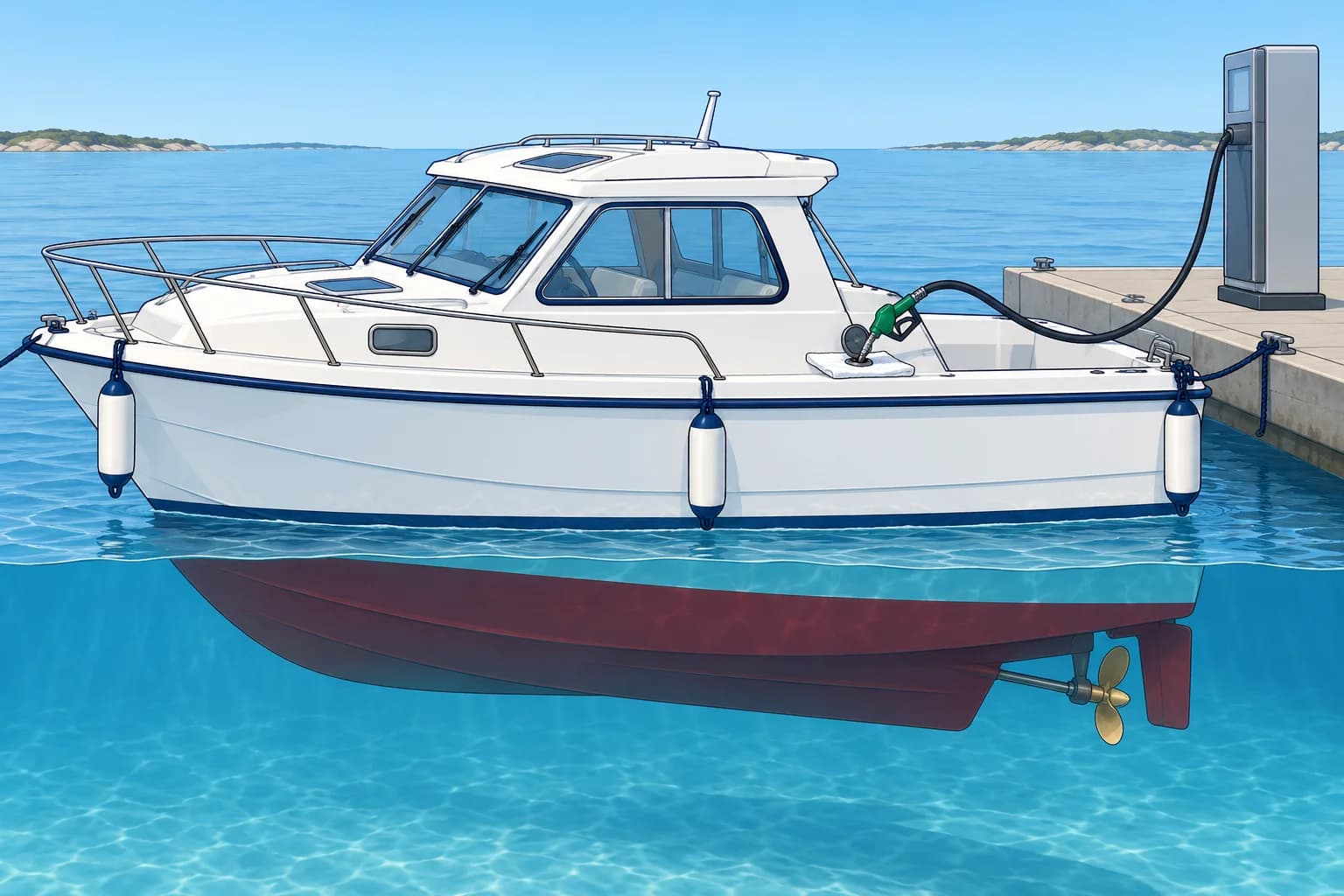
Moor securely. Stop engines and generator; cooker, heaters and nonessential electrics off. No smoking. For petrol, stop the engine-space blower before filling, close cabin openings and get passengers ashore.
At the filler
Check the deck filler: DIESEL, PETROL or GASOLINE, not WATER or WASTE. Put the pump nozzle into the filler and keep it touching the metal to prevent static sparks. Keep an absorbent pad round the filler.
Do not overfill
Fuel expands as it warms. Stop before the tank is completely full. Listen at the vent and slow down near the end. If fuel spills, stop filling and alert fuel-berth staff for assistance. Use suitable fuel-absorbent pads where safe. Do not use detergent: it disperses fuel rather than removing it.
After filling
Cap the filler and deal safely with spills. For petrol, open hatches and inspect the engine space and bilge. If you find petrol or smell vapour, do not start or operate switches; have the cause corrected. Otherwise run the blower for its labelled time, then check again before starting. If fuel or vapour is still present, do not start.
Refuelling
- Moor securely. Stop engines and generator; cooker, heaters and nonessential electrics off. No smoking. — Removes ignition sources.
- For petrol, stop the engine-space blower before filling. Close hatches, portholes and doors; passengers ashore. — Keeps heavy vapour out of the boat.
- Check the filler label; nozzle in contact with the filler; pad around it. — Checks the right tank, reduces static risk and catches small drips.
- Fill slowly towards the end and stop short of full. — Fuel expands when it warms and spills from the vent.
- Cap the filler, wipe up spills, take pads ashore. — Spilt fuel is a fire and pollution hazard.
- Ventilate. For petrol, inspect the engine space and bilge. If you find fuel or smell vapour, do not start or operate switches; have the cause corrected. Otherwise run the blower for its labelled time and check again. Do not start if fuel or vapour remains. — Blower time alone cannot make an active leak safe.
Remember
- Engines, cooker and heaters off; no smoking.
- Check the filler label before the nozzle goes in.
- Keep the nozzle in contact with the filler.
- Do not overfill: fuel expands.
- Petrol: inspect, blower, check again. Fuel or vapour found: do not start; have the cause corrected.
Common mistakes
Wrong: Fill until fuel appears at the vent so the tank is really full.
Right: Fuel at the vent goes into the sea and the tank has no room to expand. Stop short of full.
Wrong: Use washing-up liquid on a small diesel spill so it disappears.
Right: Detergent disperses fuel rather than removing it. Use suitable fuel-absorbent pads where safe. Alert fuel-berth staff for assistance.
Worked case
At the petrol berth, the nozzle has clicked off. Your friend wants to squeeze in more until fuel appears at the vent, then start immediately.
Show the answer
Do not top up: leave room for expansion. Cap the filler and deal safely with spills. Open up and inspect the engine space and bilge. If petrol or vapour is present, leave switches alone and have the cause corrected. Otherwise run the blower for its labelled time and check again before starting.
Practice question
Before taking on petrol, what do you do with hatches and portholes?
- Open all of them wide
- Close all of them
- Open the forward ones
- Leave them as they are
Show the answer
Answer: B. Petrol vapour is heavy and would flow into the cabin.
5 · Carbon monoxide
Carbon monoxide: the silent danger
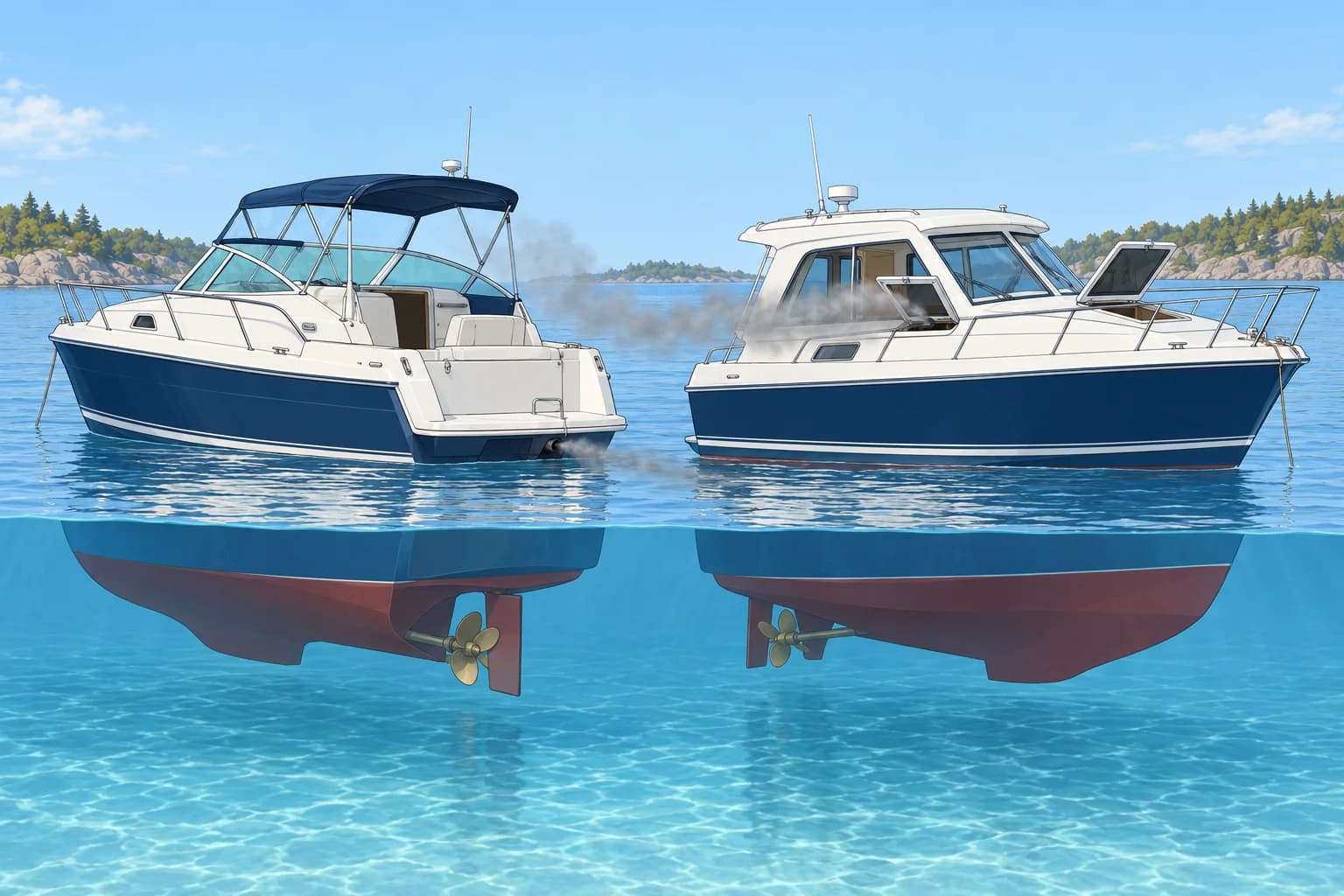
CO has no smell or colour and kills in minutes. Engines, generators, heaters and cookers make it. Fit CO alarms and know the signs.
What it is
Carbon monoxide (CO) is a poisonous gas from incomplete burning of fuel: engines, generators, cookers, heaters and barbecues. It has no colour, smell or taste. It stops the blood carrying oxygen. Effects add up with exposure.
How it gets aboard
Exhaust can be drawn into the cockpit and cabin by the wind, or swirl back into an enclosed cockpit or canopy at low speed. It collects under the swim platform near exhaust outlets. A neighbouring boat’s generator or engine can fill your cabin through open hatches. A faulty heater or a cooker used for warmth fills a closed cabin.
CO alarms
Fit a CO alarm made for boats, to EN 50291-2 in Europe or UL 2034 in the US, in each sleeping cabin and near the helm or saloon. Test it regularly and never remove its battery. CO mixes with air, so follow the maker on mounting height.
The signs
Early signs look like seasickness or a hangover: headache, dizziness, nausea, tiredness. Then confusion, collapse and death. If several people feel ill at once, suspect CO. Never swim or sit near the exhaust or under the swim platform while an engine or generator runs.
CO alarm or suspected poisoning
- Get everyone into fresh air away from exhausts. Do not enter contaminated accommodation to rescue someone. — CO can incapacitate you too; a rescue attempt can add another casualty.
- Call for urgent medical help from a safe position, even if symptoms improve. Follow emergency instructions. — Suspected CO exposure needs urgent medical assessment.
- Stop engines, generator, heater and cooker only if you can do so without exposure. — Source control must not delay escape or put anyone back in danger.
- Ventilate from a safe position. Keep people out until the source is corrected and the affected spaces are confirmed safe. — Opening a hatch alone does not prove the boat is safe.
Remember
- CO is invisible and odourless: only an alarm detects it.
- Sources: engines, generators, heaters, cookers, neighbouring boats.
- Fit marine CO alarms (EN 50291-2) in each sleeping cabin.
- Headache, dizziness, nausea in several people: suspect CO.
- Suspected CO: fresh air away from exhausts and urgent medical help. Stop sources only if safe.
Common mistakes
Wrong: If you cannot smell exhaust, there is no CO.
Right: CO has no smell. Rely on CO alarms and treat unexplained headaches seriously.
Wrong: Feeling ill in the cabin at anchor is just seasickness.
Right: If several feel ill at once with a generator or heater running, suspect CO and get everyone into fresh air.
Worked case
At anchor in a calm bay, you run the generator in the evening with hatches open. Another boat anchors close astern and runs theirs too. Overnight two crew wake with headaches and nausea; the CO alarm has no battery in it.
Show the answer
Get everyone into fresh air away from exhausts and call for urgent medical help, even if symptoms improve. Stop your generator only if safe. Stay out of the cabin; do not return to ventilate or replace the alarm battery. Have the exhaust problem and alarm checked and the spaces confirmed safe before anyone sleeps aboard again.
Practice question
How can you detect carbon monoxide aboard?
- By smelling cabin air
- By looking at its colour
- With a marine CO alarm
- With a gas bubble tester
Show the answer
Answer: C. CO has no smell or colour; only an alarm detects it.