
The ship: hull, engines and systems · Level R1 · 4 parts · about 14 min
Engine checks before you go, and outboard care
4 short parts: Before you go · Start, warm-up · Outboard care · Tender engine. Each part explains the idea, then gives the points to remember, the common mistakes, a worked case and a practice question; the Academy unit adds all 23 check questions.
1 · Before you go
Fuel, battery and a quick look before you leave
Check fuel, battery, valves and the engine before leaving. A few minutes alongside can reveal a problem before it stops you at sea.
Why it matters
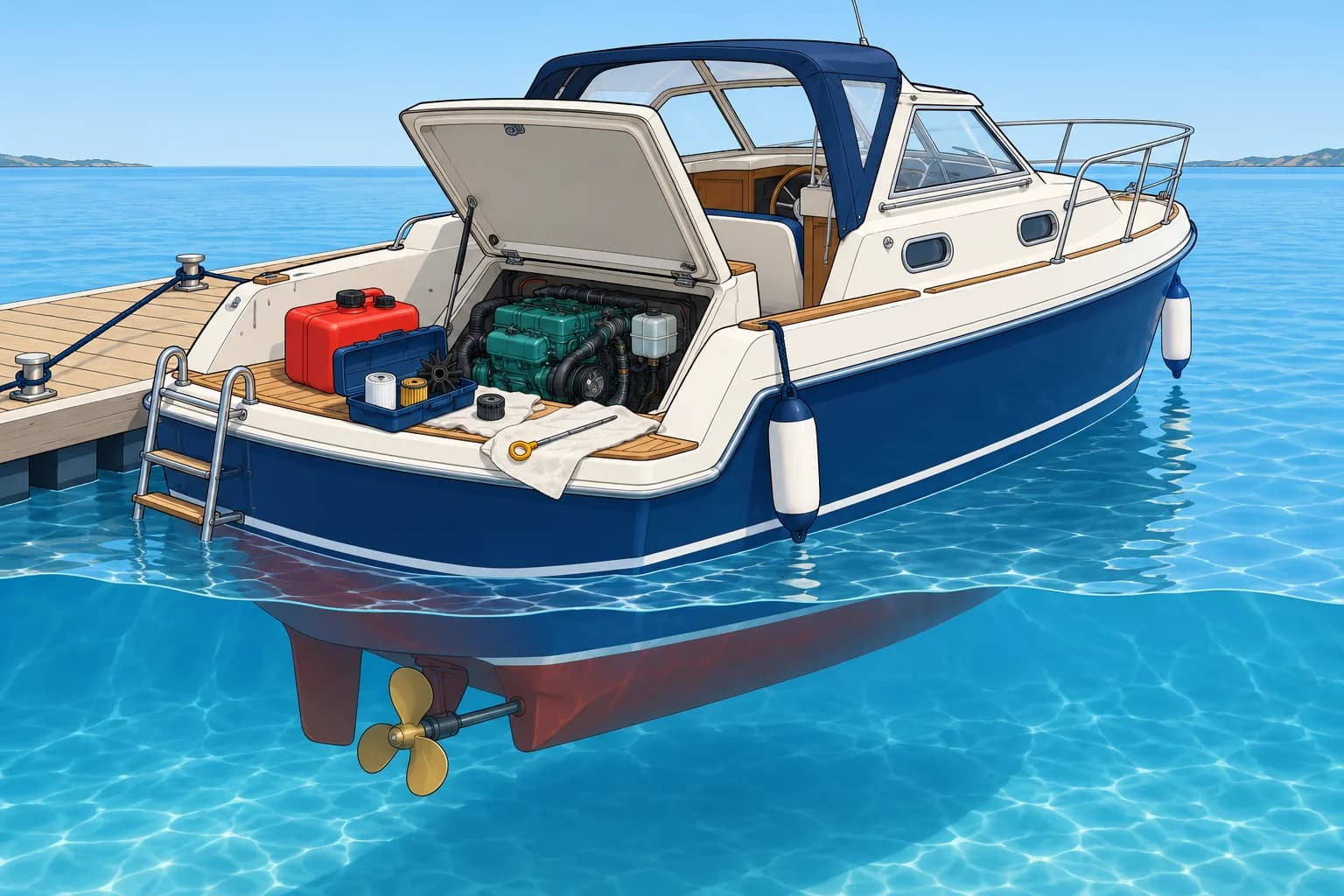
In the UK, machinery failure is the most common reason lifeboats launch to leisure boats, year after year. Common problems include no fuel, dirty fuel, a flat battery, no cooling water. A quick check alongside can reveal problems before you leave. Have any fault put right before departure.
Fuel and range
Check fuel quantity yourself using the tank maker’s approved method, such as a sight gauge (a fuel-level window) or a dipstick (a measuring rod) through a designated measuring point; do not rely on the dashboard gauge alone. Plan with the rule of thirds: one third to get there, one third to come back, one third in reserve for headwinds, a detour or a search. Fuel use rises quickly with speed and with waves.
Battery and switches
Turn the battery switch on. On many boats a separate start battery is used only for the engine. A modern panel shows battery voltage: note it before you start. Loose or corroded terminals can prevent starting even when the battery is charged.
A look at the engine
Open the engine box and look before you start: the oil level on the dipstick (oil-level measuring rod), the coolant (engine-cooling liquid) level if there is a tank, the drive belt, and any fresh drops of fuel, oil or water underneath. The full inboard routine, called W-O-B-B-L-E, is in Ship: the marine diesel engine.
Spares and tools
Carry a small kit: spare fuel filters, a water-pump impeller (the flexible rotor that pumps cooling water), a belt, fuses, a set of spanners and screwdrivers, rags, a torch and the engine manual. On an outboard, add a spare kill cord (engine cut-off lanyard) and spark plugs. Know where the fuel shut-off valve is.
Key figures
- Rule of thirds
- ⅓ out, ⅓ back, ⅓ reserve
- Commonest breakdowns
- No fuel, dirty fuel, flat battery, no cooling water
Engine check before casting off
- Check the fuel quantity yourself and work out your range with the rule of thirds. — Running out of fuel is one of the commonest causes of breakdowns.
- Open the fuel valve. On a portable tank, open its manual air vent, if fitted, so air can replace used fuel. Connect the fuel line firmly. — A closed valve or vent lets the engine start, then starve and stop.
- Battery switch on; look at the terminals and note the voltage. — A weak battery or bad connection is the usual reason an engine will not turn.
- Open the inboard cooling-water seacock (the valve admitting seawater). Check the oil and belt. — No cooling water ruins the water-pump impeller in seconds.
- Look for leaks and check the bilge (the lowest space inside the hull) is dry. — A new leak is an early warning of a failure.
- Check spares, tools and the kill cord are aboard. — Small faults are easy to fix only if the parts are with you.
Remember
- Check the fuel quantity yourself; plan with one third out, one third back, one third reserve.
- Open the fuel valve, any manual tank vent as instructed, and the inboard cooling-water seacock before starting.
- Battery switch on, terminals clean and tight, voltage noted.
- Carry filters, an impeller, a belt, fuses, tools and the manual.
Common mistakes
Wrong: The fuel gauge says half full, so we have plenty.
Right: Verify the quantity using the tank maker’s approved method, and keep a third in reserve.
Wrong: Spares can stay at home for a short trip.
Right: Breakdowns can happen on short trips too. Carry the basic kit every time.
Worked case
You plan to travel 12 miles out and 12 miles back. Your motorboat burns 1 litre per mile at cruising speed. Its only tank holds 30 litres; the gauge reads three-quarters. Can you make this trip using the rule of thirds?
Show the answer
No. You need 12 litres each way: 24 litres for travel and 12 in reserve, so 36 litres total. The gauge suggests 22.5 litres, which you must verify. Even a full 30-litre tank is too small for this plan. Shorten or postpone the trip; filling this tank alone is not enough.
Practice question
You have checked that 30 litres are aboard. At the expected consumption, each leg needs 12 litres. Does this meet the rule of thirds?
- Yes; six litres is enough reserve
- No; the trip requires 36 litres aboard
- Yes; the return leg uses the reserve
- No; half the fuel must remain unused
Show the answer
Answer: B. The 24-litre trip must use no more than two thirds of your fuel: 24 ÷ 2 × 3 = 36 litres.
2 · Start, warm-up
Starting, warming up and stopping
Start in neutral, check the cooling water and the warning lights, warm up gently, and stop the engine the way its maker says.
Inboard diesel
Select neutral (no drive to the propeller). Turn the key: oil-pressure and charge warning lamps light; the buzzer sounds. If there are glow plugs (heaters for cold starts), use their control for the time in the manual. Crank (turn the engine with its electric starter motor) in short bursts. Use the manual’s cranking limit and rest time. Stop after its allowed attempts: repeated unsuccessful cranking can fill a wet exhaust (an exhaust cooled by injected seawater) and flood the engine.
Just after starting
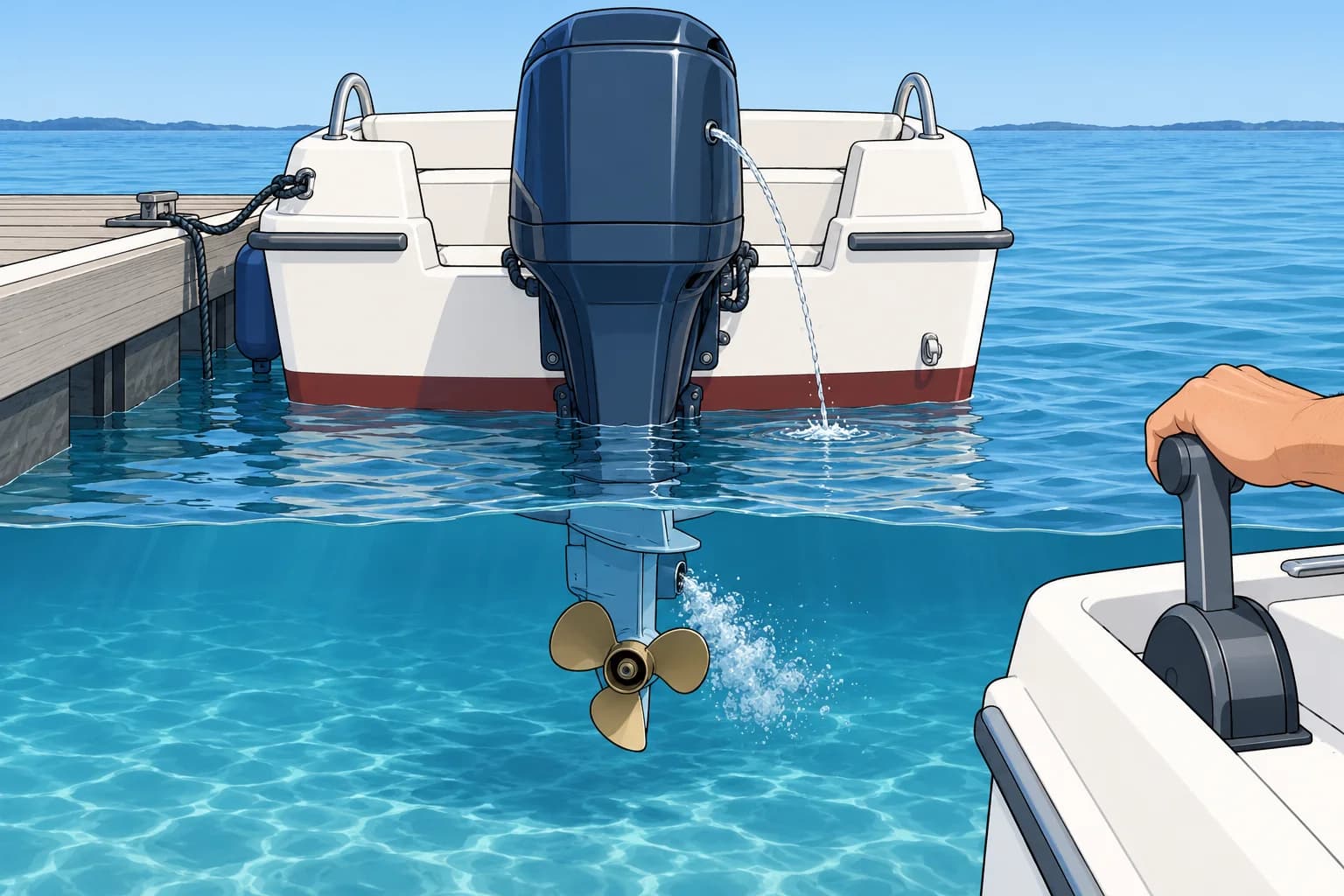
On a wet-exhaust installation, check that cooling water emerges with the exhaust at its outlet. On other installations, use the cooling-flow check specified in the manual. Check that the oil-pressure lamp goes out at once and the charge lamp goes out soon after. No expected cooling-water flow, or a lamp that stays on: stop the engine and find out why.
Outboard
Lower the engine to its running position. If fitted, open the manual tank vent and squeeze the primer bulb (fuel-line hand pump) until firm. Attach the kill cord to the engine and yourself as instructed. Select neutral. Use the choke (a cold-start control that enriches the fuel mixture), if fitted, as the manual directs. Start, then ease the choke off as instructed. Check the tell-tale, a small outlet jet that lets you check cooling-water flow.
Warming up
Run at idle (the lowest steady engine speed) briefly, as the manual directs. Then use the throttle (engine-speed control) to run gently in gear: this puts a light load on the engine and warms it faster than prolonged idling. Do not race a cold engine.
Stopping
Idle briefly in neutral, then use the normal stop control or key as the manual directs. The kill cord also stops an outboard. If leaving the boat, follow its electrical shutdown checklist; automatic bilge pumps must retain their required power. Close the fuel valve if instructed. Log the engine hours for servicing.
Key figures
- Start in
- Neutral, throttle as the manual says
- Just after start
- Expected cooling-water flow; warning lamps out
- Primer bulb
- Squeeze until firm (outboard)
Remember
- Start in neutral; crank in short bursts with rests. Stop after the manual's allowed attempts.
- Check cooling-water flow after starting, at the outlet specified for your installation.
- Oil-pressure lamp out at once; charge lamp out soon after.
- Warm up gently; never race a cold engine. Log the engine hours.
Common mistakes
Wrong: Keep cranking until the diesel fires.
Right: Use the manual’s cranking limit and rest time. Stop after its allowed attempts: repeated unsuccessful cranking can flood an exhaust system that uses cooling water, and then the engine.
Wrong: No tell-tale jet is normal on a cold outboard.
Right: If the expected tell-tale jet is absent, stop. The outlet may be blocked or cooling may have failed. Follow the manual or get help before restarting.
Worked case
Your diesel with a wet exhaust starts first time. You look over the stern and see exhaust smoke but no water coming out. The engine sounds normal. What do you do?
Show the answer
Stop the engine immediately, even though it sounds normal. Do not restart until the cooling-water supply is confirmed safe. Follow the checks in Ship: engine trouble at sea, or get qualified help.
Practice question
What is the outboard's tell-tale?
- A lamp that shows the engine is running
- A small jet of cooling water
- A cord that stops the engine if you fall
- A gauge on the tank that shows fuel level
Show the answer
Answer: B. It is a visible cooling-water outlet. Check its normal flow after starting; a missing jet needs checking.
3 · Outboard care
Looking after an outboard
Salt, old fuel and knocks are an outboard's enemies. Flush it, use fresh fuel and look at the propeller after every trip.
Flushing
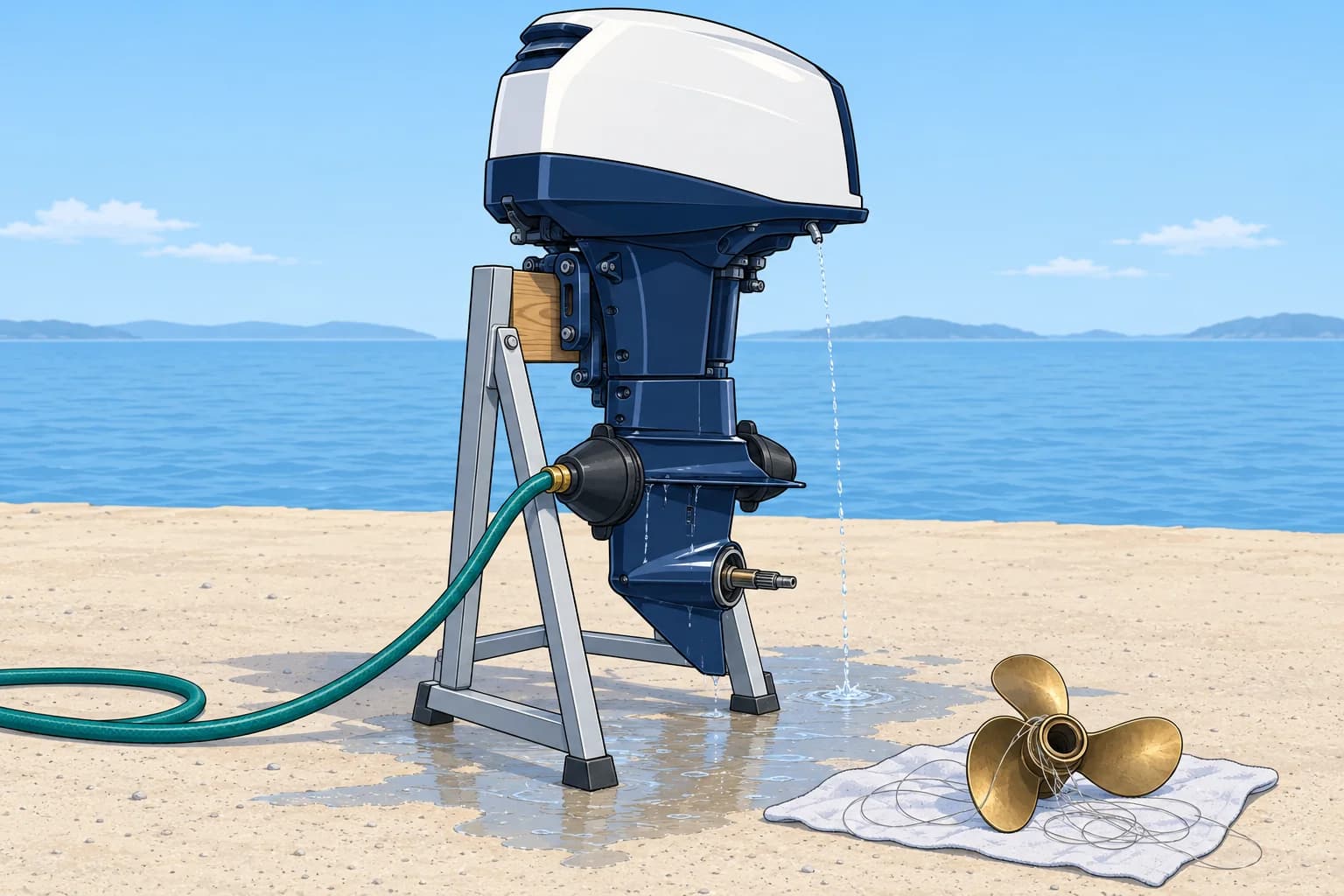
Salt water leaves salt and sand in the cooling passages. After use in salt or dirty water, flush the engine with fresh water: through the built-in flush port, or with flushing muffs (ear-muff cups over the water intakes) on a hose. Follow the manual: with some methods the engine must run, with others it must not.
Fuel
Petrol goes stale and can block carburettor jets (tiny fuel passages). E10 contains up to 10% ethanol, which absorbs water. Use fresh fuel; check the manual’s ethanol limit. Add a suitable fuel stabiliser (an additive that slows ageing) to fresh fuel before storage; it cannot restore stale fuel. Store tanks closed, out of sunlight. For a premix two-stroke, mix the specified oil and petrol at the manual ratio. An oil-injected two-stroke uses a separate oil supply: check its tank. Add oil to its petrol only if instructed.
Propeller and gearbox
Check the propeller for bent or chipped blades and fishing line wound behind it. Line can cut the oil seal on the gearbox (the gears in the lower engine housing). Impact protection may use a shear pin (a pin designed to break) or a rubber hub (an insert inside the propeller that slips on impact). Milky gearbox oil means water has entered.
Anodes and corrosion
Outboards have anodes, blocks of zinc or another metal that corrode instead of the engine. Replace them when about half worn away. Never paint them. Rinse the outside with fresh water after use.
Lifting and storing
Carry the engine upright, or lay it down only on the side the manual shows. A four-stroke laid on the wrong side can let oil run into the cylinder. Store it upright, with the propeller lowest so water drains from the leg (the lower engine housing).
Flushing an outboard after salt water
- Read which flushing method your manual allows and whether the engine may run. — Some flush ports must be used with the engine stopped; muffs usually need it running.
- With the engine stopped, keep everyone clear of the propeller; remove it if the manual requires. Fit the hose or muffs securely. — A loose muff lets the pump run dry.
- Turn on the water, then start the engine only if the manual says so, in neutral at idle. — Water protects the impeller. A propeller may turn even in neutral.
- Maintain clearance and check water flow at the outlet specified for your flushing method. — The expected outlet and flow depend on the engine and flushing method.
- Flush for the time in the manual, often a few minutes. — Gives time to wash salt and sand out.
- Stop the engine first, then the water. Rinse the outside. — Water must flow as long as the engine runs.
Remember
- Flush with fresh water after salt or dirty water, the way your manual says.
- Use fresh fuel within the manual's ethanol limit; E10 petrol absorbs water and goes stale.
- Check the propeller for damage and fishing line; milky gear oil means water.
- Replace anodes when half worn; never paint them.
Common mistakes
Wrong: Run an outboard on muffs with the water turned off for a quick test.
Right: Never run it without water. The impeller is destroyed in seconds.
Wrong: Lay a four-stroke outboard down on any side in the car.
Right: Use only the side the manual shows, or oil can run into the cylinder.
Wrong: Last season's petrol is fine if it smells normal.
Right: Replace stale or water-contaminated petrol. Add a suitable stabiliser to fresh fuel before storage; it cannot restore old fuel.
Worked case
After a weekend in the tender you notice a tangle of fishing line wound round the propeller shaft behind the propeller. The engine seemed to run normally.
Show the answer
Remove the propeller (engine stopped, kill cord off, as the manual shows) and clear all the line. Line wound tightly there can cut the gearbox oil seal. Check the gearbox oil as the manual directs. Milky oil indicates water contamination; low oil may indicate a leak. Have either fault checked before further use.
Practice question
Why flush an outboard after use in salt water?
- To clean the fuel filter and fuel line
- To wash salt and sand from the cooling passages
- To help the battery charge after a trip
- To top up the gearbox oil with fresh water
Show the answer
Answer: B. Salt and sand build up in the cooling passages and cause overheating and corrosion.
4 · Tender engine
The tender's outboard: fitting, kill cord and safety
A tender is a small boat used to reach shore or another boat. Secure its outboard, wear the kill cord and carry oars.
Fitting it
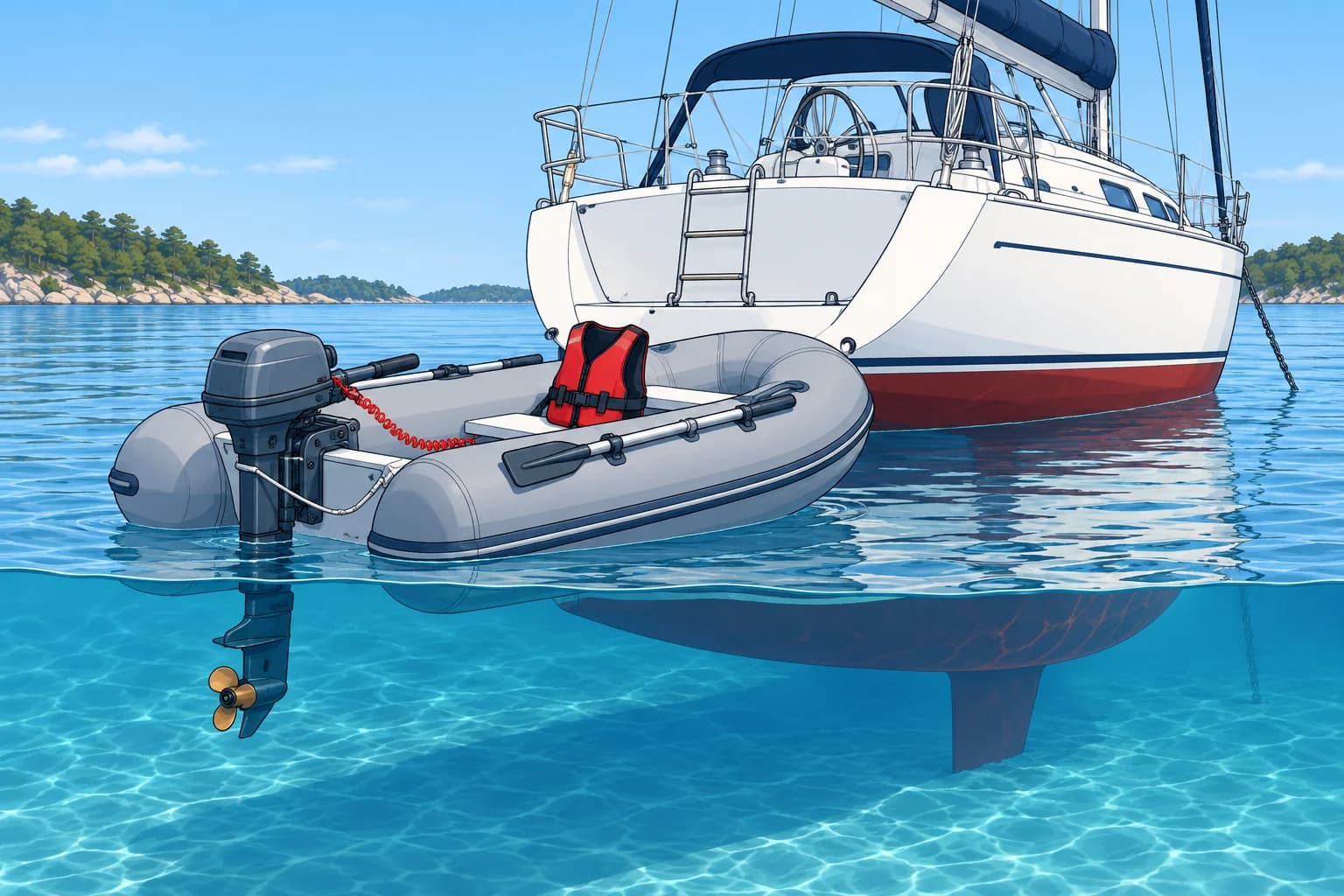
Secure the tender alongside. Lower the engine on a suitable line attached to its approved lifting point or a properly fitted engine-lifting harness. Keep people clear beneath it. Centre it on the transom (the flat back of the tender), tighten both clamp screws firmly and attach a safety line from the engine to the tender to retain it if the clamps loosen.
Kill cord
A kill cord links you to the engine cut-off switch. If you fall away, it pulls out and stops the engine. Wear it securely as the maker directs. A wireless version uses a device you wear instead of a cord.
US rule
US federal law requires using a fitted engine cut-off link on recreational boats under 26 ft with at least 115 lb static thrust (push measured while stationary; about 3 horsepower). Use it above displacement speed: when the hull starts rising and skimming over the water, including partial planing. The requirement does not apply if the main helm (steering position) is inside an enclosed cabin.
Propeller danger
A turning propeller causes terrible injuries. Go to neutral and stop the engine before anyone swims near the stern (back of the tender) or climbs in from the water.
Backup
Carry oars or paddles and a bailer (a scoop for removing water); for an inflatable tender, carry its inflation pump too. Small outboards often stop on old fuel or a closed vent. Check fuel before you leave the yacht, and tell someone where you are going, especially at night.
Shallow water and beaching
Slow down before shallows. Use only the shallow-water setting your manual allows, keeping the cooling intakes submerged. Before lifting fully for beaching, select neutral and stop the engine. Use oars to reach shore; keep the propeller and leg (lower engine housing) clear of the bottom.
Remember
- Secure the tender; lower using an approved lifting point or engine harness. Tighten both clamps; add a safety line.
- Wear the kill cord every time.
- Stop the engine before anyone is near the propeller.
- Carry oars, a bailer and fuel; stop the engine before lifting it fully for beaching.
Common mistakes
Wrong: The kill cord is only for fast boats.
Right: Small tenders flip and throw people out too. Wear it on every boat that has one.
Wrong: Leave the oars on the yacht to save space.
Right: Small outboards do stop. Without oars the tide or wind carries you away.
Worked case
At anchor, a friend wants to swim to the tender while you start its outboard to go ashore. What do you do?
Show the answer
Keep the engine stopped until the swimmer is aboard and clear of the stern. Then clip on the kill cord, check the propeller area, start in neutral and move off slowly. If someone in the water comes near, go to neutral and stop the engine.
Practice question
What does the kill cord do?
- Locks the engine firmly onto the transom
- Stops the engine if the driver falls away
- Prevents the engine starting in gear
- Holds the engine tilted up in shallows
Show the answer
Answer: B. It links the driver to a cut-off switch; pulled out, the engine stops.