
The ship: hull, engines and systems · Level P1 · 4 parts · about 15 min
Steering gear and autopilot: change-over, tests and drills (SOLAS V/26)
4 short parts: Gear types · Tests and drills · Local steering · Autopilot. Each part explains the idea, then gives the points to remember, the common mistakes, a worked case and a practice question; the Academy unit adds all 27 check questions.
1 · Gear types
Ship steering gear: rams, rotary vanes and the steering gear room
Hydraulic power turns the rudder stock through rams or vanes. Know the type on your ship and what is in the steering gear room.
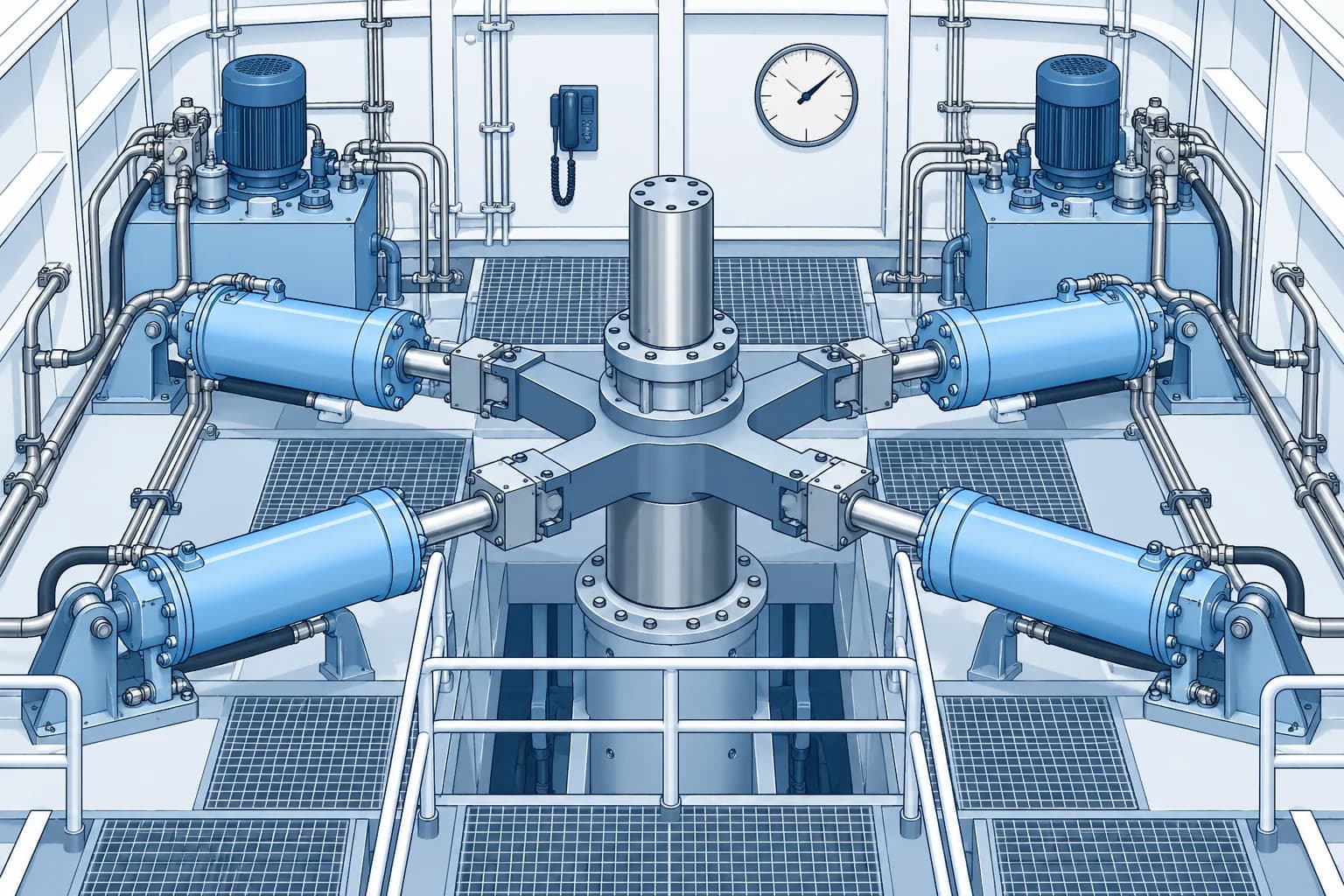
Main parts
The steering gear is the machinery that turns the rudder. A control system carries the order from the bridge, usually electrically. Power units, electric motors driving hydraulic pumps, make oil pressure. An actuator turns that pressure into a turning force on the rudder stock, the shaft that carries the rudder. Many ships have two power units. Backup depends on the fault and your ship’s arrangement. A rudder angle indicator shows the actual rudder angle on the bridge and in the steering gear room.
Ram gear
In electro-hydraulic ram gear, oil pushes pistons called rams. They act on a tiller, an arm fixed to the rudder stock. A Rapson slide lets the ram connection slide along that arm, increasing turning force as rudder angle grows. Two pumps on a two-ram gear provide backup for a pump failure, but not necessarily a damaged ram. On a four-ram gear designed for isolation, one ram pair can be isolated while the other steers at reduced performance.
Rotary vane gear
A rotary vane gear has a rotor with vanes fixed to the rudder stock, turning inside a housing with fixed vanes. Oil pressure turns the rotor directly, without rams or a tiller. Internal seal leakage lets oil bypass between chambers, reducing steering force or response without necessarily lowering the reservoir level. External leaks can lower the level. Report either sign.
What SOLAS asks
SOLAS II-1/29 requires main and auxiliary steering unless an approved redundant arrangement meets the exemption conditions. At deepest seagoing draught (loaded depth) and maximum ahead service speed, main gear must turn the rudder from 35° on either side to 35° opposite, and from 35° to 30° opposite within 28 seconds. At that draught, auxiliary gear must turn it from 15° on either side to 15° opposite within 60 seconds at half maximum ahead service speed or 7 knots, whichever is greater.
The steering gear room
The steering gear compartment is easy to reach and has a means of communication with the bridge, usually a sound-powered telephone, which needs no ship’s power. It has a rudder angle indicator, a heading display for emergency steering, and the posted change-over instructions. Keep it clean, lit and dry: oil on the gratings is a slip hazard and may show a leak. Never reach into the gear while it can move.
Key figures
- Main gear on trials
- 35° to 35°; 35° to 30° on the other side in ≤ 28 s
- Auxiliary gear on trials
- 15° to opposite 15° ≤60 s; ½ max ahead service speed or 7 kn, greater
- Rudder angle shown
- On the bridge and in the steering gear room
- Power units
- Two power units provide backup; shared faults can still stop steering.
Remember
- Control system, power units and actuator turn the rudder stock; the indicator shows the real rudder angle.
- Ram gears act on a tiller; a Rapson slide gives more turning force at larger rudder angles.
- Rotary vane gear turns the stock directly; internal seal leakage can weaken steering without lowering the oil level.
- Main gear: 35° to 30° in ≤ 28 s. Auxiliary gear: 15° to 15° in ≤ 60 s (SOLAS II-1/29).
- The steering gear room has a phone to the bridge, an angle indicator, heading display and posted instructions.
Common mistakes
Wrong: The rudder angle indicator shows the angle the wheel has ordered.
Right: It shows the actual rudder angle, on the bridge and in the steering gear room. Comparing the two is how you spot a fault.
Wrong: A small oil drip under the gear is normal and can wait for the next refit.
Right: Report every new leak at once. Lost oil means slower steering, then none, and oily gratings cause falls.
Worked case
During a watch round you find the oil level in one power unit’s reservoir lower than at your last round, and a film of oil on the gratings under a ram cylinder. The ship is at sea and steering normally.
Show the answer
Report the falling level and cylinder leak to the officer of the watch immediately. The engineers must assess the affected hydraulic circuit and follow the posted isolation procedure. Stopping one pump may not isolate a cylinder leak. Do not assume the other pump remains usable. Clean the gratings only when told it is safe.
Practice question
What does a Rapson slide do in a ram-type steering gear?
- It locks the rudder amidships if hydraulic power fails
- It increases the turning moment as rudder angle grows
- It lets oil pass between the vane chambers of the rotor
- It stops the rudder at 35° by a fixed mechanical stop
Show the answer
Answer: B. The ram connection slides along the tiller arm, increasing the turning force as rudder angle grows.
2 · Tests and drills
Steering gear tests before departure and emergency steering drills (SOLAS V/26)
Test the steering gear within 12 hours before departure, drill emergency steering at least every three months and log both.
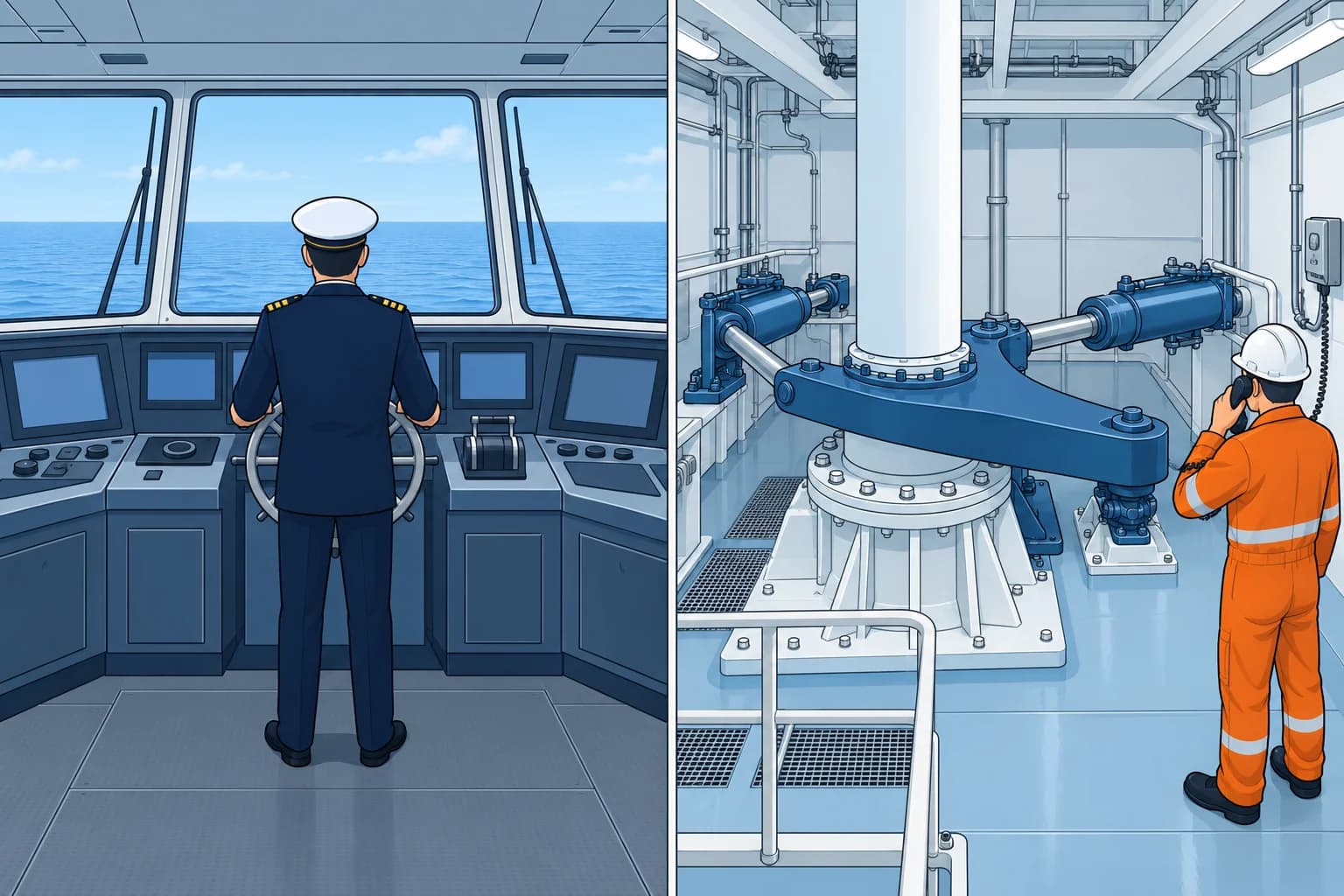
Within 12 hours of sailing
SOLAS V/26 requires the ship’s crew to check and test the steering gear within 12 hours before departure. An officer runs the test; ratings often man the steering gear room and the phone. The test covers the whole chain, from the bridge controls to the rudder, so a fault is found alongside the berth, not in the channel.
What is tested
Where fitted: the main and auxiliary steering gear, the remote control systems, the bridge steering positions and the emergency power supply. Also the rudder angle indicators against the actual rudder position, the control system power failure alarms, the power unit failure alarms, the automatic isolating arrangements and other automatic equipment. Every test includes full rudder movement, a visual inspection of the gear and its linkage, and the communication between bridge and steering gear room.
Short voyages
A ship regularly on short voyages may be allowed by its flag Administration, the government authority of the flag state, to skip the test before every departure. It must then test at least once every week.
Emergency steering drills
At least once every three months the ship holds an emergency steering drill. It practises direct control from within the steering gear compartment, the communication procedure with the bridge and, where applicable, the operation of alternative power supplies. Officers concerned with the gear must know each system and how to change from one to another.
Instructions and log
Simple operating instructions with a block diagram of the change-over procedures stay permanently displayed on the bridge and in the steering gear compartment. The logbook records the date and time of each check and test, and the date and details of each emergency steering drill.
Key figures
- Pre-departure test
- Within 12 h before departure (SOLAS V/26)
- Regular short voyages
- At least once a week, if the Administration allows
- Emergency steering drill
- At least once every 3 months
- Logbook
- Date and time of tests; date and details of drills
- Posted on bridge and in gear room
- Operating instructions with a change-over block diagram
Your part in the pre-departure steering test
- Tell the bridge you are going to the steering gear room and take a radio. — Someone must know where you are; the radio is a backup to the fixed phone.
- Check the reservoir oil levels and look for leaks before the pumps start. — A low level or leak found now is fixed in port, not at sea.
- Test the fixed phone with the bridge and report ready. — Communication between bridge and gear is itself one of the required checks.
- Keep clear of moving parts and watch the rudder go hard over each way. — Full rudder movement is required; your eyes confirm the gear runs smoothly.
- Compare the local indicator with the actual rudder position and report each reading. — The indicators must agree with the real rudder angle.
- Report alarms heard and anything abnormal, then report complete. — The officer needs your report to log the test and decide whether the ship can sail.
Remember
- Check and test the steering gear within 12 hours before departure.
- The test runs from bridge controls to rudder: indicators, alarms, power supplies and the bridge phone.
- Ships on regular short voyages may be allowed to test once a week instead.
- Emergency steering drill at least every three months: local control, communications, alternative power.
- Change-over instructions stay posted; the logbook records every test and drill.
Common mistakes
Wrong: If the ship tested the steering yesterday morning, that test covers tonight’s departure.
Right: The test must fall within 12 hours before departure. A test from yesterday morning is too old; test again.
Wrong: An emergency steering drill only needs the bridge to switch to the second power unit.
Right: The drill includes direct control from within the steering gear compartment and the communication procedure with the bridge.
Wrong: The rudder moved, so the test went well; no need to compare indicators.
Right: The rudder angle indicators must be checked against the actual rudder position, and the alarms tested too.
Worked case
The ship sails at 0600. The steering gear was tested at 1500 the day before, during cargo work. The chief officer asks whether that test counts. During the test, the local indicator read 30° to starboard when the rudder was hard over at 35°.
Show the answer
It does not count: 1500 is 15 hours before departure, more than the 12 hours allowed, so the gear must be tested again before sailing. The 5° difference between indicator and rudder is a defect: report it so the engineers can adjust the indicator before departure, and the test is logged with its result.
Practice question
Without a short-voyage waiver, what is the maximum time permitted between completing the steering test and departure?
- 24 hours
- 12 hours
- 48 hours
- 6 hours
Show the answer
Answer: B. Without a short-voyage waiver, twelve hours is the maximum interval before departure. A test six hours before departure is valid because it is within that interval.
3 · Local steering
Changing over to local and emergency steering
If bridge control fails, the ship is steered from the steering gear room on orders from the bridge. Know the posted change-over before you need it.
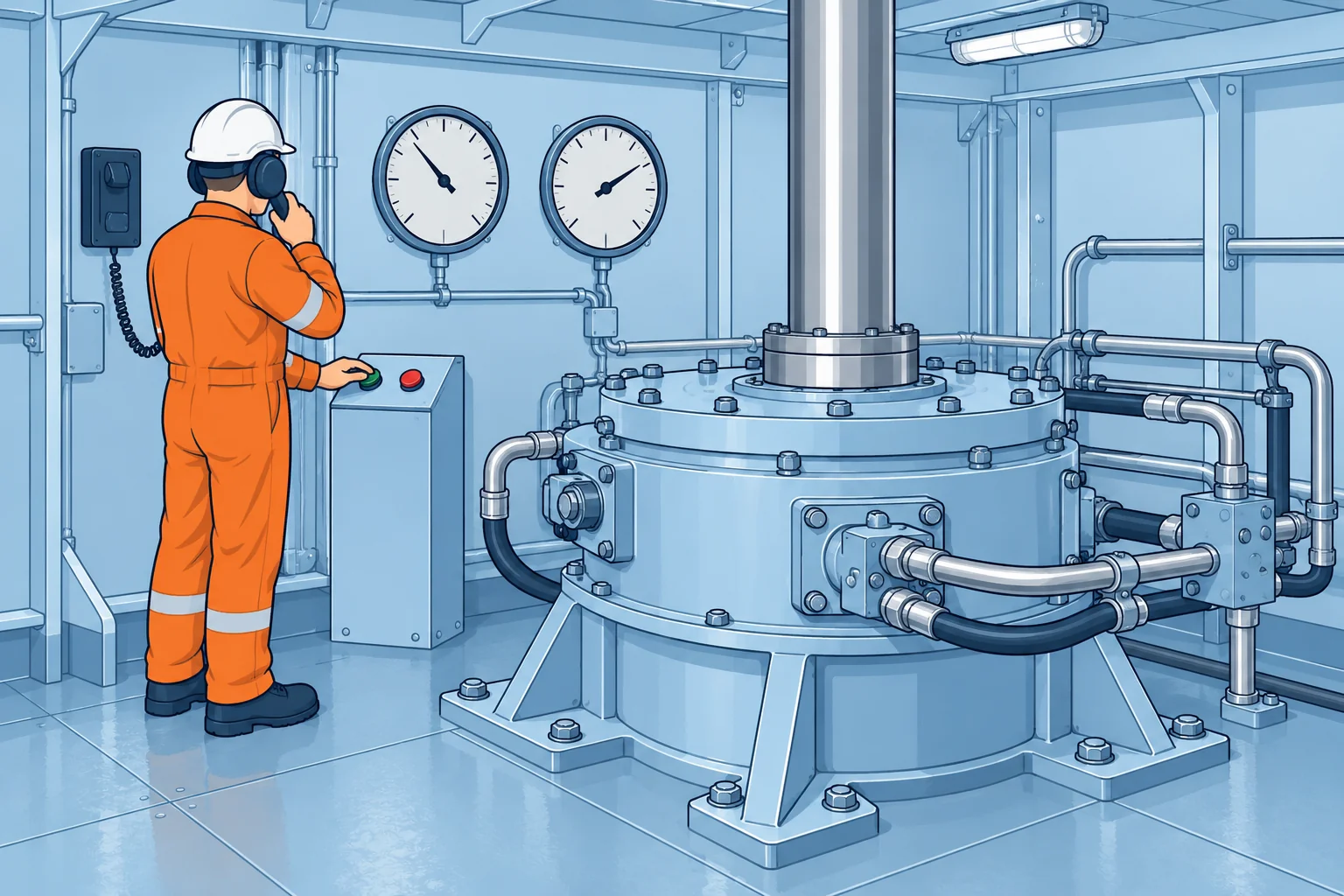
Control positions
Normally you steer from the bridge: this is remote control. Local control means steering at the gear itself, in the steering gear compartment. Ships do it by a local panel with push-buttons, a non-follow-up lever (the rudder moves only while you hold it), or by operating the hydraulic control valves by hand. Some older ships have a small trick wheel. Your ship’s method is on the posted change-over instructions.
When it is needed
If bridge steering does not answer, report it immediately. The officer follows your ship’s steering-failure procedure. Depending on the fault and fitted system, this may involve another control system, another power unit or local control. Make changes only as ordered and posted. Causes include a control system fault, a power unit failure or loss of the normal steering position. The bridge orders emergency steering from the steering gear room when local control is needed.
Steering blind
You cannot see ahead from the steering gear room. The bridge keeps the lookout and sends steering orders. Repeat every order back before acting. For an ordered rudder angle, use the local rudder angle indicator and report when the rudder reaches it. For an ordered heading, use the heading display and report when the ship reaches it. If an order is unclear, ask again.
Communication and power
Use the fixed phone, often sound-powered, with an agreed radio backup. Where SOLAS II-1/29.14 applies, an alternative supply must be available automatically within 45 seconds for one power unit, its control system and rudder angle indicator. It may come from the emergency electrical source or an independent source in the steering gear compartment. Know your ship’s arrangement.
Changing over to local control (follow your ship’s posted instructions)
- On the bridge’s order, go to the steering gear room with a radio and report arrival. — The bridge must know the position is manned before it hands over control.
- Establish the fixed phone link and agree the radio as backup. — Without communication you cannot receive steering orders.
- Check that a power unit is running, or start the one the bridge names; check oil level. — The rudder cannot move without hydraulic pressure.
- Set local control exactly as posted. Carry out the bridge’s ordered control check and confirm local control is established. — A wrong valve can block the rudder or leave two positions fighting each other.
- Repeat each order before acting. If unclear, ask again. Steer by the appropriate local display and report when the ordered rudder angle or heading is reached. — Closed-loop reports let the bridge know the ship is answering.
- Stay until relieved; change back to remote only on the bridge’s order. — An unannounced change-back leaves the ship with no one steering.
Remember
- Remote control is from the bridge; local control is at the gear in the steering gear room.
- Follow the posted change-over instructions and block diagram for your ship.
- Steer to orders: rudder angle on the local indicator or heading on the heading display.
- Repeat before acting; report when the ordered rudder angle or heading is reached. The bridge keeps lookout.
- Fixed phone first, radio as backup; know which power unit has the alternative supply.
Common mistakes
Wrong: In the steering gear room, steer by feel until the bridge sees the ship turn.
Right: Repeat each order before acting; ask again if unclear. Steer by the local angle indicator or heading display, then report when the ordered rudder angle or heading is reached.
Wrong: Once things settle, switch back to bridge control yourself to save time.
Right: Change back only on the bridge’s order and confirm it. Otherwise nobody may be steering.
Worked case
Steering from the bridge fails while the ship is in coastal waters. You are sent to the steering gear room. The fixed phone works, but the bridge’s orders are hard to hear over the pump noise.
Show the answer
Report arrival and follow the posted change-over on the bridge’s order. Agree a clear phone or radio link before steering. Use the ship’s hearing protection. Repeat each order before acting and report when the ordered rudder angle or heading is reached. Never guess an unclear order: ask for it again.
Practice question
What does local control of the steering gear mean?
- Steering from the bridge wing console instead
- Steering by the autopilot in heading mode only
- Steering at the gear in the steering gear room
- Steering by engine and thrusters alone
Show the answer
Answer: C. Local control means operating the gear in the steering gear compartment, as the posted instructions describe.
4 · Autopilot
Autopilot: heading and track control, and the rules for using it (SOLAS V/24)
The autopilot keeps a heading or a track, but it keeps no lookout. SOLAS V/24 says when manual steering must be ready and tested.
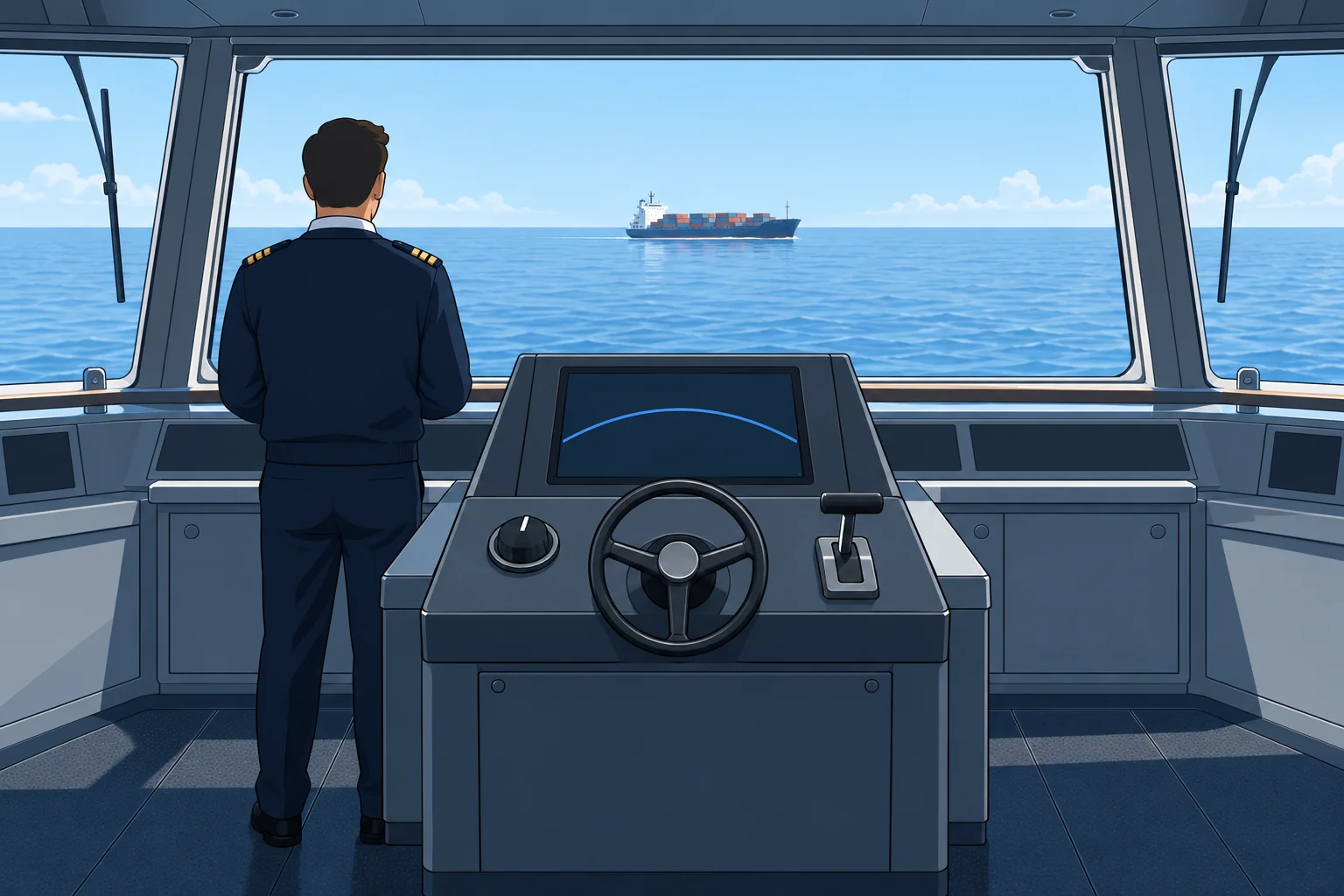
Heading and track
A heading control system (HCS), the autopilot, keeps the heading set by the officer, using the gyrocompass or another heading sensor. A track control system (TCS) keeps the ship on a planned track from the electronic chart route, correcting for wind and current. Under SOLAS V/19, ships of 10,000 gross tonnage (GT), a measure of enclosed volume, or more must have one of these, or another automatic means.
Steering modes
The mode selector usually offers hand (follow-up: the wheel or tiller sets a rudder angle and the rudder goes to it), non-follow-up (the rudder moves only while the lever is held), auto (heading) and track. Many consoles have an override tiller that takes control from the autopilot at once.
Settings and alarms
Rudder limit caps the rudder angle used. The weather (yaw) setting reduces corrections for wave-driven heading swings. Counter rudder applies opposite rudder to check a turn; rate of turn sets how quickly heading changes on systems with that function. The off-heading alarm warns of excessive departure from the set heading; a sensor alarm warns of lost or faulty heading input. Low speed, heavy weather and shallow water can limit performance. Keep your lookout.
SOLAS V/24
In high traffic density, restricted visibility and other hazardous situations, it must be possible to switch to manual steering immediately. A qualified helmsperson must be available to the officer of the watch without delay, ready at all times to take over. The change from automatic to manual and back is made by, or under the supervision of, a responsible officer. Manual steering is tested after prolonged use of the autopilot and before entering areas needing special caution.
Two pumps in caution areas
Under SOLAS V/25, in areas where navigation demands special caution, ships run more than one steering gear power unit when the units can work together. This provides redundancy against a power-unit failure; shared hydraulic, control or mechanical faults can still disable steering. How you take the wheel and answer helm orders is covered in Law: watch ratings.
Key figures
- HCS / TCS required
- Ships of 10,000 GT and more (SOLAS V/19)
- Manual steering ready
- Immediately, in traffic, poor visibility and hazards (V/24)
- Change-over auto ↔ manual
- By or under supervision of a responsible officer
- Test manual steering
- After prolonged autopilot use; before caution areas
- Caution areas
- More than one power unit running, where possible (V/25)
Remember
- Heading control keeps a heading; track control keeps a planned track. Neither keeps a lookout.
- Modes: hand (follow-up), non-follow-up, auto and track; an override tiller takes over at once.
- Off-heading warns of excessive heading difference; a sensor alarm warns of lost or faulty heading data.
- V/24: manual steering immediately available, helmsperson ready, change-over by or under an officer.
- Test manual steering after long autopilot use and before areas needing special caution.
Common mistakes
Wrong: On autopilot the lookout can relax, because the ship holds her course by herself.
Right: The autopilot only holds a heading or track. Lookout and collision avoidance stay fully with the watch.
Wrong: A rating may switch the autopilot to hand steering whenever it seems useful.
Right: The change-over is made by, or under the supervision of, the officer of the watch, who orders it.
Wrong: After ten days on autopilot across an ocean, manual steering can be assumed to work.
Right: Manual steering is tested after prolonged autopilot use and before entering areas needing special caution.
Worked case
After nine days on track control, you approach a busy traffic scheme in fog. The officer suggests leaving manual steering untested because track control has worked well. What should you report, and what must be ready before entry?
Show the answer
Explain that working track control does not prove manual steering works. Ask for the required manual test before entry. A qualified helmsperson must be ready without delay, and manual control must be available immediately. Change over by or under a responsible officer. More than one power unit must run if the units can work together.
Practice question
What does a track control system do that a heading control system does not?
- It keeps a constant heading using the gyrocompass
- It keeps the ship on a planned track over the ground
- It keeps a lookout and alters course for traffic
- It switches to hand steering when the fog thickens
Show the answer
Answer: B. A TCS follows a planned route track, correcting for wind and current. A heading control system only holds a heading. Neither keeps a lookout.