
The ship: hull, engines and systems · Level P4 · 6 parts · about 19 min
Surveys, certificates, maintenance and dry-docking
6 short parts: Survey regimes · Hull surveys · Maintenance · Docking plan · Docking stability · In dock. Each part explains the idea, then gives the points to remember, the common mistakes, a worked case and a practice question; the Academy unit adds all 37 check questions.
1 · Survey regimes
Statutory and class surveys: who checks what
Statutory surveys check flag-state requirements; class surveys check society rules. One surveyor may do both, but the consequences differ.
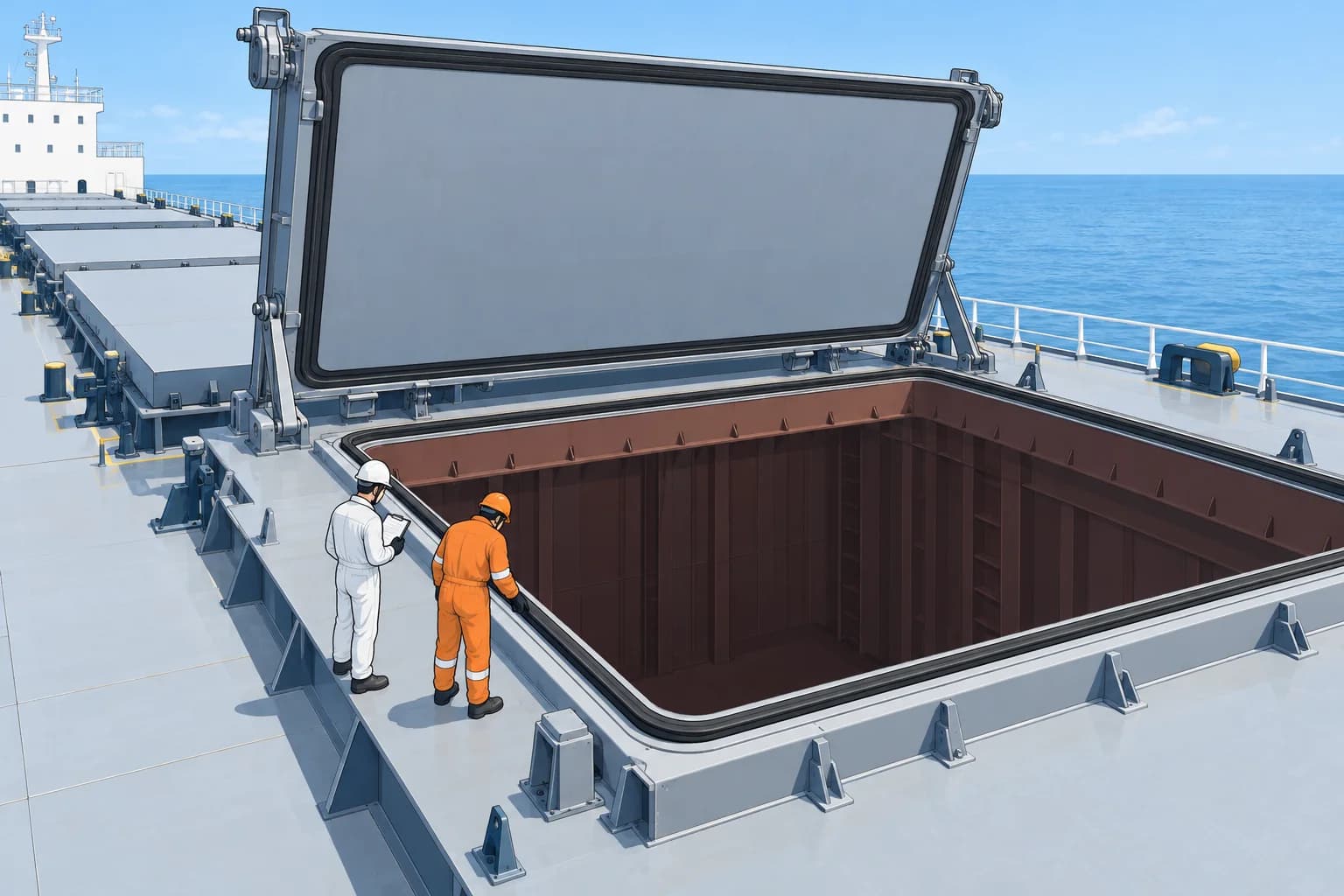
Two systems, one ship
Statutory surveys check that the ship meets the conventions (SOLAS, Load Lines, MARPOL) for her flag. The flag issues the certificates or delegates the work to a recognized organization (RO) under the IMO RO Code. Class surveys check that she meets the rules of her classification society, which insurers, charterers and banks rely on. Most ROs are class societies, so one visit often covers both. The list of certificates and their survey windows is in The master's business (law).
Class survey types
A ship stays in class through annual surveys, an intermediate survey in place of the second or third annual, and a class renewal survey (special survey) every five years. Bottom surveys, tailshaft surveys and boiler surveys run on their own cycles. Machinery can be on continuous survey: each item is examined once within five years, spread over the period instead of all at renewal.
Findings
A defect the surveyor wants fixed by a set date becomes a condition of class (some societies call it a recommendation). If the date passes without repair or an agreed extension, the ship can be suspended from class. Most charter parties and insurance policies depend on class. Memoranda record information or continuing limitations; they are not dated repair requirements. Track open items, plan repairs and warn the office early if a date cannot be met.
IACS
The leading societies form IACS, the International Association of Classification Societies. Its Unified Requirements (URs) set common minimum rules, such as UR Z7 for hull surveys and Z10 for the enhanced surveys of tankers and bulk carriers. Its Unified Interpretations explain how members read IMO wording. You meet them as references in survey reports and class circulars.
Occasional surveys
Report damage, grounding, planned major repairs and conversions to class and the relevant flag or RO; they determine the occasional surveys required before further operation. Notify changes of owner or flag and obtain their instructions. SOLAS requires the master or owner to report an accident or defect affecting safety or a certificate to the flag or RO without delay. Notify class too when its requirements may be affected. Keep reports and instructions with the repair records.
Key figures
- Class renewal (special) survey
- Every 5 years
- Annual class survey window
- 3 months either side of the anniversary date
- Intermediate survey
- In place of the 2nd or 3rd annual survey
- Continuous survey
- Each item examined once within the 5-year cycle
Remember
- Statutory surveys serve the flag and the conventions; class surveys serve the society's rules.
- An RO surveys for the flag under the RO Code; most ROs are class societies.
- A condition of class has a due date; missing it risks suspension of class.
- Report damage affecting safety or a certificate at once; class and flag or RO determine the surveys required.
Common mistakes
Wrong: A condition of class can wait until the next annual survey.
Right: It has its own due date. Repair it or agree an extension with class before that date.
Wrong: Small damage repaired by the crew need not be reported to class.
Right: Damage that could affect class or a certificate must be reported. Class decides whether a survey is needed.
Worked case
Your bulk carrier touched bottom leaving a river berth. Soundings show no leak and the hull looks fine from inside. The charterer wants the ship to load at the next port tomorrow. What must the master do about class and flag?
Show the answer
Report the grounding to the company, class and flag or RO without delay. Obtain their instructions before continuing. Class will usually require an occasional survey, often an in-water inspection by divers. Record the event in the log, keep checking soundings in all bottom tanks and save the voyage data recorder (VDR) data. Keep reports and survey instructions with the repair records.
Practice question
An owner presents a valid class certificate as proof that all statutory requirements are met. Is that sufficient?
- Yes; class approval covers every convention as well
- Yes; the same approval applies when class is the RO
- Yes; an insurer accepting class also confirms this
- No; statutory compliance must be checked separately
Show the answer
Answer: D. One organisation may act as both class society and RO, but the roles and approvals remain distinct. Check statutory compliance separately.
2 · Hull surveys
Enhanced surveys, close-up surveys and thickness measurement
Bulk carriers and tankers get surveys that grow with age. The ship's job is to have every space clean, safe and ready, and to know its own weak spots.
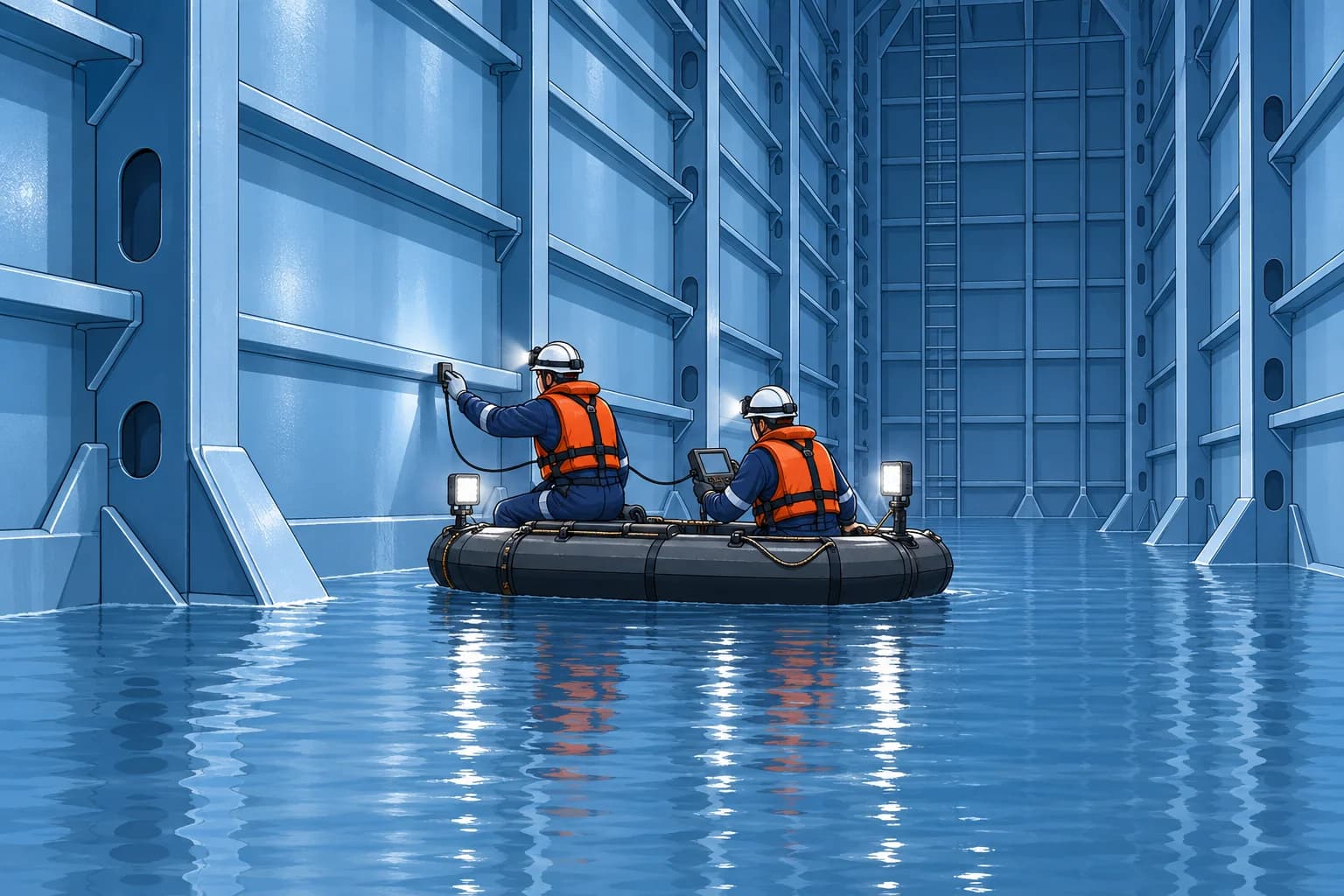
The Enhanced Survey Programme
Bulk carriers and oil tankers are surveyed under the 2011 ESP Code (resolution A.1049(27), as amended), made mandatory by SOLAS chapter XI-1. Required scope increases at specified ages and with adverse findings: more spaces, close-up surveys and thickness measurements. Before each renewal survey the owner and class agree a survey programme that lists the spaces, the access and the thickness measurements.
Overall and close-up
An overall survey checks a space's general condition and identifies suspect areas. A close-up survey examines structural details, normally within arm’s reach, using class-agreed access such as staging, rafting, a cherry-picker or rope access. Substantial corrosion remains within the applicable thickness limit but requires increased examination and gauging (thickness measurement). Steel below its allowable thickness needs repair or renewal agreed with class. In ballast tanks, a coating rated below GOOD brings annual examination.
Thickness measurement
Gauging means measuring steel thickness. A class-approved firm takes the readings with the surveyor present. The results go into the survey report file kept on board. For ESP ships it includes the condition evaluation report, which summarises the hull condition. Steel below allowable thickness needs class-agreed repair or renewal before the survey is completed.
Making spaces ready
You provide safe access. Clean and ventilate tanks and holds, arrange lighting, and confirm that the atmosphere is suitable. Follow the enclosed-space entry procedure in Deck safety. Plan which tanks are emptied in which port so cargo and ballast work allow it. Arrange class-agreed access for close-up work. A space not ready is a space not surveyed, and the survey cannot close.
Your inspections between surveys
ISM and class expect the crew to inspect ballast tanks and holds at set intervals, recording coating, anodes, cracks and leaks with photos and frame numbers. The surveyor reads these reports to decide where to look. Good reports find problems early and make the class survey shorter.
Key figures
- ESP applies to
- Bulk carriers and oil tankers (SOLAS XI-1/2, ESP Code)
- Close-up survey
- Structural details, normally within arm’s reach
- Gauging
- By a class-approved firm, surveyor present
- Kept on board
- Survey report file, condition evaluation report
Remember
- ESP surveys grow with age; plan them with class in a survey programme.
- Close-up surveys examine structural details, normally within arm’s reach; class must agree any alternative method.
- Prepare clean, ventilated, lit spaces with a suitable atmosphere and class-agreed safe access.
- Your own tank and hold reports guide the surveyor and catch problems early.
Common mistakes
Wrong: Cleaning a tank is enough preparation for a close-up survey.
Right: Cleaning does not provide close-up access. Arrange class-agreed safe access, normally within arm’s reach of the structure.
Wrong: The ship's crew can gauge the plates to save the cost of a firm.
Right: Survey gaugings must be done by a firm approved by class and attended by the surveyor.
Worked case
A required close-up survey is booked tomorrow. The yard offers only a view from the tank hatch and wants to close the tank today. What do you do?
Show the answer
Do not accept a hatch view as completion of the required close-up survey. Tell the office and class that access is inadequate. Agree safe access and revised timing before the tank is closed. Keep the relevant inspection reports and gauging arrangements ready.
Practice question
Which ships are surveyed under the Enhanced Survey Programme?
- Bulk carriers and oil tankers
- All cargo ships of 500 GT and above
- Passenger ships and ro-ro ferries
- Container ships of over 150 m
Show the answer
Answer: A. The ESP Code, made mandatory by SOLAS XI-1, covers bulk carriers and oil tankers.
3 · Maintenance
Planned maintenance and critical equipment (ISM Code section 10)
Maintenance is a system, not a habit. The ISM Code asks for planned work, records, reports of every defect and regular tests of the equipment you cannot do without.
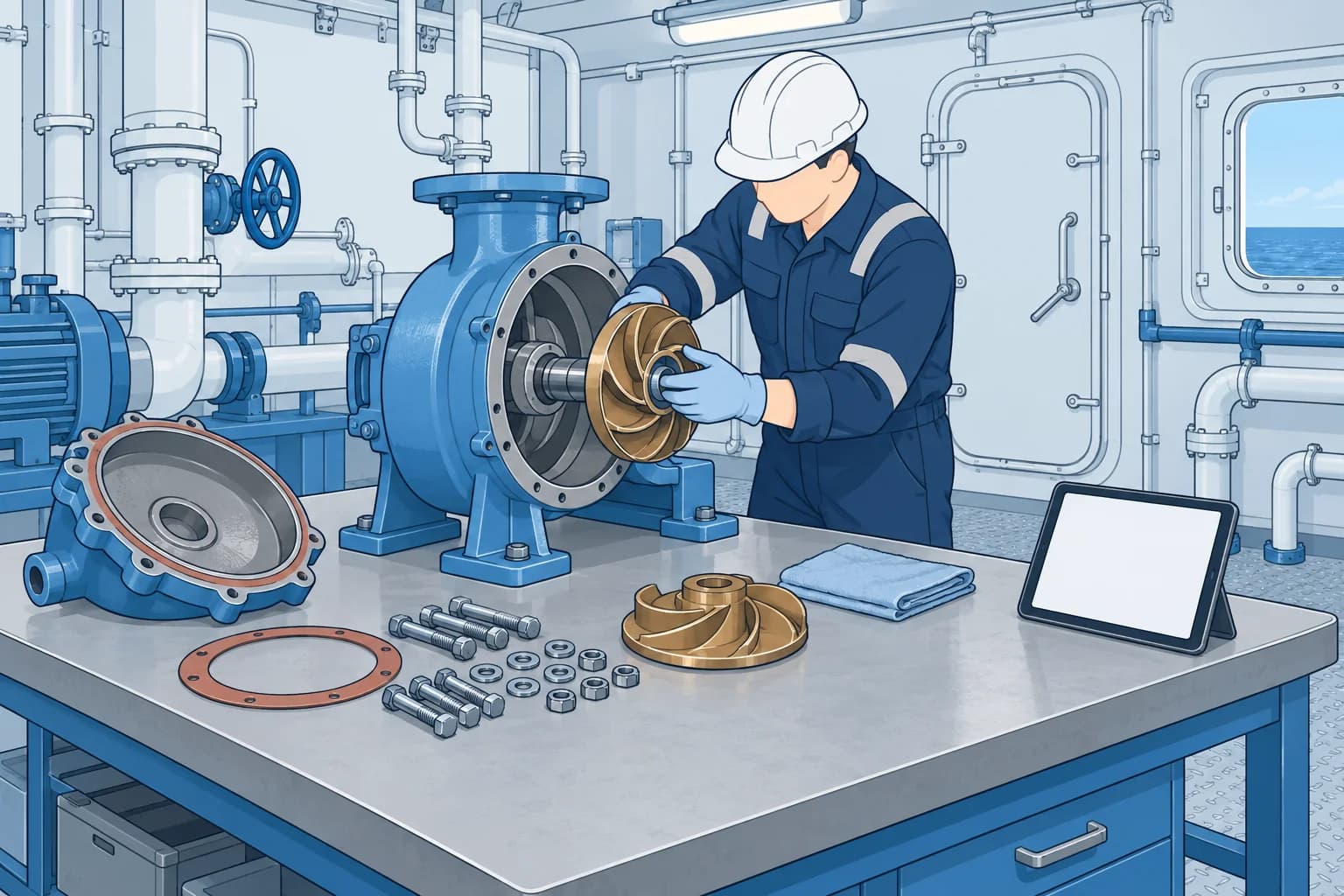
What ISM asks
Section 10 of the ISM Code requires the company to keep the ship maintained to the rules and its own requirements. Inspect at set intervals. Report each non-conformity (failure to meet a requirement), with its possible cause, if known. Take corrective action and keep records. It also asks the company to identify critical equipment, whose sudden failure could cause a hazardous situation, and to test it regularly, including stand-by items not in continuous use. The ISM system as a whole is taught in Safety management (law).
The planned maintenance system
A planned maintenance system lists every item with its jobs, its intervals by calendar or running hours, the maker's instructions and the spare parts. The software issues work orders. The crew does the job and records what was found, not just that it was done. Class can accept an approved system for the continuous survey of machinery, with the chief engineer crediting items and the surveyor auditing them each year.
Three strategies
Corrective maintenance repairs a detected fault, even before complete failure. Deliberate run-to-failure suits only items whose failure consequences have been assessed as tolerable. Preventive maintenance follows fixed intervals. Condition-based maintenance uses measurements, such as vibration, oil analysis or thermal images, to decide when work is needed. Ships combine these approaches; critical equipment needs specific reliability measures.
The deck side
The chief mate runs the deck plan: mooring winches and brake tests, life-saving and fire equipment, hatch covers, watertight doors, cranes, steel and paint. Process deferrals under the ship's safety management system. Record the reason, assess the risk and obtain company approval and any required class or flag agreement. Company approval cannot extend statutory or class deadlines or authorise operation with a prohibited defect.
Spares and records
Keep the spare parts the plan requires, including the critical spares. Record every job, measurement and defect so the trend is visible. The records prove to class, the flag, port state control and the charterer that the ship is maintained.
Remember
- ISM 10: planned inspections, reports of non-conformities, corrective action and records.
- Critical equipment is identified and tested regularly, including stand-by items.
- Record what you found, not just that the job was done.
- Assess deferrals and obtain required approvals; company approval cannot extend statutory or class deadlines.
Common mistakes
Wrong: Stand-by equipment that is never used needs no maintenance.
Right: ISM 10.3 asks for regular tests of stand-by equipment and systems not in continuous use.
Wrong: Postpone a job quietly if the ship is too busy.
Right: Follow the safety management system: record the reason, assess the risk and obtain required approvals. Company approval cannot extend statutory or class deadlines or authorise a prohibited defect.
Worked case
The emergency fire pump failed its weekly test: it ran but did not reach pressure. The ship sails tonight on a five-day passage. The chief engineer suspects a worn impeller and has no spare on board.
Show the answer
The emergency fire pump is critical equipment and a SOLAS item, so this is a non-conformity. Report it to the master and the company, and tell the flag or RO as the defect affects a certificate. Agree with them a repair or spare delivery before sailing, or compensating measures and permission to sail. Record the defect, the actions and the approvals. Order the critical spare for the plan.
Practice question
Under ISM section 10, what must the company do with critical equipment?
- Replace it with new equipment every five years
- Leave it to class to inspect at annual surveys
- Identify it and test it regularly, stand-by items too
- Have the master certify it once in every voyage
Show the answer
Answer: C. The company identifies equipment whose sudden failure could be hazardous and provides regular testing, including stand-by items.
4 · Docking plan
Planning a dry-docking: when, what and the specification
A docking is expensive and short. Good planning decides how much work gets done, at what cost, and whether the ship leaves on time.
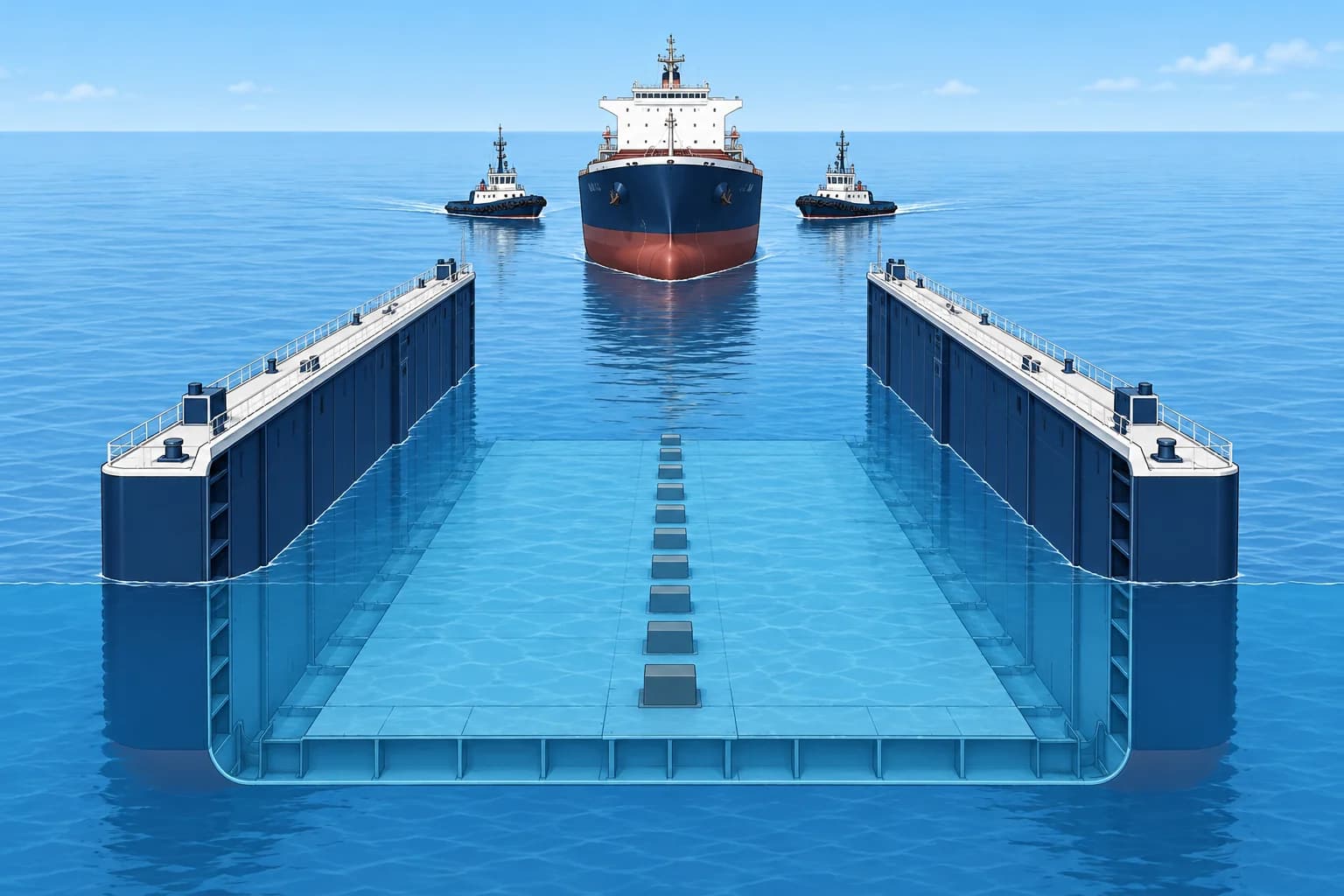
When to dock
For cargo ships under the normal five-year survey regime, two examinations of the outside of the bottom are required, one at renewal, no more than 36 months apart. The other may be an in-water survey by divers where class and flag accept it. ESP ships of 15 years and over must be dry-docked for each bottom examination. Passenger ships follow different bottom-survey requirements.
The docking specification
Months ahead the company builds a docking specification: hull cleaning and painting, steelwork, sea chests and valves, propeller, rudder, tailshaft seals, anodes, class items and the owner's own jobs. The ship feeds it with defect lists, tank reports and maker's service intervals. Yards quote against it. Work found late costs more, so a precise list saves money and days.
Before arrival
Send the yard the docking plan, the planned arrival condition and the last bottom survey report. Agree the trim, draught and stability with the dockmaster. Gas-free the fuel tanks where hot work is planned, and land or secure dangerous stores. Plan crew accommodation and the hand-over of responsibilities with the yard.
The safety meeting
Hold a meeting with the yard before work starts. Agree who is responsible for fire safety, hot work and enclosed-space permits, gas testing, shore fire main and power, and the alarm and evacuation plan. Contractors outnumber the crew in a dock, and many dock fires start in hot work near fuel or insulation.
Key figures
- Cargo-ship bottom examinations: normal regime
- 2 per 5-year cycle, max. 36 months apart
- Cargo-ship normal regime: one examination
- With the renewal survey
- In-water survey instead
- Where class and flag accept; not ESP ships ≥ 15 years
- Before arrival
- Docking plan, arrival condition, last bottom survey
Remember
- Cargo ships, normal regime: two bottom examinations in five years, one at renewal, no more than 36 months apart.
- ESP ships of 15 years and over must dock; others may use an in-water survey if accepted.
- A precise docking specification saves time and money.
- Agree fire safety, permits and responsibilities with the yard before work starts.
Common mistakes
Wrong: Every bottom survey must be done in dry-dock.
Right: The intermediate examination may be an in-water survey where class and flag accept it, except for ESP ships of 15 years and over.
Wrong: Once in the yard, fire safety is the yard's job alone.
Right: The ship's crew and the yard share it. Agree who does what in writing before work starts.
Worked case
Your container ship had her last bottom survey in dry-dock 33 months ago at the renewal survey. The intermediate survey is due. The office asks whether the ship must dock.
Show the answer
The next bottom examination must be within 36 months of the last, so it is due within 3 months. The ship is not an ESP ship, so class and flag may accept an in-water survey by approved divers, if the hull is fit for it (clear marks, accessible fittings, good visibility). If coating, propeller or sea-valve work is needed anyway, a dry-docking now may be the better choice. The office decides with class.
Practice question
For a cargo ship under the normal five-year survey regime, what is the longest interval between bottom examinations?
- 24 months
- 30 months
- 36 months
- 60 months
Show the answer
Answer: C. Under the normal cargo-ship regime, two examinations are required in each five-year period, one at renewal, with no more than 36 months between them. Passenger ships follow different requirements.
5 · Docking stability
Docking stability: the upthrust P and the critical instant, worked
Calculate block reaction P and the GM margin at the critical instant. Use the approved docking condition and dockmaster’s limits.
Where P comes from
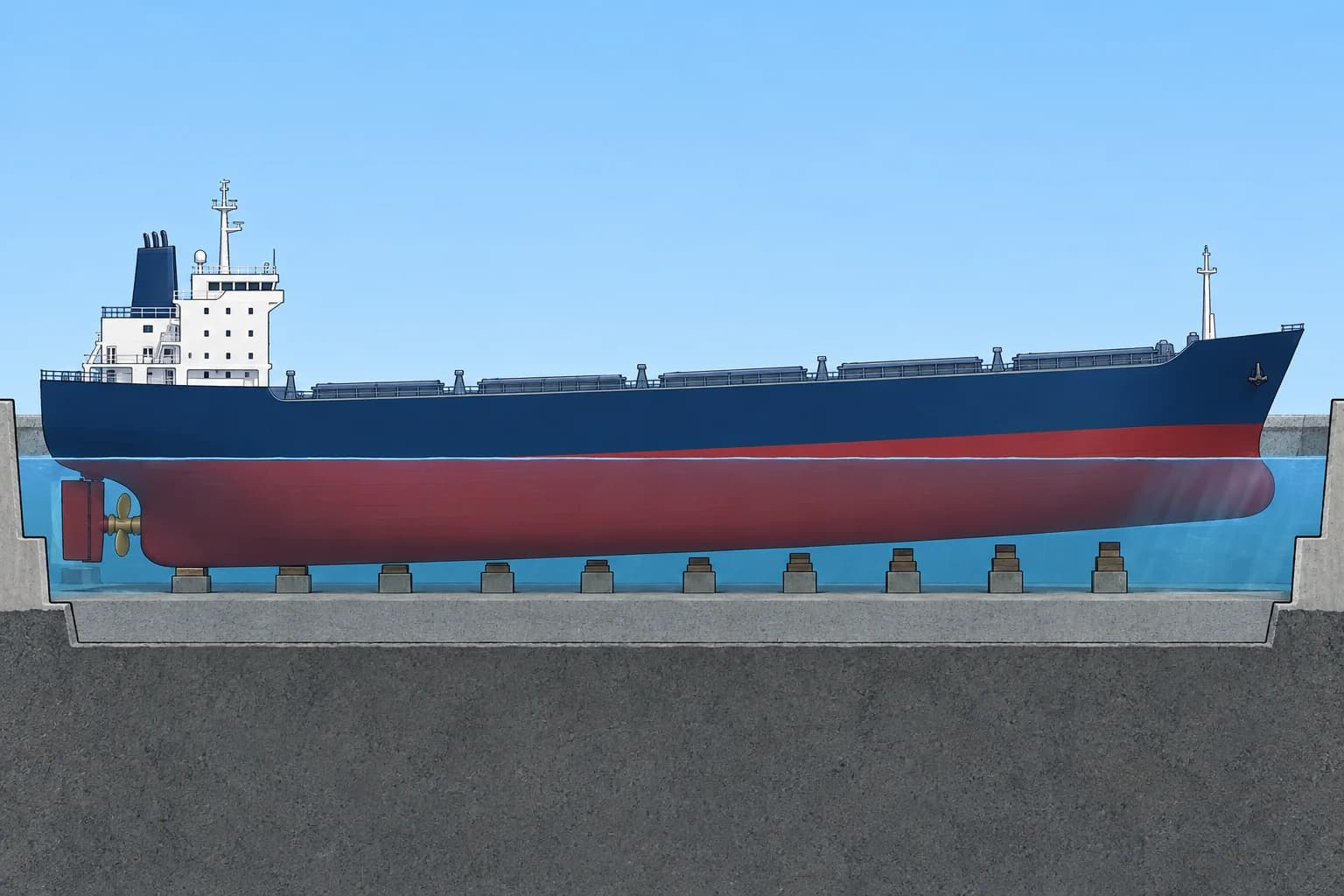
A stern-trimmed ship touches the after blocks first. As water falls, their upward reaction P removes her trim. The critical instant is just before the rest of the keel lands: P is greatest during this stern-only support. Trimming moments balance: P × l = MCTC × t. MCTC is the moment to change trim by 1 cm; t is trim removed in cm; l runs from the centre of flotation (LCF) to the after block.
Why GM falls
For small heel and fixed KM, P reduces the righting moment. Let Δ be displacement in tonnes. Method 1 subtracts P × KM ÷ Δ from starting GM, using full displacement Δ. Method 2 subtracts P × KG ÷ (Δ − P), using remaining buoyancy Δ − P. Their GM values differ but describe the same righting moment: Δ × GM₁ = (Δ − P) × GM₂. Both predict the same zero stability. State which basis defines the required minimum.
Worked example
Δ = 9,000 t; stern trim 60 cm; MCTC 150 t·m/cm; l = 72 m; KM 8.40 m; KG 7.60 m; GM 0.80 m. At the critical instant, P = 150 × 60 ÷ 72 = 125 t. Method 1: GM₁ = 0.80 − 125 × 8.40 ÷ 9,000 = 0.68 m. Method 2: GM₂ = 0.80 − 125 × 7.60 ÷ 8,875 = 0.69 m. Positive GM alone does not approve docking.
Illustrative trim limit
Using method 1, suppose the required GM₁ is at least 0.30 m at the critical instant. Allowed loss = 0.80 − 0.30 = 0.50 m. Maximum P = 0.50 × 9,000 ÷ 8.40 = 536 t. Maximum trim = 536 × 72 ÷ 150 = 257 cm, about 2.6 m by the stern. This constant-hydrostatics result is an exercise; operational trim must meet approved docking calculations and dockmaster’s limits.
Reducing the risk
Keep trim small, tanks full or empty to limit free surface, and heavy weights low. Set side blocks or shores in the sequence agreed with the dockmaster and approved docking plan; agree every ballast change. For stern-trimmed undocking, the critical stage is when the forward keel lifts and support reduces to the after blocks. P then decreases towards zero as the stern lifts clear.
Key figures
- Upthrust
- P = MCTC × t ÷ l (t in cm, l from LCF to the after block)
- GM loss, method 1: original displacement
- P × KM ÷ Δ
- GM loss / virtual rise of G, method 2: remaining buoyancy
- P × KG ÷ (Δ − P)
- Worked example
- P = 125 t; GM₁ = 0.68 m; GM₂ = 0.69 m
Checking GM at the critical instant
- Take Δ, trim, MCTC, LCF, KM and KG from the approved docking condition, allowing for free surface. — The answer is only as good as the condition it starts from.
- Find l: the distance from the LCF to the after block where she will land. — P acts there, so l sets the size of P.
- Calculate P = MCTC × t ÷ l with t in cm. — At the critical instant the whole trim has been removed by the block.
- Using method 1, calculate GM₁ = starting GM − P × KM ÷ Δ. — This GM uses the original-displacement basis; method 2 uses remaining buoyancy.
- Compare GM₁ with the minimum specified on the method-1 basis and check approved docking limits. — If it is too small, agree a revised condition before docking. Positive GM alone does not approve docking.
Remember
- The block's upthrust P removes the trim: P × l = MCTC × t.
- Method 1 loses P × KM ÷ Δ; method 2 loses P × KG ÷ (Δ − P). Use the basis specified for the minimum.
- The critical instant is when the whole trim has gone, just before the keel lands fully.
- Small trim limits P; low G and limited free surface improve the remaining stability margin.
Common mistakes
Wrong: Measure l from midships to the after block.
Right: The ship trims about the centre of flotation, so l is measured from the LCF.
Wrong: Free surface does not matter once she sits on the blocks.
Right: Free surface reduces GM until she is fully landed, adding to the loss caused by P.
Worked case
A ship of Δ 6,000 t trims 0.90 m by the stern. MCTC is 80 t·m/cm, l is 50 m, KM 7.00 m and KG 6.40 m. The required minimum GM₁, using method 1, is 0.45 m. Does this condition meet the minimum for docking?
Show the answer
P = 80 × 90 ÷ 50 = 144 t. Starting GM = 7.00 − 6.40 = 0.60 m. GM₁ = 0.60 − 144 × 7.00 ÷ 6,000 = 0.432 m, below 0.45 m. Do not proceed in this condition. Agree a revised condition, such as stern trim of about 0.80 m or less using these fixed inputs, then confirm approved docking calculations and dockmaster’s limits.
Practice question
Δ 9,000 t, MCTC 150 t·m/cm, trim 60 cm by the stern, l = 72 m. What is P at the critical instant?
- 75 t
- 125 t
- 150 t
- 216 t
Show the answer
Answer: B. P = 150 × 60 ÷ 72 = 125 t.
6 · In dock
In the dock and before flooding up: the officer's checks
A ship in dock is cut off from the sea and full of contractors. Keep her safe while she sits there, and check every opening before the water comes back.
Safety in the dock
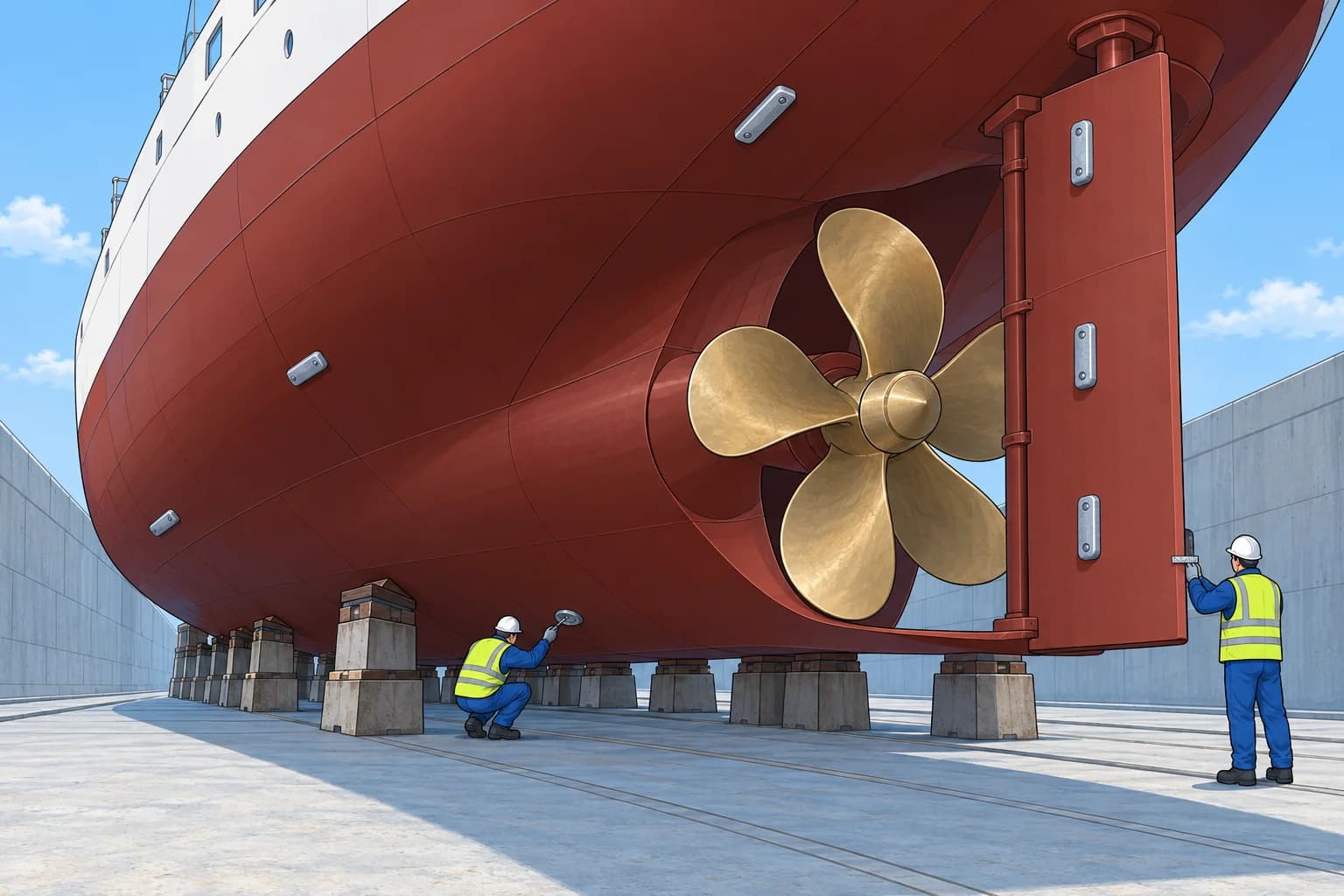
Sea suctions are unavailable while the hull is dry. Before isolating ship systems, agree and test shore or approved temporary supplies for fire water, cooling and power. Check the international shore connection, the standard flange connecting shore fire hoses, where used. Mark isolations and maintain alternative fire protection. Restore isolated systems promptly once work and personnel safety permit; verify them before sailing. Maintain fire patrols, hot-work controls, gas tests and contractor sign-in records.
Measurements in the dock
While the hull is dry, measure tailshaft wear-down (the drop of the shaft in its aft bearing, measured with a poker gauge or dial), rudder clearances (bearing gaps and jumping clearance: the upward travel allowed before the rudder meets its stop), propeller condition, and anode wastage. Record them with the readings from the last docking so the trend shows.
Before flooding the dock
Witness bottom plugs and sea-chest covers fitted and sealed. Secure protective grids: they exclude debris but are not watertight barriers. Check repaired hull openings, reassembled valves and connected pipework; set valves for the agreed flooding plan. Remove masking. Keep anodes bare and prepare transducers and logs exactly as their makers specify; use only permitted coatings. Compare tank soundings with arrival figures. Include changed weights or tank contents in a new stability check before refloating.
Refloating
Agree flooding stages with the dockmaster. Check for leaks from initial immersion as repaired boundaries and opened connections become submerged. Monitor opened spaces, sea connections and stern seals throughout. Hold at agreed safe stages, including a check before the critical period. Any additional pre-float hold must suit the approved stability sequence. Stop flooding and notify the master and dockmaster if leakage appears. Once afloat, check draught and list, test steering and restore required systems before sailing.
Checks before flooding the dock
- Walk the bottom with the yard: every plug back and sealed, signed off. — A missing plug floods a tank as soon as water returns.
- Check hull closures, sea valves and pipework complete, valve settings agreed, and sea-chest grids secured. — Sound closures, valves and pipework contain seawater; grids keep debris out.
- Remove masking, keep anodes bare and prepare transducers and logs to maker instructions; use only permitted coatings. — Coated sacrificial anodes lose protection; masking or unsuitable coatings can impair sensors.
- Compare tank soundings with the arrival figures and recalculate stability if needed. — Weights moved in dock change her stability at refloating.
- Check for leaks as repaired boundaries and opened connections first submerge. Use dockmaster-agreed safe holds before the critical period and any later check before float-off. — Low openings submerge early. If leakage appears, stop flooding, notify the master and dockmaster, and investigate before continuing.
Remember
- Agree and test shore or approved temporary fire-water, cooling and power supplies; mark isolations and maintain protection.
- Measure tailshaft wear-down, rudder clearances and anodes while she is dry.
- Before flooding: plugs, valves, grids, anodes and transducers checked and witnessed.
- Check leaks from initial immersion; use agreed safe holds before the critical period and further checks before float-off.
Common mistakes
Wrong: The yard checks the plugs, so the ship need not.
Right: Walk the bottom with the yard and sign off each plug and valve yourself.
Wrong: Flood the dock straight through to save time.
Right: Check from initial immersion as repaired boundaries submerge. Use dockmaster-agreed holds at safe stages, including before the critical period. Continue monitoring through float-off.
Worked case
Undocking is planned for 06:00. At the final bottom walk at 04:30 you find one double-bottom drain plug missing and fresh paint on two hull anodes. The yard foreman says it can be sorted after flooding.
Show the answer
Do not agree. A missing plug floods the tank as water returns and changes stability. Have it fitted and sealed, and witness it. Remove paint from the anodes. Record both defects and tell the master and dockmaster; delay flooding as needed. Complete the checks.
Practice question
Tailshaft wear-down has increased since the last docking. What should you do before accepting the condition?
- Reset the baseline to the current reading
- Accept it if the propeller turns freely
- Check maker/class limits and agree necessary action
- Apply the rudder-clearance limit to the shaft
Show the answer
Answer: C. Compare the reading with previous records and the applicable limits. Free rotation alone does not establish acceptable bearing wear.