
The ship: hull, engines and systems · Level P4 · 5 parts · about 16 min
Remote control of the propulsion plant and engineering systems (STCW A-II/2)
5 short parts: Bridge control · UMS · Electric plant · Blackout · Failures. Each part explains the idea, then gives the points to remember, the common mistakes, a worked case and a practice question; the Academy unit adds all 30 check questions.
1 · Bridge control
Bridge control of the main engine
On most ships the bridge runs the main engine with one lever. Know what that lever does for you, what it will not do, and how to hand control back.
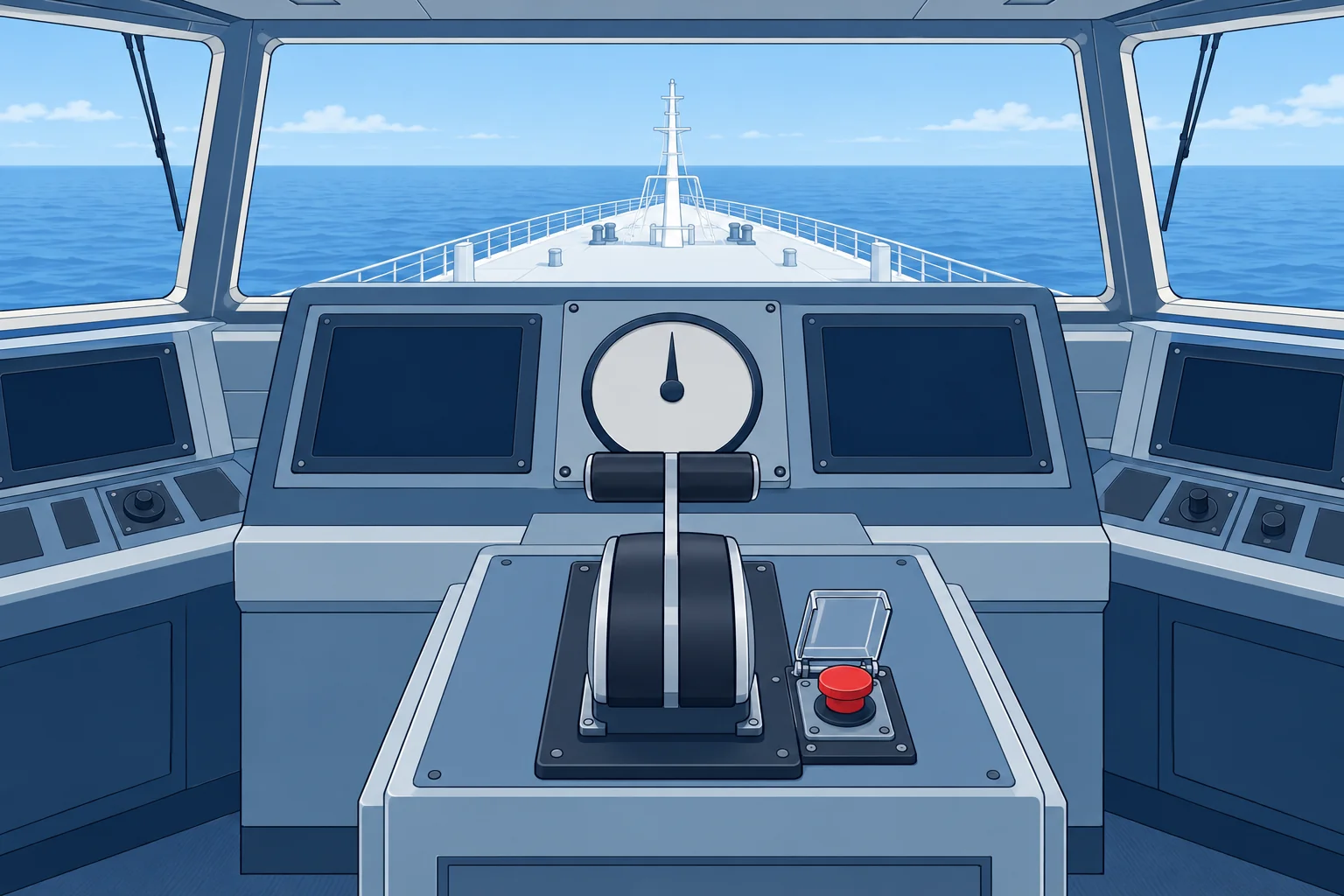
Who controls the engine
SOLAS II-1/49 asks that, under all sailing conditions, the speed, the direction of thrust and, with a controllable-pitch propeller (CPP), the pitch can be fully controlled from the bridge. One control lever per independent propeller does the rest automatically: starting air, fuel, reversing, and limits that prevent overload. Control can also be in the engine control room (ECR) or at the local control stand on the engine itself.
One place at a time
Only one location controls the engine at a time, and each shows which one it is. Transfer between the bridge and the machinery spaces is made in the machinery space or the ECR, with the receiving side accepting. The system must stop the thrust changing much at the moment of transfer, so match lever positions and agree by phone before you change over.
Indicators and the emergency stop
The bridge shows propeller speed and direction of rotation (fixed pitch), or speed and pitch (CPP). An emergency stop on the bridge works independently of the bridge control system. Know where it is and what it does: it stops the engine, not the ship. Bridge orders are also shown in the ECR or at the local stand.
Load programme and limits
The control system protects the engine. A load programme raises power slowly above a set level, for example when going from manoeuvring to sea speed. Barred speed ranges, where shaft vibration is dangerous, are passed through quickly and not used for steady running. The number of automatic start attempts is limited to save starting air, and an alarm warns of low starting-air pressure while starts are still possible.
When remote control fails
A failure of the bridge control system gives an alarm. Where practicable the last speed and direction are kept until local control takes over. Orders then go by the engine telegraph or a second independent means of communication to the ECR or the local stand. Practise this changeover in port and in drills, not for the first time at a pilot station.
Key figures
- Bridge control (SOLAS II-1/49)
- Speed, thrust direction and pitch from the bridge
- Control locations
- One at a time; transfer made in the machinery space or ECR
- Emergency stop
- On the bridge, independent of the bridge control system
- Bridge indicators
- Shaft speed and direction, or speed and pitch (CPP)
Remember
- One lever per propeller; the system handles starting, reversing and overload limits.
- Only one location controls at a time; transfer is made from the machinery space or ECR.
- The bridge emergency stop is independent of the remote control system.
- Repeated failed starts empty the air bottles; tell the engine room at once.
Common mistakes
Wrong: Keep trying to start the engine from the bridge until it fires.
Right: Each failed start uses starting air. After a failed start, call the engine room and agree what to do.
Wrong: Hold the engine at any revolutions the passage plan needs.
Right: Avoid steady running in a barred speed range. Choose revolutions above or below it.
Worked case
Approaching the pilot station, the bridge control alarm sounds and the main engine no longer answers the bridge lever. The engine is still running at the last setting, half ahead. The pilot is 2 miles away and there is traffic around.
Show the answer
Call the master and engine room at once. Ask engineers to take control in the ECR or at the local stand; pass orders by telegraph and phone. Keep steering and use available control to avoid traffic. Warn the pilot and vessel traffic service (VTS). Do not take the pilot on board until engine control is confirmed. Record times and actions, and preserve voyage data recorder (VDR) data.
Practice question
Where is control of the main engine transferred between the bridge and the machinery spaces?
- From the bridge wing control panel
- In the main machinery space or ECR
- From the master's cabin control unit
- At the steering gear room local panel
Show the answer
Answer: B. SOLAS II-1/49 allows transfer between bridge and machinery spaces only in the main machinery space or the machinery control room.
2 · UMS
Unattended machinery spaces and the bridge watch
When machinery spaces are unattended, know which alarms reach the bridge, how to contact the duty engineer and when to request a manned engine room.
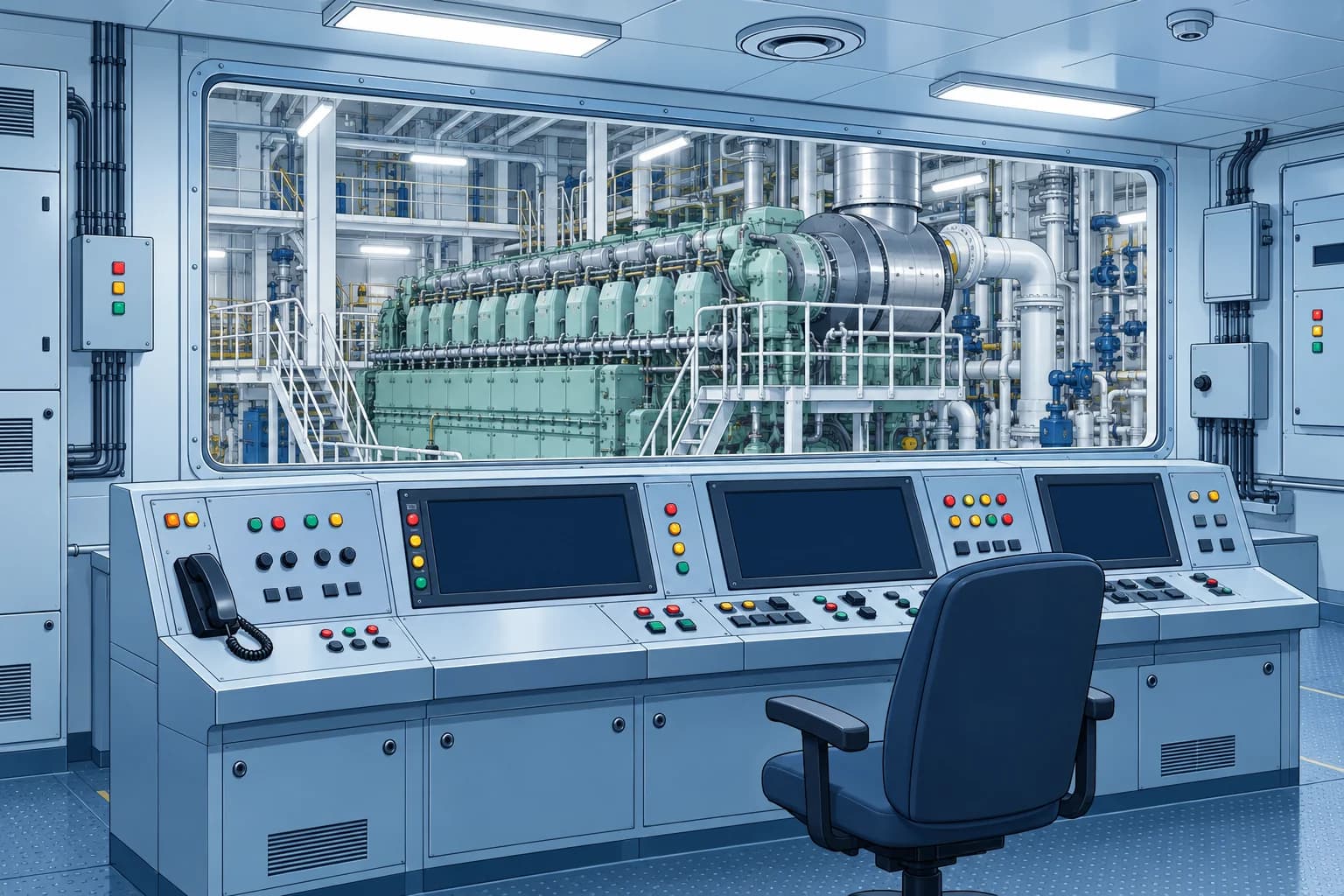
What UMS means
A ship with periodically unattended machinery spaces (UMS) may leave the engine room empty, usually at night. SOLAS II-1 Part E allows this only if the ship is as safe as with a manned engine room: early fire detection, bilge level alarms, automatic control of essential machinery and a full alarm system. Class confirms it with a notation, such as UMS or E0 depending on the society.
The alarm chain
A fault sounds and shows in the ECR and, through a selector switch, in the duty engineer's cabin and the engineers' public rooms. If nobody accepts it locally within a set time, the engineers' alarm sounds. Faults that need the attention of the officer of the watch (OOW) also sound on the bridge. Know which these are and what each asks of you: often it is only to call the duty engineer.
The bridge's part
Know who the duty engineer is and how to reach them at any time. An engineer going into the engine room alone reports to the bridge, and on most ships sets a dead-man alarm that must be reset at intervals. If it is not reset, the alarm sounds and you start the search and the response set out in the safety management system (SMS).
When to man the engine room
Standing orders say when UMS stops: arrival and departure, manoeuvring, narrow channels, restricted visibility, heavy traffic, heavy weather, and any persistent alarm on essential machinery. Ask for the engine room to be manned early. Engineers need time to get there and to start extra generators.
Slowdown, shutdown and override
Serious faults can trigger automatic slowdown (reduced load) or shutdown (stopping machinery), with an alarm. Automatic propulsion shutdown protects against serious damage, complete breakdown or explosion. An override bypasses only designated protections; some cannot be overridden. It must resist accidental operation and show when active. If slowing or stopping would create greater danger, the master and chief engineer assess the fitted override under shipboard procedures. It cannot cure the fault and risks machinery damage without guaranteeing continued propulsion.
Remember
- UMS needs fire detection, bilge alarms, automatic control and an alarm system; class confirms it.
- Unaccepted alarms escalate to the engineers' alarm; some also sound on the bridge.
- Know the duty engineer; engineers alone in the engine room use the dead-man alarm.
- Ask for the engine room to be manned early: arrival, narrow waters, poor visibility, alarms.
Common mistakes
Wrong: An engine alarm on the bridge panel is the engineers' problem; accept it and carry on.
Right: Acknowledge it, call the duty engineer and make sure someone answers. Log the time.
Wrong: Override a slowdown whenever the passage is late.
Right: An override bypasses only designated protections and may damage machinery without preserving propulsion. The master and chief engineer weigh navigational danger under shipboard procedures.
Worked case
At 02:30 in UMS mode, high cooling-water temperature causes a main-engine slowdown. You have clear sea room. The duty engineer reported entering the machinery space alone. Their dead-man alarm sounds for an overdue reset, and they do not answer repeated calls. What do you do?
Show the answer
Treat this as a possible casualty. Escalate immediately under the SMS; call the master and chief engineer. Arrange a properly equipped response team following safe-entry procedures; do not send anyone alone. Keep the bridge watch and let the slowdown protect the engine while sea room allows. Maintain contact with the team, arrange engineering response and log times.
Practice question
What happens if a machinery alarm is not accepted locally within the set time?
- The main engine stops automatically
- The general emergency alarm sounds
- The engineers' alarm sounds on board
- The alarm automatically resets itself
Show the answer
Answer: C. The alarm system activates the engineers' alarm if an alarm gets no local attention within a limited time.
3 · Electric plant
Generators, power management and the emergency switchboard
Propulsion and steering need electricity. Know how the plant keeps power on, what it drops first, and what the emergency generator will and will not run.
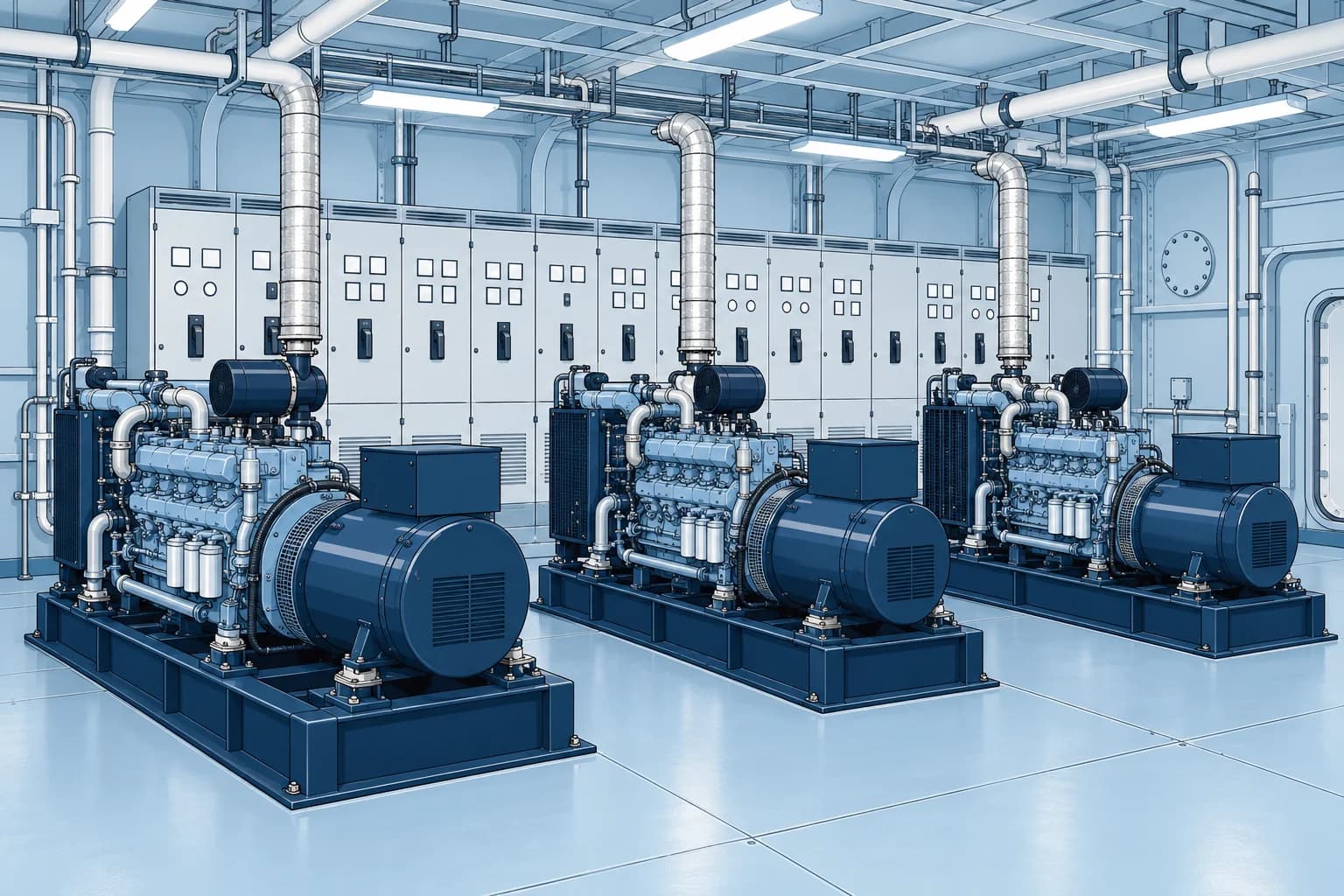
The main source
Diesel generators, and on many ships a shaft generator driven by the main engine, feed the main switchboard. A power management system starts and connects a standby generator when the load rises or a running set fails, and shares the load between sets. In UMS ships, if one generator normally carries the load, a standby set must start and connect automatically when it is lost.
Preferential tripping
On overload, preferential trips switch off non-essential consumers in stages, such as galley, air conditioning and some cargo services, so the remaining generators can keep propulsion, steering and safety. Big consumers like bow thrusters often need a second generator first. Request power before you start them and wait for the ready signal.
The emergency source
The emergency generator is above the uppermost continuous deck, with independent access and separation from the main plant. In the automatic emergency-generator arrangement, it starts and connects to the emergency switchboard within 45 seconds after main supply failure. Normal endurance for specified emergency services is 18 hours on cargo ships and 36 hours on passenger ships. Services include lighting, radio and an electrically driven emergency fire pump, where supplied from that board. Passenger ships also have a battery transitional source for 30 minutes.
Steering power
Electric steering power units use separate circuits. One may pass through the emergency switchboard. If the required rudder-stock diameter at the tiller exceeds 230 mm, excluding ice strengthening, an alternative source must connect automatically within 45 seconds. This may be the emergency source or an independent source in the steering compartment. Minimum endurance is 30 minutes at 10,000 gross tonnage (GT) and above, otherwise 10 minutes. It supplies a power unit, its controls and rudder-angle indication.
Alternative-supply performance
On that alternative supply, at the deepest seagoing draught, the gear must move the rudder from 15° on one side to 15° on the other within 60 seconds, at half maximum ahead service speed or 7 knots, whichever is greater.
Shaft generators and manoeuvring
A shaft generator is cheap power at sea speed. It may drop out when the engine slows, stops or reverses. Company orders usually require diesel generators running, often two in parallel, before manoeuvring and in confined waters.
Key figures
- Automatic emergency-generator arrangement
- On load within 45 s after main supply failure
- Normal endurance: specified emergency services
- Cargo ships 18 h; passenger ships 36 h
- Transitional source (passenger)
- Batteries for 30 min
- Required rudder stock > 230 mm at tiller, excluding ice strengthening
- Alternative supply: 45 s; ≥ 10,000 GT: 30 min; otherwise 10 min
- Steering: deepest seagoing draught; half maximum ahead service speed or 7 knots, whichever is greater
- 15° one side to 15° the other within 60 s
Remember
- The power management system starts standby sets and shares the load.
- Preferential trips drop non-essential loads to keep propulsion and steering.
- Automatic emergency generator: on load within 45 s; normal endurance for specified services: cargo 18 h / passenger 36 h.
- Run diesel generators before manoeuvring; shaft generators can drop out.
Common mistakes
Wrong: Start the bow thruster as soon as you need it.
Right: Request power first. Starting a big consumer on one generator can trip the board.
Wrong: The emergency generator runs the whole ship during a blackout.
Right: It feeds only the emergency switchboard: emergency lights, navigation lights, radio, alarms and a few essential services.
Worked case
Your ship runs on the shaft generator at sea speed. Two hours before arriving at a river entrance you plan to reduce speed, then use the bow thruster at the berth. What do you arrange with the engine room?
Show the answer
Ask the engineers to arrange the diesel generating capacity and standby readiness required by the ship's procedures before reducing speed, because the shaft generator may drop out as the engine slows. Confirm when they are on load. Before using the bow thruster, request power and wait for the ready signal. Agree when the engine room will be manned, and test the engine and steering before entering the river.
Practice question
In the automatic emergency-generator arrangement described, within what time must it take its load after main power fails?
- 15 seconds
- 30 seconds
- 45 seconds
- 90 seconds
Show the answer
Answer: C. In this automatic arrangement, the emergency generator must start and connect to the emergency switchboard within 45 seconds. Check your ship's fitted arrangement.
4 · Blackout
Blackout at sea: the first minutes and the recovery
In a blackout the ship goes dark and quiet and starts to lose way. Keep her steering while she can, tell the world, and let the engineers restore power in order.
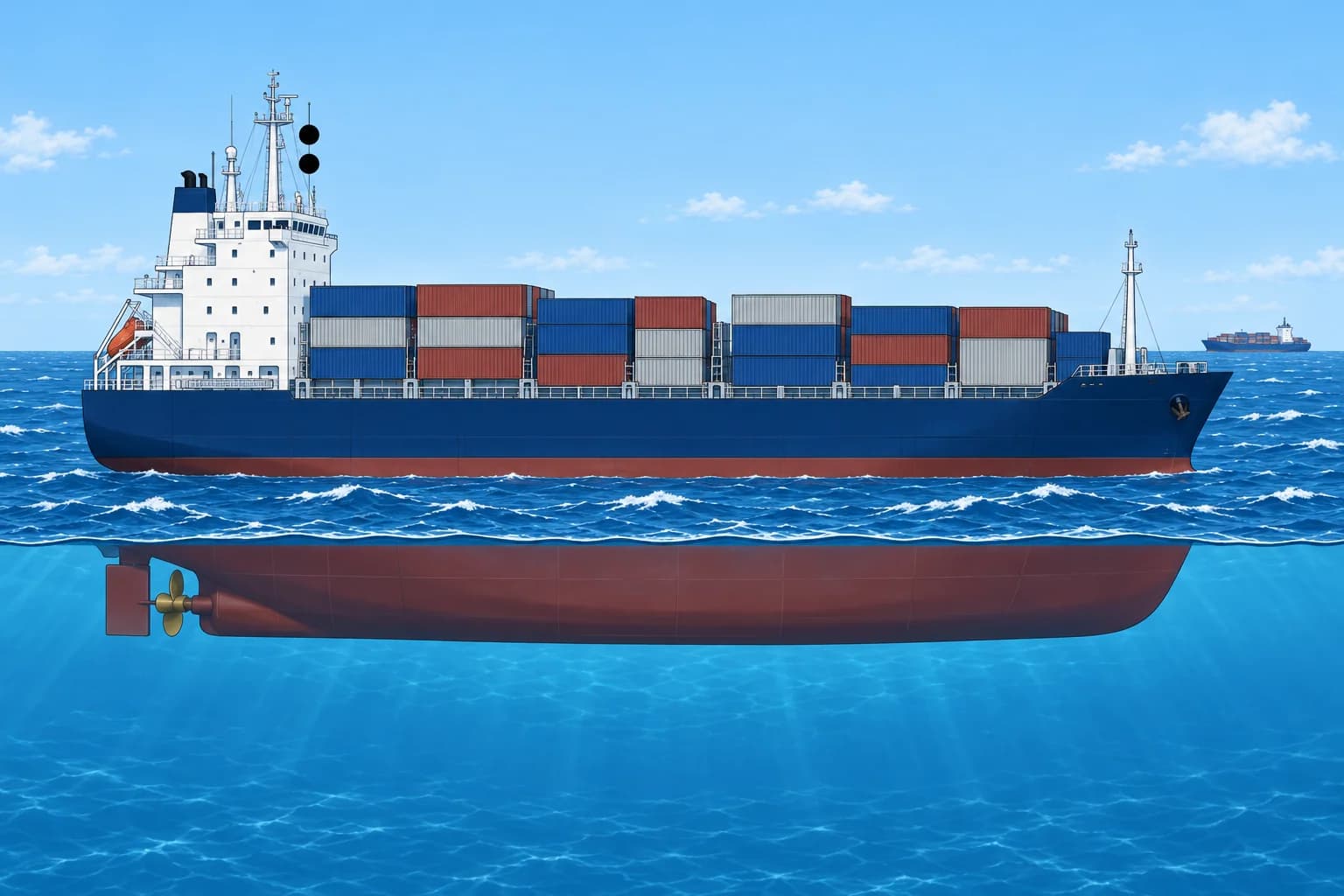
What a blackout looks like
When main power fails, lights, auxiliaries and main-fed steering pumps may stop; propulsion may trip. The emergency source supplies designated safety services. Alternative steering power, where required, may come from that source or an independent supply. Check what is running. An uninterruptible power supply (UPS) or battery keeps only its connected equipment powered without a break. Check displays, sensors and communications. A VDR reserve supply may record bridge audio rather than every sensor.
What she will still do
If steering remains available, use the ship's remaining way through the water to steer clear of traffic and dangers. Her heading and drift depend on the ship, wind and sea; do not assume she will lie beam on. Find out quickly the depth, distance to danger and rate of drift. Assess anchoring suitability against equipment limits and holding conditions as well as depth.
Restoring power
Engineers restore a main generator, reconnect essential services and restart propulsion under the ship's blackout-recovery procedure. Confirm steering as early as possible. Restore loads in stages within available generating capacity. Do not ask for full power or the bow thruster as soon as the lights come back: a big load can cause another blackout. Agree with the chief engineer what you will have and when.
Prevention
Many blackouts start with fuel: dirty filters, water in the fuel, or changeover to compliant low-sulphur fuel at an emission control area. Others come from overload during manoeuvring or a wrong switch. Finish fuel changeovers well before the boundary or the pilot station. Arrange the generating capacity and standby readiness required by the ship's manoeuvring procedures, and test standby starts as the plan requires.
Blackout: the first minutes on the bridge
- Check whether steering power is available. Check the ship's actual alternative supply and use the approved checklist to restore control. — Remaining way helps you steer only if steering control and power are available.
- Call the master and the engine room; note the time and position. — The engineers need to start at once, and the record matters later.
- If the failure leaves you unable to manoeuvre as the collision rules (COLREGs) require, show not-under-command (NUC) signals and set the automatic identification system (AIS) status accordingly. — NUC depends on the loss of control, not on the blackout alone.
- Warn ships nearby and VTS by very high frequency (VHF) radio; use urgency or distress traffic as warranted. — Early warning gives others time to keep clear.
- Assess depth, drift and dangers; prepare anchors if depth, equipment limits and holding conditions permit. — A suitable anchoring option may help prevent grounding; depth alone does not establish suitability.
- Coordinate staged restoration under the ship's procedure with the engineers; preserve VDR data. — Rushing loads can cause a second blackout; the data shows what happened.
Remember
- Emergency power supplies designated services; confirm steering and navigation equipment availability.
- If steering remains available, use remaining way; assess drift, depth, dangers and anchoring suitability.
- If unable to manoeuvre as the COLREGs require, show NUC signals; warn others and assess anchoring.
- Restore loads in order with the engineers; rushed loads cause a second blackout.
Common mistakes
Wrong: Wait for the engine before telling anyone, as it will be back in a few minutes.
Right: Warn nearby ships and VTS at once. If power takes longer, they are already keeping clear.
Wrong: Ask for full ahead as soon as the lights return.
Right: Wait until the engineers report the plant ready. Loading one generator too quickly can black her out again.
Worked case
In a coastal traffic lane at 12 knots, the ship blacks out. The emergency generator starts. The coast lies 4 miles downwind, the depth is 40 m, wind force 6 onshore, and a ship is overtaking 1 mile astern. What do you do?
Show the answer
Confirm steering power; if available, use remaining way towards assessed safe water, checking traffic. Call the master and engineers. If unable to manoeuvre as required, show NUC signals and set AIS accordingly. Warn the overtaking ship and VTS; use urgency or distress traffic as warranted. Assess drift; prepare anchors if depth, equipment limits and holding conditions permit. Coordinate recovery and preserve VDR data.
Practice question
What does the emergency generator normally not supply during a blackout?
- Main propulsion
- Navigation lights
- Emergency lighting
- Radio equipment
Show the answer
Answer: A. The emergency switchboard feeds emergency services only. Propulsion needs the main plant.
5 · Failures
Steering and propulsion failures, and the engine-room link
A steering or propulsion failure can demand immediate action. Reduce the danger, call for help and use your ship's recovery procedure.
Steering failure
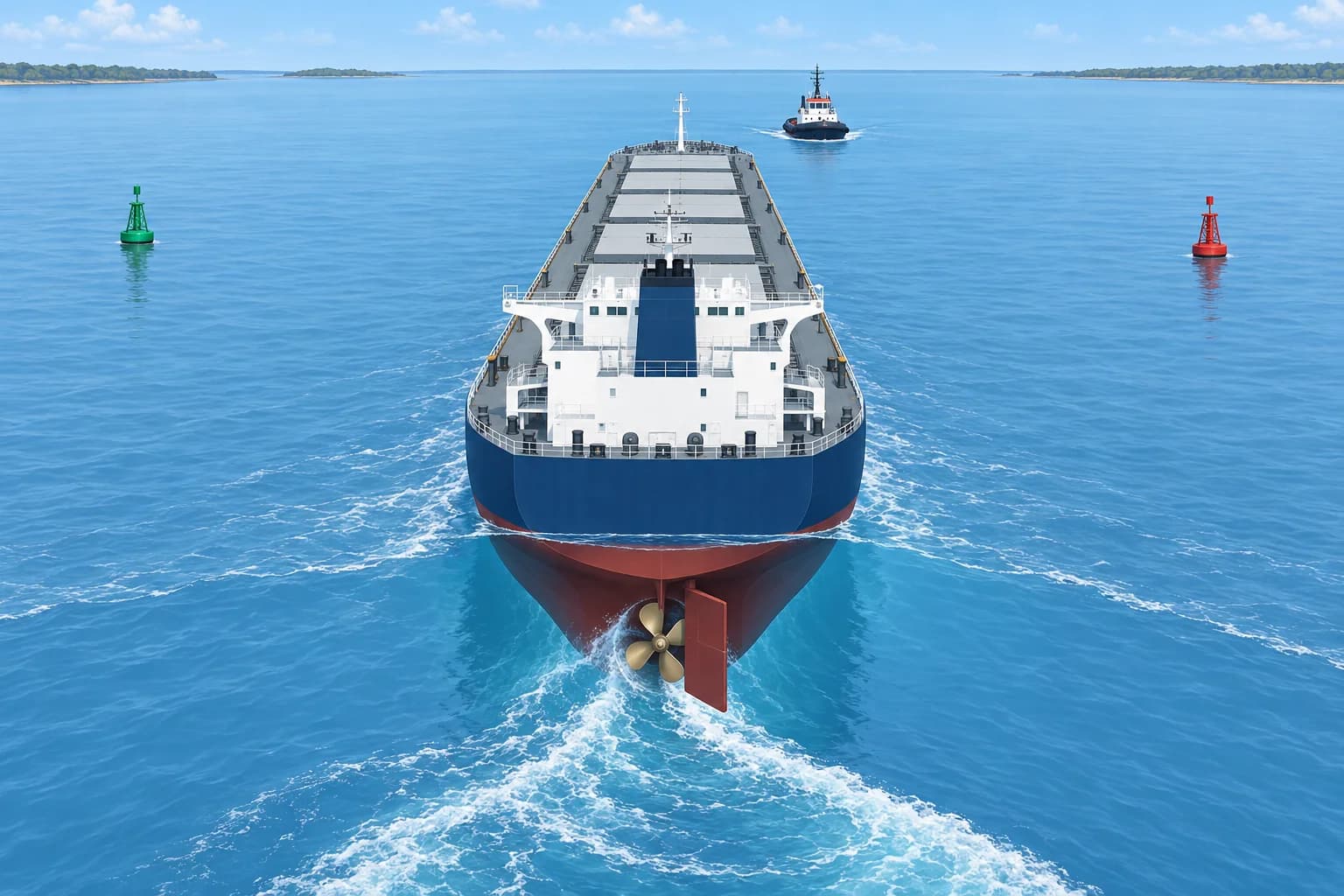
Steering alarms can indicate a power, control or hydraulic fault. Assess rudder response, reduce danger and call the master and engineers. Warn nearby traffic immediately. Follow the ship's posted failure and changeover instructions; arrange local steering if needed and maintain communications with that team. Show not-under-command (NUC) signals if unable to manoeuvre as the collision rules require. See Steering gear for changeover and drills.
Using the engine to steer
With a jammed rudder, reduce propulsion as conditions require to limit the uncontrolled turn. Reducing speed usually reduces the rate of turn and gives more reaction time; monitor track and sea room. Control is not assured. A single CPP controls thrust but does not independently steer. Differential thrust, meaning different thrust on twin screws, may help. Thrusters may help at suitable low speed, within their effective operating limits. Effectiveness depends on the ship, speed and rudder position. Request tug assistance early where available.
Propulsion failure
Ask the engine room the cause and expected restart time. If steering remains, use remaining way towards safe water. Warn others at once; show NUC signals if unable to manoeuvre as the rules require. In confined waters assess anchoring or call a tug. Passenger ships and cargo ships of 500 GT and above carry emergency towing procedures. Tankers of 20,000 dwt (deadweight) and above have towing arrangements at both ends; new non-tankers of 20,000 GT and above need them from 1 January 2028.
The bridge and engine room link
SOLAS requires at least two independent means of passing orders from the bridge to the engine room, one of them an engine telegraph. Report clearly: standby engines, full away, and finished with engines. Give the engine room early warning of manoeuvring and of planned changes in speed. The engineers, in turn, warn you before any work that reduces power or availability.
Tests before arrival and departure
Before departure, steering is tested as SOLAS V/26 requires (see Steering gear). Test the engine ahead and astern, the telegraphs and the communications before arrival and departure, as company orders say. A failure found in open water is a nuisance; at the pilot station it is a hazard.
Remember
- Steering failure: reduce danger, call for help, follow posted instructions and maintain local-steering communications.
- Reducing speed usually reduces the rate of turn and gives reaction time; monitor the track and sea room.
- Propulsion loss: assess control, warn traffic, consult engineers and consider anchoring or tug assistance.
- At least two independent means of engine orders; tests before arrival and departure.
Common mistakes
Wrong: Keep full speed after a steering failure to keep steerage way.
Right: Reduce propulsion as conditions require. Less speed usually reduces the rate of turn and gives reaction time; monitor the track and remaining sea room.
Wrong: Wait for the engineers to report before warning traffic.
Right: Warn others as soon as control is lost. The engineers' report can follow.
Worked case
At 14 knots in a buoyed channel, the steering alarm sounds and the rudder-angle indicator shows the rudder stuck at 10° starboard. The rudder does not respond to bridge commands. There is an inbound ship 2 miles ahead.
Show the answer
Reduce propulsion as conditions require; call the master and engineers. Follow posted failure instructions; arrange local steering if needed with tested communications. Warn the inbound ship and VTS. Show NUC signals if unable to manoeuvre as the rules require. Use propulsion cautiously; a thruster may be ineffective at 14 knots. Monitor track and sea room; assess anchoring suitability and tug assistance.
Practice question
The steering alarm sounds and the rudder stops answering. What should guide your recovery actions?
- The ship's posted steering-failure instructions
- The usual changeover sequence on your previous ship
- A fixed pump-to-local sequence for every ship
- The assumption that every fault is a failed pump
Show the answer
Answer: A. The correct response depends on the fault and the fitted system. Reduce danger, call the master and engineers, warn traffic and follow the ship's posted instructions.