
Emergencies at sea · Level P3 · 5 parts · about 19 min
Advanced fire fighting: control, organisation and investigation (STCW A-VI/3)
5 short parts: Command · Tactics · Fixed systems · Water & cargo · Investigate. Each part explains the idea, then gives the points to remember, the common mistakes, a worked case and a practice question; the Academy unit adds all 36 check questions.
1 · Command
Taking command of a fire and training fire parties
At officer level you direct firefighting: one commander, clear teams, a command post and training that fits your ship.
Who commands
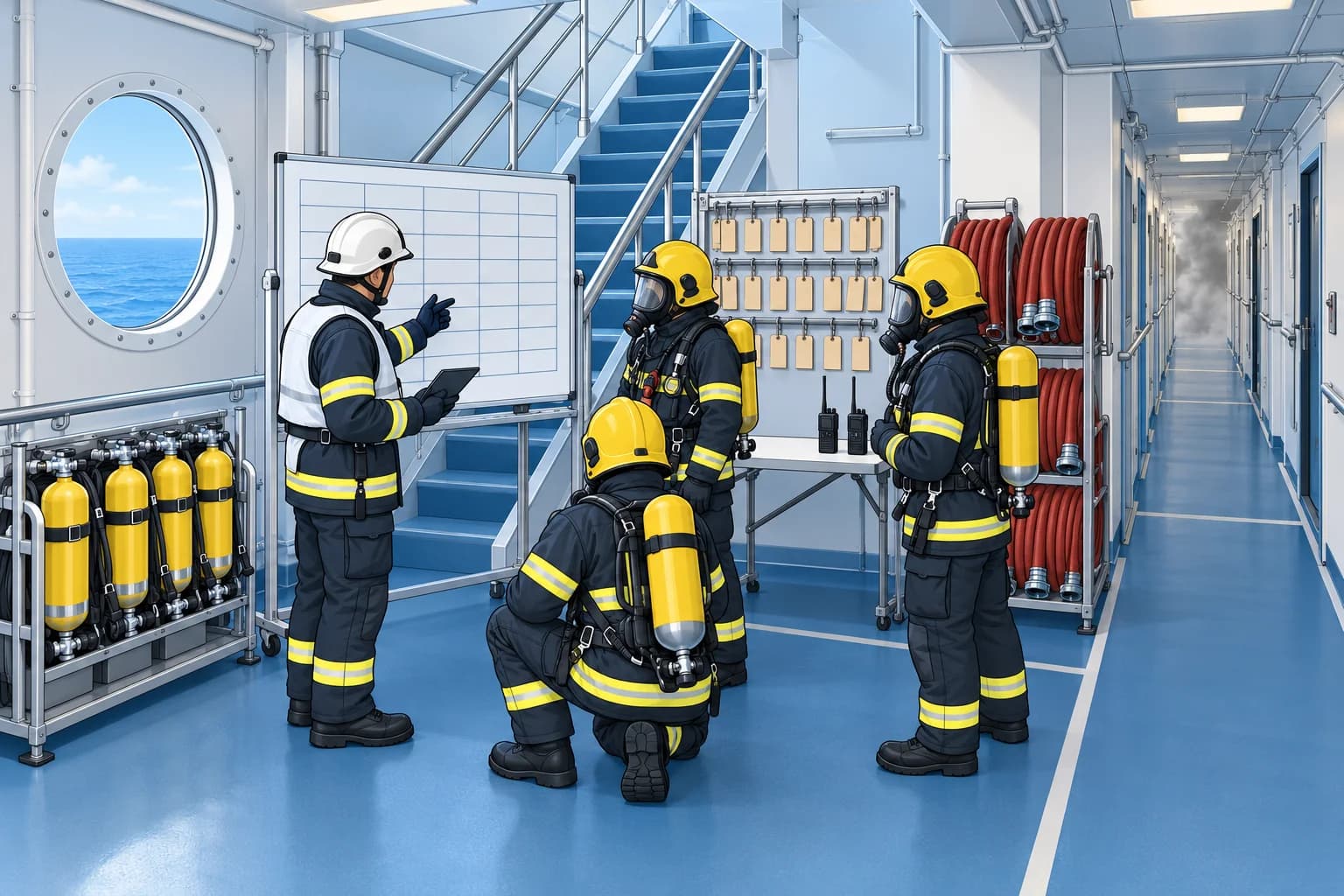
The master has overall command, normally from the bridge, which acts as the command centre: it holds the fire control plan, the fire panel, the radios and the logbook. The on-scene commander, usually the chief officer (or the chief engineer for a machinery-space fire), directs firefighting at the scene. With an A-VI/3 certificate (advanced fire fighting under STCW regulation VI/3) that may be you, so you must think about the whole fire.
The command post
Set up a forward command post near the entry, in clean air with a safe escape route and a radio link to the bridge. The on-scene commander directs operations there. The breathing apparatus (BA) controller records each team’s names, entry time, cylinder pressures and agreed withdrawal limits, tracks reports, and warns when withdrawal or relief is due. Move the post if smoke threatens it, and tell every team.
Information flow
Use one radio channel for the fire party and a second channel, or the phone, between the scene and the bridge. Teams report to the on-scene commander, who reports to the bridge. The bridge keeps a timeline: alarm, muster, entries, isolations, boundaries checked, fixed-system decisions. Insist on short messages that are repeated back, and regular situation reports. Silence from a team inside is treated as a problem, not as good news.
Organising people
Assign attack, backup, boundary cooling, ventilation, isolation, first aid and support teams. The backup team stands ready in BA at the entry before the attack team goes in. Plan reliefs early: heat and hard work exhaust teams. Life safety comes first. Confirm missing people’s names and last-known positions, then assess whether a protected rescue is viable. Do not commit crews to untenable conditions: heat or smoke that prevents safe entry and withdrawal.
Training fire parties
STCW expects you to organise and train fire parties. Train for your ship's real risks: fuel spray in the engine room, the galley, cabins, cargo, and the special cases of tankers or car carriers. Change the scenario and the location, use smoke generators or blacked-out masks, let different people lead, and debrief honestly. A drill that always ends at the same hydrant teaches very little.
Key figures
- STCW basis
- Regulation VI/3; Code table A-VI/3, advanced fire fighting
- Four competences
- Control, organise and train, inspect and service, investigate
- Comes after
- Basic fire fighting, STCW A-VI/1-2
- Keeping it valid
- Evidence of the standard of competence every 5 years
Taking charge at the scene
- Confirm the headcount, names and last-known positions of missing people with the bridge. — Life safety comes first; assess whether a protected rescue is viable. Do not enter untenable conditions.
- Size up: where the fire is, what is burning, where it is spreading, what hazards are near. — You can only choose a tactic for a fire you have understood.
- Set up the forward command post and BA entry control in clean air. — The controller records teams, entry times, pressures and withdrawal limits, tracks reports and warns when relief is due.
- Agree stopping ventilation, closing openings and isolating fuel and power that is not needed. — It starves the fire and protects the teams.
- Commit the attack team when backup, a protected withdrawal route and any boundary cooling needed for safe entry are ready. — Backup provides rescue cover; boundary protection must match the fire and entry route.
- Report to the bridge and reassess at agreed intervals. — Fires change; the master needs a current picture for big decisions.
Remember
- The master has overall command; the on-scene commander directs firefighting from a forward command post.
- The backup team is ready in BA at the entry point before the attack team goes in.
- Reports follow the chain, and the bridge keeps a timeline of every event and decision.
- Confirm names and last-known positions; assess a protected rescue. Never commit crews to untenable conditions.
- Train on your ship's real risks, vary scenarios and let different people lead.
Common mistakes
Wrong: The on-scene commander leads the attack team into the space.
Right: The commander stays at the command post: from inside the smoke you cannot see the whole fire or run the teams.
Wrong: Send the attack team in as soon as it is dressed; the backup can follow.
Right: The backup team is dressed and ready at the entry point before anyone goes in.
Wrong: Run the fire drill at the same place each month so everyone knows the routine.
Right: Vary the location and the scenario; a routine drill tests memory, not readiness.
Worked case
You are chief officer. A fire is reported in the laundry on the upper deck. Two crew members are missing from the muster. The attack team is putting on BA and the second officer asks you what to do next.
Show the answer
Confirm names and last-known positions. Assess whether a protected search is viable; do not enter untenable conditions. Set the command post and BA entry control in clean air, with backup ready before entry. Arrange agreed ventilation and power isolation and boundary cooling. Report to the master and reassess as conditions change.
Practice question
Where should the on-scene commander normally be while the attack team is inside?
- At a forward command post in clean air
- Inside the fire space, leading the attack team
- On the bridge, standing beside the master
- At the emergency fire pump in the steering flat
Show the answer
Answer: A. From the command post the commander sees the whole fire, controls the BA board and keeps contact with the bridge.
2 · Tactics
Fire tactics: attack, starve, ventilate and isolate
Size up first, then choose: go in and put it out, or hold the boundaries, starve the fire of fuel and air, and let time or a fixed system finish it.
Size up first
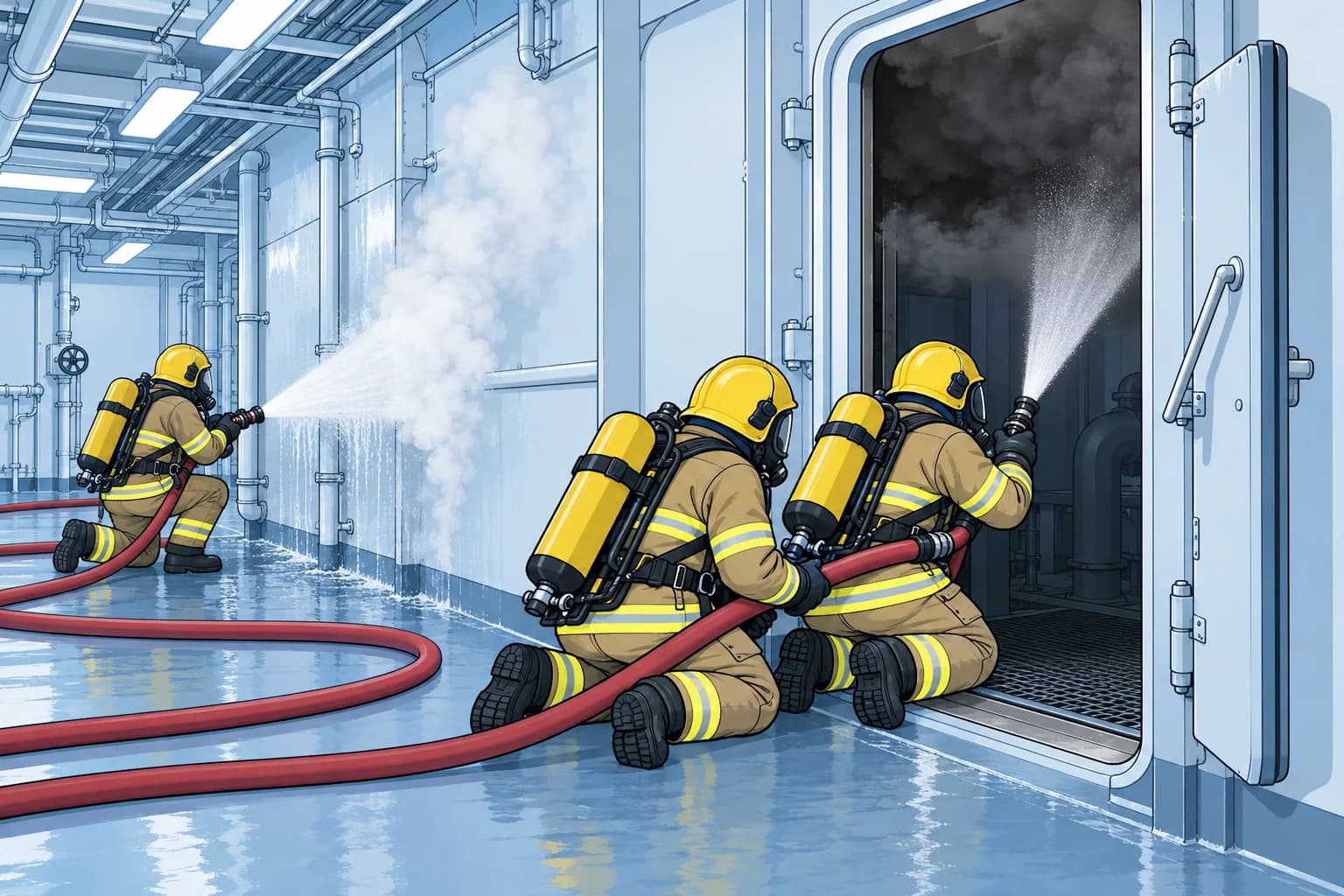
Before you choose a tactic, answer four questions: where exactly is the fire, what is burning, where is it spreading, and who might be inside? Use the fire control plan, the fire panel, a thermal imaging camera (TIC, which shows heat through smoke) and reports from people who escaped. Then choose an offensive attack (a team goes in to put it out) or a defensive one (you hold the boundaries while a fixed system or time does the work).
Direct and indirect attack
A direct attack applies water or foam to burning material. An indirect attack applies water to hot compartment surfaces from outside to generate steam. Use it only when nobody is inside: steam and displaced hot gases can cause fatal burns. Keep crews clear of escaping steam. Short fine-spray pulses into the gas layer are gas cooling, a different technique. Short pulses do not guarantee protection from scalding. Follow your ship’s training for nozzle pattern, flow and position.
Boundary starvation
Boundary starvation means taking the fuel away from around the fire: move or protect anything that can burn in the next spaces, such as paint, mattresses, stores or cargo. It works together with boundary cooling, which keeps the steel too cool to ignite things on the far side. Together they turn a growing fire into a contained one, even before anyone attacks it.
Ventilation and smoke
Normally you keep the space shut to starve the fire. Sometimes you ventilate on purpose, called smoke extraction, to clear an escape route or help a team find a casualty. Do it only to a plan: hoses charged, the team ready, an exit path for the smoke, ideally on the downwind side. Opening at the wrong time feeds a smouldering fire and can cause a backdraught or flashover (see Fire theory).
Isolating fuel and power
Stop fuel and lubricating-oil pumps, close the quick-closing valves and isolate the electrical supply to the area, while keeping the lighting, fire pumps and emergency power you still need. Shut off hydraulic and thermal-oil lines that run through the space. Agree every isolation with the engine room and log it, so nothing is restarted by mistake while a team is inside.
Key figures
- Offensive attack
- A team goes in to extinguish; needs backup and a way out
- Defensive attack
- Hold the boundaries; starve the fire or use a fixed system
- Indirect attack
- Water on hot surfaces from outside; compartment must be unoccupied
- Boundary starvation
- Remove or protect fuel in the spaces around the fire
- Smoke extraction
- Only to a plan, with hoses charged and the team ready
Remember
- Size up before you act: location, fuel, spread and people inside.
- Offensive when the fire can be reached safely; defensive when it cannot.
- Indirect attack generates steam from hot surfaces in an unoccupied compartment; gas cooling is a different technique.
- Boundary starvation and cooling contain the fire from outside.
- Ventilate only to a plan; isolate fuel and power, and log every isolation.
Common mistakes
Wrong: Open the space to let the smoke out as soon as possible.
Right: Keep it closed unless you ventilate to a plan, with charged hoses ready; fresh air can make the fire explode.
Wrong: Short spray pulses make a steam attack safe with people still inside.
Right: Indirect steam attack needs an unoccupied compartment. Keep crews clear of escaping steam; short pulses do not prevent all scalding.
Wrong: Isolate all electrical power on the ship at once.
Right: Isolate the affected area but keep the fire pumps, lighting and emergency power you need.
Worked case
Smoke is coming from under the door of the paint store forward. The door is hot at head height. Nobody is missing. The store is next to the bosun's store, which holds rope and drums of thinner.
Show the answer
The hot door suggests dangerous entry conditions. Keep it shut and choose defensive tactics; nobody is reported missing. Close down ventilation to the forecastle, cool the paint-store boundaries and the deck above, and starve the boundary by moving the thinner drums out of the bosun's store if it is safe. If the store has a fixed system, prepare it for the master's decision. Keep a charged hose at the door.
Practice question
What is an indirect attack?
- A jet aimed straight at the burning material
- Cooling the deck above from the next deck
- Water on hot surfaces to generate steam
- Applying foam directly to burning liquid
Show the answer
Answer: C. Indirect attack generates steam from hot surfaces, applied from outside an unoccupied compartment. Steam and displaced hot gases can fatally burn casualties and teams. Short pulses into hot gases are gas cooling.
3 · Fixed systems
Managing fixed systems: the release decision and after
Use fixed systems under approved instructions. Confirm release conditions, keep the space sealed as required, and plan safe re-entry with the master.
The decision
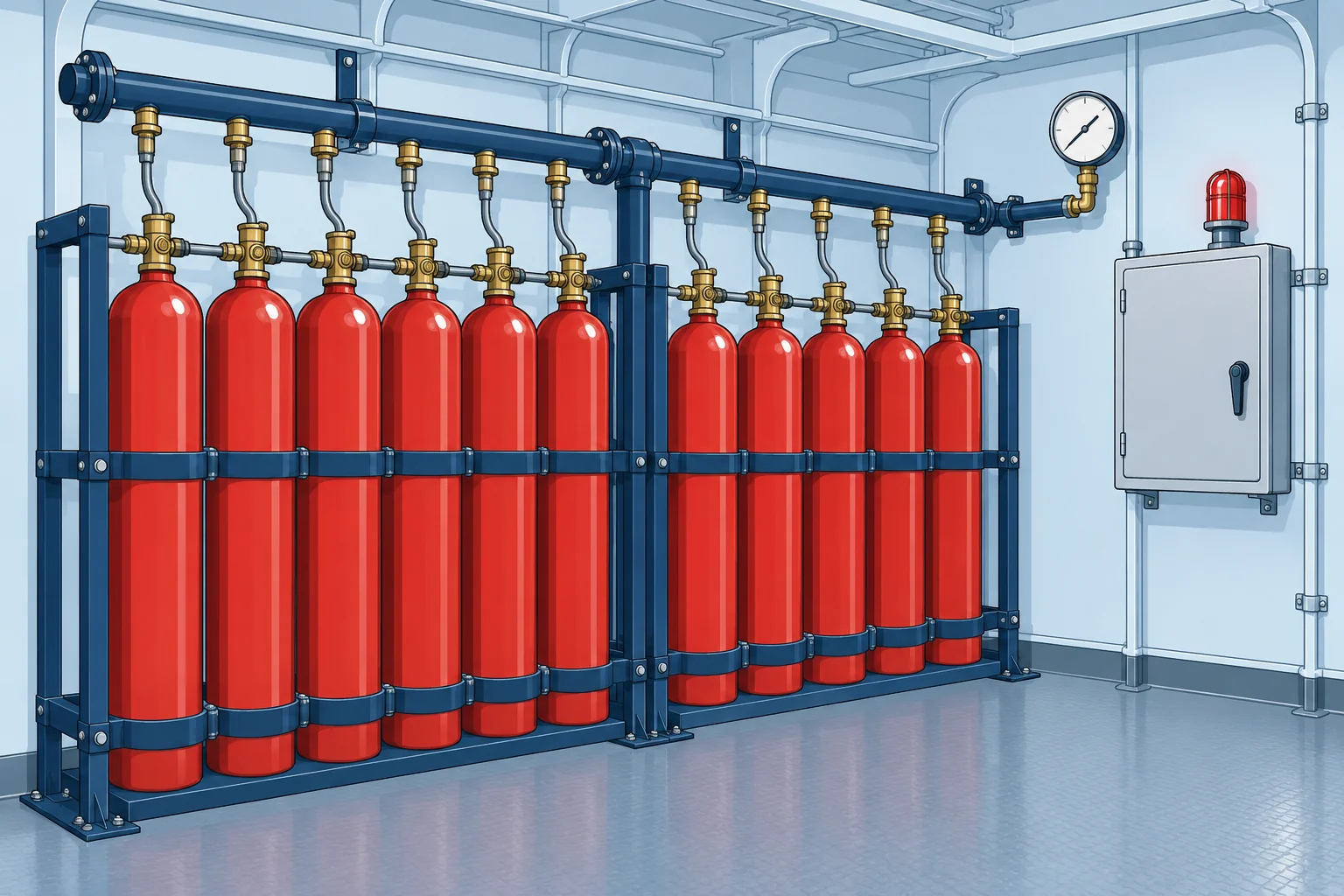
Releasing CO₂ ends any attack by people and makes the space deadly. The master decides, advised by the chief engineer and the on-scene commander. Release when the fire is beyond the fire party’s control or entry is too dangerous. First, everyone out and counted by name, openings and dampers shut, fans and fuel stopped. A late release with open doors wastes the available charge.
Machinery spaces and holds
Discharge the prescribed machinery-space CO₂ charge rapidly: 85 % within 2 minutes. A hold fire usually smoulders deep in the cargo. Hold systems carry gas for 30 % of the gross volume of the largest hold. In container and general cargo holds at least two-thirds of the gas can go in within 10 minutes (solid bulk: 20 minutes), and the controls allow one third, two thirds or all of it, based on the hold’s loading condition. Top up if temperatures rise; keep the hold sealed, sometimes until port.
Waiting before re-entry
CO₂ suppresses fire but hardly cools it. Keep the space sealed; cool and monitor boundaries until temperatures have fallen and stayed down. There is no universal waiting time. Follow the master’s authorised re-entry plan. Assess reignition and explosion risks before initial entry; BA does not protect against explosion. Initial entry needs BA, backup, communications and charged hoses. Coordinate ventilation and test oxygen, CO₂, flammable vapours and relevant toxic gases before unprotected entry.
Water mist and local application
Local application protects a particular hazard, such as a purifier or engine fuel equipment. Use it promptly under the installed instructions; it can operate without waiting for evacuation or machinery shutdown. Smoke, heat and toxic gases still make the space dangerous, so you still need BA. Whole-space water-mist systems have different operating conditions: follow their instructions. Coordinate electrical isolation without delaying an approved local system.
High-expansion foam
High-expansion foam fills the protected space with light foam. The system must fill the largest protected space within 10 minutes. Inside-air systems use air from the protected space; outside-air systems use outside air. Follow the installed ventilation shutdown, closing and pressure-relief arrangements; do not obstruct designated foam outlets or vents. Foam hides openings and obstacles and does not provide breathable air. Any authorised re-entry needs BA, lifelines, charged hoses, communications, entry control and a ready backup team.
Key figures
- CO₂ pre-discharge alarm
- At least 20 s before release (FSS Code ch. 5)
- Machinery-space CO₂
- 85 % of the prescribed charge discharged within 2 minutes
- Cargo-hold CO₂
- Gas for 30 % of the gross volume of the largest hold
- Container and general cargo holds
- Two-thirds within 10 min; release 1/3, 2/3 or all by loading
- High-expansion foam
- Fills the largest protected space within 10 minutes
- Re-entry after CO₂
- Authorised plan: cooling, protected entry, ventilation and gas tests
Remember
- The master decides on release; everyone must be out and counted by name first.
- Machinery space: 85 % in 2 minutes. Hold: 30 % of gross volume, released in thirds to suit the load; keep sealed.
- CO₂ hardly cools: opening too early can cause reignition. Follow the master’s authorised re-entry plan.
- Use approved local application promptly; it does not make the fire space safe to breathe.
- Foam hides hazards and does not supply breathable air; authorised re-entry needs BA and rescue cover.
Common mistakes
Wrong: Open the engine room an hour after the CO₂ release to see if the fire is out.
Right: Keep it sealed and cool and monitor boundaries until temperatures stay down. Follow the authorised entry, ventilation and gas-testing plan.
Wrong: Release the full hold charge at once and open the hatch the next morning.
Right: Hold fires smoulder: release the part charge the loading condition and instructions call for, top up if needed, and keep the hold sealed, often until port.
Wrong: Delay the CO₂ decision while one more hose team tries.
Right: When entry is no longer safe, clear the space and release; a delayed release into a hotter fire may fail.
Worked case
A fuel-spray fire in the engine room has spread beyond the local water-mist area. Heat has driven the attack team out. The chief engineer reports all engine staff out, fuel pumps stopped and quick-closing valves shut. One skylight is still open.
Show the answer
Confirm everyone is out and counted by name with the bridge. Check fuel isolation and confirm fans are stopped; close the skylight and verify all openings and dampers. Then obtain the master’s release order and follow the approved discharge sequence. Log the time, keep the space sealed and monitor temperatures while maintaining boundary cooling.
Practice question
Why must you wait before opening a space after a CO₂ release?
- Hot material can reignite in fresh air
- The gas needs time to turn into foam
- The alarm must finish its cycle first
- The rules require a fixed 48-hour wait period
Show the answer
Answer: A. CO₂ hardly cools hot steel and fuel. Fresh air can restart the fire, and another charge may be unavailable. Follow the authorised re-entry plan.
4 · Water & cargo
Firefighting water, stability and dangerous goods
Firefighting water can capsize the ship, and burning cargo may need special treatment. Watch stability and check cargo emergency guidance before you attack.
Water you add
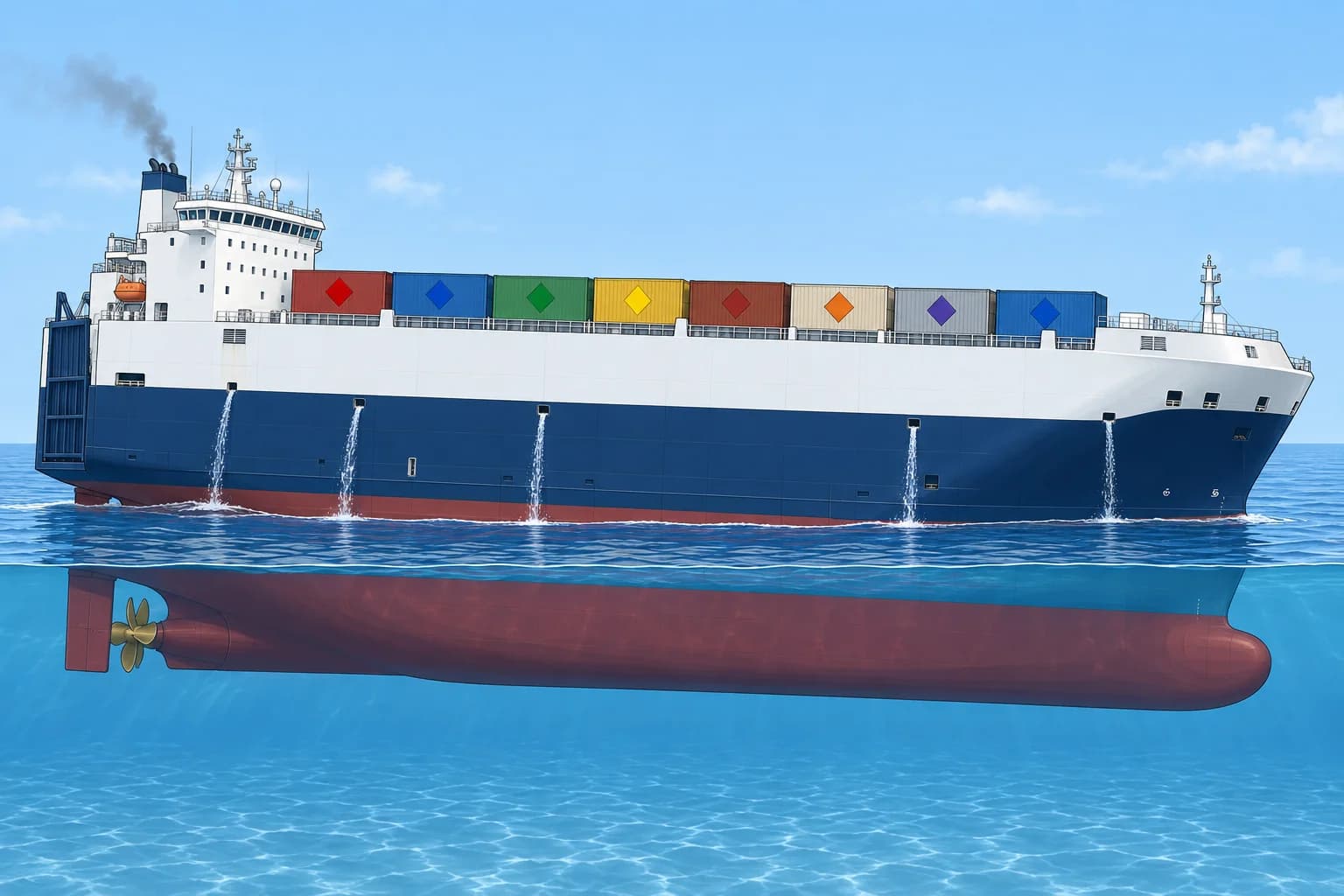
Track retained firefighting water: hose inflow minus drainage, pumping and other losses, including evaporation. High in the ship it raises the centre of gravity (G), and loose water across a deck adds a free surface effect, which acts like a further rise of G. Both reduce the metacentric height (GM), the measure of initial stability. A slow list that does not come back can mean water collecting on one side.
A worked example
Four hoses each deliver 15 tonnes an hour. With no drainage or other losses, two hours leaves 4 × 15 × 2 = 120 t on board. On a 10,000 t ship, if that water lies 8 m above G, the rise of G is about 120 × 8 ÷ 10,120 ≈ 0.09 m. That is before the free surface effect, which can be many times larger if the water spreads across a wide deck. Tell the chief officer, and plan drainage early.
Controlling the water
Use the nozzle pattern and flow needed for the fire and cargo emergency guidance. Spray is not automatically a lower flow. Shut unnecessary streams and arrange drainage early. Clear scuppers (deck drains) and use portable pumps or eductors (water-driven suction pumps). Keep vehicle-deck drains clear. Ask the engine room to watch bilges and tanks. If stability is in doubt, the master may reduce the water and accept more fire damage to save the ship.
Dangerous goods on fire
For packaged dangerous goods under the IMDG Code (International Maritime Dangerous Goods Code), identify cargo and location from the dangerous goods manifest and stowage plan. Use the UN number (cargo identifier) to find its EmS codes in Dangerous Goods List column 15. The EmS Guide (emergency response procedures for ships carrying dangerous goods) gives fire schedules, F-A to F-J, and spillage schedules, S-A to S-Z. Use both to choose safe agents, application and cooling methods.
Toxic smoke and reactive cargo
Burning cargo can give off toxic or corrosive smoke. Keep unprotected crew clear and upwind. Fire teams need BA and protective clothing suited to the chemical hazard; ordinary fire outfits are not chemical suits. Use the Medical First Aid Guide (MFAG) for crew exposed to chemicals. Some cargoes react with water; some, such as oxidising cargoes, supply their own oxygen, so smothering with CO₂ does not work. Ask the company and its shore experts for advice early.
Key figures
- Rise of G
- Weight × height above G ÷ new displacement
- Free surface
- Loose water reduces GM; wide decks are the worst
- EmS fire schedules
- F-A to F-J
- EmS spillage schedules
- S-A to S-Z
- Where to find the codes
- IMDG Dangerous Goods List, column 15; identify cargo by UN number
- Chemical exposure
- Medical First Aid Guide (MFAG)
Remember
- Water retained above G raises G; loose water adds free surface and reduces effective GM.
- Work out the tonnes you are adding, and plan drainage early.
- Match flow and pattern to the fire; shut unnecessary streams and keep drains clear.
- Dangerous goods: find the EmS fire and spillage schedules before you attack.
- Oxidising cargo makes its own oxygen; CO₂ smothering will not work on it.
Common mistakes
Wrong: More water is always safer in a big fire.
Right: Water high in the ship and loose on decks can capsize her; use only what the fire needs and drain it.
Wrong: Treat a burning container like any other fire and use jets.
Right: Check the DG manifest and EmS first; choose the agent, application and cooling method for the cargo.
Worked case
After 90 minutes fighting a fire in the accommodation on a ro-ro ship, the ship has taken a 4° list to port that is slowly increasing. Water is running along the vehicle deck below. Three hoses are still running, one of them on a boundary that is already cool.
Show the answer
Alert the master: the growing list is a stability emergency. Stop only streams confirmed unnecessary; preserve attack-team protection and essential boundary cooling. Keep monitoring the boundary. Clear vehicle-deck drains, start pumping, and check bilges and tanks with the engine room. Have the chief officer assess retained water and free surface. Do not ballast to correct the list until its cause is known.
Practice question
Why can firefighting water endanger the ship's stability?
- It can raise G and add free surface effect
- It lowers G and makes the ship too stiff
- It only changes the trim, not the stability
- It dissolves the cargo lashing points
Show the answer
Answer: A. Water high in the ship raises the centre of gravity, and loose water sloshing across decks reduces GM further.
5 · Investigate
After the fire: investigation, reports and equipment care
When the fire is out, find out why it started, report it, and put every piece of equipment back in a ready state before the next one.
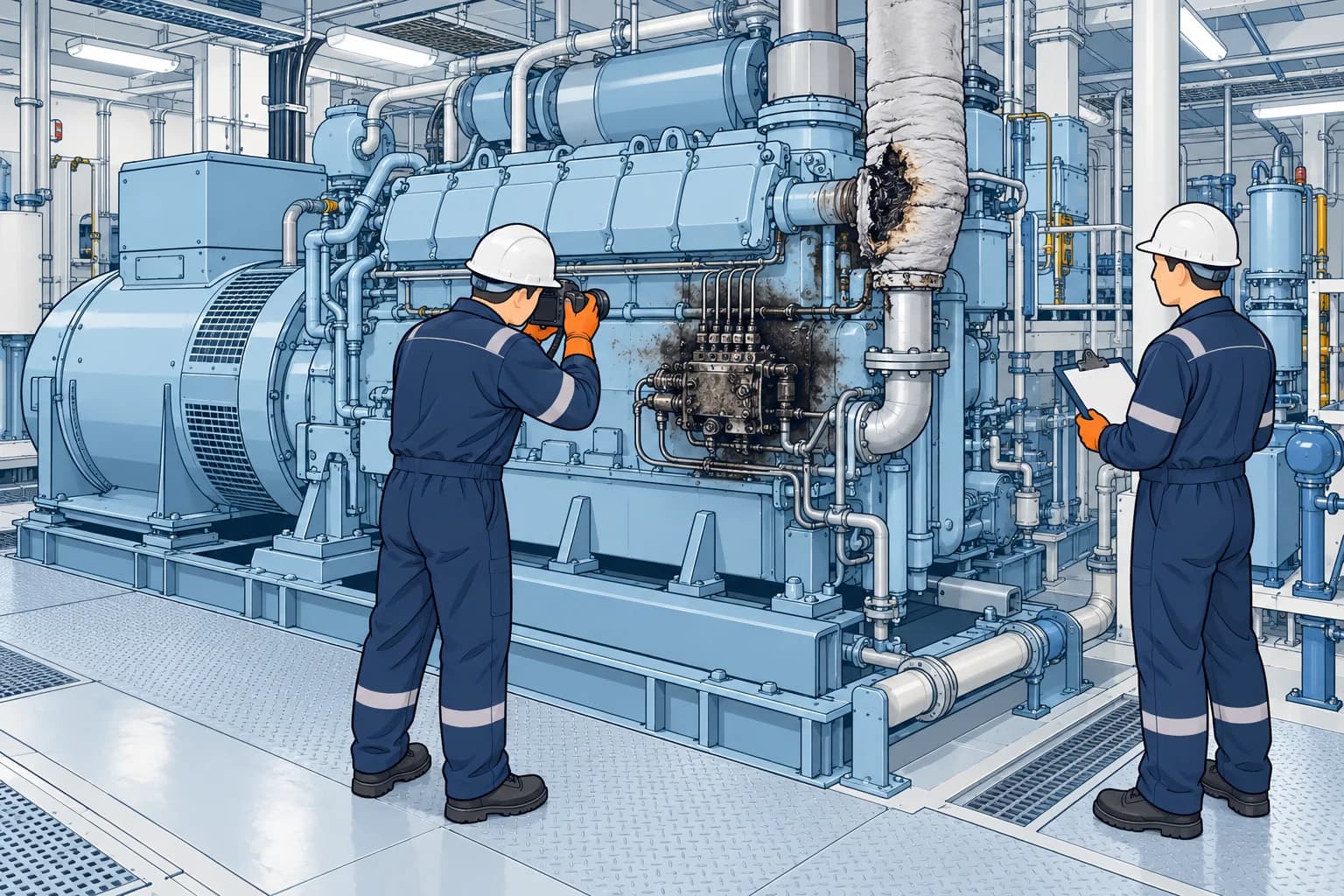
Preserve the evidence
Ask the bridge to save the voyage data recorder (VDR) data and fire-panel log as soon as practicable; do not wait for the fire to end. Once the fire is out and the space is safe, secure the scene and restrict access. Photograph it before clean-up. Keep damaged parts such as hoses, filters and cables. Take short, separate witness statements while memories are fresh.
Find the cause
Identify the point of origin, where the fire started, by comparing damage patterns with alarms, witness accounts, machinery records and the timeline. Deep or low burning is a clue, not proof: ventilation, fuel distribution, fallen material and suppression can mislead you. Identify the fuel and possible ignition source without disturbing evidence. Ask why the equipment or procedures allowed them to meet. Record uncertainty. The aim is prevention, not blame.
Reports
Report as the safety management system (SMS) requires: an internal accident report under ISM Code section 9, a logbook entry, and the casualty report to the flag state. A serious fire may be investigated by the flag state under the Casualty Investigation Code. Clear, factual reports let the company fix the cause across its whole fleet.
Keeping equipment ready
SOLAS II-2/14 requires a maintenance plan for fire protection systems. Its minimum content comes from IMO MSC.1/Circ.1432 as amended, and for CO₂ systems from MSC.1/Circ.1318/Rev.1. The crew does many checks, such as weekly panel and alarm tests and monthly rounds of hoses and extinguishers. Others need a competent person or a service firm, such as hydrostatic tests (pressure tests) of cylinders. As an officer you plan the work, check it and keep the records.
After use
Restore equipment promptly: refill BA cylinders, service used extinguishers, inspect hoses and restore detection. Report every fixed-system operation. Check the agent supply, pumps, controls, valves and coverage against its instructions before declaring it ready. A discharged CO₂ bank needs recharging. Report any impairment immediately; the company must arrange restoration and any required flag/class agreement on temporary precautions or operating restrictions.
Key figures
- Weekly
- Fire panel lamp test; general alarm and public address working
- Monthly
- Test a sample of detectors so all are tested within 5 years
- Annually
- BA air compressor air quality; BA masks and demand valves
- CO₂ cylinder contents
- Every 2 years (cargo ships: at surveys); refill below 90 %
- CO₂ cylinder pressure tests
- At least 10 % at 10 years; all by 20 years
- Maintenance plan
- SOLAS II-2/14; MSC.1/Circ.1432 as amended
Remember
- Preserve evidence before clean-up: photos, panel log, VDR, damaged parts, statements.
- Establish origin from corroborating evidence; deepest damage alone is not proof.
- Look for the system cause, not just the person; the aim is prevention.
- Report under the SMS (ISM section 9) and to the flag state.
- Keep the maintenance plan up to date and restore all equipment straight after use.
Common mistakes
Wrong: Clean up the engine room at once so the ship looks ready.
Right: Photograph and preserve the scene first; clean-up destroys the evidence of the cause.
Wrong: The investigation is done when you have found who made the mistake.
Right: Ask why the system allowed it: missing insulation, a poor procedure, too little time. Fix that.
Worked case
A fire on the generator engine has been put out with the local water-mist system and a foam extinguisher. The second engineer wants to clean the area and restart the generator before the next port. Burnt insulation lies on the deck under a fuel pipe.
Show the answer
Do not clean up yet. Photograph the area, keep burnt insulation and relevant fittings, and save alarm logs and VDR data. Take witness statements. Keep the generator isolated until competent inspection establishes the cause, corrects faults and verifies safe operation; a fuel leak onto a hot surface is only a hypothesis. Recharge the extinguisher, verify the mist system’s supply and operation before restoring it, and report under the SMS.
Practice question
What should you do before cleaning up after a fire?
- Restart the machinery to test it
- Photograph and preserve the scene
- Wash down the space
- Throw out the damaged parts
Show the answer
Answer: B. Evidence of the cause disappears with the clean-up; photographs, logs and damaged parts must be kept first.