
Emergencies at sea · Level R3 · 4 parts · about 12 min
Search and rescue: who to call and how help comes
4 short parts: Who runs SAR · How alerts flow · When help comes · Helping others. Each part explains the idea, then gives the points to remember, the common mistakes, a worked case and a practice question; the Academy unit adds all 21 check questions.
1 · Who runs SAR
How search and rescue is organised
Search and rescue (SAR) centres coordinate help within sea regions. You can alert them directly or through coast stations, other vessels or satellite beacons.
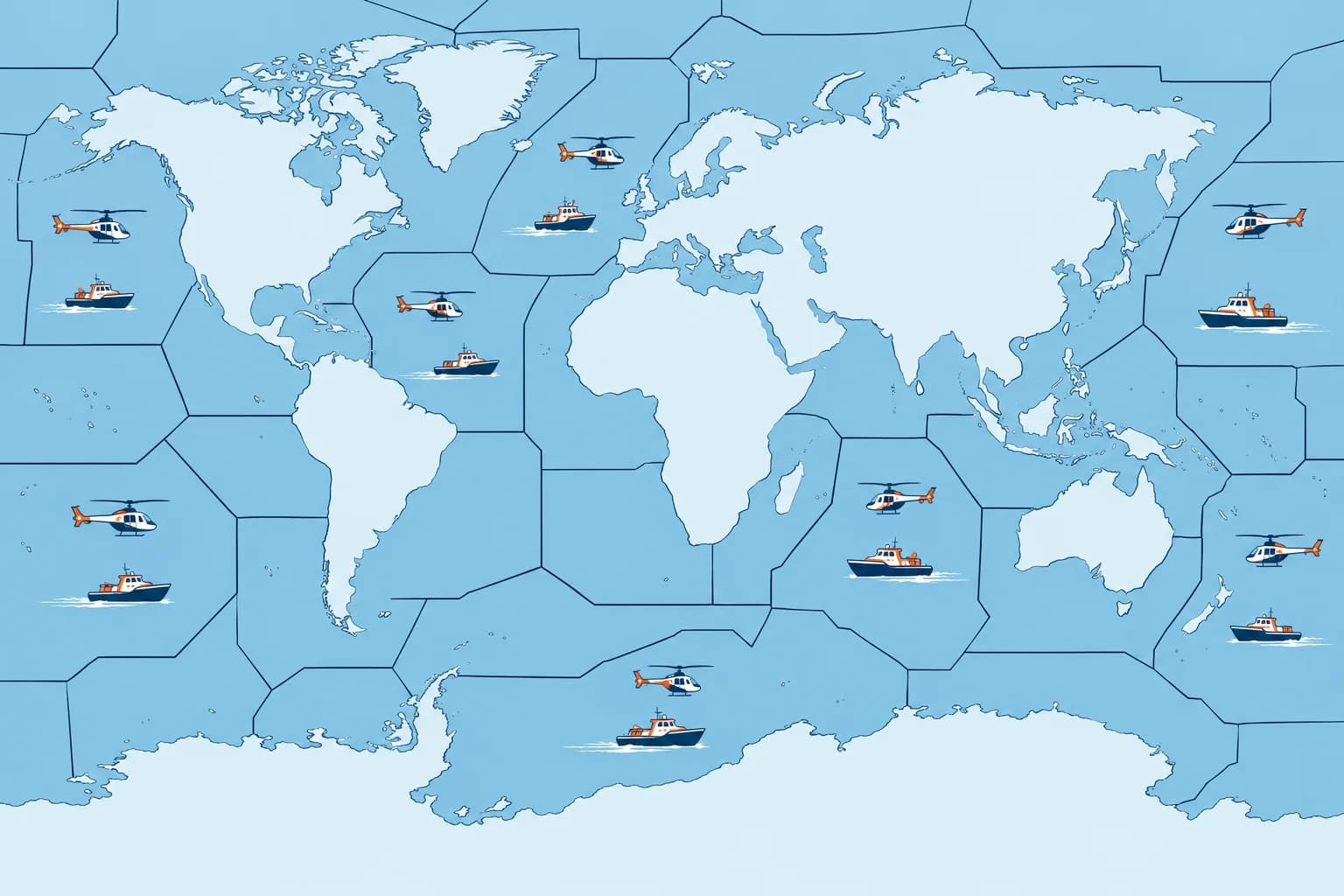
Regions and centres
Under the International Maritime Organization (IMO) SAR Convention, the world’s seas are divided into search and rescue regions (SRRs). Each has a rescue coordination centre (RCC) that runs every rescue in its area. A maritime RCC (MRCC) handles sea rescues, a joint RCC (JRCC) handles both air and sea, and a sub-centre (MRSC) covers part of a region. They are linked worldwide, so an alert is passed to the right centre.
Who they are
The service has different names in each country: HM Coastguard in the UK, the CROSS centres in France, Salvamento Marítimo with its coordination centres in Spain, the Guardia Costiera in Italy and the US Coast Guard in the United States. The centre does not usually own every rescue unit. It calls on lifeboats, helicopters, aircraft, patrol vessels and any ship nearby.
The IAMSAR Manual
The IAMSAR Manual (International Aeronautical and Maritime Search and Rescue) provides shared practical guidance. Volume I covers organisation, Volume II mission coordination, and Volume III, carried on board ships, covers what a vessel or aircraft does: how to raise an alert, respond, search and act on scene. The 2025 edition applies from 1 January 2026.
Roles on a rescue
The SAR mission coordinator (SMC) at the RCC plans the rescue. An on-scene coordinator (OSC) coordinates units there. An aircraft coordinator (ACO) manages several aircraft. Report your position and capabilities to the RCC or OSC. Follow the coordinated plan and take safe immediate action while awaiting instructions. Your skipper retains command and responsibility for your boat’s safety. Report any unsafe task or change in conditions immediately.
Key figures
- RCC
- Rescue coordination centre: runs SAR in one region
- MRCC / JRCC / MRSC
- Maritime / joint air-sea / maritime sub-centre
- SMC
- SAR mission coordinator, at the RCC
- OSC
- On-scene coordinator: coordinates units at the scene
- IAMSAR Vol III
- Mobile facilities: carried aboard ships; 2025 edition
Remember
- The seas are split into SAR regions, each with an RCC.
- MRCC for sea, JRCC for air and sea, MRSC for part of a region.
- National names differ: Coastguard, CROSS, Salvamento Marítimo.
- IAMSAR Vol III is the ship-board manual; 2025 edition.
- SMC runs the rescue from the RCC; OSC coordinates on scene.
Common mistakes
Wrong: You must call the rescue service of your own flag country.
Right: Call the nearest coast station or RCC. Alerts are passed to the centre for the region you are in.
Wrong: As a yacht nearby, you should organise the search yourself.
Right: Report and coordinate with the RCC or OSC. Until coordination is established, take safe action to help.
Worked case
A British yacht in Spain’s search and rescue region hears a Mayday from a French boat. Who will coordinate the rescue, and what should the British skipper do?
Show the answer
The Spanish RCC for that search and rescue region coordinates it, whatever the boats’ flags. The skipper reports the yacht’s position and capabilities to the RCC, offers help and coordinates with it. The skipper remains responsible for the yacht’s safety and takes safe immediate action while awaiting instructions.
Practice question
What does an RCC do?
- It builds and tests rescue equipment
- It coordinates rescues in its region
- It licenses skippers and radio operators
- It forecasts the weather for shipping
Show the answer
Answer: B. A rescue coordination centre runs all SAR operations in its search and rescue region.
2 · How alerts flow
How a distress alert reaches the rescuers
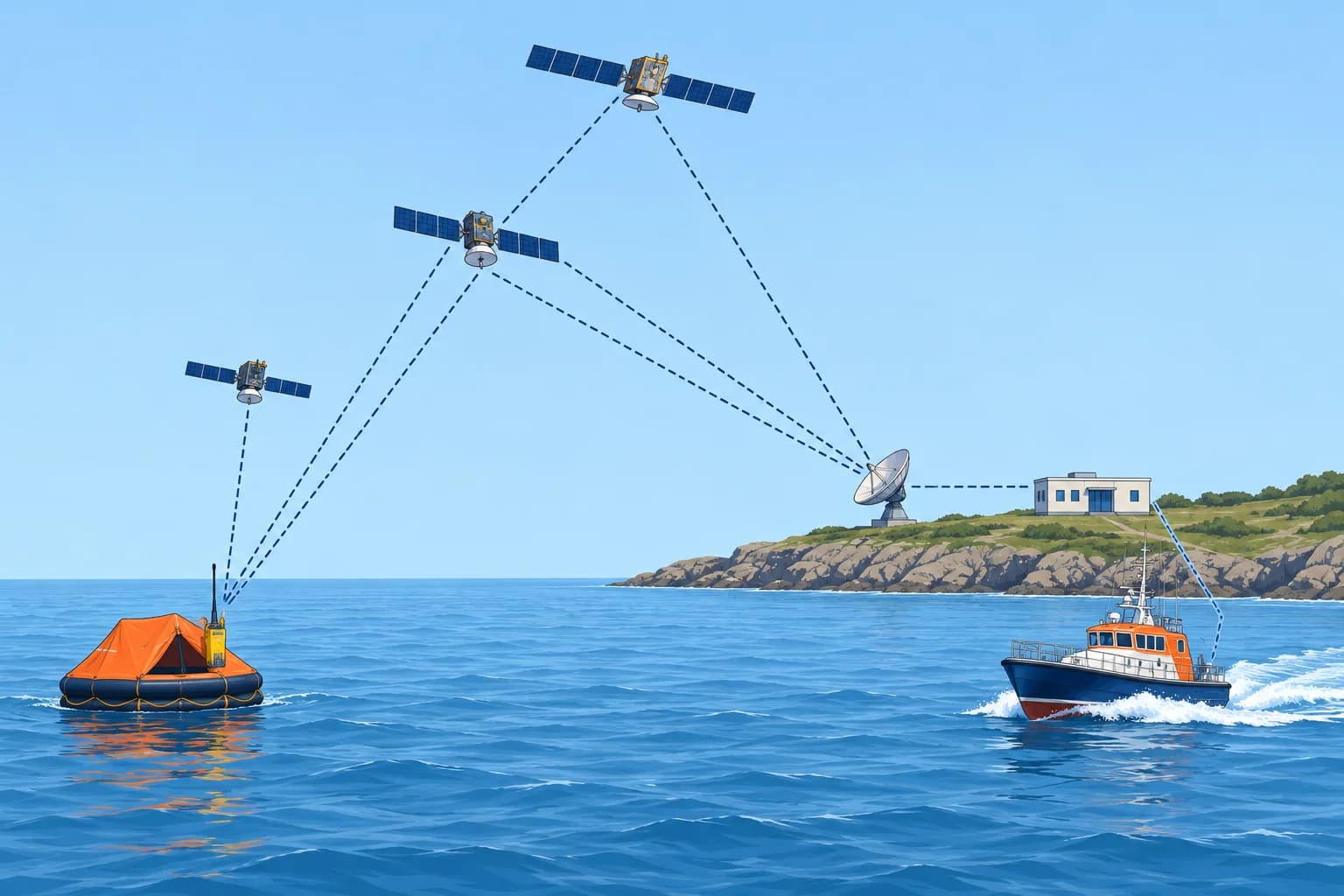
A DSC alert reaches coast stations and ships nearby; a 406 MHz beacon reaches a rescue centre through satellites. Both end at the same RCC.
DSC and VHF
Digital selective calling (DSC) sends a coded distress alert on VHF Channel 70. Coast stations and ships within radio range can receive your MMSI (your radio’s nine-digit identity number), the nature of distress if selected, and your position and its time if available. A coast station forwards the alert to the RCC. For operating steps and voice calls, see GMDSS: distress calls.
Satellite beacons
An EPIRB (emergency position-indicating radio beacon) or PLB (personal locator beacon) sends a 406 MHz alert through Cospas-Sarsat satellites to a LUT (local user terminal), a ground station. LEOSAR and MEOSAR can provide an independent location; GEOSAR relies on a position encoded by the beacon. An MCC (mission control centre) routes the alert to the responsible RCC. Rescuers navigate towards the reported position and use the separate 121.5 MHz signal for close-range homing.
MEOSAR
Cospas-Sarsat now uses three kinds of satellites: low orbit (LEOSAR), geostationary (GEOSAR) and, increasingly, medium-orbit navigation satellites such as Galileo, GPS, GLONASS and BeiDou (MEOSAR). MEOSAR detects an alert within minutes almost anywhere. It can locate a beacon from its signal alone, even if the beacon has no GNSS (global navigation satellite system) position. A position calculated by GNSS is called a fix.
Return Link Service
Galileo’s Return Link Service (RLS) sends an acknowledgement back to beacons built for it. The indicator confirms that Cospas-Sarsat has received and located the alert. It does not confirm that rescue units have been dispatched. Keep the beacon transmitting during a real emergency.
Registration
Register your 406 MHz beacon with the appropriate national authority. Keep its details and emergency contacts current so the RCC can identify you and assess an alert. If you activate it accidentally, switch it off immediately and contact the nearest RCC or coast station at once, even if nobody has called. Give the beacon ID, your position and activation time; confirm everyone is safe. Switching it off does not cancel an alert already sent.
Key figures
- DSC distress
- VHF Channel 70; MMSI; position and time if available
- Satellite beacons
- 406 MHz to Cospas-Sarsat; 121.5 MHz homing
- Chain
- Beacon → satellite → LUT → MCC → RCC
- MEOSAR
- Navigation satellites: fast alerts, position even without GNSS
- RLS
- Alert received and located; rescue dispatch is not confirmed
Remember
- DSC: Channel 70 → coast station → RCC; ships within radio range can also receive the alert.
- 406 MHz beacons: satellite → LUT → MCC → RCC.
- MEOSAR: fast alerts and independent location.
- RLS confirms receipt and location, not rescue dispatch.
- Register beacons. Accidental activation: switch off immediately and report to the RCC or coast station.
Common mistakes
Wrong: A beacon alert goes straight to the nearest lifeboat.
Right: It goes via satellites, ground stations and a mission control centre to the RCC, which sends units.
Wrong: Switch a beacon off quickly if you set it off by mistake and say nothing.
Right: Switch it off immediately and report the false alert to the RCC or coast station.
Worked case
Your registered EPIRB activates accidentally in harbour. You switch it off. Nobody calls, and a crew member says the incident is over. Are they right? What do you do?
Show the answer
No. Switching off does not cancel an alert already sent. Contact the nearest RCC or coast station immediately. Give the beacon ID, position and activation time, explain the accidental activation and confirm everyone is safe. Registration helps the RCC identify you; it does not replace reporting the false alert.
Practice question
On which VHF channel is a DSC distress alert sent?
- Channel 16
- Channel 70
- Channel 6
- Channel 13
Show the answer
Answer: B. VHF Channel 70 carries DSC distress alerts. A receiving coast station forwards the alert to the RCC.
3 · When help comes
What to expect from lifeboats and helicopters
Rescuers will call you on VHF, tell you what they want and may put crew aboard. Your job is to be ready, visible and to follow instructions.
Lifeboats
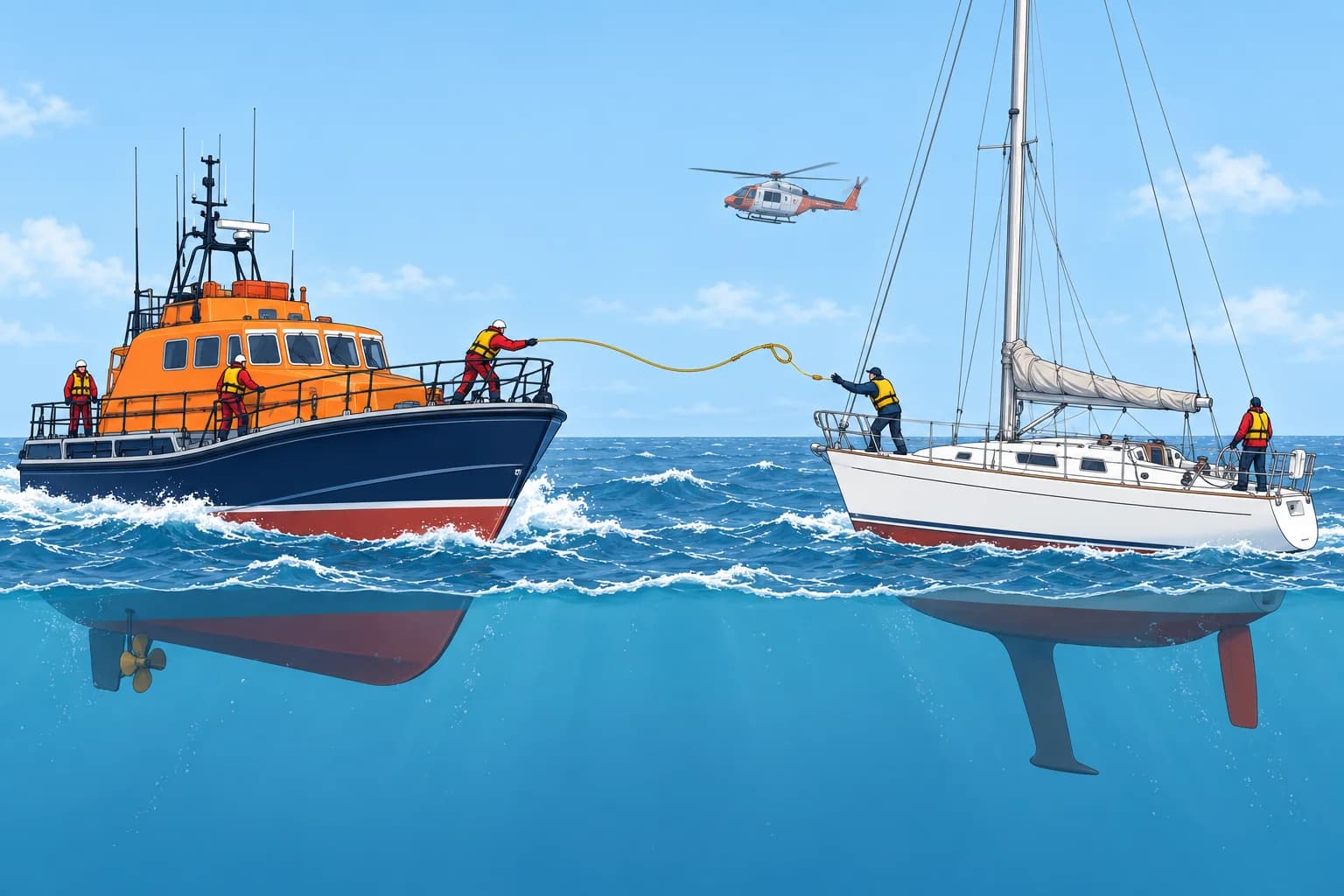
Rescue boats come from coastguards, navies and volunteer services such as the RNLI, the Dutch KNRM, the German DGzRS, the French SNSM and Spain’s Salvamento Marítimo with its Salvamar boats. Expect a VHF call, often moved to a working channel. Keep the radio on and answer briefly: position, people aboard, injuries and the problem.
Getting ready
Put lifejackets on everyone. Clear loose lines and gear from the deck and cockpit. Show a light at night and keep the boat steady. Agree a suitable towing attachment with the lifeboat crew. A tow bridle (a line arrangement sharing the load between strong attachment points) may be needed. Protect the line from chafe (wear from rubbing). Do not assume a windlass (anchor winch), mast or cleat can take towing loads. A lifeboat crew member may board to help.
Being towed
Take the line as the lifeboat crew tells you, secure it to the agreed towing attachment, and keep a knife ready. Steer to follow the towing boat unless told otherwise. Keep someone on the radio. Do not stand where a line could break and whip back. Tell them if anything changes: water coming in, a line chafing, someone hurt.
Helicopters
Secure loose gear against downdraught (air blown down by the rotors), keep listening on VHF and follow the aircrew; see Emergencies: helicopter and flares.
Remember
- Rescuers will call on VHF: keep listening and answer briefly.
- Lifejackets on, deck clear, light at night.
- For a tow: suitable towing attachment, chafe protection, knife ready.
- Follow instructions exactly; tell rescuers when anything changes.
- Helicopters: secure loose gear, keep listening on VHF and follow the aircrew.
Common mistakes
Wrong: Secure the tow line to any handy cleat.
Right: Use attachment points suitable for towing loads, following the lifeboat crew’s advice. A bridle still needs strong fittings.
Wrong: Switch the VHF off once the lifeboat is in sight, to save battery.
Right: Keep the radio on: rescuers give instructions by VHF until you are safe.
Worked case
Your engine has failed near a lee shore (a shore the wind blows you towards). You are drifting towards it. The lifeboat is 20 minutes away and plans to tow you. What must you decide while preparing?
Show the answer
Assess whether you can stay clear until help arrives and tell the lifeboat about your drift. If needed and safe for the depth and seabed, anchor early rather than wait until close to shore. Put lifejackets on, clear the deck, agree suitable tow attachments and chafe protection, and keep a knife ready. Keep listening on the agreed VHF channel and report any worsening danger.
Practice question
A lifeboat is coming to tow you. What should you prepare?
- Extra fuel containers in the cockpit locker
- A boarding ladder over the transom for them
- A suitable towing point and chafe protection
- A written list of the crew’s next of kin
Show the answer
Answer: C. Agree attachment points suitable for the towing load with the lifeboat crew, and protect the line from chafe. A bridle still needs strong fittings.
4 · Helping others
Assisting another vessel
If you can help people in distress, proceed with all speed without serious danger to your boat or those aboard. Report to the RCC and coordinate on scene.
The duty to assist
Under SOLAS (the International Convention for the Safety of Life at Sea), chapter V, regulation 33, if you are at sea and can help people in distress, you must proceed with all speed. Inform the rescue service if possible. This duty applies to pleasure craft too, regardless of the nationality or status of the people in distress. Under the law of the sea (UNCLOS), help is expected without serious danger to your boat or those aboard. If you cannot help, log why and tell the rescue service.
Listen and relay
When you hear a voice Mayday, note the position, boat’s name and problem. Allow a coast station a reasonable opportunity to acknowledge. If none does, acknowledge the casualty by voice and pass the distress to a coast station or RCC by Mayday relay. Do this even if you can also assist. Keep listening and avoid duplicate traffic. See GMDSS: distress calls for procedures.
Going to help
Tell the RCC your position, speed and what you can do. Post lookouts and keep a radio watch. Do not expose your boat or those aboard to serious danger. You may be asked to stand by, search an area or pass on messages. Coordinate with the OSC while remaining responsible for your boat’s safety. Report any task you cannot safely carry out.
On scene
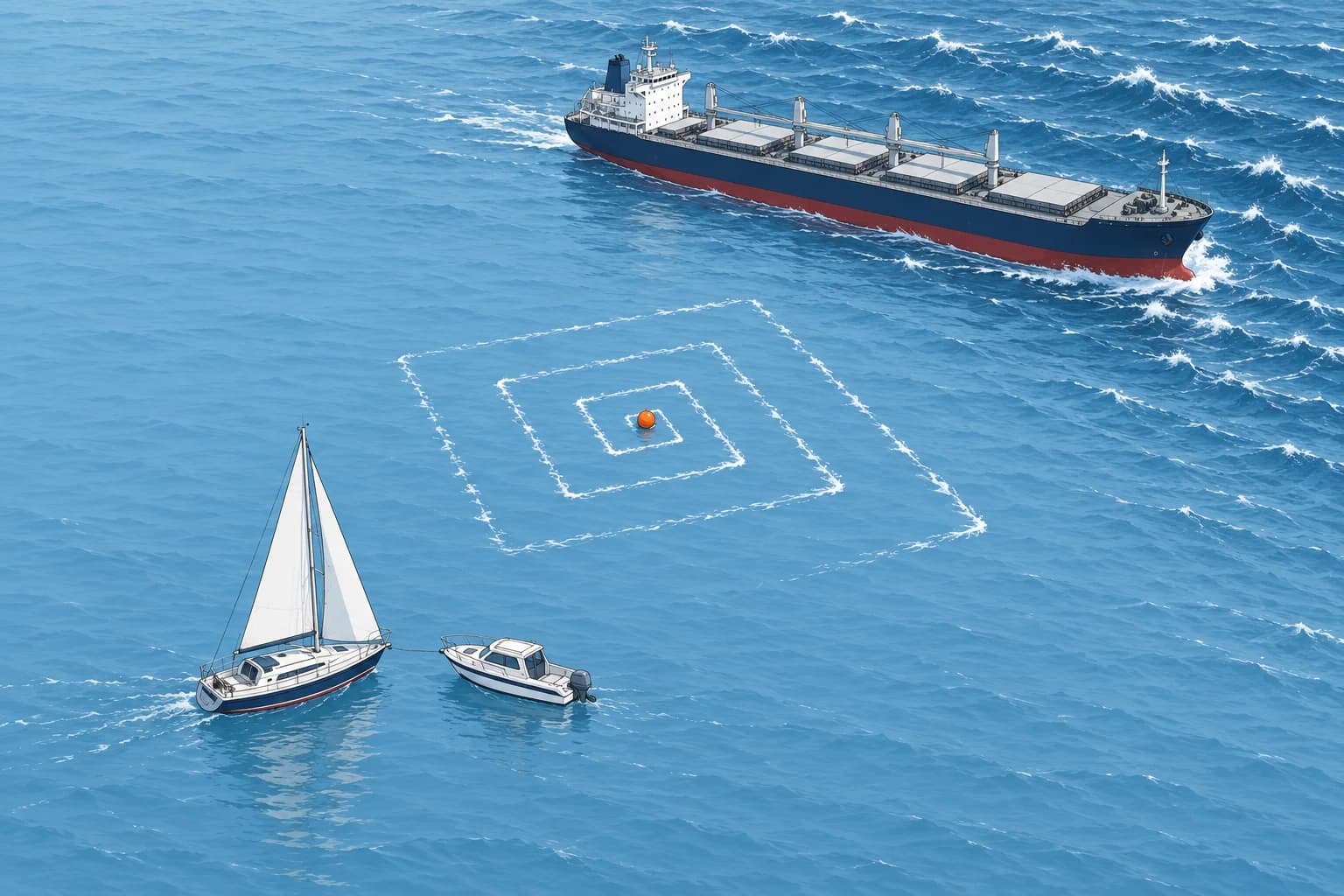
Approach a person in the water as you would a man overboard, slowly into wind or sea with the propeller stopped close by. Shout and use lights. A disabled boat may drift faster than you expect. If asked to search, follow the OSC’s pattern. An expanding square uses right-angle turns and progressively longer legs around the datum, the estimated casualty position allowing for drift. Report every sighting, including debris.
Remember
- SOLAS V/33: proceed with all speed to help, if you can.
- If no coast station acknowledges, ensure the distress reaches a coast station or RCC.
- Report to the RCC and coordinate with the OSC; your skipper retains command.
- Help without serious danger to your boat or those aboard.
- On scene: lookouts, slow approach, report all sightings.
Common mistakes
Wrong: A small yacht is not bound by the duty to assist.
Right: SOLAS V/33 applies to pleasure craft too. Assist without serious danger to your boat or those aboard.
Wrong: Answer a Mayday at once even though the coast station has acknowledged it.
Right: Keep the channel clear, listen and offer help to the coordinator without interrupting distress traffic.
Worked case
You see a red flare to windward in breaking seas. Your 10 m yacht has a tired crew and cannot safely reach the casualty. How can you still help?
Show the answer
Report the flare to the coast station or RCC, giving your position, the bearing and time. Explain why you cannot safely approach and what you can offer. Keep lookouts and a radio watch from a safe position, relay updates, and accept only tasks within your capabilities. Record why you could not proceed.
Practice question
A coast station has acknowledged a Mayday and is arranging help. What should you do?
- Repeat the entire Mayday over the ongoing exchange
- Ask the casualty to repeat all its details immediately
- Send a relay before the coast station finishes speaking
- Listen and offer useful help without interrupting
Show the answer
Answer: D. Keep distress traffic clear. Continue listening and offer relevant assistance without interrupting the coordinated response.