
Emergencies at sea · Level P1 · 6 parts · about 19 min
Life-saving appliances: lifejackets, immersion suits, lifeboats and liferafts
6 short parts: Lifejackets · Suits and TPAs · Lifebuoys · Lifeboats · Liferafts · Rescue and radio. Each part explains the idea, then gives the points to remember, the common mistakes, a worked case and a practice question; the Academy unit adds all 41 check questions.
1 · Lifejackets
SOLAS lifejackets: sizes, performance and fittings
Every person on board has a SOLAS lifejacket that keeps an unconscious wearer's mouth clear of the water. Know its sizes, fittings and how to wear it.
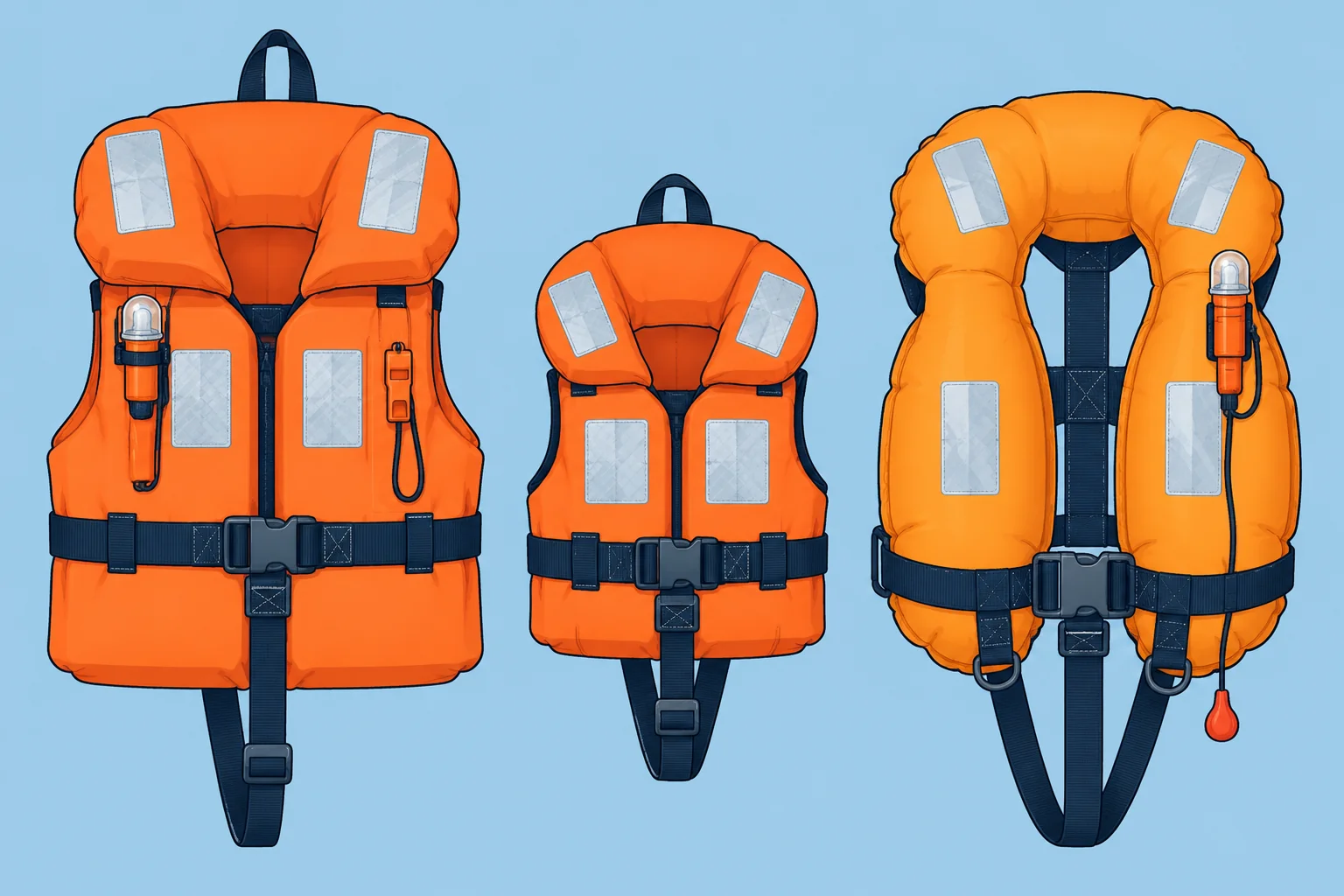
One for everyone
SOLAS, the International Convention for the Safety of Life at Sea, requires a lifejacket for every person on board, plus extra lifejackets for people on watch and at survival craft stations far from the accommodation. There are three sizes by body weight: infant (under 15 kg), child (15 to under 43 kg) and adult (43 kg and over). An adult lifejacket must fit people up to 140 kg and 1,750 mm chest girth, or accessories are carried to secure it to them.
What it must do
The LSA Code (International Life-Saving Appliance Code) requires mouth support and face-up turning at least as good as a reference test device (RTD). At least 75 % of unfamiliar adults must put it on unaided within 1 minute; after demonstration, all must do so. Small children and infants may need help. Approval includes jumps from 4.5 m holding the jacket and 1 m with arms overhead. These tests do not make every jump safe. After 24 hours in water it retains at least 95 % buoyancy.
Fittings
Each lifejacket has a light (at least 0.75 candela for at least 8 hours, steady or flashing), a whistle on a lanyard, and retro-reflective tape, which shines brightly back in a searchlight beam. It also has a buddy line, a releasable buoyant line to fasten yourself to another person in the water, and a lifting loop or strap so rescuers can lift you out. Learn where each fitting is on your ship's model.
Inflatable lifejackets
Some ships carry inflatable lifejackets. They have at least two separate buoyancy compartments. If one fails, the other must retain the required flotation performance. They inflate automatically in the water, can be fired by a single manual pull, and each chamber can be inflated by mouth. They are serviced at intervals of not more than 12 months, like inflatable liferafts. Foam lifejackets need no inflation. For water entry, follow your ship's training and the manufacturer's instructions.
Wear it right
Lifejackets are stowed where you can reach them quickly, and their places are clearly marked. Fasten every buckle and tighten the straps so it cannot ride up over your face. Yacht lifejackets and the ISO 12402 buoyancy levels are in Emergencies: safety equipment.
Key figures
- Sizes
- Infant < 15 kg; child 15 to < 43 kg; adult 43 kg and over
- Donning test
- 75 % of untrained adults, unaided, within 1 min
- Approval jump tests
- 4.5 m holding the jacket; 1 m with arms overhead
- Light
- At least 0.75 cd for at least 8 h
- Inflatable
- 2 or more chambers; automatic, manual pull and by mouth
- Inflatable servicing
- At intervals of not more than 12 months
Remember
- One lifejacket per person, plus extras at watch stations and remote survival craft stations.
- Three sizes: infant under 15 kg, child 15 to under 43 kg, adult 43 kg and over.
- It turns an unconscious wearer face-up and keeps the mouth clear of the water.
- Fittings: light, whistle, retro-reflective tape, buddy line, lifting loop.
- Inflatables: at least two chambers, serviced at least every 12 months.
Common mistakes
Wrong: Any lifejacket fits anyone if you pull the straps tight.
Right: Use the right size: infant, child or adult. A child in an adult jacket can slip out.
Wrong: Passing the jump test makes any jump safe.
Right: Approval tests do not make every water entry safe. Follow your ship's training and the manufacturer's instructions.
Worked case
Your ship takes the superintendent's 12-year-old daughter, who weighs 38 kg, on a short coastal passage. At the safety briefing she is handed an adult lifejacket from the cabin locker.
Show the answer
At 38 kg she needs a child lifejacket, for 15 to under 43 kg. An adult jacket may not turn her face-up and she could slip out. Tell the officer in charge so a child lifejacket is found and fitted, with all straps fastened. Show her the light and whistle. For water entry, follow your ship's training and the manufacturer's instructions.
Practice question
A child weighs 40 kg. Which SOLAS lifejacket size should they wear?
- Infant size
- Child size
- Adult size
- Any size
Show the answer
Answer: B. The child size covers 15 kg to under 43 kg. Adult lifejackets are for 43 kg and over.
2 · Suits and TPAs
Immersion suits, anti-exposure suits and thermal protective aids
A lifejacket provides flotation. An immersion suit adds thermal protection; a thermal protective aid reduces heat loss inside a survival craft.
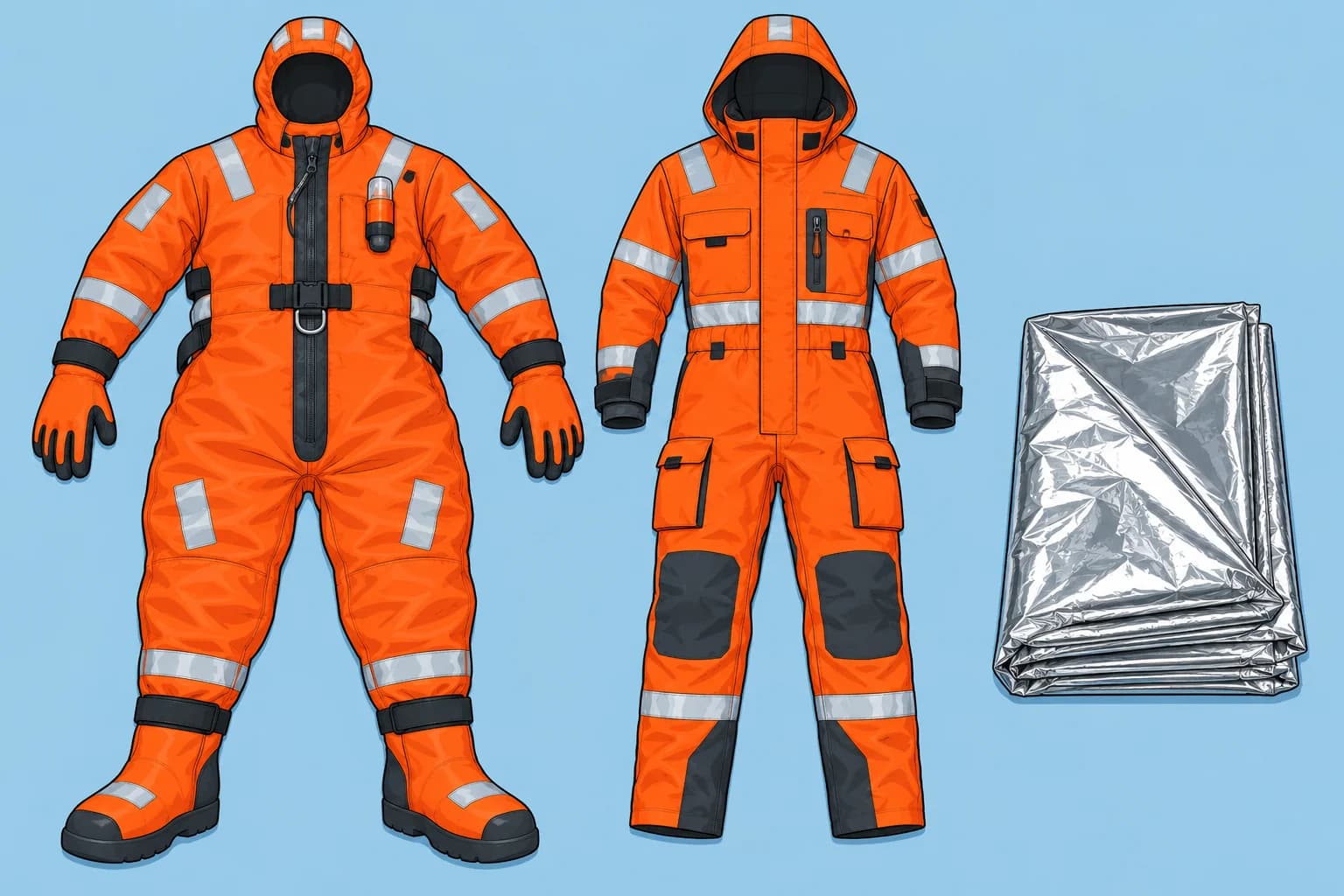
Immersion suits
An immersion suit is a waterproof suit covering the whole body except the face; gloves may be separate but are permanently attached. On cargo ships SOLAS requires one for every person on board, plus suits at watch or work stations far from where the suits are stowed. Only ships other than bulk carriers that always trade in warm climates may be exempted by their flag state. You must be able to unpack and don it without help within 2 minutes, including any lifejacket worn with it.
What it must do
In approval tests, the suit allows you to climb a 5 m vertical ladder, swim a short distance and board a survival craft. It must withstand a 4.5 m test jump. You must be able to turn yourself face-up within 5 seconds. This is not automatic self-righting. If the suit needs a lifejacket, wear it over the suit. A suit approved for use without a lifejacket has its own light and whistle.
Insulated or not
In approval tests, an insulated suit limits your core temperature fall to 2 °C after 6 hours in water at 0–2 °C. An uninsulated suit limits the fall to 2 °C after 1 hour at 5 °C, worn over warm clothing. These are controlled test results, not guaranteed survival times. Wear the clothing specified for your suit.
Anti-exposure suits
An anti-exposure suit is a working suit for rescue boat crews and marine evacuation system parties. It gives at least 70 N of buoyancy, is donned within 2 minutes, has a hood, gloves and a pocket for a portable VHF (very high frequency) radio, and lets you work and handle a boat. In approval tests in water at 5 °C, core temperature must fall no faster than 1.5 °C per hour after the first half hour. This is a test limit, not a survival-time guarantee.
Thermal protective aids
A thermal protective aid (TPA) is a bag or suit of waterproof material that holds heat in, carried in lifeboats and liferafts. It covers the whole body of a person wearing a lifejacket, except the face, and cuts heat loss from wind and evaporation. Put a cold or wet survivor in one once inside the craft. It works in air from −30 °C to +20 °C; if it hinders swimming, you can take it off in the water within 2 minutes.
Key figures
- Immersion suit donning
- Within 2 min, unaided, with any lifejacket needed
- Insulated suit
- Core fall of 2 °C or less after 6 h in water at 0–2 °C
- Uninsulated suit
- Core fall of 2 °C or less after 1 h at 5 °C, over warm clothes
- Anti-exposure suit
- 70 N or more; core fall ≤ 1.5 °C/h at 5 °C after 0.5 h
- TPAs in survival craft
- For 10 % of the persons or two, whichever is greater
- TPA air range
- −30 °C to +20 °C
Remember
- Cargo ships carry an immersion suit for every person; only some non-bulk carriers in warm climates are exempted.
- Don it unaided within 2 minutes; a lifejacket, if needed, goes over the suit.
- Insulated: 2 °C core fall in 6 h at 0–2 °C. Uninsulated: 1 h at 5 °C, over warm clothes.
- Anti-exposure suits are working suits for rescue boat crews.
- TPAs in survival craft cut heat loss from wind and evaporation.
Common mistakes
Wrong: An uninsulated immersion suit is warm enough over underwear.
Right: An uninsulated suit must be worn over the specified warm clothing to provide its tested thermal protection.
Wrong: Put the lifejacket on first and the immersion suit over it.
Right: If the suit needs a lifejacket, the lifejacket goes over the suit, never underneath.
Wrong: A thermal protective aid is a swimming suit for the water.
Right: A TPA is used inside the survival craft. Take it off in the water if it stops you swimming.
Worked case
Your bulk carrier is in the North Atlantic in winter. At the drill, a new crew member says he will not bother with the immersion suit, because his lifejacket will keep him afloat.
Show the answer
A lifejacket keeps him afloat, but in near-freezing water cold soon weakens him and can kill. Bulk carriers must carry an immersion suit for every person, and he must be able to don it within 2 minutes. Help him practise at the drill: warm clothes underneath, suit on, then the lifejacket over it if the suit is marked for one. Show him the light, whistle and buddy line.
Practice question
Within what time must you be able to unpack and don an immersion suit without help?
- 1 minute
- 2 minutes
- 5 minutes
- 10 minutes
Show the answer
Answer: B. The LSA Code requires 2 minutes, including any lifejacket that must be worn with the suit.
3 · Lifebuoys
Lifebuoys, lights, smoke signals and lifelines
A lifebuoy is the first thing thrown to a person overboard. Some carry a light and smoke to mark the spot; others a floating line to pull them in.
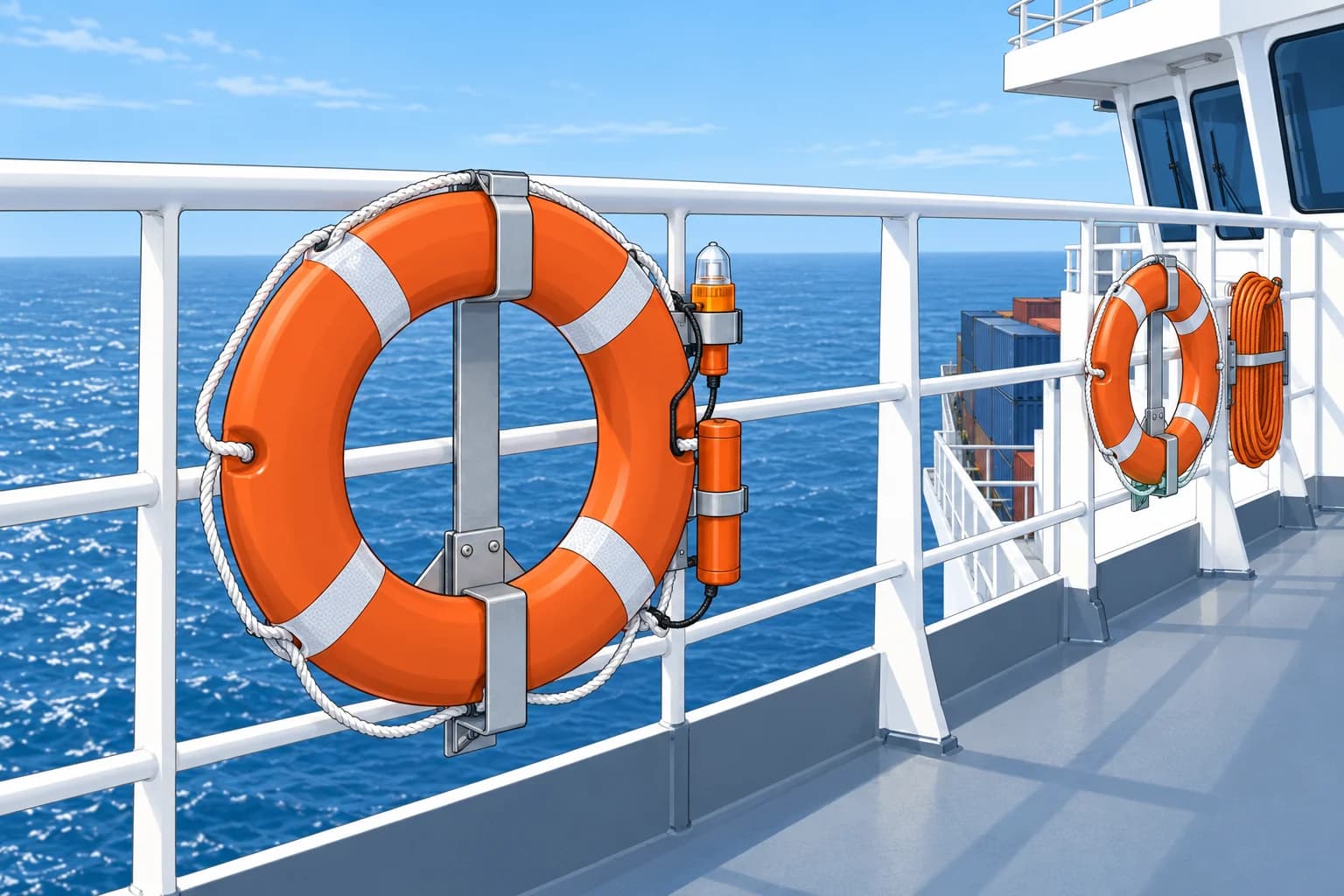
What a lifebuoy is
A SOLAS lifebuoy is a ring of solid buoyant material, never inflatable, with an outer diameter of not more than 800 mm and an inner diameter of at least 400 mm. It weighs at least 2.5 kg and supports at least 14.5 kg of iron in fresh water for 24 hours. A grabline, a rope, forms four loops. It must survive a drop into the water from its stowage height or 30 m, whichever is greater. A quick-release buoy must be heavy enough to operate its mechanism.
Lights and smoke
At least half the lifebuoys carry a self-igniting light, a white light that switches on automatically when deployed. It provides at least 2 candela (cd), steady or flashing 50–70 times a minute, for at least 2 hours. The intensity requirement applies to both modes, using effective intensity for flashes. At least two also carry a self-activating smoke signal, giving highly visible smoke for at least 15 minutes. Two light-and-smoke buoys have bridge quick release. Bridge-release buoys must weigh at least 4 kg.
Buoyant lifeline
At least one lifebuoy on each side has a buoyant lifeline, a floating rope at least 8 mm thick with a breaking strength of at least 5 kN. It is at least twice as long as the height of its stowage above the waterline in the lightest seagoing condition, or 30 m, whichever is greater. The lifebuoys with lifelines are not the ones that carry lights or smoke signals.
How many and where
A cargo ship carries at least 8 lifebuoys if under 100 m long, 10 from 100 m, 12 from 150 m and 14 from 200 m. They are spread on both sides and on all open decks to the stern, ready to throw in seconds and never permanently secured. Each is marked in capital letters with the ship's name and port of registry, and carries retro-reflective tape.
Key figures
- Size and mass
- Outer ≤800 mm; inner ≥400 mm; ≥2.5 kg; bridge release ≥4 kg
- Buoyancy
- Supports 14.5 kg of iron for 24 h in fresh water
- Self-igniting light
- White; ≥2 cd steady or effective flashing; ≥2 h; 50–70 flashes/min
- Smoke signal
- At least 15 min of highly visible smoke
- Buoyant lifeline
- 8 mm, 5 kN; twice stowage height or 30 m, whichever greater
- Cargo ship numbers
- Under 100 m: 8; 100 m: 10; 150 m: 12; 200 m and over: 14
Remember
- Lifebuoy: solid buoyant ring, at least 2.5 kg, marked with the ship's name and port.
- At least half carry self-igniting lights; two of these also carry smoke signals.
- The light-and-smoke pair is released quickly from the bridge.
- Lifeline buoys: line twice the stowage height or 30 m, whichever is greater.
- Ready to throw, never permanently secured.
Common mistakes
Wrong: Lash lifebuoys tightly to the rail so they are not lost in heavy weather.
Right: Lifebuoys must never be permanently secured. Seconds count in a man-overboard.
Wrong: Throw the lifebuoy straight at the person in the water.
Right: Throw it just beyond or beside them, so it does not hit them, and let wind or the line bring it within reach.
Worked case
Your 180 m cargo ship has 12 lifebuoys, six lights and two bridge-release light-and-smoke buoys. A separate lifeline buoy, stowed 22 m above the lightest-seagoing waterline, has a 30 m line. Is this acceptable?
Show the answer
The counts comply: 12 buoys, at least six lights and two bridge-release light-and-smoke buoys. The line does not comply. Its minimum length is twice the stowage height or 30 m, whichever is greater: 2 × 22 m = 44 m. Reject and report the short line so it can be replaced.
Practice question
For how long must a lifebuoy self-activating smoke signal give smoke?
- 2 hours
- 5 minutes
- 15 minutes
- 45 minutes
Show the answer
Answer: C. The LSA Code requires at least 15 minutes of highly visible smoke while floating in calm water.
4 · Lifeboats
Lifeboats: types, protection and equipment
Cargo ships usually carry enclosed lifeboats on each side or a stern free-fall boat, plus rafts. Some tanker cargoes require air support and fire protection.
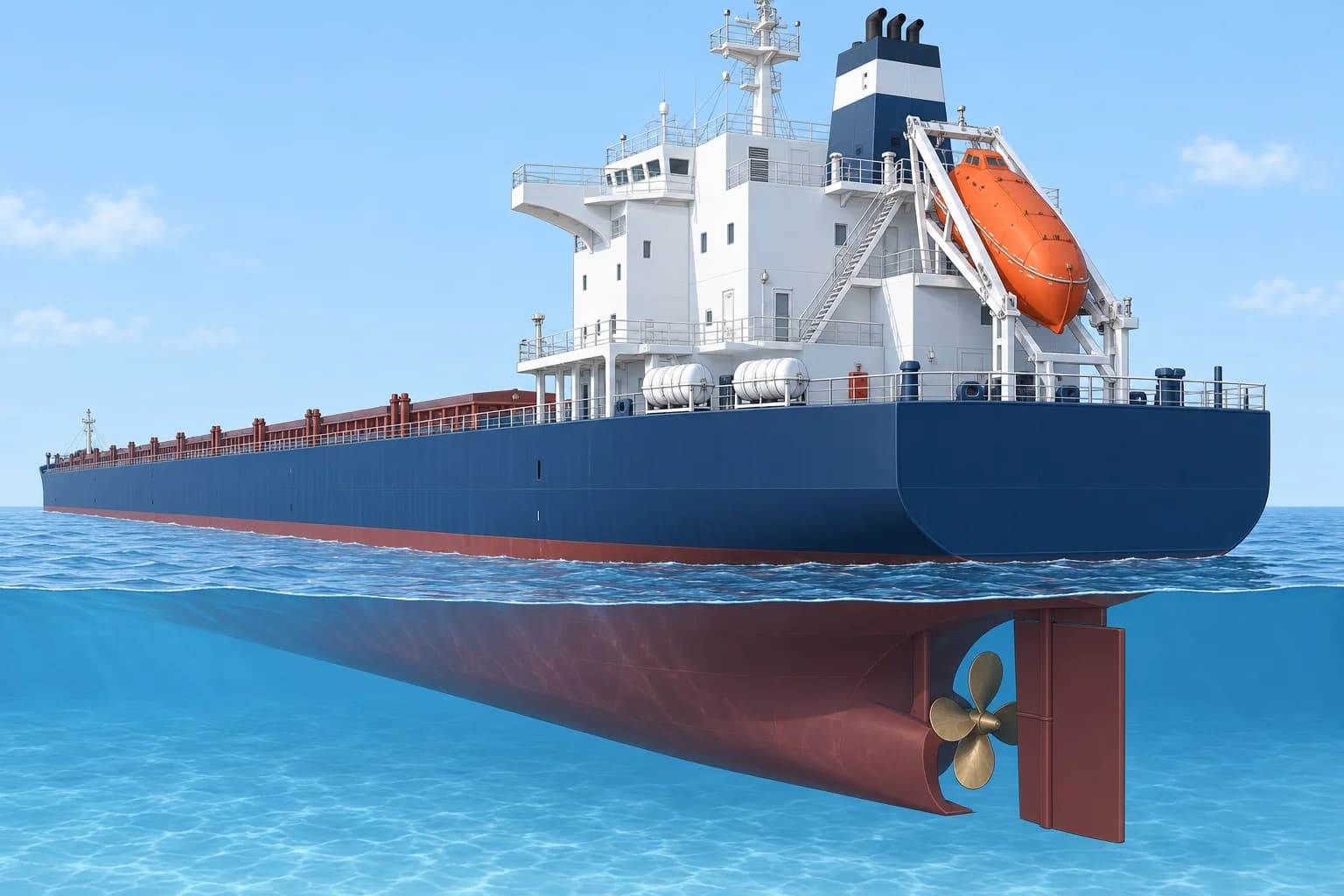
Types
A lifeboat is a rigid survival craft. Partially enclosed boats have rigid covers at bow and stern and a folding canopy between; they are used on passenger ships. Normally, cargo ships carry totally enclosed lifeboats, with a watertight cover and hatches. With everyone strapped in and hatches shut, a totally enclosed boat is self-righting: it comes upright after capsizing. Davits, lifting arms, lower boats. A free-fall lifeboat slides off a stern ramp into the sea with everyone belted in, facing aft.
Tankers and gas carriers
Self-contained air support uses compressed air to keep occupants breathing safely and toxic gas out for at least 10 minutes, with hatches closed and engine running. It is required for cargoes giving off toxic vapours. A fire-protected lifeboat, usually protected by water spray, withstands an enveloping oil fire for at least 8 minutes in approval tests. Tankers carrying cargo with a flashpoint of 60 °C or less require this protection. Flashpoint is the lowest liquid temperature at which its vapour ignites when an ignition source is applied.
Performance
No lifeboat may carry more than 150 persons. Fully loaded in calm water, it makes at least 6 knots, and at least 2 knots while towing a loaded 25-person liferaft. It carries fuel for 24 hours at 6 knots, and its engine starts within 2 minutes in temperatures down to −15 °C.
Equipment highlights
A lifeboat carries 3 litres of drinking water per person; an approved desalinator, which makes drinking water from seawater, may replace part. It carries at least 10,000 kJ of food per person, 48 hours' seasickness medicine and a bag each, thermal protective aids, a first-aid kit, a sea anchor that reduces drift, bailers for removing water, a searchlight, four rocket parachute flares, six hand flares and two buoyant smoke signals.
On a cargo ship
The usual SOLAS cargo-ship arrangements are totally enclosed davit lifeboats on each side, each side for 100 % of the people on board, or a free-fall lifeboat for 100 % at the stern. Liferafts are carried as well. LSA Code amendments in force since 1 January 2026 require ventilation of at least 5 m³ per person per hour for 24 hours in totally enclosed lifeboats installed from 1 January 2029. Launching is in Emergencies: survival craft (P3).
Key figures
- Maximum capacity
- 150 persons
- Speed
- 6 knots loaded; 2 knots towing a loaded 25-person liferaft
- Fuel
- 24 h at 6 knots
- Air support
- Safe air for at least 10 min, hatches shut, engine running
- Fire-protected
- Survives an enveloping oil fire for at least 8 min
- Water and food
- 3 L water and 10,000 kJ food per person
Remember
- Normally, cargo ships carry totally enclosed, self-righting lifeboats on davits or one free-fall boat at the stern.
- Toxic vapours: air support ≥10 min. Tanker cargo flashpoint ≤60 °C: fire protection ≥8 min.
- Lifeboats: at most 150 persons, 6 knots, fuel for 24 h.
- Equipment includes 3 L of water and 10,000 kJ of food per person.
- Self-righting works only with everyone belted in and the hatches closed.
Common mistakes
Wrong: Seat belts in a totally enclosed lifeboat are optional once you are in the water.
Right: Keep belts on in rough seas. The boat rights itself only if people stay in their seats.
Wrong: A fire-protected lifeboat can stay in a burning oil slick as long as needed.
Right: Its fire-protection approval test lasts at least 8 minutes. This is not unlimited protection.
Worked case
You join a chemical tanker whose cargo gives off toxic vapour and has a flashpoint of 40 °C. During familiarisation, the second officer asks what is special about your lifeboat compared with a container ship's.
Show the answer
Toxic vapours require a totally enclosed lifeboat with air support for at least 10 minutes, with hatches closed and engine running. A flashpoint below 60 °C also requires fire protection, tested in an enveloping oil fire for at least 8 minutes. Identify both systems during familiarisation and report either missing protection. Operation belongs in survival-craft training.
Practice question
What is the minimum speed of a fully loaded lifeboat in calm water?
- 2 knots
- 4 knots
- 10 knots
- 6 knots
Show the answer
Answer: D. At least 6 knots fully loaded, and at least 2 knots when towing a loaded 25-person liferaft.
5 · Liferafts
Liferafts: types, float-free arrangement and servicing
Liferafts are inflatable or rigid craft for six or more. With a correctly installed float-free arrangement, an inflatable raft releases as the ship sinks.
Types
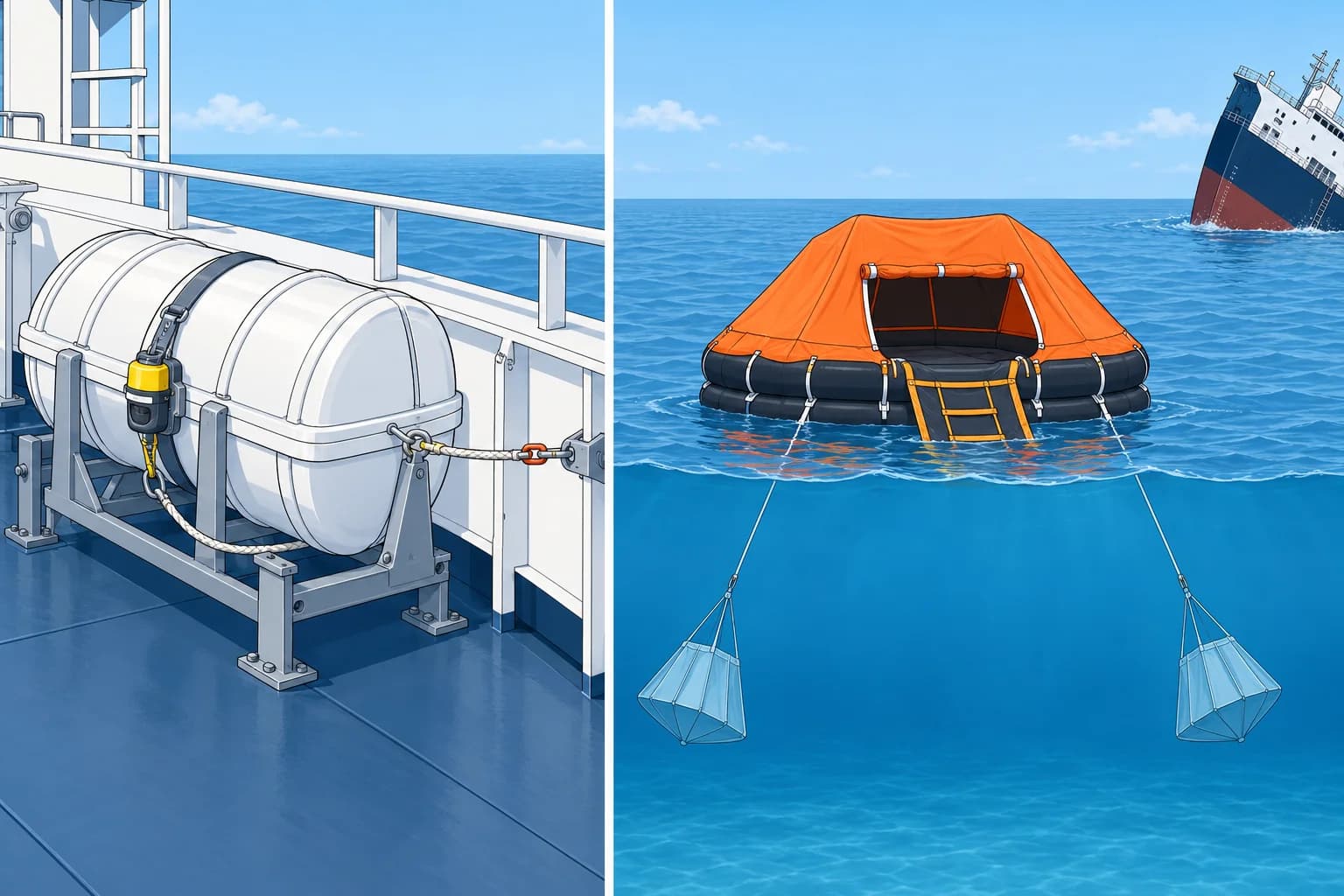
A liferaft is either inflatable, packed in a canister and filled by a gas cylinder, or rigid, with built-in buoyancy. Most ship rafts are inflatable. Each has a canopy, two sea anchors to reduce drift, lifelines inside and out, a boarding ramp or ladder, and means for collecting rain. Liferafts carry at least 6 persons.
Throw-over or davit
A throw-over liferaft has a canister designed for deployment over the side. A davit-launched liferaft uses a lifting arm and allows dry embarkation. The painter is the line that activates inflation.
Float-free
With a correctly installed float-free arrangement, an inflatable raft releases as the ship sinks. Its canister is held by a strap with a hydrostatic release unit (HRU), which frees it at a depth of not more than 4 m. The canister floats up, the painter pulls tight and activates inflation. A weak link, breaking at 2.2 ± 0.4 kN, then parts so the sinking ship cannot drag the raft under. Never bypass the weak link.
Markings and packs
The container shows identity, approval, capacity, pack, painter length, stowage limit, service date and launching instructions. A SOLAS A pack normally includes 1.5 litres of water and 10,000 kJ of food per person, flares, first aid and seasickness medicine. Approved desalination equipment may replace part of the water. A SOLAS B pack omits food and water and needs flag-state approval for suitable short international passenger voyages.
Servicing
Inflatable liferafts, inflatable lifejackets and marine evacuation systems are serviced at an approved station at intervals of not more than 12 months; the flag state may extend this to 17 months. Serviceable HRUs follow the same 12-month cycle; disposable HRUs are replaced by their expiry date. Check the dates on your rafts.
Key figures
- Minimum capacity
- 6 persons
- HRU
- Frees the raft at a depth of not more than 4 m
- Weak link
- Breaks at 2.2 ± 0.4 kN
- Servicing
- Normally ≤12 months; disposable HRUs: replace by expiry
Remember
- Liferafts carry at least 6 persons. Check the approved capacity on the container.
- Read the container markings for capacity, pack type and service date.
- Float-free: HRU releases at 4 m or less; the weak link stops the ship dragging the raft down.
- A pack is standard; B pack needs flag approval for suitable short international passenger voyages.
- Normally service inflatables and serviceable HRUs within 12 months; replace disposable HRUs by expiry.
Common mistakes
Wrong: Tie the painter straight to the ship's rail so the raft can never be lost.
Right: Attach it as the maker shows, through the weak link. A raft tied to a sinking ship is dragged under.
Wrong: Crew checks replace an inflatable raft's approved-station service.
Right: Crew inspect rafts on board. Inflatable rafts also need servicing at an approved station, normally at intervals of not more than 12 months.
Worked case
Checking a liferaft on the boat deck, you see the HRU expiry date passed two months ago. The service label shows the raft was serviced 11 months ago.
Show the answer
Report it to the officer responsible at once: an expired HRU may not release the raft if the ship sinks. If it is a disposable HRU, it must be replaced; a serviceable one goes for servicing. Also note that the raft is due for its 12-month service within a month. Do not remove or tamper with the HRU or the weak link yourself.
Practice question
What is the maximum permitted release depth for a liferaft HRU?
- 18 m
- 1 m
- 4 m
- 10 m
Show the answer
Answer: C. The HRU must release the raft by a depth of 4 m. It need not release at exactly 4 m.
6 · Rescue and radio
Rescue boats, EPIRB, SART and portable VHF
Rescue boats pick people out of the water. The EPIRB raises the alarm, SARTs guide rescuers to the craft, and portable VHFs let everyone talk.
Rescue boats
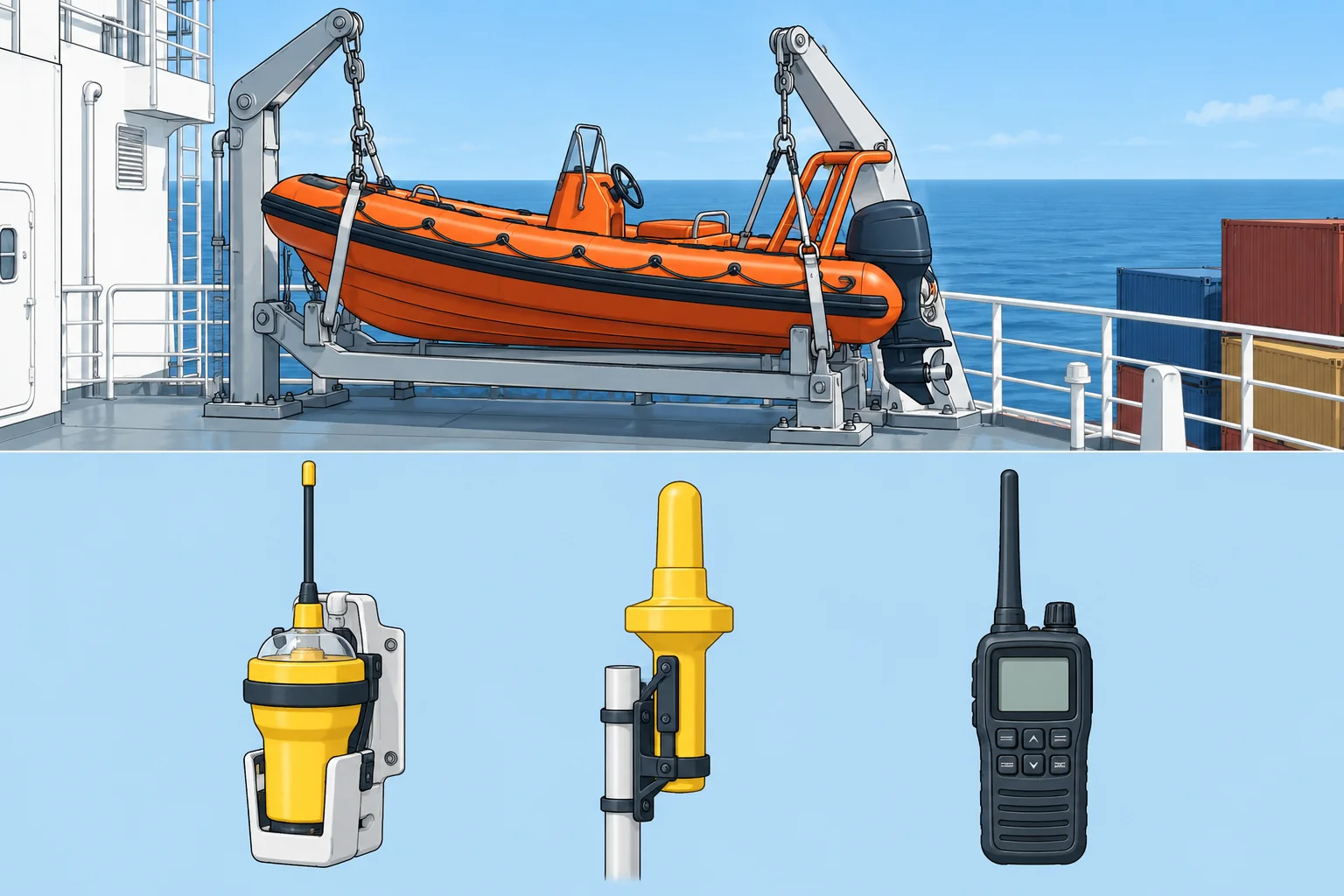
A rescue boat is designed to rescue people in the water and to marshal liferafts, gathering and towing them. SOLAS cargo ships carry at least one; a lifeboat may serve if it also meets the rescue-boat rules. It is rigid, inflated or both, 3.8 to 8.5 m long, carries at least five seated persons and one on a stretcher, runs at 6 knots or more for at least 4 hours, and can tow the ship's largest loaded liferaft at 2 knots.
Fast rescue boats
Ro-ro passenger ships, where vehicles roll on and off using ramps, carry at least one fast rescue boat, 6 to 8.5 m long, which can run for 4 hours at 20 knots with a crew of three, and at 8 knots fully loaded. Its crew need extra training; see Emergencies: fast rescue boats.
EPIRB
SOLAS passenger ships and cargo ships of 300 GT (gross tonnage, a measure of enclosed volume) or more on international voyages carry a float-free satellite EPIRB (emergency position-indicating radio beacon) in an accessible position. On sinking, it releases, floats up and activates. It sends a 406 MHz distress alert through Cospas-Sarsat satellites for at least 48 hours, plus a 121.5 MHz homing signal to guide rescuers. It can be released by hand and carried into a survival craft. Details: GMDSS (Global Maritime Distress and Safety System).
SART and AIS-SART
A radar SART (search and rescue transponder) or an AIS-SART helps rescuers locate a survival craft. AIS means automatic identification system: it shares identity and position by radio. SOLAS passenger ships and cargo ships of 500 GT and upwards carry at least one locating device on each side. SOLAS cargo ships of 300 to under 500 GT carry at least one. Detailed operation is covered in GMDSS.
Portable VHF
Survival craft talk to each other and rescuers by two-way VHF (very high frequency) radiotelephone, a waterproof handheld set. SOLAS passenger ships and cargo ships of 500 GT and upwards carry at least three; SOLAS cargo ships of 300 to under 500 GT carry at least two. Know their stowage locations and who takes them to the craft. Operation is covered in the GMDSS lessons.
Key figures
- Rescue boat
- 3.8–8.5 m; 5 seated + 1 stretcher; 6 knots for 4 h
- Fast rescue boat
- 6–8.5 m; 20 knots for 4 h with a crew of 3
- EPIRB
- Float-free, 406 MHz for at least 48 h, 121.5 MHz homing
- Locating devices, ≥500 GT
- At least one each side, two in all
- Two-way VHF, 500 GT and over
- At least three
- Cargo ship 300 to < 500 GT
- One locating device and two portable VHFs
Remember
- Rescue boats rescue people and marshal liferafts; SOLAS cargo ships carry at least one.
- The EPIRB floats free and alerts by satellite on 406 MHz for at least 48 h.
- A radar SART or AIS-SART helps nearby rescuers locate the survival craft.
- At least two locating devices (radar SARTs or AIS-SARTs) and three portable VHFs on ships of 500 GT and upwards.
- Take the locating devices and VHFs into the survival craft.
Common mistakes
Wrong: The EPIRB is fixed to the ship, so it is lost if she sinks.
Right: It floats free and starts transmitting by itself, and can also be released by hand and taken into a craft.
Wrong: Any lifeboat can automatically serve as the ship's rescue boat.
Right: A lifeboat can serve only if it also meets the rescue-boat requirements. Check which craft is designated on your ship.
Worked case
While preparing to abandon your 25,000 GT container ship, you are assigned to collect the bridge radio life-saving equipment before boarding one of two lifeboats.
Show the answer
At least two locating devices (radar SARTs or AIS-SARTs) and three portable two-way VHF sets are required. Take one locating device and at least one VHF to each lifeboat, with spare batteries, as the muster list says. Take the EPIRB if it is accessible and safe; otherwise its float-free arrangement releases it if the ship sinks. Do not delay embarkation or return aboard for equipment.
Practice question
How many search and rescue locating devices must a 20,000 GT bulk carrier carry?
- Three
- One
- Four
- Two
Show the answer
Answer: D. Ships of 500 GT and upwards carry at least one on each side: two in all.