
Emergencies at sea · Level P1 · 6 parts · about 20 min
Personal survival: abandoning, in the water and in survival craft
6 short parts: Abandoning · In the water · Boarding craft · In the craft · Staying alive · Being rescued. Each part explains the idea, then gives the points to remember, the common mistakes, a worked case and a practice question; the Academy unit adds all 36 check questions.
1 · Abandoning
The order to abandon, dressing for survival and leaving the ship
Leave only on the master's order, dressed for a long cold wait. Board the craft dry if you can; if you must jump, jump safely from as low as possible.
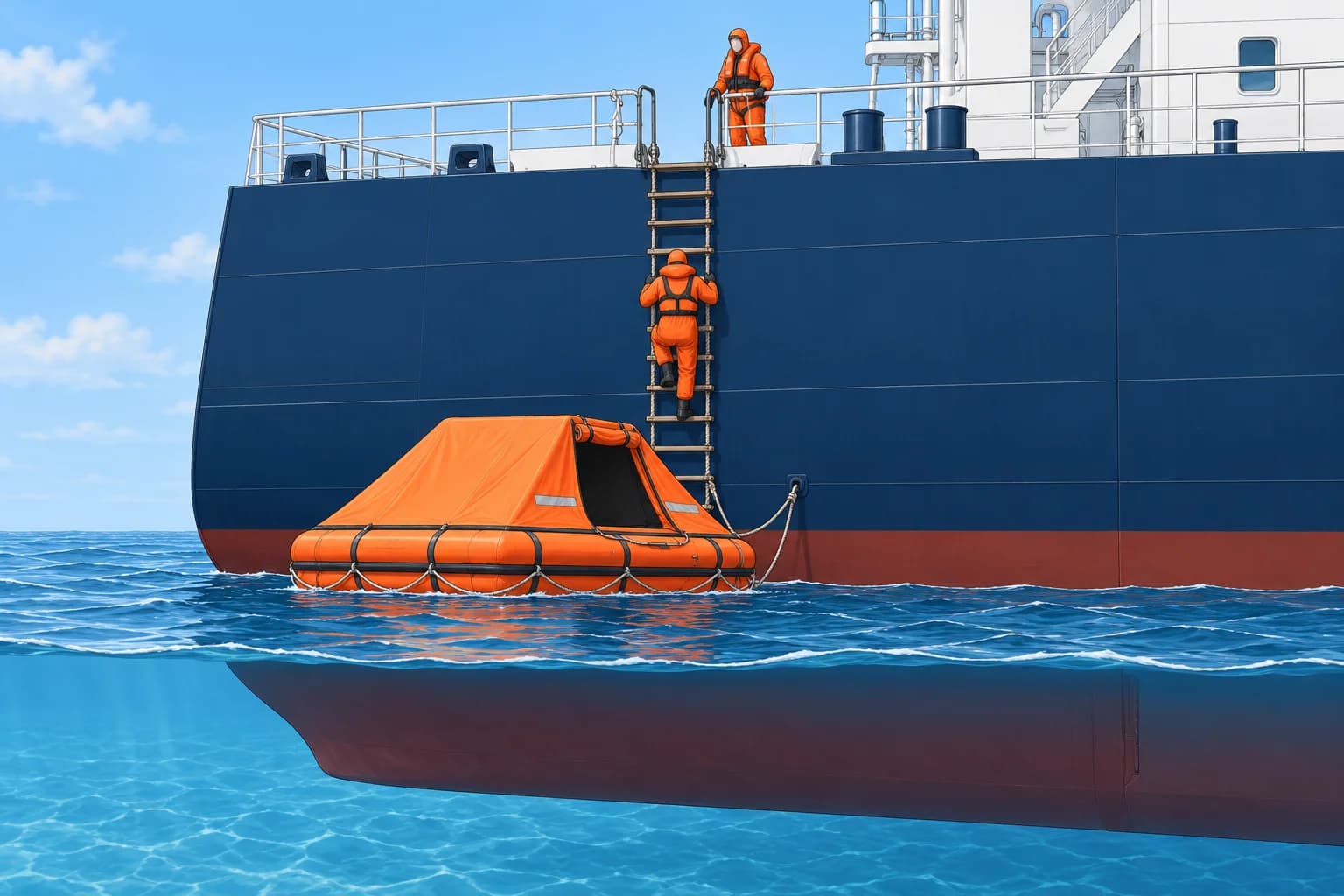
The order
The master, the ship's captain, orders abandonment by voice or the public-address system. Stay aboard until ordered: a damaged ship is often safer than the sea. Then go with your group to your embarkation station, where you board your assigned craft, and follow its leader. You practise jumping, lifejacket swimming and raft righting in your approved course.
Dress for survival
Wear warm layers, a hat, gloves and socks; wool and fleece retain some insulation when wet. Put on your immersion suit, a waterproof protective suit, with the zip closed and hood on. Wear a lifejacket over it if its label requires one. If there is time, drink water and bring extra clothing or blankets. Take issued seasickness tablets only if you can swallow safely, following the medicine's instructions.
Stay dry if you can
The best way off is dry-shod, without getting wet: step into a lifeboat or a raft lowered by a davit (a deck-mounted crane) at the embarkation deck, slide down a marine evacuation system (a chute or slide to a floating platform), or climb down an embarkation ladder. Every minute out of the water keeps you warmer and stronger. Jump only when there is no other way.
If you must jump
Jump from as low as possible. Lifejackets and immersion suits are tested for jumps from 4.5 m; higher jumps can injure you or damage your equipment. Climb down a ladder or rope part of the way if you can. Never jump onto a liferaft canopy or into the water right beside a raft, where you can land on people.
Key figures
- Abandon ship
- Only on the master's order
- Best way off
- Dry: lifeboat, davit raft, evacuation chute or ladder
- Jump test height
- Lifejackets and suits tested from 4.5 m; jump from lower
Jumping into the water safely
- Choose the lowest point you can reach, on the side away from fire and oil. — Each extra metre makes the impact harder; equipment is tested from 4.5 m.
- Check the water below is clear of people, wreckage, survival craft and burning oil. — Landing on something or someone can injure you both.
- Hold your lifejacket down with one arm across your chest; cover your nose and mouth with the other hand. — This stops the jacket hitting your chin and neck and keeps water out of your nose.
- Look straight ahead, not down, and step off. — Looking down tips your body forward, so you land badly.
- Keep your feet together and legs straight, and enter feet first. — A straight, vertical entry is the least likely to hurt you.
- When you surface, get your breathing under control, then move away from the ship's side. — Cold shock makes you gasp; wreckage and launching craft are dangers near the hull.
Remember
- Stay aboard until the master orders abandon ship.
- Warm layers, hat and gloves, then the immersion suit, then the lifejacket over it if marked.
- Board dry-shod whenever you can.
- If you must jump: low, clear below, hold the lifejacket, look ahead, feet first, legs together.
- Never jump onto a liferaft canopy or right beside a raft.
Common mistakes
Wrong: Wear as little as possible so you can swim well in the immersion suit.
Right: Wear warm layers under the suit. Cold, not swimming, is the main danger.
Wrong: Look down at the water as you jump so you can see where you land.
Right: Check below first, then look straight ahead as you step off so your body stays upright.
Wrong: Jump straight onto the liferaft to stay dry.
Right: Jumping onto the canopy can injure people inside and damage the raft. Step in dry, or jump clear into the water.
Worked case
The master orders abandon ship. Your lifeboat station is blocked by fire, and the only way off is a liferaft launched on the other side. The deck there is about 9 m above the water, and the raft is already inflated alongside.
Show the answer
Get lower first: use the embarkation ladder down towards the raft and step in dry if you can. If you must jump, go from the lowest point you can reach. Check the water is clear and jump well away from the raft, not onto it. Hold the lifejacket down, cover your nose and mouth, look ahead, feet together. Surface, control your breathing, then swim on your back to the raft.
Practice question
When do you leave the ship in an emergency?
- As soon as the general alarm sounds
- When the master orders abandon ship
- When the ship begins to list
- When most of the crew have left
Show the answer
Answer: B. Only the master orders abandon ship. Leaving early can put you in more danger than staying aboard.
2 · In the water
Staying alive in the water
Control your breathing, move away from the ship's side, and stay still and together. Swim only to a craft or group safely within reach.
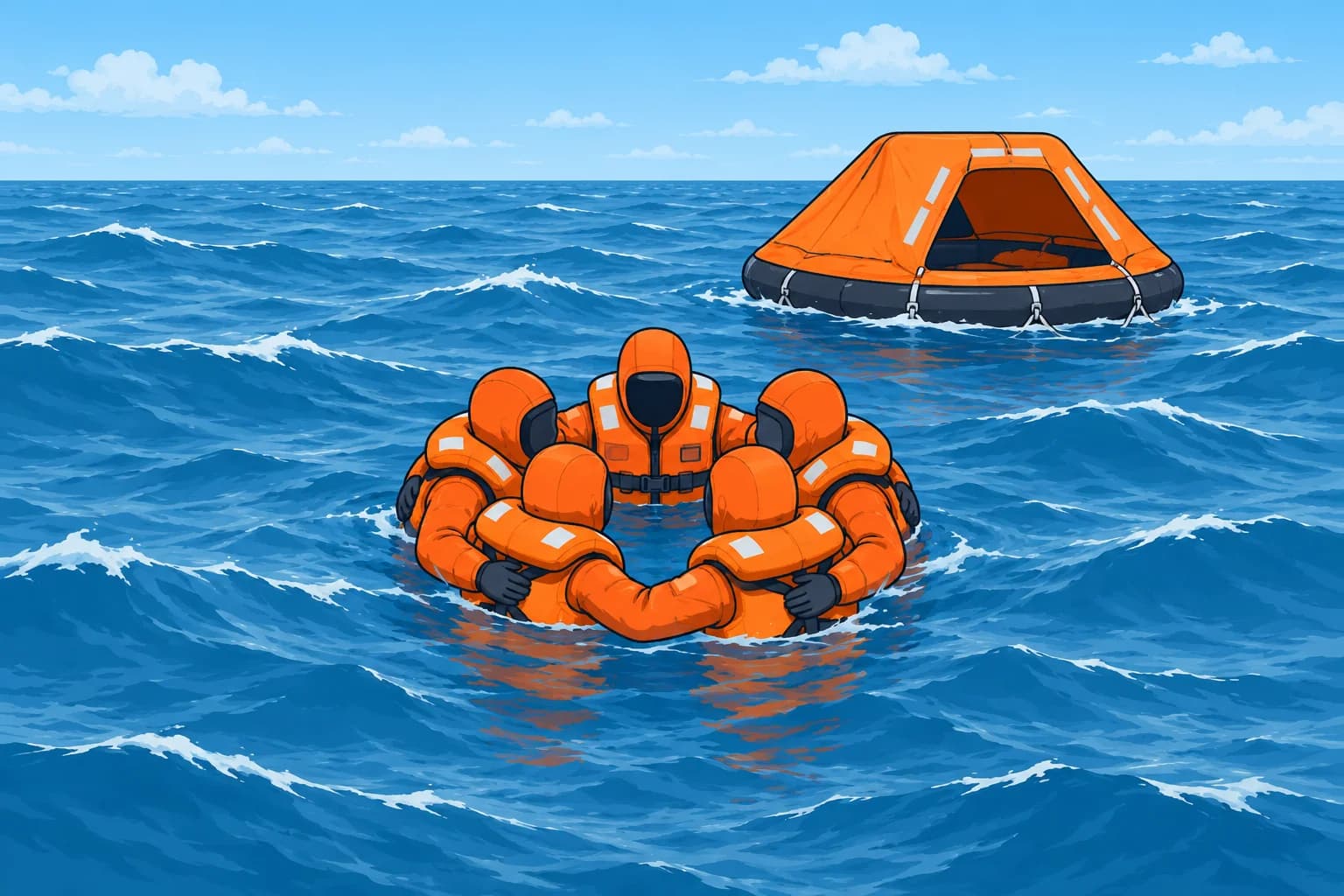
Cold-water dangers
Cold water can disrupt breathing and quickly weaken your swimming. Keep your face clear of waves, control your breathing and avoid hard swimming while it settles. See Medical: cold water for the body's reactions.
Move away
Then move away from the ship's side, where wreckage, falling objects or a survival craft being launched can hit you, and away from the propellers if the engine is still turning. Head for a survival craft only if it is safely within reach. If there is oil on the water, keep your mouth shut and your head high; if it is burning, swim upwind, away from it.
Swimming in a lifejacket
To move in a lifejacket, lie on your back and kick slowly. Cross your arms over the jacket and look over your shoulder to steer. Use the same stroke in an immersion suit. Swim only to a craft or group safely within reach: swimming pumps cold water through your clothes and burns energy.
Without a lifejacket
If you have no lifejacket, float on your back with arms and legs spread and move your hands gently back and forth to stay afloat, or tread water slowly. Hold on to anything that floats. Keep your clothes on: they trap air and warmth.
HELP and huddle
When alone, with a lifejacket keeping your mouth above water, use HELP (heat escape lessening posture): draw up your knees and cross your arms over the jacket to reduce heat loss. If this puts your face underwater, relax your legs and lean back. In lifejackets, form a huddle, a tight circle facing inwards, arms linked, with the weakest person supported in the middle. Stay together: a group is easier to see. If you must move, form a chain, linking on your backs and kicking together.
Key figures
- HELP
- Lifejacket on, mouth clear: knees up, arms across jacket
- Huddle
- In lifejackets, mouths clear: circle linked, weakest supported inside
- Swimming in a lifejacket
- On your back, arms crossed, slow leg kicks
- Burning oil
- Swim upwind, away from it
Remember
- Control your breathing first; see Medical: cold water for cold shock.
- Move away from the ship's side, propellers, wreckage and burning oil.
- Swim on your back in a lifejacket, and only to a craft or group safely within reach.
- With a lifejacket: HELP alone, huddle together; keep your mouth clear. Without one, float and hold anything buoyant.
- Keep your clothes on, with or without a lifejacket.
Common mistakes
Wrong: Swim hard to keep warm while you wait for rescue.
Right: Save heat and energy. With a lifejacket, use HELP or huddle only while your mouth stays clear. Without one, float and hold anything buoyant.
Wrong: Strip off heavy clothing in the water so you float better.
Right: Keep clothes on. They trap air and warm water and slow heat loss.
Worked case
You and four crew mates are in the water in lifejackets after a sudden capsize. The nearest liferaft is about 150 m downwind. One of the group has an injured arm and cannot swim properly.
Show the answer
Control your breathing. Do not assume you can catch a raft 150 m downwind; it may drift faster than you. Support the injured person in a huddle, keep mouths clear and signal its occupants with whistles and lights. Swim together only if the craft is clearly reachable without exhausting anyone; otherwise save heat and energy. Stay together and keep your clothes on.
Practice question
How do you swim wearing a lifejacket?
- Face down, using a fast front crawl
- On your back, kicking with your legs
- On your side, with long arm strokes
- Upright, treading water as hard as you can
Show the answer
Answer: B. Back swimming helps keep your mouth clear and saves effort. Cross your arms over the lifejacket and kick slowly.
3 · Boarding craft
Righting a liferaft and boarding from the water
Right an upside-down raft from the marked side, climb in by the boarding ramp, then help the others in, lifting them gently and as flat as you can.
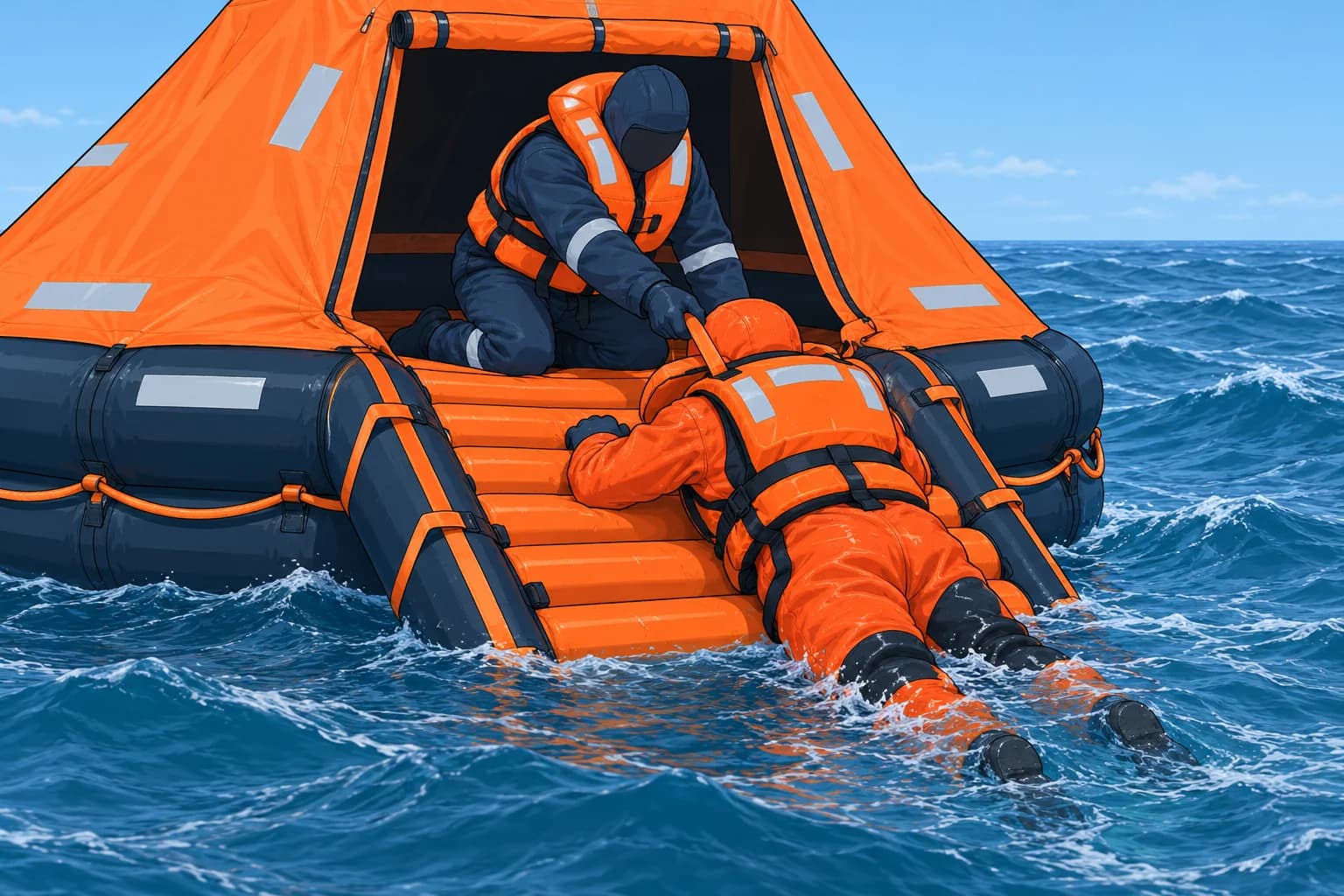
Right it first
A liferaft may inflate upside down. For a manually righted raft, use the righting strap, a strong strap on its underside, and your body weight to turn it upright. Identify the marked righting side and follow its instructions and your approved-course training. Keep contact with the raft and help others stay supported. Full steps are in Emergencies: abandon ship.
Boarding from the water
Swim to the entrance with the boarding ramp or ladder. Grip the handles or the lifeline, kick hard and pull yourself in, chest first. Once inside, move clear of the entrance to make room for the next person. At a lifeboat, hold the grabline, a rope handhold, while waiting, then use its designated boarding ladder or recovery arrangement. If you are too tired to climb, do not waste strength: hold on and wait for help.
Helping others in
Kneel beside the entrance. If the survivor's lifejacket or suit has a designated lifting loop or handle, use it only as that equipment's instructions allow. For a cold or exhausted survivor, use two helpers: one supports the head and shoulders, the other the hips and legs. Use a wave to help bring them aboard, keeping them level and their face clear. Never pull an injured limb, hood or whistle cord. Move them clear of the entrance and keep them lying down.
In an immersion suit
Keep the suit and required lifejacket on. Use the boarding ramp, kick with your legs and accept help. In cold conditions, keep the suit fastened and hood on. Once safely aboard, adjust clothing and ventilation to avoid overheating, following the person in charge.
Key figures
- Righting side
- Use the marked side and follow this raft's instructions
- Lifting a survivor
- Support the body; use the survivor's designated lifting loop if fitted
Remember
- Right an inverted raft using its marked instructions and your approved-course training.
- Board by the ramp or ladder, chest first, then move clear of the entrance.
- Use the survivor's designated lifting loop if fitted, as instructed; two helpers support head, shoulders, hips and legs.
- Lift cold or injured survivors as horizontally as possible.
- Too tired to climb: hold on and wait for help.
Common mistakes
Wrong: Pull a survivor in by the arms, upright, as fast as you can.
Right: Use the survivor's designated lifting loop if fitted, as instructed. Two helpers support the head and shoulders, hips and legs, keeping the survivor level.
Wrong: Stay in the entrance once you are in, to help the next person.
Right: Move clear first. Helpers kneel at the side of the entrance, not in it.
Worked case
You reach a 20-person liferaft that is floating upside down. Two crew mates are with you in the water; one is exhausted and very cold. The wind is light.
Show the answer
Keep the cold survivor supported. Follow the raft's marked righting instructions and your approved-course training. Board by the ramp and move clear. With the other fit survivor, use the survivor's designated lifting loop if fitted, as instructed: one helper supports the head and shoulders, the other the hips and legs. Use a wave to help, keep the person as level as possible, then keep them lying down.
Practice question
A liferaft is floating upside down. Where do you right it from?
- The side marked in this raft's instructions
- Any side that seems easiest to climb onto
- Always the entrance with the boarding ramp
- Always the side that faces into the wind
Show the answer
Answer: A. Identify the marked righting side and follow this raft's instructions and your approved-course training.
4 · In the craft
First actions in the survival craft
Get clear of the ship, gather survivors, stream the sea anchor, make the craft habitable, and use the first hours well.
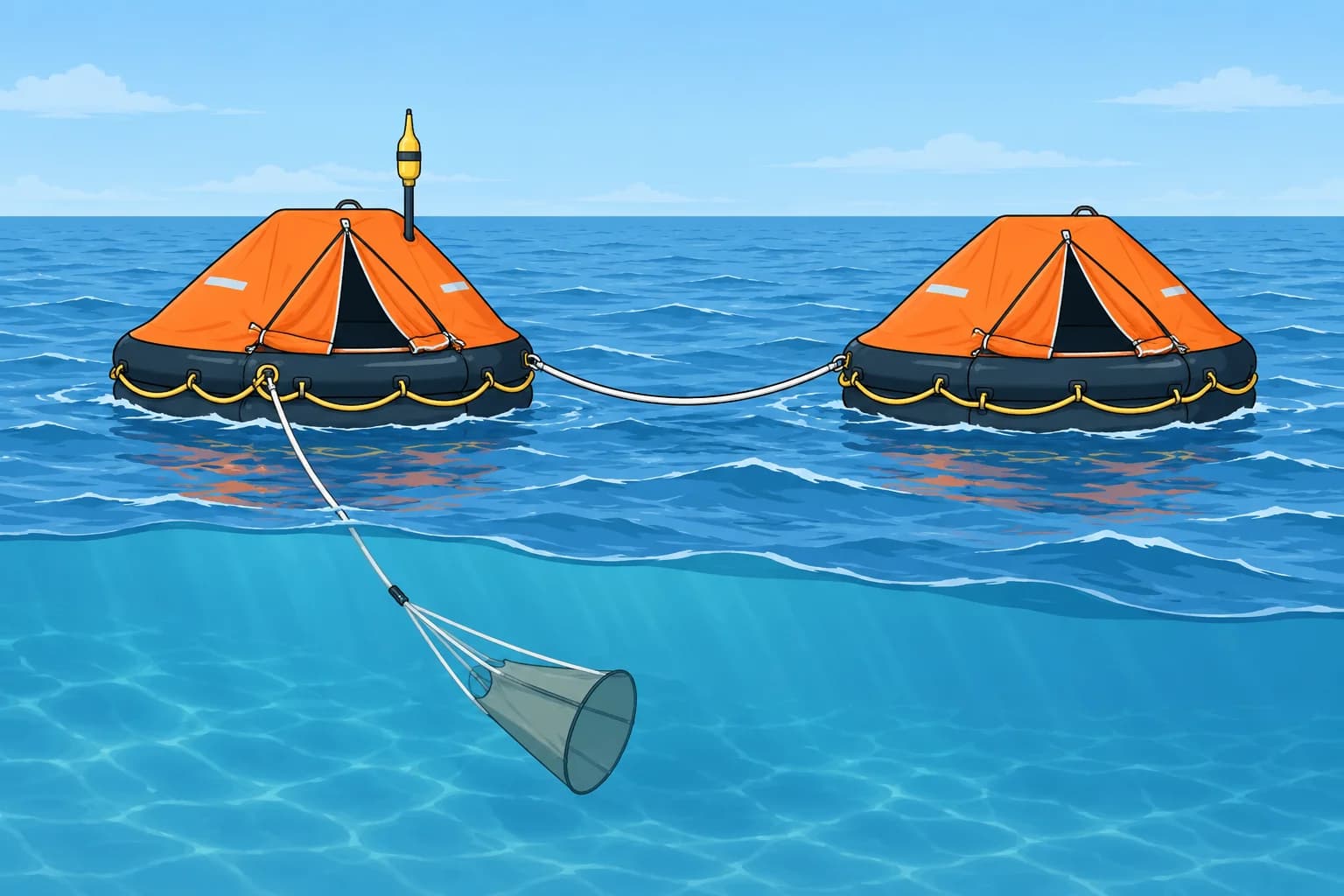
Get clear
Once afloat with everyone in reach aboard, follow the person in charge. In a liferaft, cut the painter, the line joining the raft to the ship, when ordered, using the safety knife by the entrance. In a lifeboat, follow the person in charge and trained crew. Move clear of the ship's side, fire and burning oil, but stay near the position: rescuers search there first. Basic raft actions are in Emergencies: abandon ship.
Gather and link
Pick up survivors in the water. A lifeboat can tow liferafts; rafts can be paddled. Follow the craft's instructions and leader's directions when linking. Use lines long enough to keep craft safely separated as waves move them. Watch for collisions and lines jerking tight. A group of craft is easier to see from the air and on radar, and you can share people, water and equipment.
Make it habitable
Stream means deploy: put out the sea anchor, a fabric drag device that slows drift and steadies the craft. Close the entrances against wind and spray, but ventilate, let fresh air in, regularly: carbon dioxide builds up in a closed craft, causing headaches and drowsiness. Bail, scoop out water, and sponge the floor dry. Inflate the raft floor if it has one. Huddle together for warmth.
The first 24 hours
Treat the injured. Offer seasickness tablets promptly to survivors who can safely swallow, following the medicine's instructions. Preventing vomiting saves body water. Assign someone to prepare location aids according to their instructions and training; detailed beacon operation is in the linked lessons. Keep a listening watch on the portable radio. Read the survival instructions. Set a lookout rota, a schedule of short watches, day and night, and keep a log.
Key figures
- Seasickness tablets
- Offer promptly; follow medicine instructions; safe swallowing required
- Location aids
- Use as instructed; keep a listening watch
- Lookout
- Short watches, day and night
First actions after boarding
- Once afloat, follow the person in charge: cut the raft's painter when ordered and move clear of the ship. — A sinking or burning ship is the greatest danger to the craft.
- Pick up survivors and link the craft together. — More people survive, and a group is easier to find.
- Stream the sea anchor near the ship's last position. — It reduces drift and capsizing; rescuers search the last known position.
- Close the entrances, ventilate regularly and bail the craft dry. — Keeping out wind and water saves heat; fresh air stops carbon dioxide building up.
- Treat the injured. Offer seasickness tablets promptly to survivors who can safely swallow, following the medicine's instructions. — Seasickness causes vomiting, dehydration and loss of will.
- Assign location aids to someone following their instructions and training. Set a lookout rota and read the survival instructions. — Rescue depends on being seen and heard; the instructions are written for this craft.
Remember
- Once afloat, follow orders: cut the raft's painter, clear the ship and stay near the position.
- Gather survivors; link craft with safe separation and watch for lines jerking tight.
- Stream the sea anchor; close up, but ventilate regularly; bail dry.
- Offer seasickness tablets promptly if survivors can safely swallow; follow the medicine's instructions.
- Use location aids as instructed; set a lookout rota, keep a log and give everyone a job.
Common mistakes
Wrong: Keep the entrances tightly shut all the time to stay warm.
Right: Close them against wind and spray, but ventilate regularly. Carbon dioxide builds up in a closed craft.
Wrong: Take seasickness tablets only once you start to feel sick.
Right: Offer tablets promptly to survivors who can safely swallow, following the medicine's instructions. Preventing vomiting saves water.
Wrong: Motor or paddle away from the area to search for land.
Right: Stay near the ship's last position, with the sea anchor out, unless the person in charge decides otherwise.
Worked case
Your liferaft has cleared the sinking ship with 12 people aboard. A second raft with 6 people is drifting 100 m away. Two people in your raft are injured, and several are already looking pale and queasy.
Show the answer
Have helpers assess the injured and offer seasickness tablets as instructed if swallowing is safe. Signal the other raft. The leader should arrange linking only if conditions and available strength allow safe manoeuvring. Otherwise keep contact by signals. Stream the sea anchor when clear and not manoeuvring. Close against spray, ventilate and bail. Prepare location aids, assign watches and read the survival instructions.
Practice question
Your liferaft is afloat, everyone in reach is aboard and the leader orders you clear. What do you do first?
- Cut the painter and move clear of the ship
- Stream the sea anchor at once beside the hull
- Open all the entrances wide for a lookout
- Start rationing the water for the voyage
Show the answer
Answer: A. Once afloat, cut the raft's painter when ordered and move clear. A sinking ship can drag the raft down or damage it.
5 · Staying alive
Survival priorities, water and the dangers to survivors
Protect yourself first, help rescuers find you, then manage water and food. Never drink seawater or urine, and keep hope and routine going.
Priorities
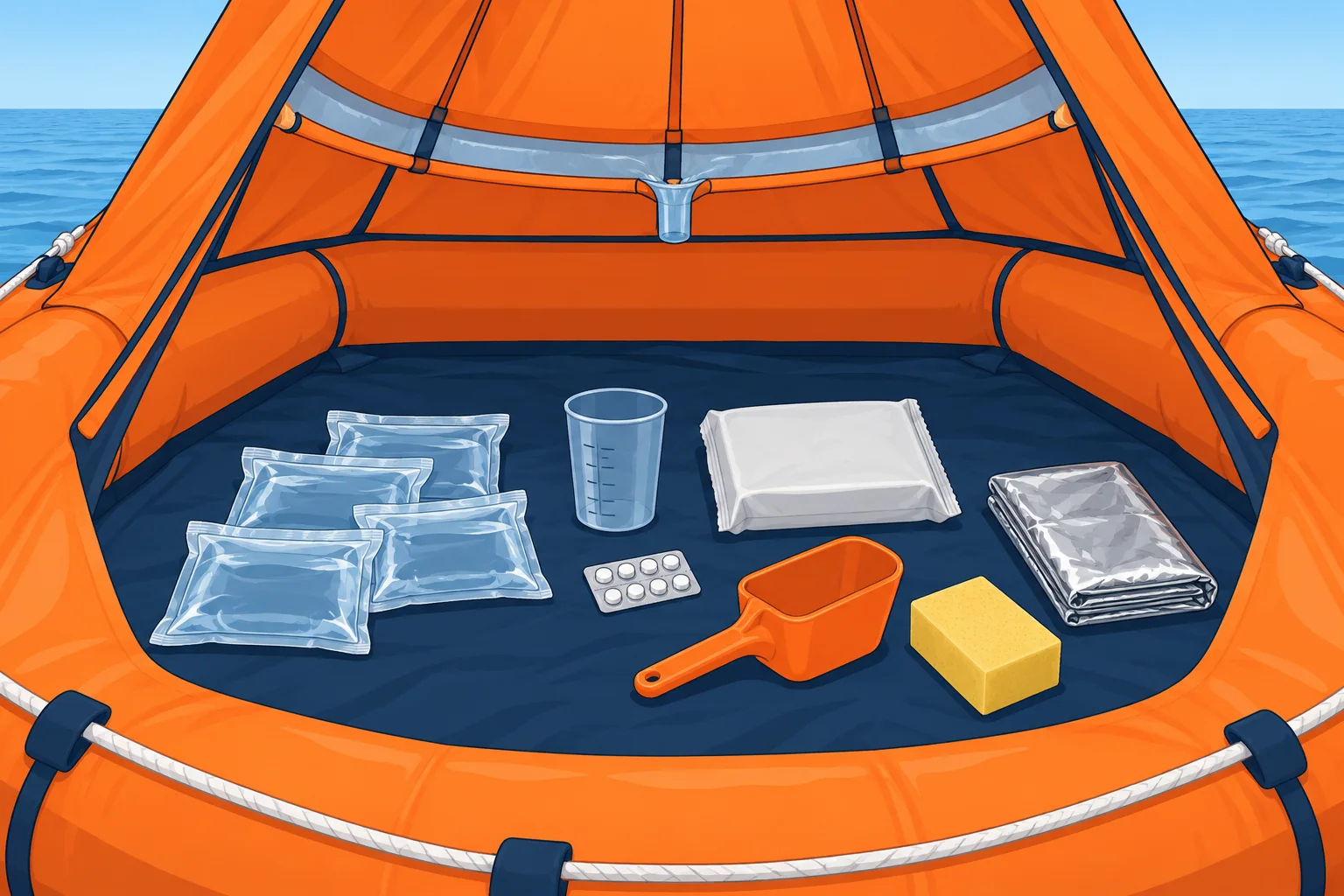
Think protection, location, water, food, in that order. Protection comes first: shelter from wind, spray, cold and sun, keep dry and close together, and treat injuries. Location means helping rescuers find you. Water keeps you alive for days; food matters least, because healthy people can live for weeks without it.
Water rules
The usual training rule is no water in the first 24 hours except for injured, sick or vomiting survivors. Start sooner in great heat or if anyone is already dehydrated, under the person in charge. Follow the craft's instructions and review rations as conditions change. Give small, regular sips and collect rain. Never drink seawater or urine.
Food
Eat the emergency rations only after the first day, in small amounts, and only when there is water: digesting food uses body water. Do not eat fish or seabirds unless you have plenty of water to spare.
Dangers to survivors
The main dangers are cold, seasickness and dehydration, a shortage of water in your body. Cold can cause hypothermia, a dangerously low body temperature. Other dangers include sunburn, heat, injuries, skin sores from wet clothing, swollen cold feet and loss of hope. Keep clothing as dry as possible and cover your skin from the sun. Treatment is in Medical: cold water.
Leadership and routine
The person in charge keeps everyone busy and informed: lookout watches, bailing, checking the craft, rationing and a written log. A routine and a leader prevent panic and keep hope alive. Talk, encourage each other and believe you will be rescued: the will to live is one of the strongest survival tools.
Key figures
- Priorities
- Protection, location, water, food
- Water, first 24 h
- Usually none; except injury, sickness, vomiting, heat or dehydration
- Water after that
- Share evenly as the instructions say, in small sips
- Never drink
- Seawater or urine
- Supplies carried
- Lifeboat 3 L water per person; SOLAS A pack raft 1.5 L
Remember
- Priorities: protection, location, water, food.
- Normally no water for 24 h; exceptions: injury, sickness, vomiting, heat or dehydration. Follow the craft's instructions.
- Then share water evenly in small sips; collect rain; never seawater or urine.
- Main dangers: cold, seasickness, dehydration; also sun, sores, injury and despair.
- A leader and a routine keep people alive.
Common mistakes
Wrong: Drink plenty in the first hours while everyone is strong.
Right: Usually no water for 24 hours except for injury, sickness or vomiting. Start sooner in great heat or existing dehydration under the person in charge; follow the craft's instructions.
Wrong: A little seawater mixed with fresh water stretches the supply.
Right: Never drink seawater, even mixed. The salt makes dehydration worse.
Worked case
On the first evening in a liferaft, one survivor demands a full bottle of water, saying he is very thirsty. Another has been vomiting all afternoon. A third suggests drinking a little seawater to save supplies.
Show the answer
Check whether the thirsty survivor is unwell or already dehydrated, and assess the heat. Follow the craft's instructions under the person in charge. The usual first-day rule has exceptions for injury, sickness, vomiting, great heat and existing dehydration. Give the vomiting survivor small sips. Never use seawater or urine. Collect rain, review rations as conditions change and assign useful jobs.
Practice question
Spray is soaking everyone. The canopy can be closed, and someone suggests opening food rations. What comes first?
- Open the food so everyone gains strength
- Count food before changing the canopy
- Close against spray while maintaining ventilation
- Leave the canopy open until everyone has eaten
Show the answer
Answer: C. Protection from exposure takes priority over food. Keep ventilation while excluding spray.
6 · Being rescued
Being rescued by a ship or a helicopter
Stay in your craft until told, let the rescuers choose the method, and expect to be lifted flat if you are cold and weak.
Stay put until told
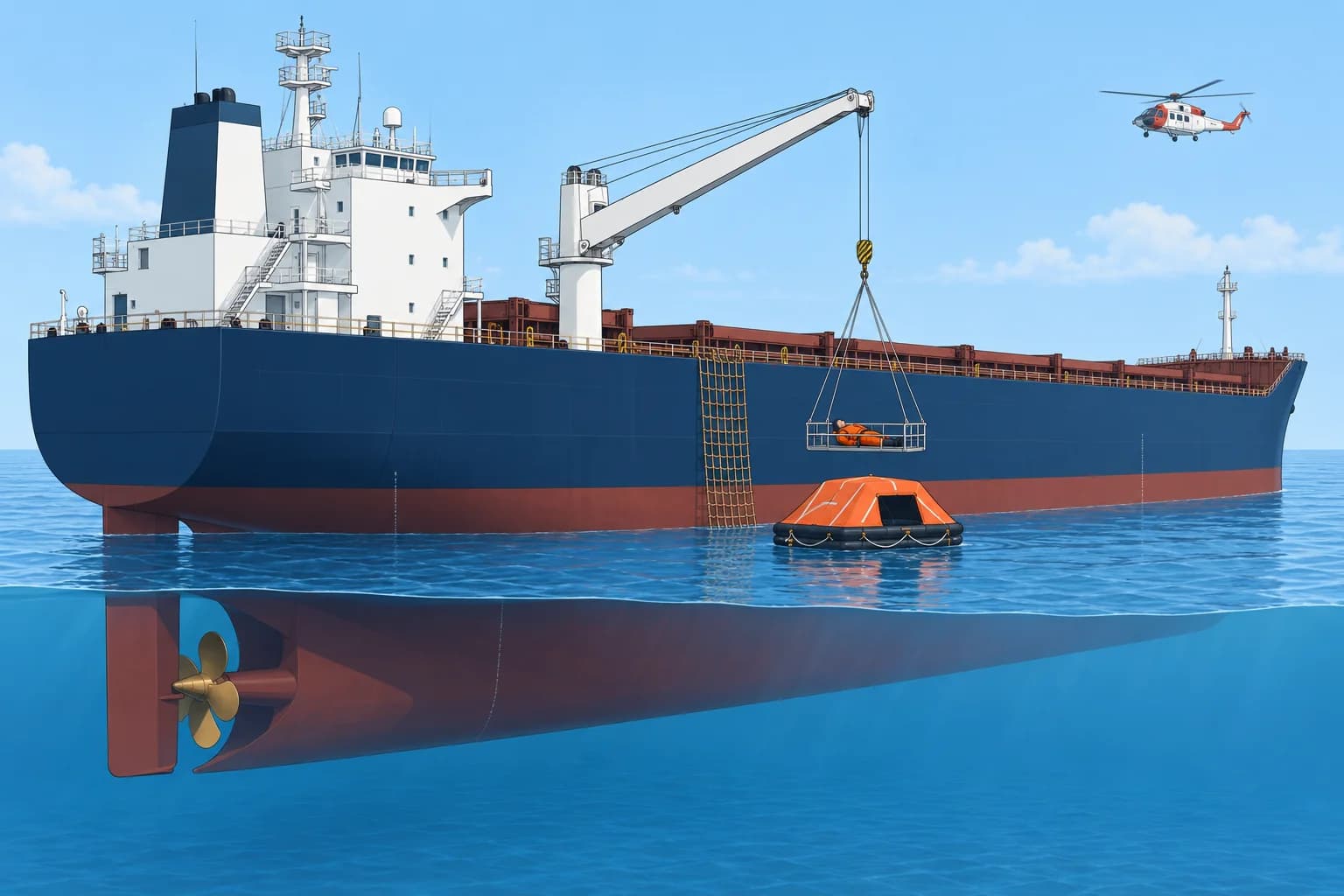
When a ship or helicopter arrives, stay in your craft and wait for instructions. Do not jump into the water or swim to the rescuer: people drown or are crushed between craft and ship. Let the rescuers decide the method and the order, and have the injured ready to go first if told.
Rescue by a ship
The rescuing ship usually makes a lee, shelter from wind and waves. It may come alongside or send a rescue boat. You may board by ladder, a scrambling net hung over the side, a rescue sling supporting your body, a crane basket or a recovery net. Ships subject to SOLAS chapter III must carry ship-specific recovery plans under III/17-1, with guidance in MSC.1/Circ.1447. The plan matches the ship's equipment and recovery methods to conditions and survivors' needs.
Lift flat if you can
After long immersion or exposure, the body struggles to keep blood pressure up when upright. A cold survivor lifted upright, or who climbs a long ladder, can collapse, even die, during or just after rescue. Where possible, rescuers lift such people lying flat: in a basket, on a stretcher or in two slings. If you are cold and exhausted, tell the rescuers rather than trying to climb.
Helicopter rescue
A helicopter usually lowers a winchman or a rescue strop, a padded loop. Follow the aircrew's directions. Let the conductive hook or earthing wire discharge static electricity, built-up electrical charge, into the sea before touching the lifting gear. Never secure the winch wire or hook to the craft. Put the strop over your head and under your armpits, pull the toggle down to your chest and keep your arms down by your sides. Details are in Emergencies: helicopter and flares.
Key figures
- Recovery plans
- SOLAS ships: III/17-1, phased in from 1 July 2014
- IMO guidelines
- MSC.1/Circ.1447 (2012)
- Cold survivor
- Lift as horizontally as possible
- Helicopter strop
- Under the armpits, toggle down, arms by your sides
- Static
- Let the conductive hook or earthing wire touch the sea first
Remember
- Stay in the craft until the rescuers tell you what to do.
- Ships use ladders, scrambling nets, slings, baskets and recovery nets.
- SOLAS chapter III ships need recovery plans under III/17-1, with guidance in MSC.1/Circ.1447.
- Lift cold survivors horizontally; climbing a ladder can make them collapse.
- Helicopter: follow aircrew; conductive hook or earthing wire discharges into sea first; strop under arms, arms down.
Common mistakes
Wrong: As soon as the rescue ship comes close, jump in and swim to her ladder.
Right: Stay in the craft and wait for instructions. The gap between craft and ship is very dangerous.
Wrong: Grab the helicopter hook as soon as it is in reach.
Right: Follow the aircrew's directions. Let the conductive hook or earthing wire discharge into the sea before touching the lifting gear. Never secure the winch wire or hook to the craft.
Wrong: Raise your arms in the strop to hold on to the wire.
Right: Keep your arms down by your sides, or you can slip out of the strop.
Worked case
After 30 hours in a liferaft, a bulk carrier makes a lee and lowers a scrambling net and a crane basket. One survivor, who was in the water for an hour before boarding, is shivering, weak and wants to climb the net to get out quickly.
Show the answer
Tell the rescuers that the survivor is cold and weak and ask for a supported horizontal lift. Do not encourage him to climb. Let the rescuers choose suitable equipment and decide who goes first. Others stay seated in the raft; fit survivors climb the net one at a time only if told. Keep lifejackets on until safely aboard, unless the rescuers instruct otherwise.
Practice question
A rescue ship arrives near your liferaft. What do you do?
- Jump into the sea and swim to the ship's side
- Stay in the craft and wait for instructions
- Climb onto the canopy and wave both arms
- Paddle as fast as possible towards her bow
Show the answer
Answer: B. The rescuers choose the method. Leaving the craft early risks drowning or being crushed against the hull.