
Emergencies at sea · Level P3 · 6 parts · about 19 min
Launching and handling survival craft and rescue boats (STCW A-VI/2-1)
6 short parts: Davits and winches · Release hooks · Launching · Free-fall boats · Checks and service · Handling the craft. Each part explains the idea, then gives the points to remember, the common mistakes, a worked case and a practice question; the Academy unit adds all 38 check questions.
1 · Davits and winches
Davits, falls and the winch brake
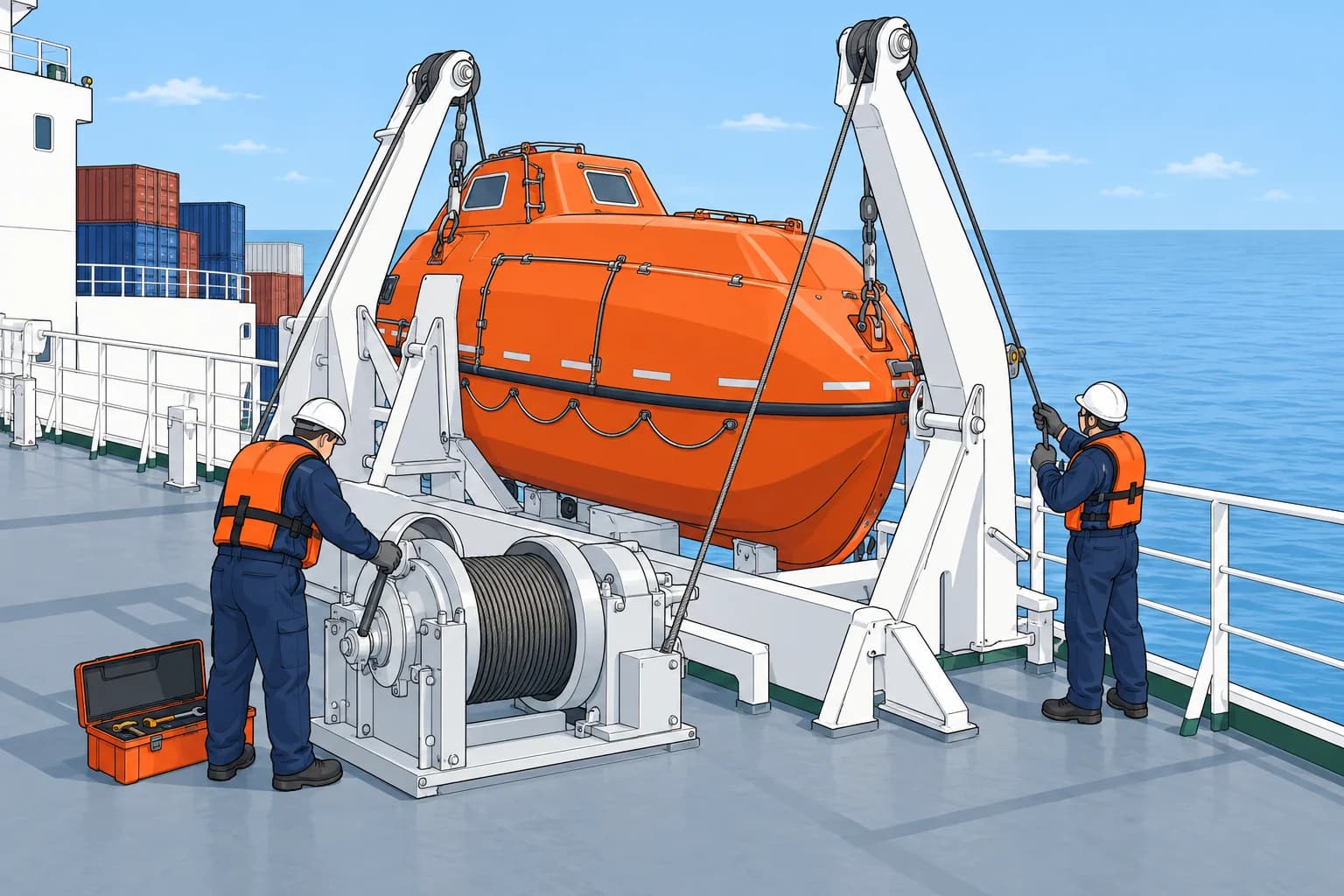
With gravity davits, the boat’s weight lowers it. You control descent with a brake that stops the boat when you let go.
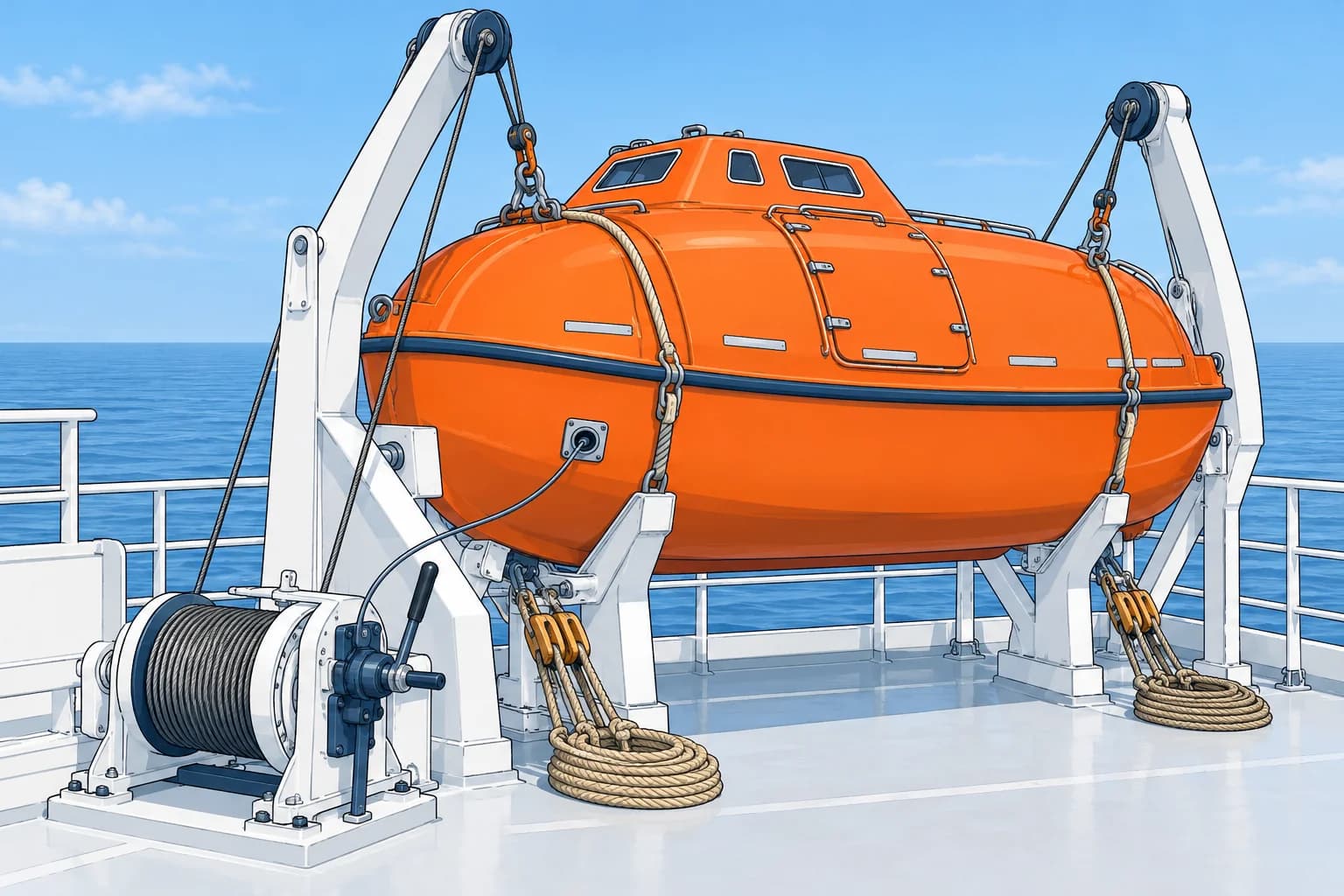
Gravity davits
Most lifeboats hang in gravity davits: when the brake is lifted, the boat's own weight swings the davit arms out and lowers it, with no power needed. The falls, rotation-resistant steel wire ropes from the winch drum over the davit heads, carry the boat by its two hooks. Rescue boats and davit-launched liferafts usually hang from a single-arm davit, a small crane, on one hook.
The winch brake
The dead-man brake applies automatically unless you hold its control in the lowering position. Release the control and the boat stops (LSA Code 6.1.2.12). One person can operate it from deck or inside the boat using a remote control wire. A centrifugal governor, an automatic speed limiter, prevents excessive lowering speed. LSA Code 6.1.2.10 requires a speed limiter, without prescribing this design.
Lowering speed
Use S = 0.4 + 0.02H metres per second to calculate the minimum for a fully loaded boat. H is the vertical distance in metres from the davit head to the waterline at the lightest permitted loading for a sea voyage. For appliances installed from 1 January 2026, the minimum is S or 1.0 m/s, whichever is lower. Their maximum is 1.3 m/s unless the flag-state authority approves another maximum.
Hoisting
A powered winch hoists (lifts) the boat. Hand gear provides manual backup. Limit switches stop powered hoisting before the davit arms reach their stops.
Secured for sea
At sea the boat sits in its cradle held by gripes, lashings with a quick-release slip. Harbour pins, or safety pins, lock the davit arms against moving in port and during maintenance. Before any launch, the pins come out and the gripes are released, otherwise the davit cannot move.
Tricing and bowsing
For a boat boarded at embarkation level, connect tricing pendants before lowering, as the manual directs. These lines draw the boat in as it lowers. Rig bowsing tackles, rope-and-pulley gear, to hold it alongside. Transfer the inward holding load and disconnect unloaded tricing pendants in the maker's sequence before boarding; keep the boat supported by the falls. Ease bowsing tackles out under control before lowering farther. Boats boarded in stowage use their own sequence.
Key figures
- Brake
- Always applied unless the operator holds it off
- Minimum lowering speed
- From 2026: minimum = lower of (0.4 + 0.02H) and 1.0 m/s
- Maximum lowering speed
- New installations from 2026: 1.3 m/s unless flag approves otherwise
- Rescue boat hoisting
- Powered winch: ≥0.3 m/s with all assigned people and equipment
- Launched by
- One person, from the deck or from inside the craft
Remember
- Gravity davits lower by the boat's own weight; the falls carry it by the hooks.
- The winch brake is a dead-man brake: let go and the boat stops.
- Minimum S = 0.4 + 0.02H m/s. For installations from 2026: cap the minimum at 1.0 m/s; max 1.3 m/s, unless flag approves.
- Remove harbour pins and release gripes before launching; tricing pulls in, bowsing holds.
Common mistakes
Wrong: Tie the brake lever up so the boat lowers on its own.
Right: Never defeat the dead-man brake; someone must hold it off and be ready to let go.
Wrong: Release the bowsing tackles all at once when everyone is aboard.
Right: Ease them out gently, so the boat swings off the ship's side under control.
Wrong: Start lowering with the harbour pins still in to test the brake.
Right: Pins and gripes must be clear before the davit moves; follow the launching sequence.
Worked case
At a drill, the boat swings out and stops at the embarkation deck, hanging 1 m from the ship's side. The crew are waiting to board.
Show the answer
Stop boarding. Do not improvise hauling on the tricing pendants. Use the maker's arrangement to bring and hold the boat alongside. Keep its weight on the falls, secure the bowsing tackles and disconnect the unloaded tricing pendants as instructed. Board only when secure; ease the tackles under control before lowering.
Practice question
What makes a gravity davit swing out and lower the boat?
- The boat's own weight
- An electric winch motor
- A hydraulic pump on deck
- Stored compressed air
Show the answer
Answer: A. When the brake is lifted, gravity swings the arms out and lowers the boat; no power is needed.
2 · Release hooks
On-load release hooks, resetting and hanging-off gear
A hook can look closed without being safely reset. Understand both release modes, the interlock and the checks before hoisting.
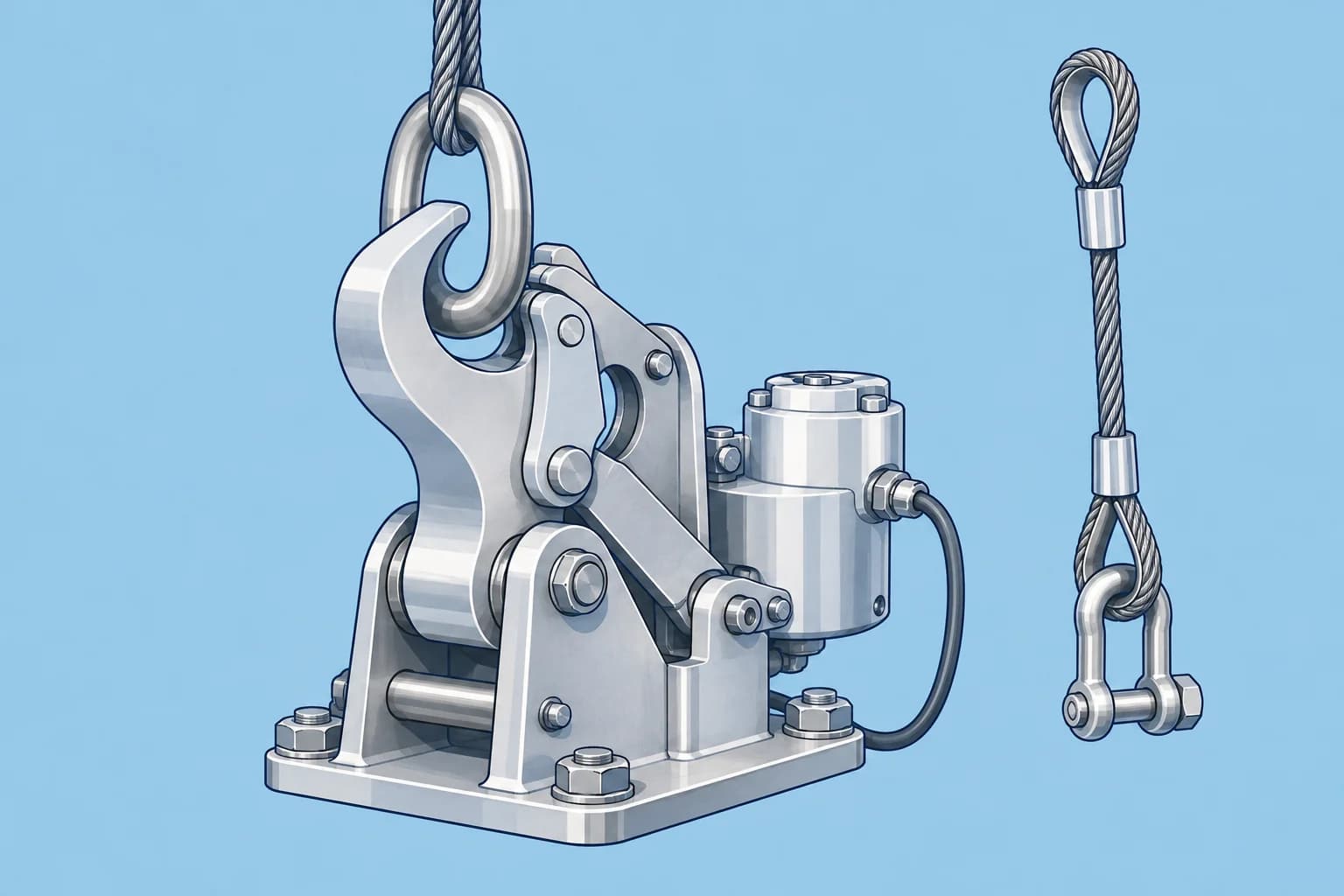
Two ways to let go
On a twin-fall davit lifeboat, suspended by two falls, the release gear has off-load and on-load capabilities (LSA Code 4.4.7.6). Off-load release frees the waterborne boat with no hook load. On-load release works with load still on the hooks. Both hooks open together from one control in the boat. Some single-fall systems have off-load release only.
The waterborne safeguard
A hydrostatic interlock, a water-pressure safeguard, or approved equivalent prevents normal on-load release operation until the boat is waterborne. A protected override is for emergencies only, following the maker’s instructions. Mechanical protection, such as a breakable cover, and a danger sign guard it against accidental use. Operation requires several deliberate, sustained actions. On-load release with the boat in the air drops it.
Why hooks changed
MSC.320(89) tightened the hook rules on 1 January 2013 after fatal drill accidents. A hook must stay closed until deliberately released, at loads from 0 to 100% of its working load. This applies at up to 10° trim (fore-and-aft tilt) and 20° list (sideways tilt). SOLAS III/1.5 required existing hooks to be evaluated under MSC.1/Circ.1392. Non-compliant hooks had to be replaced by 1 July 2019.
Resetting
After release, reset both hooks as the maker instructs. Check locks, indicators, interlock and fall connections. A partly reset hook can look closed and still open under load. Follow the approved recovery procedure: carry only essential operating crew if required, pause just clear of the water for prescribed checks, and have everyone disembark before final turning-in, when the davits bring the boat into stowage.
Hanging-off gear and fall preventers
Fall preventer devices (FPDs) add protection. Approved strops (short safety slings) provide another load path; approved pins block hook opening. MSC.1/Circ.1327 introduced interim protection. Follow flag, maker and ship procedures for continued use, including fitted secondary safety systems. When fitted, remove FPDs before release once waterborne; refit after hook-on before hoisting. Hanging-off gear supports the boat to unload release gear for maintenance (LSA 6.1.2.13). Disconnect it for drills and sea stowage. Never maintain or adjust loaded release gear.
Key figures
- Release gear
- Twin-fall: off-load and on-load; some single-fall: off-load only
- On-load protection
- Hydrostatic interlock or equivalent; protected emergency override
- Hook standard
- MSC.320(89), in force 1 January 2013
- Existing hooks
- Evaluated; non-compliant gear replaced by 1 July 2019
- Hanging-off gear
- Maintenance only (LSA 6.1.2.13), not drills
Remember
- Twin-fall: off-load needs no hook load; on-load works with load. Some single-fall systems have off-load release only.
- A hydrostatic interlock or equivalent blocks normal on-load release until waterborne; the override is for emergencies.
- Compliant hooks stay closed from zero to 100% of their approved working load until deliberately released.
- Check the reset and refit fitted FPDs before hoisting; hanging-off gear is for maintenance only.
Common mistakes
Wrong: Break the override cover in a drill when the interlock is slow.
Right: The override is for emergencies. In a drill, stop and report the fault.
Wrong: The hook looks closed, so it is reset.
Right: Check every locking part and indicator as the manual shows; a partly reset hook can open under load.
Wrong: Leave the hanging-off gear on during the drill for extra safety.
Right: Hanging-off gear is for maintenance only. Use fitted FPDs and secondary safety systems as flag, maker and ship procedures require.
Worked case
After a drill the boat is waterborne alongside, falls released. The engine runs. The second officer wants to hook on and hoist at once with the crew inside.
Show the answer
Do not hoist with the whole drill party aboard. Reset both hooks; check locks, indicators, fitted interlock and fall connections as instructed. Refit fitted FPDs after hook-on, before hoisting. Use fitted secondary safety devices as required. Carry only essential operating crew if required. Pause just clear of the water for prescribed checks; stop if any indication is doubtful. Have everyone disembark before final turning-in.
Practice question
What is off-load release?
- Release with the boat waterborne and no hook load
- Release while the hooks still carry the boat's weight
- Release the boat's painter while the hooks carry it
- Release the securing gripes before lowering the boat
Show the answer
Answer: A. Off-load release frees the boat when it floats and the falls are slack.
3 · Launching
Launching a davit lifeboat and a davit-launched liferaft
Prepare, lower under control and release when fully waterborne. Follow the maker’s painter-release and steering sequence to get clear.
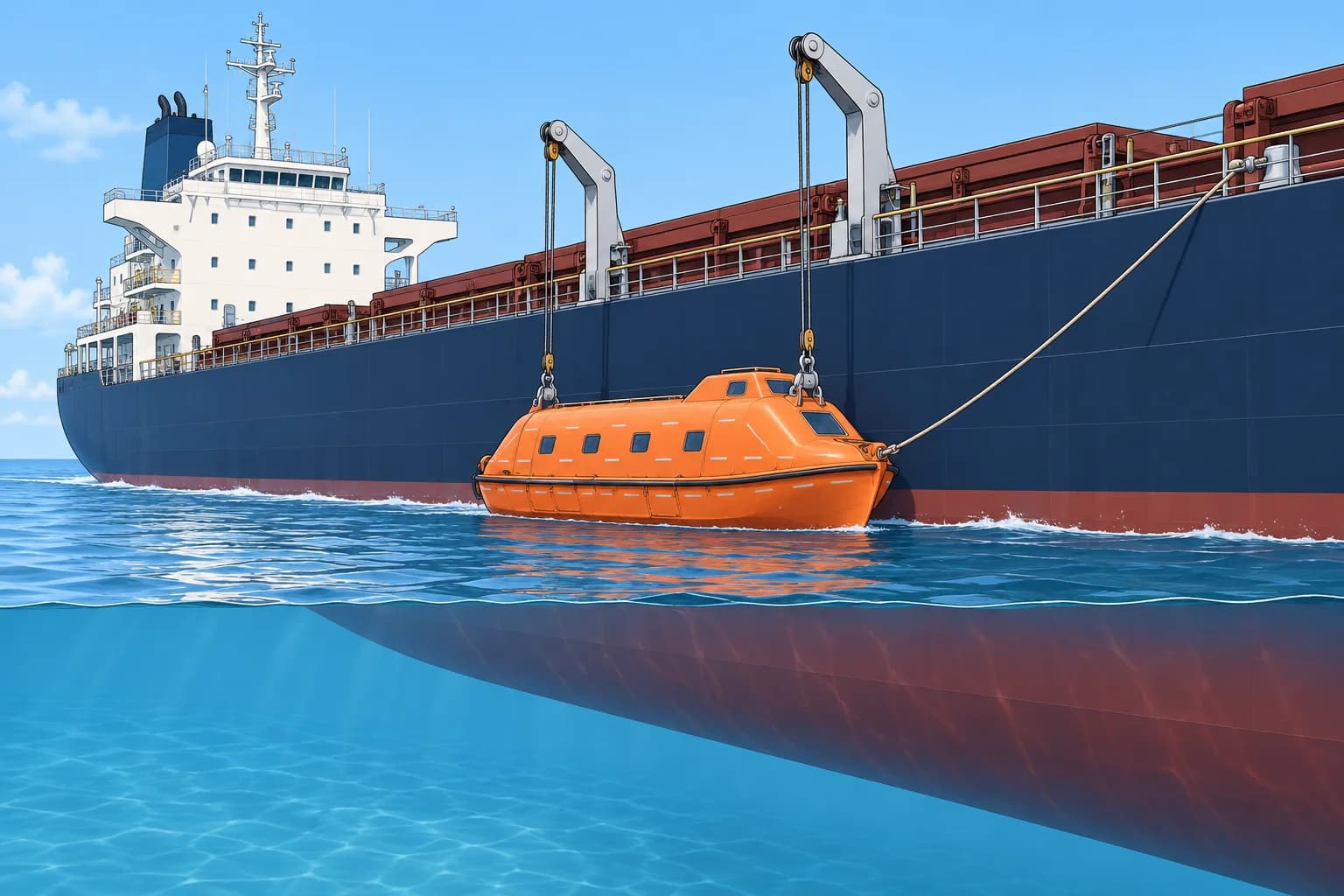
Before lowering
The boat's crew prepare it as the muster list says: harbour pins out, gripes released, drain plug in where fitted, painter (a bow line to a point forward on the ship) led and secured, falls and the water below clear. Choose the lee side if you can, out of the wind and sea. The person in charge counts heads and checks seat belts before giving the order to lower.
Into the water
Start the engine as the boat nears the water. Follow the maker's running-time and cooling limits when operating it out of water. Release the hooks promptly when fully waterborne, using the maker’s sequence; for off-load release, confirm the falls are slack. Clear fitted FPDs before release as instructed. Do not let the boat drop into a trough still hooked on: a sudden pull can damage the falls or the boat.
Getting clear
The equipment is designed for launch at up to 5 knots of headway (forward speed through the water) in calm water. Reduce headway if possible and follow the ship's launch procedure. The painter keeps the boat from moving astern relative to the ship. Follow the maker’s painter-release and steering sequence. Some boats prohibit steering while it is connected. Release it from inside when instructed, then motor clear of the hull and propeller.
Davit-launched liferafts
Check that the hook is fully reset before loading. Inflate the raft on its hook at embarkation level, hold it alongside with bowsing lines and board dry. Ease and clear these lines as instructed before lowering. Arm automatic release only at the stage specified by the maker; it frees the raft when fully waterborne. The separate on-load control needs two deliberate actions. Deck crew must be able to see that the hook is correctly set.
Key figures
- Launch with headway
- Design capability: up to 5 knots in calm water
- Painter
- Bow to forward on the ship; released from inside the boat
- Release
- Fully waterborne; off-load normally, on-load only as instructed
- Raft hook
- Automatic release when waterborne; on-load needs 2 actions
- Engine design requirement
- Designed to run ≥5 min from cold out of water; follow maker’s limits
Launching a davit lifeboat
- Remove harbour pins, release gripes, check the plug and lead the painter forward. — The davit cannot move with pins in, and the painter must be ready before the boat is in the water.
- For embarkation-deck boarding, first lower to that level and secure alongside as instructed. Board, strap in, close hatches and count heads. — Unsecured people are thrown about as the boat lands.
- Ease and clear any bowsing tackles as instructed, then lower steadily with the brake control. — Release the control to apply the brake and stop lowering if you see a hazard.
- Start the engine just before the boat reaches the water. — You need power to move clear the moment you release.
- When fully waterborne, clear fitted FPDs as instructed, then release the hooks in the maker’s sequence. — Off-load release needs slack falls; a boat still hooked can be snatched by waves.
- Follow the maker’s painter-release and steering sequence, then motor clear. — Some boats prohibit steering with the painter connected. Release it from inside when instructed.
Remember
- Prepare: pins out, gripes off, plug in, painter forward, falls and water below clear.
- Start the engine near the water; release the hooks when the boat is fully waterborne.
- The 5-knot calm-water launch capability is a design requirement; use the ship's launch procedure.
- A davit-launched raft's automatic release hook frees it when it floats.
Common mistakes
Wrong: Release the hooks a metre above the water to save time.
Right: Release only when the boat is fully waterborne. A drop injures people and damages the boat.
Wrong: Every boat uses the same painter-release sequence.
Right: Follow your boat’s manual. Some boats require painter release before you steer away.
Wrong: Run the engine for a long check while the boat is in its davits.
Right: Run it out of the water only as long as the maker allows, with cooling arranged as the manual says.
Worked case
The master orders abandon ship. Headway cannot be stopped and is 3 knots. The sea is calm, with wind from port. Your starboard lifeboat and launching area are clear.
Show the answer
Starboard is the lee side, so launch there. Check the painter is led well forward and secured. Lower under control, start the engine near the water and release the hooks when fully waterborne. Follow the maker’s painter-release and steering sequence; some boats prohibit steering while it is connected. Release it from inside when instructed, then motor clear of the hull and propeller.
Practice question
Up to what ship's speed must a lifeboat be able to be launched in calm water?
- 2 knots
- 5 knots
- 8 knots
- 10 knots
Show the answer
Answer: B. The LSA Code requires launching and towing with the ship making headway up to 5 knots in calm water.
4 · Free-fall boats
Free-fall lifeboats: launch, simulated launch and recovery
A free-fall lifeboat drops from a stern ramp. You secure every harness, check the approved limits and follow the maker’s launch and recovery procedures.
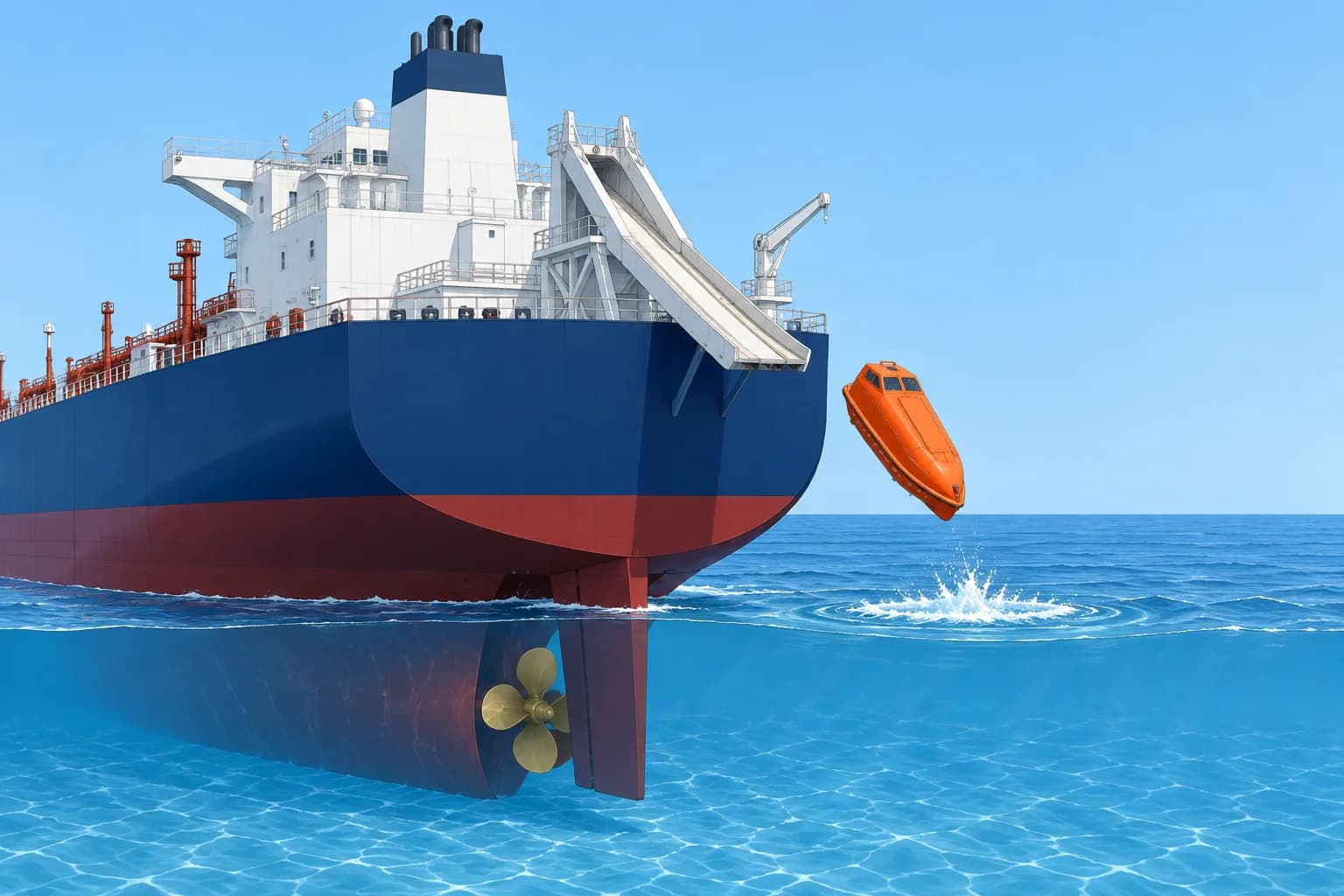
How it works
A free-fall lifeboat sits on an inclined ramp, usually at the stern, pointing down at the sea. Released, it slides and falls, enters the water bow first and drives clear. Passenger seats usually face the lifeboat’s stern; use your assigned launch seat and harness. The free-fall certification height is the maximum approved drop measured from the water surface to the boat's lowest point in launching position. Check the actual drop height and the ship's trim and list against approved limits before launch.
Launching
Board, strap in, close the hatches and check every belt. Start the engine as instructed. On the warning from the coxswain, the person in charge of the boat, everyone braces. Then operate the release from inside, normally by a hydraulic hand pump. It needs at least two independent actions to reduce the risk of unintended release. The boat makes headway as soon as it lands.
Drills
Under an experienced supervising officer, board, check harnesses and practise the launch sequence. A simulated launch rehearses the release procedure without physically activating the release mechanism. Use the maker's approved restraints and simulation instructions (MSC.1/Circ.1578/Rev.1). If these are unavailable, stop and obtain them. Restore normal readiness afterwards. Release-system testing is separate maintenance work. Drill frequencies are covered in Emergencies: musters and alarms.
Secondary launching and recovery
Each free-fall launching appliance has a secondary means to lower the boat by falls, usually a davit or crane, with off-load release. It is used for drills, maintenance and recovery. Recovery is high-risk: carry only essential operating crew if the approved procedure requires them. Hook on carefully in calm conditions. Disembark before final securing on the ramp, following the maker's sequence.
Key figures
- Release
- At least two independent actions from inside the boat
- Seating
- Use assigned launch seat and harness; brace on command
- Certification height
- Maximum approved drop: water to boat's lowest point at launch
- Simulated launch
- Approved restraints; no physical release; restore normal readiness
- Simulated launch guide
- MSC.1/Circ.1578/Rev.1 (6 July 2026)
- Secondary means
- Lowering by falls with off-load release; used for recovery
Remember
- Strap in, close hatches and brace before release; start the engine when the maker specifies.
- Release needs two independent actions from inside the boat.
- A simulated launch trains the procedure without activating the release.
- Recover with the secondary means; carry only essential operating crew if the approved procedure requires them.
Common mistakes
Wrong: Release first, then strap in while the boat slides.
Right: Secure every harness, close hatches and brace before release. Follow the maker’s engine-start sequence.
Wrong: Full crew aboard for the recovery to share the work.
Right: Carry only essential operating crew if the approved recovery procedure requires them. An approved uncrewed recovery may be possible.
Wrong: Use a simulated launch drill to test the release system.
Right: A simulated launch does not activate the release; testing it is separate maintenance work.
Worked case
Your bulk carrier must abandon. The free-fall lifeboat is at the stern; everyone has mustered. The ship is settling by the bow and the stern ramp is rising. The second officer is coxswain.
Show the answer
Check actual drop height, trim and list against the boat's approved limits; the rising stern can increase the drop. If outside limits, hold release and tell the master so an approved alternative can be used. If within limits, board as trained, secure every harness and close hatches. Start the engine as instructed. On the coxswain's warning, brace and complete both independent release actions. After entry, drive clear, count heads and report.
Practice question
What is the minimum number of independent actions required to launch from inside?
- One independent action
- Two independent actions
- Four independent actions
- No independent actions
Show the answer
Answer: B. LSA Code 6.1.4.6 requires at least two independent actions, to prevent accidental launch.
5 · Checks and service
Inspections, engine checks and servicing (SOLAS III/20, MSC.402(96))
You check boats and davits weekly and monthly. Certified personnel examine and test them annually and overhaul release gear at least every five years.
Weekly
Each week, visually inspect craft and launching appliances, including hook attachments and complete release-gear reset. Run lifeboat and rescue-boat engines for at least 3 minutes in total, provided ambient temperature is above the minimum required for starting. Check gearbox engagement safely and provide required cooling. For rescue-boat outboards that need the propeller submerged, provide a suitable water supply as instructed. Move cargo-ship lifeboats, except free-fall, uncrewed from stowage, weather and sea permitting. Test the general emergency alarm. Log the results.
Monthly
Turn out (swing out from stowage) every lifeboat except free-fall, without people aboard, weather permitting. Inspect the life-saving appliances, including lifeboat equipment, with the ship's checklist (SOLAS III/36). Check the engine: fuel, battery charge, cooling and oil. Check the equipment inventory: water and food dates, pyrotechnics, first-aid kit, bailer, sea anchor and the operating instructions. Log the inspection results.
Falls
Inspect falls periodically, with special regard to where they pass over sheaves (grooved pulley wheels). Renew them when deterioration requires it, or at intervals of not more than 5 years, whichever is earlier (SOLAS III/20.4). Turning falls end for end every 30 months is a pre-2008 rule.
Annual examination
MSC.402(96), mandatory since 1 January 2020, requires an annual thorough examination and operational tests by certified personnel of the maker or an authorised service provider. These cover the boat, launching appliance and release gear.
Five-yearly
At least every five years: overhaul the release gear, dismantling the hooks. Use test weights for release-gear and winch-brake tests at 1.1 times the fully loaded boat’s mass. Reports are signed by the technician and countersigned by the master or company, and kept on board for the equipment’s life. Never adjust release gear with load on the hooks.
Key figures
- Weekly engine run
- ≥3 min; above minimum starting temperature; required cooling
- Monthly
- Turn out lifeboats (not free-fall); checklist inspection
- Falls
- Inspect near sheaves; renew if deteriorated, or within 5 years
- Annual
- Thorough examination and tests by certified personnel
- Five-yearly
- Release gear overhaul; tests at 1.1 × fully loaded mass
- Rules
- SOLAS III/20; MSC.402(96) since 1 January 2020
Remember
- Weekly: hooks; engine ≥3 min with temperature/cooling limits; move cargo-ship lifeboats (not free-fall) uncrewed if safe; alarm.
- Monthly: lifeboats turned out and the checklist inspection, equipment included.
- Falls: inspect periodically, especially at sheaves; renew when deteriorated or within 5 years.
- Annual and five-yearly work under MSC.402(96) is done by certified service personnel.
Common mistakes
Wrong: The crew can overhaul the release gear if they follow the manual.
Right: Overhaul, repair and the annual and five-yearly tests need certified personnel of an authorised service provider.
Wrong: Run the lifeboat engine only in harbour, once a month.
Right: Run engines weekly for at least 3 minutes, with the required starting temperature and cooling. Check gearbox engagement safely.
Wrong: Falls last until they break.
Right: Inspect them periodically, especially over sheaves, and renew them when deteriorated or within 5 years at most.
Worked case
At your weekly check you find one lifeboat hook's indicator halfway between set and released. The boat is stowed in its davits. The annual service is due in two months.
Show the answer
Treat the boat as unavailable and report to the responsible officer and master. Keep people clear and record the defect. Do not operate, adjust or reset the suspect hook under load. Arrange approved support to remove the hook load, following the maker's procedure. Only personnel authorised for that work may investigate and restore it. Call an authorised service provider where required.
Practice question
Temperature permits and the maker's required cooling is provided. What is the minimum total weekly lifeboat engine run?
- A total of at least 3 minutes
- A total of at least 1 minute
- A total of at least 10 minutes
- Until the engine is warm
Show the answer
Answer: A. SOLAS III/20.6 requires at least 3 minutes in total under the stated temperature and cooling conditions.
6 · Handling the craft
Taking charge after launch: clear, gather, tow and ride it out
Once afloat, take charge: get clear of the ship, count everyone and gather the other craft. Keep everyone safe and visible until rescue.
Get clear
Motor clear of the hull, propeller and burning oil. Stay near the distress position when safe. Keep hatches closed near smoke or fire. Where fitted, the self-contained air system supplies air to occupants and engine; sprinklers cool the outside of the boat. Closed hatches alone do not make a boat fire-protected. Operate these systems as the maker instructs while clearing the danger. Count everyone, assign jobs and post a lookout. Report by VHF radio, the boat’s short-range voice radio.
Leading the group
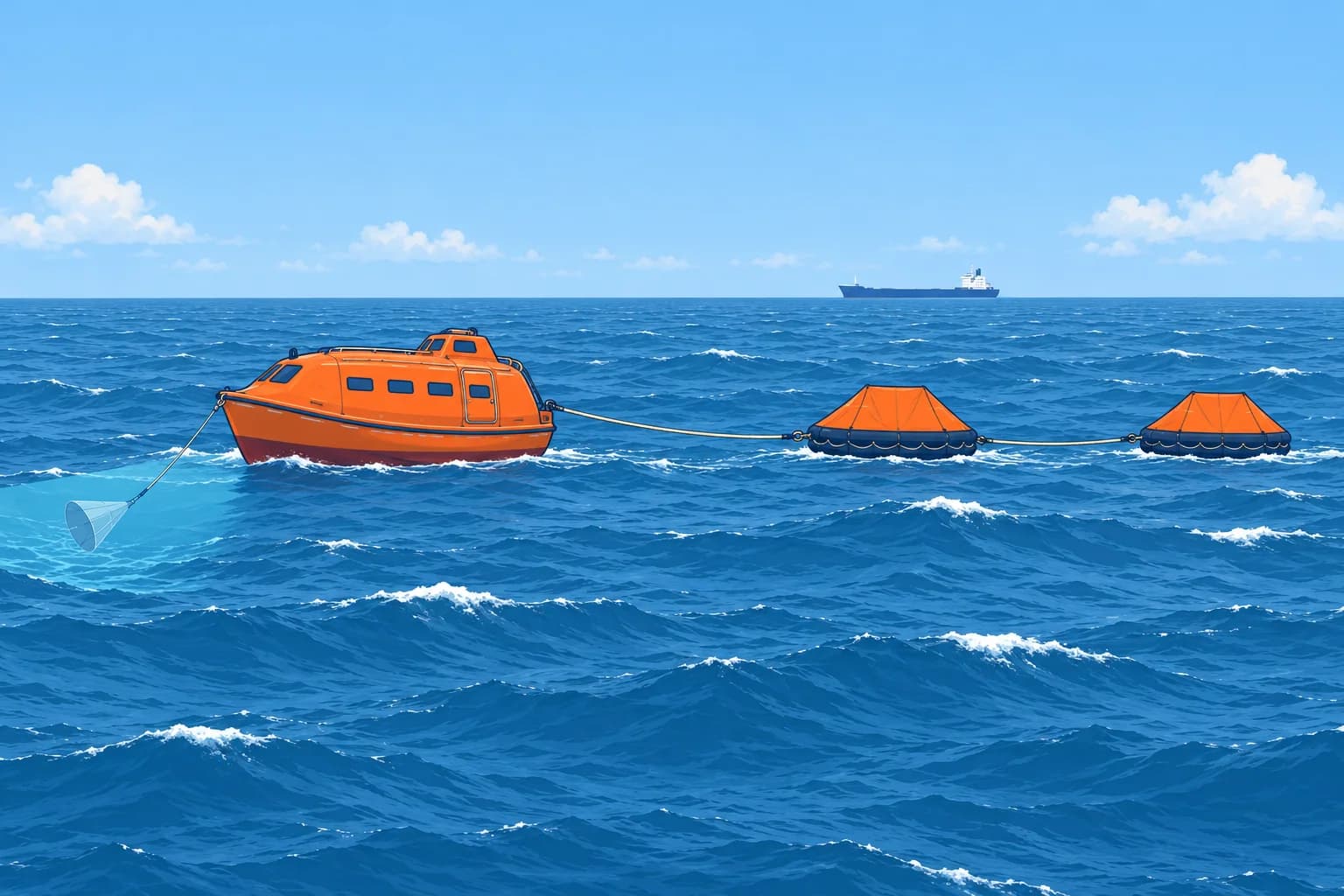
Take charge and gather the other craft. To tow is to pull another craft by a line. First check the boat and rafts’ towing limits and approved attachment points. Where approved, lead rafts in line astern, one behind another, and take up slack slowly. Adjust tow length to waves so craft rise and fall together where practicable, reducing snatching, sudden towline jerks. Tow slowly within approved limits.
Survivors in the water
Choose the approach for your craft, wind, current and waves. When approaching from downwind in flat water, head slowly into wind. Stop the propeller before coming alongside the survivor. Use the boat's approved recovery aid and lifting points. Support the head, trunk and legs to keep the person as horizontal as practicable. A single lifejacket lifting loop alone does not provide horizontal support; use one only if approved for lifting, with lower-body support.
Riding it out
Deploy the sea anchor, a canvas cone on a line from the bow, to steady the boat and slow drift. It keeps the bow towards the seas. In heavy weather keep entrances and openings watertight and everyone strapped in. A totally enclosed lifeboat is self-righting: it returns upright after capsize if openings are watertight and occupants secured. If it capsizes, stay strapped in. Once upright, check for flooding, remove any water and restart the engine if it stopped.
Key figures
- First actions
- Clear the ship, count everyone, lookout, report by VHF
- Towing liferafts
- Check limits and towing points; tow slowly, take up slack gently
- Sea anchor
- From the bow: head to sea, less drift
- Capsize
- Totally enclosed: openings watertight, occupants strapped in
- Person in water
- Choose approach for conditions; go slowly; stop propeller alongside
Remember
- Clear the ship's side and propeller, but stay near the position.
- Count everyone, set a lookout, report by VHF and gather the other craft.
- Check towing limits and attachment points; tow slowly in the approved arrangement, adjusting tow length to reduce snatching.
- Use the sea anchor to face seas. In a totally enclosed lifeboat, keep openings watertight and stay strapped in during capsize.
Common mistakes
Wrong: Head for land at full speed as soon as you are clear.
Right: Stay near the position, where rescuers will search, unless the person in charge decides otherwise.
Wrong: Tow liferafts close astern at speed to get them clear quickly.
Right: Check approved limits and attachment points. Tow slowly and adjust tow length to waves; a short, fast tow can tear the raft’s towing point.
Wrong: Unbuckle and climb out as the boat rolls over.
Right: Stay strapped in; a totally enclosed lifeboat rights itself with occupants secured and entrances and openings watertight.
Worked case
You command a lifeboat clear of the ship. Two intact liferafts nearby have everyone safely aboard. A man in a lifejacket is in the water 50 m downwind. The water is flat with a steady wind and no current. You choose to approach from downwind.
Show the answer
Recover the man first: he is exposed; raft occupants have shelter. Count everyone and assign a lookout. Pass clear, turn downwind of him and approach slowly into wind. Stop the propeller before coming alongside. Use approved recovery aids and lifting points; support head, trunk and legs as horizontally as practicable. Gather the rafts; tow slowly within approved limits. Stay near the distress position, deploy the sea anchor and report by VHF.
Practice question
After clearing the ship, where should the survival craft normally stay?
- Near the ship's last position
- At the nearest shoreline
- Downwind, as far away as possible
- Close under the ship's lee
Show the answer
Answer: A. Rescuers search around the distress position; stay near it but clear of dangers.