
Emergencies at sea · Level P1 · 6 parts · about 21 min
Fighting fire: extinguishers, hoses, breathing apparatus and the fire party
6 short parts: Extinguishers · Hoses & hydrants · Fire outfit & BA · The fire party · Smoke search · Boundaries. Each part explains the idea, then gives the points to remember, the common mistakes, a worked case and a practice question; the Academy unit adds all 36 check questions.
1 · Extinguishers
Portable and wheeled extinguishers at ship scale
Portable extinguishers are for a fire that has just started. Pick the right agent, check it, keep your exit behind you, and know when to back off.
First-aid fire fighting
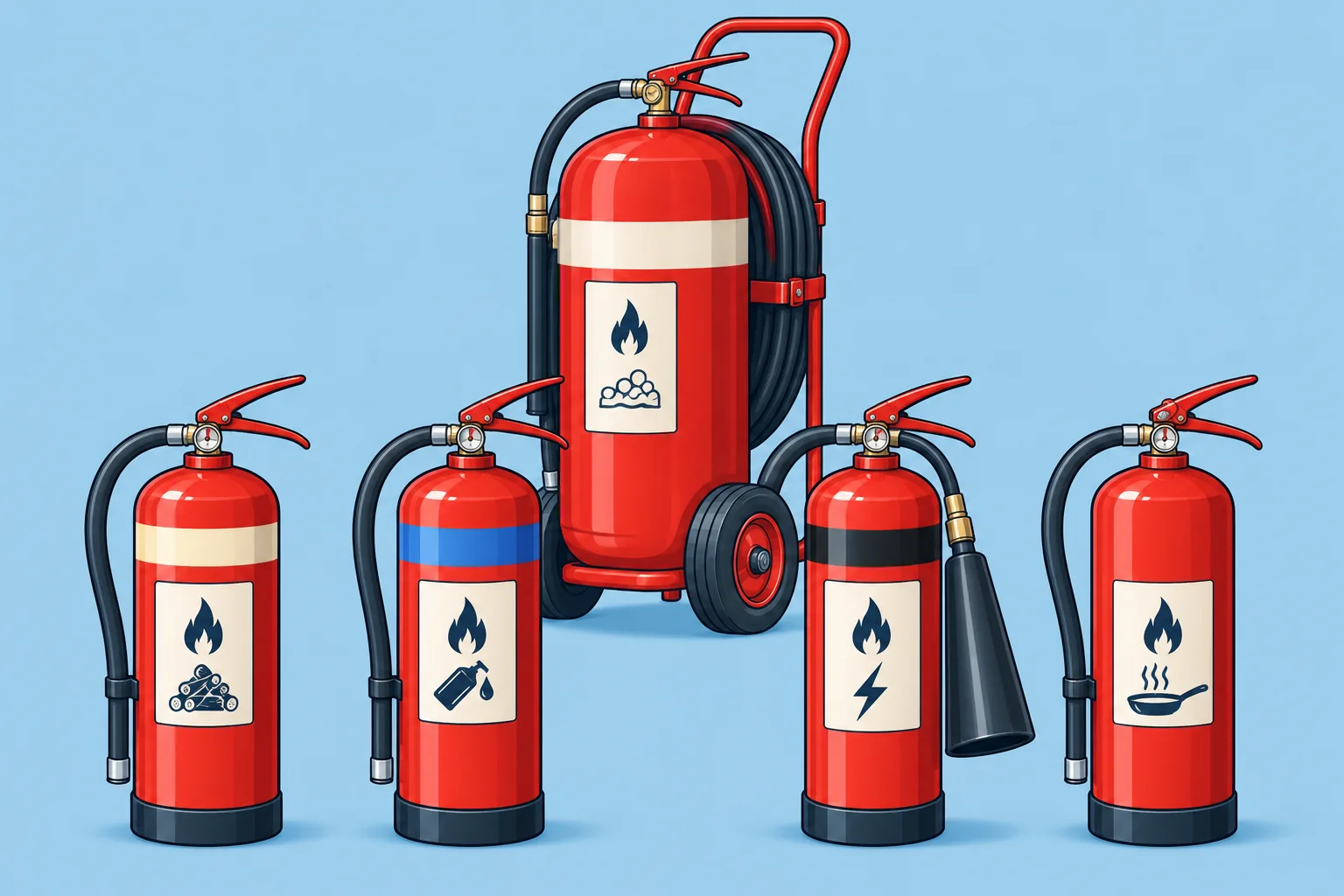
A portable extinguisher is for a small fire caught early. The Fire Safety Systems (FSS) Code, chapter 4, sets minimum sizes: water and foam at least 9 L, dry powder and CO₂ at least 5 kg, and nothing heavier than 23 kg when full. 6 kg powder units are common. SOLAS, the international ship-safety convention, sets how many go in each space and requires spare charges. You discharge real extinguishers on real fires in your approved course.
Which agent where
Water cools solid materials such as bedding; never use it on burning oil or live electrics. Foam covers solids and flammable liquids. Dry powder covers the classes on its label: ABC includes solids; BC does not. For burning gas, isolate its supply if safe; otherwise withdraw rather than extinguish a continuing leak. Powder cools little: watch for re-ignition. CO₂ suits electrical equipment and small oil fires and leaves no residue. It can suffocate you in small, poorly ventilated spaces.
Colours and labels
Under EN 3-7, the extinguisher standard, the body is red. Any agent-colour panel follows the applicable national marking system; always read the label. It states the agent, fire classes and rating (such as 13A or 55B), electrical limits and operating instructions. Check the instructions in the ship's working language and English.
Using one
Raise the alarm. Read the label for range and electrical limits. Check the pin, seal and gauge if fitted; test as instructed. Approach low with your exit behind you, within the maker's stated working range. Aim at the base and sweep. Apply foam gently off a surface, never into burning fuel. Back away facing the fire. Typical discharge: powder/CO₂ 10–20 s; water/foam about one minute. Hold CO₂ by its handle or designated insulated grip: the horn freezes. Withdraw if heat or smoke threatens your exit.
Bigger units
Where SOLAS II-2/10.5 requires them, internal-combustion machinery spaces carry 45 L foam units or approved equivalents; oil-fired boiler rooms normally require a 135 L foam unit or equivalents. Hoses must reach the fire risks. A portable foam applicator is a foam branch, a nozzle connected to the fire main by hose, with a portable tank of at least 20 L of foam concentrate and a spare tank. Wheeled units and applicators need two people.
Key figures
- Minimum sizes (FSS ch. 4)
- Water and foam 9 L; powder and CO₂ 5 kg (6 kg powder usual)
- Maximum mass
- 23 kg for a portable extinguisher
- Labels (EN 3-7)
- Red body; read the label for agent, rating and electrical limits
- Typical duration
- Powder and CO₂ about 10–20 s; water and foam about 1 min
- Foam where required; equivalents allowed
- 45 L combustion-machinery; 135 L in oil-fired boiler rooms
- Foam applicator
- Branch on the fire main; 20 L concentrate plus a spare tank
Remember
- Portable extinguishers are for small, early fires: raise the alarm first.
- Choose water, foam, powder or CO₂ by the label; check electrical limits.
- Read the label, not just the colour band.
- Test as instructed; use the maker's working range, exit behind you, aim low and sweep.
- Powder and CO₂ last only seconds: have a second extinguisher ready.
Common mistakes
Wrong: The colour tells you everything about an extinguisher.
Right: Bodies are mostly red now. Read the label for the agent, classes and electrical limits.
Wrong: Aim foam straight into a pool of burning oil.
Right: A jet into the fuel splashes it. Let foam run gently off a bulkhead or surface onto the pool.
Wrong: Powder has put the fire out, so the job is done.
Right: Powder barely cools. Watch for re-ignition and cool hot material if safe.
Worked case
A small fire starts in oily rags beside a live bench grinder that you cannot safely isolate. By your clear exit are a 9 L water extinguisher and a 6 kg ABC powder extinguisher whose label permits use on live electrical equipment.
Show the answer
Raise the alarm and report to the engine control room. If a safe small-fire attack is possible, use the labelled ABC powder within its stated range, keeping your exit behind you. ABC covers the burning rags; its electrical suitability matters while the grinder is live. Do not use water where it could reach live equipment. If heat or smoke threatens your exit, withdraw and close the door. Report the result and watch for re-ignition from safety.
Practice question
What is the FSS Code minimum capacity for a portable foam extinguisher?
- 5 litres
- 9 litres
- 6 litres
- 23 litres
Show the answer
Answer: B. Water and foam extinguishers hold at least 9 L. Powder and CO₂ hold at least 5 kg, and no portable unit may weigh more than 23 kg.
2 · Hoses & hydrants
The fire main, hydrants, hoses and nozzles
The fire main brings seawater to every deck. Know the hose lengths, the nozzle settings and the international shore connection.
Pumps and main
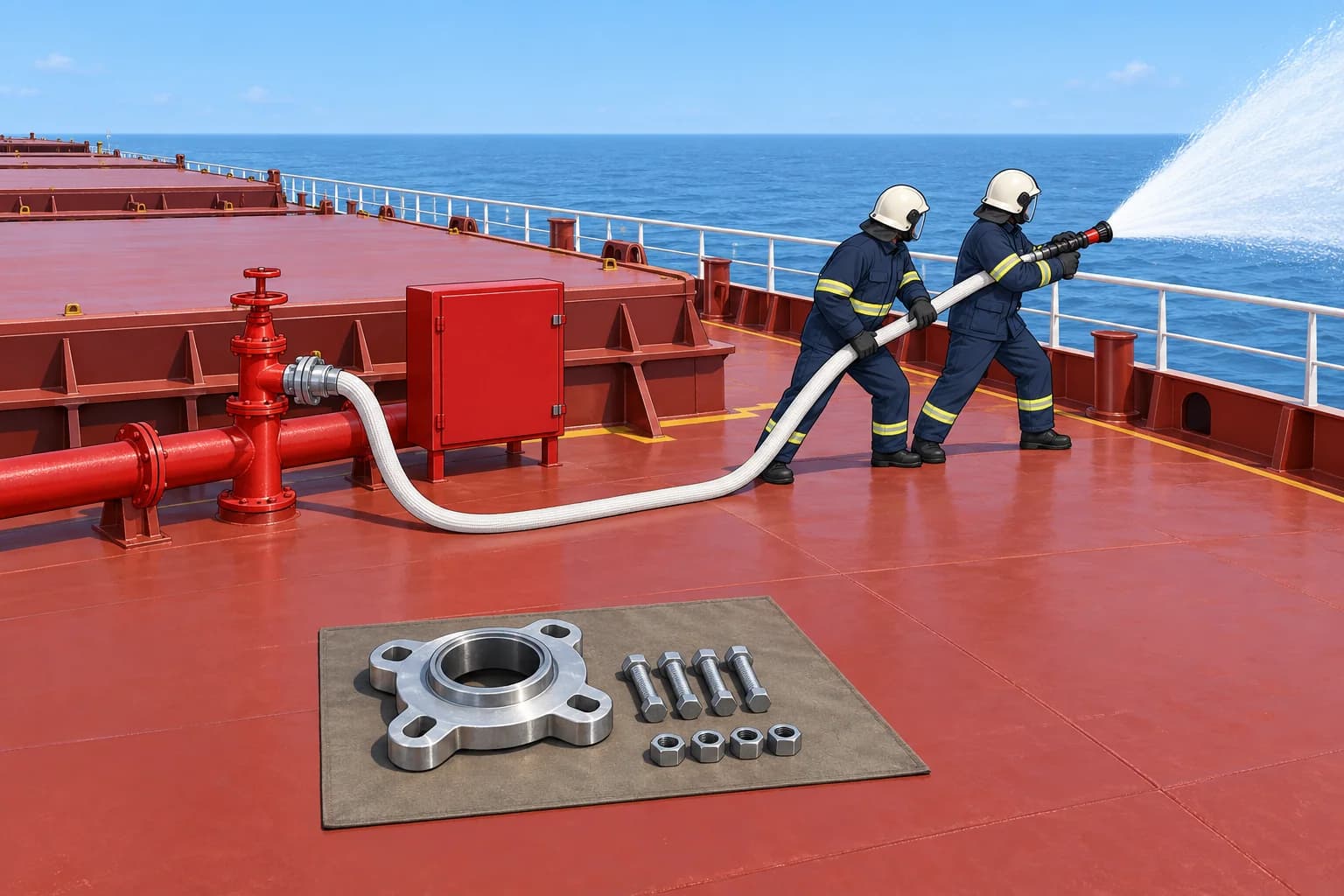
Fire pumps push seawater through the fire main, the ship's firefighting pipe system, to hydrants, hose connection points. An emergency fire pump provides water if fire disables the main pumps. Know the hydrants on your assigned route and keep access clear.
Hoses
Fire hoses are stowed in boxes or on racks near the hydrants, with a nozzle and couplings ready. SOLAS II-2/10.2.3 sets their length: at least 10 m, and no more than 15 m in machinery spaces, 20 m in other spaces and on open decks, and 25 m on the open decks of ships wider than 30 m. Lay it out without kinks, connect it and open the hydrant slowly. Two people handle a charged hose, filled with pressurised water.
Nozzles: jet or spray
Ships use dual-purpose nozzles that give a jet or spray, with a shut-off. A jet reaches far and penetrates deep fires in solid materials such as bedding or cargo. A spray (or fog) cools surfaces and makes a water curtain to shield the team when correctly applied. Control flow and application time. Never jet water into burning oil: it spreads the fire. Keep both jet and spray off live electrical equipment; have electrical isolation confirmed before applying water.
International shore connection
Hose couplings differ between countries. The international shore connection (ISC) is a standard flange, with a gasket, four bolts, four nuts and eight washers, that lets a shore fire brigade or another ship feed your fire main, or yours feed theirs. Ships of 500 gross tonnage (GT, a measure of enclosed volume) and over must carry one, ready for use on either side. FSS Code chapter 2 sets the flange: 178 mm outside diameter and four 16 mm bolts.
Look after the system
A hose that leaks, a hydrant that will not turn or a missing nozzle can lose a fire. Report damaged hoses and never use fire hoses to wash decks unless the ship allows it. Keep hydrants and hose boxes clear of stores and lashings. In freezing weather, the officers may drain exposed sections of the fire main; know which.
Key figures
- Hose length (SOLAS II-2/10.2.3)
- At least 10 m; at most 15 m in machinery spaces
- Hose length elsewhere
- At most 20 m; 25 m on open decks of ships over 30 m wide
- Emergency fire pump
- Provides water if fire disables the main pumps
- Nozzle sizes
- 12, 16 or 19 mm, dual-purpose jet/spray with shut-off
- International shore connection
- Ships ≥ 500 GT; flange 178 mm; usable on either side
Remember
- Fire pumps supply the fire main and hydrants; know the connections on your route.
- Hoses: at least 10 m; at most 15 m in machinery spaces, 20 m elsewhere, 25 m on wide decks.
- Jet for reach and penetration; spray for cooling and shielding. Control flow and application time.
- Never jet burning oil. Keep both jet and spray off live electrical equipment.
- The international shore connection lets shore or another ship feed your fire main.
Common mistakes
Wrong: Open the hydrant fully at once to get water quickly.
Right: Open it slowly. A sudden surge makes the hose whip and can knock the team over.
Wrong: A jet is always better because it reaches further.
Right: Spray cools faster and protects you. Use the jet for reach or deep-seated fires.
Wrong: Any hose length will do in the engine room.
Right: SOLAS limits engine-room hoses to 15 m so they can be handled in tight spaces.
Worked case
A shore fire brigade's hose couplings do not fit your ship's fire main. You fetch the international shore connection, but its gasket is missing. A crew member suggests bolting it together without the gasket to save time.
Show the answer
Tell the officer that the gasket is missing. Fetch the correct gasket and check for four bolts, four nuts and eight washers. Do not improvise a seal or pressurise an incomplete connection. The standard flanges join the differing couplings, but the complete assembly is needed for a sound connection. Bring it to the side ordered and report when the kit is ready.
Practice question
What is the maximum length of a fire hose in a machinery space?
- 10 m
- 20 m
- 25 m
- 15 m
Show the answer
Answer: D. SOLAS II-2/10.2.3 sets 15 m in machinery spaces, 20 m in other spaces and open decks, and 25 m on open decks of ships over 30 m wide; every hose is at least 10 m.
3 · Fire outfit & BA
The firefighter's outfit, breathing apparatus and EEBDs
Check your equipment, monitor your air and plan an early exit. If either warning whistle sounds, withdraw together immediately.
The firefighter's outfit
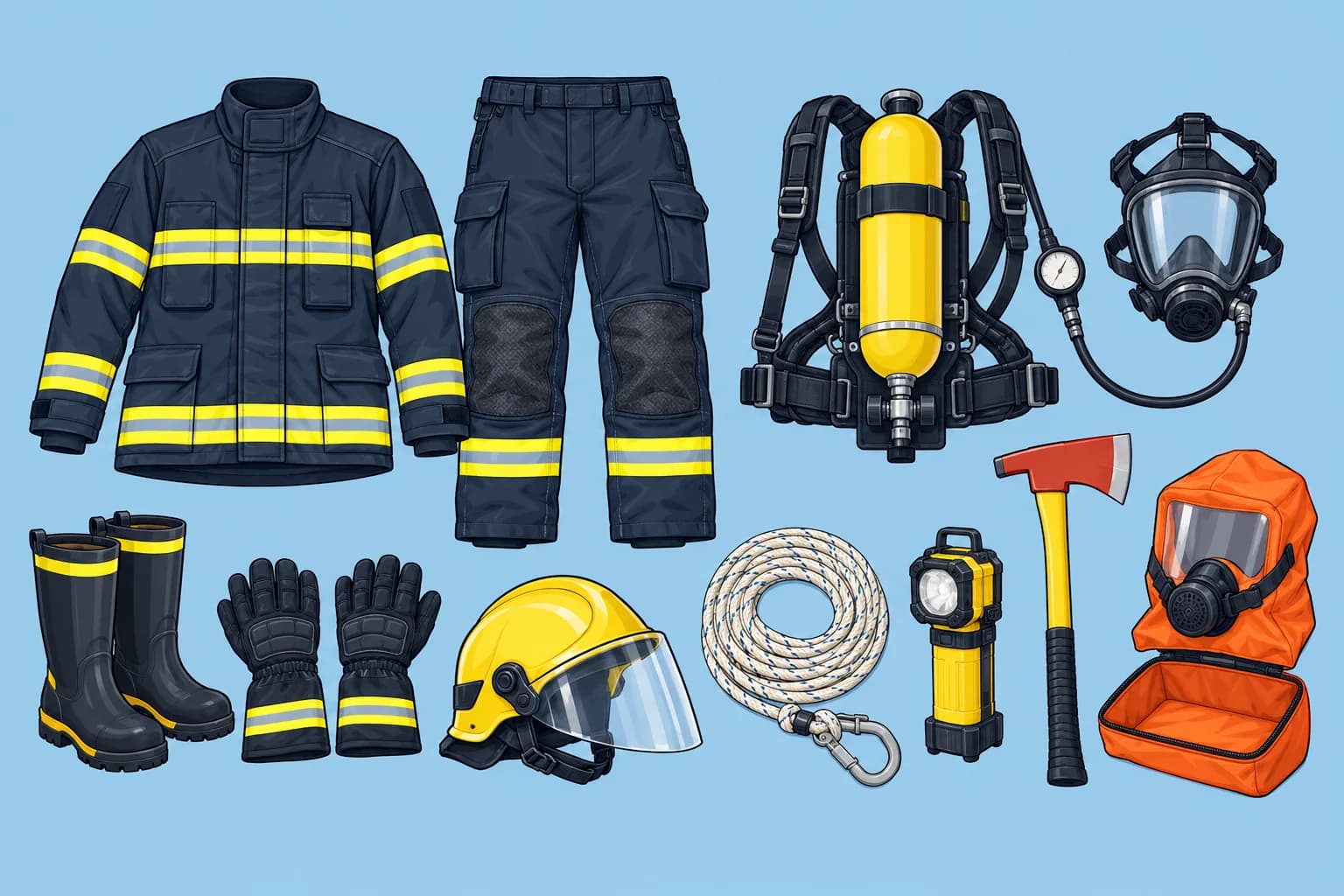
SOLAS II-2/10.10 requires at least two firefighter's outfits on cargo ships, and more on passenger ships, stored ready in separate places. FSS Code chapter 3 says what each holds: protective clothing that shields the skin from radiant heat, burns and scalding, with a water-resistant outer surface; boots and gloves of rubber or another non-conducting material; a rigid helmet; an electric safety lamp that burns for at least 3 hours (explosion-proof on tankers); and an axe with an insulated handle.
Breathing apparatus
Each outfit includes self-contained breathing apparatus (SCBA), with a harness, gauge, demand valve and full face mask. Compressed-air sets contain at least 1,200 L; other self-contained types must function for at least 30 minutes. Interchangeable cylinders and spare charges are carried on board. Hard work in heat uses air faster. Each set has a fireproof lifeline at least 30 m long; each fire party has at least two explosion-proof two-way radios.
Checks before use
Follow the maker's pre-use checks. Inspect the cylinder, harness, hoses and mask. Open the cylinder and read the gauge: pressure must meet the maker's limit. Close it and check for a pressure drop within the maker's leak-test limit. Vent slowly and confirm the warning whistle sounds. Fit the mask and check its seal as the maker directs. Reopen the cylinder fully as instructed, confirm air flows while you breathe, then buddy-check.
The whistle
Agree your withdrawal pressure or time with the BA controller, who tracks entry and air supplies, before entry. Check your gauge often and leave together early enough to reach safety with reserve air. Never wait for the low-pressure warning whistle. If either warning sounds, withdraw together immediately and report. The warning must sound before remaining air falls to 200 L. This reserve is for escape, not extra working time.
EEBDs are for escape
An emergency escape breathing device (EEBD) is a hood or mask with a small air or oxygen supply, carried in accommodation and machinery spaces. It gives at least 10 minutes of breathing to escape from smoke. It is never for fighting fires, entering tanks or rescuing others: it is designed and approved for escape, not firefighting or rescue. Know where the EEBDs are on your route.
Key figures
- SCBA air (FSS ch. 3)
- Compressed air: at least 1,200 L; other SCBA types: at least 30 min
- Low-pressure warning
- Sounds before the air left falls to 200 L
- Lifeline
- Fireproof, at least 30 m, tested to 3.5 kN
- Safety lamp
- At least 3 h; explosion-proof on tankers
- Outfits on cargo ships
- At least two (SOLAS II-2/10.10)
- EEBD
- Escape only; at least 10 min of air
Pre-use check of a breathing apparatus
- Inspect cylinder, harness, hoses and mask for damage. — A cracked mask or worn strap fails in the smoke.
- Open the cylinder fully and read the gauge. — You need a full cylinder to plan your time.
- Close the cylinder and monitor pressure for the maker's specified test period. — Reject the set if the pressure drop exceeds the maker's permitted limit.
- Vent slowly and confirm the whistle sounds. — Confirm the reserve alarm works; it is not your planned turn-back signal.
- Check the mask seal, reopen the cylinder as instructed and confirm normal breathing and gauge pressure. — A poor seal lets smoke in with every breath.
- Buddy check with your partner and report to the BA controller. If any check fails, do not use the set; report and replace it. — Two checks catch what one misses.
Remember
- Outfit: protective clothing, non-conducting boots and gloves, helmet, safety lamp, axe.
- Compressed-air SCBA: at least 1,200 L; other types: at least 30 minutes. Hard work uses air faster.
- Check gauge, leaks, whistle and mask seal; reopen the cylinder, check breathing, then buddy-check.
- Leave together at the planned air or time limit, before the whistle; either warning means withdraw immediately.
- An EEBD gives at least 10 minutes to escape; never use it to fight fire.
Common mistakes
Wrong: A 30-minute set always gives you 30 minutes inside the fire.
Right: Hard work in heat uses air fast. Watch your gauge and plan your exit early.
Wrong: The whistle means finish the job quickly.
Right: Withdraw together immediately. Plan to leave before the whistle; the reserve is for escape.
Wrong: An EEBD will do for a quick search of a smoky cabin.
Right: EEBDs are for escape only. Searching needs full BA, a partner and a team.
Worked case
You and your partner are searching a smoke-filled alleyway in BA. Your warning whistle sounds while you can still see a door you have not checked. Your partner's gauge shows more air than yours.
Show the answer
Tell your partner and leave together at once, by the way you came. The whistle means your reserve has started; it is for getting out, not for one more door. Report to the BA controller on the way out, giving what you checked and the door you did not reach, so the next team can search it. Never let one of the pair stay behind. Do not normally wait for the whistle to start withdrawing.
Practice question
What minimum air volume must a compressed-air firefighter's set contain?
- At least 600 litres
- At least 1,200 litres
- At least 2,400 litres
- At least 1,000 litres
Show the answer
Answer: B. The FSS Code requires compressed-air sets to contain at least 1,200 L. The 30-minute minimum applies to other self-contained types.
4 · The fire party
Raising the alarm and working in the fire party
A ship's fire is fought by teams, not heroes. Raise the alarm, go to your station, and work in pairs under your team leader.
If you find a fire
Raise the alarm at once: shout, operate the nearest manual fire-alarm call point and tell the bridge. Give the location, what is burning, how big it is and whether anyone is trapped or injured. Attack it with an extinguisher only if it is small, you have a clear way out behind you and you can do it safely. Otherwise get out, close doors behind you to starve it of air and report.
Muster and teams
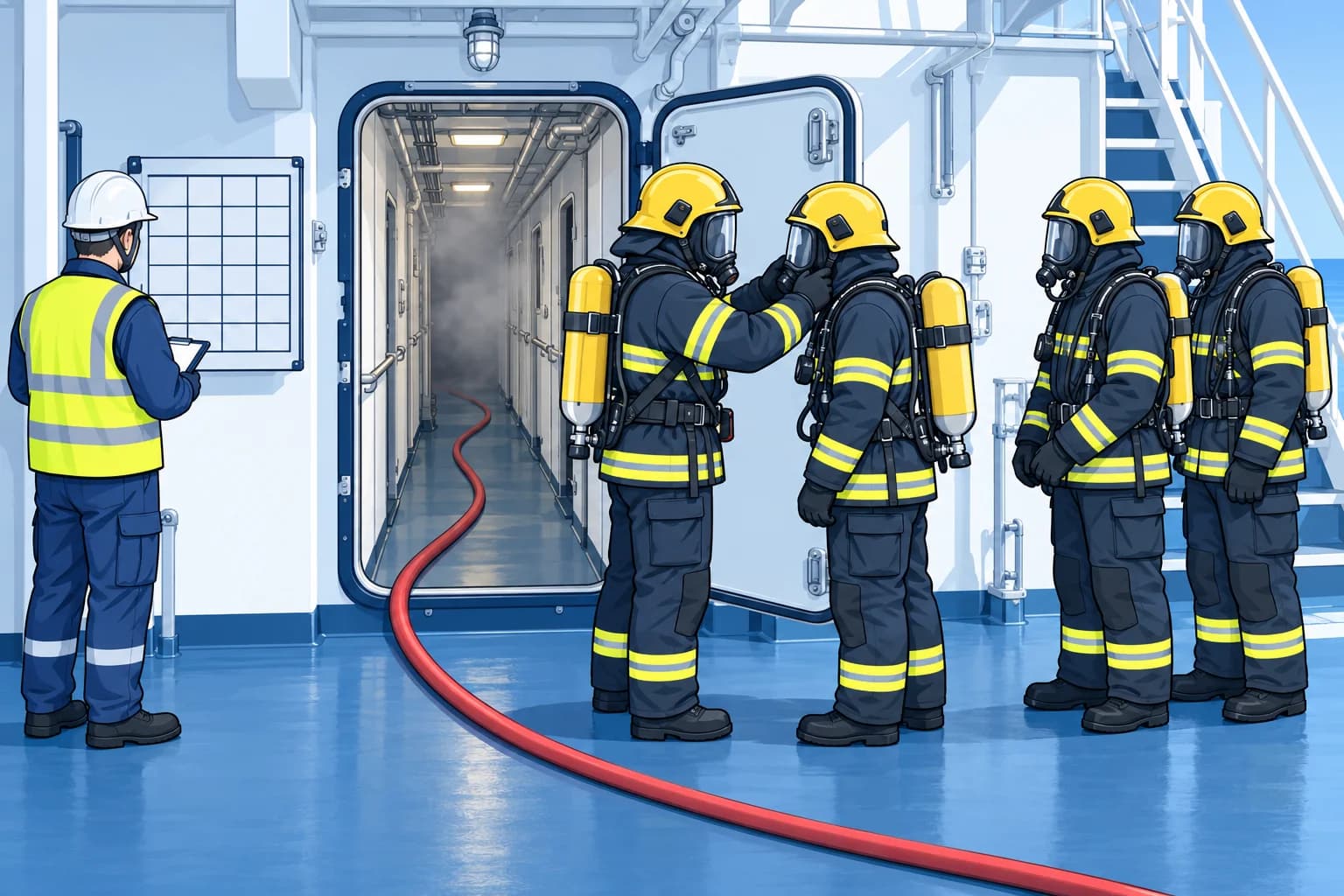
On the fire alarm, go to your station as the muster list says and report for the headcount. The master commands from the bridge. The fire party (often called the emergency party) is usually led by the chief officer, or by an engineer for an engine-room fire. Typical teams: an attack team of two in breathing apparatus (BA), a backup team ready to relieve or rescue them, a boundary-cooling team, and support for hoses, first aid, stretchers and closing down. Names vary by company.
Work in pairs
Nobody goes into smoke alone. BA wearers work in pairs, check each other and stay in touch. Withdraw together at the agreed air or time limit, before the warning whistle. Leave immediately if either has a problem or a whistle sounds. A BA controller at the entry keeps an entry control board: names, cylinder pressures, entry times and latest exit times. Report your gauge reading whenever asked.
Communications
The fire party uses portable radios, at least two per party, explosion-proof or intrinsically safe. Keep messages short and clear: who you are, where you are, what you see, what you need. Lifeline signals are a backup, such as the common OATH code (one pull OK, two Advance, three Take up slack, four Help); use the signals your ship has agreed. When you come out, report what you saw: heat, smoke, casualties, doors and hatches.
Your part as a new crew member
At first you may run hoses, carry equipment, cool boundaries, close ventilation or join the stretcher team. Do your task, stay with your team, follow orders and report back when it is done. Keep to your assigned task: a person acting alone can open the wrong door or end up as a casualty that others must rescue.
Key figures
- Report
- Location, what is burning, size, anyone trapped or hurt
- Overall command
- The master, from the bridge
- BA entry control
- Names, pressures, entry times and latest exit times
- Radios (SOLAS II-2/10.10.4)
- At least two per fire party; explosion-proof
- Lifeline signals (OATH)
- 1 OK, 2 Advance, 3 Take up slack, 4 Help
Remember
- Raise the alarm first, then report location, what, size and casualties.
- Attack only a small fire, with your exit behind you.
- Teams: attack, backup, boundary cooling, support; the master commands.
- BA wearers always work in pairs and come out together.
- The BA controller logs names, pressures and times at the entry point.
Common mistakes
Wrong: Fight the fire first and raise the alarm once you know it is serious.
Right: Raise the alarm first. A fire can grow in seconds, and help takes time to arrive.
Wrong: If your partner is slow, carry on alone to save time.
Right: Pairs stay together. Alone in smoke you have no help if something goes wrong.
Wrong: Long radio messages make sure nothing is missed.
Right: Short, clear messages keep the channel free for everyone.
Worked case
On your evening round you find smoke coming from under a cabin door in the crew accommodation. A crew member says the cabin's occupant may be asleep inside.
Show the answer
Raise the alarm and report the deck, cabin number, smoke and possible casualty to the bridge. Keep the door closed; shout to the occupant from safety. Do not enter smoke without BA and your team. Warn nearby cabins only where safe. Report to your muster station for headcount unless the bridge directs you to guide the fire party. If redirected, report your location and task so you remain accounted for.
Practice question
You discover a fire in a store. What should your report to the bridge include?
- The location, what is burning, its size and any casualties
- Your name, rank and the date you first joined the ship
- Only the deck number and the time you discovered the fire
- The extinguisher you plan to use and its total capacity
Show the answer
Answer: A. The bridge needs to know where the fire is, what is burning, how big it is and whether people are at risk.
5 · Smoke search
Searching a smoke-filled space and rescuing casualties
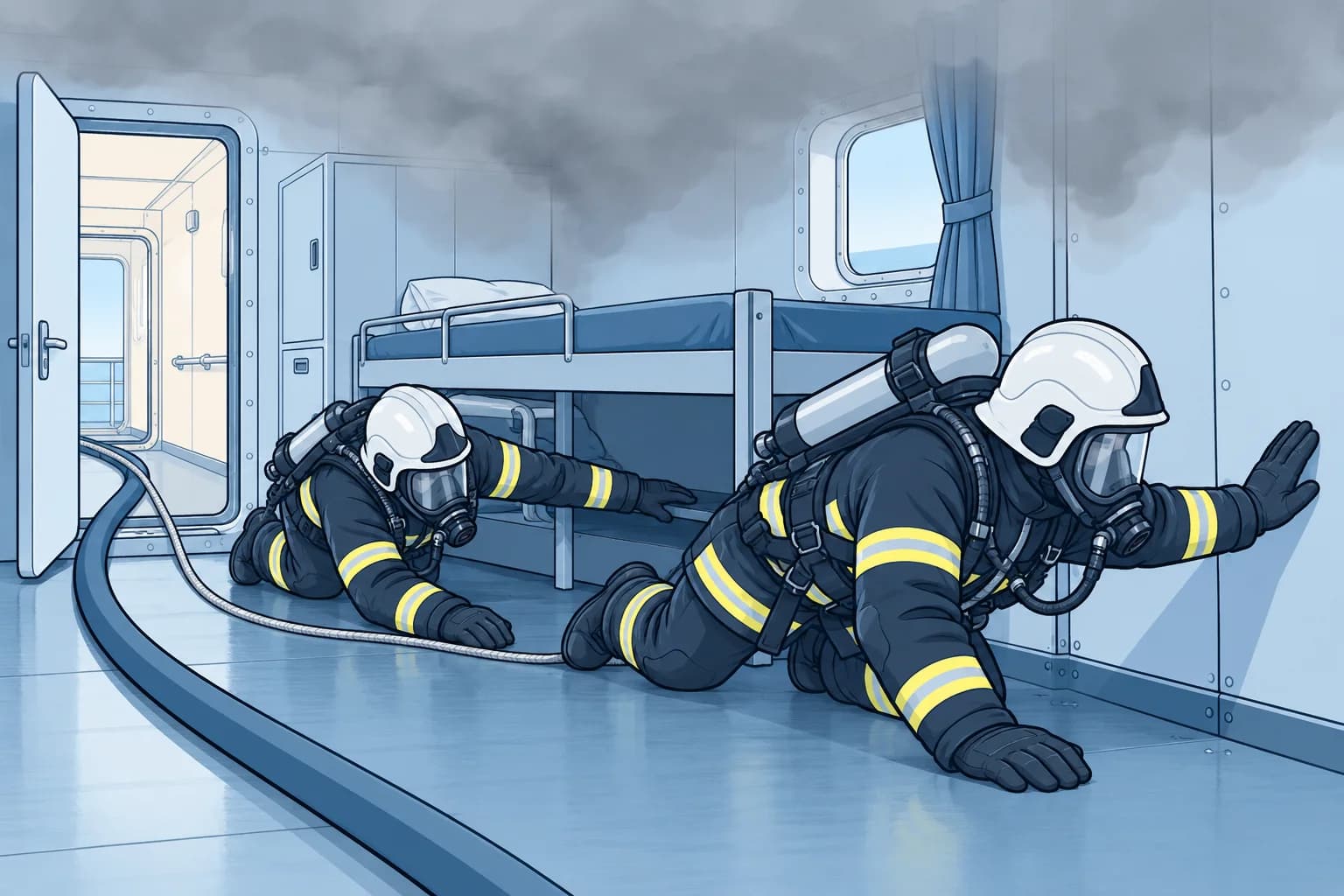
In thick smoke you cannot see your hand. Stay low, keep a hand on the wall, stay with your partner and follow your line back out.
Before going in
A search team enters only on the team leader's order, in breathing apparatus (BA), as a pair, with a charged hose (filled with pressurised water) or guide line, a radio and a lamp. Assess the door and surrounding smoke without exposing yourself. A cool door does not prove safety. Open only under the team leader's direction, staying low and to the side, with controlled door movement and a charged hose ready.
Stay low, feel ahead
Heat and smoke gather under the deckhead, the underside of the deck above. Stay low, in BA. Feel ahead cautiously with a gloved hand. Keep clear of cables and damaged electrical equipment; no hand position makes touching a live cable safe. Check the deck ahead for open hatches, ladders and holes. Move slowly and stay with your partner.
Right-hand or left-hand search
Choose a wall and keep one hand on it, for example your right, all the way round the space. That is a right-hand search. Your partner searches within reach while keeping contact. Report any area you cannot reach safely. Check under bunks, inside wardrobes, behind doors and in the bathroom: people hide or collapse there. To get out, turn round and follow the same wall with your other hand, or follow the hose or guide line back.
Guide lines and lifelines
A guide line tied off outside the space marks the way in and out. A lifeline links a wearer to someone outside who tends it. Hose lines also lead you out: never let go of the hose unless you have a wall or line. If you become separated, stop, stay calm, call by radio, and use your line or wall to find the way.
Bringing a casualty out
When you find someone, report by radio and bring them out together by the shortest safe route. Never give a casualty your own mask. Enclosed spaces, such as tanks, holds and voids, may be toxic or short of oxygen; unprotected rescuers can become casualties too. Enter only in BA, with a trained team, standby support and rescue gear. Entry rules: Law: personal safety, and Ropes: deck work safely.
Key figures
- Clearest air
- Low, near the deck: crawl
- Electrical hazards
- Avoid exposed cables; hand position does not prevent electric shock
- Right-hand search
- Right hand on the wall in; left hand on it out
- Check
- Under bunks, wardrobes, behind doors, bathrooms
- Rescue readiness
- Trained BA team, standby support and rescue equipment ready
Remember
- Search only in BA, as a pair, with a hose or guide line, radio and lamp.
- Stay low, feel ahead cautiously with a gloved hand and avoid electrical hazards.
- Keep one hand on the same wall; reverse hands to come out.
- Search under bunks, in wardrobes, behind doors and in bathrooms.
- Enclosed-space rescue needs BA, a trained team and standby support; unprotected rescuers can become casualties too.
Common mistakes
Wrong: Walk upright so you can search faster.
Right: Heat and smoke are worst high up, and you cannot feel holes ahead. Stay low.
Wrong: Let go of the wall to reach the middle of the room.
Right: Keep wall or line contact. Search only within safe reach and report any area you cannot reach.
Wrong: Share your mask with a casualty to keep them alive.
Right: Removing your mask can kill you. Get them out fast instead.
Worked case
You are the second in a BA pair searching a smoke-filled crew mess room with no visibility. Your leader keeps her right hand on the bulkhead. You feel a closed door on the wall.
Show the answer
Tell your leader. A cool door does not prove the space beyond is safe. Keep contact with your partner and your wall or line. Do not open it or extend the search without your leader's assessment and order. If ordered to open, stay low and to the side, keep the door controlled and the charged hose ready. Report heat or smoke changes. Withdraw together at the planned air or time limit, or immediately if either wearer has a problem or a whistle sounds.
Practice question
Why do you crawl when searching a smoke-filled space?
- Because the deck is the coolest place to rest
- Because the air is cooler and clearer low down
- Because BA works better when you are low
- Because standing makes the hose harder to drag
Show the answer
Answer: B. Heat and smoke collect under the deckhead. Low down it is cooler and you can feel for holes in the deck ahead.
6 · Boundaries
Boundary cooling, closing down and water on board
Contain the fire: check all six sides and cool hot boundaries as directed. Control air and fuel as ordered, and report water building up.
Six sides
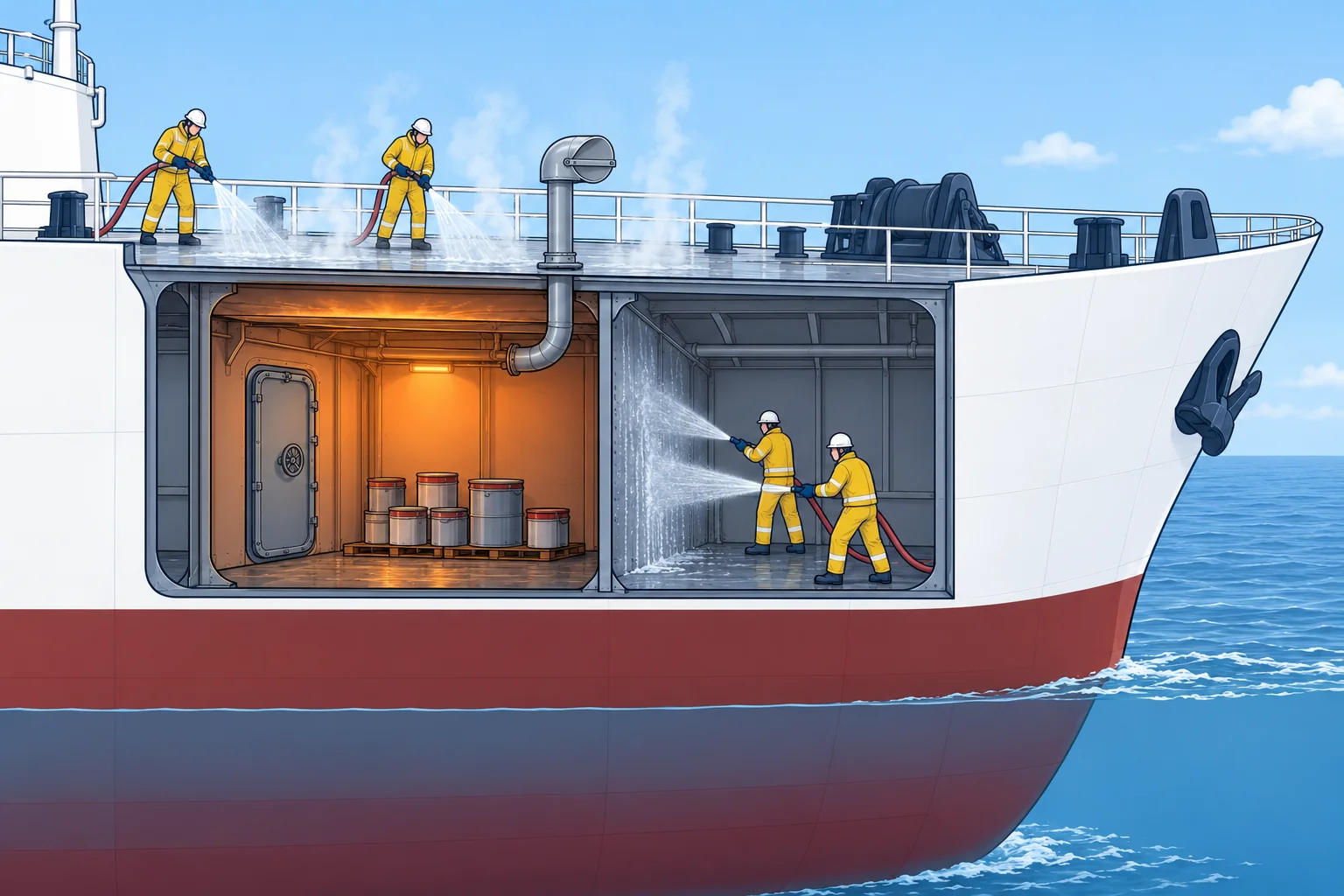
A fire space has six boundaries: four bulkheads (ship's walls), the deck above, whose underside is the deckhead, and the deck below. Heat conducts through all of them. The boundary-cooling team checks spaces on every side for heat and smoke, removes anything that can burn and cools hot steel as directed. The deck above needs most attention, because heat rises. Report any boundary you cannot reach, such as a tank or cargo on the far side.
How to cool
Apply controlled spray to hot steel and move it across the surface. Reassess temperatures regularly, using the ship's checking method or a thermal camera. Report persistent or increasing heat and blistering paint. Visible steam alone does not establish that the boundary is safe; no steam does not prove it is cool. Keep checking temperatures and follow your team leader's instructions. Use only the water needed for effective cooling.
Ventilation control
Closing down means cutting the fire's air and fuel supplies as ordered: stop fans; close fire dampers (shutters in ventilation ducts), skylights, portholes and doors. In the engine room, stop fuel pumps and close quick-closing valves, fuel shut-off valves operated remotely. These remote controls are outside the space. The fire control plan shows where they are.
Before a fixed system
Before a fixed-system release, report that everyone is out and accounted for. Stop fans and isolate fuel as ordered. Prepare openings and ventilation exactly as the installed system requires: CO₂ total flooding needs the space sealed; foam systems may need designated air vents open. Do not improvise or release the system yourself. After release, keep cooling and watching boundaries as ordered. Do not reopen or enter until authorised under the ship's procedures.
Water and stability
Firefighting water can collect inside the ship. A hose can put in many tonnes an hour, often high up. Loose water sloshing across a deck has a free surface that reduces stability and can make the ship list or capsize. Use the flow and duration needed for effective cooling. Report water building up and help clear deck drains and scuppers (drain openings at the ship's sides). The stability side is covered in Stability: stability basics.
Key figures
- Six sides
- Four bulkheads, the deck above and the deck below
- Most attention
- The deck above: heat rises
- Closing down
- Fans off, dampers, doors, skylights shut; fuel off remotely
- Before a fixed system
- All out and counted; prepare space to installed system instructions
- Firefighting water
- Tonnes per hour per hose; free surface reduces stability
Remember
- Check all six sides and cool hot boundaries as directed, especially the deck above.
- Use spray, move it across the steel and keep checking for heat.
- Closing down: stop fans, close dampers and openings, shut fuel remotely.
- Before release, account for everyone and prepare the space exactly as the installed system requires.
- Firefighting water can reduce stability. Use enough for effective cooling and report water building up.
Common mistakes
Wrong: Boundary cooling means the bulkheads next to the fire.
Right: Six sides: four bulkheads, the deck above and the deck below.
Wrong: More water always means a safer ship.
Right: Loose water high up can list or capsize the ship. Use only what is needed.
Wrong: Leave the fans running so the smoke clears.
Right: Fans feed the fire with air. Stop them and close the dampers.
Worked case
A fire is burning in a paint store in the forecastle. You are on the boundary-cooling team. The store has a deck above it with mooring ropes, a stores room alongside and a void space below with no safe access.
Show the answer
Check all six sides and cool hot boundaries as directed. Start with the deck above: move mooring ropes away from the hot area, spray hot steel and keep checking its temperature. Check the stores room alongside, remove combustibles from the shared bulkhead and cool hot steel. Report that the void below cannot be reached so the team leader can decide. Control flow and application time, and report water collecting.
Practice question
How many sides of a fire space must the boundary-cooling team check?
- Six: four bulkheads, the deck above and the deck below
- Four: the bulkheads around the space, excluding decks
- Two: the decks above and below, excluding bulkheads
- One: the bulkhead with the main door into the space
Show the answer
Answer: A. Heat can pass through every steel boundary. Check all six sides and cool hot boundaries as directed.