
Emergencies at sea · Level P3 · 5 parts · about 16 min
Emergency organisation on board and responding to distress (IAMSAR)
5 short parts: Teams · Plans · Drills · Distress alert · Going to help. Each part explains the idea, then gives the points to remember, the common mistakes, a worked case and a practice question; the Academy unit adds all 35 check questions.
1 · Teams
The emergency organisation and the muster list
One organisation for every emergency, built from teams with named leaders and deputies, and a muster list the officers keep accurate.
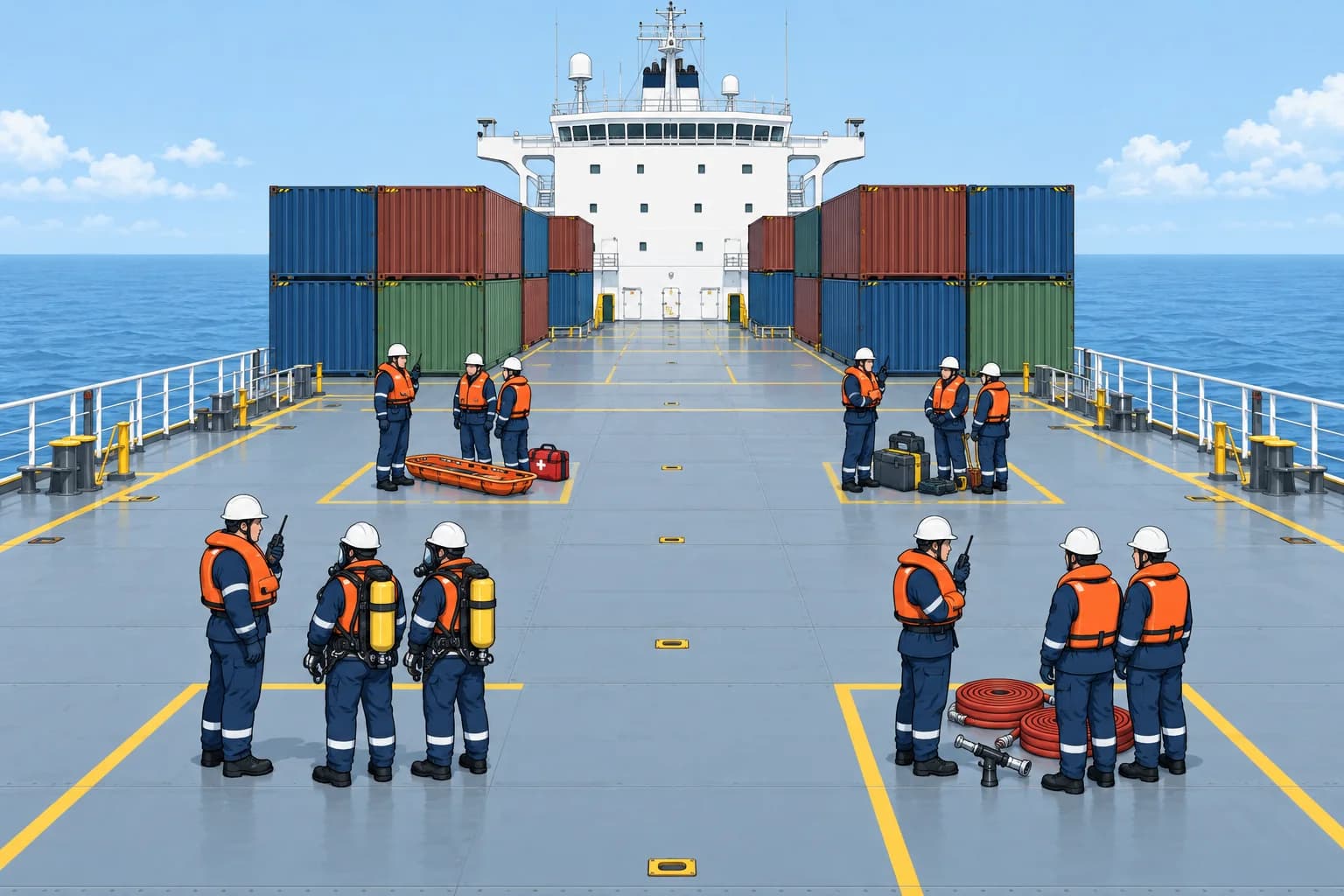
One organisation
Most ships use one emergency organisation for fire, flooding, collision, pollution and rescue, so people learn one set of stations. It is built from teams: the command team on the bridge, the emergency team (the attack or fire party) at the scene, a support team for containing the emergency, securing openings, equipment and stretchers, the engine-room team keeping power, pumps and propulsion, and a first-aid team. Names differ between companies; the logic is the same.
Who leads what
The master leads the command team, with the officer of the watch, a helmsman and someone on the radio and the log. The chief officer often leads the emergency team, a second officer or the bosun (senior deck rating) the support team, and the chief engineer the engine-room team. The officer in charge of medical care leads first aid. Every leader needs a named deputy, because the leader may be ashore, asleep after a long watch, or the casualty.
The muster list, officer's side
As a crew member you read your own line on the muster list. As an officer you help keep it accurate: update it when crew change, check that every key duty has a qualified person and a substitute, and make sure it matches the number on board. SOLAS III/37 lists duties such as closing watertight and fire doors, preparing survival craft, manning fire parties, communications and mustering passengers. Find the gaps in port, not in a fire.
Counting people
Each muster station reports its headcount to the bridge within minutes. Compare it with the list of everyone on board, including visitors, additional crew travelling on board and contractors. Report discrepancies immediately. Check for counting errors and report anyone missing with their last known location. The command team assesses rescue and containment priorities and assigns a properly protected search when safe. Keep the list exact at every port: a wrong number can send searchers after someone who is ashore.
Stations that work
Each team needs a muster point away from the likely fire areas, with its equipment ready: breathing apparatus sets, radios, stretcher, first-aid kit. Plan an alternative point in case the first one is inside the emergency area. When you review the plan, ask: can every team reach its station if the main stairway is full of smoke?
Key figures
- Muster list
- SOLAS III/37; ready before the ship sails
- Duties listed
- Watertight and fire doors, survival craft, fire parties, radio
- Substitutes
- Named for key persons who may be disabled
- Headcount
- Report missing people; assess and assign a safe search
- Basic view
- Signals and your own duties: Emergencies, musters and alarms
Remember
- One emergency organisation for all emergencies: command, emergency, support, engine-room and first-aid teams.
- Every team leader has a named deputy.
- Officers keep the muster list accurate: crew changes, qualified people, substitutes.
- The headcount is checked against an exact list of everyone on board.
- Plan alternative muster points for when the first is in the emergency area.
Common mistakes
Wrong: The muster list is fine if it was correct at the last port.
Right: Update it whenever crew change; a missing substitute is found in port, not in a fire.
Wrong: Visitors and contractors are not on the muster list, so they are not counted.
Right: Everyone on board is counted. They must be on the list of persons on board and told where to go.
Worked case
Today's new stretcher-team leader is also the only deputy for the bridge command team. Both teams may be needed together. The ship sails tonight. Is naming them on both lines enough?
Show the answer
No. Resolve the competing duties before sailing. Assign qualified leaders and deputies who can cover both teams at the same time. Update and post the muster list, check all key duties and substitutes, and arrange familiarisation for the changed roles.
Practice question
Which team keeps power, pumps and propulsion going during an emergency?
- The support and boundary team
- The engine-room team on duty
- The command team on the bridge
- The first-aid and stretcher team
Show the answer
Answer: B. The engine-room team, usually led by the chief engineer, keeps the services the other teams depend on.
2 · Plans
Contingency plans and decision support
Every likely emergency has a short plan: ISM requires them, MARPOL adds pollution plans, and the damage control plan shows how to save a flooded ship.
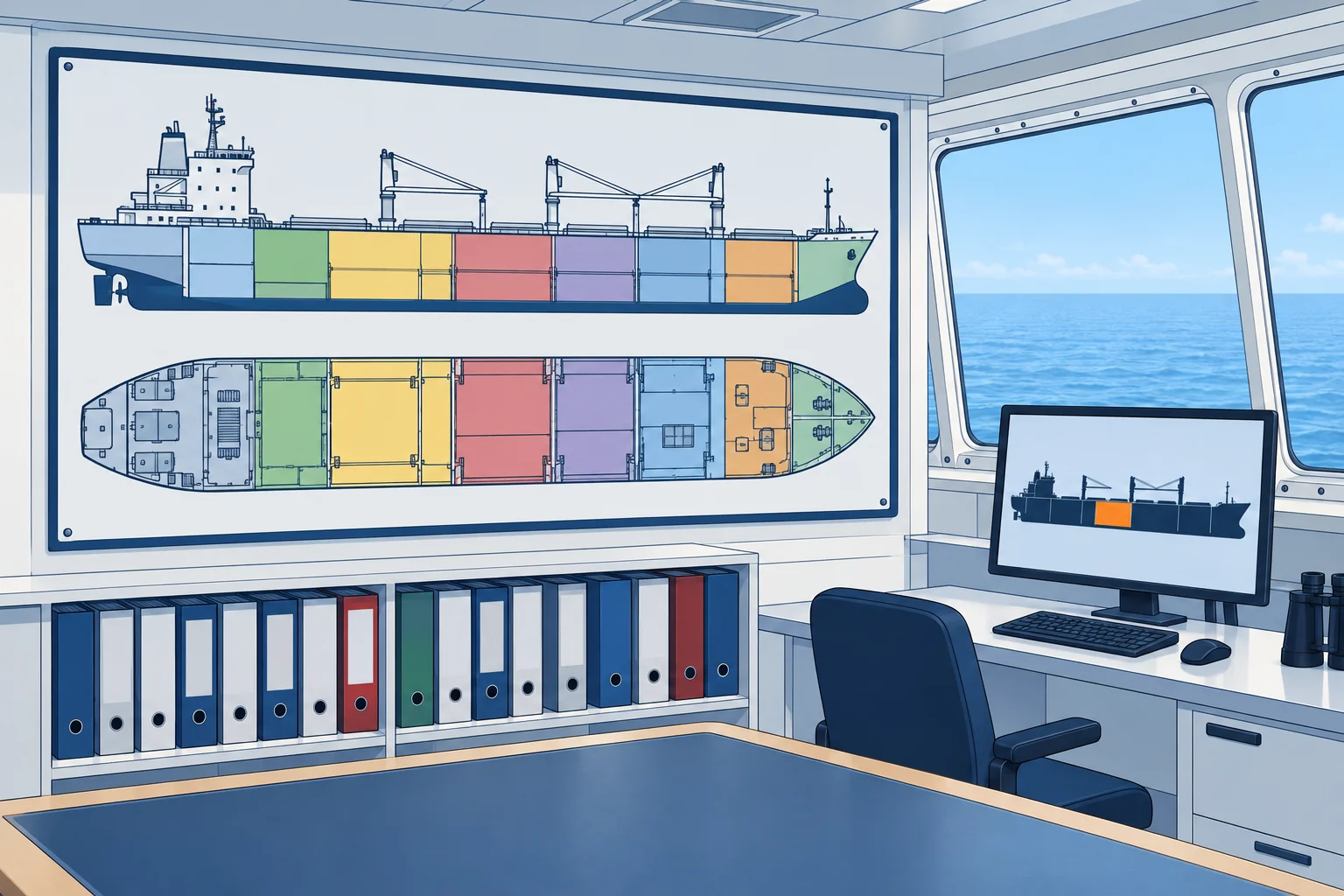
ISM: be ready
The ISM Code (International Safety Management Code) section 8 requires the company to identify potential emergencies, write procedures to respond to them and set up programmes of drills and exercises. The company's shore organisation must also be able to respond at any time. In practice the SMS (safety management system) has a contingency manual with one checklist per emergency: fire, flooding, collision, grounding, steering failure, blackout, man overboard, piracy, pollution and more.
One structure
IMO resolution A.1072(28) groups integrated emergency plans into six modules: introduction; provisions; planning, preparedness and training; response actions; reporting procedures; and annexes. This gives different emergency plans a common structure. Put immediate actions, including urgent alerts and reports, first. Follow with continuing actions and later reports. Keep checklists short and know where copies are kept.
Pollution plans
MARPOL requires a SOPEP (shipboard oil pollution emergency plan) on oil tankers of 150 GT (gross tonnage, a measure of enclosed volume) and above, and other ships of 400 GT and above. Ships of 150 GT and above certified to carry noxious liquid substances (harmful liquids) in bulk need an SMPEP (shipboard marine pollution emergency plan). The plans may be combined. They list reporting contacts, reporting steps and actions to control a spill. Detailed response belongs to the pollution unit.
Damage control plan
Passenger and cargo ships carry a damage control plan, permanently displayed or readily available on the bridge, with booklets for officers. It shows watertight boundaries, openings, controls and measures to correct a list (sideways tilt) after flooding. Many ships have onboard stability software. Oil tankers of 5,000 tonnes deadweight and above must have prompt access to shore-based computer programs for damaged stability and residual structural strength. Deadweight measures the weight a ship can carry.
Decision support
SOLAS III/29 requires passenger ships to have a decision support system for masters on the bridge: at least a printed emergency plan for fire, damage to the ship, pollution, unlawful acts threatening the ship, personnel accidents, cargo accidents and emergency help to other ships. It may also be computer based. On cargo ships, the SMS checklists play the same role.
Key figures
- ISM Code section 8
- Identify emergencies, procedures, drills, shore response
- Integrated plans
- IMO resolution A.1072(28)
- SOPEP
- Oil tankers ≥ 150 GT; other ships ≥ 400 GT (MARPOL I/37)
- SMPEP
- ≥150 GT, certified for noxious liquids in bulk (MARPOL II/17)
- Damage control plan
- SOLAS II-1/19; displayed or readily available on the bridge
- Decision support system
- SOLAS III/29; passenger ships
Remember
- ISM section 8: identify emergencies, write procedures, drill them, and keep the shore ready.
- Integrated plans: introduction; provisions; planning, preparedness and training; response; reporting; annexes.
- SOPEP and SMPEP cover pollution; they belong to the same emergency organisation.
- The damage control plan shows watertight boundaries and how to correct a list.
- Passenger ships have a decision support system for masters (SOLAS III/29).
Common mistakes
Wrong: Contingency plans are paperwork for the auditor.
Right: They are the first-minute checklists you will use under stress; know them and drill them.
Wrong: Flooding is handled from memory; the damage control plan is for the shipyard.
Right: Keep the damage control plan permanently displayed or readily available on the bridge, to find openings and correct a list.
Worked case
During an audit on your bulk carrier, the auditor finds that the steering-failure checklist is a five-page text and that the bridge copy of the damage control plan is missing. The master asks you, the chief officer, to fix it.
Show the answer
Rewrite the steering-failure checklist in the company format. Put immediate actions, including urgent alerts and reports, first, followed by continuing actions and later reports. Obtain a replacement damage control plan and booklets for officers; keep the plan permanently displayed or readily available on the bridge. Test both in the next drill.
Practice question
The onboard emergency checklists are ready, but company emergency support answers only during office hours. What is missing?
- Another printed bridge checklist
- An additional annual shipboard audit
- Shore response available at any time
- A separate checklist for each officer
Show the answer
Answer: C. ISM section 8 also requires the company organisation to respond at any time to emergencies involving its ships.
3 · Drills
Planning and evaluating drills
A drill is only as good as its plan and its debrief: set an objective, make it real but safe, measure it, and close the loop.
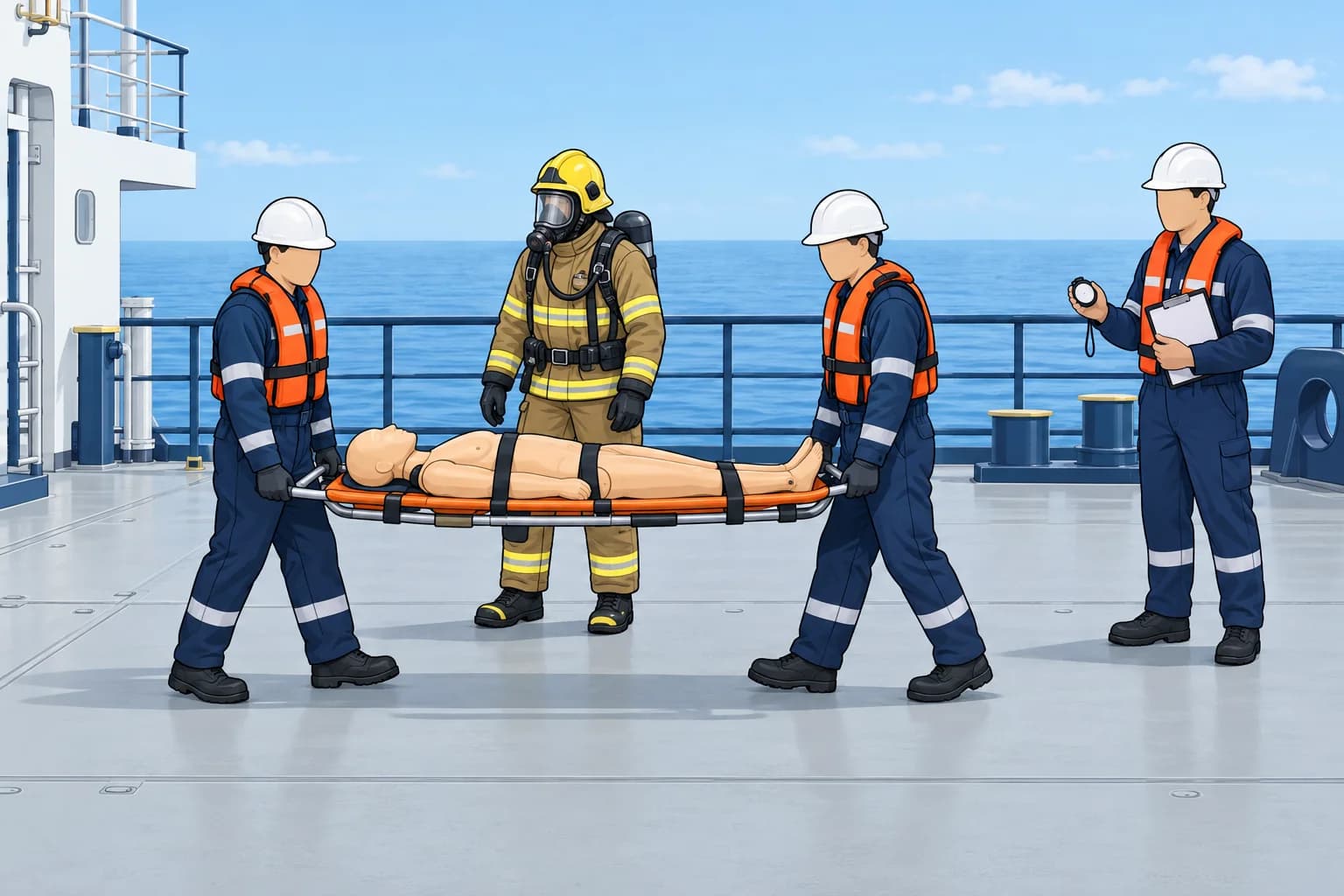
Plan the year
Basic training covers how often drills happen (see Musters and alarms). As an officer you plan what they test. SOLAS asks that fire drills cover the different emergencies your ship type and cargo could face. A good yearly plan rotates fire locations, flooding, collision, enclosed-space rescue, man overboard, blackout, steering failure, pollution and medical cases, and links them to the company's ISM drill programme.
Design a drill
Start with an objective: what should the team be able to do at the end? Write a short scenario with a location, a time and a complication, such as a missing person or a radio that fails. Brief the safety limits: no real smoke in occupied areas, full breathing apparatus checks, and a stop word that ends the drill at once. Name an observer to record performance and stop unsafe acts.
Real but safe
Hold drills at varied times, including at night and in port when safe. Use casualty dummies and controlled training smoke only after a risk assessment. Risk-assess any obscured-vision exercise. Follow company procedures, provide supervision and safety cover, and keep escape routes clear. Follow manufacturer instructions and company safety rules for boats, enclosed spaces and hoses.
Evaluate
Judge the drill against its objective, not by whether it felt good. Typical measures: time to muster and headcount, time to deploy suitable equipment safely, whether all boundaries were found, how clear the messages were. Hold a short debrief straight away: what worked, what did not, what we change. Let everyone speak, the most junior first, before senior crew influence their answers.
Close the loop
Record the drill in the logbook, as SOLAS requires, and in the SMS. Turn findings into actions with a name and a date: repair the radio, change the muster list, retrain a team. Verify that each fix works and record closure; recheck at the next drill. Report anything that needs the company, such as a design fault, through the SMS.
Key figures
- Fire drills
- Planned for the emergencies of your ship type and cargo
- Drill programme
- ISM Code 8.2: programmes for drills and exercises
- Records
- Drills and training entered in the logbook (SOLAS III/19)
- Debrief
- Straight after; judged against the objective; actions with dates
Remember
- Plan a yearly cycle of scenarios that match your ship's risks.
- Every drill has an objective, a scenario, safety limits and an observer.
- Make drills realistic without creating real danger.
- Measure against the objective and debrief at once, juniors first.
- Record drills; assign actions with owners and dates, verify fixes and record closure.
Common mistakes
Wrong: A drill went well if it finished quickly and nobody complained.
Right: It went well if it met its objective; slow or awkward moments are what the drill is for.
Wrong: Hold the debrief at the next safety meeting, when everyone has time.
Right: Debrief straight after, while details are fresh, and write actions with an owner and a date.
Wrong: For realism, run the drill without the usual breathing apparatus checks.
Right: Realism never replaces safety: full checks, safety limits and a stop word every time.
Worked case
Your container ship has repeated the same engine-room fire drill for a year. Musters are fast, but at a real galley fire the team took four minutes to identify a safe access route after going to the engine-room station first.
Show the answer
Plan a cycle with different locations: galley, accommodation, cargo and engine room, at varied times. Give each drill an objective, such as identifying the simulated fire, reporting a safe access route and selecting and preparing suitable equipment within a safe target time. Use an observer to measure it. Debrief at once, assign actions with owners and dates, then verify the fixes and record closure.
Practice question
You are planning a galley-fire drill. What should you define first?
- The action the team must demonstrate
- The number of hoses to be deployed
- The crew member who leads the debrief
- The route the team will use to enter
Show the answer
Answer: A. The objective defines the action the team must demonstrate. It guides the scenario you design and how you evaluate the drill.
4 · Distress alert
On watch: receiving a distress alert
A distress alert reaches your bridge. Call the master, note the details, listen first, and follow the IMO flow diagram rather than pressing buttons.
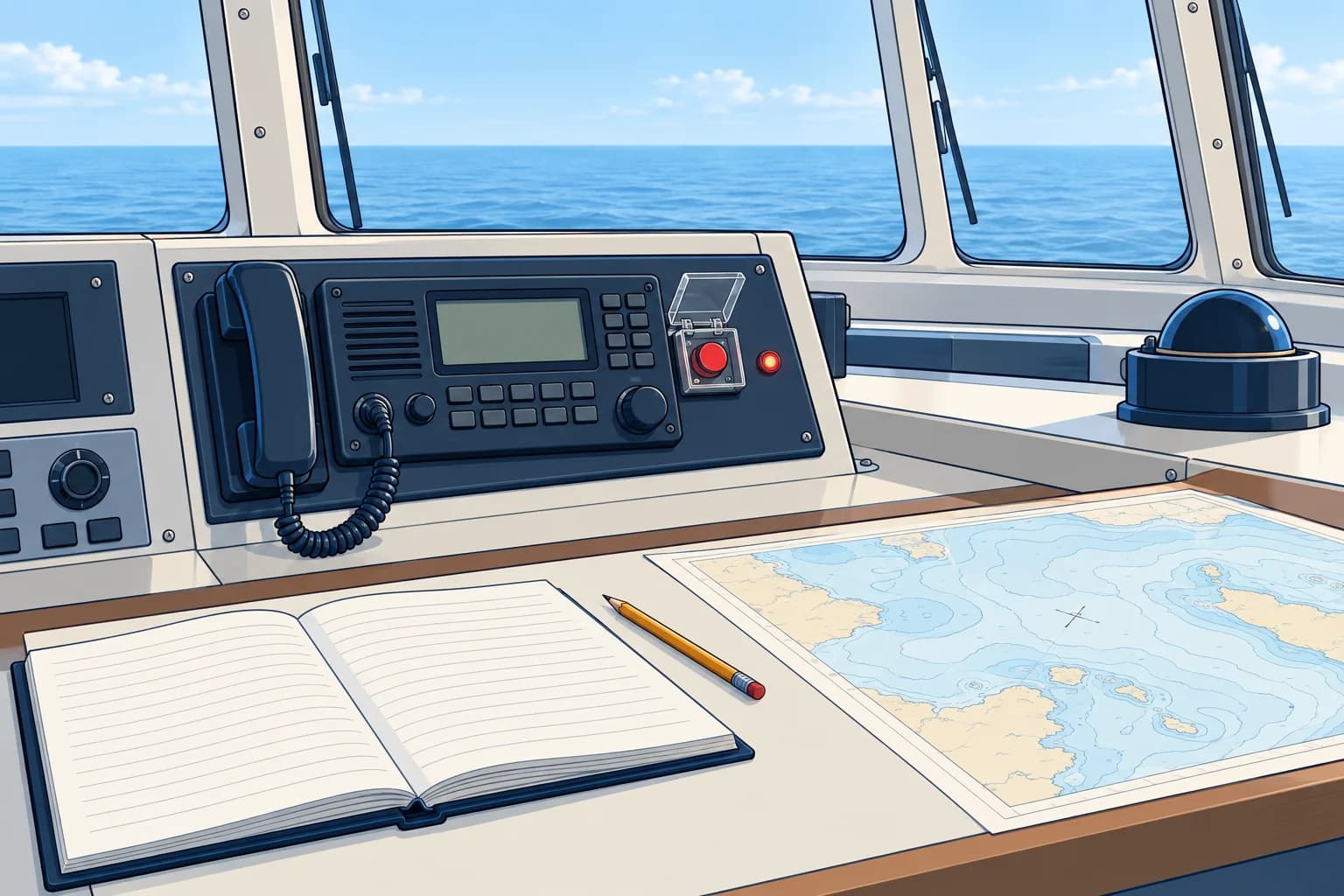
First minutes
When a distress alert or call reaches the bridge, the officer of the watch (OOW) acts at once: call the master, note the time, the casualty's identity, position and nature of distress, and plot that position against your own. DSC means digital selective calling; an RCC is a rescue coordination centre.
VHF or MF DSC alert
For a very high frequency (VHF) or medium frequency (MF) DSC alert, follow the six steps below. Keep the MSC.1/Circ.1657/Rev.1 flow diagram on the bridge.
What not to do
Do not acknowledge a DSC distress alert by DSC unless a coast station or RCC tells you to. Never send an all ships DSC distress relay after receiving a VHF or MF DSC alert: it floods the system and confuses the rescuers. Only the master can permit a distress alert, acknowledgement or relay from your ship.
HF alerts
For a high frequency (HF) alert, listen on its voice channel for 5 minutes. If a coast station or RCC has acknowledged or relayed the alert, or distress traffic is in progress, contact the RCC to offer help if you can assist. If neither applies, inform a coast station or RCC by suitable means; send a DSC relay only if instructed. Avoid unnecessary traffic if distant or others are better placed. Log the details.
Relaying for others
You may need a Mayday relay when the casualty cannot alert for itself, for example after you see red flares or hear a weak voice call, and the master decides more help is needed. Address it preferably to one coast station or RCC. Then keep a continuous watch and log every message.
Key figures
- Guidance
- MSC.1/Circ.1657/Rev.1 (2026); flow diagrams posted on the bridge
- First listening
- 5 minutes on channel 16 or 2182 kHz
- DSC acknowledgement
- Only if a coast station or RCC tells you to
- All-ships DSC relay
- Never, after a VHF or MF DSC alert
OOW actions on a VHF or MF DSC distress alert
- Call the master, record the time, casualty's identity, position and nature of distress, and plot the position. — The master authorises transmissions; recording and plotting start immediately.
- Listen on channel 16 or 2182 kHz for 5 minutes. — A coast station or RCC normally acknowledges first and takes control.
- If acknowledged or distress traffic is underway, check whether you can assist. If able, acknowledge by voice and inform a coast station or RCC. — This branch checks your ability to assist. If unable, keep watch.
- If there is no acknowledgement or distress traffic and DSC alerts continue, acknowledge by voice and inform a coast station or RCC. — A continuing unacknowledged alert needs a coordinated response.
- If there is no acknowledgement or distress traffic and alerts have stopped, inform a coast station or RCC. — Silence does not show that the emergency is over.
- Log the details and reset the system, keeping watch. — Keep a record and remain ready for further distress traffic.
Remember
- Call the master, record and plot promptly; monitor channel 16 or 2182 kHz for 5 minutes before voice acknowledgement.
- VHF/MF: if acknowledged or distress traffic is underway, check ability to assist; if able, reply by voice and inform RCC.
- No acknowledgement or distress traffic: continuing alerts need a voice reply and RCC report; stopped alerts need an RCC report.
- No DSC acknowledgement unless told, and never an all-ships DSC relay after a VHF or MF alert.
- HF: inform an RCC, relay only on its instruction; log everything.
Common mistakes
Wrong: Press the DSC acknowledge button at once so the casualty knows you heard.
Right: Listen first; acknowledge by voice if needed. A DSC acknowledgement is sent only when a coast station or RCC tells you to.
Wrong: Relay the DSC alert to all ships so everyone hears it.
Right: Never send an all-ships DSC relay after a VHF or MF alert; inform a coast station or RCC instead.
Worked case
At 0310 your VHF DSC sounds a distress alert from a fishing vessel 9 miles away, nature 'flooding'. After 5 minutes on channel 16 you hear no acknowledgement or distress traffic and the alert repeats. Your ship can assist; the master is coming to the bridge.
Show the answer
Having already called the master, recorded the details and plotted the position, acknowledge by voice on channel 16 with the master's permission. Inform the coast station or RCC by the quickest means. Do not send a DSC acknowledgement unless directed, or an all-ships DSC relay. Log subsequent actions and keep watch.
Practice question
After a VHF DSC distress alert, you call the master, record the details and plot the position. What is your first radio step?
- Acknowledge the distress alert by DSC
- Send an all-ships DSC distress relay
- Listen on channel 16 for 5 minutes
- Switch the DSC off to stop the alarm
Show the answer
Answer: C. Listening first lets the coast station or RCC acknowledge and take control.
5 · Going to help
Proceeding to assist and preparing the ship
If your ship can help, SOLAS requires you to proceed with all speed. Report your ETA and prepare for safe recovery during the passage.
The duty
SOLAS V/33 requires a master at sea able to help to proceed with all speed, informing the casualty or SAR (search and rescue) service if possible. If unable, or assistance is unreasonable or unnecessary in special circumstances, log why and inform SAR. A non-requisitioned ship (not formally directed to assist) is released when told requisitioned ships are complying. Release also follows word from the casualty, SAR service or a master reaching the casualties that help is no longer needed.
Proceed and report
Tell the RCC and, if possible, the casualty: your name, position, speed and ETA (estimated time of arrival), and what you can offer. Plot the casualty's position and likely drift. Keep a watch on the distress channels and any channel the RCC assigns. Post extra lookouts and use radar and searchlights if you arrive at night.
Prepare the ship
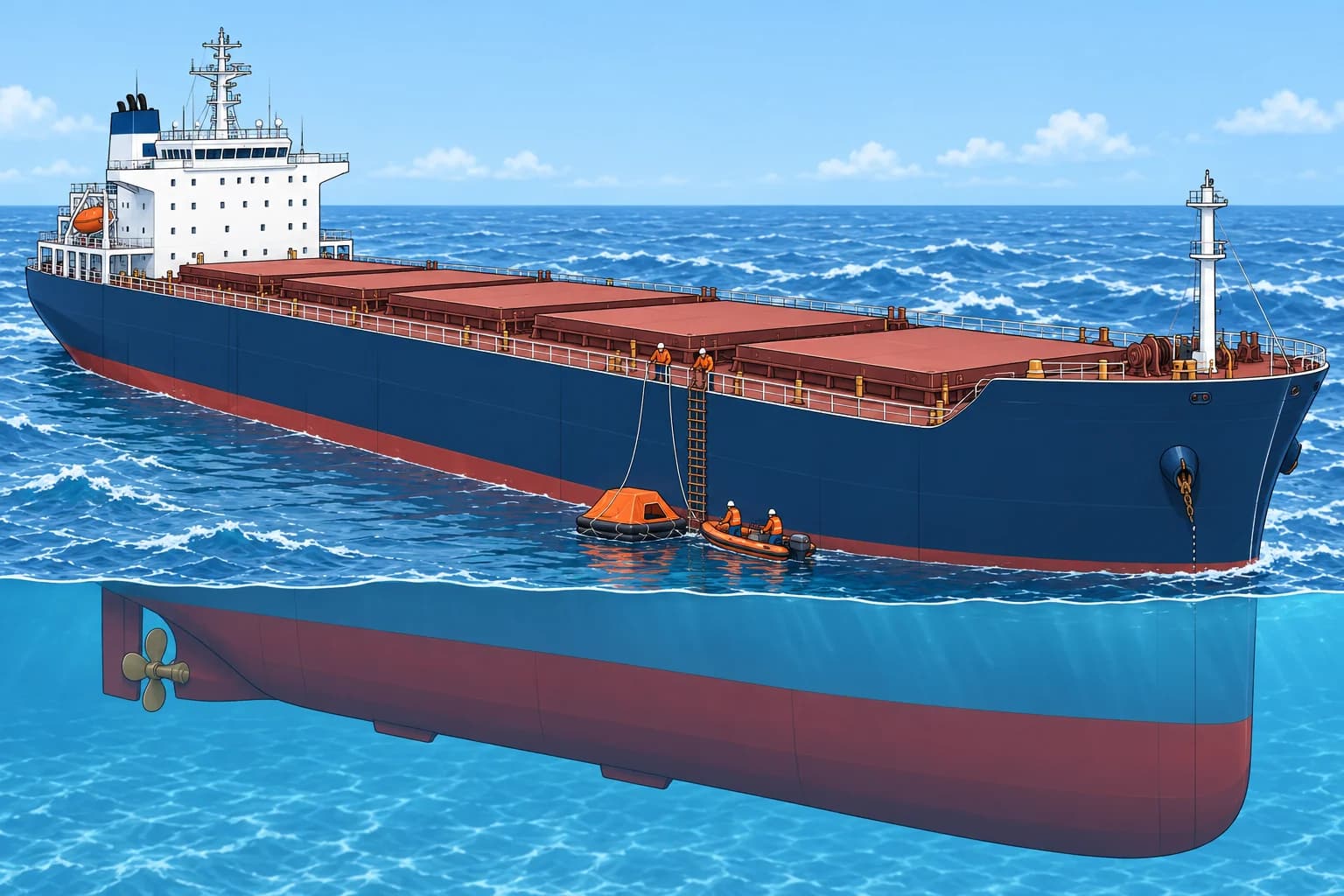
Use the passage time. Brief the crew. Prepare the rescue boat and its crew. Rig pilot or embarkation ladders, scrambling nets (nets for climbing aboard), heaving lines and lifebuoys. Ready blankets, dry clothes, warm drinks and the hospital, and a space and list for survivors. Your ship-specific recovery plan, required by SOLAS III/17-1, says which equipment you use to bring people out of the water.
Making a lee
On scene, approach with care. Place the ship so that her hull shelters the survivors from wind and sea: a lee. A high-sided ship can drift down onto survivors or a raft; assess relative movement continuously and keep them clear of the hull and propeller. A liferaft or the rescue boat held at the ship's side can serve as a boarding platform.
Bringing people aboard
A person lifted upright out of cold water can collapse, so lift horizontally where you can, in a basket, net or stretcher. Do not expect exhausted survivors to climb a ladder. Count, register and care for each one and report to the RCC. Rescue includes delivery to a place of safety, where lives are no longer threatened, basic needs can be met and onward transport arranged. Coordinate this with the RCC.
Key figures
- Duty to assist
- SOLAS V/33: proceed with all speed
- If you do not go
- Log the reason and inform the SAR service
- Recovery plans
- SOLAS III/17-1; guidelines MSC.1/Circ.1447
- Recovery techniques
- IMO guide MSC.1/Circ.1182/Rev.1
- After cold immersion
- Lift horizontally where possible
- End of the rescue
- Delivery to a place of safety (guidelines MSC.167(78))
Remember
- SOLAS V/33: proceed with all speed; if you do not, log why and inform the SAR service.
- Report position, speed, ETA and what you can offer to the RCC.
- Use passage time to prepare boat, ladders, nets, lines, survivor care.
- Make a lee and monitor relative drift: the ship may close on survivors. Keep them clear of the hull and propeller.
- Lift cold survivors horizontally where possible; register and report them.
Common mistakes
Wrong: Another ship is closer, so you can carry on without telling anyone.
Right: Another ship being closer does not release you. Follow SOLAS V/33 release conditions; otherwise proceed, or log and report a justified decision not to.
Wrong: Survivors in the water can climb the pilot ladder.
Right: Cold, exhausted people often cannot. Use nets, baskets or a boarding platform, and lift horizontally where possible.
Worked case
Your 180 m bulk carrier is 25 miles from a liferaft reported by the RCC, with four people aboard. Wind is force 5, sea moderate. ETA is in two hours. The rescue boat is serviceable.
Show the answer
Report identity, position, speed, ETA and recovery capability to the RCC. Prepare crew, recovery equipment and survivor care under the recovery plan. Assess wind, sea, drift and closing speed before making a lee; keep survivors clear of hull and propeller. Launch the rescue boat only if safe. Use suitable boarding and lifting equipment; lift cold survivors horizontally where possible. Register survivors and arrange a place of safety with the RCC.
Practice question
Your ship can help a nearby vessel in distress. Another ship is closer, but you have not been released. What must you do?
- Proceed with all speed and report
- Keep your course and wait for news
- Wait until the closer ship arrives
- Ask the company before responding
Show the answer
Answer: A. SOLAS V/33 requires a master able to assist to proceed with all speed. A closer ship alone does not release you; the regulation sets specific release conditions.