
Emergencies at sea · Level P3 · 5 parts · about 17 min
Fast rescue boats: launching, handling and recovery (STCW A-VI/2-2)
5 short parts: Boat and crew · Launching · Heavy weather · Casualty pick-up · Recovery and care. Each part explains the idea, then gives the points to remember, the common mistakes, a worked case and a practice question; the Academy unit adds all 32 check questions.
1 · Boat and crew
The fast rescue boat, its crew and their kit
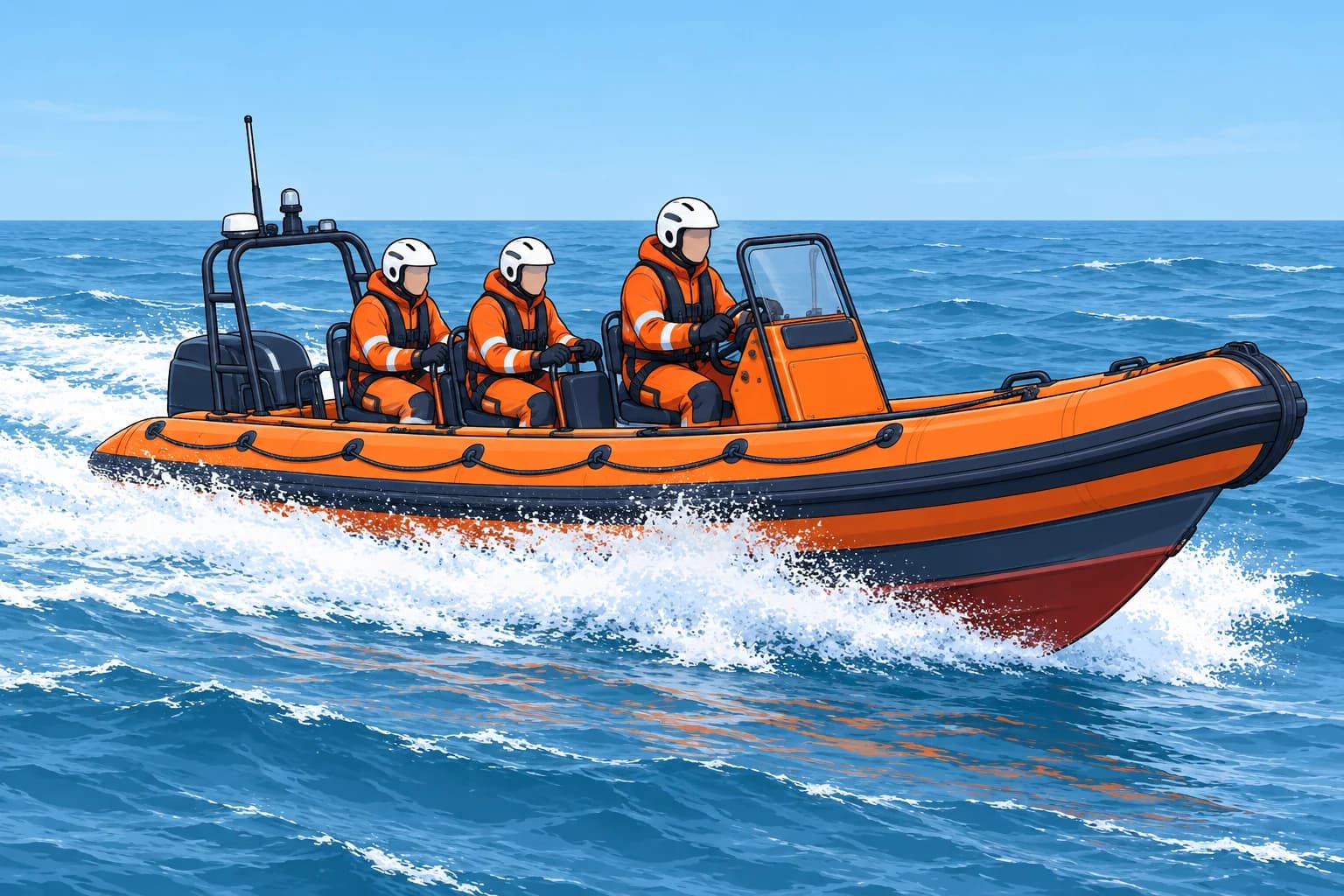
A fast rescue boat is a powerful small craft built to be launched and recovered in bad weather. It needs a trained crew of at least three, properly dressed.
What makes it fast
A fast rescue boat (FRB) is a rescue boat built to the extra rules of LSA Code 5.1.4. Its hull is 6 to 8.5 m long, including inflated tubes or fenders. It can run for at least 4 hours at 20 knots in calm water with a crew of three, and at 8 knots fully loaded. It must be launched and recovered safely in adverse weather and sea conditions. Ro-ro passenger ships must carry one; offshore and other ships often do too.
Built to survive a capsize
An FRB is self-righting, designed to return upright after a capsize using its righting system, or can be quickly righted by no more than two crew. It drains itself or is quickly cleared of water. On capsize, the engine stops automatically or through the helmsman's kill cord, an emergency stop switch on a lanyard. Once upright, follow the maker's checks and reset any tripped emergency stop before restarting. It has a steering wheel, emergency steering and hands-free watertight very high frequency (VHF) radio.
The crew
The crew are at least three: a coxswain in charge, who steers, and two crew who handle lines, the casualty and the radio. Each holds the STCW certificate of proficiency in fast rescue boats (Code section A-VI/2-2), which needs the survival craft and rescue boat certificate first, and shows every five years that they have kept up their competence. On ro-ro passenger ships at least two crews per boat are trained.
Dress for speed and cold
Your personal protective equipment (PPE) includes an immersion suit or anti-exposure suit with a lifejacket, helmet, gloves, boots and eye protection. An immersion suit limits heat loss in water; an anti-exposure suit protects rescue crews against cold and spray. Clip the kill cord to your body before starting the engine if you are the coxswain. Falls and impacts in the boat can cause serious injuries. Brace, hold on and avoid standing.
Key figures
- Hull length
- 6–8.5 m including inflated tubes or fenders
- Speed
- 20 knots for 4 h with crew of 3; 8 knots fully loaded
- Capsize
- Self-righting or righted by no more than 2 crew
- Engine on capsize
- Stops automatically or by the kill cord; restartable
- Crew
- At least 3: coxswain and two crew, STCW A-VI/2-2
- Competence
- Evidence of maintained competence every 5 years
Remember
- An FRB is 6–8.5 m long and runs 4 hours at 20 knots with three crew (LSA Code 5.1.4).
- It is self-righting or righted by two crew; the engine stops on capsize.
- At least three FRB crew; STCW A-VI/2-2 competence must be evidenced every five years.
- Suit, lifejacket, helmet, gloves and eye protection; the coxswain wears the kill cord.
Common mistakes
Wrong: The kill cord gets in the way, so hook it to the console.
Right: Clip it to your body: if you are thrown from the helm, the engine must stop.
Wrong: A lifejacket is enough for a short trip in summer.
Right: Wear a suit, lifejacket, helmet and eye protection: speed, spray and impacts injure crews in any season.
Wrong: Any rescue-boat crew can take the FRB out.
Right: FRB crews need the A-VI/2-2 certificate and regular practice in that boat.
Worked case
Your ro-ro ferry's FRB is ordered away to a capsized dinghy. One trained crew member is ashore; a deckhand without FRB training volunteers.
Show the answer
Use the second trained crew, not an untrained volunteer: the boat needs a coxswain and two trained crew. Each dresses in a suit, lifejacket, helmet, gloves and goggles. The coxswain clips the kill cord on, checks the VHF headset and engine, and reports ready to the officer in charge of the launch.
Practice question
A proposed FRB achieves 20 knots with three crew for four hours in calm water, but only 7 knots fully loaded. Does it meet the stated speed requirements?
- Yes; the three-crew speed is sufficient
- No; loaded speed must be at least 8 knots
- Yes; the loaded speed is only advisory
- No; loaded speed must be at least 20 knots
Show the answer
Answer: B. Both loading conditions must meet their respective requirements: at least 20 knots for four hours with three crew in calm water, and at least 8 knots fully loaded. A loaded speed of 7 knots fails the second requirement.
2 · Launching
The launching appliance and launching under way
An FRB davit absorbs shocks and keeps the wire tight. Launch in the lee with the painter rigged; start and check the engine as the maker permits before hook release.
A davit built for waves
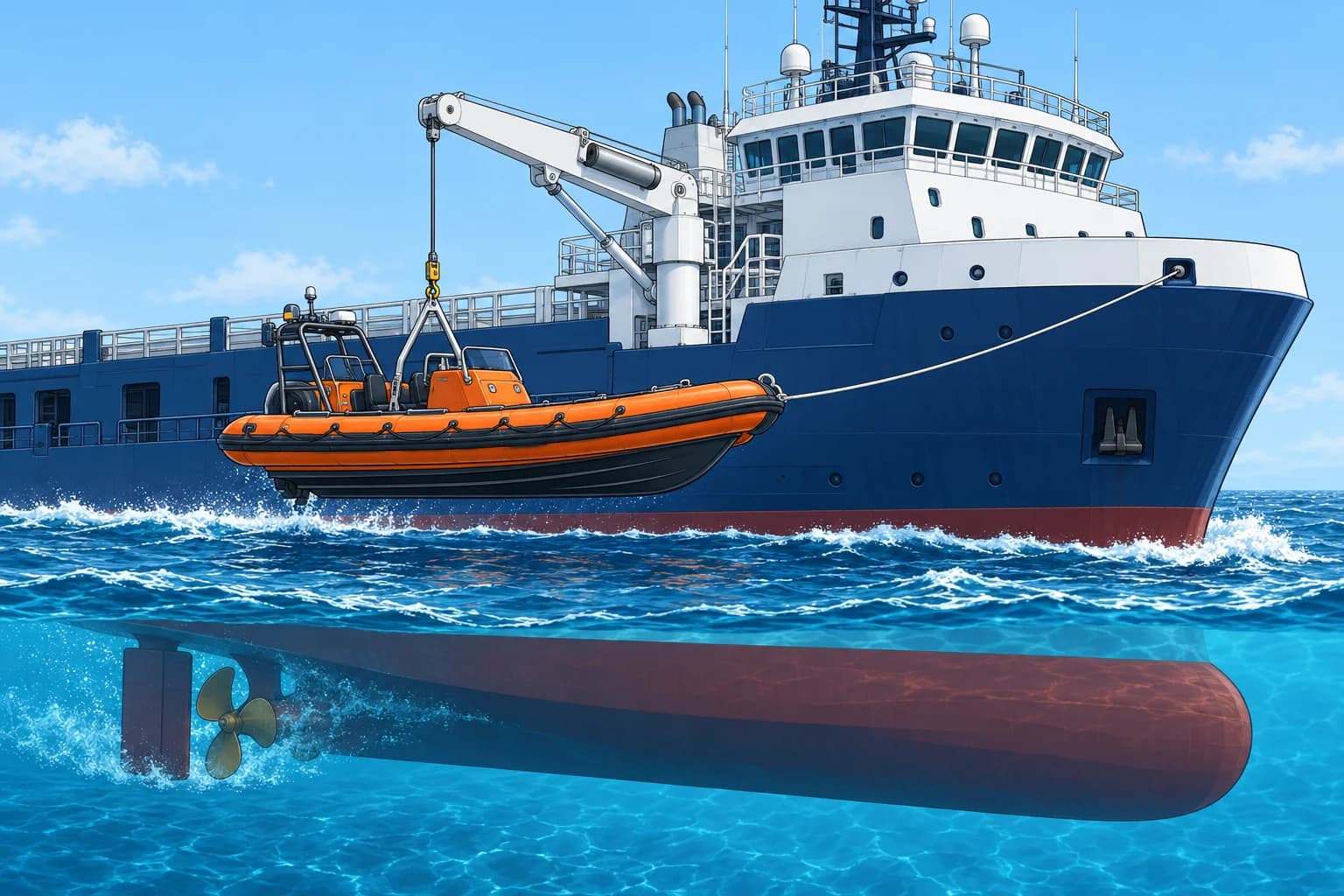
An FRB davit, the boat-launching crane, meets extra rules (LSA Code 6.1.7). A shock absorber with a damping element softens the jerks when the boat meets waves. An automatic high-speed tensioning device, often called heave compensation, keeps the wire from going slack as the boat rises and falls. The brake acts gradually. The loaded boat is lowered at not more than 1 m/s, and the winch hoists it with six people aboard at not less than 0.8 m/s.
One hook
A single-point suspension hook holds the boat at one lifting point. Know whether your fitted hook releases only off-load, when the water supports the boat, or also on-load, while carrying weight. Use its approved release procedure only when fully waterborne. Check the hook and any bridle, the lifting sling, before launch.
Launching under way
Agree slow, steady headway, forward movement through the water, and course with the bridge. Launch on the lee side, sheltered by the ship. Attach the painter, a line controlling the boat alongside, led forward to the ship, before lowering. Start only when the engine's cooling arrangements and maker permit; check steering before releasing the hook. If immersion is required, do these checks waterborne. Release the hook fully waterborne and running with the ship. Steer away from the ship while still attached to the painter, then release it and motor clear.
Who does what
The officer in charge directs the launch. A trained, designated operator controls the davit, using agreed signals with the coxswain. The coxswain confirms readiness and releases the hook under the approved procedure. Confirm who operates each control and who gives release and stop signals. Agree hand signals and the VHF channel before starting. Keep crew seated and holding on until clear of the ship.
Key figures
- Launching appliance
- LSA Code 6.1.7: shock damping and high-speed tensioning
- Lowering speed
- Not more than 1 m/s fully loaded
- Hoisting speed
- At least 0.8 m/s with 6 persons and equipment
- Brake
- Gradual action; extra dynamic load ≤ 0.5 × working load
- Suspension
- Fixed single-point hook where possible
- Launch
- Lee side, slow steady headway, painter rigged forward
Launching an FRB with the ship under way
- Ship steady at slow speed with the boat on the lee side; brief signals and channel. — A steady lee and agreed signals make the launch predictable.
- Crew aboard in full PPE; coxswain clips on the kill cord; painter attached forward. — The painter holds the boat against headway; the kill cord stops the engine if the coxswain falls.
- Complete the maker's permitted pre-lowering checks. Start the engine here only if its cooling arrangements allow. — Some engines need cooling water before starting; propulsion and steering must be ready before release.
- Lower steadily under the approved tensioning procedure. Once waterborne, start the engine if not already running and check steering before hook release. — A slack wire that snatches tight can injure the crew and damage the boat.
- Release the hook under its approved procedure only when fully waterborne and running with the ship. — The water supports the boat, allowing release as the fitted hook requires.
- Steer away on the painter, then release it and motor clear. — Turning away first keeps the boat from being drawn under the flare or towards the propeller.
Remember
- The FRB davit has a shock absorber and high-speed tensioning to keep the wire tight.
- Lowering is at most 1 m/s; hoisting at least 0.8 m/s with six people.
- A single-point hook holds one lifting point; follow its approved waterborne release procedure.
- Launch on the lee side at slow headway with the painter rigged and the engine running.
Common mistakes
Wrong: Change the ship's speed during an agreed under-way launch without warning.
Right: Maintain the agreed course and speed throughout this launch. Whether to launch stopped or under way follows the ship's approved procedure and conditions.
Wrong: Start the engine only after the hook is released.
Right: Start only when cooling arrangements and the maker permit. If immersion is required, wait until waterborne; have the engine running and steering checked before hook release.
Wrong: Release the painter at the same moment as the hook.
Right: Release the hook, steer away on the painter, then release the painter and motor clear.
Worked case
The bridge confirms a safe lee and steady slow headway. As the FRB becomes waterborne, a crew member reaches for the painter release while the suspension hook is still connected.
Show the answer
Keep the painter attached. Start the engine only when cooling arrangements and the maker permit; confirm it is running and steering is checked. Release the hook only when fully waterborne and running with the ship. Steer away on the painter, then release it and motor away.
Practice question
What does the high-speed tensioning device on an FRB winch do?
- Keeps the wire from going slack
- Lowers the boat faster in calm water
- Stops the engine if the boat capsizes
- Releases the hook when waterborne
Show the answer
Answer: A. It keeps the wire taut as the boat rises and falls, so it does not snatch.
3 · Heavy weather
Handling an FRB in heavy weather, and righting it
Control speed and heading to avoid slamming, surfing and broaching. Keep the crew braced and know the boat's capsize procedure.
Head seas
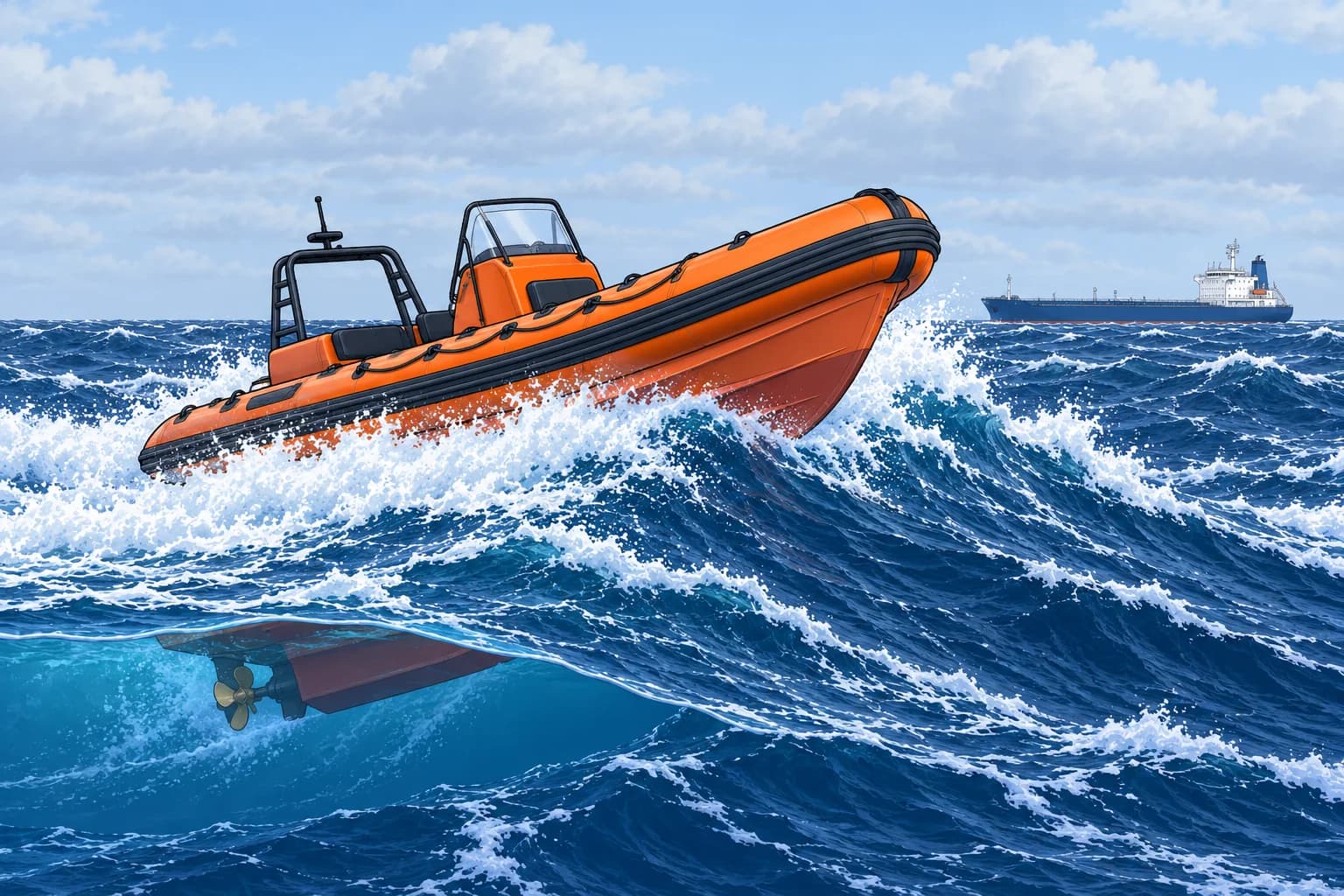
In non-breaking head seas, a slight angle off the bow can reduce slamming. Adjust speed to each wave. Use enough power to climb; ease before the crest to limit leaping and slamming. Avoid breaking crests where possible. For steep or unavoidable breaking waves, use the heading and controlled speed taught for this FRB; do not apply one fixed angle or let them strike the boat's side. Warn the crew before hard impacts. Heavy spray is normal; airborne slams injure crews and damage the boat.
Following and beam seas
In following seas, adjust course and speed to avoid surfing down a steep wave face. The bow can bury and the boat can broach, turning uncontrollably beam-on, side-on to the sea. Stay on the back of a suitable wave only while safe; do not accelerate simply to match wave speed. Avoid lying beam-on to breaking seas. If you must cross, wait for a quieter interval and turn smoothly at a controlled speed without slamming.
Crew and boat
Crew sit low or brace, with knees bent, holding on. The coxswain warns before each big wave and before turns. Keep weight low and trimmed as the maker advises; in head seas, weight aft helps the bow rise. Check the crew after any hard landing.
If it capsizes
The engine stops automatically or through the kill cord. Stay with the boat; keep everyone clear of the propulsion unit and righting path. Follow this boat's trained righting procedure; some systems need activation. Keep clear as it rolls upright. Account for everyone and recover the crew. Clear water and complete the maker's post-capsize checks. Before restarting, select neutral; check people and lines are clear of propulsion. Reset an emergency stop if fitted and tripped, then restart as instructed. Report to the ship.
Key figures
- Non-breaking head seas
- Slight angle off the bow; adjust speed and ease before the crest
- Following seas
- Control speed; avoid surfing, bow burial and broaching
- Beam seas
- Do not lie beam-on to breaking waves
- After capsize
- Trained righting; crew clear; maker checks before restart
Remember
- In non-breaking head seas, use a slight angle and ease off before the crest to limit leaping and slamming.
- In following seas control speed to avoid surfing and broaching; stay on a suitable wave back only while safe.
- Avoid lying beam-on to breaking seas; cross in a quieter interval at a controlled speed.
- Capsize: trained righting; crew and lines clear; maker checks, neutral and stop reset if needed before restart.
Common mistakes
Wrong: Keep full power over every crest to get there faster.
Right: In non-breaking head seas, ease before the crest to limit slamming. For steep or breaking waves, use this FRB's trained heading and speed.
Wrong: Run down the face of a following wave for extra speed.
Right: Adjust speed and course to avoid surfing, bow burial and broaching. Stay on a suitable wave back only while safe; do not accelerate simply to match wave speed.
Wrong: After a capsize, swim for the ship.
Right: Stay with the boat, keeping clear of propulsion and its righting path. Use the trained righting procedure and the maker's checks before any restart.
Worked case
Returning to the ship with a following sea of 2.5 m, your FRB starts surfing down the face of each wave and the bow buries at the bottom.
Show the answer
Reduce speed to avoid surfing and bow burial while maintaining steering control. Adjust course as needed; stay on a suitable wave back only while safe. Keep weight as the maker advises and warn the crew to brace. If you must cross the sea, wait for a quieter interval and turn smoothly at a controlled speed. Tell the ship your estimated arrival time so it can prepare for recovery.
Practice question
How do you meet non-breaking head seas in an FRB?
- Square on; hold full throttle over crests
- At a slight angle; ease before the crest
- Beam-on; let each wave pass beneath you
- Stern first; go astern slowly over crests
Show the answer
Answer: B. In non-breaking head seas, a slight angle and easing before the crest help limit leaping and slamming; they cannot guarantee prevention. For steep or breaking waves, follow this FRB's trained handling technique.
4 · Casualty pick-up
Approaching and recovering a person in the water
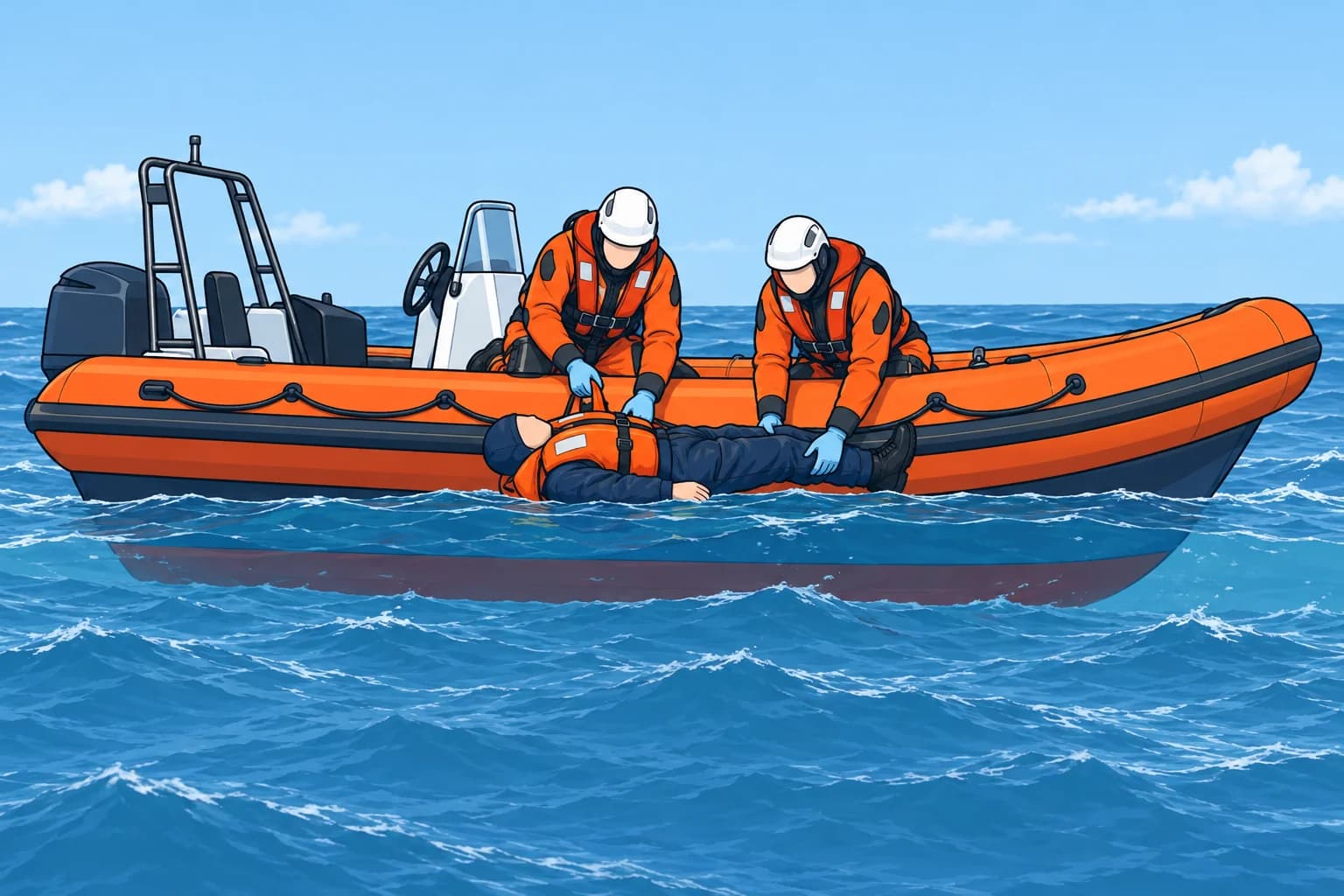
Find the person, approach slowly into wind or sea, stop propulsion as required and keep clear of it. Two crew support torso and legs for a horizontal lift.
Finding them
The ship's bridge guides you by VHF radio, giving bearing and distance from the ship. At low height, a head in the water is hard to see: one crew member points and never looks away. Follow the ship's search directions; search patterns are covered in Emergencies: search and rescue near the coast.
The approach
Slow early. Approach slowly into the dominant wind or sea, keeping the person in the coxswain's view and clear of propulsion. With propeller drive, select neutral and ensure the propeller has stopped; stop the engine if necessary. Waterjet neutral does not stop the impeller, the rotating pump blades: follow the maker's recovery procedure and shut down when required. Keep the person and lines clear of the propeller, jet intake and outlet.
Getting them aboard
Two crew recover the person as horizontally as possible. Use the boat's recovery net or a parbuckle, a sling or net that rolls them aboard. For a trained manual lift, support the upper body and pelvis or legs together. A lifejacket lifting loop alone does not support the lower body; use only a designated lifting point, never arbitrary clothing. Handle gently. For medical care after recovery, see Emergencies: survival in water.
Radio and signals
The FRB carries a hands-free watertight VHF. Report when you are away, when you sight the person, when they are aboard and their condition, and your estimated time of arrival (ETA) back at the ship. Agree hand signals with the ship for when the radio cannot be heard. Agree the communication link with the helicopter, directly on its assigned channel or through the ship. Report your position and intentions, clarify instructions and keep clear of its winching area unless directed.
Key figures
- Final approach
- Slowly into wind or sea; person on the coxswain's side
- Close to the person
- Propeller stopped; waterjets: maker shutdown procedure; keep clear
- Lift
- Two crew; support torso and legs for a horizontal lift
- Radio
- Hands-free watertight VHF; agreed hand signals as backup
Recovering a person in the water
- Slow down early and keep one crew member pointing at the person. — At sea level the person disappears behind every wave.
- Make the final approach slowly into the wind or sea, person on the coxswain's side. — You keep control and the coxswain can see them all the time.
- Select neutral and ensure the propeller has stopped; stop the engine if needed. For waterjets, follow the maker's recovery shutdown procedure. Keep people and lines clear of propulsion. — Neutral alone may not stop propulsion; a stationary propeller remains a contact hazard.
- Two crew position the approved recovery aid or, for a trained manual lift, support the upper body and pelvis or legs. Use designated lifting points, never arbitrary clothing. — A lifting loop alone leaves the lower body unsupported.
- Lift together using the trained method, keeping the person as horizontal as possible. — Supporting the torso and legs keeps the person horizontal and secure.
- Report to the ship and return gently. — The ship prepares the recovery and medical care; slamming harms the casualty.
Remember
- One crew member points at the person at all times.
- Final approach slowly into wind or sea, person on the coxswain's side.
- Propeller stopped near the person; for waterjets, follow the shutdown procedure. Keep everyone clear of propulsion.
- Two crew support torso and legs, lifting as horizontally as possible; report to the ship.
Common mistakes
Wrong: Approach fast and stop with a burst astern next to the person.
Right: Slow down early. Ensure the propeller has stopped before the person reaches its danger area. For waterjets, follow the maker's shutdown procedure. Keep the person clear of propulsion throughout.
Wrong: Pull the casualty up by the arms, upright.
Right: Two crew use the boat's trained recovery method, supporting torso and legs for a horizontal lift. Use designated lifting points, never arbitrary clothing.
Wrong: Talk to the ship only when you are back alongside.
Right: Report each stage: away, sighted, aboard with condition, and your ETA.
Worked case
Your FRB reaches a man in a lifejacket who is shivering hard and cannot hold a line. Wind 15 knots, short sea of 1 m.
Show the answer
Slow down, keep a crew member pointing and approach slowly into the dominant wind or sea, keeping him in the coxswain's view. Stop propulsion as the installed system requires and keep him clear of it. Two crew use approved recovery gear or a trained manual lift, supporting torso and legs as horizontally as possible. Keep him supported, report his condition and return gently. For medical care, see Emergencies: survival in water.
Practice question
How should the final approach to a person in the water be made?
- Downwind at moderate speed
- Across the sea at full speed
- Astern, propeller turning
- Slowly, into the wind or sea
Show the answer
Answer: D. A slow approach into the wind or sea keeps the boat controlled and the person in view.
5 · Recovery and care
Recovering the FRB in a seaway, maintenance and drills
Match the ship's speed for recovery. Hook on as the boat rises, confirm the hook is reset and locked, then hoist promptly. Keep boat, davit and crew ready.
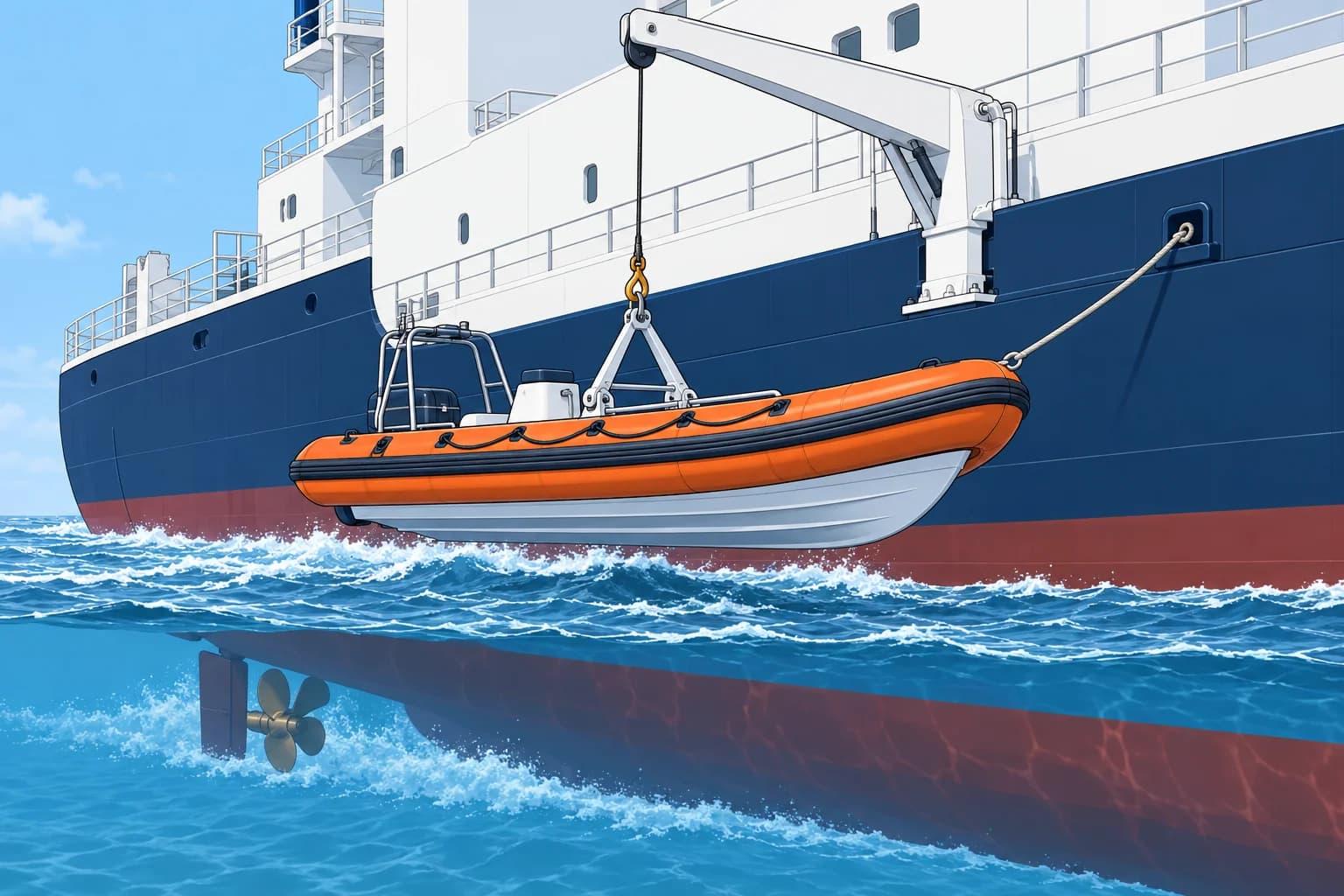
The approach
Wait until the bridge confirms a safe lee, the side sheltered by the ship, and steady course and speed. Approach from astern on the lee side, come under the davit, the boat-launching crane, and match the ship's speed. Take the painter, a line controlling the boat alongside, or a recovery line, so the boat rides steadily under the hook. Ship handling for the lee is in Manoeuvring: heavy weather.
Hooking on
Bring the hook within safe reach; keep clear of a swinging fall block, the pulley assembly above it. Use foul-weather recovery strops, lifting straps that keep a dangerous heavy block away from the crew, where provided. As the boat rises, connect the lifting point and confirm the hook is fully closed, correctly reset and locked. Signal the winch operator, then take the weight and hoist promptly using the approved system procedure. Stay seated, hold on and keep clear of the fall, the hoisting wire.
Upkeep
Check weekly: tubes and pressure, hull, fuel, engine operation as the maker allows, kill cord, lights, radio and equipment. Check the davit, wire, damper and hook to the manual. Under MSC.402(96), certified personnel of the manufacturer or an authorised service provider carry out annual thorough examinations and operational tests. Five-yearly work includes thorough examination, release-gear overhaul and overload operational tests by appropriately certified personnel.
Drills
Rescue boats are launched with their crew and manoeuvred each month where reasonable and practicable, and at least every 3 months (SOLAS III/19). FRB crews practise launching, handling, recovery and righting in different conditions, building up from calm weather. Brief every launch, stop any drill that becomes unsafe, and debrief afterwards.
Key figures
- Recovery position
- From astern, lee side, matching the ship's speed
- Hook on
- Boat rising; confirm hook reset and locked, then hoist at once
- Foul weather
- Recovery strops where heavy fall blocks are a danger
- Drills
- Launch monthly if practicable; at least every 3 months
- Servicing
- Annual examination/tests; 5-year examination, overhaul, overload tests
Remember
- Approach from astern into the lee, match the ship's speed and ride on the painter.
- Hook on as the boat rises; once the hook is confirmed correctly reset and locked, signal to hoist at once.
- Stay seated and clear of the fall; use foul-weather recovery strops where needed.
- Launch and manoeuvre monthly where practicable, at least every 3 months.
Common mistakes
Wrong: Hook on in the trough and wait for the ship's crew to take the weight.
Right: Hook on as the boat rises. Confirm the hook is fully closed, correctly reset and locked, then signal to hoist promptly using the approved procedure.
Wrong: Grab the swinging hook as soon as it comes near.
Right: Wait until it is steady and in reach; a swinging hook and block can break bones.
Wrong: Only practise FRB launches in harbour on calm days.
Right: Build up to realistic conditions with care, so the crew can launch and recover when it matters.
Worked case
The FRB returns with a survivor. The ship has stopped and is rolling in a 2 m beam swell, with the davit on the weather side.
Show the answer
Tell the bridge the recovery side is exposed. Hold clear until a safe lee and agreed steady speed are confirmed. Approach from astern, match speed and take the painter. Connect as the boat rises, confirm the hook is fully closed, correctly reset and locked, then signal to hoist at once under the approved procedure. Keep crew seated and clear of the fall.
Practice question
From where does the FRB normally approach the ship for recovery?
- From ahead, on the weather side
- From abeam, at right angles
- From astern, on the weather side
- From astern, on the lee side
Show the answer
Answer: D. Coming up from astern in the lee lets the boat match the ship's speed and settle under the davit.