
Emergencies at sea · Level R3 · 5 parts · about 14 min
Drills: emergencies step by step
5 short parts: Safety briefing · Drills · Roles & checklists · VHF practice · Debrief. Each part explains the idea, then gives the points to remember, the common mistakes, a worked case and a practice question; the Academy unit adds all 25 check questions.
1 · Safety briefing
The safety briefing before departure
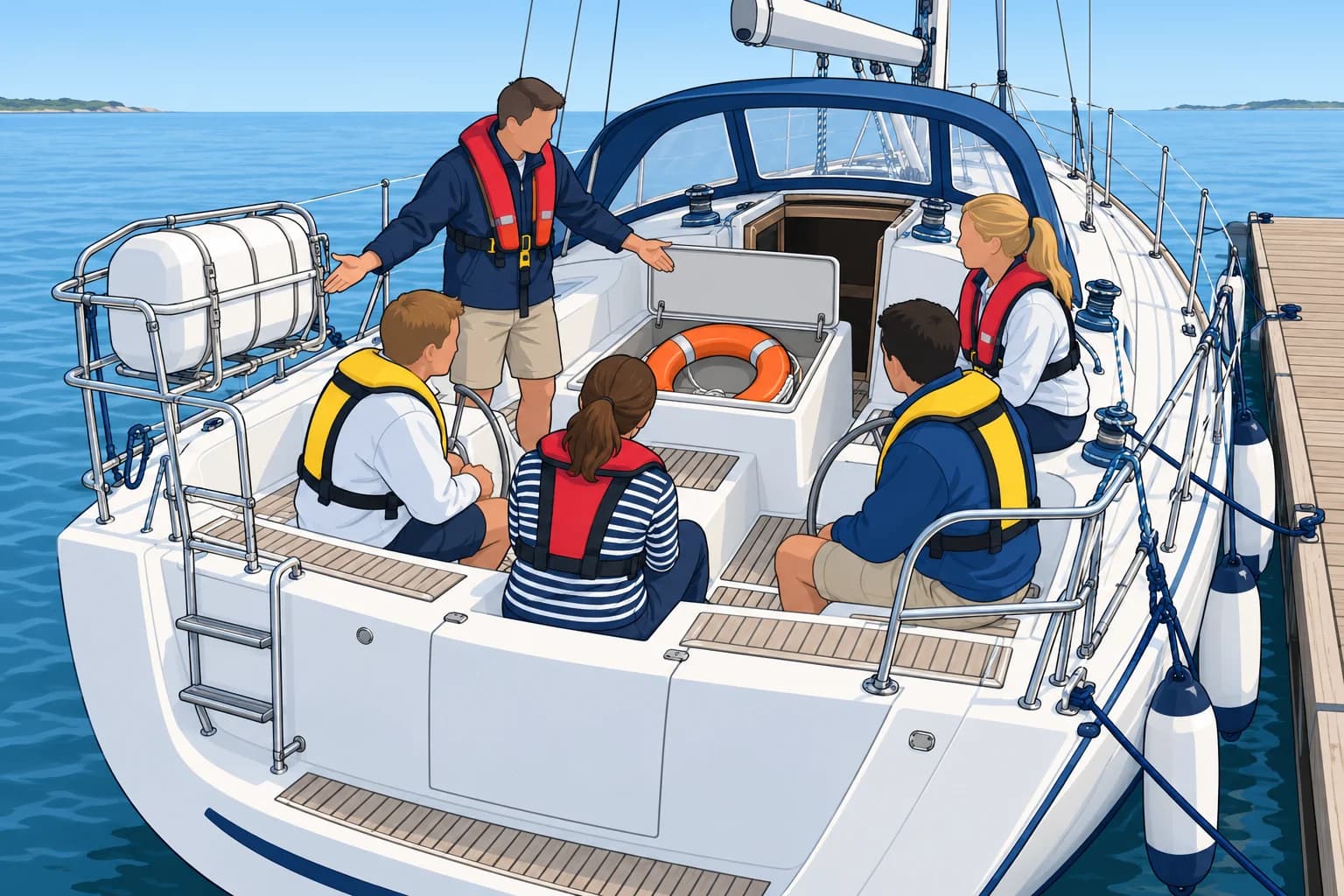
Before you cast off, every person aboard learns where the kit is, how to use it and what to do if the skipper is the one in trouble.
Why brief
A crew that has never seen the liferaft or the radio cannot use them in the dark. The briefing turns passengers into crew. Do it every time with new people aboard, and refresh it at the start of a season or a long passage. Keep it short, practical and on the spot: show, don’t just tell.
What to cover
Lifejackets and harnesses: when to wear them and how they fit. Moving safely on deck: one hand for you, one for the boat. The heads, the marine toilet, the cooker and gas, and the engine. Locate extinguishers, fire blanket, bilge pumps (which remove water from inside the hull), bungs (tapered plugs for leaks) and first-aid kit. Show the liferaft, grab bag (a bag of emergency supplies), flares and EPIRB (emergency position-indicating radio beacon).
Calling for help
Explain, without transmitting, that DSC (digital selective calling) distress alerting uses Channel 70 automatically, while a voice Mayday uses Channel 16. Keep a radio card with the boat’s name, call sign, MMSI (the radio’s nine-digit identity) and position instructions. For man overboard (MOB): shout the alarm, throw flotation, point continuously and press the plotter’s MOB button to mark the position.
Personal matters
Ask about swimming ability, seasickness, medical conditions, allergies and medicines, and note them privately. Agree the rules for alcohol, smoking and going on deck at night. Tell the crew the passage plan and the weather, and who to wake if in doubt. Write in the log that the briefing was given.
A safety briefing in order
- Fit everyone’s lifejacket and harness, and say when they must be worn. — Checking the fit beforehand avoids delay and catches problems before an emergency.
- Walk the deck: handholds, clipping points, jackstays (deck safety lines for clipping on), winches and lines. — Most injuries and falls happen on deck.
- Go below: heads, gas and cooker, engine start and stop, seacocks (valves at hull openings), pumps and bungs. — Misused heads, gas and seacocks can flood or explode the boat.
- Show the fire kit, first-aid kit, flares, liferaft, grab bag and EPIRB. — Everyone must reach them without asking.
- Identify distress controls without operating them. Rehearse the voice Mayday aloud without transmitting, and demonstrate MOB first actions. — The skipper may be the casualty.
- Ask about health and swimming, give the passage plan, and log the briefing. — You need to know your crew; the log shows the briefing was given.
Remember
- Brief every new crew, and refresh at season start or before long passages.
- Show the kit in place; do not just list it.
- Every person can send a DSC alert and voice Mayday.
- Cover MOB first actions, engine stop and the gas routine.
- Ask about health and swimming; log the briefing.
Common mistakes
Wrong: A safety card on the bulkhead replaces the briefing.
Right: A card helps, but people remember what they were shown and did.
Wrong: Experienced friends do not need a briefing.
Right: They do not know this boat: where her kit is, how her radio and gas work.
Worked case
Four friends join you for a day sail. Two have never sailed. You have 15 minutes before the bridge opens. How do you brief them?
Show the answer
Do not let the bridge opening rush the briefing; wait for the next opening if needed. Fit lifejackets and harnesses, walk the deck and show the heads, gas and engine controls. Locate fire, first-aid and abandon kit. Rehearse help calls off air and MOB first actions. Ask crew to show key controls back to you. Cover health, swimming, rules and the passage plan, then log the briefing.
Practice question
When should a safety briefing be given?
- Only on the first trip of the season
- Before departure, whenever new crew join
- Only for passages longer than a day
- After the first hour at sea, once settled
Show the answer
Answer: B. Anyone new must be briefed before you leave; refresh it for everyone at intervals.
2 · Drills
Running MOB, fire and abandon-ship drills
A drill done once in calm water is worth ten read about. Practise MOB, fire and abandon-ship until the first steps happen without thinking.
Why drill
Under stress, people do what they have practised and freeze at what they have not. For races using World Sailing’s Offshore Special Regulations (OSR), crews must practise crew-overboard recovery and abandoning ship at least annually. Make drills short, safe and regular, and include fire. Start in calm water with plenty of room, then try a little more wind or the dark.
MOB drill
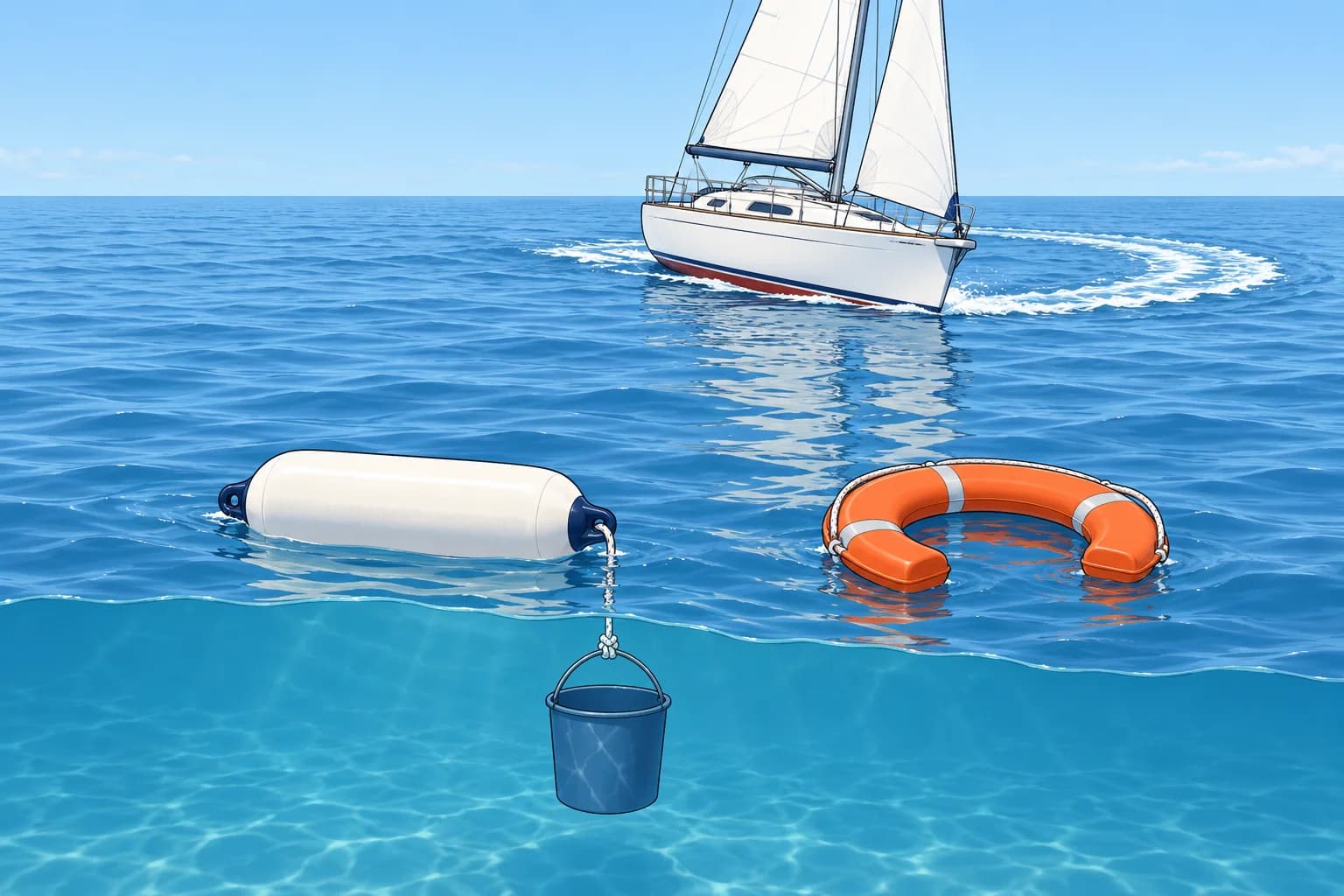
Throw a fender tied to a bucket, which drifts like a person, without warning, shouting ‘Man overboard!’. The crew run the first actions: shout, throw, point, press MOB, call. The helm chooses the manoeuvre and returns. Recover the dummy aboard using your boat’s planned recovery method. Then let a less experienced crew member helm while the skipper plays ‘overboard’ by watching only.
Fire drill
Announce ‘Drill: fire in the engine compartment’. Identify the engine stop, fuel shut-off and ventilation closures. Simulate operating them unless the skipper has confirmed that a real shutdown is safe and planned. Identify the fire port (an opening for discharging an extinguisher); do not open the engine compartment or discharge equipment. Rehearse a Mayday off air. Vary the scenario: galley, cabin, electrical. Check that everyone can find the extinguishers and fire blanket.
Abandon-ship drill
On a calm day at the mooring, walk through the steps: Mayday and EPIRB (simulated), warm clothes and lifejackets, grab bag to the cockpit, liferaft ready, who does what. Time it. Take a sea survival course: inflating and boarding a real raft in a pool is the best practice there is, as it is not done with your own raft.
Stay safe
Never use a person in the water for a drill. Simulate radio calls on a trainer, or with an instructor using a properly isolated dummy load, never on air. Tell the crew it is a drill, keep watch for other boats and stop if anything goes wrong.
Running a man-overboard drill
- Pick calm water with room, brief that drills will happen, and keep a lookout. — The drill must not create a real emergency.
- Throw the dummy without warning and shout ‘Man overboard!’. — Surprise tests the first reactions.
- Let the crew run the first actions and the manoeuvre while you watch. — They learn by doing, not by being told.
- Practise bringing the dummy aboard using your boat’s recovery equipment. — This rehearses the recovery sequence; a light dummy does not prove you can lift a person aboard.
- Time it and swap roles so another crew member helms. — Anyone may have to do it, including when the skipper is overboard.
- Debrief briefly on what worked and what to change. — Each drill makes the next one better.
Remember
- Practise MOB and abandonment at least annually; include regular fire drills.
- Use a fender and bucket as an MOB dummy; never a real person.
- Swap roles so others helm, not only the skipper.
- Simulate radio calls off air.
- A sea survival course gives real liferaft practice.
Common mistakes
Wrong: Inflate your own liferaft for practice.
Right: It must then be repacked by a service station. Practise on a course with a training raft.
Wrong: Use a real Mayday on Channel 16 to make the drill realistic.
Right: Practise on a simulator or with an instructor using a properly isolated dummy load. A false Mayday can start a real search.
Worked case
You planned an MOB drill today. The crew are new, the harbour entrance is busy and the wind is rising. Tomorrow offers sheltered water. What do you practise now, and what waits?
Show the answer
Do a clearly announced walkthrough at the berth now. Rehearse roles and calls off air. Postpone the dummy recovery until you have calm, clear water and a dedicated lookout. Brief stop conditions, then run the drill, swap roles and debrief. Fit fire and abandon-ship walkthroughs around safe conditions, rather than a fixed timetable.
Practice question
What makes a good man-overboard dummy?
- A fender tied to a bucket
- A spare lifejacket alone
- A brightly coloured cushion
- A real person in a drysuit
Show the answer
Answer: A. The bucket drags in the water so it drifts like a person, and the fender keeps it afloat.
3 · Roles & checklists
Roles and checklist culture
In an emergency, everyone needs a job and the skipper needs a checklist. Decide the jobs before you leave and keep the checklists where you can reach them.
Give everyone a role
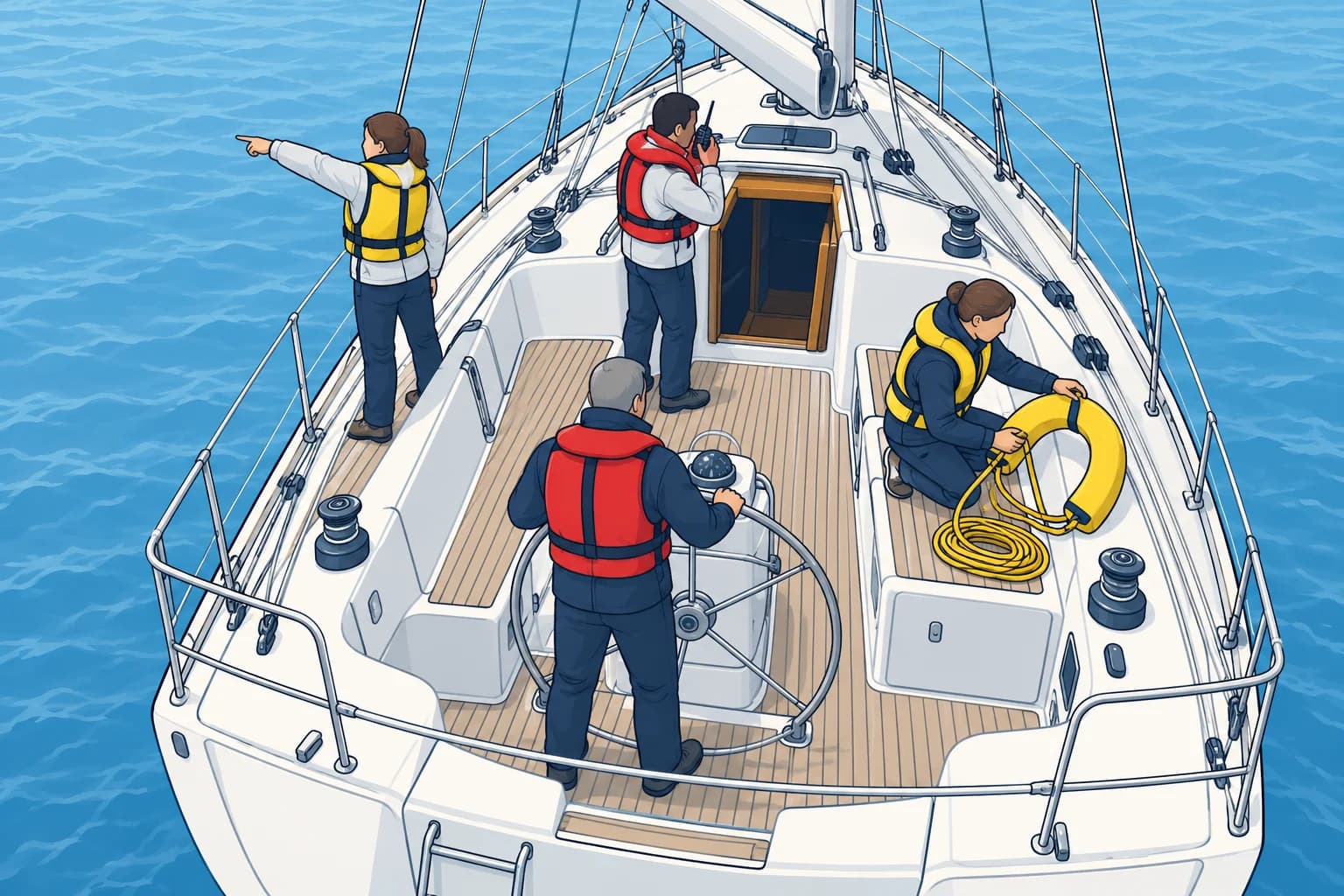
Assign named jobs to suit your crew; combine compatible tasks and set priorities. For MOB: a spotter who keeps pointing, someone to steer, radio and recovery gear. For fire: isolate the source where safe, call for help and prepare to abandon. Attempt to extinguish a small fire only if safe, with a clear escape route; withdraw if unsafe. For abandoning: assign the raft, grab bag and help for anyone needing it.
The skipper leads
The skipper should stay free to think and give orders, not disappear into the fire or the engine. Give clear, short commands to named people: ‘Ana, point at him and don’t stop.’ If the skipper is the casualty, a named second-in-command takes over. Agree this at the briefing.
Checklists
Pilots and ship officers use checklists because stress makes everyone forget steps. Keep short emergency cards for MOB, fire, flooding, abandon ship and the Mayday call, laminated and stowed at the chart table and in the cockpit. Use routine checklists too: before leaving, engine checks, before dark, and arriving.
A culture, not a form
Encourage anyone to speak up: ‘I smell gas’, ‘we’re getting close to those rocks’. Thank them even when it was nothing. Saying out loud what you are going to do, and checking with someone else, catches mistakes before they become emergencies.
Remember
- Agree roles for MOB, fire and abandon ship before you leave.
- The spotter points and never looks away.
- The skipper leads and decides; a named second-in-command takes over if needed.
- Laminated emergency cards at the chart table and in the cockpit.
- Make it normal to speak up and to think aloud.
Common mistakes
Wrong: The skipper should personally do the most important job.
Right: The skipper leads. Doing a task hands-on often means nobody is watching the whole situation.
Wrong: Checklists are for beginners; experienced crews remember.
Right: Stress makes experts skip steps too. Checklists protect everyone.
Worked case
You skipper with three crew. In an engine-fire drill, all three reach for an extinguisher. Nobody handles the shutdown or simulated call. How do you allocate the work?
Show the answer
Keep yourself free to coordinate. Name one crew member for safe engine and fuel shutdown, one for the simulated call, and one for appropriate fire equipment. Attempt only a small fire with a clear escape route; withdraw if unsafe. Assign raft preparation once someone’s first task is complete. Name a deputy and write the priorities on the fire card. Repeat the drill and check for missed tasks.
Practice question
What is the spotter’s job during a man overboard?
- To point at the person and never look away
- To helm the boat back to the person
- To send the DSC alert and the Mayday
- To prepare the sling and the halyard
Show the answer
Answer: A. A head in the waves is lost in seconds. One person does nothing but point.
4 · VHF practice
Practising emergency calls with the VHF
A Mayday is easy to say and hard to get right under stress. Rehearse it off air with a simulator or course, until the actions and words come naturally.
Why rehearse
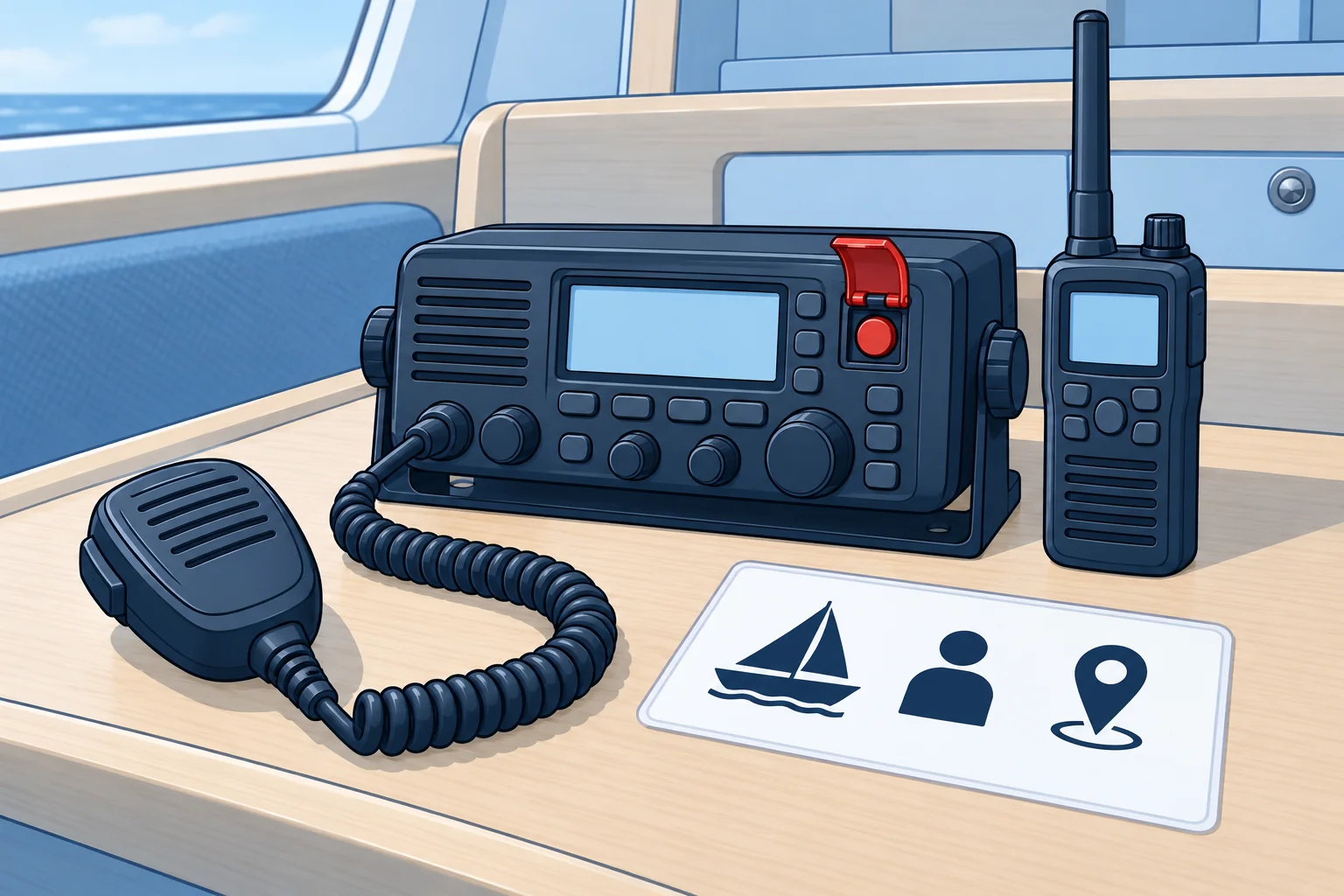
In an emergency, people forget the boat’s name, the position or which button to press. A practised call is clear and complete. Rehearse without transmitting: a real Mayday, even by mistake, can launch a search and endanger rescuers.
How to practise
Use a VHF simulator, a radio course or a manufacturer-confirmed non-transmitting training mode. A dummy load absorbs transmitter power instead of the aerial; use one only in a properly isolated, instructor-controlled setup. On an ordinary live set, identify controls without operating distress controls or pressing transmit. Read the Mayday card aloud. For operating instructions, see the GMDSS lesson on distress calls.
What to practise
In simulation, practise reading your position from the plotter in latitude and longitude, or as a true bearing (measured from true north) and distance in nautical miles from a charted point. Give the number of people and the help you need. Practise switching to Channel 16 and high power, using a handheld VHF from the cockpit or liferaft, and cancelling a false alert.
Routine checks
A radio check with a coast station or marina, where allowed, confirms transmission. A DSC test call to a station that supports these calls checks the DSC link without a distress alert. Check that the radio shows a current position from its built-in or connected GNSS (satellite-navigation) receiver. If unavailable, enter and update position and UTC (Coordinated Universal Time) manually according to its instructions.
Remember
- Rehearse the Mayday off air: simulator, confirmed non-transmitting mode or dummy load in an instructor-controlled setup.
- Practise DSC alerts and voice Mayday only in a confirmed safe training setup.
- Practise reading the position and stating people aboard.
- Use a DSC test call to a compatible station to check the link without a distress alert.
- Check the DSC radio’s position is current, whether automatic or manually entered.
Common mistakes
Wrong: Press the red DSC button for a few seconds to test it.
Right: That can send a real distress alert. Use the test-call function with a compatible station; rehearse alerts only off air.
Wrong: The DSC alert always includes your position.
Right: Check that the radio shows a current position. It may use a built-in receiver, an external feed or manual entry; update manual position and UTC.
Worked case
Your new crew member asks how she can practise a Mayday before the passage. The boat’s VHF is a fixed DSC set. What do you suggest?
Show the answer
Keep the fixed set in normal service. Identify its controls without operating them. Have her read the Mayday card aloud, using the plotter position and stating people aboard and help needed. Practise button presses on a simulator or a set confirmed to be in non-transmitting training mode. For operating instructions, see the GMDSS lesson on distress calls.
Practice question
Why should Mayday practice never be transmitted on air?
- It uses up the radio’s battery
- It may start a real search
- It breaks the radio’s DSC unit
- It is heard only by marinas
Show the answer
Answer: B. Any Mayday received is treated as real. Practise off air.
5 · Debrief
After the incident: debrief and follow-up
After any incident or drill, talk it through: what happened, what worked, what to change. Then fix the kit, update the cards and report if required.
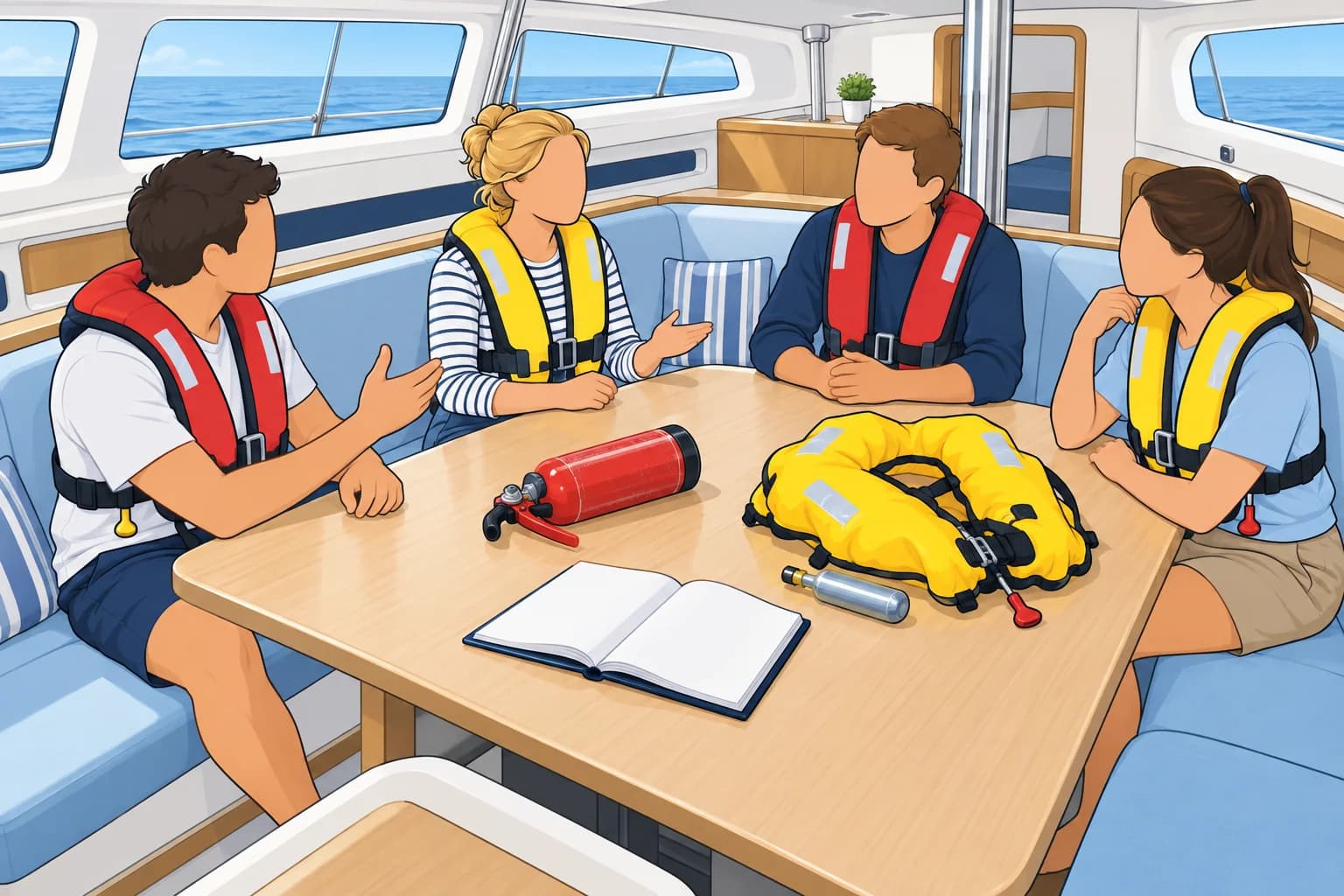
Right after
Once everyone is safe, check people first: injuries, cold, shock. Restore the boat to a safe state: pumps, seacocks, sails, a safe course or a berth. Make a note in the log while it is fresh: times, positions, actions, calls and who did what.
The debrief
Gather the crew when they have rested, within a day. Ask four questions: What did we expect? What happened? Why was there a difference? What will we change? Let the least experienced speak first. Focus on what happened, not on blame. A good debrief makes people want to speak up next time.
Follow-up
Replace or recharge anything used: extinguishers, flares, lifejacket cylinders, first-aid stock. Repair what failed. Update the emergency cards and the briefing with the lessons. If a drill showed a gap, practise that part again soon.
Reporting
Your flag state is the country where your boat is registered. Report serious accidents promptly to the relevant authorities under flag-state and local rules. Notify your insurer as required. Read published accident reports: they show how small mistakes build up and help you prevent similar incidents.
Remember
- People first, then make the boat safe, then log the facts.
- Debrief within a day: expected, happened, why, change.
- No blame; let the least experienced speak first.
- Replace and repair kit; update cards and briefing.
- Report promptly under flag-state and local rules; read accident reports.
Common mistakes
Wrong: Debrief only real incidents, not drills.
Right: Drills are where you find gaps safely. Debrief every one, even for two minutes.
Wrong: Use the debrief to find out whose fault it was.
Right: Blame stops people talking. Focus on what happened and what to change.
Worked case
During a gusty day, a crew member was knocked overboard and recovered in eight minutes. The lifejacket inflated, but nobody could find the recovery sling and the halyard was jammed. What do you do after?
Show the answer
Check the casualty for cold and injury; get medical advice if needed. Make the boat safe. Log times and positions. Restore the lifejacket to service following its instructions. Hold a no-blame debrief: why were the sling and halyard not ready? Secure the sling where the crew can reach it quickly, clear the halyard, update the briefing and MOB card, and drill the recovery again. Report promptly under flag-state and local rules.
Practice question
What comes first after an incident?
- Checking the crew for injury and cold
- Writing up the full report for the insurer
- Holding the debrief with the whole crew
- Replacing the gear that was used up
Show the answer
Answer: A. People first; then a safe boat, then notes, debrief and follow-up.