
Emergencies at sea · Level P4 · 6 parts · about 18 min
Leading the emergency response and coordinating search and rescue
6 short parts: Leading · On-scene lead · Search planning · Mass rescue · Shore support · Afterwards. Each part explains the idea, then gives the points to remember, the common mistakes, a worked case and a practice question; the Academy unit adds all 39 check questions.
1 · Leading
Leading the emergency response on board
The master decides and coordinates; others fight the fire and work the radio. Build the picture, decide out loud, and ask for help early.
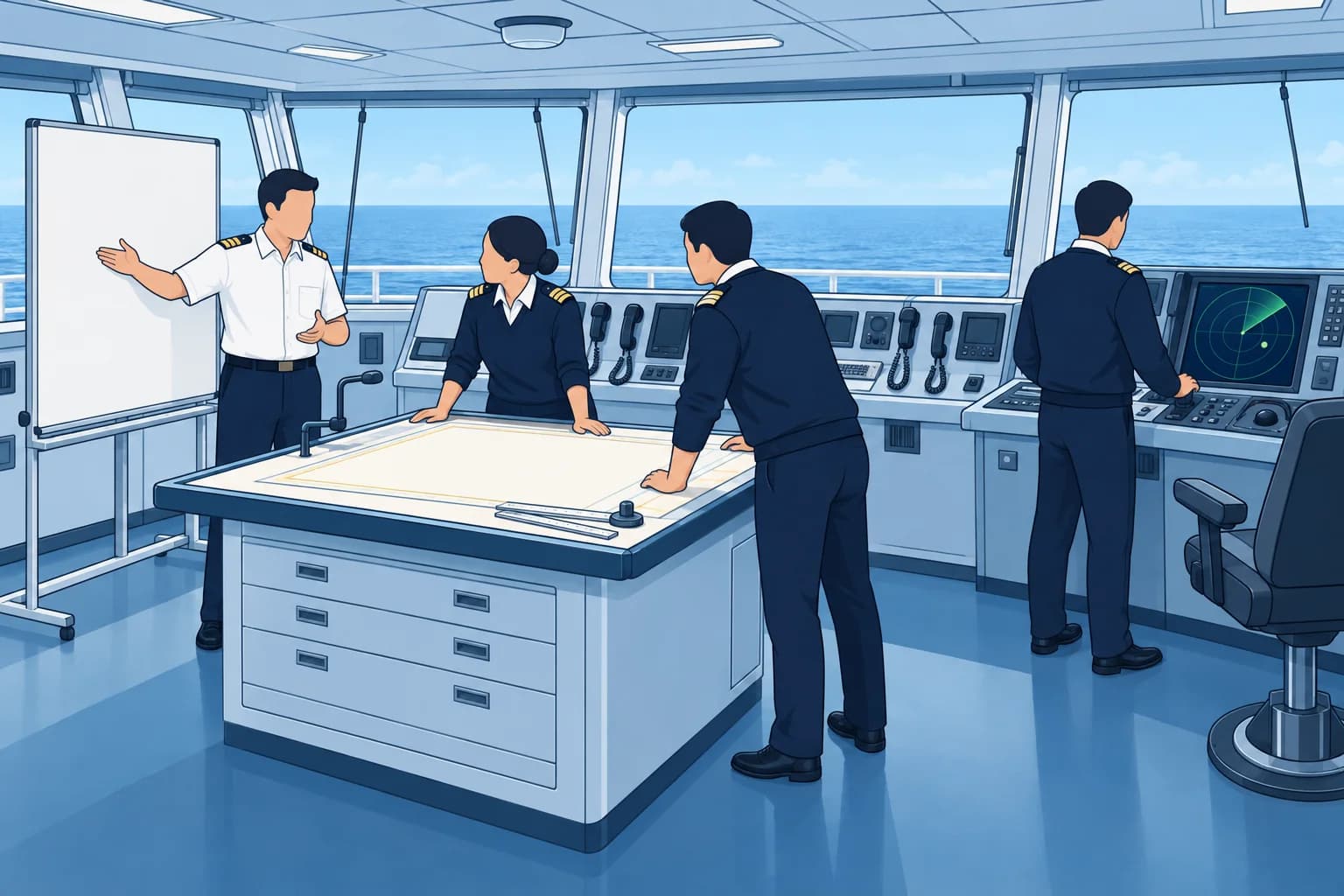
The master's job
In an emergency the master holds the whole picture: people, ship, environment and the outside world. The job is to decide and coordinate, not to hold a hose or work the radio. Hand tasks to the team leaders and to a chief mate who can act as deputy. Keep your span of control small, about three to seven people reporting to you, and protect your time to think.
Build the picture
Ask for reports at a fixed rhythm and in a fixed form: what has happened, what is happening now, what is needed. Use a status board on the bridge: people missing, teams deployed, boundaries, isolations, stability, weather, outside help. Keep the ship safe as a ship too: someone must have the con (control of the ship’s movements) and keep a lookout while everyone else looks at the emergency.
Decide under pressure
Under stress people fix on their first plan and stop seeing new facts. Guard against it: say your plan aloud, ask the team what are we missing? and set a time to review it. Some decisions cannot be undone, such as releasing CO₂, flooding a hold, beaching or abandoning ship. For these, check the facts, weigh the options, decide, and record why. Welcome challenge from anyone; silence is not agreement.
Escalate early
Contact the rescue coordination centre (RCC) and company early. Use PAN-PAN for an urgent safety concern; use MAYDAY when grave and imminent danger requires immediate assistance. Do not wait for company approval. Consider tugs, salvage, refuge or evacuation early: help may take hours to arrive.
Crisis management
An emergency may require sustained crisis management: a controlled fire can leave the ship disabled, or a casualty may be days from port. Plan the next 24 hours: watch rotation and rest, food and water, power and stability, communications. Look after your own rest too: a master who has not slept for 36 hours is a risk to the ship.
Key figures
- Span of control
- About 3 to 7 people reporting to one leader
- Report format
- What happened, what is happening now, what is needed
- Irreversible decisions
- CO₂ release, flooding a hold, beaching, abandoning ship
- Early warning
- Alert RCC and company early; match priority to the danger
Remember
- The master decides and coordinates; team leaders do the tasks.
- A status board and fixed-rhythm reports keep the picture current.
- Say the plan aloud, invite challenge, set a review time.
- Irreversible decisions: check, weigh options, decide, record why.
- Warn the RCC and the company early; plan rest for a long crisis.
Common mistakes
Wrong: A good master goes to the scene and leads from the front.
Right: From the scene you lose the whole picture. Stay where information comes in, usually the bridge, and lead the leaders.
Wrong: Call the RCC only when you are sure you need rescue.
Right: Warn the RCC early, using the priority the danger requires: MAYDAY for grave and imminent danger requiring immediate assistance; PAN-PAN for an urgent safety concern below that threshold. Help may take hours.
Worked case
Your container ship has a fire in a hold, held by CO₂ but still hot. The engine is running, the weather is worsening and the nearest port is 30 hours away. The chief mate has been on deck for 14 hours and the crew are tired.
Show the answer
Treat it as a crisis, not a short emergency. Warn the RCC early, using the priority the danger requires. Brief the company's emergency team. Set a watch rotation so the chief mate and the crew rest, with a deputy named for each post. Keep hold temperatures and boundaries on the status board with fixed reporting times. Decide with the company about the nearest suitable port or a place of refuge, and record each decision and its reasons.
Practice question
What is the master's main role in a serious emergency?
- To lead the attack team at the scene himself
- To decide and coordinate the response
- To keep the radio log personally
- To operate the emergency fire pump
Show the answer
Answer: B. The master holds the whole picture and directs the team leaders; tasks are delegated.
2 · On-scene lead
SAR coordination and acting as on-scene coordinator
The SMC runs the case from the RCC; on scene, someone must coordinate the units. Often that is a merchant ship, and its master.

The chain
Search and rescue (SAR) coordination has three levels. The SAR coordinator (SC) is the person or agency responsible for establishing and managing the SAR service. The SAR mission coordinator (SMC), at the RCC, runs one case: plans the search, tasks units and decides when to end it. At the scene the on-scene coordinator (OSC) coordinates the units. When several aircraft are involved, an aircraft coordinator (ACO) coordinates them and works with the OSC.
Becoming OSC
The SMC normally designates the OSC. Until then, the first suitable unit to arrive takes the role. With the SMC’s agreement, hand over when a better-suited unit is ready. Brief the incoming OSC on the plan, units, areas covered, sightings, hazards, communications and outstanding tasks. Agree when responsibility transfers and tell all units.
What the OSC does
The OSC carries out the SMC's search action plan or rescue action plan, or makes one if none has arrived, and changes it as conditions demand, keeping the SMC informed. The OSC sets the on-scene radio channels, gives each unit a search area or task, keeps surface units and aircraft safely separated, and keeps a log of who searched where and what was found.
SITREPs
The OSC sends situation reports (SITREPs) to the SMC: on arrival, then at the intervals the SMC sets, and whenever something important happens. A SITREP gives weather and sea, units on scene, areas searched, results, plans and needs. Keep it short and factual, and number each one so nobody acts on an old report.
Your ship still comes first
As OSC the master remains responsible for the safety of the ship. Do not give a unit a task beyond its ability, such as sending a small boat to search in a gale. Accept the SMC's help with planning. When survivors are found, decide with the SMC which unit recovers them and where they go.
Key figures
- SC
- Person or agency responsible for managing the SAR service
- SMC
- At the RCC; plans and runs one SAR case
- OSC
- Coordinates the units on scene; designated by the SMC
- ACO
- Coordinates aircraft; works with the OSC
- No OSC yet
- The first suitable unit on scene takes the role
Remember
- SC: manages the service; SMC: runs the case; OSC: coordinates on scene; ACO: coordinates aircraft.
- Until the SMC designates one, the first suitable unit on scene acts as OSC.
- The OSC carries out or makes the action plan, assigns tasks, separates air and surface units.
- SITREPs on arrival, at set intervals and on any important change; numbered.
- The OSC master stays responsible for the ship and does not overtask other units.
Common mistakes
Wrong: Wait for the RCC to name an OSC before coordinating the ships already there.
Right: The first suitable unit on scene takes the OSC role until the SMC designates one.
Wrong: As OSC, give every unit the same task so the search is even.
Right: Match tasks to each unit's ability: a fast boat, a large ship and a helicopter do different jobs well.
Worked case
Your tanker is acting as OSC. Two ships are searching and a helicopter is due. A steering fault now threatens your ability to remain safely on scene. The SMC can contact another suitable ship. What do you prioritise?
Show the answer
Protect your ship first. Tell the SMC and units about the steering fault and your limits. Request transfer to a suitable unit. Brief the replacement on the plan, units, areas covered, sightings, hazards, communications and outstanding tasks. Agree and announce the transfer time. Keep a log and maintain coordination only while safe; do not let OSC duties prevent the response to your own emergency.
Practice question
Who plans and runs an individual SAR case?
- The SAR coordinator (SC)
- The SAR mission coordinator (SMC)
- The on-scene coordinator (OSC)
- The aircraft coordinator (ACO)
Show the answer
Answer: B. The SMC manages the case; the SC is the person or agency responsible for the SAR service.
3 · Search planning
Search planning with the RCC
Understand datum, drift and detection estimates so you can follow the search plan, prepare an initial plan if needed, and report the area actually searched.

Datum
Search planning starts from the datum: the most probable position of the search object, corrected for its movement since the incident. It may be a point (a probable position), a line (possible positions along a route, adjusted for drift) or an area. The SMC computes it. As OSC you may have to make an initial estimate until a plan arrives, and you should feed back anything that improves it, such as debris sightings.
Drift
The object moves with the total water current (tidal stream, ocean current and wind-driven current) and with leeway, the push of the wind on the part above water. Leeway depends on the object. A person in the water has little; a liferaft without a drogue (a drag device that slows drift) has much more and may drift at an angle to the wind. Errors grow with time, so the search area grows the longer the case lasts.
Detection
Sweep width (W) is an effective detection width for the object and conditions, not a maximum sighting range. Use the relevant tables and correction factors. Track spacing (S) is the distance between search legs. Coverage factor C = W ÷ S: W 1.5 NM and S 3 NM give C = 0.5. Probability of detection (POD) is the chance of finding the object if it is there. With fixed effort, tighter spacing raises POD but covers less area; C = 1 does not guarantee detection.
The trade-off
The planner balances the probability of containment (POC), the chance that the object is inside the area, against POD. Their product is the probability of success (POS): POS = POC × POD. A small area searched thoroughly fails if the object is outside it; a huge area searched thinly may miss it inside. The SMC usually makes that call; your job is to follow the plan accurately and report what you really covered.
Choosing a pattern
The pattern follows the datum: an expanding square or sector search for a small, well-known datum, parallel tracks for a large area, a track-line search along a route. The geometry is in Search and rescue near the coast. Here, report your actual track spacing and any legs you could not cover.
Key figures
- Datum
- Most probable position, corrected for drift
- Drift
- Total water current + leeway
- Coverage factor
- C = W ÷ S (sweep width ÷ track spacing)
- Probability of success
- POS = POC × POD
- Worked example
- W 1.5 NM, S 1.5 NM: C = 1.0; S 3 NM: C = 0.5
Remember
- The datum is the most probable position, corrected for drift since the incident.
- Drift = total water current + leeway; leeway depends on the object.
- C = W ÷ S; with fixed effort and conditions, tighter spacing raises POD but covers less area.
- POS = POC × POD: the planner balances area against thoroughness.
- Follow the plan accurately and report the area and track spacing actually searched.
Common mistakes
Wrong: Search around the last known position; the object will still be there.
Right: Search around the datum, corrected for drift; errors grow with every hour.
Wrong: Report the planned track spacing even if you had to open it in bad weather.
Right: Report what you actually covered; the SMC uses it to plan the next search.
Worked case
The plan used W = 2 NM and S = 2 NM. Visibility falls; the relevant tables and corrections now give W = 1.5 NM. Your spacing is still 2 NM. What changes, and what do you report?
Show the answer
Coverage falls from 1.0 to 0.75 because C = W ÷ S = 1.5 ÷ 2, so detection probability falls. Tell the SMC immediately about the reduced detection conditions; do not wait for the routine SITREP. Propose tighter spacing or more units; with fixed effort, tighter spacing covers less area. Follow the updated plan. Log and report conditions, actual spacing and legs completed, including gaps.
Practice question
What is the datum in search planning?
- The last position heard on the radio
- The most probable position, allowing for drift
- The position of the on-scene coordinator's ship
- The centre of the search and rescue region
Show the answer
Answer: B. The datum allows for the object's movement since the incident; it may be a point, line or area.
4 · Mass rescue
Mass rescue operations
When rescue needs exceed normal SAR capacity, merchant ships may become essential. Plan the response, coordinate recovery and prepare to care for survivors.

What makes it mass
A mass rescue operation (MRO) is one where so many people are in distress that the SAR services' normal capability is not enough: a passenger ship fire, a ferry capsizing, an aircraft ditching, an overloaded migrant boat. Nearby merchant ships may become essential; plan for the expected number of survivors.
Plans before the event
SOLAS V/7.3 requires passenger ships on international voyages to carry a SAR cooperation plan, developed with the company and SAR services and exercised regularly (MSC.1/Circ.1079/Rev.1). SOLAS III/17-1 requires ship-specific plans and procedures for recovering people from the water: identify equipment and measures that protect the crew. Before an incident, check your recovery arrangements and capacity for survivors, including shelter, blankets, water and toilets.
On scene
The SMC and OSC allocate recovery and transport tasks. Choose a method from the ship’s recovery plan that suits the sea conditions, height to the deck and survivors’ ability. Launch a rescue boat only if it can be operated and recovered safely. People on a crowded boat may rush to one side as you approach and capsize it. Approach slowly, talk to them, and bring them out in groups.
Survivors on board
Register every survivor: name, age, nationality, health, and who is missing. Keep families together and give children extra care. Give first aid, with radio medical advice where needed (see Medical: radio medical advice). Food, water, toilets and shelter run out fast. Keep an eye on security, and on stability if many people gather on one deck. Report numbers to the RCC regularly.
A place of safety
Rescue ends at a place of safety, where life is no longer threatened, basic needs such as food, shelter and medical care can be met, and onward transport can be arranged. Being aboard a ship does not automatically meet these conditions. Under SOLAS V/33.1-1 and MSC.167(78), the government responsible for the SAR region where recovery occurred leads coordination for prompt disembarkation. Keep the RCC and company informed of your capacity and needs.
Key figures
- MRO
- More people in distress than normal SAR capability can handle
- International passenger ship SAR plan
- SOLAS V/7.3; guidance MSC.1/Circ.1079/Rev.1
- Persons rescued at sea
- Guidelines MSC.167(78); delivery to a place of safety
- Survivor register
- Name, age, nationality, health, missing persons
Remember
- An MRO exceeds normal SAR capability; merchant ships become rescue platforms.
- Passenger ships on international voyages carry an exercised SAR cooperation plan (SOLAS V/7.3).
- Approach crowded boats slowly: a rush to one side can capsize them.
- Register every survivor and report numbers to the RCC.
- The rescue ends at a place of safety, arranged with the responsible government and RCC.
Common mistakes
Wrong: Come alongside an overloaded boat quickly to save time.
Right: Approach slowly and calmly; a sudden rush to one side can capsize the boat and put everyone in the water.
Wrong: Once survivors are on board, the rescue is over.
Right: It ends at a place of safety. Until then they need registering, care, food, water and shelter.
Worked case
Your bulk carrier with 21 crew is asked by the RCC to help an overloaded boat with about 150 people, taking water. A naval vessel is 10 hours away. Wind force 4.
Show the answer
Confirm your arrival time and capacity to the RCC. Prepare shelter, water, blankets, toilets, first aid and a survivor register; brief the crew. Approach slowly, make a lee (shelter from wind and waves) and talk to the people. Use the ship’s recovery plan and equipment assessed as safe for the sea conditions, deck height and survivors’ ability, while protecting your crew. Recover in small groups. Report numbers and health to the RCC and ask it to arrange a place of safety.
Practice question
What defines a mass rescue operation?
- Any rescue that involves more than ten units
- Any rescue involving a passenger ship
- More people than normal SAR can handle
- Any rescue that lasts longer than one day
Show the answer
Answer: C. The defining feature is that normal SAR capability is not enough for the number of people.
5 · Shore support
The company, the DPA, media and families
The company's emergency team takes the outside world off the bridge. Call early, report facts, and leave the media and families to the company.
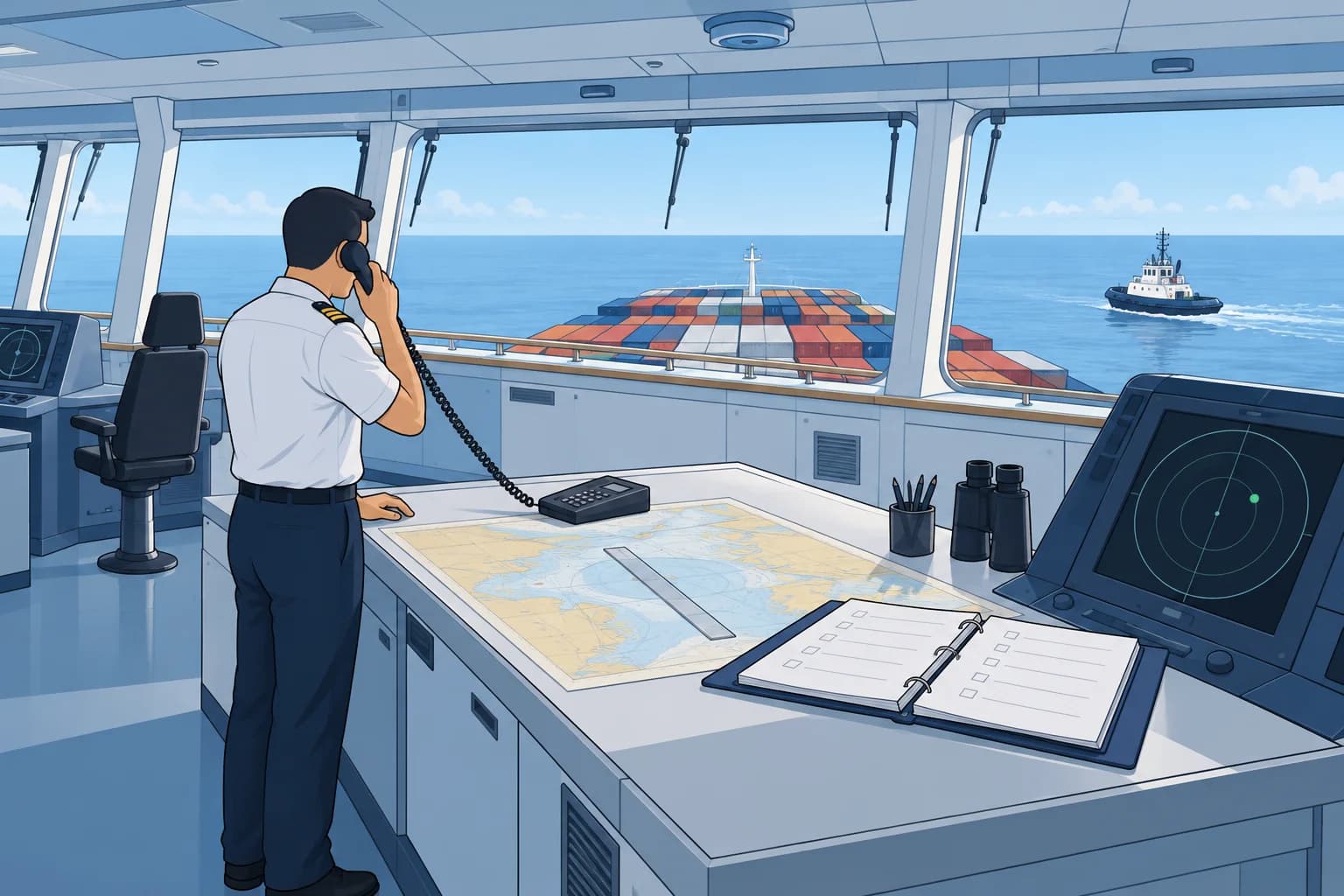
The company emergency team
Your company’s safety management system (SMS) sets out how to activate its shore emergency response team (ERT). It provides specialist support: contacting the flag State, the classification society (which checks the ship against its technical rules), the P&I (protection and indemnity) insurer, salvors, charterers and port authorities. The master keeps command of the ship; the ERT takes as much of the outside world off the bridge as it can.
The DPA
The ISM Code requires a designated person ashore (DPA) with direct access to the highest level of management, who monitors safety and pollution prevention. In an emergency the DPA is often the master's direct link to the company and makes sure resources arrive. Keep the DPA's 24-hour number with the emergency checklists.
The first call
Call the company early with a short, factual report: what happened, people on board and their condition, position, damage, weather, and what help you have asked for. Then report again at agreed times. Assign a separate operator to maintain the required radio watch during company calls.
Media and families
Follow your SMS: refer media questions to the designated spokesperson unless you are authorised to speak. Agree with the crew how personal phones and social media are used. A photo or message sent too early can reach a family before the company has spoken to them, or spread false news. Families hear from the company, not from rumour.
Stick to facts
Keep what you say factual and consistent: no guesses about the cause and no blame. Investigators, insurers and the flag state will want the facts later; early speculation can hurt the crew and the company.
Key figures
- DPA
- ISM Code section 4; direct access to top management
- Company ERT
- Flag, class, P&I, salvors, charterers, ports, media
- First report
- What happened, people, position, damage, weather, help asked
- Media
- Refer questions to the spokesperson named in your SMS
Remember
- The company ERT handles the outside world so the master can run the ship.
- The DPA links the ship to top management; keep the 24-hour number ready.
- First call early and factual, then report at agreed times without interrupting the radio watch.
- Follow the SMS media policy; agree crew phone and social-media use.
- Facts only: no guesses about cause, no blame.
Common mistakes
Wrong: Wait until the situation is under control before calling the company.
Right: Call early; the shore team needs time to arrange tugs, salvors, experts and ports.
Wrong: A short comment to a journalist who calls the ship does no harm.
Right: Follow the SMS media policy; refer questions to the designated spokesperson unless authorised to speak. Speculation can mislead families and investigators.
Worked case
After an explosion in the engine room of your product tanker, one engineer is missing. Within an hour a news site calls the ship's satellite phone, and crew members are messaging home. Your SMS names a company spokesperson; you are not authorised to speak.
Show the answer
Refer the journalist to the company media contact. Ask crew not to post casualty details or speculation, especially before next of kin are notified; allow private reassurance that they themselves are safe. Give the DPA and emergency team a factual update and agree the next report time.
Practice question
Who links the ship directly to the highest level of company management under the ISM Code?
- The charterer's local agent
- The designated person ashore
- The P&I club's correspondent
- The attending class surveyor
Show the answer
Answer: B. The DPA has direct access to top management and is often the master's link in an emergency.
6 · Afterwards
Records, after-action review and crew welfare
Keep records and preserve evidence from the start. Afterwards, review the response, restore rest and support your crew.
Records
From the first minute the logbooks are evidence: the deck log, the GMDSS radio log, the engine log and the bridge timeline. Write facts and times, not opinions, and never alter an entry; add a dated correction instead. Save the VDR (voyage data recorder) data as the safety management system (SMS) says, before it is overwritten, and keep alarm printouts, charts, photographs and messages.
Investigation
The flag State must ensure a safety investigation into a very serious marine casualty: total loss of the ship, a death or severe environmental damage. States concerned may agree who leads under the Casualty Investigation Code. The company also investigates through its safety management system (SMS). Cooperate and let witnesses give their own statements. The purpose is prevention, not assigning blame or liability; legal or disciplinary proceedings may also follow.
After-action review
When the danger is over, hold an after-action review with the teams: what was supposed to happen, what did happen, why they differed, and what we change. Keep it short and blame-free, write actions with an owner and a date, and send them to the company through the SMS so the whole fleet learns.
Rest after the emergency
For the immediate safety of the ship and people on board, or to help others in distress, the master may suspend the normal hours of rest. Afterwards, as soon as practicable, everyone who worked during their rest period must get compensatory rest (MLC, 2006 and STCW). Plan it deliberately: tired crews make mistakes on the next watch.
Crew welfare
A traumatic emergency can affect mental health. Reactions may include poor sleep, distressing memories, irritability or guilt. Use psychological first aid: make people safe, listen, give practical help, keep them in touch with home. Ask the company for professional support, and share contacts such as SeafarerHelp, a free 24-hour helpline run by ISWAN. Watch for anyone who withdraws, or whose problems last for weeks.
Key figures
- VDR
- Save the data after an incident, before it is overwritten
- Safety investigation
- Casualty Investigation Code (resolution MSC.255(84))
- Hours of rest
- Master may suspend in an emergency; compensatory rest after
- SeafarerHelp
- Free, confidential 24-hour helpline run by ISWAN
Remember
- Logs are evidence: facts and times, corrections dated, never erased.
- Save the VDR data before it is overwritten; keep printouts and photos.
- Safety investigations seek causes to prevent a repeat, not blame.
- After-action review: planned versus actual, why, and actions with owners.
- Compensatory rest after the emergency; psychological first aid and professional support.
Common mistakes
Wrong: Tidy up the logbook afterwards so it reads clearly.
Right: Never alter entries; add a dated correction. Altered logs destroy trust in all the evidence.
Wrong: Crew who seem fine after a death on board need no support.
Right: Stress reactions can appear days or weeks later; keep watching and offer professional help.
Worked case
Two days after a mass rescue in which several people drowned before your crew could reach them, the bosun is not sleeping and avoids the mess. The crew have worked through their rest periods for 30 hours. The company asks for your report.
Show the answer
Send a brief factual update now and confirm that logs and VDR data are secured. Arrange relief to maintain safe watches while exhausted crew get compensatory rest; record it. Speak privately with the bosun, listen and offer professional support through the company or SeafarerHelp. Hold a blame-free review when people are rested. Send the fuller report with actions, owners and dates afterwards.
Practice question
You find an error in a logbook entry made during the emergency. What do you do?
- Erase the entry and write it again
- Remove the page and write it again
- Add a dated, signed correction
- Leave the error without reporting it
Show the answer
Answer: C. Keep the original entry legible and add a dated, signed correction under the logbook procedure.