
Emergencies at sea · Level P1 · 6 parts · about 20 min
Fire on ships: fire chemistry, ignition sources, detection and fixed systems (STCW A-VI/1-2)
6 short parts: Fire chemistry · Ignition sources · Fire spread · Detection · Fixed systems · Fire divisions. Each part explains the idea, then gives the points to remember, the common mistakes, a worked case and a practice question; the Academy unit adds all 38 check questions.
1 · Fire chemistry
Fire chemistry: what burns, and when
Liquids do not burn; their vapour does. Flash point, auto-ignition and flammable limits tell you when a fuel on board becomes a fire.
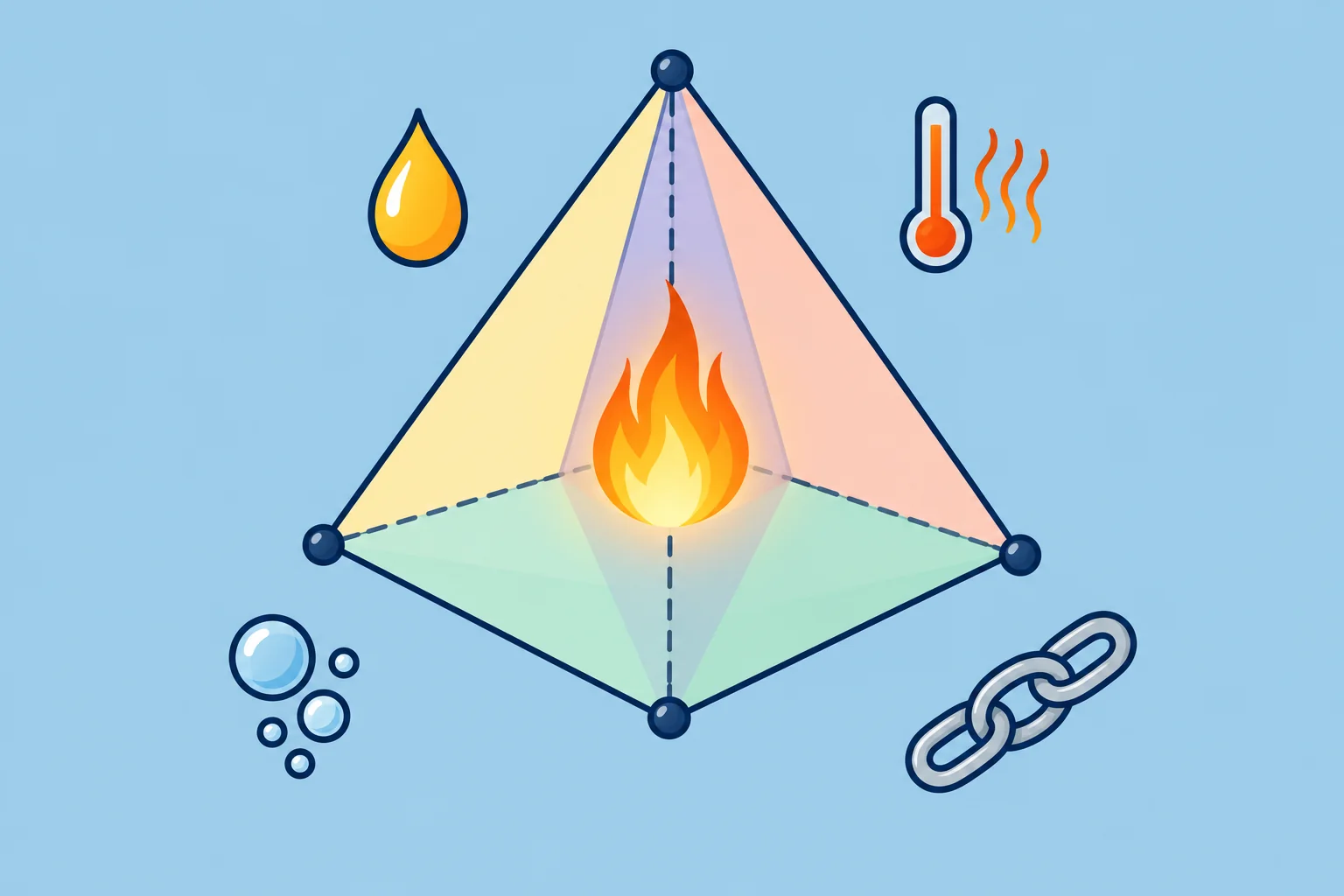
The tetrahedron
You may know the fire triangle: fuel, heat and oxygen. Flames also need a self-sustaining chain reaction in the burning gases, which makes the fire tetrahedron. There are four ways to put a fire out: cooling removes heat (water), smothering keeps oxygen from the fuel (foam) or reduces oxygen around the fire (CO₂), starving removes fuel (closing a fuel valve, moving cargo away) and breaking the chain reaction (dry powder). This unit gives the knowledge; you practise on real fires, with breathing apparatus (BA), in your approved course.
Flash point and fire point
The flash point is the lowest temperature at which a liquid gives off enough vapour to ignite briefly when a flame is applied. The fire point, a few degrees higher, is where the vapour keeps burning. SOLAS, the International Convention for the Safety of Life at Sea, normally requires fuel oil with a flash point of at least 60 °C. Heating fuel increases vapour production. A fine fuel mist from a leak can ignite even below the liquid’s flash point.
Auto-ignition
The auto-ignition temperature is the temperature at which a substance catches fire by itself, with no flame or spark. Marine diesel is often quoted around 250 °C, but values vary by fuel and test conditions. An engine exhaust manifold or turbocharger casing can be much hotter than that. This is why fuel spraying from a cracked pipe onto an uninsulated hot surface can start an engine-room fire.
Flammable limits
Vapour burns only when mixed with air in the right proportion. The lower flammable limit (LFL) is the leanest mixture that burns; the upper flammable limit (UFL) is the richest. For petroleum vapours the range is roughly 1–10 % by volume. A mixture above the UFL is too rich, but it becomes flammable as air gets in. For oil cargoes, inerting keeps oxygen at 8 % or less and maintains positive pressure to keep air out, preventing a flammable hydrocarbon-air mixture.
Classes of fire
Standard EN 2 groups fires by fuel: A solids such as wood and paper; B liquids such as fuel oil and paint; C gases such as liquefied petroleum gas (LPG) and acetylene; D metals such as magnesium; F cooking oils and fats. IMO guidance accommodates different classifications. This lesson uses EN 2; check the classification on your ship’s equipment. Electrical equipment is not a class: it is a shock hazard until isolated. US National Fire Protection Association (NFPA): A solids, B liquids/gases, C live electrical, D metals, K cooking oils.
Key figures
- Fuel-oil flash point (SOLAS)
- At least 60 °C (43 °C allowed for emergency generators)
- Diesel auto-ignition
- Typically about 250 °C; hot exhausts run far hotter
- Petroleum vapour range
- Roughly 1–10 % by volume in air (LFL to UFL)
- Inerted oil-cargo tank
- Oxygen 8 % by volume or less
- EN 2 classes
- A solids, B liquids, C gases, D metals, F cooking oils
- Electrical fires
- Under EN 2: a shock hazard, not a fire class
Remember
- Four ways to extinguish: cool, smother, starve, break the chain reaction.
- Liquids burn as vapour: the flash point tells you when there is enough of it.
- Heating fuel increases vapour; a fine fuel mist can ignite below its flash point.
- Fuel spray can ignite on a hot surface without a flame or spark; actual ignition conditions vary.
- A too-rich mixture becomes flammable as air enters; oil-cargo inerting keeps oxygen at 8 % or less.
Common mistakes
Wrong: Diesel has a flash point above 60 °C, so a diesel leak cannot catch fire.
Right: A fine spray can ignite below the liquid’s flash point, especially on a hot surface.
Wrong: A tank too rich to burn is safe to ventilate and enter.
Right: Fresh air can bring the mixture into the flammable range. Do not ventilate or enter the tank yourself; report the hazard.
Wrong: Electrical fires are a separate class with their own letter.
Right: Under EN 2 electricity is a hazard, not a class. Isolate the supply; the burning material sets the class.
Worked case
A shipmate says a tank atmosphere above the upper flammable limit cannot burn, so opening it to admit fresh air must be safe. How do you respond?
Show the answer
Do not open it. Above the UFL the mixture is too rich to burn, but admitting air can bring it into the flammable range. Tell your shipmate why the reading does not prove safety and report to the responsible officer. A non-burning atmosphere may still be deadly to breathe.
Practice question
Dry powder knocks flames down quickly. Which side of the fire tetrahedron does it mainly attack?
- The heat stored in the burning fuel
- The chain reaction in the flames
- The oxygen in the whole compartment
- The fuel supply feeding the fire
Show the answer
Answer: B. Dry powder interrupts the chain reaction. It cools very little, so hot material can re-ignite once the powder settles.
2 · Ignition sources
Ignition sources on ships, and preventing fire
Engine rooms, galleys (kitchens) and accommodation (living spaces) have familiar fire risks. Spot ignition sources and report defects on your rounds.
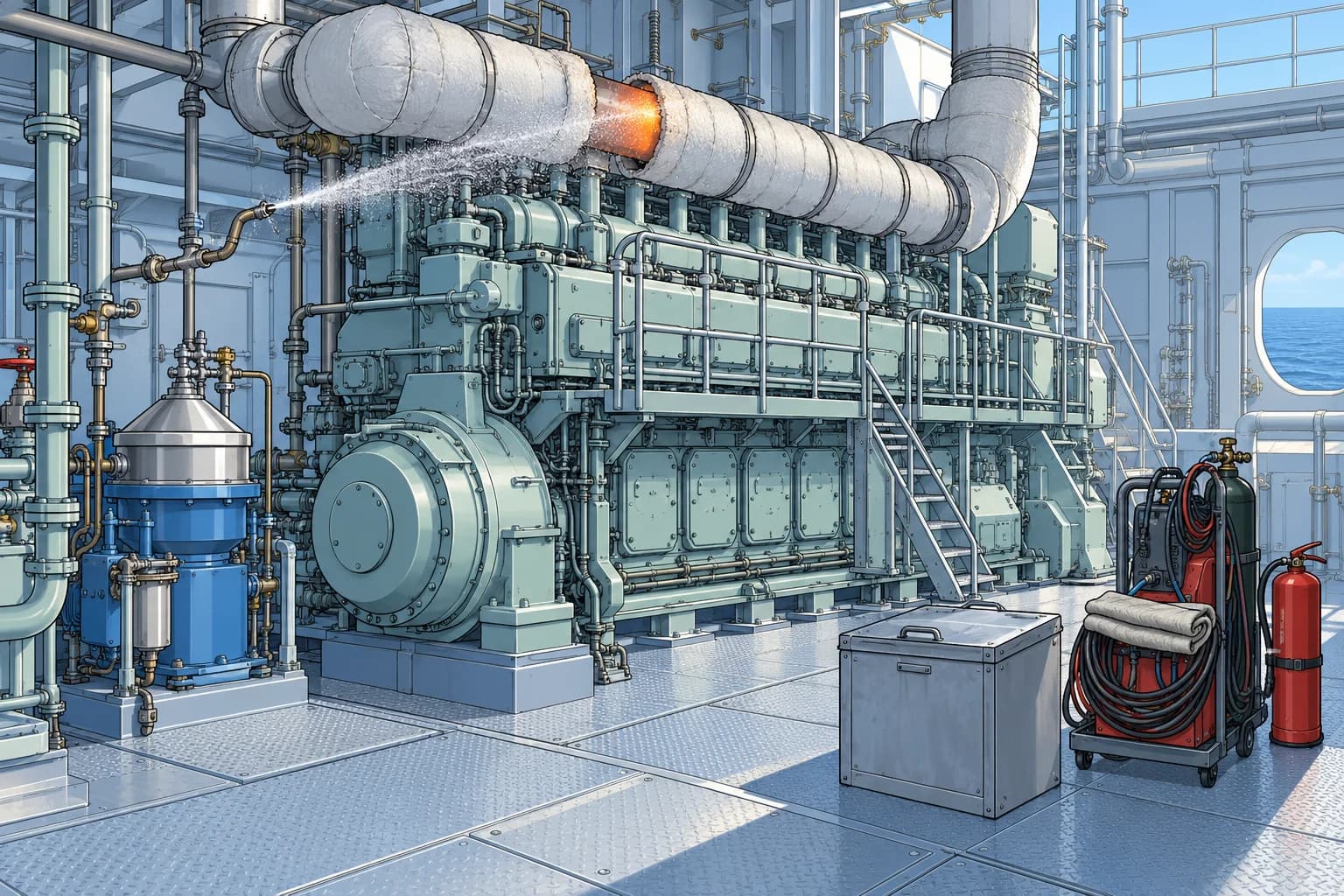
Engine rooms
Fuel or oil can leak from pipes, filters and injectors onto hot surfaces, such as exhausts and turbochargers. SOLAS requires surfaces above 220 °C that a leak could reach to have lagging (heat insulation). External high-pressure lines between injection pumps and injectors need jacketed containment; spray shields protect other potential leak points. Leaking purifiers (oil-cleaning machines), oil-soaked insulation and oily bilges (low spaces where liquids collect) add fuel. Report leaks, missing insulation or damaged spray shields at once.
Hot work and electrics
Hot work—welding, cutting or grinding—needs a hot-work permit. Sparks and molten metal can fall through gratings and ignite waste below. Electrical fires can start at overloaded sockets, damaged cables or loose connections that overheat. Personal heaters and faulty chargers in cabins can also start fires. Report damaged or overheating equipment at once.
Galley, cabins and smoking
Galley fires start with unattended pans, overheated oil and grease in the extraction ducts. In cabins, smoking in bed and cigarettes thrown into bins are common causes. Smoke only where the ship allows it, use proper ashtrays and never throw a cigarette over the side, where the wind can blow it back on board or into a ventilator.
Self-heating, static and batteries
Spontaneous combustion happens when a material reacts slowly with oxygen and traps the heat until it ignites. Keep oily rags and cotton waste in closed metal bins and land them ashore. Some cargoes can also heat themselves and ignite. Static electricity can build up as fuel flows or splashes; a spark can ignite flammable vapour. Lithium-ion batteries can overheat uncontrollably, called thermal runaway, and start a fire.
Prevention every day
Fire prevention is everyone's job. Keep spaces clean, stow combustibles away from heat, wipe up oil spills, keep fire doors closed and never block extinguishers, hydrants or escape routes. Report defects such as missing insulation or a failed light. On your rounds look, listen and smell: smoke, a burning smell, heat or the hiss of a leak. Raise the alarm early; this gives the crew more time to respond safely.
Key figures
- Hot surfaces (SOLAS II-2/4)
- Above 220 °C, where a leak could reach: insulated
- Electrical ignition risks
- Overloads, damaged cables and loose, overheating connections
- Oily rags
- Closed metal bin; land ashore; never in a hot corner
- Main fire areas
- Engine room, galley, accommodation, cargo spaces
Remember
- Engine-room fires mostly start with fuel or oil reaching a hot surface.
- Loose electrical connections can overheat and ignite nearby material.
- Oily rags heat themselves: closed metal bins, landed ashore.
- Smoke only where allowed, and never throw a cigarette overboard.
- Report leaks, missing insulation and damaged cables at once.
Common mistakes
Wrong: A small fuel drip in the engine room can wait until the end of the watch.
Right: Any leak near a hot surface is a fire risk. Report it at once so it can be isolated.
Wrong: A loose electrical connection is harmless while the equipment still works.
Right: A loose connection can overheat and start a fire. Report it and keep clear of damaged equipment.
Wrong: Oily rags are safe in an open cardboard box.
Right: They can heat themselves until they ignite. Use a closed metal bin and land them ashore.
Worked case
In the crew mess, a socket supplying a heater is darkened and smells of hot plastic. The heater still works. A shipmate says it can stay on until the break ends.
Show the answer
Keep people clear and report the hot socket and burning smell immediately. A loose connection can overheat even while equipment works. Have an authorised person isolate the supply. Do not touch the damaged socket or try to repair it. Raise the fire alarm if you see smoke or fire.
Practice question
Why is a small fuel leak beside an uninsulated exhaust urgent?
- Fuel can ignite on the hot surface without a spark
- Fuel must first reach its boiling point to ignite
- Only a large pool of fuel can sustain a fire
- The engine-room detector prevents ignition
Show the answer
Answer: A. Leaked fuel or mist can reach a surface above its auto-ignition temperature. Keep clear and report immediately.
3 · Fire spread
How fire spreads, flashover and backdraught
On a steel ship heat travels through bulkheads, up stairways and across rooms. Learn flashover and backdraught signs; keep suspected fire compartments closed.
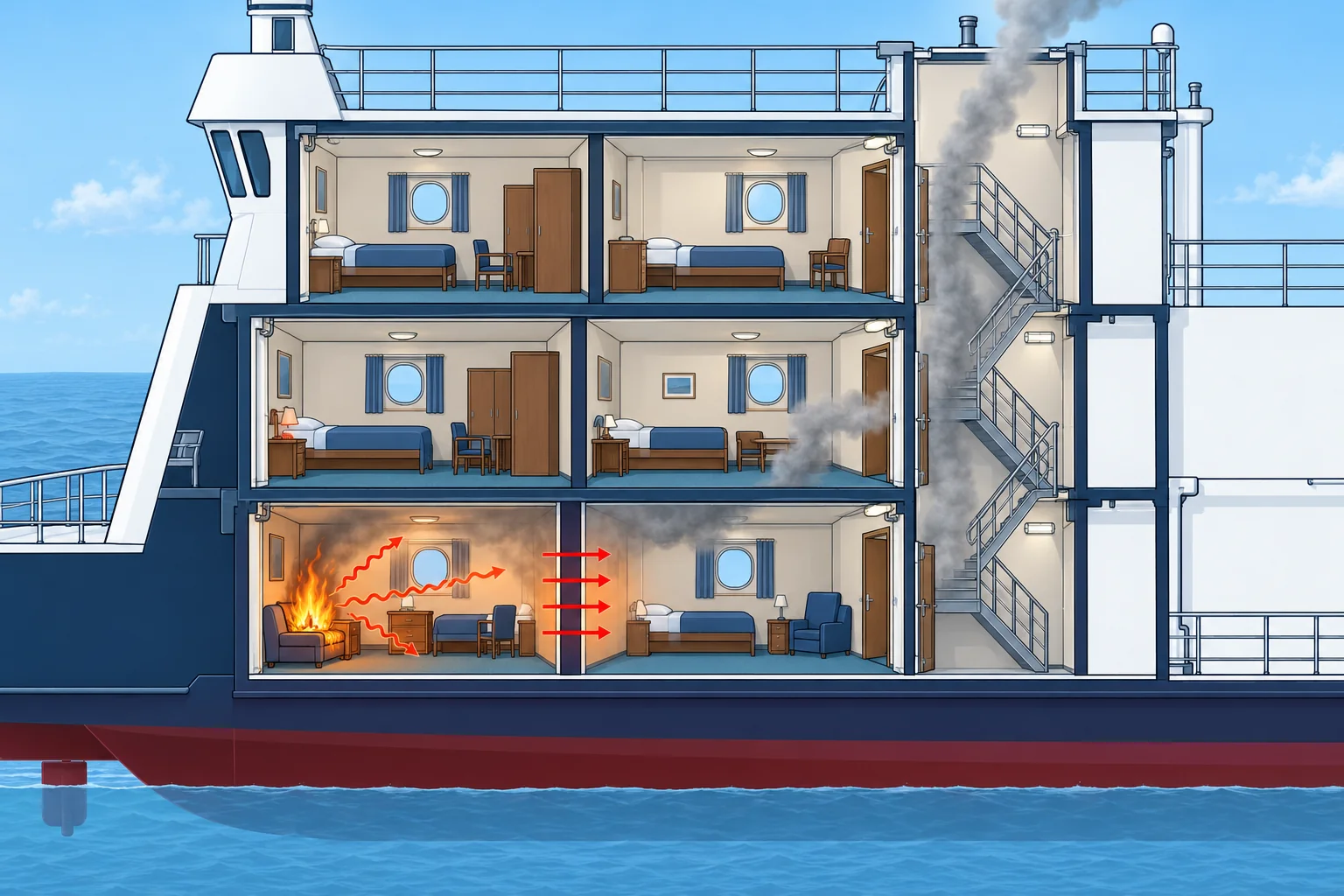
Four ways fire spreads
Conduction carries heat through steel bulkheads (walls) and decks (floors), which can ignite material on the far side. Convection carries hot gases upwards through stairways and vertical enclosures around machinery, lifts and ventilation ducts. Radiation transfers heat across a gap, without contact with hot gases or solids. Direct burning spreads fire when flames reach the next fuel.
Smoke travels fastest
Hot smoke rises, fills the top of a space and then banks down towards the deck. It carries carbon monoxide (CO) and other toxic gases, and it hides exits. Smoke can travel along alleyways and up stairways much faster than you can walk. That is why you stay low, close doors behind you and use your escape route before smoke fills it.
Flashover
In a closed space the hot smoke layer under the deckhead (ceiling) radiates heat down. Contents heat up and give off flammable gases. Often at 500–600 °C in the smoke layer, they ignite almost together: flashover. It can kill even a fully equipped firefighter. Warning signs include rapidly rising heat, smoke thickening and banking down, flames rolling through the smoke (rollover) and contents starting to smoke. Withdraw immediately if these signs develop.
Backdraught
A fire in a closed space can use up its oxygen and die down, leaving the space full of hot, unburnt gas. If someone opens a door, fresh air rushes in and the gas ignites with explosive force: a backdraught. Warning signs: a hot door or bulkhead, smoke pulsing or puffing out of gaps, yellow-grey or brown smoke, oily stains on glass, whistling as air is drawn in, and little visible flame.
Keep suspect doors closed
If you suspect fire behind a door, keep it closed, raise the alarm and report. Opening it can feed the fire, cause a backdraught and let smoke into your escape route. A cool door does not prove safety: insulation can hide the heat. Suspected-fire entry is for the equipped fire party, using breathing apparatus (BA) and charged hoses, filled and ready.
Key figures
- Conduction
- Through steel bulkheads and decks to the next space
- Convection
- Hot gases rise through stairways, enclosures and ventilation ducts
- Flashover
- Rapid transition to a fully developed compartment fire
- Backdraught
- Air enters a hot, oxygen-starved space: gas explodes
- Suspected fire behind a door
- Keep it closed; a cool door does not prove safety
Remember
- Steel conducts heat: fire can start on the other side of a bulkhead or deck.
- Convection drives smoke up stairways and enclosures, faster than you walk.
- Flashover signs: rapid heat, thick banking smoke, flames rolling through smoke.
- Backdraught signs: hot door, pulsing smoke, brown smoke, air drawn in.
- Keep suspected fire compartments closed, even if the door feels cool; withdraw and report.
Common mistakes
Wrong: A steel bulkhead stops a fire spreading to the next cabin.
Right: Steel conducts heat. The far side can become hot enough to ignite nearby paint or furnishings.
Wrong: Little visible flame behind a door means the fire is nearly out.
Right: It may be starved of oxygen and full of hot gas. Opening the door can cause a backdraught.
Wrong: A cool door means it is safe to open a suspected fire compartment.
Right: Insulation can hide the heat. Keep suspect doors closed, withdraw, raise the alarm and report.
Worked case
You smell smoke in the accommodation. The door of a store room is shut. Grey-brown smoke is puffing out round its edges in pulses, and you hear a faint whistling. A shipmate reaches for the handle to see what is inside.
Show the answer
Stop your shipmate. Pulsing smoke and air being drawn in can warn of backdraught: hot gas may ignite explosively when air enters. Raise the fire alarm and report the location to the bridge. Keep the door shut, withdraw and warn people nearby. Follow your emergency duties. Entry is for the equipped fire party using breathing apparatus (BA) and charged hoses, filled and ready.
Practice question
A fire in one hold sets paint alight on the far side of a steel bulkhead. How did the heat travel?
- By radiation across the open air of the hold
- By conduction through the steel bulkhead
- By convection up the ventilation trunk
- By direct burning along the cargo itself
Show the answer
Answer: B. Conduction transfers heat through solid steel, even when smoke and flames cannot pass through it.
4 · Detection
Fire detection and alarm systems
Detectors, call points and the fire panel give the earliest warning. Know what each detector senses and what to do when the alarm comes in.
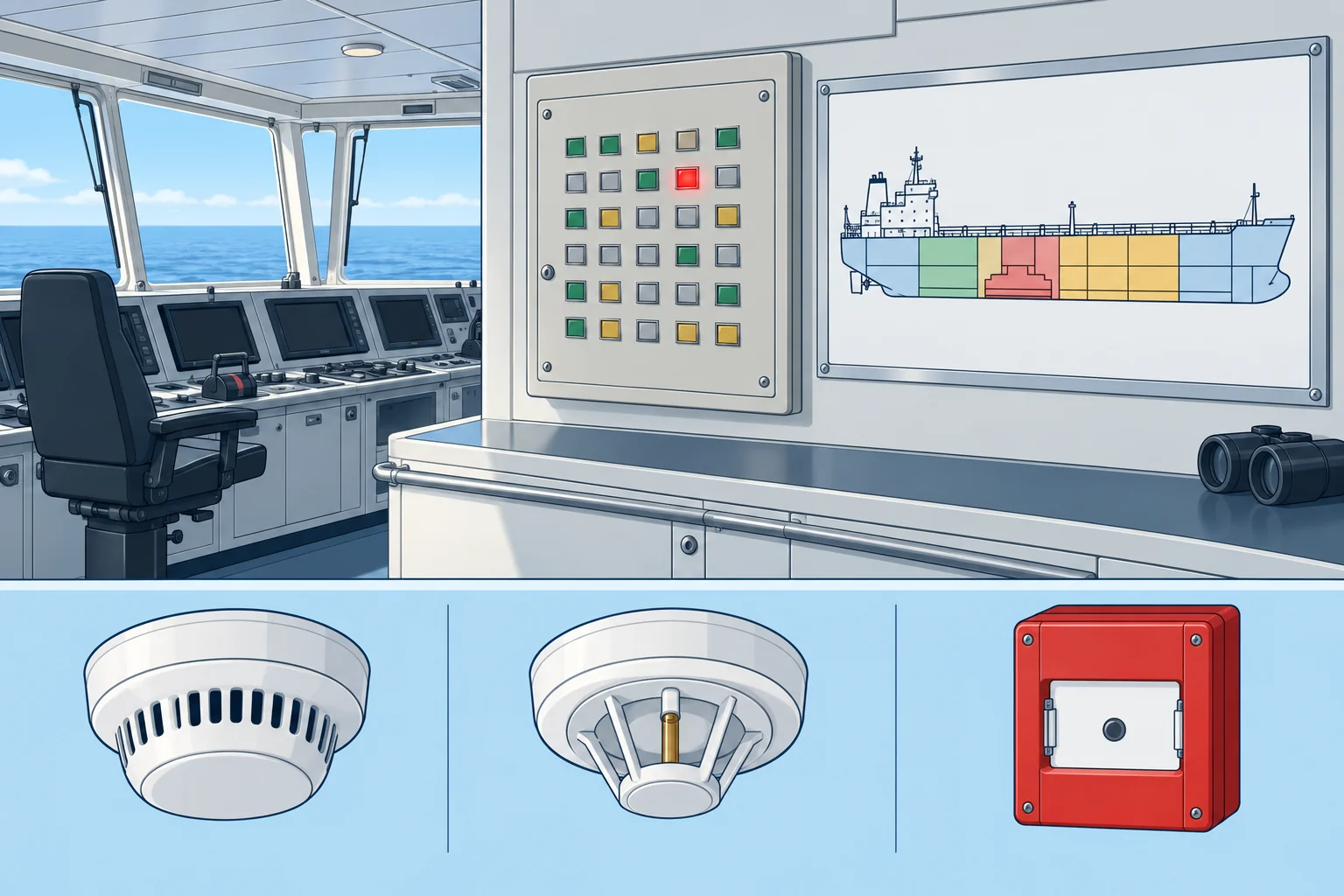
Why detection matters
Early detection gives you time to raise the alarm and escape. SOLAS II-2/7 requires fixed fire detection and fire alarm systems in specified spaces, including periodically unattended machinery spaces and accommodation. The FSS Code (Fire Safety Systems Code under SOLAS), chapter 9, sets how these systems work. The control panel identifies the alarm section and, on addressable systems that identify individual devices, the detector or call point.
Three kinds of detector
Smoke detectors sense smoke particles and usually warn earliest; they suit cabins, alleyways and stairways. Heat detectors respond to a fixed temperature or a rapid temperature rise; they suit galleys and laundries where smoke or steam is normal. Fixed-temperature detectors normally operate at 54–78 °C; approved higher settings suit hotter spaces. Flame detectors sense infrared or ultraviolet light from flames and are used near engines, purifiers and boilers.
Manual call points
A manual call point is a red box with a glass or plastic panel that you break or press to raise the fire alarm. They are fitted throughout the accommodation, service spaces and control stations, with one at each exit. If you find a fire, raise the alarm at once with the nearest call point, then report the location to the bridge by phone or radio. Do not assume someone else has done it.
The fire panel
On cargo ships, the panel is on the bridge or in the fire control station; on passenger ships, it is in the safety centre. It identifies the alarm section or device, not the fire’s size. After two minutes without acknowledgement, an audible alarm sounds in crew accommodation, service spaces, control stations and category A machinery spaces, such as engine and boiler rooms. It also shows faults and isolated sections. Know where alarms are received on your ship, including in port.
Fire control plan
Find your ship’s fire control plan: a general arrangement drawing showing fire divisions, detectors, call points, extinguishing systems, fire doors, ventilation controls and escape routes. It is normally displayed; a flag-approved booklet is also permitted. A duplicate plan or booklet is kept in a marked weathertight container outside the deckhouse for shore firefighters. Study it when you join.
Key figures
- Rules
- SOLAS II-2/7; FSS Code ch. 9
- Heat detectors (FSS)
- Normally 54–78 °C; approved higher settings in hotter spaces
- Unacknowledged after 2 min
- Alarm: crew/service/control areas; category A machinery spaces
- Call points
- Throughout accommodation and control stations; one at each exit
- Fire control plan
- Displayed plan or approved booklet; duplicate outside for shore crews
Remember
- Smoke detectors usually warn early in accommodation; heat suits steamy spaces; flame detectors watch machinery hazards.
- The panel identifies the alarm section or device; report the conditions you can safely observe.
- Find a fire: break the nearest call point, then tell the bridge where it is.
- After 2 min unacknowledged: alarm in crew accommodation, service spaces, control stations and category A machinery spaces.
- Study the fire control plan when you join.
Common mistakes
Wrong: If the detector has gone off, the bridge already knows everything.
Right: The panel identifies an alarm location, not the fire’s size or conditions. Report what you can see from safety.
Wrong: Covering a smoke detector while you work stops nuisance alarms safely.
Right: Never cover or isolate a detector yourself. Isolation is done by an officer under a controlled procedure.
Wrong: Heat detectors are best everywhere because they give the earliest warning.
Right: Smoke detectors usually warn earlier. Heat detectors are used where smoke or steam is normal.
Worked case
At night, the bridge fire panel alarms for the laundry and a store room. The officer assigns you, an available crew member with no bridge-watch duty, to investigate with a radio.
Show the answer
Take the radio and a torch. Keep clear of smoke and leave suspect doors closed. If you see fire or smoke, use the nearest safe call point and radio the exact location, what you can see and anyone at risk. If access is unsafe, withdraw and report. Follow the officer’s instructions.
Practice question
Which detector would you expect in a ship's galley?
- A smoke detector, as in the ship's cabins
- A flame detector, as at the ship's purifiers
- A heat detector, since steam is normal there
- None, since someone is always in the galley
Show the answer
Answer: C. Cooking makes smoke and steam that would trip a smoke detector. A heat detector avoids false alarms and still detects a fire.
5 · Fixed systems
Fixed fire-extinguishing systems
Fixed systems protect machinery, cargo and accommodation spaces. Know what each system does. When the CO₂ alarm sounds, leave immediately.
CO₂ flooding
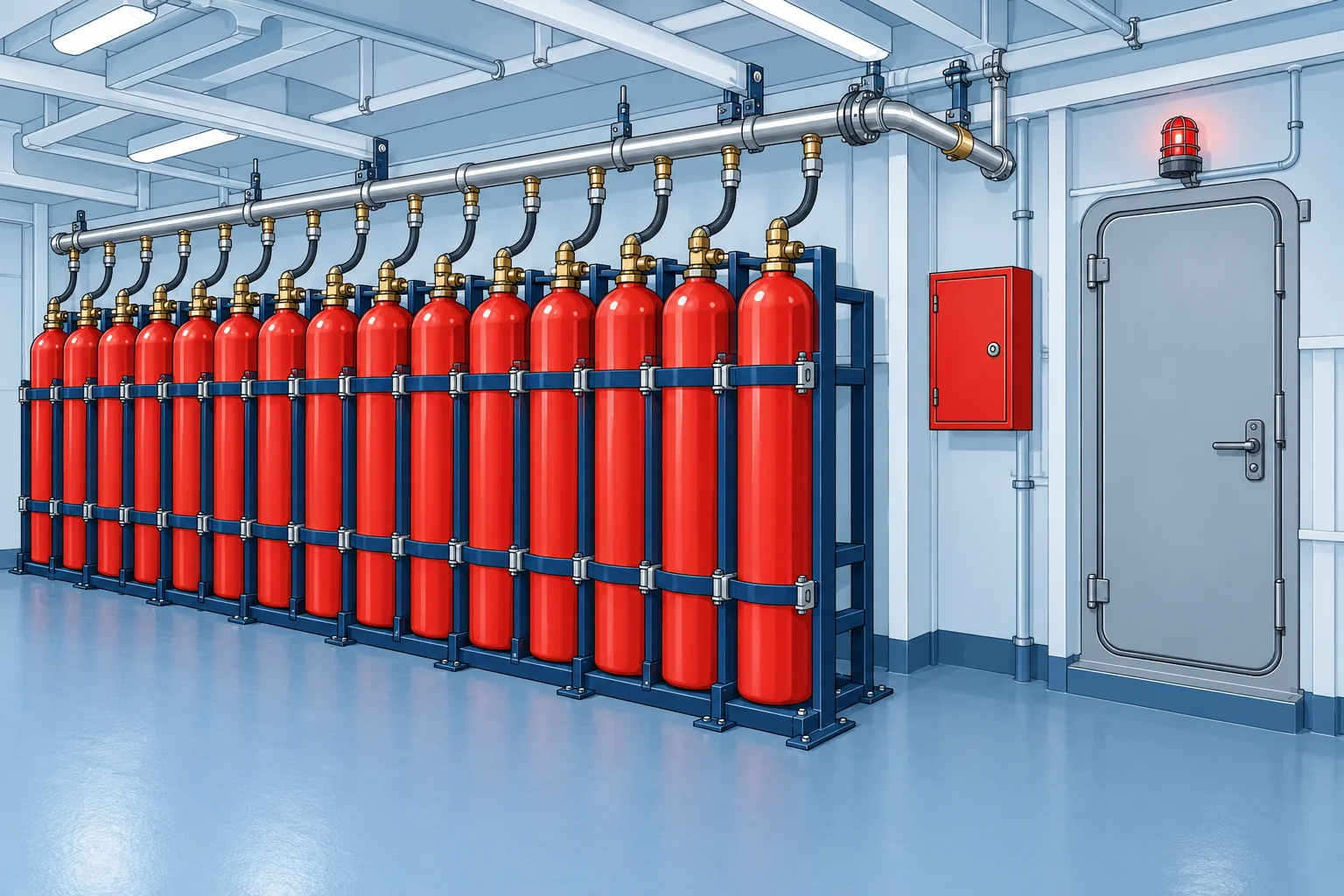
Carbon dioxide (CO₂) systems flood a closed space, such as an engine room or cargo hold, and smother fire by reducing oxygen. High-pressure systems store CO₂ in banks of cylinders; low-pressure systems keep it liquid in one refrigerated tank, at about −18 °C. FSS Code chapter 5 requires 85% of the required machinery-space CO₂ quantity to discharge within two minutes. CO₂ at flooding concentration is lethal through oxygen reduction and direct toxicity.
The CO₂ alarm
The pre-discharge alarm gives audible and visual warning in the protected space. It must sound for at least 20 seconds before release, and longer if needed for evacuation. Leave immediately; do not finish your job or collect belongings. Report for the headcount and report anyone missing, including their last known location. Do not operate release controls.
Foam systems
Foam is water, a foam concentrate and air. High-expansion foam, up to about 1,000 times its liquid volume, fills an engine room or hold. Medium-expansion foam covers areas such as deck spills. Low-expansion foam, under about 20 times, is thick and travels far; tankers use it for their deck foam systems. Foam cools and smothers fuel fires. FSS Code chapter 6 covers fixed foam systems and chapter 14 tanker deck foam.
Water mist and local application
Water mist systems spray very fine droplets that cool fast and push oxygen away close to the fire, with little water. Local application systems, required in specified SOLAS machinery spaces, protect the main hazards, such as purifiers, boiler fronts, engine fuel injection and incinerators, without flooding the whole space. FSS Code chapter 7 covers water-spray and water-mist systems.
Sprinklers
Automatic sprinkler systems protect accommodation on passenger ships and on some cargo ships. Heat opens each sprinkler head individually, often by breaking a glass bulb. Accommodation heads normally operate at 68–79 °C; hotter spaces may need higher ratings. Only heads heated enough to operate open. FSS Code chapter 8 covers them. Never hang clothes on a sprinkler head or paint it.
Key figures
- CO₂ pre-discharge alarm (FSS ch. 5)
- At least 20 s before release; longer if needed to evacuate
- CO₂ in machinery spaces
- 85 % of the gas discharged within 2 min
- Foam expansion
- Low < about 20; medium about 20–200; high up to 1,000
- Sprinkler operating temperature
- Normally 68–79 °C in accommodation; higher ratings in hotter spaces
- FSS Code chapters
- 5 gas, 6 foam, 7 water mist, 8 sprinkler, 14 deck foam
When the CO₂ pre-discharge alarm sounds
- Leave immediately by the nearest safe exit; do not delay. — You have only seconds; CO₂ at flooding strength kills.
- Close doors behind you if safe, without delaying escape. — The space must be sealed for the CO₂ to work.
- Go to your muster station and report for the headcount. — Report promptly so responders know who has escaped and who may remain inside.
- Report anyone missing and their last known location. — The officer needs their identity and last known location immediately.
- Never re-enter after release without orders and breathing apparatus. — The space stays deadly long after the fire is out.
Remember
- CO₂ smothers a closed space and is lethal to people at flooding strength.
- Pre-discharge alarm: at least 20 seconds; leave immediately.
- High-pressure CO₂ uses cylinder banks; low-pressure CO₂ uses a refrigerated liquid-storage tank.
- Foam: high expansion fills spaces; low expansion travels far on tanker decks.
- Water mist cools; sprinklers normally operate at 68–79 °C in accommodation, with higher ratings in hotter spaces.
Common mistakes
Wrong: When the CO₂ alarm sounds, you have time to finish and tidy up.
Right: Leave at once. The alarm may last only 20 seconds before the gas comes.
Wrong: After a CO₂ release you can enter as soon as the fire seems out.
Right: Keep the space closed while it cools. Re-entry is ordered by the master, in breathing apparatus.
Wrong: A sprinkler system floods every cabin when one head opens.
Right: Only heads heated by the fire open, so water falls where it is needed.
Worked case
You are cleaning a filter in the engine room when the ship’s identified CO₂ pre-discharge alarm sounds. A shipmate says it is probably a test and wants to finish the job first.
Show the answer
Tell your shipmate to leave now and head for the nearest safe exit. Do not delay your escape to finish work, argue or force them to move. Close doors as you leave if safe. Report at your muster station. If your shipmate has not left, immediately tell the officer their name and last known location. Treat the alarm as real even if you suspect a test.
Practice question
The CO₂ pre-discharge alarm sounds while you are working. What should you do?
- Leave immediately and report for the headcount
- Finish the task during the warning period
- Wait at the exit until gas starts discharging
- Check the release cabinet before leaving
Show the answer
Answer: A. Leave immediately by a safe exit and report for the headcount. The minimum warning is not spare working time.
6 · Fire divisions
Structural fire protection and fire doors
Steel divisions, insulation and fire doors split the ship into boxes that hold a fire back. A wedged-open fire door undoes all of it.
Boxes of steel
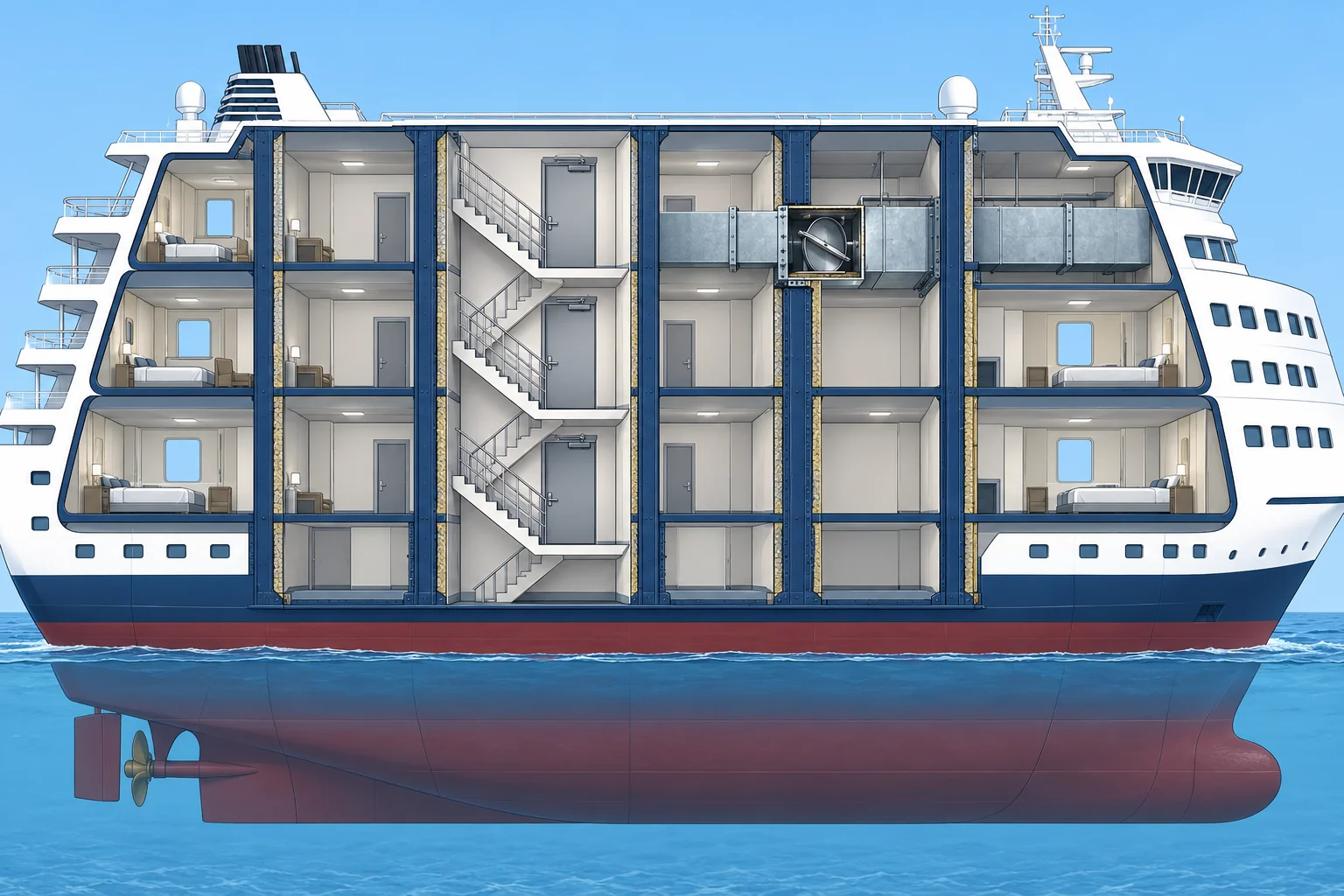
SOLAS II-2/9 splits a ship into spaces bounded by fire divisions, so that a fire stays where it starts long enough to be fought and for people to escape. Divisions are rated by how long they stop smoke, flame and heat in a standard fire test. The required rating depends on the spaces on each side and the applicable SOLAS table.
A-class divisions
A-class divisions are steel or equivalent bulkheads and decks that stop smoke and flame for one hour. With insulation they also limit heat on the unexposed side: the average temperature may rise no more than 140 °C, and no single point more than 180 °C, within the rated time. A-60 holds this for 60 minutes; A-30 for 30, A-15 for 15, and A-0 has no specified heat-insulation period.
B- and C-class
B-class divisions are non-combustible panels, often in cabins and alleyways, that stop flame for the first half hour. B-15 limits heat on the far side for 15 minutes, B-0 for none. C-class divisions are simply made of non-combustible materials, with no fire-test rating.
Main vertical zones
Passenger ships are divided into main vertical zones by A-class divisions, generally rated A-60, running from deck to deck through the whole ship. Their length on any deck is generally no more than 40 m. The divisions and their fire doors limit spread from one zone to the next.
Fire doors and dampers
A fire door must match its division’s fire resistance. Stairway doors are self-closing. Approved magnetic hold-backs release remotely or on power loss. Never wedge, tie or obstruct a fire door. Fire dampers close ventilation ducts to stop fire and smoke travelling through them. Detectors give early warning; closed doors and dampers help the divisions contain the fire. Follow your ship’s instructions for any door that fails to close.
Key figures
- A-class
- Steel/equivalent; smoke/flame 60 min; heat rating 60/30/15/0 min
- A-class heat limit
- Unexposed side: average +140 °C, any point +180 °C
- B-class
- Non-combustible; stops flame 30 min; B-15 or B-0
- C-class
- Non-combustible materials, no fire-test rating
- Main vertical zone
- Passenger ships; generally ≤ 40 m long on any deck
- Rule
- SOLAS II-2/9 (containment of fire)
Remember
- Fire divisions keep a fire in its space long enough to fight it and escape.
- A-class: steel, one hour against smoke and flame; A-60 insulated for 60 minutes.
- B-class stops flame for 30 minutes; C-class is non-combustible only.
- Main vertical zones on passenger ships are bounded by A-class divisions.
- Never wedge open a fire door or block it with hoses or cables.
Common mistakes
Wrong: An A-0 bulkhead stops heat reaching the next space.
Right: A-0 still resists smoke and flame for one hour in the standard test, but has no rated period limiting heat transmission.
Wrong: Wedging a fire door open is fine while you carry stores through.
Right: An open fire door lets smoke and fire spread. Hold it, or use the approved hold-back with remote release.
Wrong: The number in A-60 is the temperature the bulkhead can stand.
Right: It is the time, 60 minutes, for which the insulation limits heat on the far side.
Worked case
During stores loading, a shipmate ties back a self-closing stairway fire door with a rope so that trolleys can pass. Later, the fire alarm sounds for a fire two decks below.
Show the answer
Cut or untie the rope and let the door close, if you can do it safely on your way out. The stairway fire door holds smoke and fire out of an escape route used by everyone above. Tell the bridge or your team leader that the door was tied open. Afterwards, the stores team should use the approved hold-back arrangement or someone to hold the door, never a rope or wedge.
Practice question
What does the 60 in an A-60 division mean?
- It withstands a fire of 60 °C on the far side
- It is 60 mm thick, steel plus insulation
- It limits heat on the far side for 60 minutes
- It must be inspected every 60 days at sea
Show the answer
Answer: C. The number is the time the insulation keeps the unexposed side below the temperature limits in the standard fire test.