
Emergencies at sea · Level R3 · 5 parts · about 17 min
Collision, grounding, flooding and damage control
5 short parts: Find the leak · Inflow vs pumps · Patching · Collision · Grounding. Each part explains the idea, then gives the points to remember, the common mistakes, a worked case and a practice question; the Academy unit adds all 27 check questions.
1 · Find the leak
Water in the boat: find the leak
Most water in a yacht enters through a fitting, hose or seal. Keep pumping while you search quickly and in order.
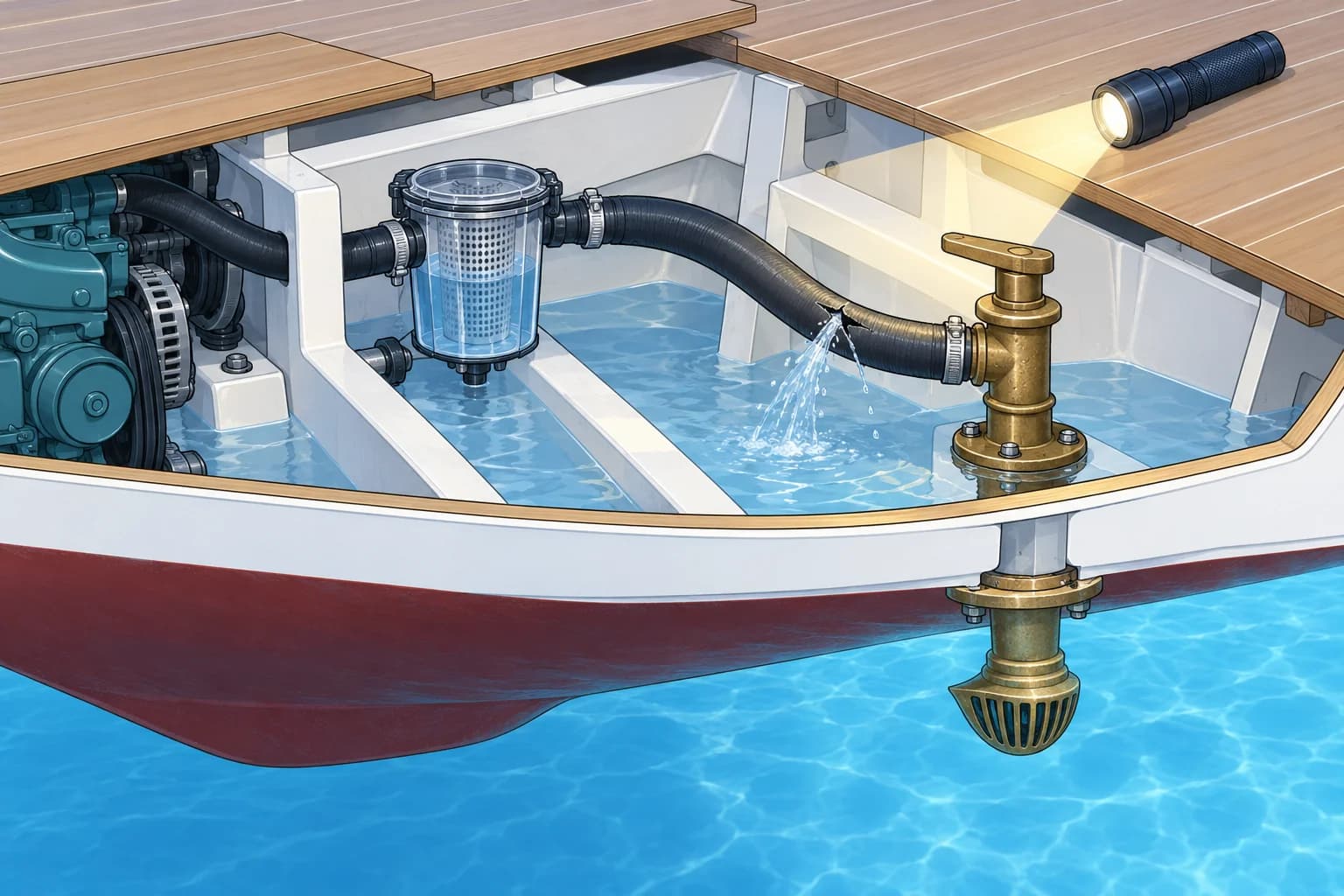
First moves
Water above the cabin floor is an emergency. Get everyone into lifejackets, start every available bilge pump, and give one person the job of pumping or bailing while others search. Note the time and mark the water level, so you can tell whether it is rising or falling. If it is rising fast, call for help at once.
Salt or fresh?
Never taste water from the bilge (the lowest space inside the hull): fuel, sewage or chemicals may contaminate it. Check tanks, pipes and deck openings as well as underwater fittings. Rain is fresh; spray and boarding seas bring seawater. Outside water may be fresh or brackish (partly salty). Fresh water does not rule out a hull leak. Salt content is only a clue: keep pumping and searching until you find the source.
Where it comes in
Search the through-hull fittings (openings through the hull) first: intakes, toilets, drains and instruments. Then check the engine seawater cooling circuit: strainer, pump, hoses and exhaust. Then check the stern gland (the seal around the propeller shaft), saildrive seal (around a drive leg through the hull), rudder bearing and keel bolts. A split hose or loose hose clip (the band securing a hose) can let in water quickly.
Shut it off
Close a suspect seacock (the valve on a hull opening), but stop the engine before closing its cooling-water intake. Do not restart until the fault is repaired and cooling restored. If a fitting has broken off, tap in the softwood bung (a tapered wooden plug) tied beside it. If the leak is hidden, empty lockers and lift floorboards systematically from one end of the boat to the other.
Heel and trim
Heel is sideways lean; trim describes how high the bow and stern sit. Many leaks depend on depth or on which side is down. Tacking (turning the bow through the wind) so the leaking side is high, or safely moving crew weight, can lift the leak above water. Move weight aft to lift bow damage, or forward to lift stern damage. A leak only under power suggests the engine circuit.
Remember
- Lifejackets on, all bilge pumps going, mark the water level and the time.
- Trace water sources; never taste bilge water.
- Check through-hulls, the engine seawater cooling circuit and the stern gland first.
- Close the seacock or fit a softwood bung; stop the engine before closing its cooling intake.
- Heel or trim to lift the leak clear of the water while you work.
Common mistakes
Wrong: Search first and start pumping once you know the cause.
Right: Pump at once and keep pumping. Search at the same time with other crew.
Wrong: Call for help only once you are sure the boat will sink.
Right: Call as soon as flooding threatens safety. Choose Mayday or Pan-Pan according to the danger.
Worked case
Water rises while motoring. When you stop the engine, it stops rising; the bilge pumps keep running. Which system deserves an early check, and what must happen before restarting?
Show the answer
Keep pumping, mark level and time, and get lifejackets on. The change under power points towards the engine seawater circuit, but does not prove the source. Check its strainer, hoses and exhaust. Keep the engine stopped before closing its intake. Repair the fault and restore cooling before restarting. Continue searching if water still enters; call early if safety is threatened.
Practice question
What can fresh water in the bilge indicate?
- A tank leak, rain or outside fresh water
- Only a leaking drinking-water tank below
- Proof that underwater fittings are sound
- Proof that no flooding emergency exists
Show the answer
Answer: A. Freshness alone cannot establish the source. A tank, rain or outside water may be responsible. Never taste bilge water; keep pumping and tracing the source.
2 · Inflow vs pumps
How fast a hole floods, and how fast you can pump
A submerged hole a few centimetres across can exceed your pumps’ output. Reduce the leak while pumping, and call early if safety is threatened.
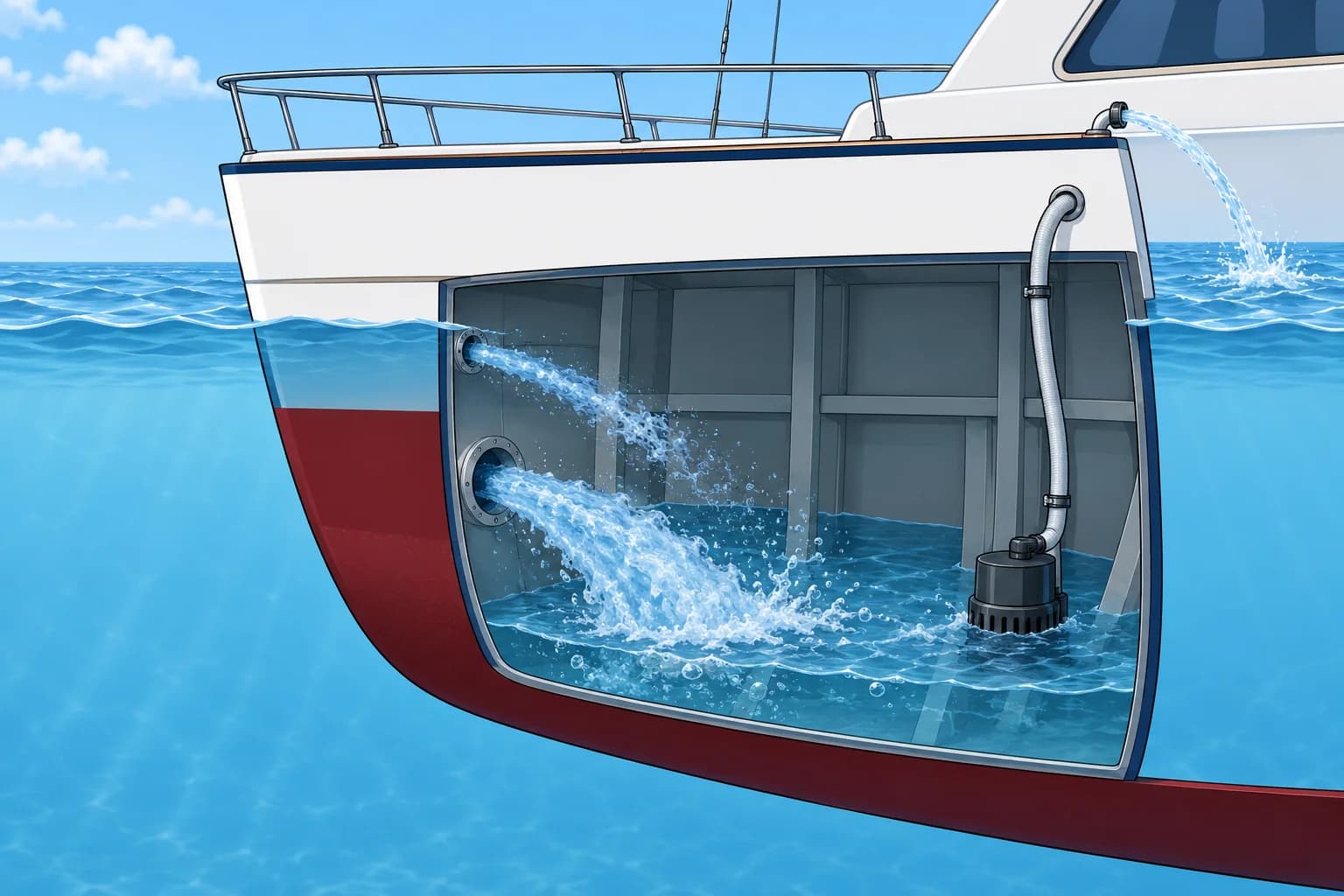
The inflow formula
Estimate Q = 0.6 × A × √(2gh). Q is inflow in cubic metres per second (m³/s); A is hole area in square metres (m²); g is gravitational acceleration (9.81 m/s²). If the hole discharges into air, h is its depth below the outside waterline, in metres. If water inside covers it, h is the difference between outside and inside water levels. For a round hole, A = πd²/4; d is diameter in metres. Multiply Q by 60,000 for litres/minute. The factor 0.6 allows approximately for flow restrictions.
What it means
With water discharging into air, a 38 mm hose fitting, 0.5 m below the waterline, lets in about 130 litres a minute. A 50 mm hole at 1 m lets in about 310 litres a minute, nearly 19 tonnes an hour. Double the diameter and the flow goes up four times, because area grows with the square. Four times deeper only doubles it, because flow grows with the square root of depth.
Pump reality
A large manual bilge pump may move about 50–70 litres a minute, but output depends on the pump and operator. People tire quickly. A pump rated at 500 US gallons an hour delivers about 32 litres a minute before losses from lifting water and resistance in hoses. Flooding can disable its power supply, wiring or controls. Buckets can help.
Reduce, don’t just pump
Keep pumping while you reduce the inflow: close the seacock, fit a bung, stuff and brace the hole, or raise it by heeling. Reducing inflow is the priority because a submerged hole can exceed their combined output. Once the flow slows, pumping may catch up. Slow down: speed drives water through a hole in the bow.
Mayday or Pan-Pan
Send Mayday for grave and imminent danger needing immediate assistance, such as uncontrolled flooding threatening the boat. Use Pan-Pan for an urgent safety problem below distress level. An optional escort request can be routine. Call early. The calling procedure is in GMDSS: distress calls.
Key figures
- Inflow estimate
- Q = 0.6 × A × √(2gh), m³/s
- 38 mm at 0.5 m
- About 130 L/min
- 50 mm at 1 m
- About 310 L/min (about 19 t/h)
- Hole diameter ×2
- Inflow ×4
- Depth ×4
- Inflow ×2
- Typical manual pump
- Roughly 50–70 L/min while pumped hard
Remember
- Inflow grows with hole area and the square root of depth.
- Double the hole diameter, four times the water.
- A submerged hole a few centimetres across can exceed pump output.
- Keep pumping while you reduce the inflow; slow down.
- Mayday: grave and imminent danger needing immediate assistance. Pan-Pan: urgent safety help below distress level.
Common mistakes
Wrong: The electric pump’s label tells you what it will move.
Right: Check the maker’s test head and voltage. Installed flow can be much lower because of lift, hose resistance and voltage drop.
Wrong: A hole twice as deep lets in twice as much water.
Right: Flow grows with the square root of depth. Twice as deep gives about 1.4 times as much.
Wrong: Wait until the boat is nearly sinking before calling for help.
Right: Call as soon as uncontrolled flooding threatens safety. Do not wait for the pumps to fail.
Worked case
A 25 mm cockpit drain fitting breaks off, 0.4 m below the waterline, discharging into air. Your manual pump moves about 50 L/min. Can you keep up, and what should you do?
Show the answer
Inflow ≈ 0.6 × 0.00049 × √(2 × 9.81 × 0.4) ≈ 0.00083 m³/s, about 50 L/min. That just matches your pump, so you will not gain. Keep pumping while you fit the bung. Send Mayday for grave and imminent danger needing immediate assistance; use Pan-Pan for urgent safety help below distress level.
Practice question
If a hole’s diameter doubles, how does the inflow change?
- It increases about two times
- It increases about four times
- It increases about 1.4 times
- It stays at its original rate
Show the answer
Answer: B. Flow is proportional to area, and area grows with the square of the diameter.
3 · Patching
Damage control: bungs, plugs and collision mats
Stop as much water as you can, as fast as you can, with whatever is to hand. A rough patch that holds is better than a neat one that never gets fitted.
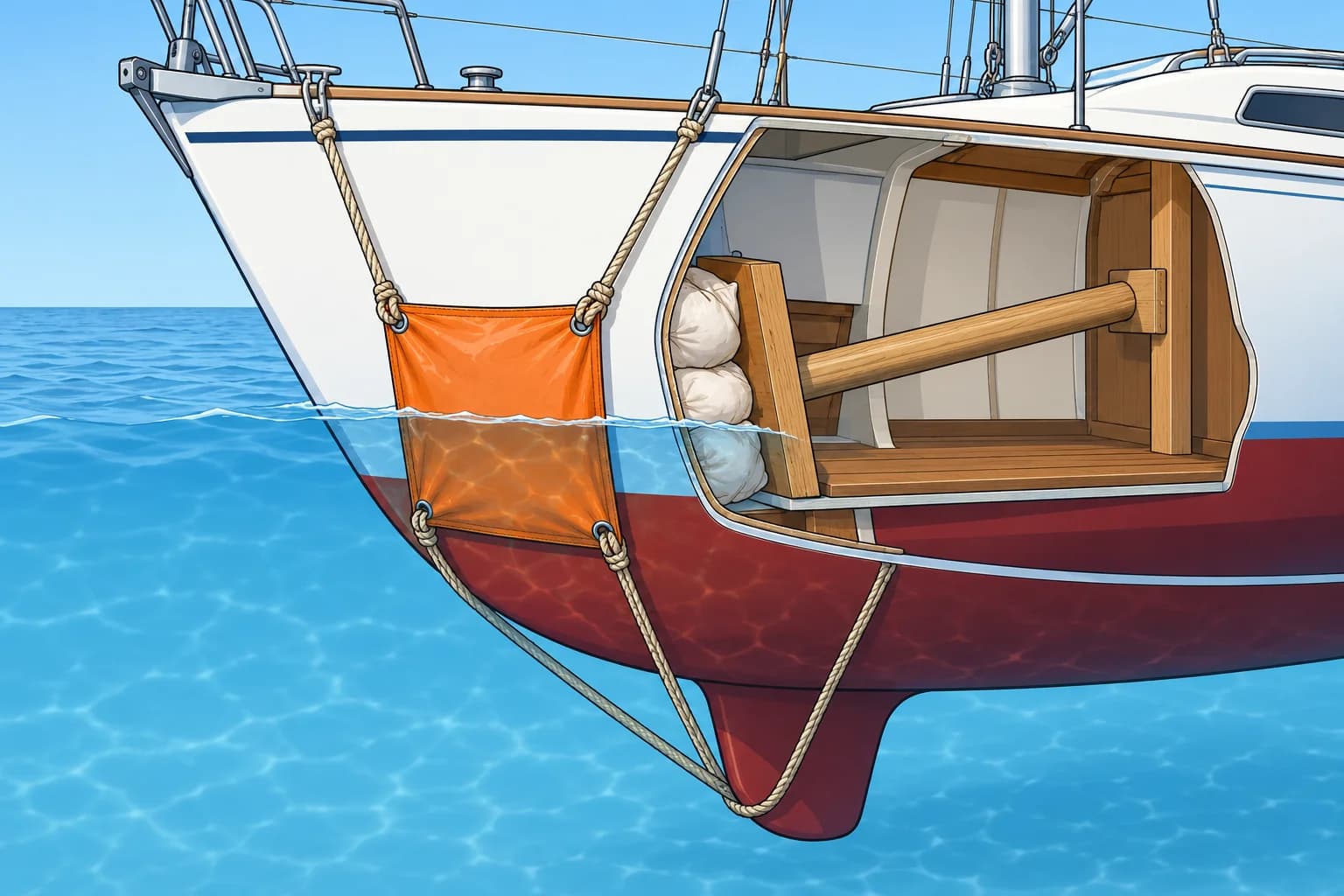
Bungs and repair compounds
Tap a tapered softwood bung gently into a damaged fitting; wet wood swells and grips. Cloth can help seal an irregular gap. Carry spare sizes beside those tied to fittings. Use underwater-curing epoxy putty for small cracks once flow is controlled; follow its mixing and cure instructions. A rubber emergency plug can suit an irregular opening; follow the kit instructions and check that it holds.
Plugging from inside
For a larger hole, push in soft material: cushions, sleeping bags, sail bags or clothing. Then hold it with something stiff, such as a floorboard or locker lid, braced against the hull with a strong pole or oar wedged against a strong structure. This is called shoring. Water pressure is trying to push the plug in, so a good brace matters.
Collision mat from outside
A sail or tarpaulin over the hole can slow the leak. Stop propulsion before handling lines and keep it stopped while lines are beneath the boat. Attach strong corner lines, lower the mat over the bow and draw it aft from deck until it covers the damage. Secure it with lines led to both sides. Keep lines clear of propellers; do not send anyone into the water. Water pressure helps press the mat against the hull, reducing inflow for inside repairs.
Use heel and trim
Lift the hole out of the water if you can. Put the damaged side up by tacking or by moving weight: crew, water cans, anchor and chain. Trim the boat bow-up for damage forward. Slow down, especially for damage in the bow, because speed rams water in.
Keep a damage-control kit
Bungs, epoxy putty, a rubber plug kit, a bag of rags, duct tape, a hacksaw, spare hose clips, hose lengths, a sheet of plywood and some wedges let you deal with most leaks. Check that every crew member knows where it is and where every seacock is.
Remember
- Tap a softwood bung gently into a damaged fitting; carry spare sizes and underwater-curing epoxy putty.
- Plug from inside with soft material, then shore it with a brace.
- A collision mat outside is pressed on by the sea itself.
- Heel and trim to lift the hole; slow down.
- Keep a damage-control kit and show the crew every seacock.
Common mistakes
Wrong: An inside patch only needs to be pushed in place.
Right: Water pressure pushes it out of the hole. Brace it firmly against strong structure.
Wrong: Keep sailing fast towards harbour to get there sooner.
Right: Speed forces water through bow damage. Slow down until the hole is controlled.
Worked case
A floating log has punched a hand-sized hole in the bow just below the waterline. Water pours in. You have cushions, a spare headsail, lines and a strong pole. What do you do?
Show the answer
Stop the boat and propeller. Get lifejackets on, start pumps and send a Mayday. Trim bow-up by moving weight aft. Plug with cushions and brace with a floorboard and pole. From deck, draw the headsail over the hole using corner lines beneath the bow; secure it and keep propulsion stopped. Check that the patch holds and the water level falls. Agree a tow or safe destination with rescuers; keep pumping and checking the repair.
Practice question
Why is a softwood bung used to plug a broken fitting?
- It swells when wet and grips the hole
- It floats, so it is easy to find later
- It is soft enough to bend into any shape
- It is lighter than a metal or rubber plug
Show the answer
Answer: A. Wet softwood swells and jams tight in the fitting.
4 · Collision
After a collision
After a collision, protect people, call promptly when danger is clear, and assess damage. An embedded bow may be plugging a hole.
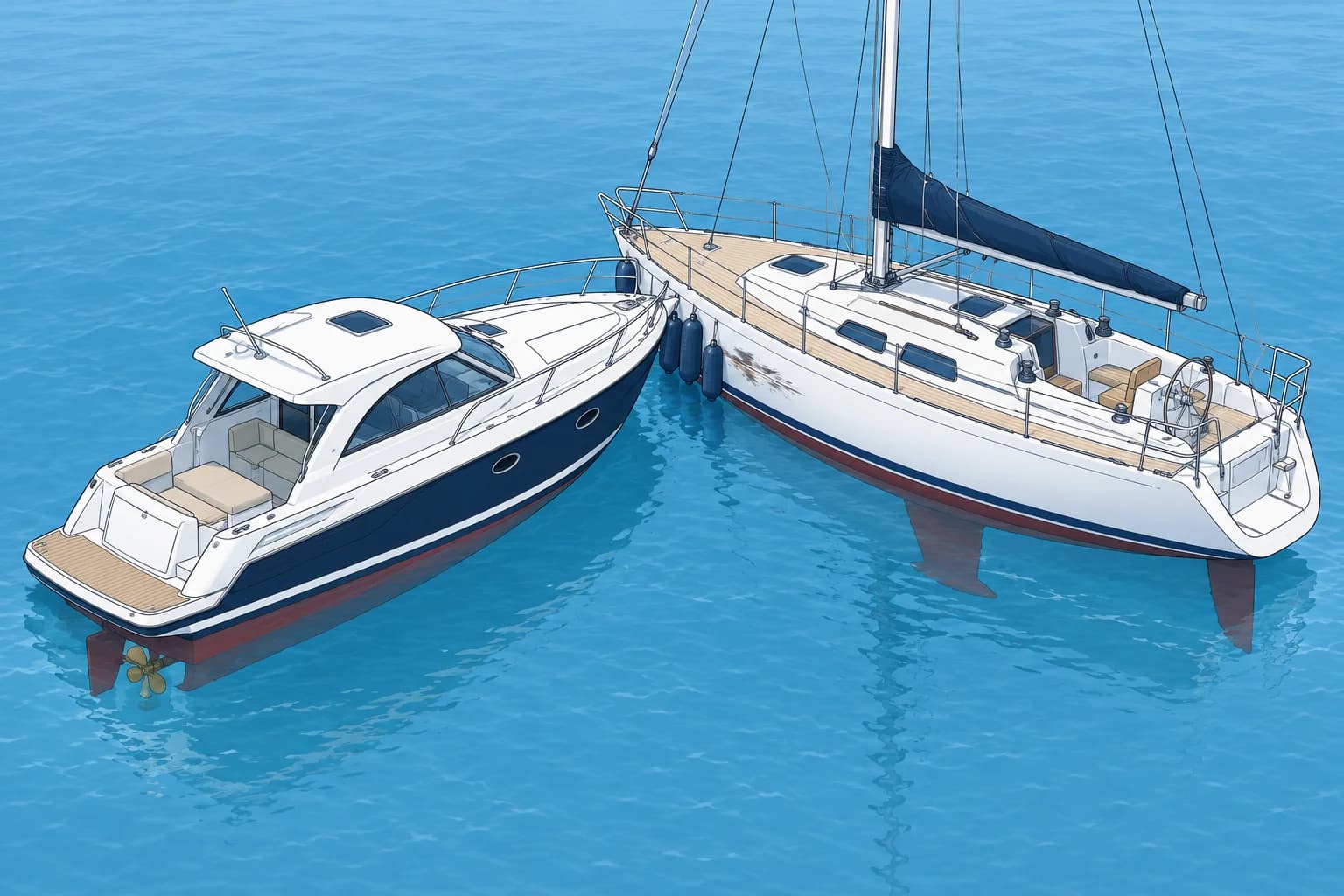
People first
Count heads. Check for injuries and anyone in the water. Get lifejackets on. Someone may have been thrown overboard or crushed between the boats, so look all round before you manoeuvre. Stop the propeller near people in the water.
Check the damage
Check every compartment for holes, cracks and leaks. Check the rig (mast, sails and supporting wires): a broken stay (a wire supporting the mast) can bring it down. If a bow is embedded in another hull, it may be plugging the hole. Do not separate just to inspect damage. If stable, await rescue advice; separate only if necessary and safe, with both crews ready to control flooding.
Call for help
Send Mayday for grave and imminent danger needing immediate assistance, such as uncontrolled flooding or a life-threatening injury. Send Pan-Pan for an urgent safety problem without that level of danger. Minor injuries or a routine escort request do not automatically justify either call. Crew can call while others inspect the damage.
Duties after a collision
Most countries require each vessel to stand by and give assistance, so far as she can without serious danger to her own vessel, crew and passengers, and to exchange names, home ports and destinations. Note the time, position, weather, lights shown and the other vessel’s details in your log. Report as required by your flag state and the coastal state where the collision occurred. The collision rules themselves are in COLREG: conduct.
Remember
- People first: count heads, check injuries and the water around you.
- Inspect every compartment and the rig.
- An embedded bow may be plugging the hole; separate only if necessary and safe, with flooding control ready.
- Mayday: grave and imminent danger needing immediate assistance. Pan-Pan: urgent safety help below distress level.
- Stand by, exchange details, log and report.
Common mistakes
Wrong: Reverse out immediately to see the damage.
Right: The bow may be plugging the hole. Separate only if necessary and safe, with both crews ready to control flooding.
Wrong: If your own boat is fine you can leave.
Right: You must stand by and help as far as you safely can, and exchange details.
Worked case
In poor visibility a motor cruiser hits your yacht amidships. Her bow is stuck in your hull at the waterline. Her skipper wants to reverse off. What do you say?
Show the answer
Ask the skipper to avoid relative movement if safe while you assess both boats. Count heads, put lifejackets on and call for help as needed. Check flooding and prepare pumps and patches. Do not separate just to inspect damage. If stable, await rescue advice; separate only if necessary and safe, with both crews ready to control flooding. Stand by and exchange details; log and report.
Practice question
What is the first priority after a collision?
- Check every compartment for incoming water
- Check for injuries and people overboard
- Inspect mast supports for collision damage
- Exchange vessel details with the skipper
Show the answer
Answer: B. Check people first. Call as soon as danger is clear; continue assessing damage while help is being arranged.
5 · Grounding
Running aground
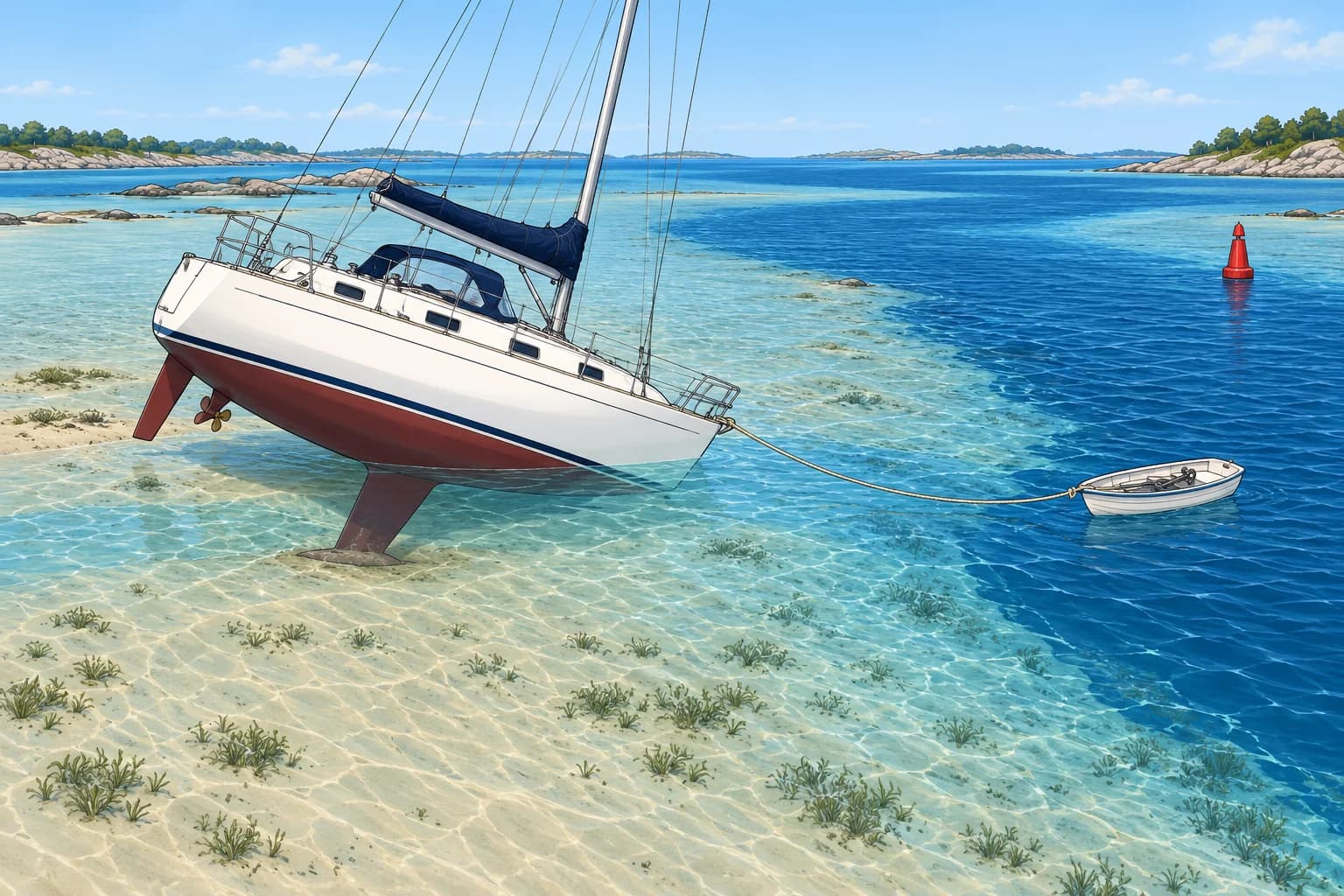
When you touch bottom, stop and think: check the hull, find out what the tide is doing and where deep water is, before you try to power off.
Stop and check
Select neutral immediately. Count heads, check injuries and put lifejackets on. Call immediately if danger is developing; do not wait for refloating attempts. Check the bilges for water, especially around the keel bolts and rudder. A holed boat that floats off can sink in deep water, so check for leaks before trying to get off.
Read the tide
If the hull is sound and conditions are safe, a rising tide may let you refloat. An anchor towards deep water can stop you being driven further on while you wait. A falling tide leaves you harder aground, so assess safe options promptly. Check tide times and measure depths around the boat with a weighted sounding line or boathook. Assess the bottom, slope, wind and waves as well as the escape route.
Don’t power off blindly
Full astern can drive sand or mud into the engine intake, overheat the engine, damage the rudder or propeller, or swing you further on. Try gentle, brief reverse only if hull checks, conditions and the escape route make refloating safe. Check the propeller is clear and watch the cooling water. Usually the safest route is back the way you came.
Getting off
Draught is the vertical distance from the waterline to the boat’s deepest point. If hull and rig are sound, gentle heel (sideways lean) may reduce a single fin keel’s vertical reach; on twin-keel boats it can increase draught. Keep crew secure on deck and the rudder clear. A kedge is an anchor carried towards deep water by dinghy, if safe, then hauled on to pull you off. Remove heavy loose gear safely. For a tow, agree signals and stopping; use sound strong points and keep clear of loaded lines.
Drying out
Drying out means resting on the bottom as the tide falls. An unsupported fin-keeler may fall onto its side. Assess hull suitability, support, resting side, bottom, slope and waves; seek help early if unsure. If safe, anchor towards deep water, secure gear and protect the hull. Stop the engine before closing seacocks. Secure vulnerable openings; keep an escape route. Watch throughout: openings may submerge before lift-off. Once afloat, recheck for leaks. Reopen the cooling intake before restarting; confirm cooling-water flow immediately after starting.
If you run aground
- Select neutral immediately, check people and put lifejackets on. Call immediately if danger is developing: Mayday for grave and imminent danger needing immediate assistance; Pan-Pan for urgent safety help below distress level. — People come first and assistance takes time; do not wait for refloating attempts.
- Check the bilges, keel area and rudder for leaks and damage before trying to refloat. — A holed boat can sink once it floats into deep water.
- Check tide, surrounding depths, bottom, exposure and the escape route. — Rising water may help if waiting is safe; falling water may leave you harder aground.
- Only if safe, lay out an anchor towards deep water. — It can stop wind and waves pushing you further on and provide something to haul on.
- Only if hull checks, conditions and the escape route allow, try lightening or kedging; use controlled heeling only if suitable for your keel configuration. Use gentle reverse only with a clear propeller and cooling water flowing. Otherwise seek help and assess safe drying out. — Refloating must be safe; heeling can increase draught on twin-keel boats. Full astern can choke the intake or damage the rudder and propeller.
- If drying out safely, stop the engine before closing seacocks; secure vulnerable openings and monitor through refloating. Once afloat, check bilges, keel and rudder again. Reopen the engine cooling intake before restarting; confirm cooling-water flow immediately after starting. — Openings may submerge before lift-off, and leaks may appear once afloat. Running without cooling water can damage the engine and exhaust.
Remember
- Check people and the hull before trying to refloat.
- Rising water may help if waiting is safe; falling water may leave you harder aground.
- Don’t power off blindly: sand in the intake, rudder damage.
- Heel only if suitable for your keel; keep crew secure and rudder clear. Kedge towards deep water.
- Assess safe drying out; seek help if unsafe. Protect openings and monitor through refloating.
Common mistakes
Wrong: Give full astern straight away before the tide drops.
Right: Check the hull and the tide first. Use gentle reverse only, watching the cooling water.
Wrong: Once she floats, carry on with the passage.
Right: Check the bilges, keel and rudder again. Damage may only show once she is afloat and moving.
Worked case
Your fin-keel sailing yacht touches a sandbank one hour after high water and stops. There is no water in the bilge. A light wind blows you further onto the bank. What do you do?
Show the answer
Stop propulsion. Check people and hull; the tide is falling. If safe, anchor towards deep water and kedge off. Heel gently with crew secure and rudder clear. Reverse only if safe, with propeller clear and cooling flowing. If stuck, seek help early: assess support and a safe resting side. Stop the engine before closing seacocks. Secure low openings and monitor through refloating. Once afloat, recheck leaks; reopen cooling intake before restart and confirm flow after starting.
Practice question
Why check the bilges before trying to refloat?
- A holed boat may sink once she is in deep water
- A dry bilge guarantees the hull is undamaged
- A dry bilge means the engine cooling has failed
- A full bilge pump means the batteries are flat
Show the answer
Answer: A. On the bank, the ground may be supporting a holed boat. Know before you float off.