
Emergencies at sea · Level R3 · 5 parts · about 14 min
Abandoning ship: liferaft, grab bag and survival
5 short parts: When to go · Grab bag · Launch & board · In the raft · EPIRB & SART. Each part explains the idea, then gives the points to remember, the common mistakes, a worked case and a practice question; the Academy unit adds all 26 check questions.
1 · When to go
When to abandon, and getting ready
Prepare early. Stay aboard while the boat is safer than the raft, and leave before a safe transfer becomes impossible.
Step up
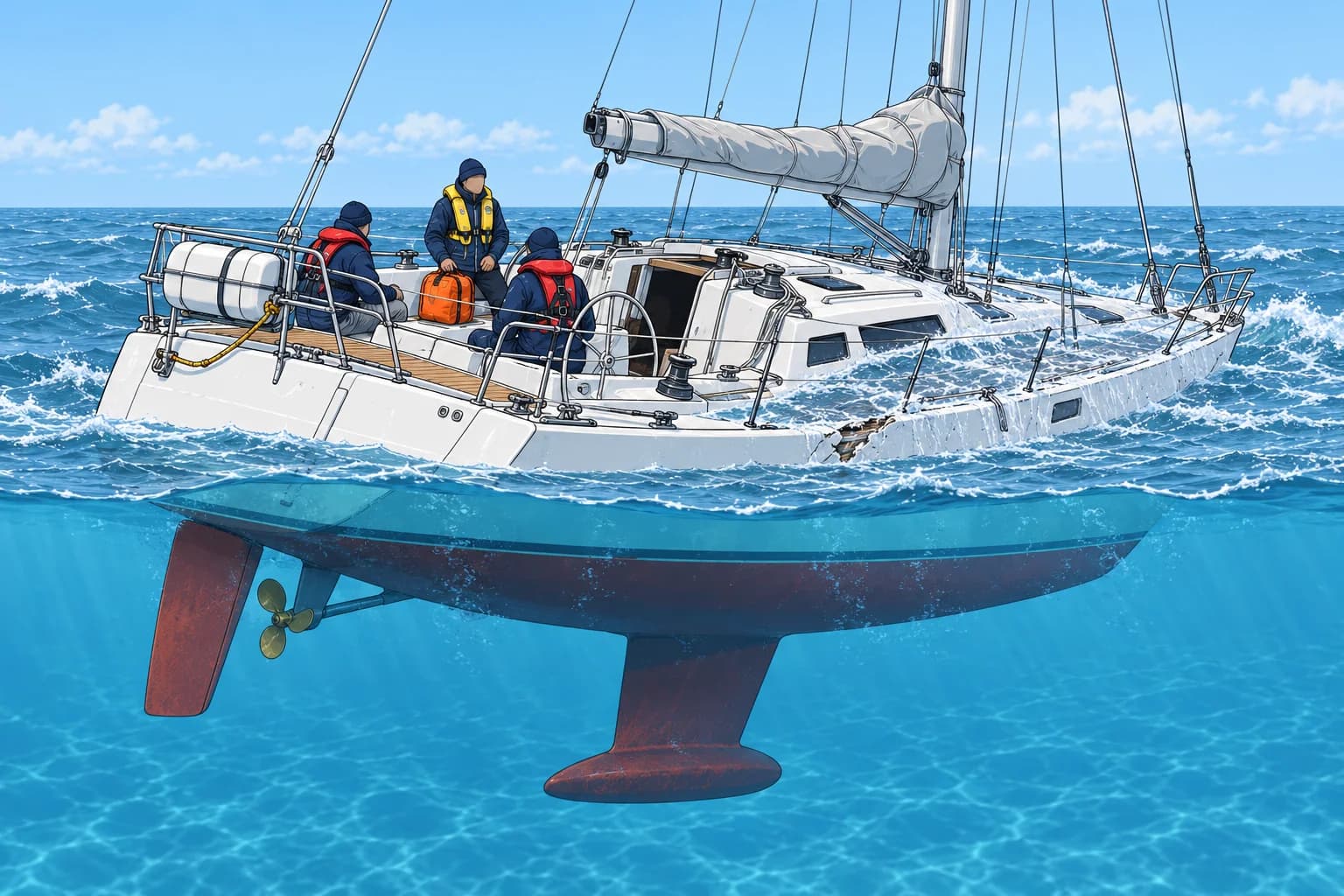
The rule to step up into the liferaft means staying with the boat while it remains the safer refuge. Leave before the danger traps you. A damaged yacht may be bigger, warmer, easier to see and easier to rescue from than a raft. In the 1979 Fastnet storm, several yachts abandoned by their crews were later found still afloat, while some who took to liferafts died.
Reasons to go
Abandon when flooding is beyond the pumps and the boat is clearly settling, when fire has taken hold, or when the boat is breaking up or on rocks with no other way off. A dismasting, a lost rudder or seasick crew are not reasons on their own. If it remains safe, stay aboard until rescuers arrive.
Prepare early
While you still fight the emergency, get ready. Send a Mayday distress call with your position, number aboard and intention to abandon. Activate the EPIRB, the emergency position-indicating radio beacon. Dress warmly, with hats, and fit lifejackets with crotch straps. Bring the grab bag, extra water and handheld VHF marine radio on deck. Secure the liferaft’s painter, its tether and inflation line, to a strong point.
Before you leave
Take seasickness tablets now: seasickness in a raft causes vomiting, dehydration and despair. Drink water if you can before you go. Count heads and give each person a job: launch the raft, carry the grab bag, help the weakest. Leave dry if you can: wet clothes lose heat fast.
Remember
- Step up into the raft: stay aboard while the boat is safer; leave before danger prevents a safe transfer.
- A damaged boat is usually safer and easier to find than a raft.
- Prepare early: Mayday, EPIRB on, warm clothes, lifejackets, grab bag.
- Take seasickness tablets and drink before leaving.
- Count heads and give jobs; board dry if you can.
Common mistakes
Wrong: Launching the raft means everyone must leave the boat immediately.
Right: Prepare early. Launch when needed for a safe transfer; stay aboard while the boat remains the safer refuge.
Wrong: Take off heavy clothes so you can swim to the raft.
Right: Keep warm clothing and a hat on. Fit your lifejacket over your clothing.
Worked case
Twenty miles offshore at night, your yacht has lost her mast and the crew is seasick and frightened. There is no water coming in. One crew member wants to get into the liferaft. What do you decide?
Show the answer
Stay aboard while the yacht remains the safer refuge. Prepare the raft and grab bag, give the crew warm clothing, water and seasickness tablets, and assign jobs. Keep checking for damage or flooding. Leave if conditions make staying aboard more dangerous than a safe transfer.
Practice question
What does ‘step up into the liferaft’ mean?
- Stay aboard while the boat remains the safer refuge
- Step onto the canopy and then slide into the liferaft
- Leave the boat as soon as the raft is ready alongside
- Always board from the highest point of the boat’s deck
Show the answer
Answer: A. Prepare early and leave when staying aboard becomes more dangerous than transferring to the raft. Do not wait until a safe transfer is impossible.
2 · Grab bag
The grab bag
A grab bag holds what the liferaft pack lacks: ways to call, signal, see and stay well. It must float, be easy to see and be ready by the cabin entrance.
The bag itself
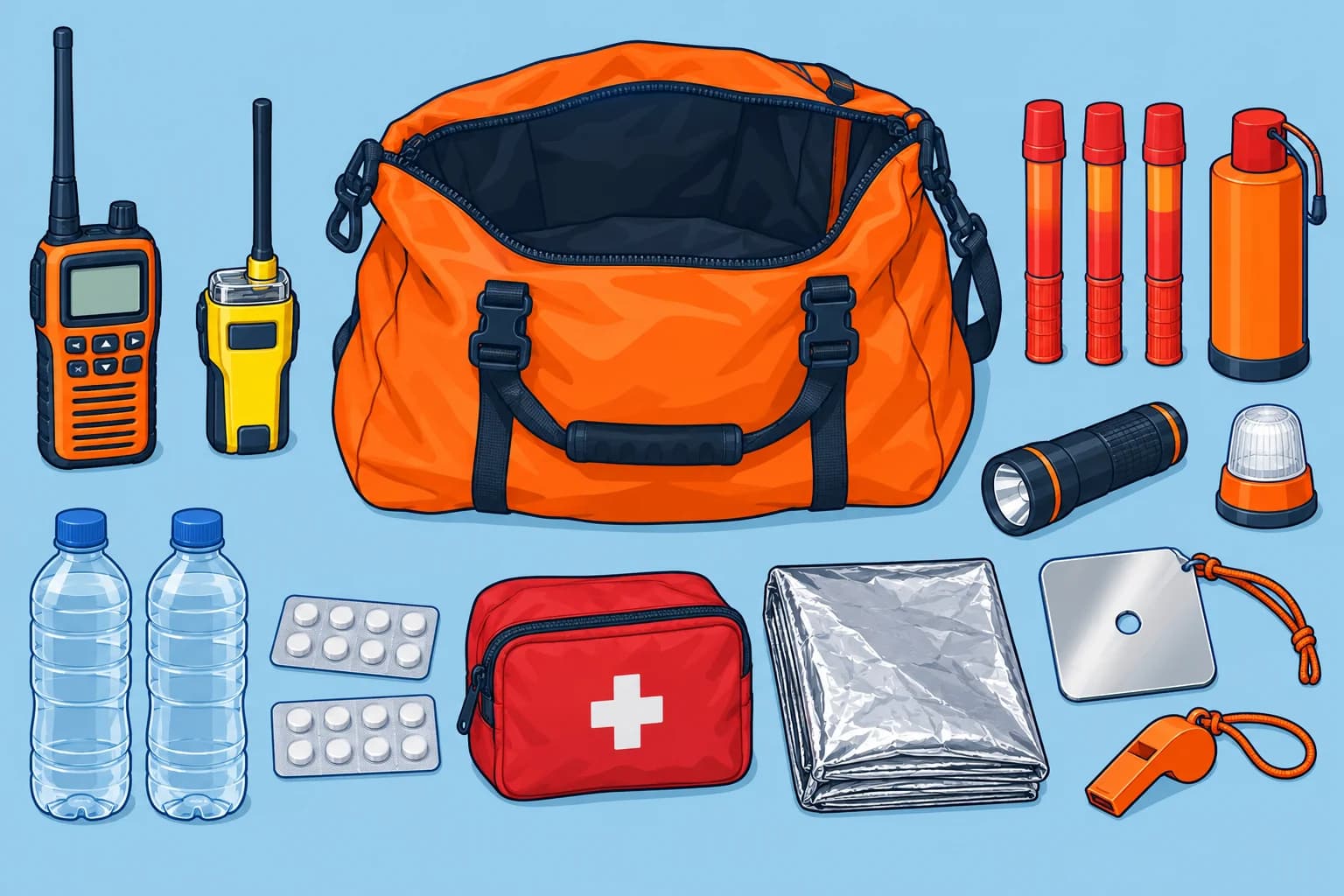
A grab bag is a waterproof bag kept near the companionway, the cabin entrance, ready to take into the raft. Choose one that floats, has a bright colour, carries the boat’s name and has a lanyard (securing cord) and clip so you can attach it to yourself or the raft. One person is given the job of bringing it.
Calling and signalling
Pack a waterproof handheld VHF marine radio, ideally with a digital distress-alert button (DSC) and satellite positioning (GNSS), plus spare batteries. Add a personal locator beacon (PLB) or the EPIRB if kept separately, and a SART, a beacon that helps rescuers locate you nearby. Pack flares, orange smoke, a waterproof torch, flashing strobe light, signal mirror and whistle. A phone in a waterproof pouch may help near the coast.
Staying alive
Add water in sealed bottles (aim for 2 litres per person as extra emergency water), seasickness tablets, a first-aid kit, personal medicines, spare glasses, sunscreen, a hat, thermal protective aids (insulating survival bags), energy bars, a knife and tape. Check that sealed water bottles float; a little air helps.
Keep it ready
Check the contents and batteries at the start of each season and before passages. Brief the crew on where it is. Keep copies of passports and boat papers inside. Do not overload it: a bag too heavy to lift will be left behind. A second container of water can be tied to the raft.
Key figures
- Must
- Float, be bright, carry the boat’s name, have a lanyard and clip
- Call
- Handheld DSC VHF, PLB or EPIRB, SART, phone in pouch
- Signal
- Flares, orange smoke, strobe, torch, mirror, whistle
- Survive
- Water, seasickness tablets, first aid, medicines, thermal aids
Remember
- The grab bag must float, be bright, named and have a lanyard and clip.
- Call: handheld DSC VHF, PLB or EPIRB, SART.
- Signal: flares, smoke, strobe, torch, mirror, whistle.
- Survive: water, seasickness tablets, first aid, medicines, thermal aids.
- One person’s job; check contents and batteries each season.
Common mistakes
Wrong: The liferaft pack has everything, so a grab bag is optional.
Right: Raft packs are minimal. The grab bag adds radio, beacons, water, medicines and more signals.
Wrong: Pack it as full as possible with tins of food.
Right: Water matters far more than food, and a heavy bag gets left behind.
Worked case
Preparing for a two-day passage, you find the grab bag holds old flares, a handheld VHF with a flat battery and no water. What do you change?
Show the answer
Replace out-of-date flares and dispose of the old ones properly. Charge the VHF and add spare batteries, or a second radio. Add sealed water, seasickness tablets, crew medicines, a torch and strobe, a PLB, a knife, a mirror and thermal aids. Check it floats with its lanyard and clip, then show the crew where it is.
Practice question
Why should a grab bag have a lanyard and clip?
- To hang it neatly inside the cockpit locker
- To attach it to yourself or the raft
- To use it as a sea anchor if needed
- To lift it aboard a lifeboat later
Show the answer
Answer: B. Clipped on, it cannot be lost when you jump or as the raft capsizes.
3 · Launch & board
Launching, boarding and righting the liferaft
Tie on, usually launch to leeward, clear of fire, fuel and wreckage, then pull and tug the painter. Board dry, strong person first; skipper last.
Launching
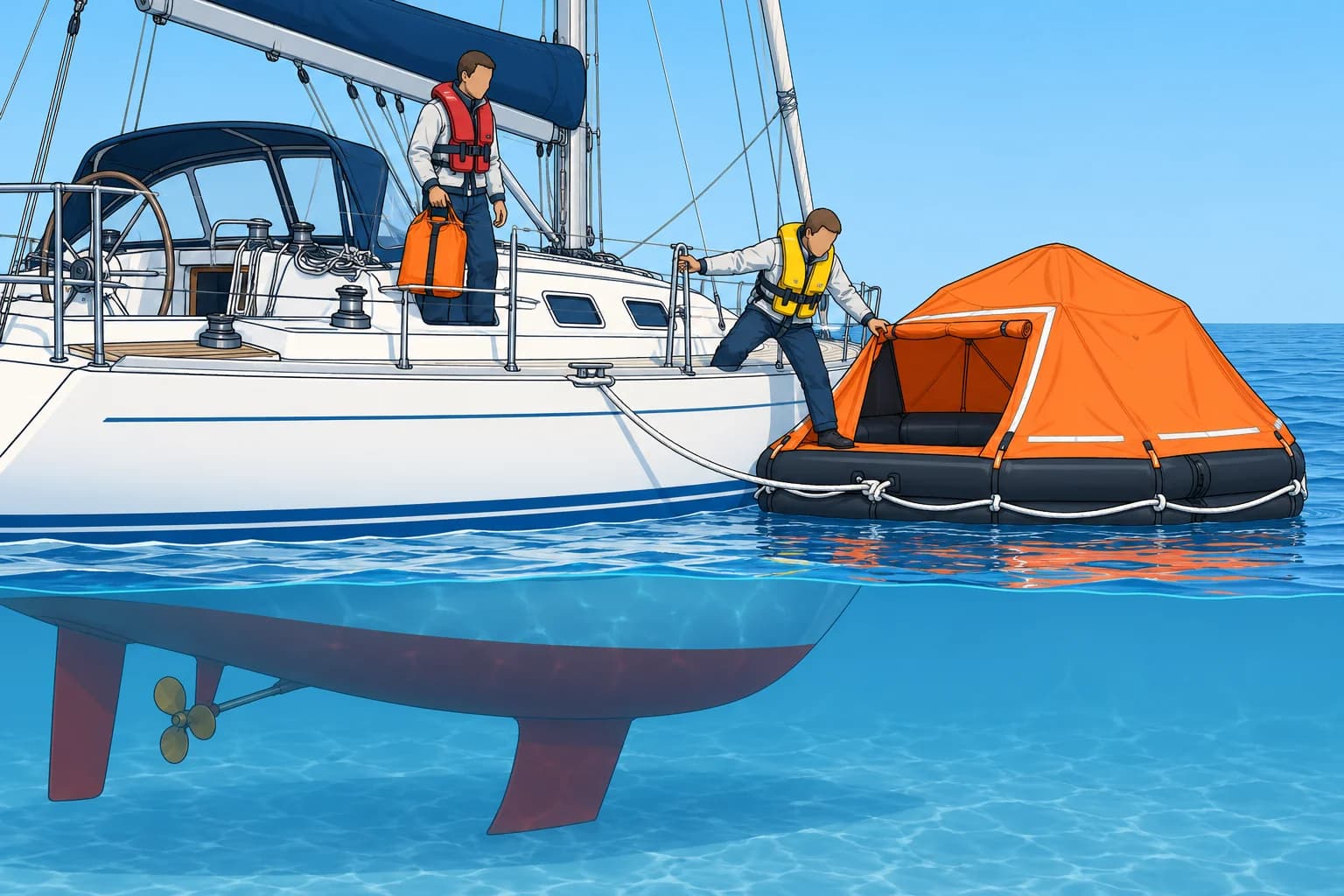
A painter is the raft’s tether and inflation line. Secure it to a strong point and release its securing straps. Usually launch to leeward, the side away from the wind, but keep clear of flames, fuel and wreckage. Follow the raft’s instructions: pull out the painter and tug sharply to trigger inflation, then bring the raft alongside.
Boarding dry
Step from the deck straight into the raft if you can, keeping dry. Do not jump onto the canopy, the raft’s fabric roof: you can injure people or damage it. The first in should be strong and able to help the others and to stabilise the raft. Pass in the grab bag, then the weaker crew, with the skipper last.
From the water
If you must enter the water, go in feet first, holding your lifejacket down. Swim to the raft on your back, in a group if there are several of you. Use the boarding ramp or ladder and the grab lines. Helpers kneel inside and assist using the raft’s boarding aids or a lifejacket’s marked lifting loop; never lift by unmarked collar fabric.
Righting a capsized raft
A raft may inflate upside down. Follow its righting instructions. Swim to the marked righting side, by the gas cylinder, with the wind blowing towards you over the raft so it helps lift it. Climb onto the bottom, stand on the cylinder, hold the righting strap and lean back. The raft comes over on top of you; swim out from under it, keeping a hand on the raft. Then board.
Launching and boarding the liferaft
- Check the painter is tied to a strong point on the boat. — Otherwise the inflated raft can blow away empty.
- Usually launch to leeward, keeping clear of flames, fuel and wreckage. — Use the boat’s shelter only where the raft will be safe.
- Pull the painter out to its full length and tug sharply. — The final tug fires the gas cylinder.
- Pull the raft alongside and board dry, strongest first. — Dry clothes keep heat; the first aboard stabilises the raft and helps others.
- Pass in the grab bag and weaker crew; the skipper boards last. — Nothing and nobody gets left behind.
- Stay attached only while safe; cut free before sinking, fire or wreckage threatens the raft, then paddle clear. — Avoid being trapped against the hull or caught in rigging.
Remember
- Painter tied on before launching; usually launch to leeward, clear of flames, fuel and wreckage.
- Pull the painter fully out and tug sharply to inflate.
- Board dry, strongest first; never jump onto the canopy.
- From the water: feet first, on your back, in a group, use the ramp.
- To right it: stand on the cylinder, pull the strap, lean back.
Common mistakes
Wrong: Throw the raft to windward so it blows clear of the boat.
Right: Usually launch to leeward, in the boat’s shelter, but keep clear of flames, fuel and wreckage. Choose a safe launch point.
Wrong: Jump in the water and swim for it; it is quicker.
Right: Boarding dry keeps you warmer. Enter the water only if you cannot step in.
Worked case
The raft is upright alongside and you can step into it. A tired crew member suggests everyone jump into the water. The strongest person offers to board last. What do you change?
Show the answer
Use the dry transfer. Send a strong, able person first to steady the raft and help others. Pass in the grab bag and help weaker crew aboard. The skipper checks everyone is accounted for and boards last. Enter the water only if a dry transfer becomes unsafe.
Practice question
What must you check before throwing the liferaft over the side?
- That the painter is tied to the boat
- That the canopy entrances are open
- That the sea anchor is streamed
- That the raft’s light is switched on
Show the answer
Answer: A. An untied raft can blow away the moment it inflates.
4 · In the raft
First actions inside and survival priorities
Cut, stream, close, maintain. Then protection, location, water and food, in that order.
Cut
Stay attached only while safe. Cut free before sinking, fire or wreckage threatens the raft, using the safety knife near the entrance. Paddle clear of the hull, rigging and burning fuel. Remain near the boat only while safe; it is easier for rescuers to see.
Stream
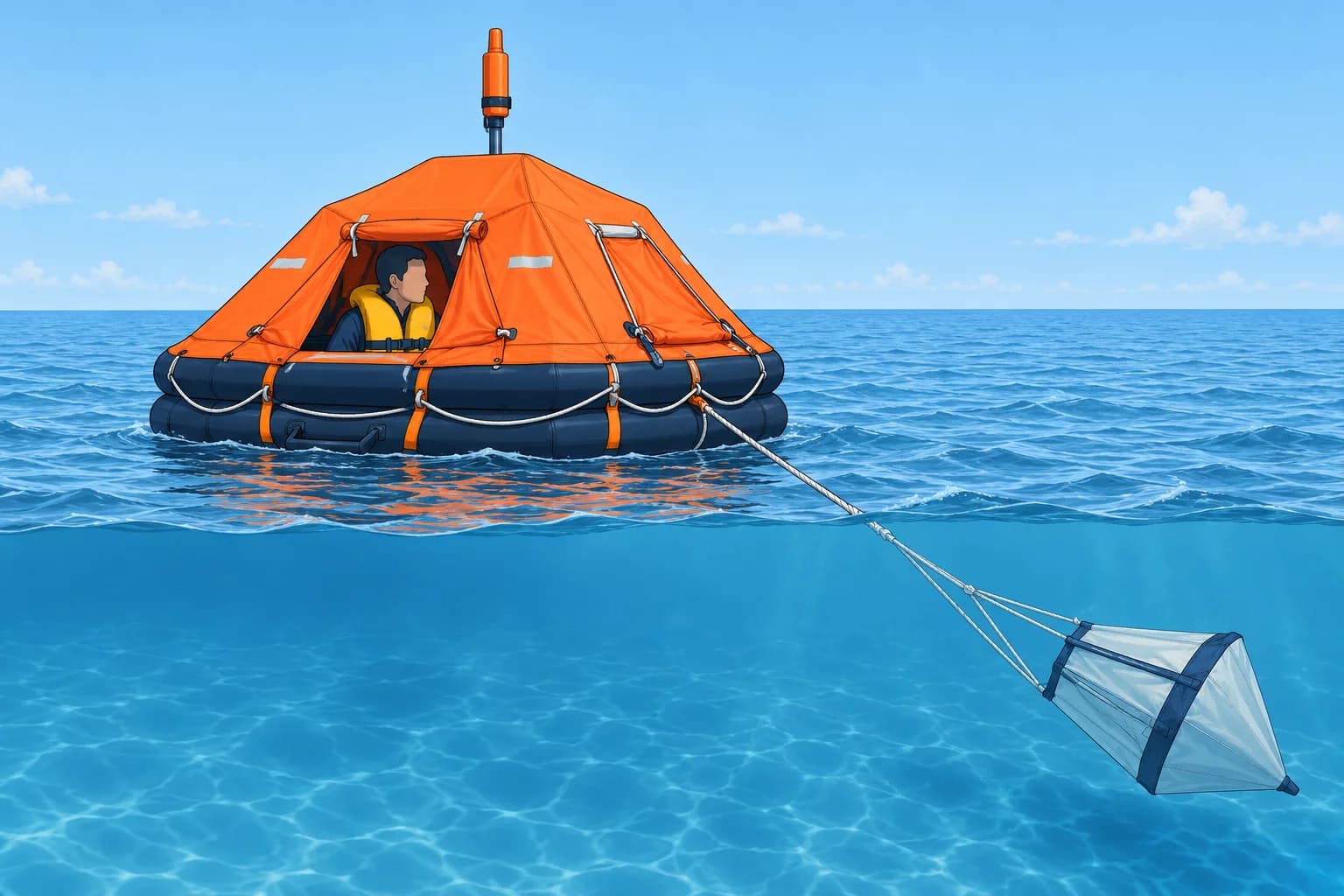
Stream the drogue means put the sea anchor into the water. This drag device slows wind-driven drift and steadies the raft, reducing capsize risk. Currents can still carry you away. Check its line for chafe, or rubbing damage.
Close
Close the entrances to keep out wind and spray, leaving a small gap for air and a lookout. Huddle together on the dry, insulated floor to share warmth. Bail out water and sponge the floor dry.
Maintain
Maintain the raft: inflate the floor if designed for inflation, check for leaks and fit plugs, top up the tubes with the pump as they cool and soften at night, and ventilate regularly. Read the survival instructions. Set a lookout rota, so someone is always watching for ships, aircraft and lights.
Priorities
Then think protection, location, water, food. Protect against cold, spray and sun. Keep the EPIRB on and SART switched on and raised. Count drinking water and collect rain. Follow the raft’s instructions and the usual training rule: no water for the first 24 hours except for the injured, the sick and anyone vomiting; start sooner in great heat or if people are already dehydrated. Then agree small regular rations. Never drink seawater or urine. Food is a lower priority.
Key figures
- First actions
- Cut, stream, close, maintain
- Priorities
- Protection, location, water, food
- Water ration
- First 24 h: only injured, sick or vomiting; then regular rations.
- Never drink
- Seawater or urine
Remember
- Cut free before sinking, fire or wreckage threatens the raft; paddle clear. Stay near the boat only while safe.
- Stream the drogue to slow drift and steady the raft.
- Close the entrances, bail, sponge, huddle.
- Maintain: inflate an inflatable floor, plug leaks, check tube pressure and keep a lookout.
- Protection, location, water, food; never seawater.
Common mistakes
Wrong: Stay attached until the boat sinks, even if fire threatens the raft.
Right: Stay attached only while safe. Cut free before sinking, fire or wreckage threatens the raft, then paddle clear.
Wrong: Share out all the water on the first day to keep spirits up.
Right: Usual rule: only the injured, sick and vomiting drink in the first 24 hours. Then agree small regular rations and review them.
Wrong: Fire a flare whenever someone thinks they see a ship.
Right: Fire flares only when a rescuer is close enough to see them. Supplies are limited.
Worked case
Four crew are in the liferaft, the yacht has just sunk and the sea is rough. Water is sloshing on the floor and everyone is cold and frightened. What do you do in the first hour?
Show the answer
Check the painter is cut and paddle clear of debris. Stream the drogue. Close the entrances, bail and sponge out, and inflate the floor if designed for inflation. Check for leaks and top up the tubes. Hand out seasickness tablets, huddle together and set a lookout rota. Confirm the EPIRB is on and switch on and raise the SART. Ration water to supplies and conditions.
Practice question
You are clear of the wreckage, but the raft is drifting and rolling heavily. What should you do next?
- Open every canopy door
- Stream the drogue now
- Start dividing the food
- Wait for a ship to appear
Show the answer
Answer: B. The drogue reduces wind-driven drift and helps steady the raft, reducing capsize risk. It does not hold you at a fixed position.
5 · EPIRB & SART
Using EPIRB, SART and PLB in survival
Leave the EPIRB on and floating as directed. Switch on the SART and mount it high. Keep a PLB’s antenna upright and clear of the water.

EPIRB
Switch on the EPIRB and leave it on. It sends a 406 MHz satellite alert with its identity and, if GNSS-equipped, its satellite position. GNSS means satellite positioning. Its 121.5 MHz signal helps rescuers home in. Follow its instructions: a float-free model works best floating on its lanyard, tied to the raft, antenna upright. Some show a Return Link Service (RLS) light when the alert has been received.
SART
Switch on the SART (search and rescue transponder) and mount it high on its pole or the canopy. Height improves range. A radar SART answers a ship’s or aircraft’s 9 GHz radar: a line of 12 dots appears on their screen, leading from your position outwards. An AIS-SART shows as a special target on AIS, the automatic identification system used to display vessel positions. Use the SART alongside the EPIRB.
PLB
A PLB (personal locator beacon) works like a small EPIRB for one person, usually for at least 24 hours. Most must be switched on by hand and held with the antenna up, out of the water. Keep a PLB ready as backup and follow rescuers’ instructions. Do not cycle an active distress beacon on and off to save power.
Other signals
Keep the handheld VHF dry. When rescuers are nearby, call on Channel 16 with your position, then listen for instructions. Use the signal mirror in sunshine; it can be seen far away. Use flares and orange smoke when rescuers could see them; follow each device’s instructions.
Remember
- EPIRB on and left on: 406 MHz alert plus 121.5 MHz homing.
- A float-free EPIRB works best floating on its lanyard, antenna up.
- Radar SART: 12 dots on rescuers’ radar; AIS-SART on AIS screens.
- Switch on the SART alongside the EPIRB and mount it high: range depends on height.
- PLB: switched on by hand, antenna up and out of the water.
Common mistakes
Wrong: Switch the EPIRB off once you hear it has been received.
Right: Leave it on. Rescuers use its signals to home in on you until you are found.
Wrong: The SART is as effective lying on the raft floor.
Right: Its range falls sharply near the water. Mount it as high as possible.
Worked case
Your EPIRB and radar SART have been on for six hours. The SART is mounted high and the EPIRB’s RLS light confirms receipt. A crew member suggests switching both off to save power. A ship appears on the horizon. What do you do?
Show the answer
Leave both devices on. RLS confirms receipt, not that rescue has launched. Check that the radar SART remains mounted high and the EPIRB is deployed as instructed. Call the ship on Channel 16 with the handheld VHF, giving your position, and follow its instructions. Use a flare when the ship is close enough to see it.
Practice question
What does a radar SART look like on a rescuer’s radar screen?
- A single large echo at the centre
- A line of 12 dots leading outwards
- A ring of light around the screen
- A flashing number with your MMSI
Show the answer
Answer: B. The SART replies to the radar pulses, painting a line of 12 dots from your position outwards.