
Emergencies at sea · Level P1 · 5 parts · about 18 min
Emergency types, alarm signals and muster lists (STCW A-VI/1-1)
5 short parts: Emergencies · Alarm signals · Muster list · At the muster · Drills. Each part explains the idea, then gives the points to remember, the common mistakes, a worked case and a practice question; the Academy unit adds all 32 check questions.
1 · Emergencies
Shipboard emergencies and who does what
Fire, collision, flooding and the rest can strike any ship. The master takes command, the crew work in teams, and you must know your own part from day one.
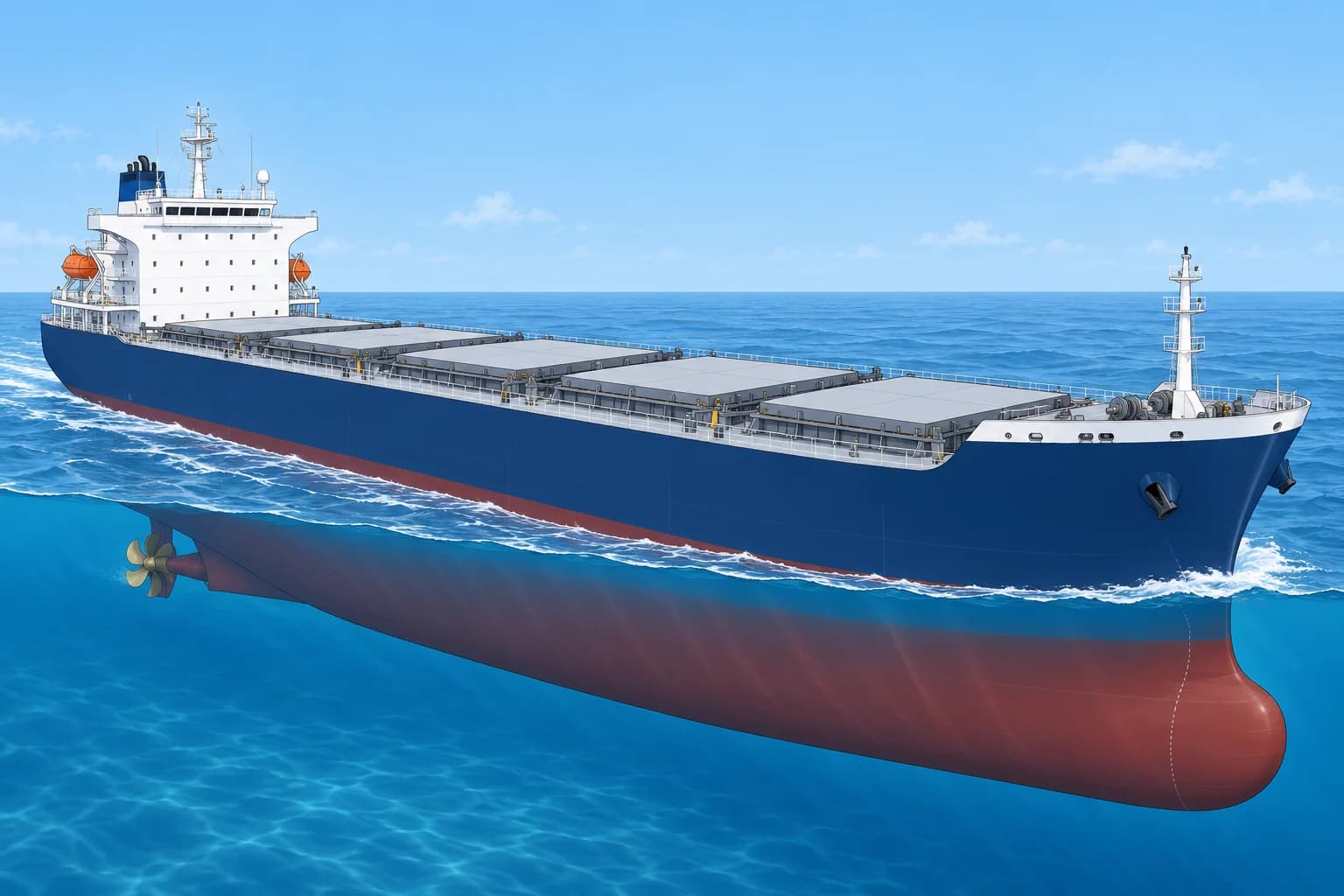
What can go wrong
A ship is an isolated workplace, often far from help. The emergencies you train for are fire, collision, grounding (striking the seabed), flooding, abandoning ship, man overboard (a person falling into the sea), pollution such as an oil spill, and security threats such as piracy or a stowaway. One can lead to another: a collision can bring flooding, fire and pollution at the same time. Help from shore may be hours or days away, so the crew must handle the first stage themselves.
Who is in charge
The master is in overall command in every emergency, normally from the bridge. The crew are organised in teams, for example a command team on the bridge, an emergency party (often a fire party led by the chief officer), an engine-room party under the chief engineer, and a support party for first aid, stretchers and survival craft. Names vary between companies; your ship's muster list tells you which team you are in.
Your part
As a new crew member you are not expected to lead, but you must know your duties. From the day you join, find your muster station (the place you report to in an emergency), your emergency duty, your lifejacket and immersion suit (a protective suit that reduces heat loss in cold water), and at least two ways out of every space where you work or sleep. Follow orders, report what you see, and never act alone in a dangerous space.
Why we train
In a real emergency people are frightened, it may be dark, the ship may be leaning to one side and the alarms are loud. Under stress you do what you have practised. That is why SOLAS, the International Convention for the Safety of Life at Sea, requires regular drills on board. The practical exercises of this basic training, such as putting on an immersion suit, jumping into a pool and righting a liferaft, are done in your approved course; these lessons give you the knowledge behind them.
Key figures
- Overall command
- The master, in every emergency
- STCW basis
- Regulation VI/1; Code table A-VI/1-1, personal survival
Remember
- Main emergencies: fire, collision, grounding, flooding, abandon ship, man overboard, pollution, security.
- One emergency can trigger others; the crew must handle the first stage alone.
- The master commands; the crew work in teams named in the muster list.
- Know your muster station, duty, lifejacket, immersion suit and two escape routes from day one.
Common mistakes
Wrong: As a new crew member, emergencies are for the officers to deal with.
Right: Every person has a duty in the muster list. Learn yours, and your station, on the day you join.
Wrong: One escape route from your cabin is enough.
Right: Smoke or damage can block any route. Know at least two ways out of every space you use.
Wrong: A collision is only a navigation problem.
Right: A collision can cause flooding, fire and pollution at once. Be ready for all of them.
Worked case
It is your second day on a bulk carrier. During a tour, the bosun (senior deck crew member) asks you what you would do if the alarm sounded at night while you were asleep. You are not sure where your muster station is.
Show the answer
Say so honestly and fix it now. Read your cabin card and the muster list to find your station and duty. Walk from your cabin to the muster station by the main route and by a second route. Find where your lifejacket and immersion suit are kept. Ask the bosun or an officer to explain anything you do not understand. Ask for safety familiarisation before you start any duties.
Practice question
Who is in overall command during a shipboard emergency?
- The chief engineer, from the engine room
- The master, normally from the bridge
- The officer of the watch who raised it
- The leader of the emergency fire party
Show the answer
Answer: B. The master is always in overall command. Team leaders such as the chief officer or chief engineer run their parties under the master's orders.
2 · Alarm signals
The general emergency alarm and other signals
Seven or more short blasts and one long blast call you to follow your muster-list duties. Learn your ship's other signals too.
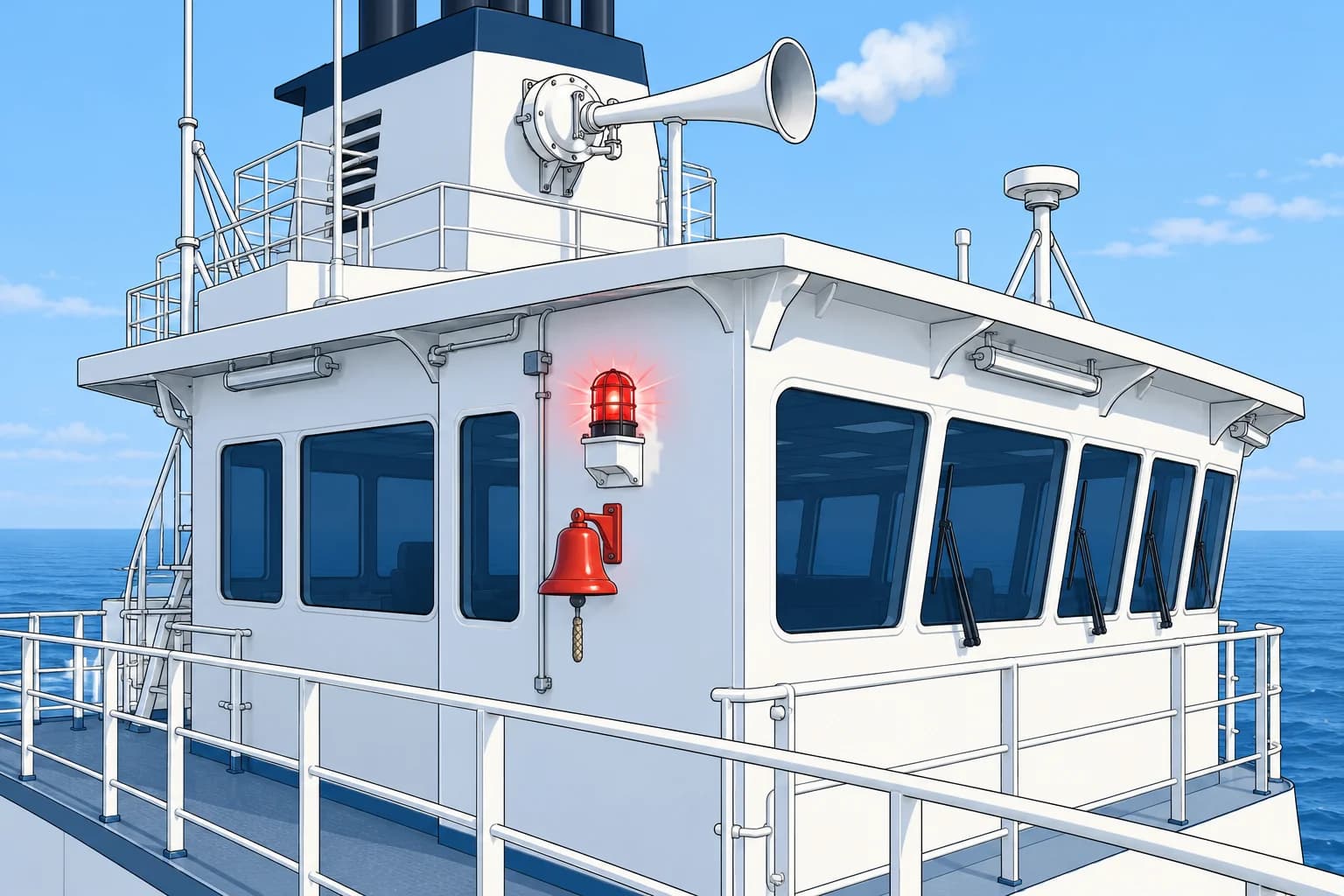
The general emergency alarm
The general emergency alarm is seven or more short blasts followed by one long blast on the whistle or siren and electric bells or klaxons throughout the ship (SOLAS III/6.4.2). Follow your muster-list instructions: report to your assigned station or carry out your emergency duty. If on watch, follow your emergency instructions; do not simply abandon your post. The alarm is sounded from the bridge. On its own it does not mean abandon ship.
Announcements
After the alarm, the bridge normally uses the public address (PA) system to say what is happening and where, for example 'Fire, fire, fire in the engine room'. Listen carefully: the message may change your route, because you must not walk through the affected area. Drills are announced as drills. The muster list shows every signal used on your ship and what it means.
Fire alarm
Fire detectors and manual call points, break-glass alarm buttons in corridors and spaces, raise the fire alarm on the bridge and at the fire control station. The crew are then summoned with the ship's fire signal, often continuous ringing of the alarm bells; the exact signal is in your muster list. If you discover a fire, shout 'Fire!', press the nearest call point and make sure the bridge knows.
CO2 release alarm
Some spaces, such as the engine room, are protected by a fixed CO2 (carbon dioxide) system. Before the gas is released, a pre-discharge alarm, a distinct siren or horn with flashing lights, sounds in the space for at least 20 seconds. CO2 puts out fire by pushing out the oxygen, and it will kill you too. Leave at once by the nearest exit and never go back in until an officer says it is safe.
Man overboard
If you see someone fall into the sea, shout 'Man overboard' and the side, port or starboard. Throw the nearest lifebuoy towards them, keep pointing at them, and make sure the bridge knows. The ship's own man-overboard signal is set by the company and shown in the muster list; many ships use three long blasts.
Abandon ship
No alarm abandons the ship automatically. Only the master decides, and the order is normally given by word of mouth or over the PA after the crew have mustered; the muster list says how. Never leave the ship on your own because the general alarm has sounded.
Key figures
- General emergency alarm
- 7 or more short blasts + 1 long, on whistle and bells
- Its meaning
- Follow your muster-list duty; not an order to abandon ship
- Fire signal
- Ship's own signal in the muster list, often continuous bells
- CO2 pre-discharge alarm
- At least 20 s before release (FSS Code ch. 5); leave at once
- Abandon ship
- Ordered by the master only, by voice or PA
Remember
- General alarm: 7+ short blasts, then 1 long. Follow your muster list: report to your station or carry out your duty.
- Listen to the PA: it tells you what and where, and may change your route.
- CO2 pre-discharge alarm: leave the space at once; the gas kills.
- Man overboard: shout, throw a lifebuoy, point, tell the bridge.
- Only the master orders abandon ship, by voice or PA.
Common mistakes
Wrong: The general emergency alarm means abandon ship.
Right: Follow your muster-list instructions. Abandon ship is a separate order from the master.
Wrong: When the CO2 alarm sounds, finish what you are doing first.
Right: Leave at once by the nearest safe exit. Never use the warning interval to finish a job.
Wrong: Run to the bridge to report a man overboard.
Right: Shout the alarm, throw a lifebuoy and keep pointing. Direct a named person to alert the bridge and confirm it. If alone, alert the bridge by the quickest available means while keeping the person in sight where possible.
Worked case
You are painting in the engine room when a siren you have not heard before starts and lights flash at the exits. Your workmate says it is probably a test and keeps working.
Show the answer
Treat it as a CO2 pre-discharge alarm. Put the brush down and leave at once by the nearest exit, telling your workmate to come with you. Close doors behind you if that is the drill on your ship. Report to your muster station or the person in charge and say who was in the space with you. Do not go back in until an officer says it is safe. A test is announced in advance; if you are unsure, get out first and ask afterwards.
Practice question
What is the general emergency alarm signal?
- Seven or more short blasts, then one long blast
- One long blast, then seven or more short blasts
- Three long blasts, repeated at short intervals
- Continuous sounding of the ship's whistle
Show the answer
Answer: A. SOLAS III/6.4.2: seven or more short blasts followed by one long blast on the whistle or siren, and on bells or klaxons throughout the ship.
3 · Muster list
The muster list and emergency instructions
The muster list is the ship's emergency plan on one page: the signals, every person's duty and who stands in for whom. Read it on the day you join.
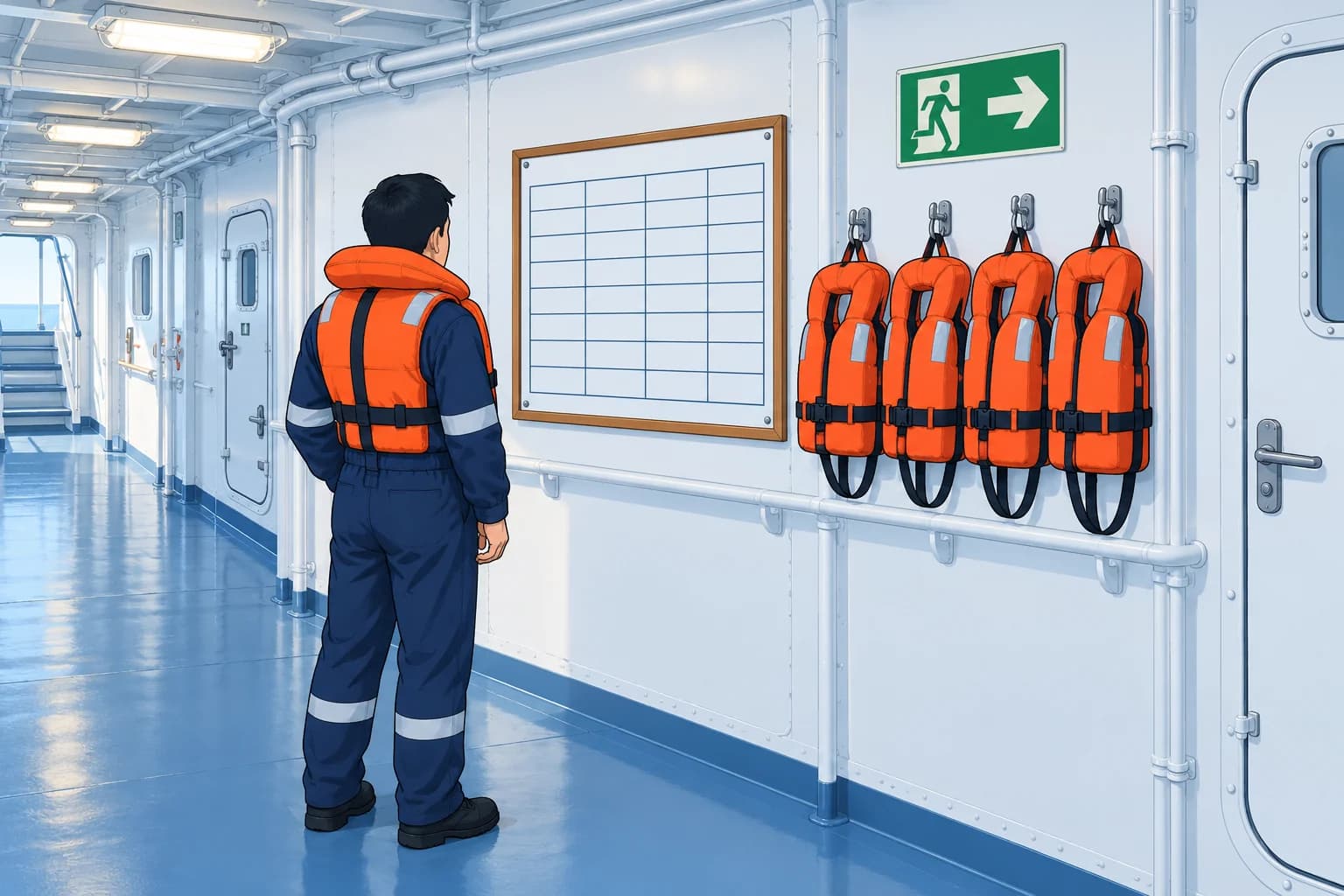
What it is
The muster list is the ship's emergency plan in one table. SOLAS regulations III/8 and III/37 require one on every ship. Copies are displayed in conspicuous places, including the bridge, the engine room and the crew accommodation.
What it contains
It describes the general emergency alarm and PA signals, what crew must do when they sound, and how the order to abandon ship will be given. It gives each person a duty: closing watertight and fire doors, valves and ventilation openings, equipping and launching survival craft, preparing other life-saving appliances, mustering passengers, using communication equipment or manning fire parties. It names the officers who keep life-saving and fire appliances ready, and substitutes for key persons who may be injured.
Emergency instructions
Every person on board must have clear emergency instructions. Many ships put a cabin card (or bunk card) in each cabin showing that person's muster station, survival craft and duty. On passenger ships, illustrated instructions on muster stations, essential actions and how to put on a lifejacket are posted in cabins and at muster stations; many cargo ships post pictures showing how to put them on near the lifejacket stowage too.
Muster and embarkation
The muster station is where you gather, are counted and get orders. The embarkation station is where you board the survival craft. On many cargo ships both are on the boat deck, close together; on others they are apart. Routes to them are marked with escape signs. Find both on the day you join and walk the route.
The training manual
SOLAS III/35 also requires a training manual on life-saving appliances in each crew mess room and recreation room, or in each crew cabin. With pictures, it explains how to put on lifejackets and immersion suits, how survival craft are launched and boarded, and how to survive in them. Parts may be supplied through audiovisual training aids instead of text. Ask where to use the manual and aids in your first days on board; they do not replace supervised practice.
Key figures
- Rules
- SOLAS III/8 (instructions) and III/37 (muster list)
- Displayed
- Bridge, engine room and crew accommodation
- Training manual
- Each crew mess and recreation room, or each cabin (SOLAS III/35)
Remember
- The muster list gives the signals, how abandon ship is ordered, and every person's duty.
- It is posted on the bridge, in the engine room and in the crew accommodation.
- It names substitutes for key persons and the officers who keep the equipment ready.
- Muster station: gather and be counted. Embarkation station: board the craft.
- Your cabin card shows your own station, craft and duty.
Common mistakes
Wrong: The muster list is the officers' business; deck crew do not need to read it.
Right: It gives every person on board a duty, including you. Read it the day you join.
Wrong: Muster station and embarkation station always mean the same place.
Right: You gather at the muster station and board at the embarkation station. On some ships they are apart.
Wrong: If the officer with a key duty is injured, the duty is simply skipped.
Right: The muster list names substitutes so that every key duty is still done.
Worked case
You join a container ship as an ordinary seaman. Your cabin card says 'Muster B, Lifeboat 2 (port), duty: bring portable VHF from the bridge'. You have never been to the bridge.
Show the answer
Find the muster list to confirm your entry and see who else is in your group. Ask the officer of the watch to show you where the portable VHF sets are kept on the bridge and how to carry them safely. Walk the route from your cabin to the bridge, then to muster station B and lifeboat 2, and learn a second route. Read the training manual pages on lifeboats. At the next drill, carry out your duty for real.
Practice question
Where must the muster list be displayed?
- Only on the bridge, in the master's file
- Bridge, engine room and crew accommodation
- Only at the lifeboat embarkation stations
- In the company's office ashore
Show the answer
Answer: B. SOLAS III/8 requires the muster list in conspicuous places throughout the ship, including the bridge, engine room and crew accommodation.
4 · At the muster
Responding to the alarm: from your bunk to the muster station
Follow your muster-list duty. Escape at once if threatened; collect clothing and equipment only if safe, without delaying escape. Report and follow orders.
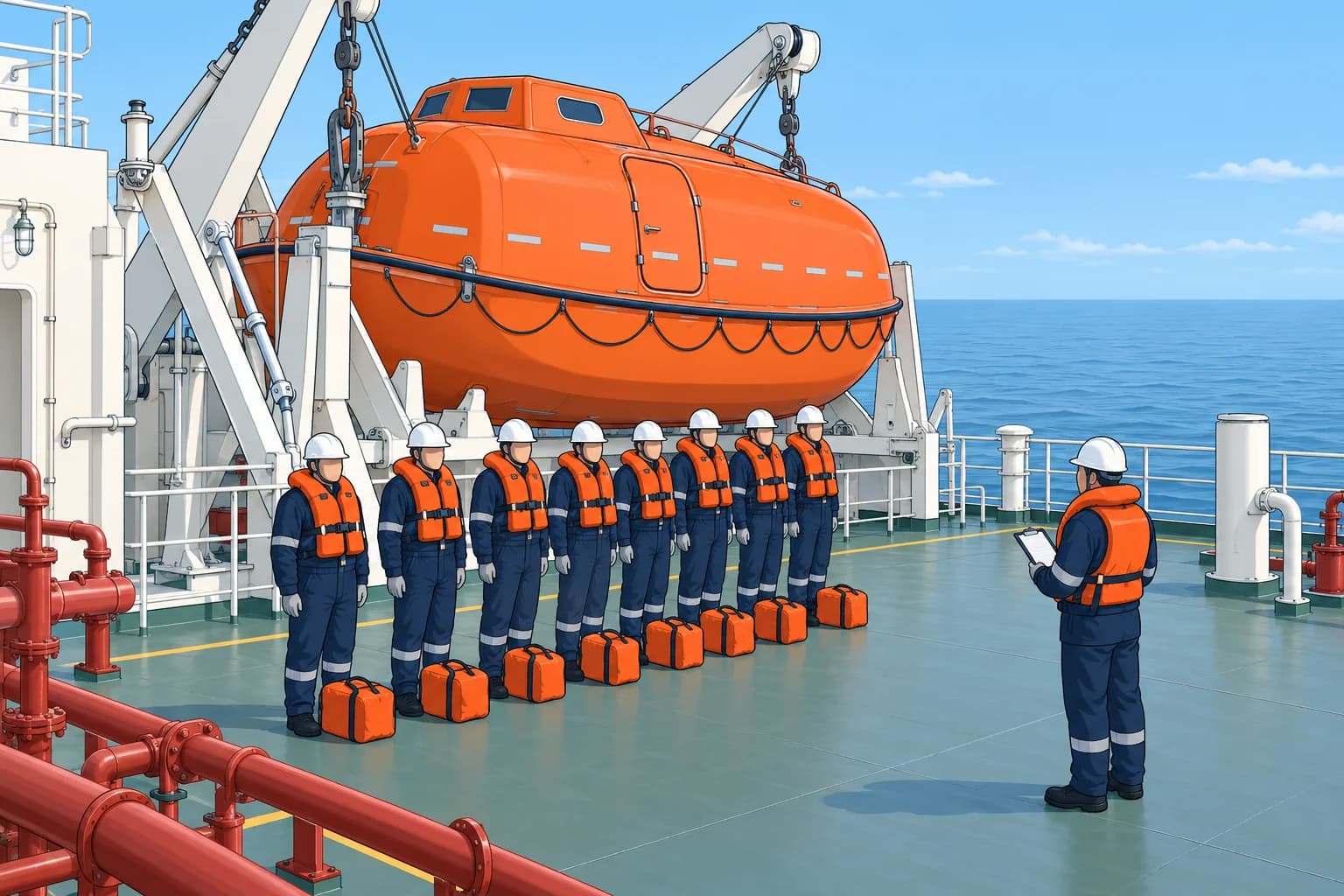
Every alarm is real
Treat every alarm as real until you are told otherwise. A drill is announced on the public address (PA) system, but follow your emergency instructions. Carry out your muster-list duty and report to your assigned station. If on watch, follow your emergency instructions; do not simply abandon your post. If smoke or heat threatens you, escape at once.
Dress for the worst
If safe and without delaying escape, wear warm layers covering arms and legs, a hat and closed shoes. Take your lifejacket and immersion suit as specified in your instructions. Never enter smoke or make an unsafe detour to fetch equipment. Clothing protects you from cold, fire and sun. Watchkeepers use the extra lifejackets kept on the bridge, in the engine control room and at other manned watch stations; do not leave an essential watch to collect equipment.
The headcount
At the muster station the person in charge checks names against the muster list. Answer clearly. If someone is missing, say where you last saw them; the master may send a search party. Never go back alone to look for anyone. Put on your lifejacket when ordered and check your neighbour's straps.
To the embarkation station
When instructed, move with your group to the embarkation station, where you board the survival craft. Board only when the person in charge orders it. Boarding may be part of a drill or preparation; the general alarm alone never authorises it. Only the master orders abandon ship. What to do in the craft or in the water is in Emergencies: survival in water.
Key figures
- Extra lifejackets
- Bridge, engine control room, other manned stations (SOLAS III/7)
When the general emergency alarm sounds
- Make your own task safe if you can do so without delaying escape. Follow your assigned emergency duty. Do not stop essential machinery or leave an essential watch unless instructed or in immediate danger. — Your response must follow the muster list and preserve essential ship operations. Immediate danger requires escape.
- Only if safe and without delaying escape, dress warmly with arms and legs covered, shoes and a hat; take the lifejacket and immersion suit specified in your instructions. — Clothing protects against cold, fire and sun, but collecting it or equipment must never delay escape.
- Follow your muster-list duty: report to your assigned emergency station or carry out your emergency duty. If moving, use a safe route; change it if smoke or the PA requires. — The PA may name the danger area. Smoke kills faster than fire.
- When moving, close doors behind you and never use a lift. — Closed doors slow fire and smoke; a lift can stop between decks.
- Report to the person in charge and say who is missing or injured. — The headcount tells the master who may still be in danger.
- Put on your lifejacket when instructed, and follow orders at your assigned station. — The master decides the next step; acting alone puts you and others at risk.
Remember
- Treat every alarm as real; drills are announced on the PA.
- Dress warmly and take your lifejacket and suit only if safe, without delaying escape.
- Use a safe route, close doors, never use a lift.
- Follow your muster-list duty and report as instructed; never search alone for missing people.
- Board survival craft only when ordered.
Common mistakes
Wrong: Run to the muster station in shorts and sandals so you are not late.
Right: Dress warmly with arms and legs covered only if safe and without delaying escape. If smoke or heat threatens you, leave at once.
Wrong: Go back to your cabin to look for a missing friend.
Right: Report them to the person in charge. A search party with the right equipment will be sent if needed.
Worked case
At 03:00 the general emergency alarm wakes you. The PA says 'Fire in the accommodation, deck B, port side'. Your cabin is on deck B, starboard side, and the corridor smells of smoke.
Show the answer
If smoke or heat threatens you, escape at once. Take warm clothes, your lifejacket and suit only if safe; never delay escape to fetch them. Check the door for heat before opening. Use a route clear of smoke; starboard is not safe just because fire is reported to port. Close doors, avoid lifts and report smoke and missing people at your assigned station. If no route is safe, keep the door closed and alert the bridge to your location.
Practice question
The alarm sounds while you are in the shower. If dressing will not delay safe escape, what should you wear?
- Whatever is quickest, even only shorts and sandals
- Warm layers covering arms and legs, a hat and shoes
- Just your boiler suit, leaving everything else behind
- Your uniform and best shoes for the roll call
Show the answer
Answer: B. Warm layers covering arms and legs, a hat and shoes protect you from cold, fire and sun. Dress only if safe and without delaying escape. If smoke or heat threatens you, leave at once.
5 · Drills
Familiarisation, training and drills on board
You get safety familiarisation before any duties, training within two weeks, and regular drills set by SOLAS. Know the intervals: they are exam favourites.
Familiarisation first
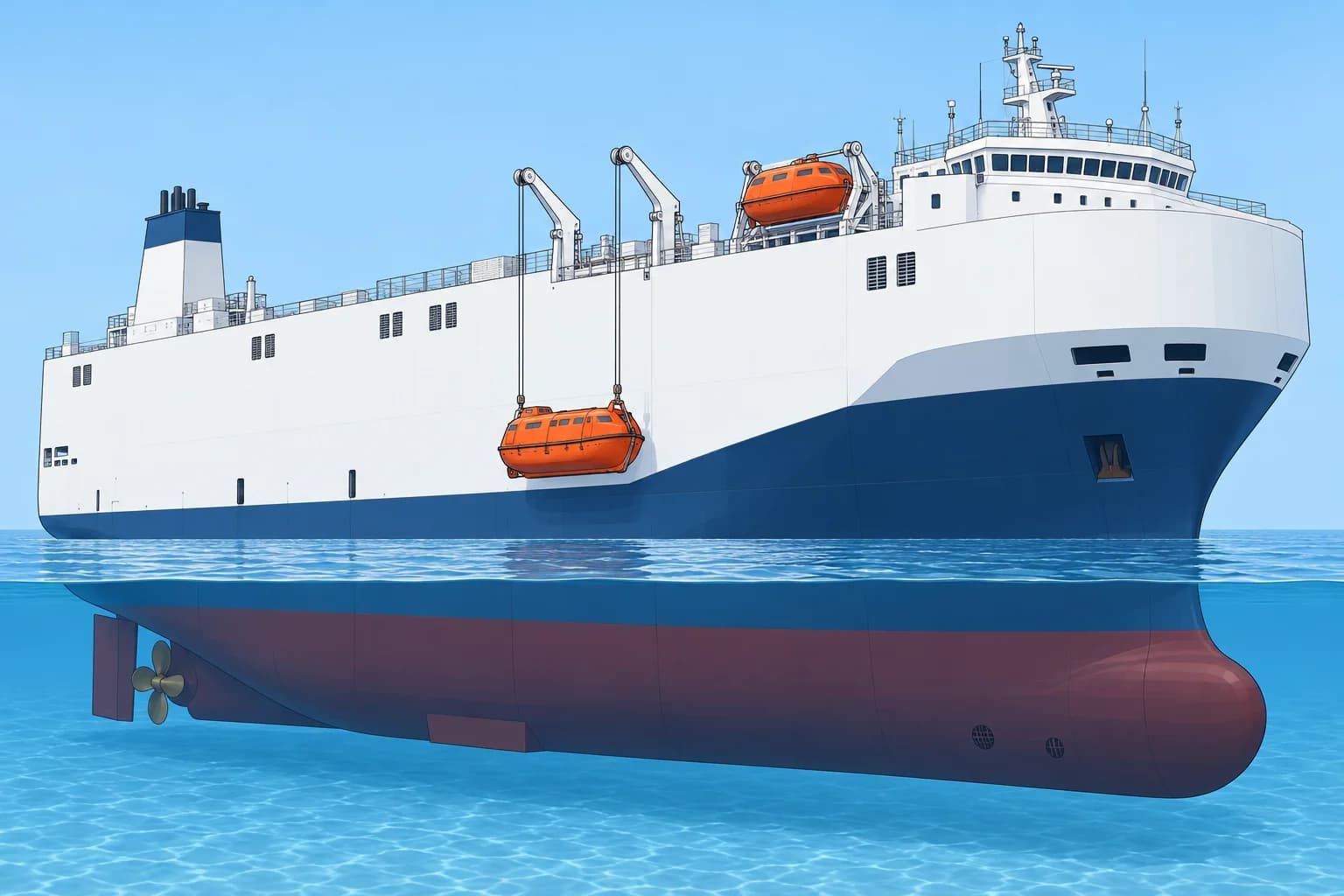
Before you are given any duties, you receive safety familiarisation on board (STCW Regulation VI/1, Code section A-VI/1). You learn to understand safety signs and alarm signals; what to do if someone falls overboard, if fire or smoke is found, or if the fire or abandon-ship alarm sounds; your muster and embarkation stations and escape routes; how to put on a lifejacket, raise the alarm and use a portable extinguisher; immediate first aid; and how to close the fire, weathertight and watertight doors.
Training on board
SOLAS III/19 adds that crew with emergency duties must know them before the voyage begins. Training in the ship's life-saving and fire-fighting appliances is given as soon as possible, and not later than two weeks after you join.
How often
Every crew member takes part in at least one abandon-ship drill and one fire drill every month. If more than 25 % of the crew have not taken part in these drills on that ship in the previous month, they are held within 24 hours of leaving port. On a new ship, after major modification or with a new crew, drills are held before sailing. Passenger ships hold them every week. Crew with enclosed-space duties drill at least every two months.
Boats in the water
Conventional lifeboats on davits (boat-handling arms) are launched and manoeuvred by their operating crew at least every three months. For free-fall lifeboats, every three months crew board, strap in and rehearse up to release; the boat is then free-fall launched with its operating crew or lowered by its secondary system, and manoeuvred by that crew. At least every six months, carry out a free-fall launch with operating crew or approved simulated launch. Rescue boats launch and manoeuvre with their crew monthly where practicable, and at least every three months.
Inside an abandon-ship drill
The drill starts with the general alarm and a PA announcement. Crew report to muster stations, prepare for their duties, and are checked for suitable clothing and lifejackets put on correctly. At least one lifeboat is lowered after the preparations for launching, and its engine is started; liferaft davits are operated; the crew are taught to use the radio life-saving appliances. Emergency lighting for mustering and abandonment is tested at every drill. Drills are recorded in the logbook.
Safe drills
A drill must teach, not injure. Follow the officer's briefing, report faulty equipment, and never stand under a boat being lowered. IMO guidance on safety during abandon-ship drills (MSC.1/Circ.1578) helps officers plan them. Small-boat drills are in Emergencies: drills.
Key figures
- Abandon-ship and fire drill
- Each crew member monthly; passenger ships hold drills weekly
- 24-hour rule
- Within 24 h of sailing if over 25 % missed last month's drills
- Lifeboat in the water
- Each lifeboat, with its operating crew, at least every 3 months
- Free-fall lifeboat
- 3-month rehearsal and water drill; free-fall/simulation every 6 months
- Enclosed-space drill
- At least every 2 months
- On-board training
- Within 2 weeks of joining (SOLAS III/19)
Remember
- Safety familiarisation comes before any shipboard duties (STCW VI/1).
- Each crew member joins abandon-ship and fire drills at least monthly. Passenger ships hold these drills weekly.
- Over 25 % missed last month: drills within 24 h of leaving port.
- Lifeboats: 3-month launch/lower and manoeuvring; free-fall boats also rehearse. Free-fall launch or simulation every 6 months.
- Enclosed-space drills every 2 months; emergency lighting tested at each abandon-ship drill.
Common mistakes
Wrong: A drill is a formality: walk to the muster station and sign the sheet.
Right: Act as in a real emergency: follow your assigned duty. Collect clothing and your lifejacket only if safe and without delaying escape. That is how you learn.
Wrong: Familiarisation can wait until the first monthly drill.
Right: Safety familiarisation comes before you are given any duties on board.
Wrong: Stand close under the lifeboat to watch it being lowered.
Right: Keep clear of a boat being lowered or recovered, and follow the officer's briefing.
Worked case
Your tanker sails tomorrow. Eight of the 24 crew joined this week and have not yet done a drill on this ship. The last drills were held three weeks ago.
Show the answer
Eight of 24 is one third, more than 25 % of the crew, who have not taken part in drills on this ship in the previous month. SOLAS therefore requires an abandon-ship drill and a fire drill within 24 hours of leaving port. The new crew must also have had safety familiarisation before being given duties, and must know their emergency duties before the voyage begins. Training in the ship's equipment follows within two weeks.
Practice question
More than 25 % of the crew have not taken part in drills on board in the previous month. When must the drills be held?
- Within 24 hours of leaving port
- Within 7 days of leaving port
- Before the next port state inspection
- At the next routine monthly drill
Show the answer
Answer: A. SOLAS III/19: within 24 h of leaving port if more than 25 % of the crew missed the previous month's drills on that ship.