
Decide
Four situations at sea. Decide first, then read why.
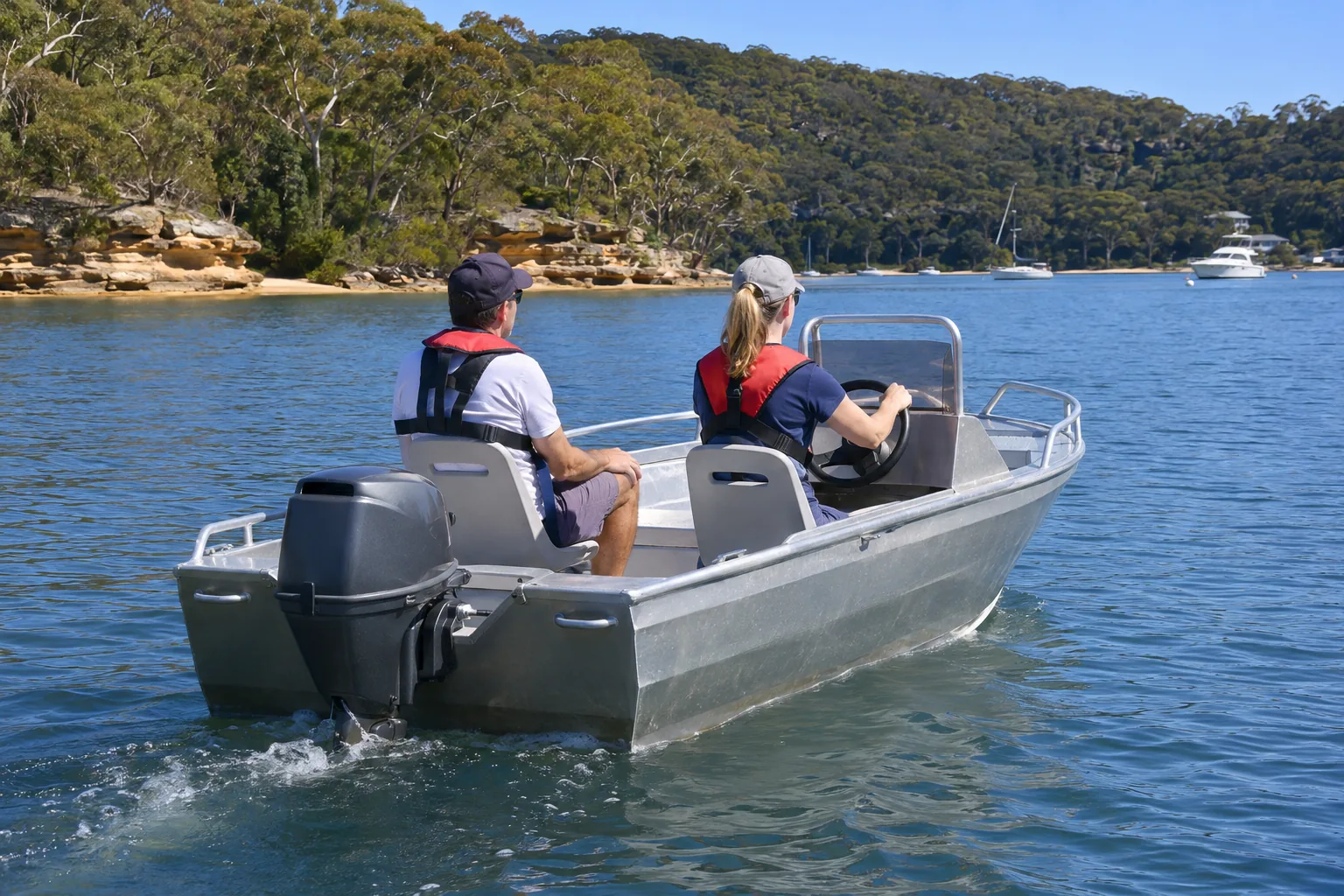
You are an adult without a boat licence. While learning in a runabout on Pittwater, you want to increase from 8 to 12 knots. Your licensed friend is beside you. What should you do?
Key points
- Know your boat and your roleThe skipper is in charge; the driver is at the controls.
- Facing the bow, port is left and starboard is right; the stern is behind you.
- A sailing boat using its engine is a powered vessel. Drifting still counts as underway.
- Transport for NSW regulates maritime safety. Learn the collision rules as well as the licensing rules.
- Ten knots is the NSW boat licence triggerFor an ordinary recreational powered boat, 10 knots or more needs a licence; PWC driving needs a PWC licence at any speed.
- You can apply from 12, with additional restrictions under 16. Identity, eyesight and health requirements apply. A current master or coxswain certificate of competency is an alternative driving authority.
- General boat test: 50 questions, at least 24/30 in A and 20/20 in B. Do not rely on the order: Handbook p. 15 and the webpage describe it differently; check the current TfNSW page.
- Practical route: at least 3 logged trips with an eligible skipper, or an ATP course including on-water training.
- Apply within 12 months of passing, with practical experience also within its 12-month window. Test success alone is not your licence.
- Under 16: extra care and extra limitsA licensed adult aboard does not remove the 20-knot maximum.
- Use the stricter supervision reading: a person aged 16 or over aboard at 10 knots or more, with a general boat or PWC licence for an ordinary boat, and a PWC licence for a PWC.
- Use the stricter night and towing reading: no driving between sunset and sunrise and no towing a person.
- The handbook and webpage conflict on these thresholds: check the current TfNSW page. Do not treat the cautious reading here as resolved legal wording.
- No races, displays, regattas or similar operations unless an authorised event exemption applies.
- Keep your licence current and handyCarry your current licence when driving at 10 knots or more, or when driving a PWC.
- Stop and show it when an authorised officer asks. Borrowing or hiring does not remove the requirement.
- Renew for 1, 3, 5 or 10 years. If not renewed within 5 years of expiry, the full licensing process applies again.
- Notify changed personal details within 14 days. Moving to NSW or using its waterways beyond 3 consecutive months requires a NSW licence.
- Registration belongs to the boatRegistration covers the boat. An ordinary powered boat's driver needs a licence at 10 knots or more; PWC have their own licence requirement.
- Register powerboats and sailing boats with engines rated at least 4.0 kW, or hull length at least 5.5 metres, plus vessels needing a mooring licence or marina berth, and all PWC.
- Transfer registration within 14 days after buying or selling. Registration lasts 12 months; renew before use after expiry. Moving an interstate-registered boat to NSW also requires NSW registration.
- Display clear registration numbers above the waterline: both hull sides, or the transom for a sailing boat. Minimum height: powerboats 150 mm; sailing boats and PWC 100 mm. Check the required safety or PWC behaviour label too.
- Commercial use brings AMSA requirements. When hiring, receive a safety briefing and follow the hire conditions as well as NSW rules.
- Cross a border? Check the local rulesThe NSW 10-knot trigger is not an Australia-wide licensing rule.
- Victoria generally requires a marine licence for powered recreational operation, with specific exemptions. Its marine test pass is 26/30; a PWC endorsement starts at 16 and needs 13/15 on the extra test.
- For driving alone, Queensland requires an RMDL above 4.5 kW, from age 16. BoatSafe includes theory and practical competency; its theory assessment is 50 questions, 45 minutes, all correct.
- Queensland's supervised-operation permission does not remove NSW's own driver-licence requirement. Queensland towing a person requires the operator's own licence.
Lessons
Short lessons, each ending with 2 questions.
- 1.1Welcome aboard: the skipper, the boat and the rulesYou do not need boating experience to start studying.Estimated time: about 3 minutes
- 1.2Getting licensed: the knowledge test and practical experienceYou can apply from age 12.Estimated time: about 4 minutes
- 1.3Your licence has limitsUnder-16 licence holders have extra restrictions.Estimated time: about 3 minutes
- 1.4Buying, registering and hiring a boatYour licence is about you; registration is about the vessel.Estimated time: about 4 minutes
- 1.5In Victoria and QueenslandThese are other states' rules.Estimated time: about 3 minutes
Check what you have read
Question 1/3
On a Hawkesbury River trip, the person in charge hands the wheel to another licensed adult. Who is the skipper?