
Decide
Four situations at sea. Decide first, then read why.
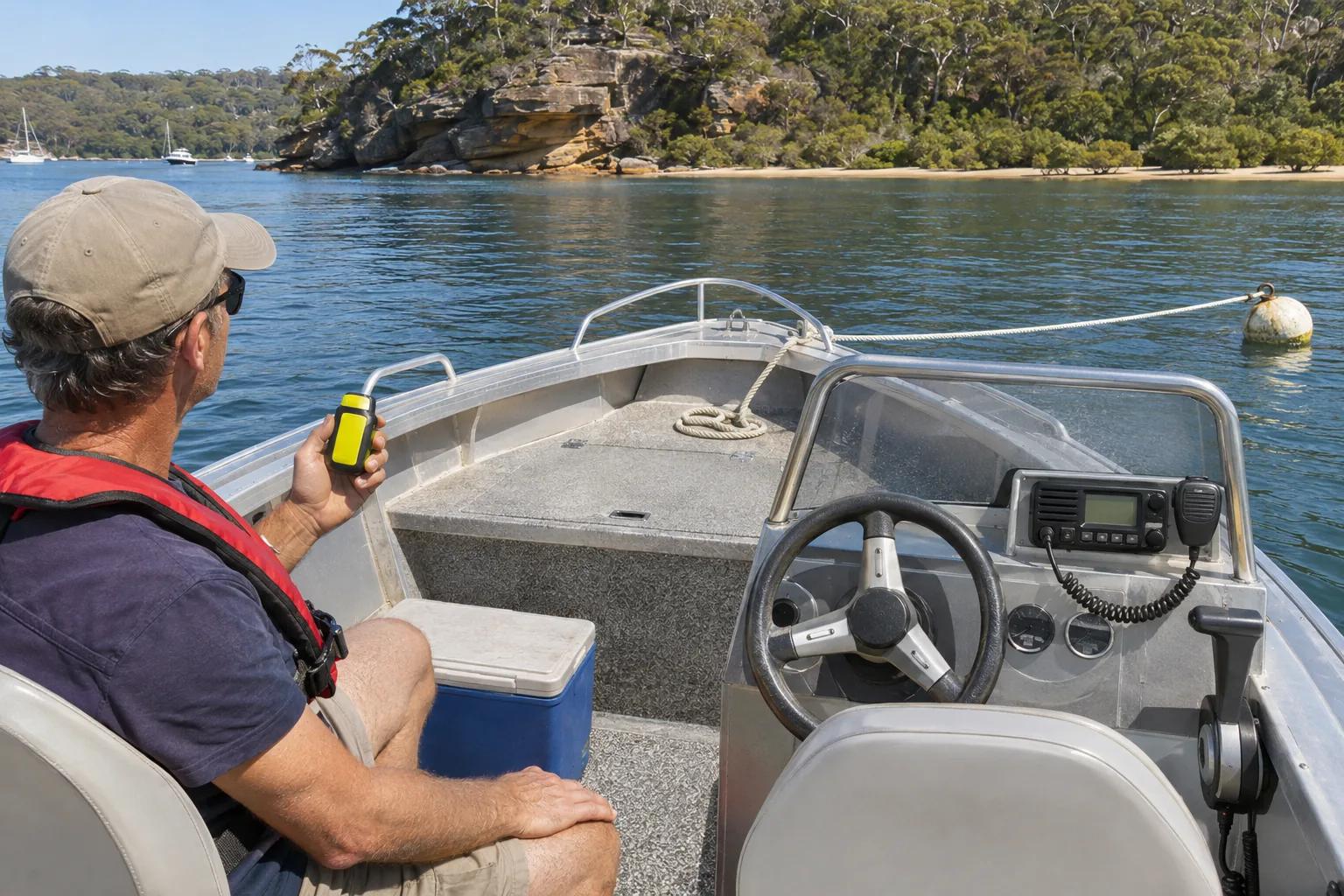
You are preparing to take a runabout 3 nautical miles offshore from Pittwater. It has a marine radio and you brought a PLB. Can the PLB replace the required EPIRB?
Key points
- The core kit on both watersThe main checklist applies to ordinary powerboats and sailing boats, with stated exceptions.
- One approved lifejacket per person; anchor and chain/line except on sailing boats up to 6 metres.
- Required extinguisher, sound signal and a working, floating waterproof torch; display the ordinary powerboat safety label where everyone can see it.
- Up to 6 metres: paddles or oars with rowlocks unless you have a second means of propulsion.
- Keep equipment serviceable, within expiry where applicable and easy to reach. Check the detailed list for your vessel.
- Remove water before it overwhelms youA bailer works by hand; pumps drain covered bilges and relevant underfloor compartments.
- A bailer or bucket needs a lanyard. Required pumps must drain each compartment and have strainers.
- The main checklist excludes airtight void spaces from its underfloor pump provision.
- Bailer exemptions differ between handbook and web checklist for some powerboats. Carry both a bailer or bucket with a lanyard and the required pump; check the current TfNSW page.
- Open waters add navigation and waterA short coastal trip still needs the open-water additions.
- Carry a chart for the area, printed or digital, and a fluid-filled magnetic compass.
- Download digital charts before departure. Satellite navigation does not replace the compass.
- Carry at least 2 litres of fresh drinking water per person.
- Enclosed waters include rivers, lakes and enclosed bays and harbours; calm weather does not turn coastal ocean waters into enclosed waters.
- Make a distress signal visibleOn open waters, carry two orange smoke flares, two red hand flares and a V sheet.
- Orange smoke: day. Red hand flares: day or night. All required flares must be within expiry.
- Keep flares accessible and dry, and make sure everyone knows how to use them.
- The orange-red V sheet has a black V and is at least 1.8 metres by 1.2 metres.
- Prepare for 2 nautical miles or moreUse the stricter open-water checklist threshold for both EPIRB and marine radio.
- At 2 nautical miles or more from shore: registered, in-date 406 MHz EPIRB plus marine radio.
- Descriptive official text says 'more than 2nm', while the checklist includes exactly 2. Carry both at exactly 2 and check the current TfNSW page.
- A PLB does not replace the EPIRB; a mobile phone does not replace the radio.
- Both are recommended closer to shore too. VHF is recommended over 27 MHz.
- Check the craft, not just its sizePWC, tenders and paddlecraft have specific equipment provisions.
- PWC: behaviour label visible from the steering position; wear a lifejacket at all times.
- A tender up to 3 metres needs the main equipment list anywhere on open waters or more than 200 metres from shore on enclosed waters.
- Tenders over 3 metres use the main list. A vessel more than 1 nautical mile from its parent is no longer classed as a tender.
- A canoe or kayak with an engine uses the main checklist on open waters. For rowing boats used as tenders, sources differ: use the main list and check the current TfNSW page. See pp. 59–62 for special craft.
- Add useful backupsRecommended extras help you deal with injury, breakdown and separation from the boat.
- A complete first-aid kit for the maximum number of people your vessel is designed to carry.
- A basic toolkit with suitable tools and spares for your boat.
- If possible, two means of communication, such as marine radio plus mobile phone in a waterproof cover.
- On a boat with a lanyard-operated kill switch, strongly recommended: connect it to yourself and wear it with the engine on and in gear.
Lessons
Short lessons, each ending with 2 questions.
- 3.1Start with your boat and your watersThe minimum kit depends on the type of vessel and where you take it. The main checklist is for powerboats and sailing boats of any size, except tenders and…Estimated time: about 2 minutes
- 3.2The equipment you use on both kinds of waterAn anchor can stop a broken-down boat drifting onto rocks or breaking waves.Estimated time: about 4 minutes
- 3.3Add the open-water equipment before you leaveFor a powerboat or sailing boat covered by the main checklist, open waters require extra navigation, signalling and drinking-water supplies.Estimated time: about 4 minutes
- 3.4Small craft have their own checklistsDo not transfer the ordinary powerboat list to every small craft.Estimated time: about 4 minutes
- 3.5Recommended extras that help when plans changeThe handbook recommends a first-aid kit, a kill switch lanyard for small powerboats, a basic toolkit and, if possible, two means of communication.Estimated time: about 2 minutes
Practise and go further
Check what you have read
Question 1/3
Your engine stops in Pittwater and the wind is pushing you towards rocks. What is the safety purpose of your anchor?