
Maritime law, rules and watchkeeping · Level P3 · 6 parts · about 17 min
Leadership, teamwork, fatigue and seafarers' rights (MLC)
6 short parts: Teamwork · Awareness · Fatigue · Error & culture · MLC rights · Harassment. Each part explains the idea, then gives the points to remember, the common mistakes, a worked case and a practice question; the Academy unit adds all 36 check questions.
1 · Teamwork
Leadership and teamworking at operational level (STCW A-II/1)
As a junior officer you lead a small team every watch. Plan the work, share it fairly, communicate clearly and decide with the team's knowledge.
The competence
STCW table A-II/1 lists application of leadership and teamworking skills for every officer of the watch (OOW). It covers four areas: knowing how crew are managed and trained on board; task and workload management; effective resource management; and decision-making techniques. You need these on watch, in port, in drills and when you supervise ratings at work on deck.
Task and workload
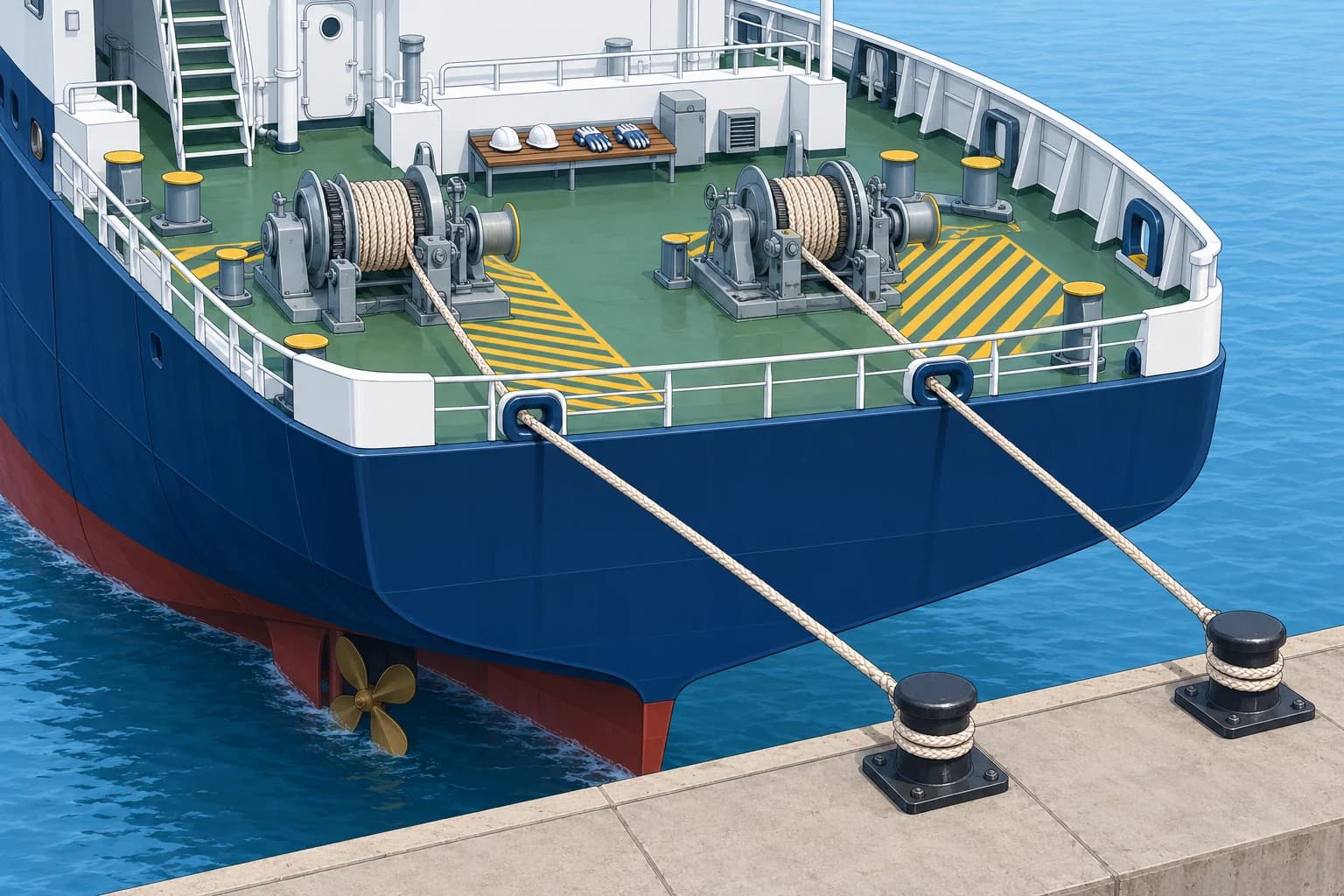
Task and workload management means planning and coordinating the work, assigning people to tasks, respecting time and resource limits, and setting priorities. Before mooring, for example, check who is at each station, what equipment they need, and what comes first. Spread the load: an overloaded person misses things, and an idle one loses attention.
Resources and communication
Effective resource management means allocating, assigning and prioritising people and equipment. It also means communicating clearly on board and ashore and making decisions that use the team's experience. Assertiveness means stating your view clearly and respectfully, neither silent nor aggressive. Leadership includes motivating people, giving reasons for orders and recognising good work.
Deciding
A simple decision method fits most situations: assess the situation and the risk; identify the options; choose a course of action; act; then evaluate whether it worked. Under time pressure, keep the steps but shorten them. Ask the team what they see before you choose. Say your decision aloud so everyone knows it.
Leading upwards
Leadership is not only for the master. When you see a risk, you lead by speaking up with facts and a proposal. When a rating raises a concern, you thank them and act on it. A ship where juniors stay silent is a ship waiting for an accident. Bridge communication techniques are covered in Law: watchkeeping.
Remember
- STCW A-II/1 requires leadership and teamworking skills from every OOW.
- Plan tasks, assign people, respect limits and set priorities.
- Use the team's experience; be assertive, not silent or aggressive.
- Decide in steps: assess, options, choose, act, evaluate.
- Leadership includes speaking up to seniors and listening to juniors.
Common mistakes
Wrong: Leadership skills only matter for the master and chief mate.
Right: STCW A-II/1 makes them part of every watch officer's competence. You lead ratings every watch.
Wrong: Being assertive means insisting loudly until the other person gives in.
Right: Assertiveness is stating facts and your view clearly and respectfully, then listening to the answer.
Worked case
You are third officer in charge of the aft mooring station with two ratings. The master wants the ship all fast in 20 minutes. One rating is new and nervous; a spring line is fouled on the winch drum. How do you lead the station?
Show the answer
Stop the affected work and keep everyone clear of the fouled line. Tell the bridge about the hazard and delay. Agree a safe plan before work resumes. Assign tasks to match experience and supervise the new rating. Explain priorities and ask both ratings to raise concerns. Check whether the plan works and review the job afterwards.
Practice question
Which STCW table makes leadership and teamworking skills part of the OOW's competence?
- Table A-II/1
- Table A-II/4
- Table A-VI/6
- Table A-III/2
Show the answer
Answer: A. Table A-II/1, for officers in charge of a navigational watch, includes application of leadership and teamworking skills.
2 · Awareness
Situational awareness: perceive, understand, predict
Situational awareness is knowing what is happening, what it means and what will happen next. Learn the warning signs that you are losing it.
Three levels
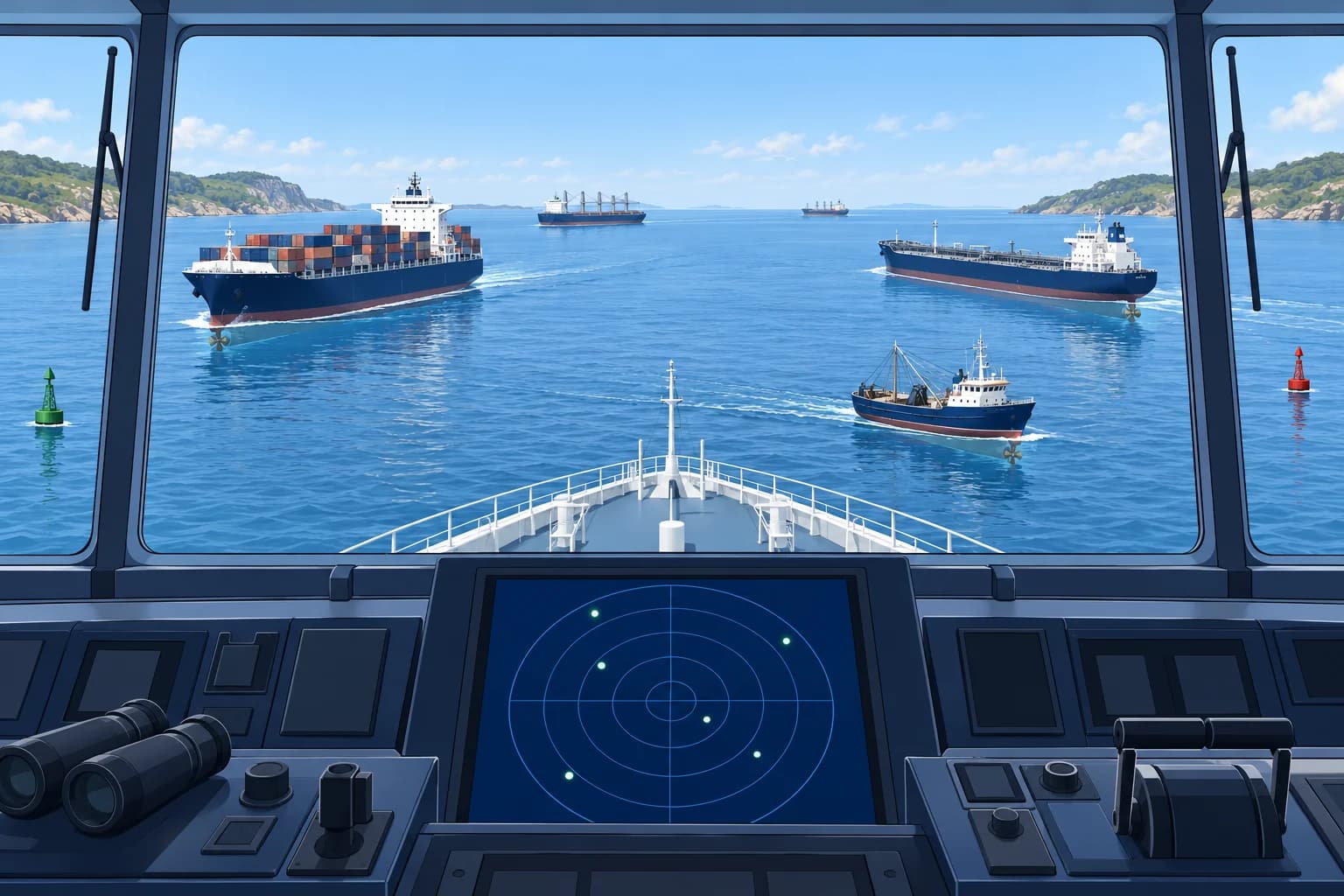
Psychologist Mica Endsley described situational awareness (SA) in three levels. Level 1, perception: noticing the relevant facts, such as a target, a depth or an alarm. Level 2, comprehension: understanding what they mean together, such as 'that ship is on a collision course'. Level 3, projection: predicting what will happen next, such as 'the ship will reach the harbour entrance before the tug arrives'. Good decisions need all three.
How it is lost
Most SA errors happen at Level 1: you did not notice, because of distraction, overload, fatigue or poor equipment set-up. Others happen at Level 2 or 3: you saw the facts but misread them, often because you expected something else. Confirmation bias means noticing facts that fit your picture and ignoring those that do not.
Warning signs
Signs that SA is slipping include: ambiguity, two sources disagreeing; fixation, staring at one screen or task; confusion or uncertainty; departing from the plan without a reason; not meeting a target or limit; nobody looking out of the window; and an unresolved discrepancy. When you notice one, stop and rebuild the picture.
Building it back
Compare genuinely independent observations; two displays may share the same source. Ask others what they see. Share what you know and what remains uncertain. Reduce distractions and delegate secondary tasks. Keep the person directing the ship free to concentrate on that task.
Remember
- Endsley's three levels: perception, comprehension, projection.
- Most SA errors are at Level 1: a relevant fact is never noticed.
- Warning signs: ambiguity, fixation, confusion, unexplained deviation, unresolved discrepancy.
- Rebuild SA by cross-checking sources and sharing your picture aloud.
Common mistakes
Wrong: If one display shows normal readings, you have full situational awareness.
Right: That is one Level 1 fact. Cross-check other sources and think about what is coming next.
Wrong: Two sources disagreeing is normal; pick the one you trust more.
Right: A discrepancy is a warning sign. Resolve it before you rely on either source.
Worked case
During cargo work, a rating reports water spreading near a hose connection. The control screen shows normal pressure, and the team is rushing to finish. What do you do?
Show the answer
Treat the disagreement as a warning, not proof that either source is right. Pause the affected task safely and alert the responsible officer. Cross-check independent observations and ask others what they see. Share what is happening, what it means and what could happen next. Reduce distractions. Resume only when the discrepancy is resolved and controls are agreed.
Practice question
In Endsley's model, what is Level 3 situational awareness?
- Noticing the relevant facts in the surroundings
- Understanding what the facts mean together
- Predicting what will happen in the near future
- Recording events accurately in the log book
Show the answer
Answer: C. Level 1 is perception, Level 2 comprehension and Level 3 projection of the near future.
3 · Fatigue
Fatigue: causes, signs and managing it (MSC.1/Circ.1598)
Fatigue hits everyone, whatever their skill. Know its causes and signs, respect the body clock, and plan work so the team stays alert.
What it is
The IMO Guidelines on Fatigue (MSC.1/Circ.1598, 2019) define fatigue as a state of physical or mental impairment. It results from factors such as too little sleep, long wakefulness, work and rest out of step with the body clock, and physical, mental or emotional exertion. It can impair alertness and safe operation. Fatigue affects everyone, whatever their skill, knowledge or training.
Causes
The Guidelines name six main causes: lack of sleep; poor sleep and rest; work or sleep at the wrong times of the circadian rhythm, the body's 24-hour clock; staying awake for long periods; stress; and excessive workload. On ships, add noise, vibration, motion, heat, port calls and changing watch patterns. Sleep debt builds up when you sleep less than you need over several days.
The body clock
Fatigue is most likely and most severe in the early morning, around 3 to 5 a.m.: the window of circadian low (WOCL). A smaller dip comes around 3 to 5 p.m. Maritime incidents with fatigue as a cause cluster between midnight and 6 a.m. Seven to eight hours of good-quality, unbroken sleep per 24 hours is the general recommendation. Six one-hour naps are not equal to one six-hour sleep.
Signs
The Guidelines group signs into three kinds. Cognitive: lapses of attention, poor memory, slow or risky decisions, fixation on one task. Physical: drooping eyelids, nodding off, clumsiness, slurred speech, headaches. Behavioural: irritability, a 'don't care' attitude, ignoring checks. Tired people often do not notice their own decline. A microsleep, a few seconds of sleep while working, is a real danger on watch.
Managing it
Companies manage fatigue as a risk under the safety management system (SMS) through manning, schedules and port workload. As an officer, plan work and drills to protect rest. If someone cannot stay alert, arrange relief. Report when you cannot get your rest. Movement, fresh air and caffeine cannot replace sleep. Caffeine helps only briefly and can harm later sleep. Rest-hour limits and records are covered in Law: watchkeeping.
Key figures
- Guidelines
- IMO MSC.1/Circ.1598 (2019), replacing MSC/Circ.1014
- Window of circadian low
- About 3–5 a.m.; smaller dip 3–5 p.m.
- High-risk hours at sea
- Midnight to 6 a.m.
- Sleep need
- About 7–8 h of good, unbroken sleep per 24 h
Remember
- Fatigue is impairment from too little sleep, long wakefulness, body-clock disruption and exertion.
- The window of circadian low is about 3–5 a.m.; incidents cluster midnight to 6 a.m.
- Signs are cognitive, physical and behavioural; the tired person often misses them.
- Sleep debt builds over days; unbroken sleep beats several short naps.
- Manage fatigue through the SMS, work planning and honest reporting.
Common mistakes
Wrong: Experienced officers do not get fatigued on watch.
Right: Fatigue affects everyone, regardless of skill or experience. Experience does not replace sleep.
Wrong: If the rest records comply, the crew cannot be fatigued.
Right: Compliant hours can still mean poor sleep: noise, motion, broken rest and the body clock all count.
Wrong: Strong coffee on the 0000–0400 watch solves the problem.
Right: Caffeine helps for a short time and disturbs later sleep. Only sleep restores alertness.
Worked case
After three busy port calls in four days, the second officer on the 0000–0400 watch misses a VHF call, then reads a bearing wrongly twice. He insists he is fine. You are the chief mate, called to the bridge at 0330. What do you do?
Show the answer
Treat the repeated errors as signs of unsafe fatigue at the circadian low. Tell the master and arrange a proper handover to a qualified, rested officer. Ensure support until the handover is complete, then let the tired officer sleep. Adding someone beside him is not a substitute for relief. Review his sleep opportunity and schedule, and report the workload problem through the SMS.
Practice question
A colleague repeatedly nods off during a safety-critical task. What should you do?
- Give him coffee and continue the same task
- Move him to another safety-critical task
- Arrange safe relief, report and protect sleep
- Wait for him to agree that he is fatigued
Show the answer
Answer: C. Arrange safe relief and report the impairment. Protect time for sleep; stimulation cannot restore fitness for duty.
4 · Error & culture
Error chains, the Swiss cheese model and just culture
Accidents rarely have one cause. Break the chain early, find the holes in the defences, and report honestly in a just culture.
The error chain
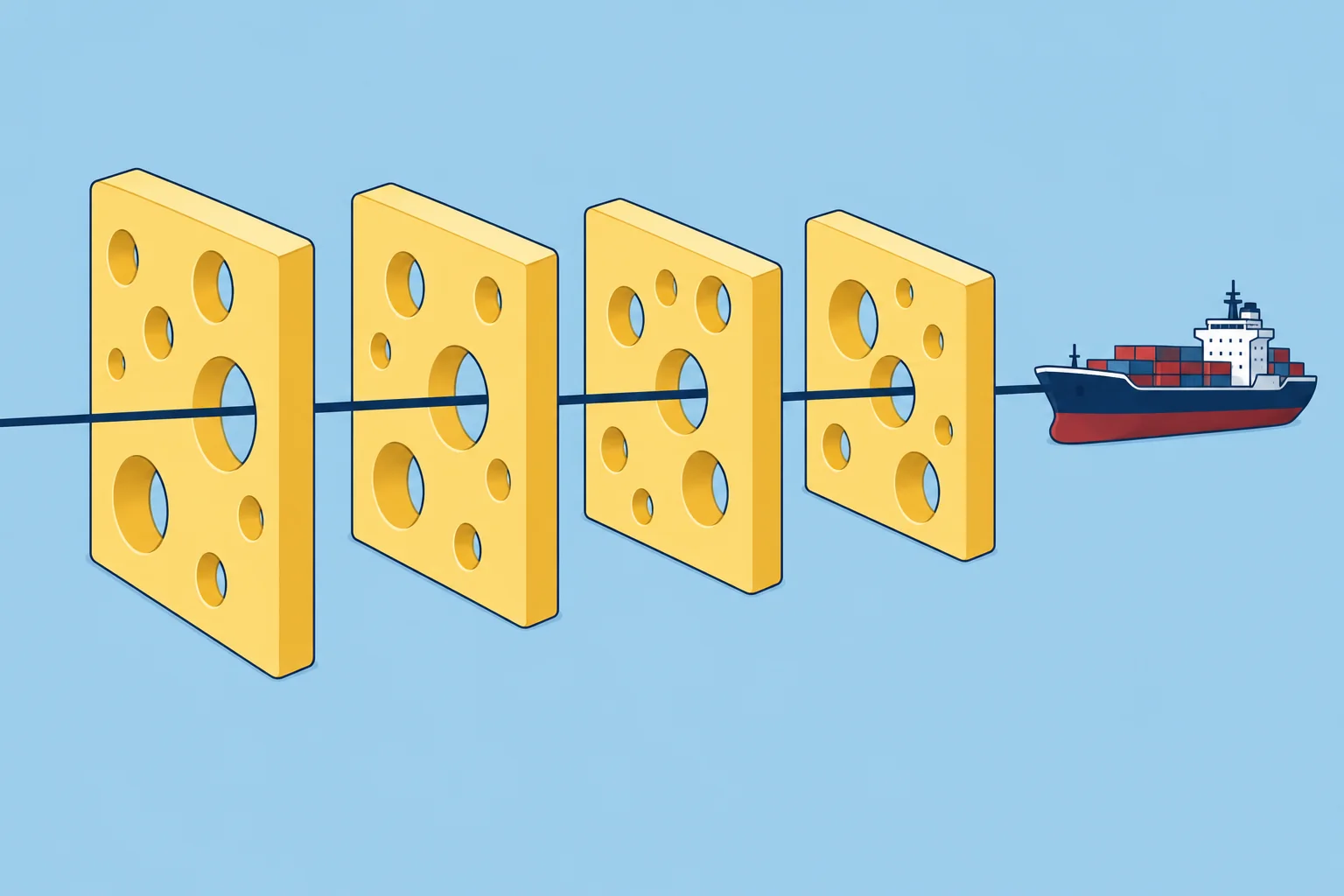
An error chain is a sequence of events and decisions that contributes to an accident. Fatigue, outdated information, unsuitable equipment settings and an unchallenged order can combine. Interrupting the sequence can prevent harm. Check for other remaining hazards too.
The Swiss cheese model
Psychologist James Reason pictured defences as slices of Swiss cheese. Each slice has holes. Active failures are unsafe acts by people at the sharp end, such as a missed check. Latent conditions are hidden weaknesses built in earlier, such as poor procedures, bad design, low manning or commercial pressure. An accident happens when holes in several slices line up. Fixing latent conditions protects against many future errors.
Kinds of error
A slip is a correct plan carried out wrongly, such as pressing the wrong button. A lapse is a memory failure, such as forgetting a step. A mistake is a wrong plan, from poor knowledge or a misread situation. A violation is a deliberate departure from a rule. It may be routine, a shortcut everyone takes, or exceptional. Each needs a different fix: design, checklists, training or supervision.
Just culture
A just culture encourages honest reporting and fair accountability. Distinguish unintentional error, risky shortcuts and reckless conduct. Examine intent, risk awareness, training, workable procedures and operating conditions before deciding the response. The ISM Code, section 9, requires reporting and analysis of accidents, hazardous situations and non-conformities. A near miss is an event that could have caused harm but did not. Near-miss reports show weaknesses before an accident.
Remember
- Breaking an error chain can prevent harm; check for remaining hazards.
- Swiss cheese: active failures at the sharp end, latent conditions built in earlier.
- Slips, lapses, mistakes and violations need different fixes.
- Just culture: no blame for honest error, no tolerance for recklessness.
- Report near misses; ISM section 9 requires reporting and analysis.
Common mistakes
Wrong: After an accident, find the person who made the mistake and the job is done.
Right: Look for the latent conditions too: procedures, design, manning and pressure that set the person up to fail.
Wrong: A just culture means nobody is ever held accountable.
Right: Learn from honest errors and examine why rules were bypassed; reckless conduct can warrant discipline.
Worked case
During cargo work, a rating opens the wrong ballast valve. The valve labels had faded, the mimic diagram was out of date, and he was working alone at the end of a 14-hour day. The chief mate wants to give him a written warning. What do you advise?
Show the answer
Establish his intention and what happened before classifying the error or deciding on discipline. A correct plan carried out wrongly is a slip; a wrong plan is a mistake. Record the faded labels, outdated diagram and workload as contributing conditions. Report through the near-miss or incident procedure. Correct the labels and diagram, and review workload and checks before the task resumes.
Practice question
In Reason's Swiss cheese model, what is a latent condition?
- An unsafe act by the person at the controls
- A hidden weakness built into the system earlier
- A collision that has already happened earlier at sea
- A deliberate breach of the master's orders
Show the answer
Answer: B. Latent conditions such as poor procedures, design or manning lie dormant until they combine with active failures.
5 · MLC rights
Seafarers' rights under the MLC, from the officer's side
As an officer you have MLC rights yourself and help apply them for your team: contract, pay, leave, repatriation, care and complaints.

Contract and pay
Every seafarer has a signed seafarer employment agreement (SEA) and time to review it. A record of employment shows service but not the quality of work or wages. Wages are paid at least monthly, with a monthly account. Allotments let you send part of your wages to family. Leave is at least 2.5 calendar days per month of service. Shore leave supports health and well-being and must be granted consistently with your position's operational requirements.
Repatriation
The shipowner pays for repatriation when the SEA ends or is terminated for justified reasons, and when a seafarer can no longer work. It may not ask for an advance. The maximum service period before repatriation is less than 12 months. The 2022 amendments, in force since 23 December 2024, require states to facilitate prompt repatriation. Seafarers must not be held on board because a state blocks their travel.
Financial security
The 2014 amendments, in force since 18 January 2017, require financial security on every ship. One part covers abandonment: the owner fails to pay repatriation, leaves the crew without food, water, accommodation or medical care, or does not pay wages for at least two months. It covers up to four months of outstanding wages, repatriation and essential needs. Another covers contractual claims for death or long-term disability from occupational injury, illness or hazard. Certificates of both are posted on board.
Living and care
The master or an authorised person inspects accommodation frequently and records results; follow your flag's interval. Food and drinking water are free, good quality and inspected. The 2022 amendments require social connectivity, contact with people ashore, and properly fitting protective equipment. Guidance recommends internet access where reasonably practicable. Medical care is free; urgent cases are disembarked promptly. Ships with 100 or more persons on international voyages over three days carry a doctor.
Complaints
Every ship has an on-board complaint procedure. Seafarers may complain directly to the master and, where they consider it necessary, to outside authorities. They may be accompanied or represented. Victimisation for complaining is forbidden. They get the contact details of the flag and home-country authorities, and the name of someone on board who gives confidential, impartial advice. Port states also run an onshore complaint procedure.
Key figures
- Annual leave
- At least 2.5 calendar days per month of service
- Max service before repatriation
- Less than 12 months (national law sets it)
- Abandonment cover
- Up to 4 months' wages, repatriation, essential needs
- Abandonment trigger (wages)
- Contractual wages unpaid for at least 2 months
- 2014 amendments
- In force 18 January 2017 (financial security)
- 2022 amendments
- In force 23 December 2024
Remember
- SEA, monthly wages and account, allotments, leave of 2.5 days per month, shore leave.
- Repatriation at the owner's cost, no advance; service under 12 months.
- Financial security: abandonment (up to 4 months' wages) and death or long-term disability.
- Frequent, recorded accommodation inspections, free food and water, social connectivity, medical care.
- On-board complaints to the master or outside, with no victimisation.
Common mistakes
Wrong: A seafarer must first complain to the head of department and may never go outside the ship.
Right: The procedure aims to settle complaints at the lowest level, but seafarers may complain directly to the master and outside authorities.
Wrong: If the owner stops paying, the crew must wait for a court case.
Right: Wages unpaid for two months can count as abandonment. The financial security provider then pays up to four months' wages and repatriation.
Worked case
Your ship has been under arrest for six weeks. Wages for the last two months are unpaid, the owner no longer answers, and provisions run low. A rating asks you, the second officer, what the crew can do. How do you answer?
Show the answer
Unpaid wages for two months and the owner cutting contact can be abandonment under the MLC. The ship must carry a financial security certificate for abandonment, posted on board. With the master, contact the provider named on it; the crew can also request help directly. They may complain to the port state and the flag state. The ITF and unions can help. The provider covers up to four months' wages, repatriation and essentials.
Practice question
Which rule correctly states the minimum paid annual-leave accrual under the MLC?
- 2.5 calendar days per month of service
- 2 calendar days per month of service
- 2.5 calendar days per completed voyage
- 1.5 calendar days per month spent at sea
Show the answer
Answer: A. Standard A2.4 sets minimum paid annual leave of 2.5 calendar days per month of employment. Leave accrues with employment, not with completed voyages.
6 · Harassment
Harassment and bullying: officer duties and what is changing
STCW basic training now covers violence and harassment. As an officer, prevent abuse, receive reports and protect fair reporting.

The rules now
The 2022 MLC amendments improved welfare, including social connectivity and properly fitting protective equipment. From 1 January 2026, STCW table A-VI/1-4, amended by MSC.560(108), adds a competence: contributing to preventing and responding to violence and harassment, including sexual harassment, bullying and sexual assault. If you already hold a certificate, check your flag state's training requirements. The basics, definitions and bystander actions, are in Law: personal safety.
What changes next
The 2025 MLC amendments, adopted on 6 June 2025, are expected to enter into force on 23 December 2027. They address violence and harassment, make shore leave easier, strengthen fair repatriation, and call on states to treat seafarers as key workers. Check your flag's national rules as they are updated. The comprehensive STCW review is ongoing. Its timetable is separate from the harassment competence already in force; follow IMO updates for confirmed milestones.
Your role as officer
Officers hold power over ratings and cadets, which makes abuse easier and reporting harder. Set the tone: no humiliating jokes, no initiation rituals, no favours for silence. Watch for signs: a crew member who becomes withdrawn, avoids someone or asks to change watch. Cadets are especially exposed. Follow the company's policy, often based on the ICS–ITF Guidance on Eliminating Shipboard Harassment and Bullying.
Receiving a report
Listen privately and take the report seriously, without judging guilt. Check immediate safety and agree protective steps. Record facts, dates and witnesses. Use the company reporting procedure and tell the master. If the master is involved, report ashore. Explain who must be told; share details only with those handling the report. Watch for retaliation. For sexual assault, preserve evidence and contact the authorities.
When a crew member reports harassment to you
- Listen privately and calmly; do not judge or blame. — A poor first response stops people from reporting again.
- Make the person safe, for example by changing watch or cabin. — Safety comes before investigation.
- Write down facts, dates, places and witnesses. — Accurate records support a fair investigation.
- Report through the company procedure and to the master, or ashore if the master is involved. — The company must investigate; the right channel avoids conflicts of interest.
- Explain confidentiality limits, share only as needed, and watch for retaliation. — Limited disclosure supports safety and a fair investigation.
Remember
- STCW A-VI/1-4 harassment competence in force since 1 January 2026 (MSC.560(108)).
- 2025 MLC amendments expected in force 23 December 2027.
- Officers hold power: set the tone and protect cadets and juniors.
- Receive reports privately, make the person safe, record, report, share only as needed.
- If the master is involved, report ashore to the company.
Common mistakes
Wrong: Initiation pranks on cadets are a harmless tradition.
Right: Humiliating rituals are harassment or bullying. Officers must stop them, not tolerate them.
Wrong: A report against a senior officer must go through that officer's line manager on board.
Right: Use the channel that avoids a conflict: the master, or the company ashore if the master is involved.
Worked case
A deck cadet tells you, the third officer, that the bosun keeps sending her sexual messages and has threatened her training record if she reports him. She begs you not to tell anyone. What do you do?
Show the answer
Thank her and listen without blame. Explain who must receive the report and why; do not promise secrecy. Agree immediate protection with her and arrange it through the master. Record her account and preserve the messages. Report through the company procedure. Ask for an impartial training assessor. Watch for retaliation affecting her work or training record, report it promptly and explain how to raise further concerns.
Practice question
Since when has STCW basic training included a competence on violence and harassment?
- 1 January 2017
- 1 January 2026
- 23 December 2024
- 1 July 2025
Show the answer
Answer: B. The amendments to table A-VI/1-4 in resolution MSC.560(108) entered into force on 1 January 2026.