
Maritime law, rules and watchkeeping · Level R2 · 4 parts · about 15 min
Spain: navigation zones, required equipment and documents
4 short parts: Zones 1–7 · Safety gear · Boat papers · Licences. Each part explains the idea, then gives the points to remember, the common mistakes, a worked case and a practice question; the Academy unit adds all 26 check questions.
1 · Zones 1–7
Spain's seven navigation zones and where you may go
Spain sorts recreational waters into seven zones. Your boat's design category and the gear on board decide the zones it may use.
One rule book since 2021
Spanish safety rules for recreational craft are in Real Decreto 339/2021, in force since 1 July 2021. It replaced the old Orden FOM/1144/2003, which many books still quote. It covers boats from 2.5 to 24 m that carry no more than 12 passengers. It applies to Spanish-registered boats. It also applies to foreign-flag boats owned or used by Spanish residents while in Spanish internal maritime waters or territorial sea.
The seven zones
Zone 1 is unlimited. Distances are in nautical miles (NM). Zone 2 reaches 60 NM from the coast, zone 3 25 NM and zone 4 12 NM. Zones 5 and 6 allow 5 NM and 2 NM from a shelter or accessible beach. Zone 7 covers protected coastal waters: ports, roadsteads (sheltered anchoring areas), rías (tidal inlets) and bays. A shelter (abrigo) lets your boat take refuge and everyone get ashore.
Design category sets the ceiling
A boat bearing CE marking (the EU conformity mark) may use the zones of its design category (the EU rating of the wind and waves a hull is built for), if it carries the gear for the zone. Category A: zones 1–7. B: zones 2–7. C: zones 4–7. D: zone 7 only. A boat without CE marking uses the zone shown in its papers. Whatever the zone, never sail in wind or waves beyond the design limits.
Bathing zones near the beach
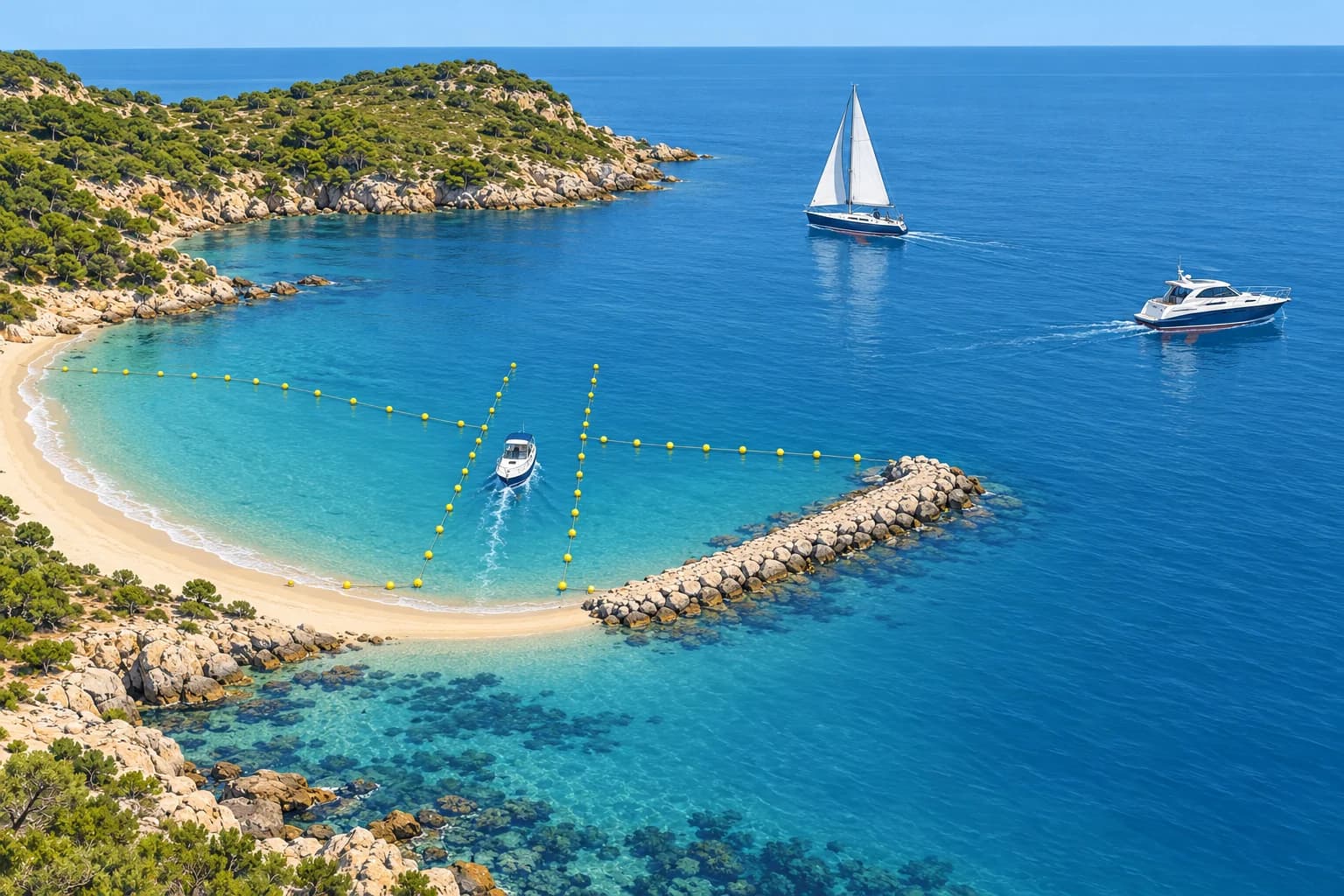
Where a bathing area is marked with buoys, recreational craft may not enter it. Launch and land only through the marked channels. Where the coast is not marked, the bathing zone is assumed to be 200 m wide off beaches and 50 m wide off the rest of the coast. Inside it, keep to 3 knots or less and discharge nothing.
Sewage
Untreated sewage: beyond 12 NM from nearest land. Sewage ground and disinfected by an approved system: beyond 3 NM. Empty holding tanks gradually while under way at 4 knots or more. An approved treatment plant may discharge outside zone 7 if its effluent has no visible floating solids or discoloration. Where discharge is prohibited, retain sewage for pump-out. Check local restrictions. For these limits, nearest land means the territorial-sea baseline, not necessarily the visible shoreline.
Key figures
- Zones 1–4 (from the coast)
- Unlimited, 60 NM, 25 NM, 12 NM
- Zones 5–6 (from a shelter)
- 5 NM and 2 NM from a shelter or accessible beach
- Zone 7
- Ports, roadsteads, rías, sheltered bays
- Design categories
- A: 1–7 · B: 2–7 · C: 4–7 · D: 7
- Unmarked bathing zone
- 200 m off beaches, 50 m elsewhere; max 3 kn
Remember
- RD 339/2021 (since 1 July 2021) sets zones and gear; Orden FOM/1144/2003 is repealed.
- Zones 1–4 count from the coast (unlimited, 60, 25, 12 NM); zones 5–6 count from a shelter (5, 2 NM).
- Design category A, B, C or D caps the zones a CE boat may use.
- Keep out of buoyed bathing areas; at 3 knots or less within 200 m of an unmarked beach.
Common mistakes
Wrong: Zone 5 means you may go up to 5 NM from the coastline anywhere.
Right: Zones 5 and 6 are measured from a shelter or accessible beach, not from the coast in general.
Wrong: A category C boat can sail in zone 3 if it carries a liferaft.
Right: Category C is limited to zones 4–7. Extra gear never lifts a boat above its design category.
Wrong: The safety gear rules are in Orden FOM/1144/2003.
Right: That order was repealed on 1 July 2021. The current rules are in Real Decreto 339/2021.
Worked case
Your CE category C motorboat would pass a point 15 NM from the nearest coast before returning to an unmarked beach. May you follow this route, and how should you approach the beach?
Show the answer
No. That point is beyond zone 4's 12 NM limit. Choose a route that stays within 12 NM of the nearest coast. Near the unmarked beach, the first 200 m count as a bathing zone: slow to 3 knots or less, watch for swimmers and discharge nothing. If the beach has a buoyed bathing area, stay out of it and use the marked channel.
Practice question
Which Spanish zone allows navigation up to 25 NM from the coast?
- Zone 2
- Zone 3
- Zone 4
- Zone 5
Show the answer
Answer: B. Zone 3 runs to a line 25 NM off the coast. Zone 2 reaches 60 NM and zone 4 reaches 12 NM.
2 · Safety gear
Required safety equipment by zone
Farther offshore, you must carry more safety gear. Missing or out-of-date items are serious offences, fined item by item.
Lifejackets and lifebuoys
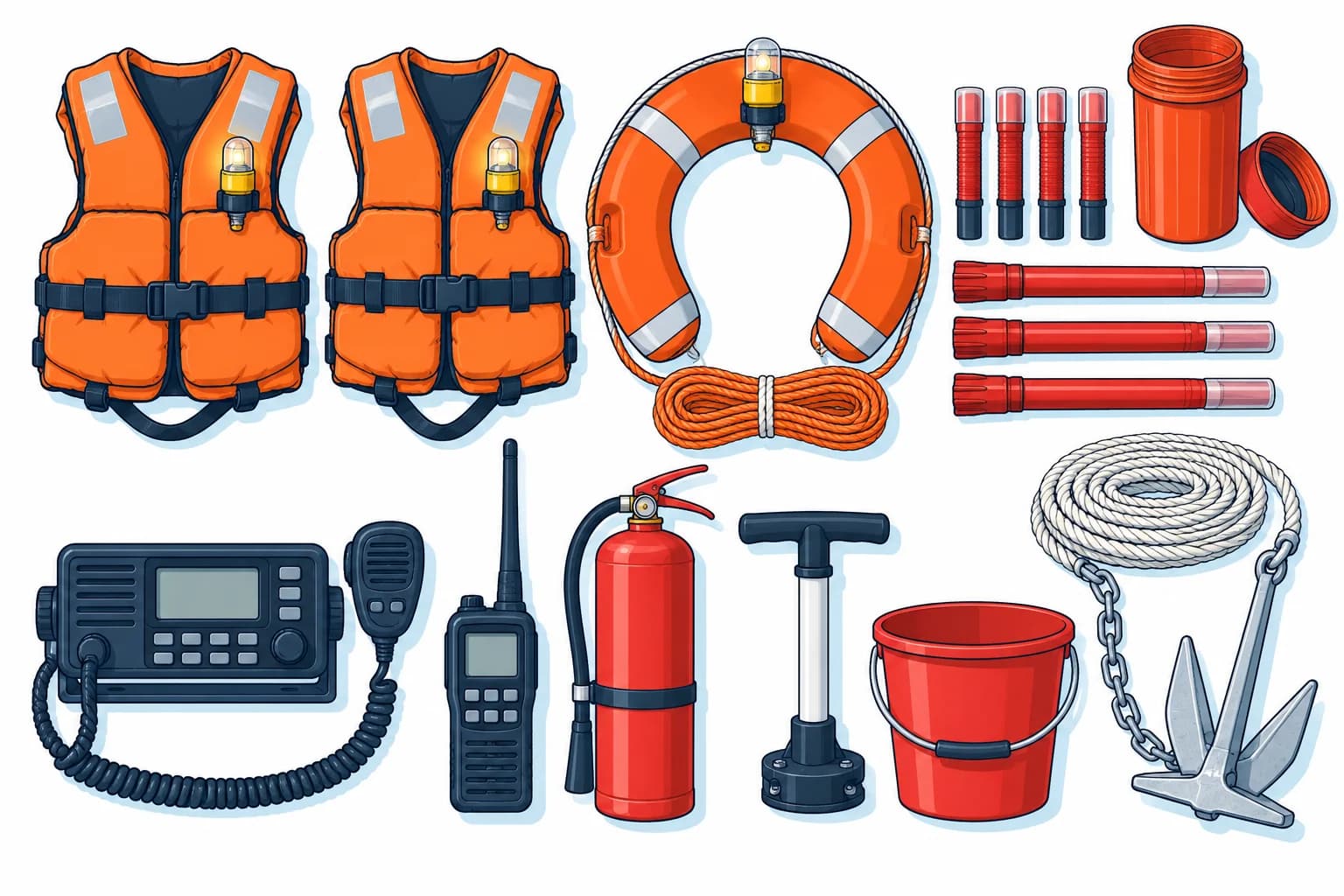
Carry at least one lifejacket per person, with a light. In zones 4–7, lights are optional for boats sailing only by day. Zone 1 needs one spare jacket. Children and babies need jackets matching their weight. Buoyancy is upward support, measured in newtons (N). Minimum ratings: 275 N in zone 1, 150 N in zones 2–4, 100 N in zones 5–7. Zones 1–4 need a lifebuoy with light and line; zone 1 adds a second lifebuoy.
Liferaft and flares
Zones 1–3 need a liferaft for everyone on board. Farther offshore, you need more distress signals. Zone 1: 6 hand flares, 6 red parachute rockets and 2 floating smoke signals. Zones 2–3: 6, 6 and 1. Zone 4: 3 hand flares and 3 rockets. Zones 5–6: 3 hand flares. Out-of-date flares count as missing.
Navigation gear
Carry the RIPA (Spain's COLREG) lights, shapes and sound signals, a foghorn and an anchor line at least five times boat length. In every zone carry a national flag, waterproof torch with spare batteries, radar reflector (non-metal hulls), and rescue-signal and flag tables if radio is fitted. Zones 1–4 add a compass, charts, publications and binoculars. Category A/B boats with an enclosed cabin used for steering or navigation need those four items even in zones 5–7.
Fire
A CE boat follows its owner's manual for extinguishers; keep it aboard. If it gives no requirements, use the national length-and-power table, as non-CE boats do.
Bilge
Bilge pumps remove water collecting inside the hull. Zones 1–3: one manual and one powered pump, plus two 5-litre buckets. Zones 4–6: a manual or electric pump and one 5-litre bucket. Zone 7: a pump, or a 2-litre bailer for boats up to 6 m with buoyancy chambers. Sailing boats in zones 1–6 need a fixed manual pump operable from the cockpit with hatches and interior accesses shut.
Radio
RD 1185/2006 sets radio carriage. VHF is very high frequency radio; DSC is digital selective calling; EPIRB is a satellite distress beacon. Zones 6–7: none required. Zone 5: fixed VHF or IPX7 waterproof handheld. Zone 4: fixed VHF. Zones 1–3: fixed DSC VHF and 406 MHz EPIRB; zones 1–2 require automatic/manual beacon activation. Zone 2 adds a handheld VHF or 9 GHz radar transponder (a radar locating device). Zone 1 needs both, plus an approved satellite ship station or DSC-capable MF/HF radio (medium/high frequency).
Key figures
- Lifejacket buoyancy
- Zone 1: 275 N · zones 2–4: 150 N · zones 5–7: 100 N
- Liferaft
- Zones 1, 2 and 3, for everyone on board
- Hand flares / rockets / smoke
- Z1: 6/6/2 · Z2–3: 6/6/1 · Z4: 3/3/0 · Z5–6: 3/0/0
- Anchor line
- At least 5 × the boat's length
- Fines (examples, RD 339/2021)
- €200–250 per lifejacket, €100–150 per flare
Remember
- Lifejackets: one per person; 275/150/100 N by zone; zone 1 adds a spare. Lights optional in zones 4–7 for day-only boats.
- Liferaft in zones 1–3; lifebuoy with light and line in zones 1–4.
- Flares: zone 4 needs 3 hand flares and 3 parachute rockets; zones 5–6 need 3 hand flares.
- VHF: fixed in zone 4, fixed or IPX7 handheld in zone 5, none required in zones 6–7.
- CE extinguishers: follow the manual and keep it aboard. If it gives no requirements, use the national length-and-power table.
Common mistakes
Wrong: Expired flares still count, because they usually work.
Right: An item past its expiry or service date is treated as missing and is a serious offence. Replace and dispose of old flares properly.
Wrong: A handheld VHF is enough everywhere within 12 NM.
Right: Zone 4 requires a fixed VHF. A waterproof handheld is accepted as the alternative only in zone 5.
Wrong: Lifejacket lights are optional on every small boat.
Right: Lights are required, except on boats in zones 4–7 that sail only by day.
Worked case
You are preparing an 8 m category C boat for zone 4 with six people, by day only. All other gear is compliant. You find six 100 N lifejackets without lights, an unlit lifebuoy with line, three hand flares and only a handheld VHF. What must you correct before departure?
Show the answer
Replace the six lifejackets with 150 N models. Their lights are optional because the boat sails only by day in zone 4. Add a light to the lifebuoy and three red parachute rockets. Fit a fixed VHF; the handheld alone does not meet zone 4.
Practice question
What is the minimum lifejacket buoyancy for a boat sailing in zone 3?
- 50 N
- 100 N
- 150 N
- 275 N
Show the answer
Answer: C. Zones 2–4 need 150 N. Zone 1 needs 275 N and zones 5–7 need 100 N.
3 · Boat papers
Registration, insurance and inspections
Carry your boat papers, insurance proof and skipper card. List 7 boats of 6 m or more also need an in-date inspection.
Registration
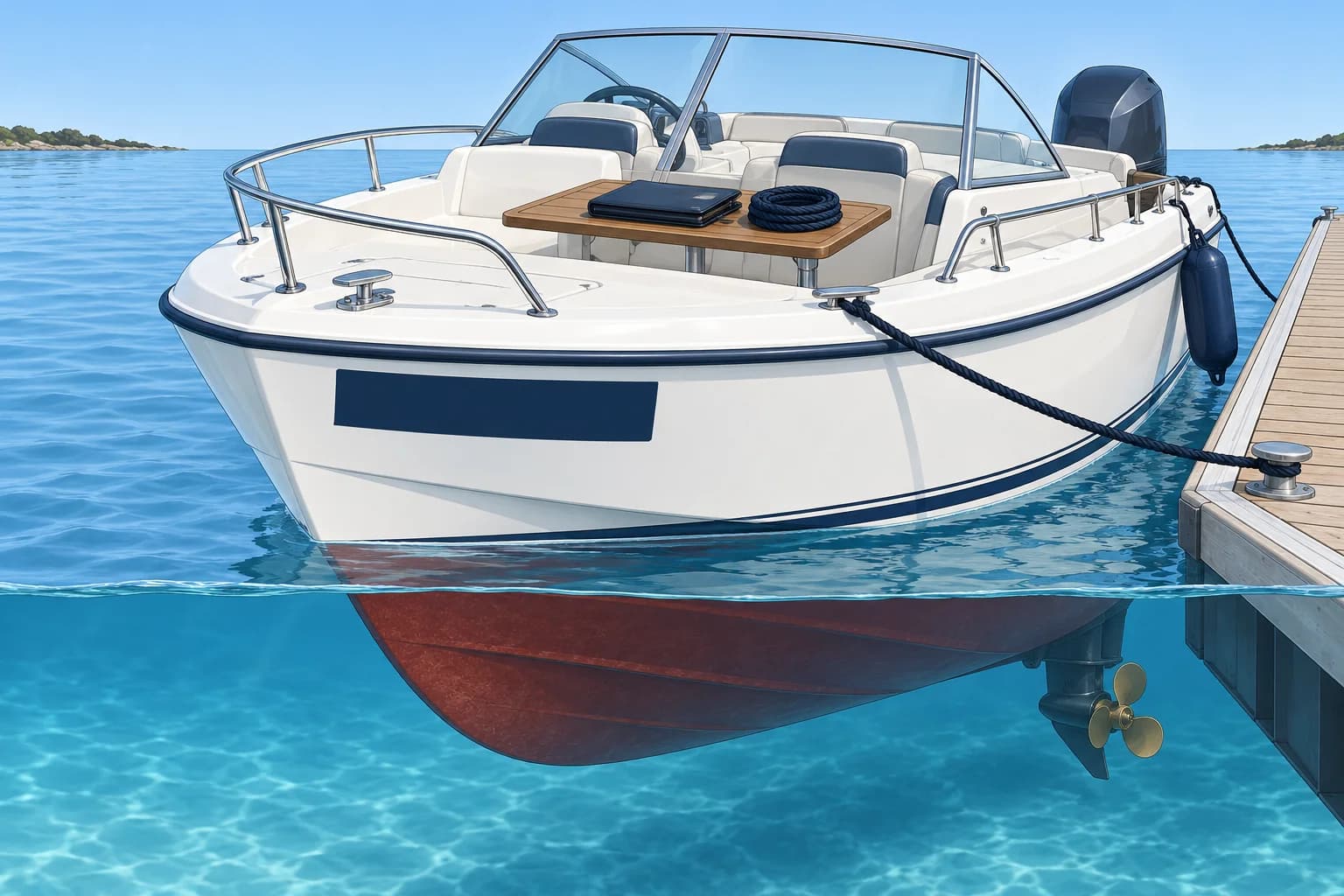
A recreational boat is registered on list 7 (private use) or list 6 (commercial use, such as charter). A registered boat receives the Certificado de Registro Español–Permiso de Navegación, which you renew every five years. If it expires, the boat may not sail. The registration mark goes on both bows, light on a dark hull and dark on a light hull.
CE boats up to 12 m
A CE-marked boat up to 12 m (except high-speed craft) need not be flagged and registered in full. It gets a certificado de inscripción instead, with its number on both bows. Such a boat may sail only in the Spanish territorial sea and within its design category. The owner can still choose full registration.
Inspections
The certificado de navegabilidad (seaworthiness certificate) records the boat's inspections. List 7 boats of 6 m or more are inspected at least every five years by an authorised inspection body. Boats under 6 m on list 7 are exempt from periodic inspection; their certificate reads «sin caducidad» (no expiry). For boats using simplified inscription, the certificado de inscripción replaces this certificate and records the inspections.
Compulsory insurance
Real Decreto 607/1999 requires third-party insurance for every motor boat, jet skis included, and for unpowered craft over 6 m. Minimum cover for injury is €120,202.42 per victim and €240,404.84 per accident. Property damage is covered to €96,161.94. Keep the proof on board. If you cannot show it, you have five working days to prove the cover. Foreign boats entering a Spanish port need the same cover.
Other papers
In zones 1–3 a boat with a radio needs a ship station licence (LEB). In zones 4–7 the licence is not needed, but a fixed DSC radio or an EPIRB still needs an MMSI (the boat's radio identity number). The skipper carries the licence card at sea. For foreign-flag documents, see Foreign waters.
Key figures
- Registration certificate
- Renew every 5 years; expired means no sailing
- CE boats ≤ 12 m
- Certificado de inscripción; Spanish territorial sea only
- Periodic inspection
- List 7 boats ≥ 6 m: at least every 5 years
- Insurance (injury)
- €120,202.42 per victim; €240,404.84 per accident
- Insurance (property)
- €96,161.94 per accident
- Who must insure
- All motor craft incl. jet skis; unpowered craft over 6 m
Remember
- List 7 is private use, list 6 commercial use; renew the registration certificate every 5 years.
- CE boats up to 12 m may use a simpler certificado de inscripción, valid in Spanish territorial waters only.
- List 7 boats of 6 m or more need a periodic inspection at least every 5 years.
- Motor boats, including jet skis, and unpowered boats over 6 m need third-party insurance.
Common mistakes
Wrong: An unpowered sailing dinghy of 5 m needs compulsory insurance.
Right: Unpowered craft need it only above 6 m. Fit an outboard, though, and the dinghy becomes a motor boat that must be insured.
Wrong: A CE boat with a certificado de inscripción can cross to Portugal or France.
Right: That simplified regime allows only the Spanish territorial sea. Full registration is needed to go abroad.
Worked case
Before departure, your 7 m list 7 motorboat has a periodic inspection six years old. Insurance is valid, but its receipt is at home. A friend says the five-working-day allowance lets you resolve both later. Should you leave?
Show the answer
No. The five-working-day allowance concerns proving insurance already in force; it does not extend an overdue inspection. Arrange the inspection before sailing and bring the insurance proof aboard. Buying insurance after a check would not prove cover existed when checked.
Practice question
Which registration list is for privately used recreational boats in Spain?
- List 5
- List 6
- List 7
- List 8
Show the answer
Answer: C. List 7 is private recreation. List 6 is recreational boats used commercially, such as charter.
4 · Licences
Who may skipper: qualifications and the licence exemption
Spain offers a navigation licence and four skipper qualifications. Since 1 October 2026, the licence exemption excludes rental boats.
The licence exemption changed
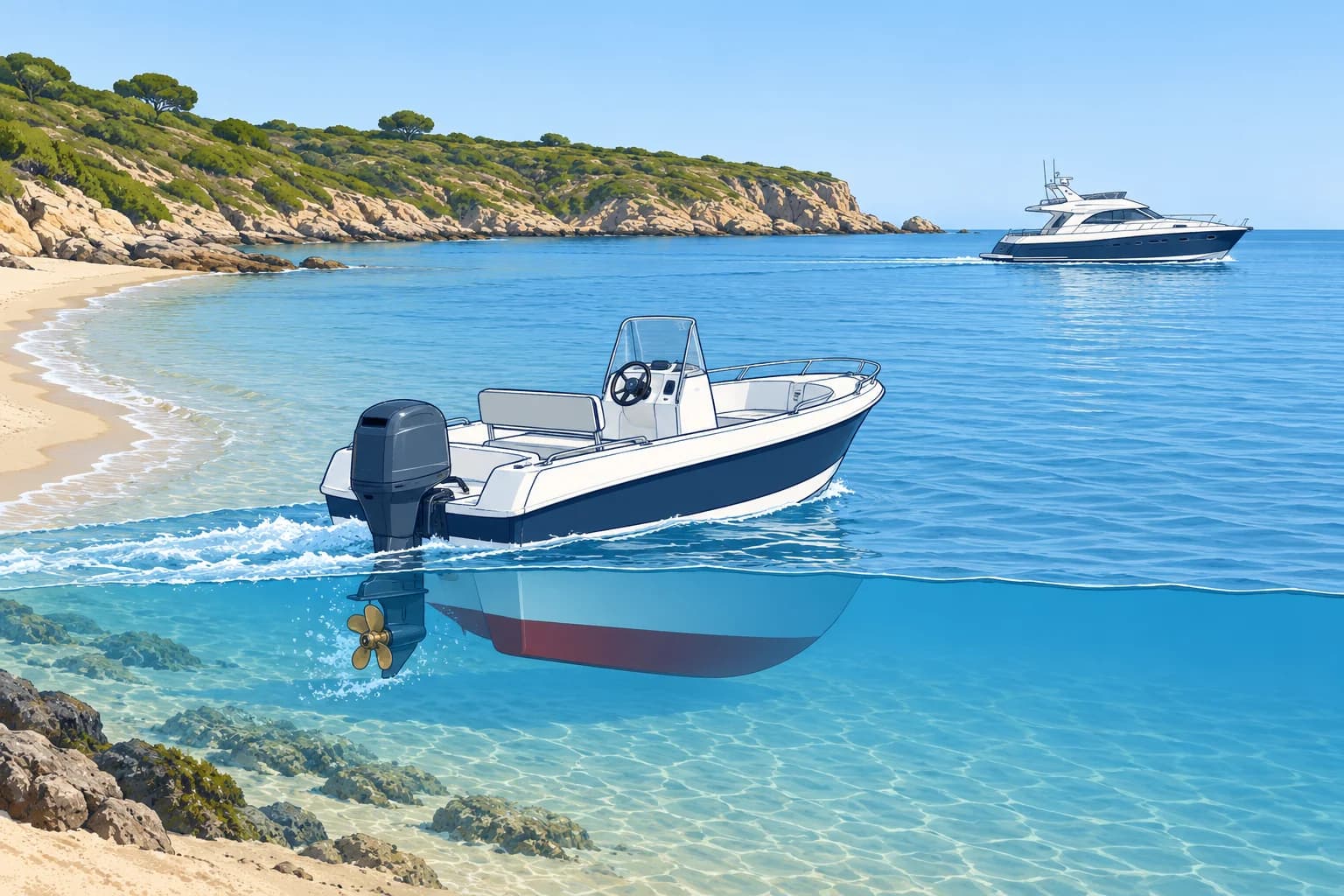
Since 1 October 2026, Real Decreto 1188/2025 has narrowed the rule. You may skipper without a qualification only a motorboat up to 5 m and 15 hp for private use, without a power-reducing device, or a sailing boat up to 6 m for sport use. Stay by day, within 2 NM of the port, marina or beach you left from. You must be 18. Jet skis are excluded. Renting one of these boats now needs the matching qualification.
The ladder
The Licencia de Navegación requires training, no exam. It covers boats up to 6 m and jet skis, by day, within 2 NM of shelter. The Patrón para Navegación Básica (PNB) covers motorboats up to 8 m within 5 NM of shelter. The Patrón de Embarcaciones de Recreo (PER) covers motorboats up to 15 m within 12 NM of the coast, plus inter-island trips in the Balearics and Canaries.
Higher qualifications
Patrón de Yate (PY) and Capitán de Yate (CY) both cover motorboats up to 24 m. PY allows trips up to 150 NM from the coast. CY has no distance limit.
Sail and extensions
PNB, PER, Patrón de Yate and Capitán de Yate cover motorboats; sail needs extra sailing practice. With extra navigation practice, the PER covers motorboats up to 24 m and the crossing between the mainland and the Balearic Islands. You may start with the licence, PNB or PER. Patrón de Yate needs the PER, and Capitán de Yate needs Patrón de Yate.
Age and card
The minimum age is 18, or 16 for the Licencia de Navegación and PNB with written parental consent. Carry the card at sea. Qualifications never expire, but the card is renewed every 10 years, every 5 years from age 70. The full comparison with other countries is on the boating-licence page.
Key figures
- Licence exemption (since 1 Oct 2026)
- Motor ≤ 5 m and 15 hp (private) or sail ≤ 6 m; day; 2 NM
- Licencia de Navegación
- ≤ 6 m and jet skis; day; 2 NM from shelter
- PNB
- ≤ 8 m; 5 NM from a port, marina or shelter
- PER
- ≤ 15 m; 12 NM from coast; inter-island Balearics and Canaries
- Patrón / Capitán de Yate
- Both ≤ 24 m; PY 150 NM from coast; CY no distance limit
- Card renewal
- Every 10 years; every 5 years from age 70
Remember
- Since 1 Oct 2026 (RD 1188/2025) the licence exemption is for private motor use and sport sail only.
- Licence exemption: motor ≤ 5 m and 15 hp or sail ≤ 6 m, by day, within 2 NM of where you left, age 18.
- Hiring a small motorboat now needs the appropriate qualification. Jet skis are outside the licence exemption.
- PNB: 8 m / 5 NM from shelter; PER: 15 m / 12 NM from coast; PY: 24 m / 150 NM from coast; CY: 24 m, unlimited distance.
Common mistakes
Wrong: Tourists can still hire a 15 hp boat without any qualification.
Right: Not since 1 October 2026. The renter needs the qualification that matches the boat; the exemption now covers private use only.
Wrong: The PNB limit of 5 NM is measured from the coastline.
Right: It is 5 NM in any direction from a port, marina or place of shelter.
Wrong: A Licencia de Navegación never allows jet skis.
Right: It does cover jet skis, by day and within 2 NM of shelter. The licence exemption is the rule that excludes them.
Worked case
Your 30-year-old friend has no qualification. He owns a 4.5 m boat with a 15 hp outboard and no power reducer. At midday, he wants to take his family to a point 3 NM in a straight line from his departure beach. Next week he plans to rent a similar boat. What may he do?
Show the answer
By day, he may skipper his own boat without a qualification within 2 NM of the departure beach. His planned point is 3 NM away, so he must choose a closer destination. For the hired boat, the exemption no longer applies since 1 October 2026. He needs at least the Licencia de Navegación, which covers boats up to 6 m by day within 2 NM of shelter.
Practice question
An adult rents a 4.5 m, 15 hp motorboat in November 2026 for a daytime trip within 2 NM of shelter. What is the minimum qualification?
- No qualification for this size
- PNB for any rented motorboat
- Licencia de Navegación
- PER for any hired motorboat
Show the answer
Answer: C. Since 1 October 2026, rental is excluded from the licence exemption. The Licencia de Navegación covers this boat up to 6 m, by day, within 2 NM of shelter.