
Maritime law, rules and watchkeeping · Level P3 · 5 parts · about 18 min
The law of the sea, flag states and port state control
5 short parts: Sea zones · Passage · Flag state · High seas · PSC regimes. Each part explains the idea, then gives the points to remember, the common mistakes, a worked case and a practice question; the Academy unit adds all 32 check questions.
1 · Sea zones
Baselines and the maritime zones of UNCLOS
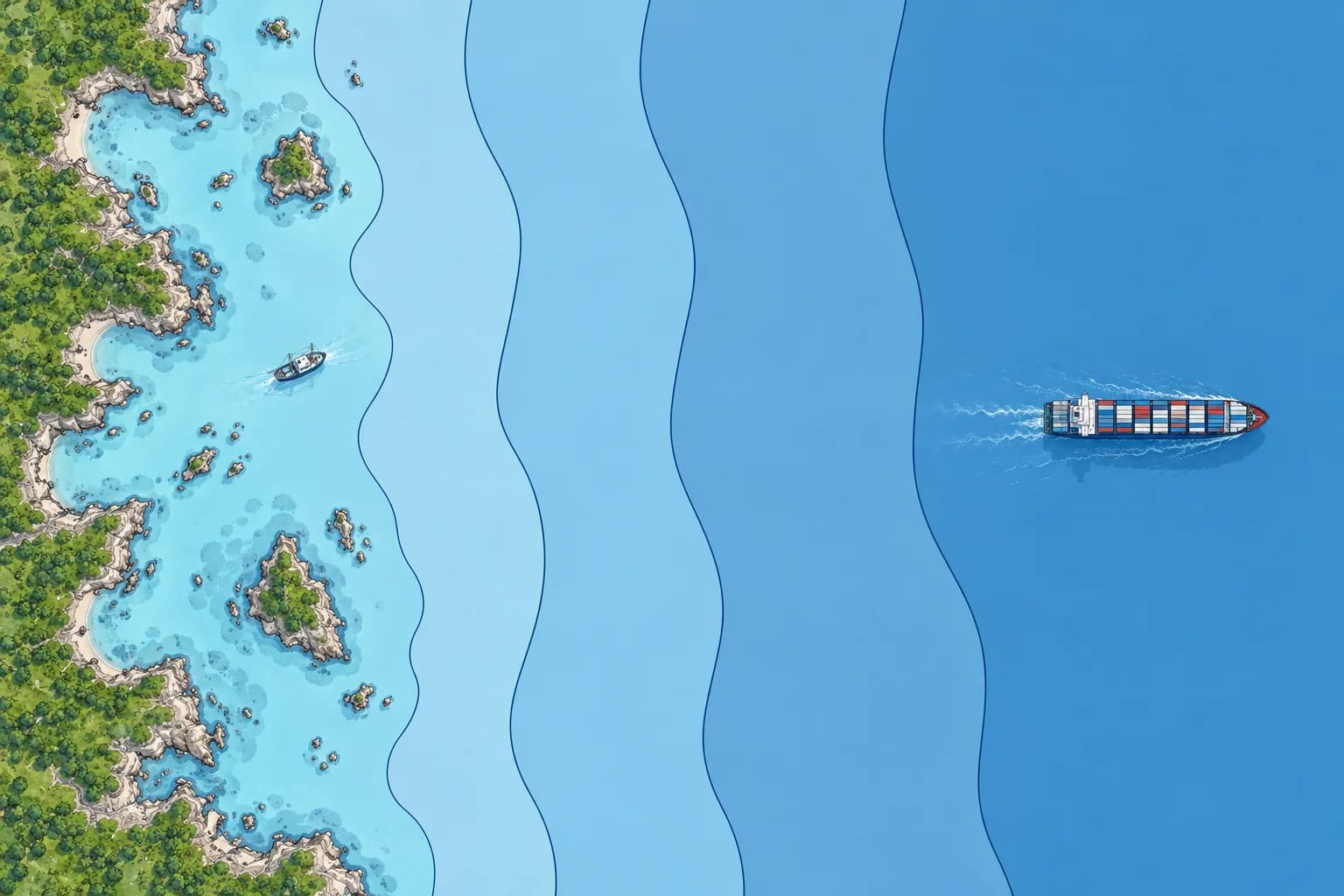
Coastal distance limits use baselines. Each zone gives the coastal state different powers; shelf rights concern the seabed.
UNCLOS
The United Nations Convention on the Law of the Sea (UNCLOS) 1982 entered into force on 16 November 1994. It has more than 165 parties, including the EU. The United States is not a party, but it accepts most of the navigation rules as customary law, meaning rules arising from general state practice accepted as legally binding. UNCLOS sets out the zones, the rights of passage and the duties of flag states.
Baselines and internal waters
Coastal distance limits use the baseline. The normal baseline is the low-water line along the coast, as marked on the state's large-scale charts. Where the coast is deeply indented or fringed with islands, a state may draw straight baselines between points. Except under the archipelagic regime, waters landward of baselines, such as ports, bays and estuaries, are internal waters. There the coastal state has full sovereignty, and there is no general right of passage.
Territorial sea and contiguous zone
The territorial sea extends up to 12 NM from the baseline. The coastal state has sovereignty over the water, the seabed and the airspace, but foreign ships have the right of innocent passage. Beyond it, up to 24 NM from the baseline, a state may claim a contiguous zone. There it may act to prevent or punish breaches of its customs, tax, immigration and health laws committed in its territory or territorial sea.
EEZ and continental shelf
The exclusive economic zone (EEZ) extends up to 200 NM from the baseline. The coastal state has resource rights and specified jurisdiction; you retain navigation and overflight freedoms. The continental shelf covers seabed and subsoil, not the water above. It normally reaches 200 NM. Beyond 200 NM, article 76 uses geological criteria and constraints of 350 NM or 100 NM beyond the 2,500 m isobath, a line joining points 2,500 m deep. Special limits apply to submarine ridges. Extended limits are established on recommendations from the UN shelf commission.
High seas and the Area
Beyond the EEZ lie the high seas, open to all states. The seabed beyond any continental shelf is the Area. Its minerals are the common heritage of mankind and are managed by the International Seabed Authority. The BBNJ Agreement on marine biodiversity beyond national jurisdiction entered into force on 17 January 2026. It allows marine protected areas on the high seas.
Key figures
- Territorial sea
- Up to 12 NM from the baseline
- Contiguous zone
- Up to 24 NM from the baseline
- EEZ
- Up to 200 NM from the baseline
- Extended continental shelf
- Art. 76: 350 NM or 100 NM beyond 2,500 m isobath; special limits
- UNCLOS
- Signed 1982, in force 16 November 1994
- BBNJ Agreement
- In force 17 January 2026
Remember
- Measure territorial-sea, contiguous-zone and EEZ distance limits from the baseline.
- Internal waters: full sovereignty, no general right of passage.
- Territorial sea 12 NM, contiguous zone 24 NM, EEZ 200 NM.
- In the EEZ the coastal state controls resources; you keep freedom of navigation.
Common mistakes
Wrong: The EEZ is part of the coastal state's territory.
Right: The EEZ gives rights over resources and some jurisdiction. Navigation remains free, as on the high seas.
Wrong: The territorial sea is measured from the coastline at high water.
Right: It is measured from the baseline: normally the low-water line, or straight baselines where allowed.
Wrong: In the contiguous zone the coastal state can enforce all its laws.
Right: These powers concern customs, tax, immigration and health laws, to prevent or punish breaches in the state's territory or territorial sea.
Worked case
Your ship is 18 NM from the coastal state's baseline, outside its territorial sea but inside its claimed contiguous zone. Customs orders you to stop after observing an unlawful transfer of goods inside the territorial sea. May it act?
Show the answer
Yes. You are inside the claimed contiguous zone, within 24 NM of the baseline. Article 33 allows customs action to punish a breach committed in the state's territorial sea. Comply and record events. These contiguous-zone powers would not cover a fishing-gear breach; separate EEZ resource powers may apply in the same waters.
Practice question
From where is the breadth of the territorial sea measured?
- From the high-water line on the coast
- From the baseline, usually the low-water line
- From the outer limit of the nearest port
- From the 20 m depth contour on the official chart
Show the answer
Answer: B. UNCLOS article 5 sets the normal baseline as the low-water line on large-scale charts.
2 · Passage
Innocent passage, transit passage and archipelagic sea lanes
In the territorial sea, you have innocent passage. Transit passage in qualifying straits and archipelagic sea lanes passage cannot be suspended.
Innocent passage
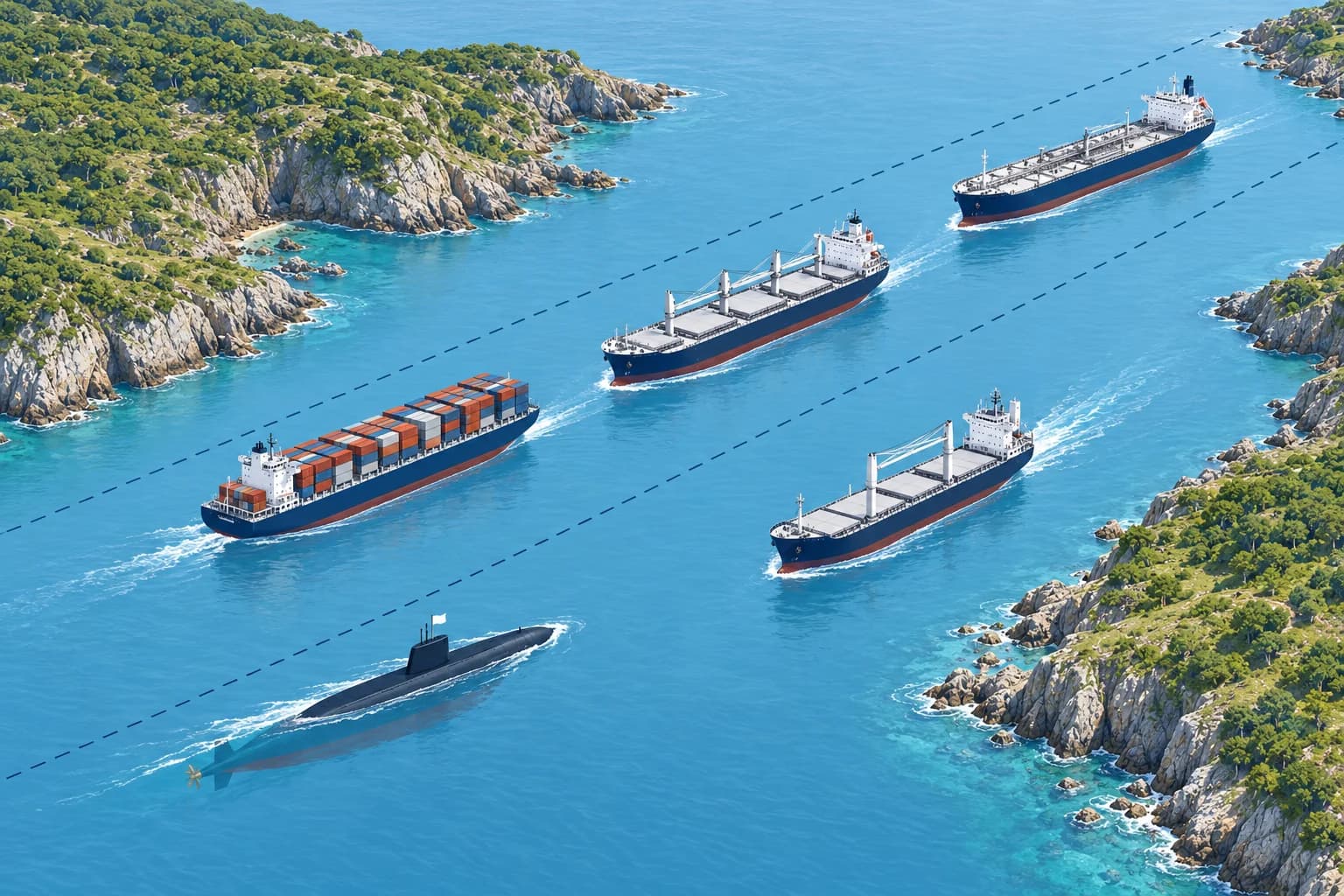
Ships of all states enjoy the right of innocent passage through the territorial sea (article 17). Passage means navigation that is continuous and expeditious: keep moving and proceed without unnecessary delay (article 18). You may stop and anchor only when this is incidental to ordinary navigation, forced by distress or weather, or needed to help people, ships or aircraft in danger. Passage may cross the territorial sea, or lead into or out of internal waters.
When passage is not innocent
Passage is innocent as long as it does not harm the peace, good order or security of the coastal state (article 19). The convention lists activities that make it non-innocent. Examples are weapons practice, spying, launching aircraft, loading or unloading goods or people against customs or immigration law, wilful and serious pollution, fishing, survey work and jamming communications. Submarines must navigate on the surface and show their flag (article 20).
What the coastal state may do
The coastal state may make laws on safety of navigation, protection of cables, fisheries and pollution (article 21). You must obey them and COLREG. It may require ships to use sea lanes and traffic separation schemes (TSS), especially tankers and ships carrying nuclear or dangerous cargoes (article 22). It may temporarily suspend innocent passage in specified areas when essential for security, without discrimination, after publication. It may not charge you for passage, only for services.
Transit passage
In qualifying straits used for international navigation, linking high seas or EEZs, ships and aircraft have transit passage (articles 37–44). Some straits have different regimes, including certain island–mainland straits and those governed by longstanding treaties. Transit passage allows continuous, expeditious transit in normal mode; submarines may stay submerged. You must proceed without delay, follow COLREG and pollution rules, and use IMO-adopted lanes and schemes. Transit passage cannot be suspended (article 44).
Archipelagic sea lanes
An archipelagic state, such as Indonesia, may enclose islands with baselines. Inside are archipelagic waters. Archipelagic sea lanes passage permits continuous, expeditious transit in normal mode and cannot be suspended. Without designated lanes, it applies through routes normally used for international navigation. In designated lanes, stay within 25 NM of the axis and no closer to shore than 10% of the distance between the nearest points on islands bordering the lane. Innocent passage also applies in archipelagic waters, subject to the convention.
Key figures
- Innocent passage
- Territorial sea; continuous and expeditious; can be suspended
- Submarines
- Surfaced and showing the flag (art. 20)
- Transit passage
- Qualifying international straits; cannot be suspended (art. 44)
- Archipelagic sea lane
- Within 25 NM of axis; also observe the 10% coastal-clearance rule
- Passage charges
- None for passage; only for services rendered
Remember
- Innocent passage must be continuous and expeditious; stop only for navigation, distress or rescue.
- Article 19 lists non-innocent activities, including wilful and serious pollution, fishing and survey work.
- The coastal state may require sea lanes and TSS and may suspend passage temporarily.
- Transit passage in straits and archipelagic sea lanes passage cannot be suspended.
Common mistakes
Wrong: Innocent passage lets you drift for hours off the coast waiting for orders.
Right: Passage must be continuous and expeditious. Waiting for orders is not a reason to stop or drift in the territorial sea.
Wrong: A coastal state can close an international strait whenever it wishes.
Right: Transit passage cannot be suspended. Innocent passage may be suspended temporarily in specified territorial-sea or archipelagic-water areas when essential for security, without discrimination, after publication.
Wrong: Coastal state laws may impose their own design and equipment rules on passing ships.
Right: Laws on design, construction, manning or equipment must follow generally accepted international rules (article 21(2)).
Worked case
Your ship arrives early off a port. The charterer asks you to drift for 36 hours, 6 NM off the coast, rather than going to the anchorage. The coast has no published waiting area. What do you advise the master?
Show the answer
Drifting for hours inside the 12 NM territorial sea is not passage. It is neither continuous nor incidental to ordinary navigation. Advise the master to wait outside the territorial sea, or use the official anchorage with the port's permission. Inform the charterer of the reason in writing. Remember that drifting near the coast also raises collision and grounding risks.
Practice question
When may you stop and anchor during innocent passage?
- When the charterer orders a pause during the voyage
- Only after the coastal state gives written permission
- When incidental to navigation, in distress or to rescue
- Never; innocent passage always requires forward motion
Show the answer
Answer: C. Article 18 allows stopping and anchoring only for ordinary navigation, force majeure or distress, or to help those in danger.
3 · Flag state
Nationality of ships and the duties of the flag state
Your ship has the nationality of its flag. On the high seas, jurisdiction normally rests with that state, which must control the ship effectively.
Nationality
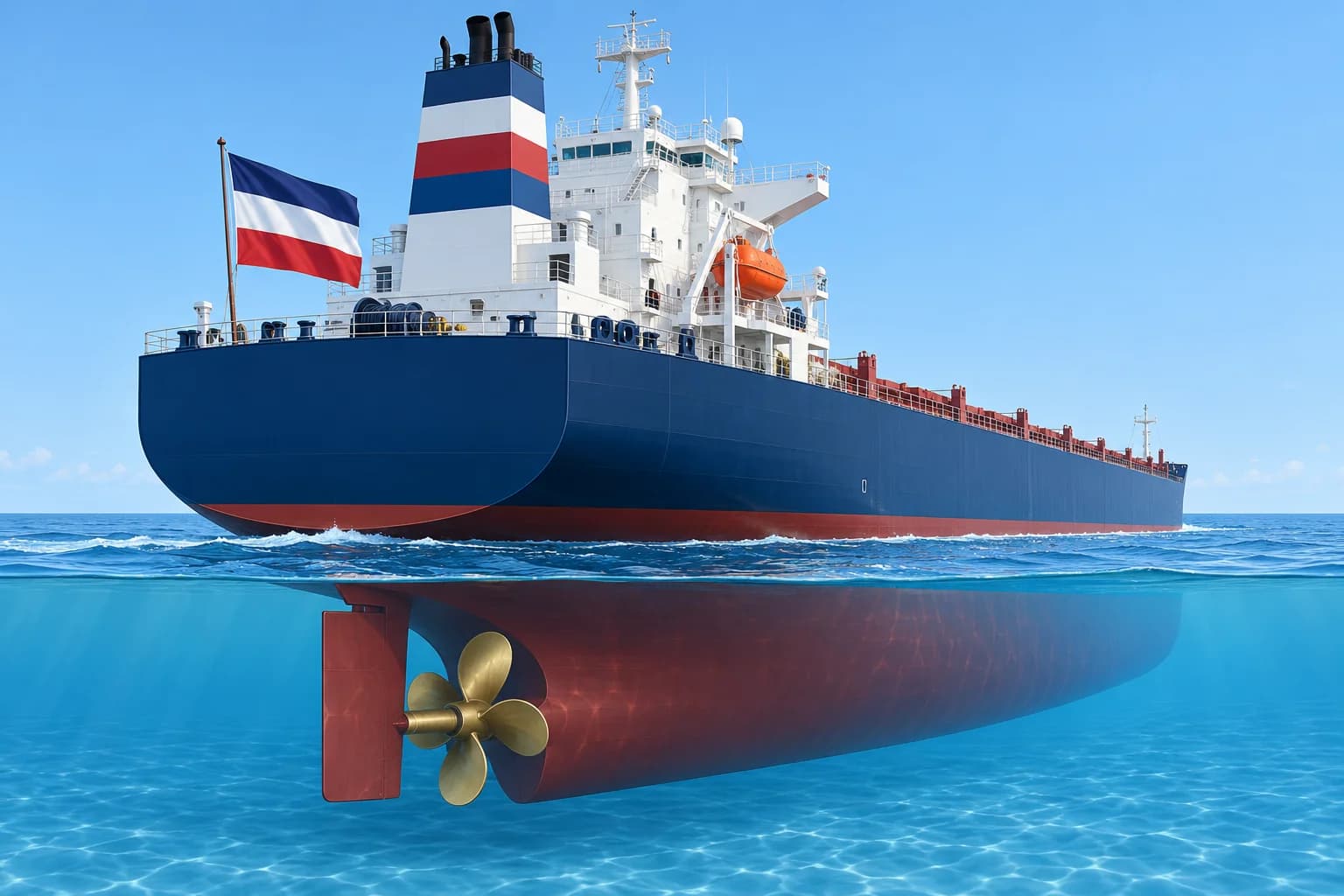
Every state may let ships fly its flag (article 90). It decides how a ship gets its nationality, registers her and issues documents. There must be a genuine link between the state and the ship (article 91). Many owners use open registers, flags that accept ships owned abroad. These are sometimes called flags of convenience. The genuine link then rests on the flag's real control over the ship, not on the owner's nationality.
One flag only
A ship sails under one flag only (article 92). During a voyage or port call, she may change flag only after a real transfer of ownership or change of registry. Using flags as convenient may lead to treatment as a ship without nationality. A bareboat charter hires a ship without crew. Where permitted, bareboat registration lets her fly the charter registry's flag while her right to fly the underlying registry's flag is suspended.
Flag state duties
Under article 94 the flag state must exercise effective jurisdiction and control over its ships in administrative, technical and social matters. It must keep a register. It must ensure that its ships are surveyed, properly built and equipped, and manned by qualified crews with decent conditions. It must ensure that masters and officers know the international rules on safety, collisions, pollution and radio. These duties are spelt out in SOLAS, MARPOL, STCW and the MLC.
Checks and inquiries
A state that has clear grounds to believe that the flag is failing may report this to the flag, which must investigate (article 94(6)). The flag must also hold an inquiry into a high-seas casualty or incident of navigation involving its ship if it kills or seriously injures another state's nationals, seriously damages another state's ships or installations, or seriously harms the marine environment (article 94(7)).
Collisions on the high seas
After a collision on the high seas, penal (criminal) or disciplinary proceedings against the master or crew may be brought only by the flag state or the person's national state (article 97). Only the state that issued a certificate may withdraw it. For these collision proceedings, only the flag state may order arrest or detention of the ship, even for investigation.
Duty to assist
Article 98 requires you to assist people in danger without serious danger to your ship, crew or passengers. When informed of people needing rescue, proceed with all possible speed if reasonably expected. After collision, assist the other ship and people; where possible, exchange ship names, registry ports and next ports of call.
Key figures
- Genuine link
- UNCLOS art. 91
- One flag only
- Art. 92: using flags as convenient may mean stateless treatment
- Flag state duties
- Art. 94: effective jurisdiction and control
- High-seas collisions
- Art. 97: flag/national state proceedings; only flag detains ship
- Duty to assist
- Art. 98, also SOLAS V/33
Remember
- A ship has the nationality of her flag; there must be a genuine link (article 91).
- A ship using different national flags as convenient may be treated as stateless.
- The flag must exercise effective jurisdiction and control (article 94).
- High-seas collision: only the flag state or the person's state may prosecute (article 97).
Common mistakes
Wrong: After a high-seas collision, any port state may bring penal proceedings against your master.
Right: Only the flag state or the master's national state may bring penal or disciplinary proceedings. For these collision proceedings, only the flag state may order arrest or detention of the ship, even for investigation.
Wrong: A ship may change flag during a voyage if the owner wishes.
Right: During a voyage or port call, a ship may change flag only after a real transfer of ownership or change of registry.
Worked case
Your Malta-flag ship collides with a Greek-flag ship on the high seas, beyond all EEZs. At the next port, in a third state, police want to arrest your Indian master for questioning about the collision. What does UNCLOS say?
Show the answer
Under article 97, only Malta or India may bring penal or disciplinary proceedings against your Indian master. For these collision proceedings, only Malta, the ship's flag state, may order her arrest or detention, even for investigation. Inform the company and flag and seek consular help. Separate civil claims follow their own rules.
Practice question
You learn of people needing rescue nearby. Assisting would not seriously endanger your ship or anyone aboard. What should you do?
- Wait for the next port to report their position
- Proceed with all possible speed to assist them
- Keep your schedule and leave rescue to others
- Wait for flag-state permission before assisting
Show the answer
Answer: B. Article 98 requires assistance without serious danger to your ship, crew or passengers. When informed of people needing rescue, proceed with all possible speed if reasonably expected.
4 · High seas
The high seas: freedoms, piracy, the right of visit and hot pursuit
The high seas are free to all, but not lawless. Warships may visit suspect ships, and a coastal state may chase a lawbreaker out to sea.
Freedoms
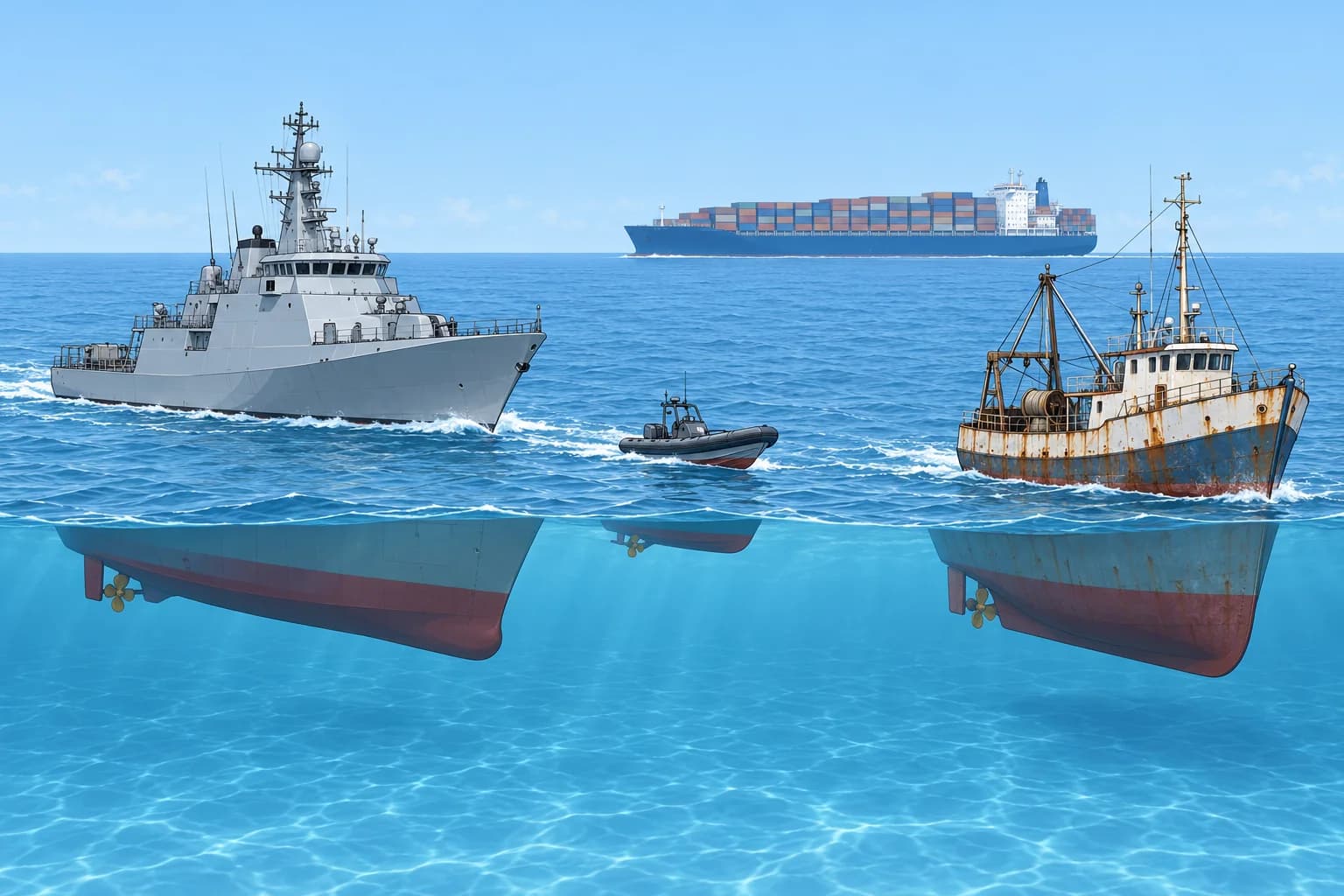
The high seas are open to all states (article 87). Their freedoms include navigation, overflight, laying cables and pipelines, fishing and scientific research, each subject to other rules. Each must be used with due regard for the interests of others. On the high seas your ship is under the exclusive jurisdiction of her flag state, with a few exceptions.
Piracy
Piracy (article 101) is illegal violence, detention or robbery for private ends, by crew or passengers of a private ship or aircraft against another ship, aircraft, people or property aboard. It occurs on the high seas or outside any state's jurisdiction. These piracy rules also apply in EEZs. Comparable attacks in internal, archipelagic or territorial waters are armed robbery against ships. Every state may seize pirate ships using warships, military aircraft or clearly marked, authorised government ships or aircraft.
Right of visit
Without treaty-based authority, article 110 permits a warship to visit a foreign merchant ship on reasonable suspicion of piracy, slave trade, unauthorised broadcasting, no nationality, or concealed nationality matching the warship's. For broadcasting, the warship's state must have jurisdiction. It may first check documents, then investigate further if suspicion remains. If suspicion is unfounded and the ship did nothing to justify it, compensation is due for resulting loss or damage.
Hot pursuit
A coastal state may pursue a foreign ship for breaching applicable laws from internal, archipelagic or territorial waters, or the contiguous zone, EEZ or continental shelf. The ship or its boat must be there at the start. First give a visual or sound stop signal within seeing or hearing distance. Pursuit must be continuous, by warships, military aircraft or clearly marked, authorised government ships or aircraft. It ends when the ship enters the territorial sea of its flag state or a third state.
Drug cooperation
Under article 108, states cooperate to suppress illicit drug trafficking by ships on the high seas. A flag state may request other states' assistance if it reasonably suspects a ship flying its flag. Drug suspicion alone is not an article 110 ground for boarding; treaty-based authority may provide separate powers.
Key figures
- High-seas freedoms
- Art. 87: navigation, overflight, cables, fishing, research
- Piracy
- Private ship/aircraft attacks another vessel; private ends; EEZ too
- Right of visit
- Art. 110: piracy, slaves, broadcasts, stateless, concealed own flag
- Hot pursuit
- Art. 111: start in relevant zone, stop signal, continuous
- Pursuit ends
- Entry into the flag state's or a third state's territorial sea
Remember
- On the high seas the flag state has exclusive jurisdiction, with listed exceptions.
- Piracy: private ends, a private ship or aircraft attacking another vessel; rules apply on the high seas and in EEZs.
- Without treaty-based authority, article 110 limits visits to its listed grounds; drug suspicion alone is insufficient.
- Hot pursuit: start in the relevant zone, signal, continuous; ends in the flag state's or a third state's territorial sea.
- Comparable attacks in internal, archipelagic or territorial waters are armed robbery against ships.
Common mistakes
Wrong: An attack on an anchored ship in a port is piracy under UNCLOS.
Right: Comparable attacks in internal, archipelagic or territorial waters are armed robbery against ships. Piracy rules also apply in EEZs.
Wrong: Hot pursuit can start on the high seas once the coastal state learns of a breach.
Right: Pursuit must start while the ship is in the zone where the law applies, and be continuous.
Wrong: Any warship may search any merchant ship on the high seas.
Right: Without treaty-based authority, article 110 permits visits only on its listed grounds, starting with document checks.
Worked case
Your refrigerated cargo ship transfers fish without the required coastal-state licence, 20 NM inside its EEZ. A clearly marked, authorised coastguard boat gives a visible stop signal. You leave; it pursues continuously and stops you 30 NM beyond the EEZ. Is this lawful?
Show the answer
Yes. The pursuit starts in the EEZ for a breach of the coastal state's applicable fisheries law. The boat is authorised and clearly marked, its stop signal is visible, and pursuit is continuous. It may continue beyond the EEZ. It must end if your ship enters her flag state's or a third state's territorial sea.
Practice question
An armed gang robs a ship at anchor inside a port's limits. What is this called?
- Piracy under UNCLOS article 101
- Armed robbery against ships
- Mutiny under the flag's law
- Unlawful pursuit under UNCLOS
Show the answer
Answer: B. Comparable attacks in internal, archipelagic or territorial waters are armed robbery against ships. Piracy rules apply on the high seas and, through article 58(2), in EEZs.
5 · PSC regimes
Port state control: the MoUs and how ships are targeted
Port states cooperate in regional MoUs. A risk profile decides how often your ship is inspected, and repeated detentions can ban her.
Why ports inspect
Port state control (PSC) is the inspection of foreign ships in a state's ports to check that they meet the conventions. Its legal basis is the port state's sovereignty over its ports and the PSC clauses in each convention. The IMO's 2023 procedures are in resolution A.1185(33), the Procedures for Port State Control 2023. PSC is a safety net behind the flag state, not a replacement for it.
The MoUs
Port states work together in regional memoranda of understanding (MoUs). Members share inspection records and coordinate targeting within each regional regime. The Paris MoU (1982) covers Europe and the North Atlantic. The Tokyo MoU covers Asia-Pacific. Others are the Indian Ocean, Mediterranean, Black Sea, Caribbean, Abuja (West and Central Africa), Riyadh (Gulf) and Viña del Mar (Latin America) MoUs. The US Coast Guard runs its own programme.
Ship risk profile
Under the Paris MoU's New Inspection Regime (NIR), in use since 2011, each ship has a ship risk profile recalculated daily: high, standard or low risk. It weighs ship type and age; performance of the flag, company and recognised organisation (RO), an authorised body acting for the flag; and 36-month deficiency and detention history. Periodic inspection windows are 5–6 months for high-risk ships, 10–12 for standard and 24–36 for low.
Inspection priority
A ship past her periodic inspection window, or with an overriding factor such as a collision, is Priority I and must be inspected. Inside her window she is Priority II and may be inspected. Unexpected factors, such as a pilot's safety report, can also trigger selection.
Inspection types
An initial inspection checks certificates, documents and overall condition. Clear grounds, evidence that the ship or crew may not meet requirements, lead to a more detailed inspection of suspect areas. An expanded inspection covers prescribed risk areas in greater depth. Due periodic inspections are expanded for high-risk ships of any age, and for oil, gas and chemical tankers, bulk carriers and passenger ships over 12 years old.
Lists and bans
Paris MoU white, grey and black flag lists apply from 1 July, using three-year inspection and detention records. Access is refused after a third Paris-region detention within 36 months for black-list flags or 24 months for grey-list flags. Bans last at least 3 months, then 12 months. A third refusal is permanent unless strict lifting conditions are met after at least 24 months. Any detention following the third refusal leads to permanent refusal.
Key figures
- IMO PSC procedures
- Resolution A.1185(33), 2023
- Paris MoU windows
- High risk 5–6, standard 10–12, low 24–36 months
- Tokyo MoU windows
- High risk 2–4, standard 5–8, low 9–18 months
- Expanded inspection
- High-risk ships; tankers, bulkers, passenger ships over 12 years
- Paris MoU ban trigger
- Paris-region detentions: black >2/36 months; grey >2/24
- Ban durations
- Minimum 3, then 12 months; third ≥24 if liftable, else permanent
Remember
- PSC is a safety net behind the flag; IMO's 2023 procedures are A.1185(33).
- Nine regional MoUs coordinate inspections; the US Coast Guard runs a separate programme.
- The ship risk profile (high, standard, low) sets the inspection window.
- Flag lists run from 1 July; repeated detentions lead to refusal of access.
Common mistakes
Wrong: A low-risk ship cannot be inspected inside her window.
Right: She can still be inspected as Priority II, or must be if an overriding factor applies.
Wrong: Port state control replaces the flag's surveys.
Right: PSC is a safety net. The flag state remains responsible for surveys and certificates.
Worked case
Your 14-year-old bulk carrier has a grey-list flag and a periodic inspection due at Antwerp. She was detained in Rotterdam 20 months ago and Hamburg 8 months ago, with no previous access ban. What is at stake?
Show the answer
The due periodic inspection must be expanded because she is a bulk carrier over 12. These facts do not establish her live risk profile; check it. A detention now would be her third Paris-region detention within 24 months. With a grey-list flag and no previous ban, this triggers refusal of access for at least 3 months, subject to lifting conditions.
Practice question
Which region does the Paris MoU cover?
- The Asian and Pacific regions
- The states of the Indian Ocean
- Europe and the North Atlantic
- Latin America and the Caribbean
Show the answer
Answer: C. The Paris MoU covers European coastal states and Canada. Asia-Pacific is the Tokyo MoU.