
Maritime law, rules and watchkeeping · Level R2 · 4 parts · about 15 min
Croatia: navigation areas, safety equipment and documents
4 short parts: Areas I–IV · Safety gear · Coast rules · Papers and fees. Each part explains the idea, then gives the points to remember, the common mistakes, a worked case and a practice question; the Academy unit adds all 23 check questions.
1 · Areas I–IV
Croatia's navigation areas and boat types
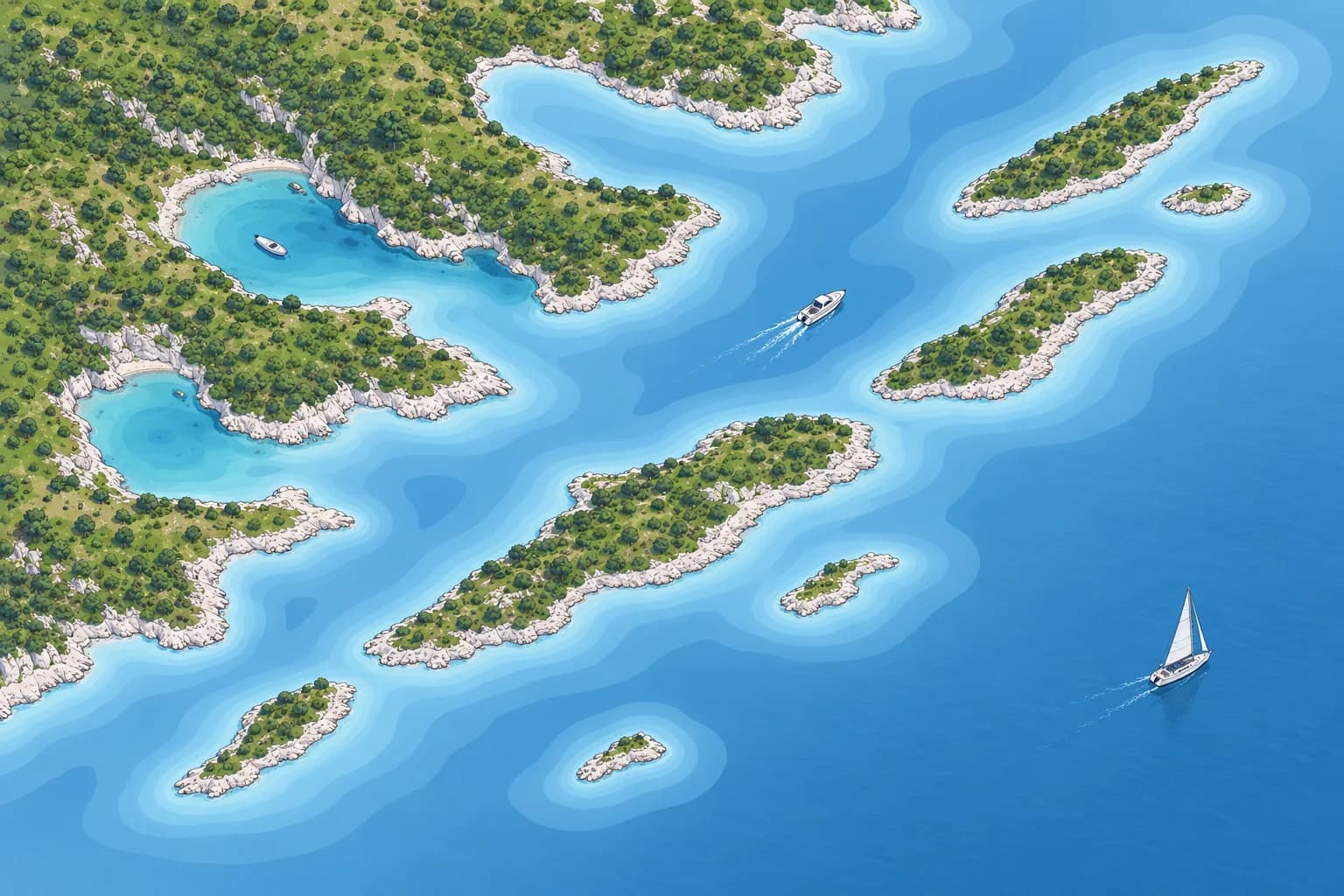
Area III reaches 12 nautical miles (NM) from the nearest mainland or island coast. Its sub-areas IIIa, IIIb and IIIc reach 6, 3 and 1 NM.
The rule book
Croatian boats are governed by the Pravilnik o brodicama, čamcima i jahtama (Ordinance on boats and yachts, Narodne novine 13/2020, amended by 52/2020), made under the Pomorski zakonik (Maritime Code). The harbour master's offices (lučke kapetanije) and the Croatian Register of Shipping apply it.
Boat types
A brodica is a seagoing boat with hull length up to 15 m, authorised for no more than 12 passengers, that is over 2.5 m in hull length or has total propulsion power over 5 kW. A jahta has hull length over 15 m, is built for extended recreational stays at sea and is authorised for up to 12 passengers besides crew. A čamac is for inland waters.
The areas
Area I: unlimited international navigation. Area II: up to 20 NM from the nearest coast of the mainland or an island. Area III: up to 12 NM, with three sub-areas: IIIa up to 6 NM, IIIb up to 3 NM and IIIc up to 1 NM. Area IV: ports, bays, river mouths and rivers as far as they are navigable from the sea.
Design category
A CE-marked boat (built to EU design standards) may use areas that match its design category. A: all areas. B: II, III, its sub-areas and IV. C: III, its sub-areas and IV. D: IV only. Check the area in your boat’s papers: the harbour master may set a narrower area, weather or seasonal limit.
Jet skis and small hire boats
A jet ski may only use area IIIc, and only in Croatian internal and territorial waters. Hire boats up to 5 m with engines up to 5 kW may use only areas IIIc and IV. Distances are measured from the nearest coast of the mainland or an island, which helps in the Croatian archipelago.
Key figures
- Area I
- Unlimited international navigation
- Area II
- Up to 20 NM from the mainland or an island
- Area III
- Up to 12 NM; IIIa 6 NM · IIIb 3 NM · IIIc 1 NM
- Area IV
- Ports, bays, river mouths and rivers
- Jet ski
- Area IIIc only, in Croatian waters
- Brodica / jahta: hull length
- Brodica: ≤15 m; >2.5 m or >5 kW. Jahta: >15 m.
Remember
- Areas: I unlimited, II 20 NM, III 12 NM, IV ports and bays.
- Area III splits into IIIa (6 NM), IIIb (3 NM) and IIIc (1 NM).
- Distances count from the mainland or the nearest island.
- CE categories: A all; B II, III, IIIa–c, IV; C III, IIIa–c, IV; D IV only. Recorded restrictions still apply.
- Jet skis: area IIIc only.
Common mistakes
Wrong: Area III means within 12 NM of the mainland.
Right: It is 12 NM from the nearest coast of the mainland or of an island, so a route along the islands can stay in area III far from the mainland.
Wrong: A jet ski may go wherever its owner's boat goes.
Right: A jet ski is limited to area IIIc, 1 NM from the coast, in Croatian waters.
Worked case
Your CE category C motorboat (7.5 m, Croatian-registered) is entered for area IIIa. You want to cross from Split to the island of Vis, a crossing where you will be up to about 8 NM from the nearest land. May you?
Show the answer
No. Your papers limit you to IIIa: 6 NM from the nearest mainland or island coast. The route reaches 8 NM. Category C can qualify for area III, but does not override that recorded limit. Stay within 6 NM, or ask the harbour master about approval for area III before taking this route.
Practice question
Your papers permit IIIb. Your route stays 2.5 NM from an island but reaches 9 NM from the mainland. Does it meet the distance limit?
- No: IIIb permits only 1 NM from an island
- Yes: IIIb permits 3 NM from an island
- No: IIIb measures from the mainland only
- Yes: IIIb permits 12 NM from an island
Show the answer
Answer: B. IIIb permits up to 3 NM from the nearest mainland or island coast. Here that distance is 2.5 NM.
2 · Safety gear
Required gear for private boats, area by area
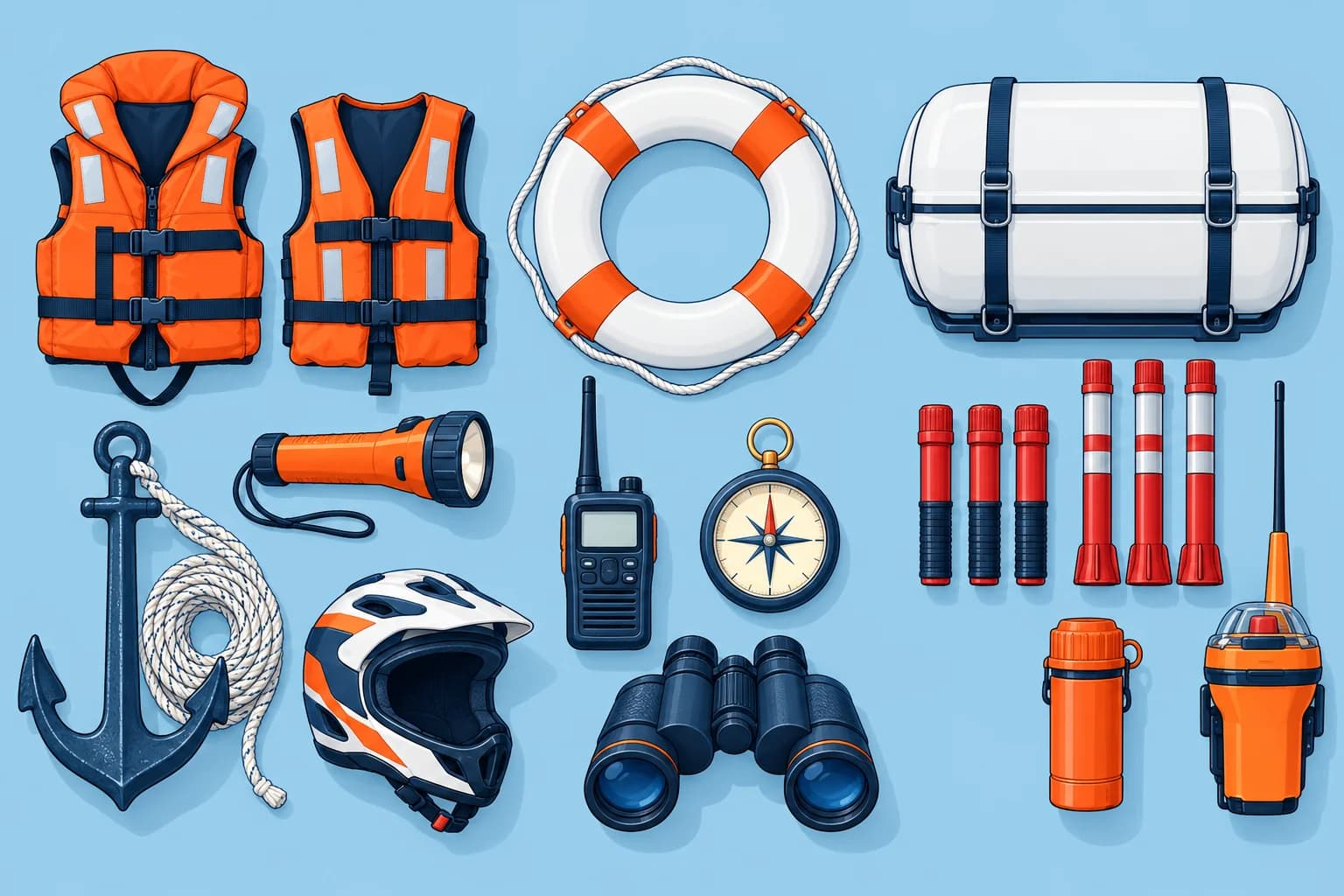
Carry lifejackets and a torch everywhere. Compass and charts start in III; VHF radio, flares and a liferaft in II; a satellite distress beacon in I.
Whose rules
The tables below are for Croatian-registered private boats (brodice for personal use). A foreign-flagged boat is equipped to her flag state's rules, but the Croatian table is a good benchmark, and inspectors expect sound basic kit.
In every area
Carry a lifejacket for each adult and child, anchor and line, a towline four times the boat’s length, mooring lines, a waterproof torch, and two boxes of matches or a lighter, kept waterproof. Carry bilge pumps suited to the boat’s layout, and required navigation lights at night and in restricted visibility. A tiller-steered outboard needs a kill cord (engine-stop lanyard) for the driver. Jet ski riders and passengers wear lifejackets and helmets.
Areas III, II and I
Add a lifebuoy, a GNSS satellite-position receiver, a lit compass, binoculars, current official charts, chart tools, a current official small-craft pilot (coastal sailing guide) and List of Lights and Fog Signals (details of navigation aids and fog signals). A sound signal is needed from area IIIb. A first-aid box is carried from IIIc to III.
Areas II and I
Add a liferaft for everyone, to ISO 9650 (the rules still name a tender of matching capacity as an alternative), an additional lifebuoy with self-igniting light and line, lifejackets with whistle and self-lighting lamp, thermal protective aids (covers that reduce body-heat loss), a first-aid cabinet, a sea anchor (device to slow drift) and day shapes (daytime status signals). Carry 3 red hand flares, 3 parachute rockets, and 1 floating smoke signal in II or 2 in I. Area I also requires a 406 MHz EPIRB, a satellite distress beacon.
Fast boats
On a boat whose maximum speed exceeds 20 knots, everyone outside an enclosed space wears a lifejacket whenever under way. The boat needs a kill cord and, in IIIc, IIIb, IIIa, III, II and I, a radar reflector (device that helps radar detect you). At night in those areas, its lifejackets need a whistle and light.
Radio
Areas II and I require VHF marine radio. DSC (digital selective calling) can send digital distress alerts. Boats built from 1 July 2006, or older boats fitting new stations, need DSC; class D suffices.
Key figures
- Every area
- Lifejacket per person, waterproof torch, anchor
- VHF radio: II and I
- DSC: built from 1 July 2006, or older boat fitting a new station
- Lifebuoy
- III: one; II/I: add a second with light and line
- Flares (II and I)
- 3 hand flares, 3 rockets, smoke 1 (II) or 2 (I)
- Liferaft for everyone
- Areas II and I
- Maximum speed >20 knots
- Under way: lifejackets worn outside enclosed spaces; kill cord
Remember
- Lifejackets for everyone, in every area, children included.
- GNSS, compass and charts start in III. VHF starts in II; DSC depends on build date or fitting a new station.
- Liferaft, flares and rockets: II and I. Smoke: 1 in II, 2 in I. EPIRB: I only.
- On boats capable of more than 20 knots, everyone outside an enclosed space wears a lifejacket under way.
- Jet ski riders and passengers wear lifejackets and helmets.
Common mistakes
Wrong: Every area III boat must carry VHF with DSC.
Right: VHF carriage starts in area II. DSC is required on boats built from 1 July 2006 and older boats fitting a new station; class D is sufficient.
Wrong: Flares are required on every boat.
Right: For private boats the Croatian table asks for hand flares, rockets and smoke only in areas II and I. Carry some anyway if you go far from help.
Worked case
Your Croatian private motorboat was built in 2005 and has its original non-DSC VHF. It is approved for III and can reach 30 knots. Under way at 9 NM, only children wear lifejackets in the open cockpit. You have phone charts but no other navigation kit, kill cord or reflector. Other gear complies. What must change?
Show the answer
Everyone in the open cockpit must wear a lifejacket under way: the boat can exceed 20 knots. Area III needs GNSS, a lit compass, binoculars, chart tools, current official charts, a small-craft pilot and List of Lights and Fog Signals; phone charts do not replace these. Fit a radar reflector and use the kill cord. This pre-July-2006 boat retains its original radio, so no DSC upgrade is required here.
Practice question
From which area must a Croatian-registered private brodica built in 2010 carry VHF with DSC?
- Area IIIc
- Area IIIa
- Area III
- Area II
Show the answer
Answer: D. VHF carriage starts in area II. A boat built in 2010 is after the 1 July 2006 cutoff, so its required VHF station must have DSC; class D is sufficient.
3 · Coast rules
Distances from shore, beaches and the 8-knot strip
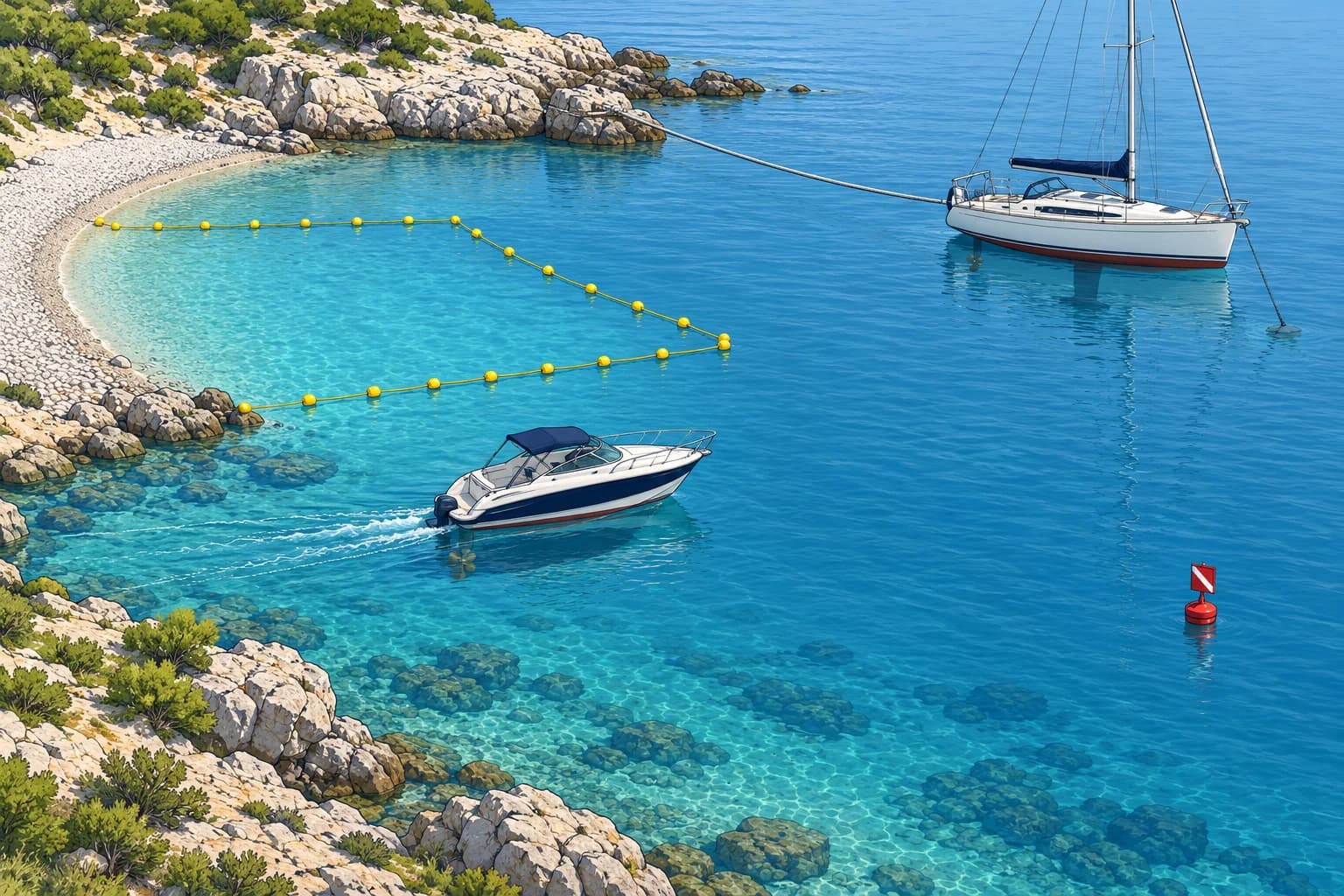
Within 300 m of the coast: 8 knots maximum, no planing. Boats under 15 m stay at least 50 m from shore and managed-beach barriers.
The new ordinance
Coastal navigation rules are in the Pravilnik o sigurnosti pomorske plovidbe (Ordinance on safety of navigation in internal waters and the territorial sea), NN 52/2025, in force since 29 March 2025, amended by NN 40/2026. It replaced the 2013 ordinance that older guides quote.
Speed near the coast
Within 300 m of the coast, in narrow channels and on approaches to ports and anchorages, go with special care at no more than 8 knots. Motorboats and jet skis may plane (skim over the water at speed) only beyond 300 m from the coast, where planing is not banned. Check charts and official publications for lower local limits.
Keep off the shore
Boats under 15 m stay at least 50 m from the coast; 15 m to under 30 m, 150 m; 30 m and over, 300 m. You may come closer slowly to enter or leave port, anchor, berth, or where the channel requires it. Stay 50 m from a managed beach’s barrier (100 m for 15 m to under 30 m; 300 m for 30 m and over). Keep boats and jet skis outside bathing areas.
Anchoring and shore lines
Keep your swinging circle (the area your boat can sweep around its anchor) at least 50 m clear of a beach barrier and 150 m off a natural beach. Do not anchor where charts or the harbour master forbid it, or over cables and pipes. When tied ashore, every part of the boat and her gear must remain under 70 m from shore. Mark ropes and anchor chains, keep navigation clear, and never tie ashore in bathing areas.
Small craft and divers
Personal craft (kayaks, paddleboards, pedalos, windsurfers) normally stay within 300 m of shore, by day. They may go farther with an appropriate motor-vessel escort arranged by the organiser, rental operator or activity leader. Mechanically powered personal craft stay at least 50 m offshore. Pedalos and paddleboards may use managed bathing areas. Keep at least 50 m from a diver’s marker unless you are the diver’s escort vessel.
Key figures
- Within 300 m of the coast
- 8 knots maximum; no planing
- From the shore
- < 15 m: 50 m · 15–<30 m: 150 m · ≥ 30 m: 300 m
- Managed-beach barrier
- < 15 m: 50 m · 15–<30 m: 100 m · ≥ 30 m: 300 m
- Anchoring off a natural beach
- At least 150 m from the shore
- Diver's marker
- At least 50 m away, except the diver’s escort vessel
- Shore lines
- Every part of the boat and gear under 70 m from shore
Remember
- 8 knots maximum within 300 m of the coast, in narrow channels and on port approaches.
- Plane only beyond 300 m from the coast.
- Boats under 15 m: 50 m from the shore and 50 m from a beach barrier.
- Do not anchor within 150 m of a natural beach.
- Keep 50 m from a diver’s marker unless you are the diver’s escort vessel.
Common mistakes
Wrong: The coastal speed limit is 5 knots within 150 m, as in older guides.
Right: Under NN 52/2025 the limit is 8 knots within 300 m of the coast, in narrow channels and port approaches, and planing is only allowed beyond 300 m.
Wrong: I may anchor just outside the swimmers at a natural beach.
Right: Anchoring is forbidden within 150 m of the shore of a natural beach.
Wrong: Long shore lines are fine if they are marked.
Right: Every part of the boat and her gear must remain under 70 m from shore. Mark ropes and chains; keep navigation clear and stay outside bathing areas.
Worked case
You are planing at 20 knots, 250 m off Hvar in a 10 m motorboat. You propose anchoring 80 m off a natural beach. At a separate, non-bathing site, you propose a 60 m shore line; the furthest offshore point of the boat and gear is unknown. What must change?
Show the answer
Stop planing and slow to 8 knots or less. Reject the 80 m anchorage: keep the whole swinging circle at least 150 m off the natural beach. At the separate site, a 60 m line alone proves nothing. Confirm that every part of the boat and gear stays under 70 m from shore. If you cannot meet that limit, abandon the shore line. Use only a permitted site outside bathing areas; mark ropes and chains and keep navigation clear.
Practice question
Where no lower local limit applies, what is the maximum speed within 300 m of the Croatian coast?
- 5 knots
- 8 knots
- 10 knots
- 12 knots
Show the answer
Answer: B. NN 52/2025 sets 8 knots within 300 m of the coast, in narrow channels and on port approaches.
4 · Papers and fees
Arrival, crew list, fees and insurance
A visiting boat reports arrival yearly, keeps a certified crew list, pays the safety fee and tourist tax, and carries insurance.
Arriving
Croatia has been in the Schengen area since 2023. From a non-Schengen country such as Montenegro, enter at a port of entry and clear border control first. From Italy there is no passport control. Either way, report the boat’s arrival once a year: a foreign boat’s first report is made in person at a harbour master’s office, and later years can use eNautika.
Crew list
The harbour master certifies the crew and passenger list (popis posade) of a foreign boat: everyone who will sail or stay aboard. Keep it on board. Have each change of people certified at a harbour master’s office before you sail on. Croatian charter operators register crew and guests in eCrew before departure and update it when people change.
Two charges
The yearly navigation safety fee (naknada za sigurnost plovidbe) depends on length and engine power. You get the payment details when you report arrival; after an online report, pay within 7 working days. The nautical tourist tax (turistička pristojba) applies to boats over 7 m with built-in berths. Pay it before sailing at nautika.evisitor.hr: a flat rate by length and period, or per person per night.
Insurance
Compulsory boat insurance covers death or bodily injury to specified third parties, such as swimmers. It does not automatically cover property damage or people aboard boats; check your policy for wider cover. It is compulsory for boats with total propulsion power over 15 kW, and yachts. A foreign boat entering Croatian waters must hold valid cover too, unless another guarantee applies. Carry the certificate.
Licence
You need a skipper qualification accepted in Croatia: the Croatian voditelj brodice certificate (categories A, B, C) or a recognised foreign licence. If the boat has VHF marine radio, ensure someone aboard holds an accepted qualification to operate it; your skipper’s certificate may already include that authority. Before you book or sail, check that your qualification is accepted for this boat and your planned navigation area.
Key figures
- Arrival
- Yearly; first time in person, then eNautika
- Crew list
- Certified by the harbour master; charter: eCrew
- Navigation safety fee
- Yearly, by length and power; eNautika
- Tourist tax
- Boats > 7 m with berths; nautika.evisitor.hr
- Insurance
- Total propulsion >15 kW; yachts; foreign flags included
Arriving in Croatia on your own boat
- From outside Schengen, enter at a port of entry and clear border control. — External-border entry needs passport control; arrival from Italy normally does not.
- Report the arrival: first time in person at the harbour master, later years on eNautika. — The report is made once a year and gives the safety-fee payment details.
- Get the crew and passenger list certified. — Inspectors compare it with the people on board.
- Pay the safety fee and, for a boat over 7 m with berths, the tourist tax. — Settle both before you cruise and keep the receipts aboard.
- Check registration papers, insurance, skipper qualification and radio documents. — Carry the required papers and ensure the installed radio has a qualified operator.
Remember
- From outside Schengen, clear border control; every foreign boat reports arrival once a year.
- Keep the certified crew list aboard and certify every change; charters use eCrew.
- Pay the yearly safety fee; boats over 7 m with berths pay tourist tax before sailing.
- Insurance is compulsory for boats with total propulsion power over 15 kW, and yachts, any flag.
- Skipper needs a licence accepted in Croatia; check before you go.
Common mistakes
Wrong: Since Schengen, an Italian boat needs no formalities at all.
Right: Italy–Croatia needs no passport control, but you still report the boat, certify the crew list and pay the safety fee and tourist tax.
Wrong: Crew changes can wait until I leave Croatia.
Right: Have every change of crew or guests certified on the list before you sail on.
Worked case
You sail an 11 m Italian-flagged sailing boat with a 25 kW auxiliary engine from Ancona to Mali Lošinj for three weeks, sleeping aboard. In Zadar, two friends leave and two others join. What formalities and payments should you check?
Show the answer
No passport control applies from Italy. Report the arrival in person at a harbour master’s office (later years via eNautika), pay the safety fee and have the crew list certified. The boat is over 7 m with berths, so pay the tourist tax at nautika.evisitor.hr before sailing. Carry third-party insurance (25 kW exceeds 15 kW) and an accepted skipper qualification. In Zadar, certify the crew change before sailing on.
Practice question
You hold a foreign skipper licence. What must you establish before booking a Croatian charter?
- That any European licence permits this charter
- That Croatia accepts it for this boat and area
- That eCrew registration makes the licence valid
- That Schengen membership removes the licence duty
Show the answer
Answer: B. Check Croatian recognition and the qualification’s vessel and navigation-area limits before booking.