
Maritime law, rules and watchkeeping · Level R2 · 4 parts · about 15 min
Germany: the seaways rules (SeeSchStrO): fairways, signals and right of way
4 short parts: Where it applies · Fairway rules · Signals & speed · Licence & papers. Each part explains the idea, then gives the points to remember, the common mistakes, a worked case and a practice question; the Academy unit adds all 27 check questions.
1 · Where it applies
Where the SeeSchStrO applies, and how it sits on top of the KVR
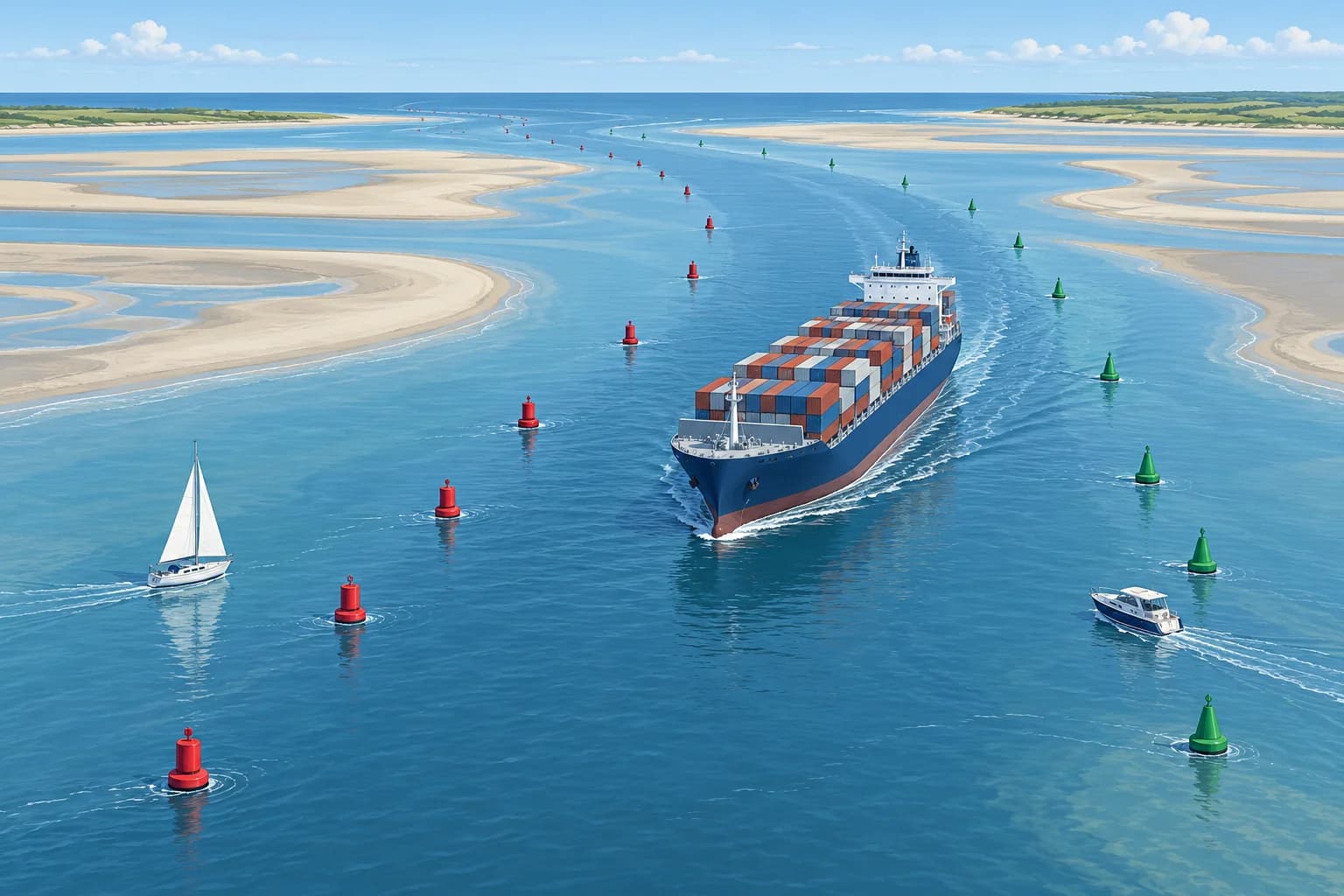
Germany's coastal waters, estuaries and the Kiel Canal follow the KVR (the COLREG) plus a national rule book: the SeeSchStrO. Where they differ, the SeeSchStrO wins.
Two rule books at once
On German coastal waters you follow the KVR (Kollisionsverhütungsregeln, Germany's name for the COLREG) and the SeeSchStrO (Seeschifffahrtsstraßen-Ordnung, the seaways traffic order). The SeeSchStrO says the KVR apply unless it states otherwise. So learn the KVR first; this lesson covers the German additions. The version in force was last amended on 18 September 2024.
Which waters
The Seeschifffahrtsstraßen (federal seaways) reach from the coast at mean high water to 3 nautical miles (NM) seaward of the baseline, the line used to measure the territorial sea. They also include the buoyed outer fairways in the territorial sea and listed river stretches: the Elbe up to Hamburg's port, the Weser up to Bremen, the Trave up to Lübeck, the Warnow and the Kiel Canal, among others. The Ems estuary has its own order. Hamburg's port has its own port rules.
Out to 12 NM
Beyond the general 3 NM boundary, outside buoyed outer fairways, only selected SeeSchStrO provisions apply. These include basic duties, signs, public-service exemptions, use of roadsteads (designated anchoring areas), dangerous-goods separation and police powers. The KVR still apply.
Listen to the traffic centres
Germany's estuaries are watched by Verkehrszentralen (traffic centres of the federal waterways administration). If your boat has a VHF radio, you must listen to their traffic information, given in German and on request in English. Then you must take it into account at once.
Alcohol and drugs
Do not skipper or perform bridge, deck or engine duties at or above 0.5 ‰ blood alcohol, 0.25 mg/l breath alcohol or 3.5 ng/ml THC in blood serum. THC is the main intoxicating substance in cannabis. Impairment bans these activities below those figures too. The substance-based ban has an exception for medicines taken as prescribed; impairment remains prohibited. These rules also cover jet skis, kites and windsurfers. Passenger-ship masters must start duty free of alcohol’s effects and drink none while on duty underway.
Key figures
- Seaward limit
- 3 NM beyond the baseline, plus buoyed outer fairways
- Alcohol and THC limits
- Alcohol: 0.5 ‰ blood / 0.25 mg/l breath; THC: 3.5 ng/ml serum
- Passenger-ship master on duty
- No drinking on duty underway; no alcohol effects at duty start
- Collision rules
- KVR (COLREG) apply unless the SeeSchStrO says otherwise
Remember
- The KVR apply everywhere; the SeeSchStrO adds to them and wins where the two differ.
- Seaways run 3 NM beyond the baseline and up the listed estuaries and the Kiel Canal.
- Outside buoyed outer fairways, only selected SeeSchStrO rules apply between 3 and 12 NM.
- With VHF on board, listen to the traffic centre and promptly take its information into account.
- Alcohol limit: 0.5 ‰ blood or 0.25 mg/l breath, also for jet skis and windsurfers.
Common mistakes
Wrong: German coastal waters have their own collision rules instead of the COLREG.
Right: The KVR are the COLREG. The SeeSchStrO adds local rules and overrides the KVR where it expressly differs.
Wrong: Below 0.5 ‰ you are always fine to steer.
Right: Anyone impaired by alcohol or drugs may not steer, whatever the number. The 0.5 ‰ value is the hard limit, not a free pass.
Worked case
Your 9 m yacht has VHF. You plan to enter the Elbe fairway. The traffic centre reports a deep-draught ship approaching your entry point. You can wait safely outside its track. What do you change, and why?
Show the answer
Delay entry and wait in the safe water until the ship has passed. Keep listening and reassess before entering. Having VHF means you must listen to the traffic information and promptly take it into account; being a small pleasure boat gives no exemption.
Practice question
Which collision rules apply on the German seaways?
- Only the SeeSchStrO, never the KVR at all
- CEVNI, as on German inland waters
- The KVR, unless the SeeSchStrO differs
- The KVR only beyond 12 nautical miles
Show the answer
Answer: C. The SeeSchStrO applies the KVR (the COLREG) and adds or changes rules only where it says so.
2 · Fairway rules
Fairway rules: keep right, give way to fairway traffic, don't anchor
In a German Fahrwasser the boat following the fairway has priority. Entering, crossing or turning means waiting, whatever your size or rig.
What a fairway is
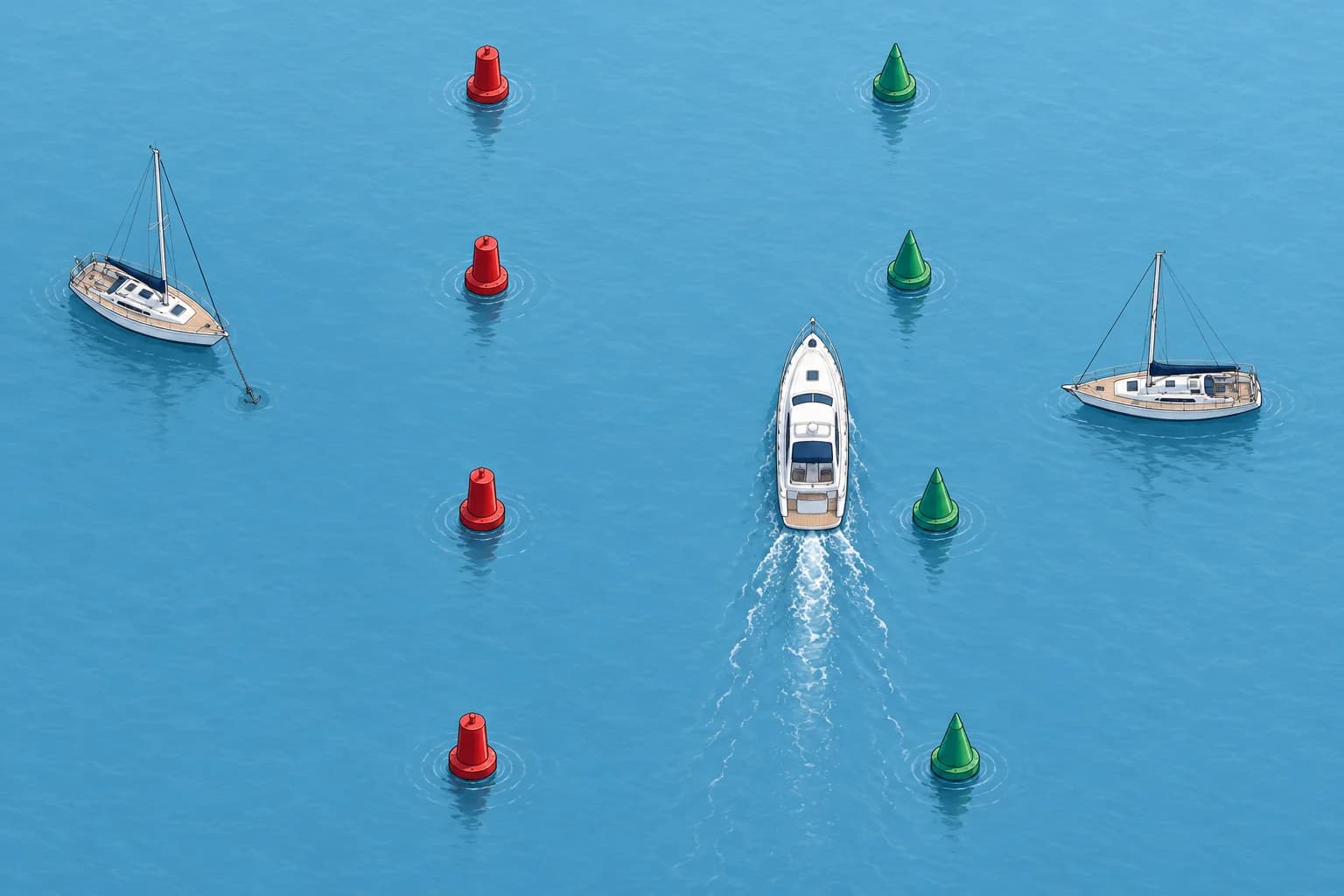
A Fahrwasser (fairway) is water marked by lateral signs, or unmarked inland water meant for through navigation. Every fairway counts as a narrow channel under KVR Rule 9. Its starboard side is normally to your right coming from sea. Where it joins two sea areas or waters separated by shoals, the reference approach is from north through west, excluding south. If that fairway is strongly curved, its northernmost entrance sets the direction for the whole fairway. Check the chart.
Keep right, pass port to port
Keep to the right in your direction of travel, as far as safe. Outbound, this is the fairway's port side as defined from sea. Meet port to port by altering to starboard. Normally overtake to port; use starboard only when required. Do not overtake at narrows, blind bends, before or inside locks, near moving cable ferries or in prohibited stretches. Outside the fairway, make clear you are not using it.
Who has priority
A boat following the fairway has priority over boats that enter it, cross it, turn in it or leave a berth or anchorage. That holds even if the fairway boat could go elsewhere. It replaces the KVR crossing and sail-versus-power rules. Sailing boats that are not following the fairway apply the KVR among themselves, as long as they do not hinder fairway traffic.
Narrow places
If a narrowing cannot safely take both boats at once, or a sign prohibits meeting, the boat going with the current has priority. At slack tide, priority goes to the boat previously going against the stream. Wait outside until the other boat has passed.
No anchoring
Do not anchor in the fairway except in a permitted roadstead, a designated anchorage. Outside it, anchoring is banned at narrows and blind bends; within 300 m of floating equipment, wrecks, obstructions, cables and pipelines; within 100 m before or after tidal barriers; off harbour entrances, landing places, locks and sluices; in Kiel Canal approaches; and on ferry, bridge or locally prohibited stretches. In poor visibility, keep 300 m from overhead power lines.
Crossing a busy German fairway
- Wait outside the buoy line and look both ways along the fairway. — Every boat following the fairway has priority over you.
- Show early that you will wait; slow or hold position safely outside the fairway. — The give-way boat must show by its behaviour that it will wait.
- Pick a gap that lets you cross without anyone changing course or speed. — You must not hinder fairway traffic, so judge the gap generously.
- Once you have a safe gap, cross directly, allowing for wind and current. — Keep your time in the fairway short and make your intention clear.
- Once across, stay outside the buoy line. — Outside the fairway you must make clear you are not using it.
Remember
- Every buoyed fairway counts as a narrow channel: keep right in your direction of travel.
- Boats following the fairway have priority over those entering, crossing, turning or leaving a berth.
- That priority overrides the KVR sail-over-power rule: a yacht crossing must wait.
- If boats cannot safely pass simultaneously at a narrowing, or meeting is prohibited, the boat with the current has priority.
- No anchoring in the fairway except in designated anchorages; many places outside it are banned too.
Common mistakes
Wrong: Under sail I always stand on against a motor vessel, also when crossing a fairway.
Right: Fairway priority replaces the KVR sail-over-power rule. A yacht crossing or entering the fairway gives way to every boat following it.
Wrong: Overtaking is free on either side if there is room.
Right: Overtake on the other boat's port side as a rule; to starboard only when the situation requires it. Do not overtake at narrows or blind bends, before or inside locks, near moving cable ferries, or in prohibited stretches.
Wrong: A quick lunch stop at anchor beside the channel buoys is fine.
Right: Stopping for lunch does not remove the anchoring bans. Being outside the buoys does not make anchoring legal. Check the chart and local notices for cables, pipelines, entrances and other exclusions. Choose a permitted spot clear of the fairway.
Worked case
Under sail, you want to cross the buoyed Jade fairway. A motor cruiser approaches from your port side, following the fairway. Does being under sail give you priority here?
Show the answer
No. You must give way to the cruiser. A boat following the fairway has priority over a crossing boat, whatever its propulsion. This replaces the KVR sail-over-power rule. Show early that you will wait safely outside the buoy line. Let the cruiser pass, then cross directly when clear, allowing for wind and current.
Practice question
How does the SeeSchStrO treat a buoyed fairway?
- As open water with no special rules
- As a traffic separation scheme
- As an area closed to all pleasure craft
- As a narrow channel under KVR Rule 9
Show the answer
Answer: D. Fairways count as narrow channels, so keep to the right in your direction of travel, as far as safe.
3 · Signals & speed
German signals, signs and speed limits on the seaways
The SeeSchStrO adds its own sound signals, ship signals and signboards to the KVR, and sets speed limits on stretches announced by the waterways authority.
Extra sound signals
Outside the Kiel Canal, one long blast means attention; give it when traffic conditions require, such as entering a harbour. Two groups of one long and four short blasts warn of danger. The stay-away signal warns that dangerous cargo is escaping, may escape or may explode: short-long, at least five times each minute, with two-second gaps between groups. The vessel giving it also uses a synchronised white all-round light if fitted. If you hear it, close openings, put out flames, stop smoking and keep clear.
Signals on other ships
A blue quick-flashing light marks a public-service vessel carrying out police duties or a DGzRS (German Maritime Search and Rescue Service) vessel on a rescue operation. Certain dangerous-goods ships, including specified empty tankers, show a red all-round light at night and flag B (a red flag with a V-shaped notch) by day, also when anchored or moored. Customs vessels show three green all-round lights vertically at night and a square green flag by day.
Signboards
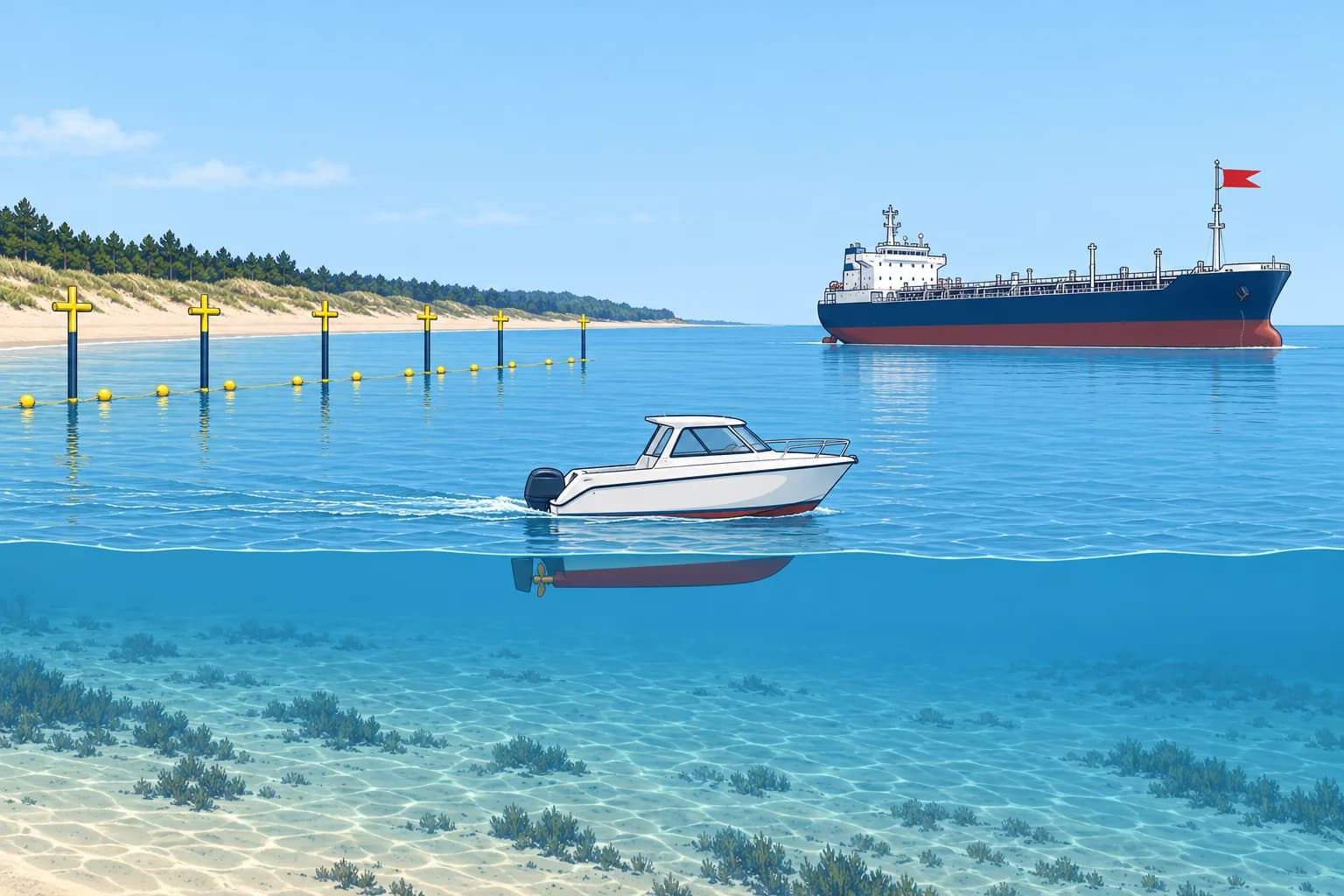
Red-bordered white boards show prohibitions or requirements; read the symbol. Prohibition signs usually add a red diagonal slash. Blue boards generally give information or indicate permission. A white board with a red border and a number is a speed limit in km/h through the water, or over the ground in the Kiel Canal. Poles with a yellow X-shaped cross mark bathing beaches.
Speed limits
Always keep a safe speed and slow down early near harbours, locks, ferries, dredgers and moored boats, so your wash (waves made by your boat) does no harm. Limits for named stretches are set by notice of the waterways authority and shown on signs and in the official notices. Outside the fairway, less than 500 m from the current shoreline in front of recognisable bathing activity, the limit is 8 km/h (4.3 kn) through the water (speed relative to the water, not the shore).
Water sports
In the fairway, water skiing, towing inflatables, jet skis, kitesurfing and windsurfing are banned except in areas announced or released by signs. Outside the fairway, water skiing, towing, jet skis and windsurfing are allowed except in announced zones. None of them at night or in restricted visibility. Skiers, riders and surfers keep clear of all vessels.
Key figures
- Attention signal
- Outside Kiel Canal: 1 long blast when traffic requires attention
- Danger and warning
- 2 groups, each 1 long + 4 short
- Stay-away signal
- Short-long ≥5/min; 2-second gaps; white all-round light if fitted
- Bathing, outside the fairway
- 8 km/h through water; <500 m from shoreline where people are bathing
- Dangerous-goods ship
- Red all-round light / flag B; includes specified empty tankers
Remember
- Outside the Kiel Canal: one long attention blast when traffic conditions require it.
- Two groups of one long and four short blasts warn of danger; repeated short-long means stay away.
- Blue quick-flashing: police duties or DGzRS rescue. Customs: three green all-round lights vertically / square green flag.
- Outside fairways: 8 km/h <500 m from current shoreline in front of recognisable bathing. Yellow crosses mark bathing areas.
- In fairways, water skiing, jet skiing and kitesurfing require an authorised area. Never take part at night.
Common mistakes
Wrong: Short-long signals from a tanker are just a greeting.
Right: Short-long, repeated, is the stay-away signal: dangerous cargo is escaping, may escape or may explode. Keep clear and put out every flame on board.
Wrong: Speed limits are only in the harbour bylaws, not on the coast.
Right: The waterways authority announces limits for named seaway stretches and posts them on signs. Outside fairways, 8 km/h applies less than 500 m from the current shoreline in front of recognisable bathing activity.
Worked case
You motor at 15 knots off Travemünde, 300 m from the current shoreline, outside the fairway. You see bathing activity and a yellow-cross pole. A ferry behind you sounds two groups, each one long and four short blasts. What do you do?
Show the answer
Slow to 8 km/h (4.3 kn) or less through the water: outside the fairway, you are less than 500 m from the current shoreline in front of recognisable bathing activity. The yellow cross marks a bathing area. Two groups of one long and four short blasts are the danger and warning signal. Look around, identify the danger and keep clear of the ferry's track.
Practice question
Outside the Kiel Canal, what does one long blast mean under the SeeSchStrO?
- Turning to starboard
- Pilot requested
- Attention signal
- Stay-away signal
Show the answer
Answer: C. Outside the Kiel Canal, one long blast means attention. Give it when traffic conditions require, for example when entering or leaving a fairway or harbour.
4 · Licence & papers
Licence, papers and gear for German coastal waters
You need the SBF See above 11.03 kW combustion or 7.5 kW electric. Private boats have no general safety-gear checklist; required lights and sound gear still apply.
When you need the SBF See
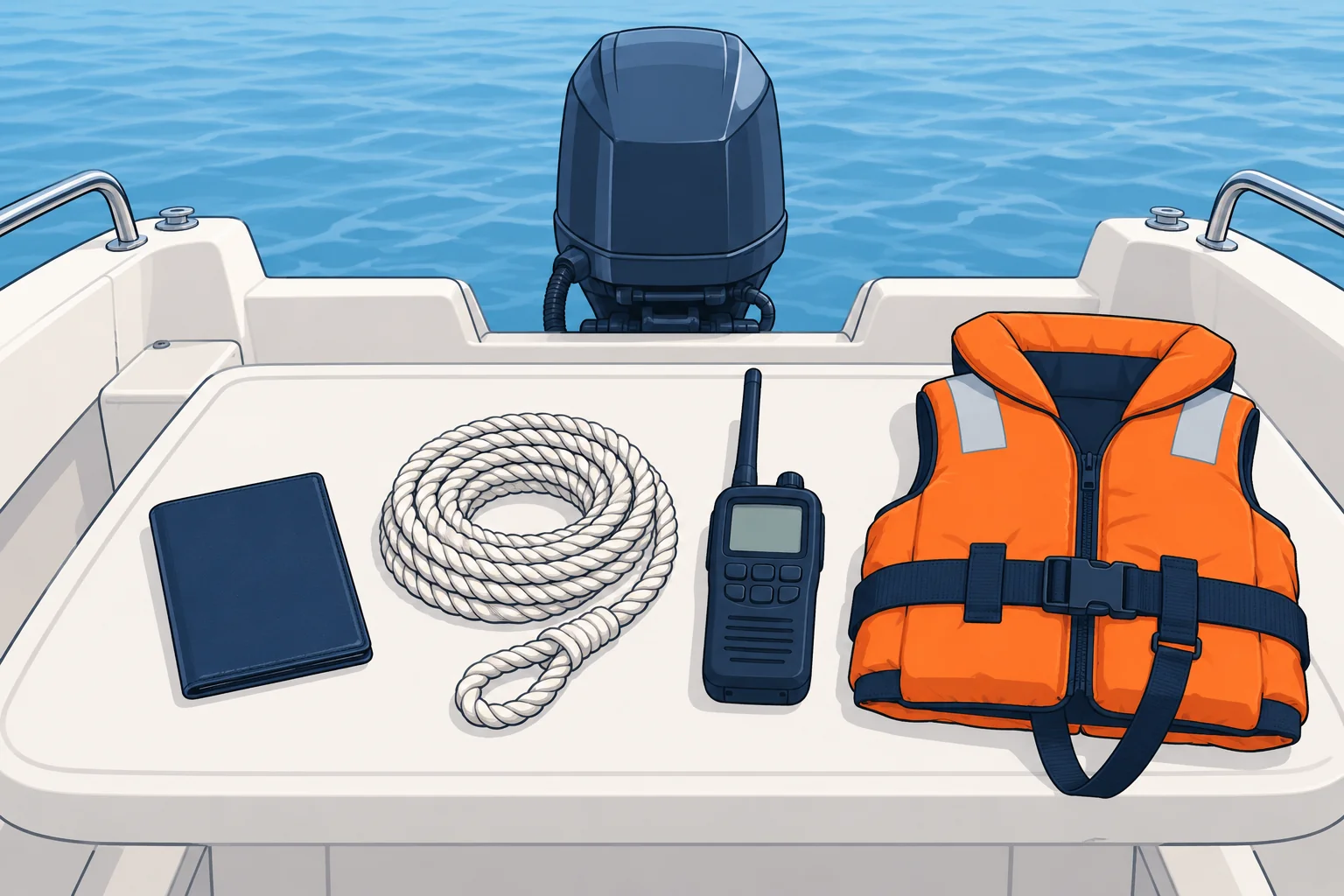
To skipper an engine-equipped pleasure boat, you normally need the SBF See (Germany's coastal motorboat licence). No licence is needed up to 11.03 kW (15 hp) maximum power for combustion engines, or 7.5 kW continuous power (power it can sustain) for electric motors. The fitted engine counts even when off: a yacht with a more powerful auxiliary engine (an engine supporting sail power) needs the licence under sail. There is no length limit at sea. An engineless sailing boat needs no sea licence.
Age and carrying your licence
The minimum age for the SBF See is 16. Carry your licence when you are the skipper and show it on request. You may steer under the licensed skipper's constant supervision without becoming the skipper. You may carry SKS (coastal skipper certificate), SSS (offshore skipper certificate) or SHS (ocean skipper certificate) instead of the SBF See.
Visitors
If you live outside Germany and visit for no longer than one year, you need no German licence under the visitor rule. If your country of residence requires a certificate or applies UNECE Resolution 40, the UN standard for international boating certificates, you must hold its relevant certificate or a suitable ICC (International Certificate for Operators of Pleasure Craft). Otherwise, this visitor exemption requires no certificate.
Papers and registration
At sea, only jet skis must carry an official mark. German seagoing ships required to fly the German flag must enter the sea-ships register above 15 m hull length. Smaller ships may register voluntarily. A flag certificate or IBS (international boat certificate) provides boat documentation without sea-register entry. A marine VHF needs a ship's radio licence. On a German pleasure boat, the skipper needs the appropriate radio certificate, such as the SRC (Short Range Certificate) for VHF with DSC (digital selective calling).
Gear
Private pleasure boats have no general statutory safety-gear checklist. Carry the required lights and sound equipment, and choose safety gear for your voyage. Navigation lights normally use electricity; rowing boats and sailboats under 20 m without enough electrical power may use non-electric navigation lights.
Small-boat lights
A sailboat under 12 m or a rowing boat unable to carry normal KVR lights must show a white all-round light. If it cannot, or a motorboat under 7 m cannot carry its required lights, do not sail while lights are required, except in an emergency. Then keep a white torch or lantern ready and show it in time to prevent collision.
Key figures
- Licence-free engine
- Up to 11.03 kW combustion or 7.5 kW electric
- SBF See minimum age
- 16
- Length limit at sea
- None for the SBF See
- Sea-ships register
- German seagoing ships required to fly German flag: over 15 m hull
Remember
- SBF See above 11.03 kW (combustion) or 7.5 kW (electric) fitted; a boat with no engine needs none.
- SBF See minimum age 16. Carry your licence as skipper; supervised steering does not make you the skipper.
- SKS, SSS or SHS may be carried instead of the SBF See.
- Visitors up to one year: certificate requirements depend on your country of residence, including Resolution 40.
- Private pleasure boats have no general legal safety-gear list; required lights and sound equipment still apply.
Common mistakes
Wrong: A 15 hp outboard always needs the SBF See.
Right: The limit is the maximum power: up to 11.03 kW (15 hp) is licence-free. Only above it do you need the SBF See.
Wrong: German law lists the lifejackets and flares every pleasure boat must carry.
Right: No such general list exists for private boats. Carry good safety gear anyway; hire and training boats follow separate rules.
Wrong: My yacht's 20 kW diesel is off while I sail, so I need no licence.
Right: The rule looks at the engine the boat is fitted with. Above 11.03 kW you need the SBF See, under sail as well.
Worked case
You live in Hamburg and hold no licence. A club offers a boat rated at 8 kW continuous electric power or an engineless 6 m dinghy. The dinghy cannot carry normal sailing lights but has an electric white all-round light. You plan to return after sunset. Which boat may you use?
Show the answer
The electric boat needs the SBF See because it exceeds 7.5 kW. The engineless dinghy needs no sea licence and may use the small-sailing-boat white all-round-light exception. Check that the light works and that the trip suits your experience and conditions.
Practice question
From what engine power do you need the SBF See for a combustion engine?
- Over 3.68 kW
- Over 7.5 kW
- Over 11.03 kW
- Over 22.06 kW
Show the answer
Answer: C. Up to 11.03 kW (15 hp) is licence-free; above it the SBF See is required. For electric motors the limit is 7.5 kW.