
Maritime law, rules and watchkeeping · Level P1 · 5 parts · about 15 min
Keeping a watch as a rating: helm orders in English and handovers (STCW A-II/4)
5 short parts: Bridge team · Helm orders · Steering · Wheel handover · Port watches. Each part explains the idea, then gives the points to remember, the common mistakes, a worked case and a practice question; the Academy unit adds all 33 check questions.
1 · Bridge team
The bridge team and your place in it
On watch you work for the officer of the watch. You steer, keep a lookout and report, and you speak up when something looks wrong.
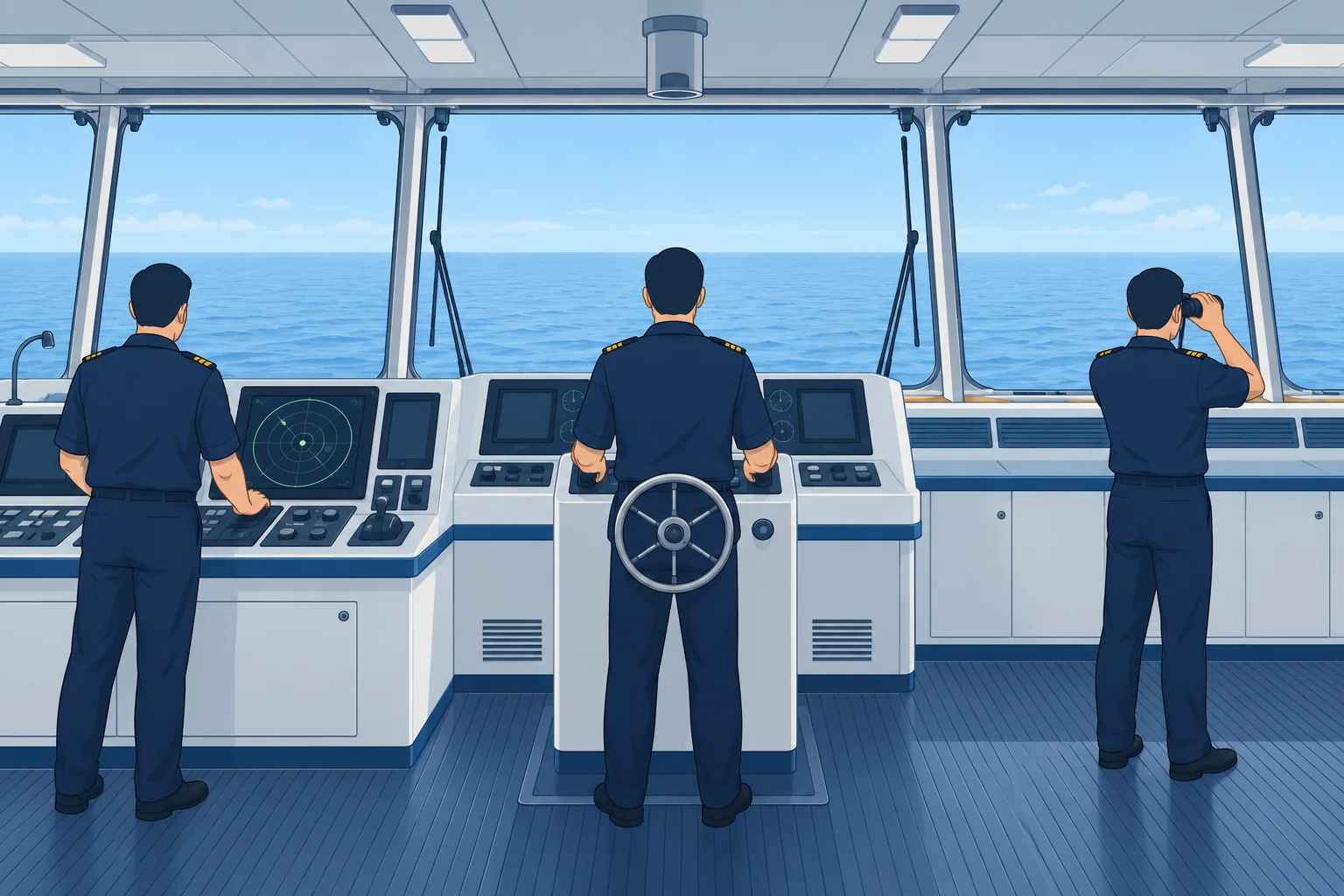
Who is who
The master commands the ship. The officer of the watch (OOW) is in charge of the bridge for the master. A pilot on board advises, but does not take over the duties of the master or the OOW. A rating forming part of a navigational watch (STCW II/4) supports the OOW as helmsperson or lookout. An able seafarer deck (STCW II/5) has more experience and also works on deck, at mooring stations and in port.
Your tasks
STCW table A-II/4 covers four competences: steering and following helm orders in English; keeping a lookout by sight and hearing; helping maintain a safe watch; and operating emergency equipment and applying emergency procedures. You also need compass use, changing between autopilot (automatic steering) and hand steering, bearing reports, internal communications, alarms and proper watch handover. Other safety lessons cover the emergency equipment.
Closed-loop talk
In a closed loop, the OOW gives an order; you repeat it, carry it out and report completion. The OOW confirms. Ask again if unsure. Use the ship’s agreed working language. For bridge-to-bridge, bridge-to-shore and pilot–bridge safety communication, SOLAS V/14.4 requires English unless everyone directly involved shares another language. You must understand helm orders in English. The IMO Standard Marine Communication Phrases (SMCP) provide standard English wording.
Fit for watch
You must be rested and sober. STCW requires at least 10 hours of rest in any 24 hours and 77 hours in any 7 days. The 10 hours may be split into no more than two periods, one of them at least 6 hours long, with no more than 14 hours between rest periods. The alcohol limit is 0.05 % in the blood or 0.25 mg/l in the breath; your company’s policy may be stricter.
Speak up
You are part of the team, not a passenger. If you see something the OOW may have missed, say it clearly: ‘The ship on the starboard bow has a steady bearing.’ If the OOW does not respond or seems unwell, call the master at once. Good bridge teams welcome a rating who speaks up.
Key figures
- Rest (STCW A-VIII/1)
- At least 10 h in any 24 h and 77 h in any 7 days
- Splitting rest
- Max 2 periods, one ≥ 6 h; ≤ 14 h between rest periods
- Alcohol limit (STCW A-VIII/1)
- No more than 0.05 % in blood or 0.25 mg/l in breath
- Bridge-to-bridge/shore and pilot–bridge
- English unless all directly involved share another language
Remember
- The OOW is in charge of the bridge for the master; a pilot does not relieve them of their duties.
- Closed loop: order, repeat, carry out, report done. Ask again if unsure.
- Rest: at least 10 h in any 24 h and 77 h in any 7 days.
- Alcohol on watch: no more than 0.05 % in the blood or 0.25 mg/l in the breath.
- Speak up when something looks wrong; call the master if the OOW does not react.
Common mistakes
Wrong: Once the pilot is on board, the OOW is no longer responsible.
Right: The pilot advises and often gives wheel orders, but the master and the OOW keep their duties and monitor what is done.
Wrong: I half-heard the order, so I’ll carry out what I think it was.
Right: Ask again. Repeat every order back, so the OOW can catch a mistake before you act.
Wrong: Rest hours are just paperwork.
Right: Tired watchkeepers miss lights and mishear orders. Rest hours are a safety limit; tell the OOW if you are not fit.
Worked case
Night. You are the lookout. The OOW has been sitting very still for several minutes and does not answer when you report a light closing on the port bow. What do you do?
Show the answer
Report again, louder, and check the OOW. If there is still no response, call the master at once by the means your ship’s orders give. Keep the lookout going and report the closing light. Do not wait for BNWAS, the bridge watch alarm: it may not alert help before danger develops.
Practice question
A pilot is on board. Who is still responsible for the bridge watch?
- Only the pilot on board
- The master and the OOW
- The helmsperson on duty
- The pilot’s own company
Show the answer
Answer: B. The pilot’s presence does not relieve the master or the OOW of their duties and obligations.
2 · Helm orders
Helm orders in English (SMCP)
Wheel orders use standard SMCP English. Repeat each order, carry it out at once, and hold it until a new order replaces it.
The rules
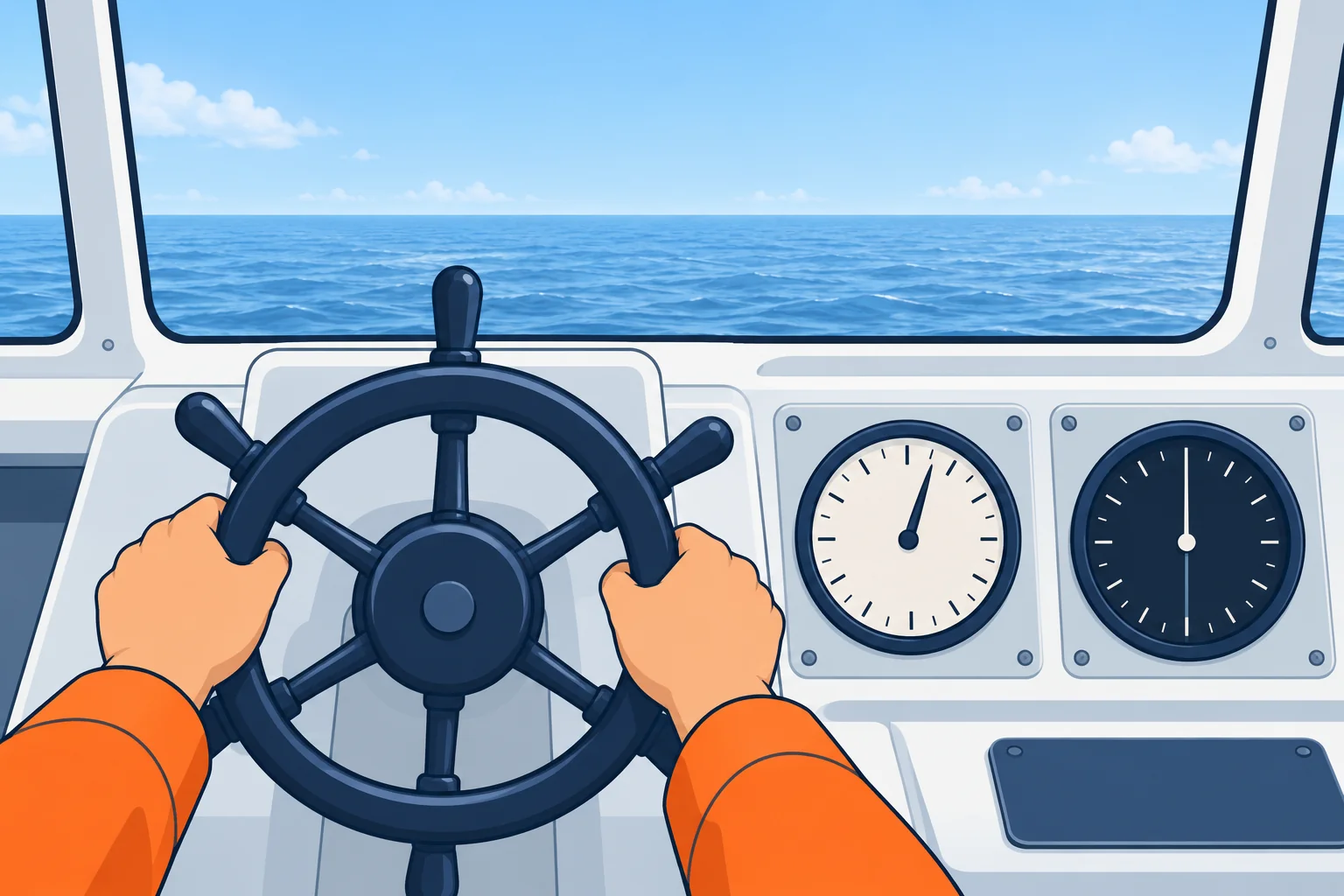
The SMCP says every wheel order is repeated by the helmsperson, carried out at once, and held until countermanded: until a new order replaces it. Report at once if the ship does not answer the wheel. Rudder angles are spoken as whole numbers, ‘ten’, ‘twenty’, while courses are spoken figure by figure.
Rudder angle orders
‘Port five’, ‘starboard ten’, and so on up to ‘twenty-five’ mean put that many degrees of rudder on that side and hold it. ‘Hard-a-port’ or ‘hard-a-starboard’ means rudder fully over. ‘Midships’ means hold the rudder at zero degrees, in line with the ship. ‘Ease to ten’ means reduce the rudder to ten degrees on the same side and hold it. Watch the rudder angle indicator, the gauge that shows where the rudder really is.
Checking the swing
‘Meet her’ means use opposite rudder to slow or stop the ship’s turn. ‘Steady’ means reduce the swing as quickly as possible. ‘Steady as she goes’ means steer the heading the ship has at that moment: repeat the order, call out the heading, and when she is steady report ‘Steady on …’. ‘Nothing to port’ means do not let the ship’s head go to port of the course; ‘nothing to starboard’ is the opposite.
Other orders
‘Keep the buoy on the port side’ asks you to steer so that the mark passes on that side. ‘Report if she does not answer the wheel’ asks you to watch for a slow response. ‘Finished with wheel’, or ‘no more steering’, ends steering duty, for example when the ship is secured alongside. If the OOW asks ‘What is your heading?’, answer ‘My heading is … degrees.’
The loop in practice
OOW: ‘Starboard twenty.’ You: ‘Starboard twenty.’ You turn the wheel and, when the indicator shows it, report ‘Wheel starboard twenty.’ Many ships expect this last report; follow your master’s standing orders. The OOW confirms, for example ‘Thank you.’
Key figures
- Rudder orders
- Port/starboard 5, 10, 15, 20, 25; hard-a-port/starboard
- Midships
- Rudder held at zero degrees, in line with the ship
- Steady
- Reduce the swing as quickly as possible
- Meet her
- Use opposite rudder to slow or stop the ship’s turn
- Nothing to port
- Do not let the head go to port of the course
- Source
- IMO SMCP (Res. A.918(22)), A2/1 Standard wheel orders
Remember
- Repeat every wheel order, carry it out at once and hold it until a new order.
- Rudder angles are said as numbers, ‘ten’, ‘twenty’; courses figure by figure.
- ‘Ease to ten’: reduce to ten degrees on the same side and hold it.
- ‘Steady as she goes’: steer the present heading and report ‘Steady on …’.
- Report at once if the ship does not answer the wheel.
Common mistakes
Wrong: ‘Ease to ten’ means take ten degrees off the rudder.
Right: It means bring the rudder back to ten degrees on the same side and hold it there.
Wrong: ‘Steady’ and ‘Steady as she goes’ mean the same.
Right: ‘Steady’ means stop the swing as quickly as possible. ‘Steady as she goes’ means steer the heading at the moment of the order and report it.
Wrong: Once the rudder reaches the ordered angle, I bring it back to midships.
Right: Hold the ordered rudder until the OOW gives a new order. Wheel orders are held until countermanded.
Worked case
The ship is turning to starboard with starboard twenty on. The OOW orders ‘Ease to ten’, then ‘Midships’, then ‘Steady as she goes’. The heading is 087° at the last order. What do you do and say?
Show the answer
Repeat each order and carry it out: reduce to starboard ten and hold, then put the rudder midships, then use rudder as needed to hold the heading of that moment. Call out ‘Steady as she goes, zero eight seven.’ When she is steady, report ‘Steady on zero eight seven.’ The OOW acknowledges each report.
Practice question
What does ‘Midships’ mean?
- Hold the rudder at zero, in line with the ship
- Steer for the middle of the channel ahead
- Hold the ship’s head halfway through the turn
- Reduce the rudder to half its present angle
Show the answer
Answer: A. ‘Midships’ means hold the rudder at zero degrees, in line with the ship.
3 · Steering
Steering a course: compass, rudder and autopilot change-over
Steer the ordered course with small rudder, check the swing early, and change between autopilot and hand steering only on the OOW’s order.
Course orders
To steer a compass course, the OOW gives the direction to turn and then the course figure by figure: ‘Starboard, steer two three five.’ Repeat it, bring the ship round steadily, and when she is steady report ‘Steady on two three five.’ The OOW acknowledges. You may also be told to ‘steer on’ a buoy or other mark.
Which compass
You normally steer by a gyro compass repeater, a display of the ship’s gyro heading. The gyro points to true north and needs power. The magnetic compass works without power and is the backup. Use the compass and course the OOW specifies. Tell the OOW if the two compasses start to disagree.
Steering well
Use small rudder and check the swing early: the ship keeps turning after you move the wheel back. Watch how fast the heading changes, not only the heading itself. Note how much rudder she needs to hold the course, for example ‘carrying five port’ against wind or sea, and say it at the handover. If she needs more and more rudder, or does not answer the wheel, report at once.
Autopilot and hand
The autopilot holds a heading automatically. Change control only on the OOW’s order and under the officer’s supervision, following the posted console instructions. To return to autopilot, steady the ship on the ordered course. Confirm and set the OOW’s ordered heading. Engage autopilot as instructed. Check the selected heading, mode indication and that the ship holds the heading. Report the mode and heading. Keep watching until the OOW releases you from the wheel. The steps below cover taking hand control.
Changing from autopilot to hand steering
- Take your place at the wheel; check the heading and the course to steer. — You must know the course before you take control.
- Follow the posted console instructions. Check the actual rudder angle and prepare the wheel or control as those instructions require. — The transfer sequence depends on the fitted equipment.
- On the OOW’s order, select hand steering as the posted console instructions require. — SOLAS V/24: change-over by or under the supervision of the officer.
- Check that the ship answers the wheel. — Proves the steering responds before you rely on it.
- Report: ‘Hand steering, steering two three five.’ — Closes the loop: the OOW knows the mode, the course and who is steering.
Remember
- Course orders: direction of turn first, then each figure: ‘Starboard, steer two three five’.
- Report ‘Steady on …’ when on the ordered course; the OOW acknowledges.
- Small rudder, early checks; watch the rate of swing as well as the heading.
- Change autopilot ↔ hand only on the OOW’s order; report the mode and course.
- Tell the OOW at once if the ship does not answer the wheel.
Common mistakes
Wrong: I turn the shortest way to the new course, whatever the order says.
Right: Turn in the direction ordered. The OOW chooses the direction for a reason, such as traffic or shallow water.
Wrong: I switch to hand steering myself when I think it is needed.
Right: Tell the OOW. The change-over is made by or under the supervision of the officer.
Wrong: Big rudder gets her back on course quicker.
Right: Big rudder makes her overshoot. Use small rudder and meet the swing early.
Worked case
Course 220° on autopilot. The OOW says: ‘Take the wheel, hand steering.’ Then: ‘Port, steer one nine five.’ What do you do and say?
Show the answer
Check the heading and rudder angle and prepare the controls as the console instructions require. Select hand steering on the OOW’s order, check she answers the wheel, and report ‘Hand steering, steering two two zero.’ Repeat ‘Port, steer one nine five’, turn to port with moderate rudder, slow the turn as she nears 195°, and report ‘Steady on one nine five.’
Practice question
The OOW wants a turn to port to course 182°. Which order uses SMCP?
- ‘Port, steer one eight two’
- ‘Steer one hundred eighty-two’
- ‘Port one eight two degrees’
- ‘Course one-eighty-two, port’
Show the answer
Answer: A. The order specifies port; the course is spoken figure by figure.
4 · Wheel handover
Taking over and handing over the wheel
Before you take the wheel, know the course, the steering mode and the rudder she carries. Report the change so the OOW hears it.
Before you take over
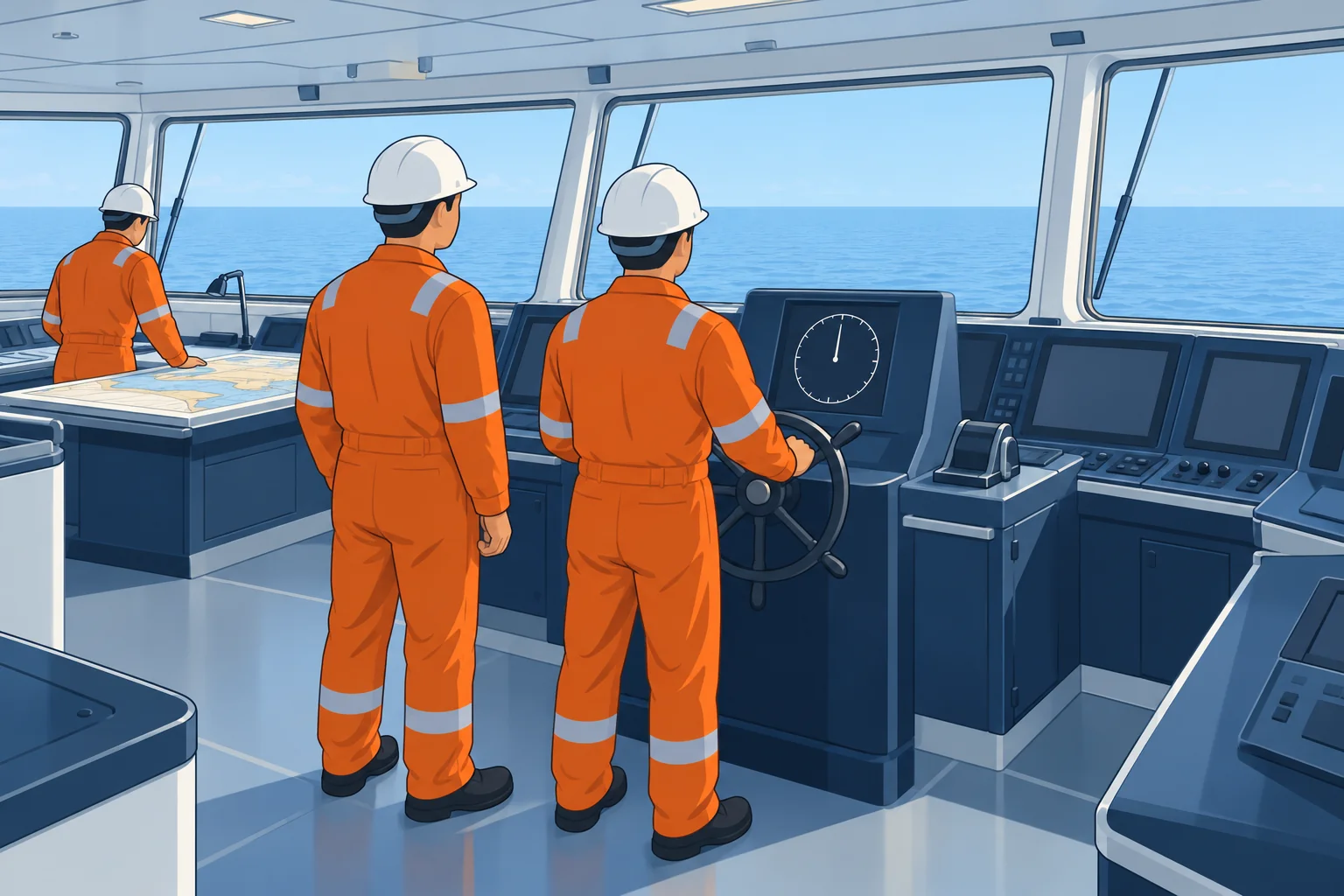
Arrive early and fit; at night let your eyes adjust first. Look at the course to steer, the heading, the steering mode (hand or autopilot), the rudder angle indicator and the traffic. Ask the helmsperson how she has been steering: how much rudder she carries, meaning needs to hold the course, and whether she yaws, swinging either side of the course in the sea.
The handover words
The outgoing helmsperson gives you the course, helm carried and any special orders. Repeat them before taking the wheel. For example: ‘Course two three five, carrying five port; nothing to starboard.’ After taking the wheel, report to the OOW: ‘Relieved the wheel, course two three five, carrying five port.’ The outgoing helmsperson stays beside you until the OOW acknowledges, then leaves.
When not to hand over
Do not change helmsperson during a turn, a close-quarters situation or a manoeuvre the OOW is directing. Wait until the ship is steady and the OOW agrees.
End of the watch
At the end of your watch, also hand over anything the OOW asked you to watch for and any faults you noticed, such as a lamp out or a door left open. The lookout handover is covered in the COLREG lookout lesson. Never leave the wheel or the lookout empty: if your relief is late, stay and tell the OOW.
Taking over the wheel
- Check the course, heading, steering mode and rudder angle indicator. — You see the real situation before you hear the summary.
- Listen to the course, helm carried and any special orders; repeat them. — Repeating catches a misheard figure.
- Take the wheel only when the ship is steady and the OOW agrees. — A change in the middle of a turn invites a wrong rudder movement.
- Report the course and helm carried to the OOW. — The OOW confirms who is steering and to what.
- The outgoing helmsperson leaves only after the acknowledgement. — The wheel is never without a confirmed helmsperson.
Remember
- Check course, heading, steering mode, rudder indicator and traffic before taking over.
- Before taking the wheel, hear and repeat the course, helm carried and any special orders.
- Report the change to the OOW and wait for the acknowledgement.
- No handover during a turn or manoeuvre; wait until the ship is steady.
Common mistakes
Wrong: I can take the wheel in the middle of a turn to save time.
Right: Wait until she is steady and the OOW agrees. Then take over.
Wrong: The OOW knows the course, so I need not report the change.
Right: Report the course and helm carried. The OOW must know who is steering and to what.
Wrong: ‘Carrying five port’ means the ship is turning to port.
Right: It means five degrees of port rudder are needed to hold the course, usually against wind or sea. The ship is not turning.
Worked case
You arrive to relieve the helmsperson. The ship is turning to port and the OOW is giving wheel orders to pass a fishing vessel. What do you do?
Show the answer
Wait beside the wheel and watch the heading and rudder indicator. Once the ship is steady and the OOW agrees, hear and repeat the course, helm carried and any special orders before taking the wheel. Then take control and report the change to the OOW. The outgoing helmsperson leaves only after the OOW acknowledges.
Practice question
What does ‘carrying five port’ mean at a wheel handover?
- The ship is turning five degrees to port
- Five degrees of port rudder hold the course
- The course is five degrees to port of north
- The autopilot is set five degrees to port
Show the answer
Answer: B. The ship needs five degrees of port rudder to keep her course, usually because of wind or sea.
5 · Port watches
Watches at anchor and in port: anchor, gangway and deck
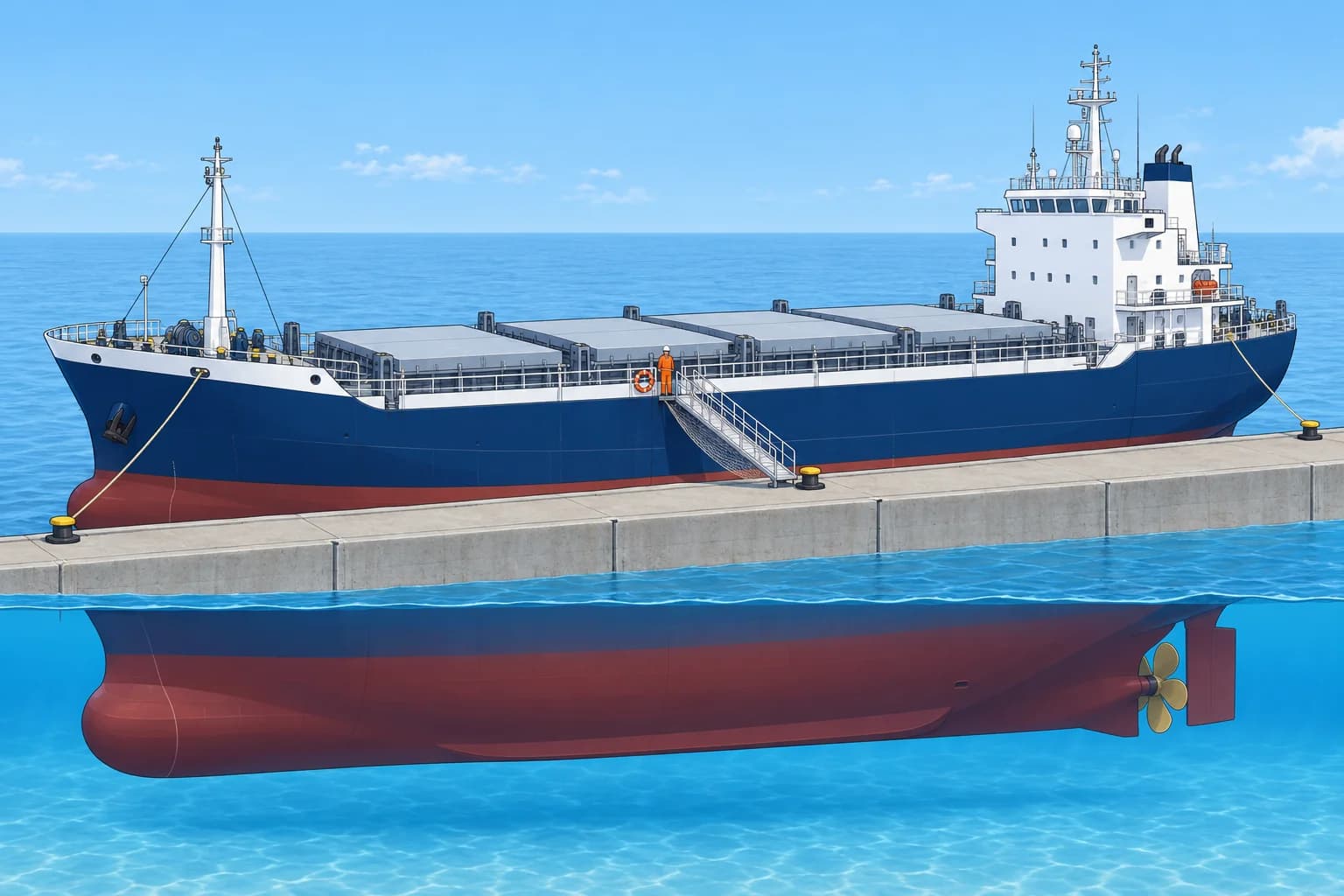
At anchor and alongside, the watch goes on: watch the anchor and the weather, control the gangway, tend the moorings and report to the duty officer.
Anchor watch
At anchor the OOW checks the ship’s position regularly. You help. Watch the cable, the anchor chain, for heavy strain or jerking. Look for dragging: shore lights or marks moving steadily one way. Report weather changes and nearby traffic. Check the anchor lights by night or black ball by day. Under 50 m, one all-round white light may be shown where best seen. Ships 100 m or longer must also illuminate their decks.
Gangway watch
In port, check each visitor’s identity and reason for boarding. The ship security plan, required by the International Ship and Port Facility Security (ISPS) Code, sets the access rules. Log visitors in and out. Refuse anyone who cannot show why they should be on board, and call the duty officer. Never leave the gangway unattended.
Gangway and moorings
Tide changes the water level. Cargo changes the ship’s draught, how deep her hull sits below the waterline. As the ship rises or falls, watch the gangway’s landing and angle against its posted limits; report unsafe access immediately. Watch the moorings, the lines holding the ship to the berth: slack lines let her move away; overtight lines can break. Report lines that need adjusting. The deck machinery and ship mooring lessons cover the equipment and line work.
Rounds and reports
A deck watch also makes rounds: look for fire or smoke, oil on the water, flooding, open doors and hatches, loose gear and people in danger. In port, report to the duty officer. Know the alarms, how to raise them, and the ship’s orders for calling help ashore.
Key figures
- At anchor, by day
- One black ball in the fore part (COLREG Rule 30)
- At anchor, by night
- ≥50 m: all-round white forward + lower aft; <50 m: one where best seen
- Tide and draught
- Check gangway landing and mooring strain as the ship moves
- Access control
- Ship security plan under the ISPS Code
Remember
- Anchor watch: watch the cable, look for dragging, report weather changes and close traffic.
- Check that the anchor lights or the black ball are shown.
- Gangway watch: check identity and purpose, log visitors, never leave the gangway.
- As tide and draught change, watch the gangway’s landing and angle; report moorings that need adjusting.
- Rounds: fire, oil on the water, flooding, open doors; report to the duty officer.
Common mistakes
Wrong: At anchor the watch can relax.
Right: Ships drag, the weather changes and traffic passes close. Keep watching and reporting.
Wrong: A visitor in overalls with a toolbox can come straight on board.
Right: Check identity and the reason for the visit, as the ship security plan says. Call the duty officer if in doubt.
Wrong: Tight moorings are always the safest.
Right: Overtight lines can break as the ship rises or moves. Report them so they can be adjusted.
Worked case
Night at anchor, wind rising. Two shore lights you have been watching, one behind the other, are slowly opening apart and keep moving the same way, and the cable is jerking. What do you do?
Show the answer
Report to the OOW at once: ‘Wind rising, the two shore lights are opening and still moving, cable jerking. The ship may be dragging.’ The OOW checks the position by radar and GNSS and may call the master and the engine room. Keep watching the cable and the lights and report any further change.
Practice question
Which day signal does a vessel at anchor show?
- Two black balls in a line
- One black cone, point down
- One black ball forward
- One black cylinder aft
Show the answer
Answer: C. COLREG Rule 30: one ball in the fore part, where it can best be seen.