
Maritime law, rules and watchkeeping · Level R2 · 4 parts · about 13 min
Greece: speedboat rules, coastal limits and documents
4 short parts: Speedboat licence · Beaches, jet skis · Papers, no DEKPA · TEPAI fee. Each part explains the idea, then gives the points to remember, the common mistakes, a worked case and a practice question; the Academy unit adds all 22 check questions.
1 · Speedboat licence
What counts as a speedboat, and the licence to drive one
In Greece, engine power and hull type define a speedboat. To drive one or a jet ski, you need a valid operator licence; check foreign licences first.
Who makes the rules
The Hellenic Coast Guard (Λιμενικό Σώμα) writes the rules for small craft in General Port Regulations (ΓΚΛ, Γενικός Κανονισμός Λιμένα). ΓΚΛ 20 covers speedboats, jet skis and other sea leisure craft. ΓΚΛ 50 covers the speedboat licence exam, instructors and schools. Each port authority may add a local port regulation for its own coast.
What is a speedboat
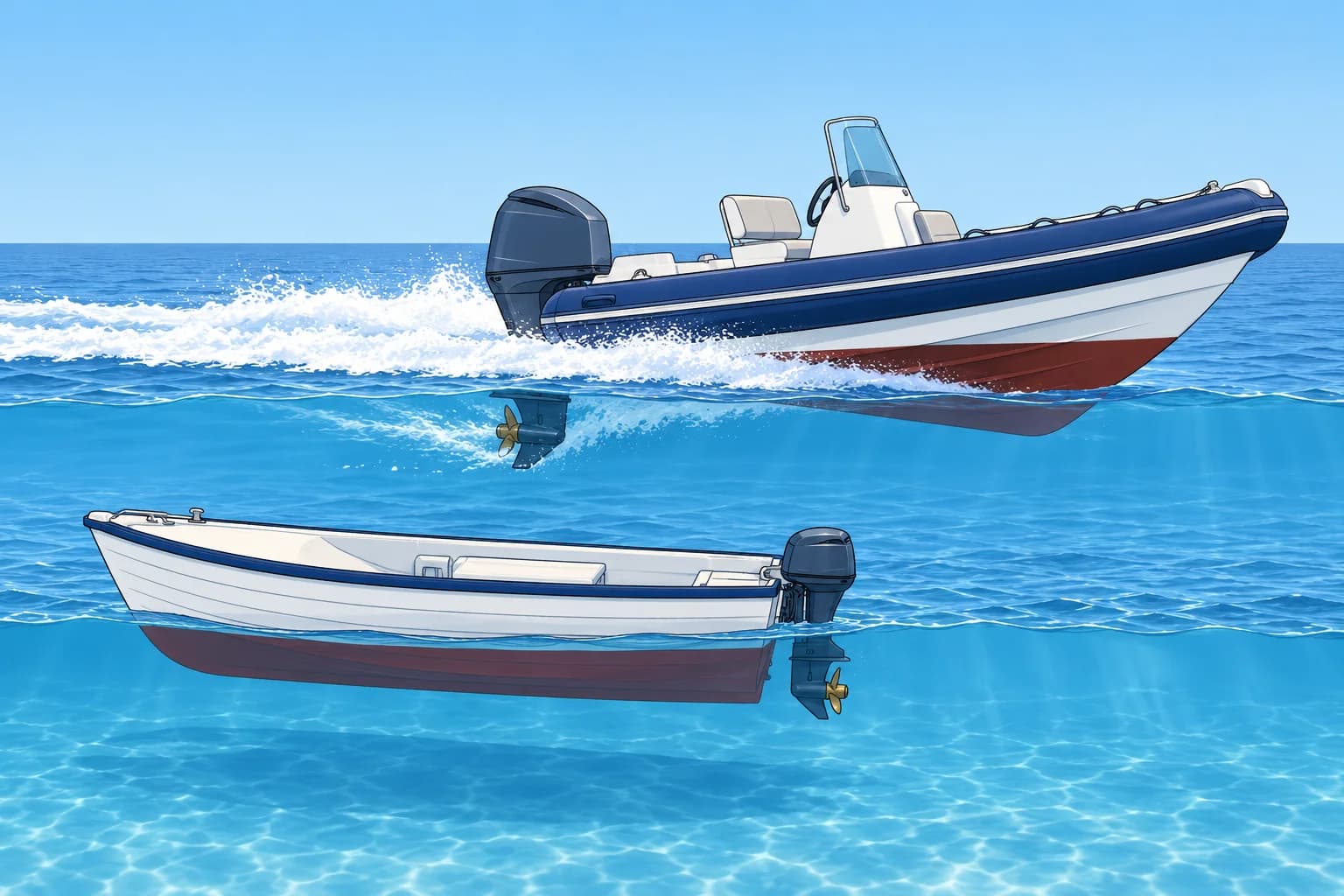
The hire rules (ΓΚΛ 38) define a speedboat (ταχύπλοο) by engine horsepower (HP) and hull type. Outboard (engine outside the hull): over 30 HP; petrol inboard (engine inside) or sterndrive (inside engine driving an external leg): over 40 HP; diesel inboard: over 70 HP. For inflatables, multihulls (two or more hulls) and V-shaped hulls: outboard, over 15 HP; petrol inboard or sterndrive, over 30 HP; diesel inboard, over 50 HP. Jet skis need the same operator licence.
The licence
Driving a speedboat without a valid speedboat operator licence (άδεια χειριστή ταχυπλόου σκάφους) is forbidden. You must be 18, healthy and able to swim. You first take at least 12 hours at an approved school: 6 of theory and 6 of practice. You book the exam online and file the papers through the Coast Guard's e-ΔΛΑ portal at least 7 days before.
The exam
The theory test has 20 multiple-choice questions; you pass with 18 correct. Candidates who cannot read Greek may take it orally through a certified interpreter, paid by them. The practical test covers handling, a knot such as the bowline or clove hitch, and basic chart reading. The licence is valid until you turn 65, then must be renewed on medical certificates.
Visiting skippers
Greece has no general list of accepted foreign licences. Ask the competent port authority whether your qualification is legally accepted for this boat; confirm the hire company's requirements separately. Check before you book. The licence comparison is on the boating-licence page.
Key figures
- Speedboat (hire rules)
- Outboards: >30 HP; >15 HP on inflatables, multihulls or V hulls
- Minimum age
- 18; must be healthy and able to swim
- School training
- At least 12 h: 6 theory + 6 practical
- Theory test
- 20 questions, 18 correct to pass
- Validity
- Until age 65, then renewal
Remember
- ΓΚΛ 20 governs speedboats and jet skis; ΓΚΛ 50 governs the licence exam.
- A speedboat licence is needed for any ταχύπλοο and for jet skis.
- Age 18, swimming ability, 12 hours at an approved school.
- Theory: 20 questions, 18 correct; then a practical test.
- Licence valid to age 65; local port regulations can add rules.
Common mistakes
Wrong: A 25 HP outboard on a rigid inflatable is too small to be a speedboat.
Right: For inflatables and V hulls the outboard threshold is 15 HP, so 25 HP makes it a speedboat under the hire rules.
Wrong: Any foreign boating licence is automatically valid in Greece.
Right: There is no blanket recognition. Ask the port authority about legal acceptance for this boat; confirm the hire company’s requirements separately.
Worked case
You are 19, on holiday in Naxos, and want to hire a 5 m rigid inflatable with a 40 HP outboard for a day. You have no licence of any kind. Can the hire company let you drive it?
Show the answer
No. A rigid inflatable with an outboard over 15 HP is a speedboat, so the driver needs a speedboat operator licence, and since July 2026 the hire company must refuse people without the required qualification. Choose a smaller motor boat that is not a speedboat, or hire with a licensed skipper. Getting the licence takes school hours and an exam at the port authority.
Practice question
What is the minimum age for a Greek speedboat operator licence?
- 16
- 17
- 18
- 21
Show the answer
Answer: C. Candidates must have completed their 18th year, be healthy and be able to swim.
2 · Beaches, jet skis
Swimming zones, channels and hired craft
Stay outside buoyed swimming zones unless a rule allows access. Use only a beach channel authorised for your craft, at the lowest speed. Check local rules.
Swimming zones
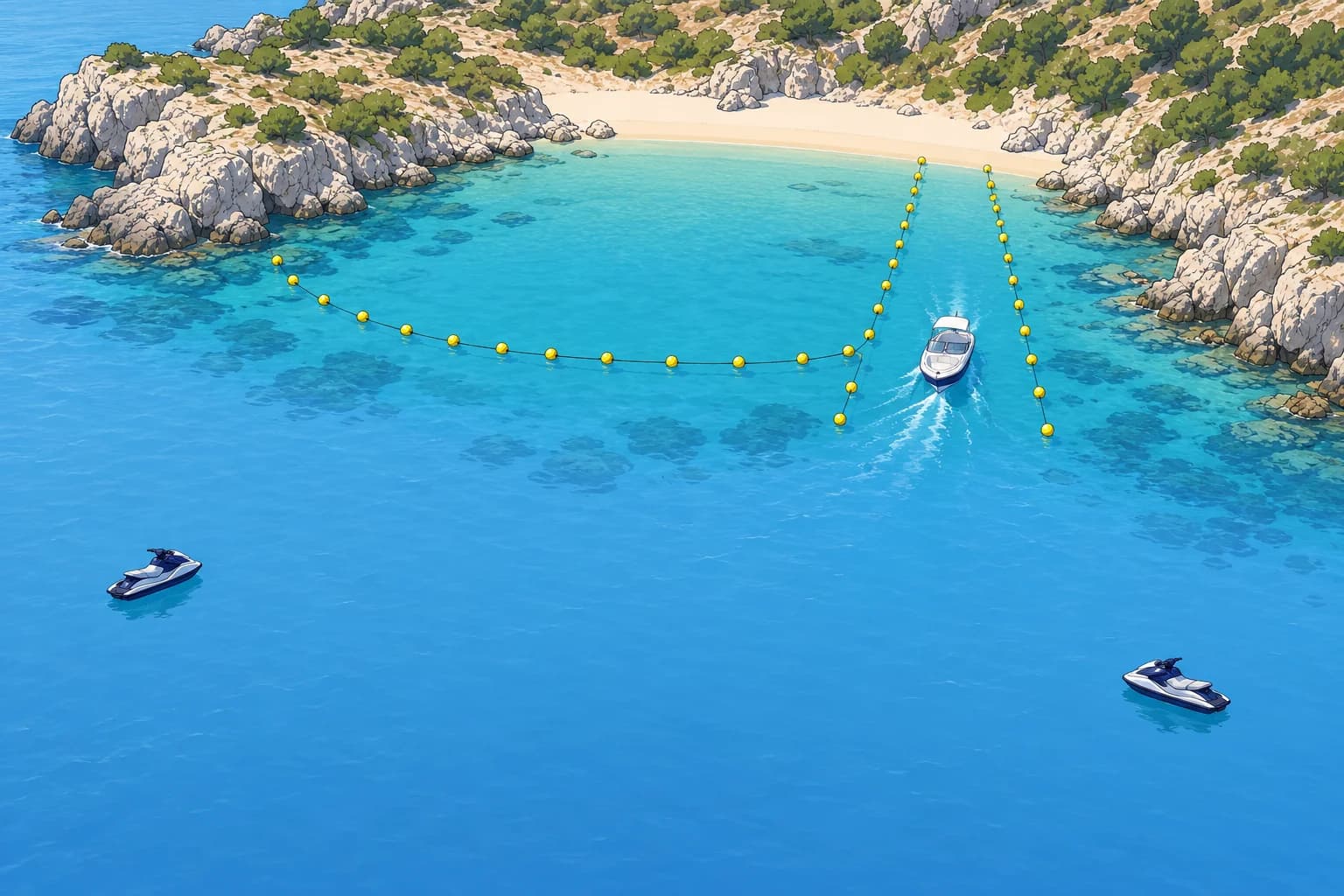
Many beaches are marked with a line of floating buoys. Inside the buoyed area, motor craft, private or hired, may not move or anchor unless a rule says otherwise. This was restated in the July 2026 amendment of ΓΚΛ 20. For carboats (car-shaped motorboats), private or hired, the 2026 carboat rules require at least 200 m from the usual swimming limit where there are no buoys. Check the rules for your craft.
Channels
Before approaching a beach, check that landing is permitted and that the marked channel (διάδρομος) is authorised for your craft. Use it at the lowest possible speed. Keep clear of swimmers. If the channel is blocked, wait safely outside or choose another permitted landing place.
Local port rules
Port authorities publish extra rules for busy coasts. In 2024 Lefkada, for example, kept boats 300 m away from some named beaches and set narrow access lanes by the hour. Before a trip, ask the port office or read the local regulation; the fines are real.
Hired jet skis and boats
For a hired jet ski or speedboat, the company must check your required operator licence and refuse an unqualified driver. It must explain safety rules and keep watch. It must attach the kill cord (the safety link that stops the engine if you fall away from the controls) to you. Since July 2026, hire companies may not give driving lessons. From late December 2026, hired jet skis must have satellite tracking and remote control from the hire base.
Key figures
- Buoyed swimming zone
- No motor movement or anchoring, except where a rule permits
- Carboats, no buoys
- At least 200 m from the usual swimming limit
- Access to the beach
- Use only a channel authorised for your craft, at the lowest speed.
- Hired jet skis
- Satellite tracking required from late Dec 2026
- Latest ΓΚΛ 20 change
- ΦΕΚ Β' 4559, 24 July 2026
Remember
- Stay outside buoyed swimming zones except in an authorised channel or where a rule allows.
- Use only a channel authorised for your craft, at the lowest speed.
- Carboats, private or hired: at least 200 m from the usual swimming limit where there are no buoys. Check rules for your craft.
- Local port regulations may add bigger distances on specified beaches.
- Hire companies must check operator licences where required; they may not give driving lessons.
Common mistakes
Wrong: Inside the buoys is fine if I go slowly.
Right: Motor craft may not move or anchor inside the buoyed swimming area at all, except where a channel or rule allows.
Wrong: The same distances apply on every Greek beach.
Right: Local port regulations add their own limits, sometimes 300 m on specified beaches. Check the port authority's rules.
Worked case
You are licensed to drive a hired motorboat. Swimmers are blocking a marked beach channel authorised for your boat. Your passenger suggests crossing the buoy line slowly to land. What do you do?
Show the answer
Wait safely outside the swimming zone until the channel is clear, or choose another permitted landing place. Do not cross the buoy line or anchor inside the swimming zone. When the channel is clear, use it at the lowest possible speed. Check local port rules before approaching.
Practice question
May you anchor a motorboat inside a buoyed swimming zone?
- Yes, with the engine off
- Yes, outside July and August
- No, unless a rule allows it
- Only with a local permit card
Show the answer
Answer: C. Motor craft may not move or anchor inside the buoyed swimming area unless otherwise provided.
3 · Papers, no DEKPA
Papers on board: the DEKPA is gone, the list stays
The DEKPA cruising log was abolished in 2020. Now you keep a signed passenger list, insurance papers and, for non-EU boats, a digital transit log.
The DEKPA is gone
The ΔΕΚΠΑ (Δελτίο Κίνησης Πλοίου Αναψυχής), the yacht movement log stamped by port police, was abolished by Law 4676/2020 (article 68). Many guides still mention it. It was replaced by a simpler duty in article 10 of Law 4256/2014.
The passenger list
Every private pleasure craft, whatever its flag, carries an up-to-date list of people on board (κατάσταση επιβαινόντων). The skipper signs it and every change, with date and time. The port authority does not stamp it. Show it on request. If you employ crew from outside the EU or European Economic Area (EEA), keep a separate crew list and have it stamped at the first Greek port and the last port before leaving.
Transit log for non-EU boats
A private yacht under a non-EU flag, or one on which EU duties and taxes have not been paid, needs a Transit Log from Greek customs. Since August 2024 it is filed online through myAADE. Where the cruising fee (TEPAI) is due, show proof of payment before the Transit Log is issued.
Insurance
Third-party insurance covers injury or damage you cause to others. It is compulsory for pleasure craft in Greek waters, whatever the flag. Keep the certificate on board in Greek or English. Ask your insurer to confirm that the cover meets Greek minimums.
Other papers
Carry the boat's registration certificate from the flag state, any skipper qualification required for your boat and use, and the TEPAI payment proof where the fee is due. If a VHF (very high frequency) radio is fitted, carry the boat's radio station licence and the required operator certificate. Courtesy flag, ICC and EU VAT questions are covered in Law: foreign waters.
Key figures
- DEKPA
- Abolished by Law 4676/2020 (article 68)
- Passenger list
- All flags; skipper signs; no port stamp
- Employed crew outside EU/EEA
- Stamped at first and last Greek port
- Transit Log
- Non-EU flag or duties unpaid; online via myAADE
- Insurance
- Compulsory; certificate in Greek or English
Remember
- The DEKPA no longer exists; it was abolished in 2020.
- Keep a passenger list signed by the skipper, updated at every change.
- Non-EU flag yachts need a customs Transit Log, filed online.
- Where TEPAI is due, show proof of payment before the Transit Log is issued.
- Third-party insurance is compulsory; carry the certificate in Greek or English.
Common mistakes
Wrong: An EU yacht must get its DEKPA stamped at the first Greek port.
Right: The DEKPA was abolished in 2020. Keep the signed passenger list on board instead; the port does not stamp it.
Wrong: A Transit Log is needed by every foreign yacht.
Right: It is for non-EU flags or boats whose EU duties are unpaid. EU yachts with taxes settled do not need one.
Worked case
You sail a 12 m UK-flagged yacht (owner resident in the UK) from Montenegro to Corfu. A friend says you must buy a DEKPA at the port office. What papers do you need?
Show the answer
There is no DEKPA any more. After border and customs clearance, the yacht needs a Transit Log from customs, filed through myAADE, because the UK flag is non-EU; where TEPAI is due, first pay for the month and keep the proof. Keep a passenger list signed by you, the UK registration, insurance meeting Greek minimums (certificate in English is fine), any required skipper qualification and the radio station licence and required operator certificate if VHF is fitted.
Practice question
What happened to the DEKPA?
- It became an app in 2024
- It was abolished in 2020
- It is now issued by customs
- It applies only above 12 m
Show the answer
Answer: B. Article 68 of Law 4676/2020 abolished it and replaced it with a passenger list kept on board.
4 · TEPAI fee
The TEPAI cruising fee, month by month
TEPAI is a fee for boats over 7 m in Greek waters, whatever their flag. Pay for each calendar month before it starts, or on your arrival day.
Who pays
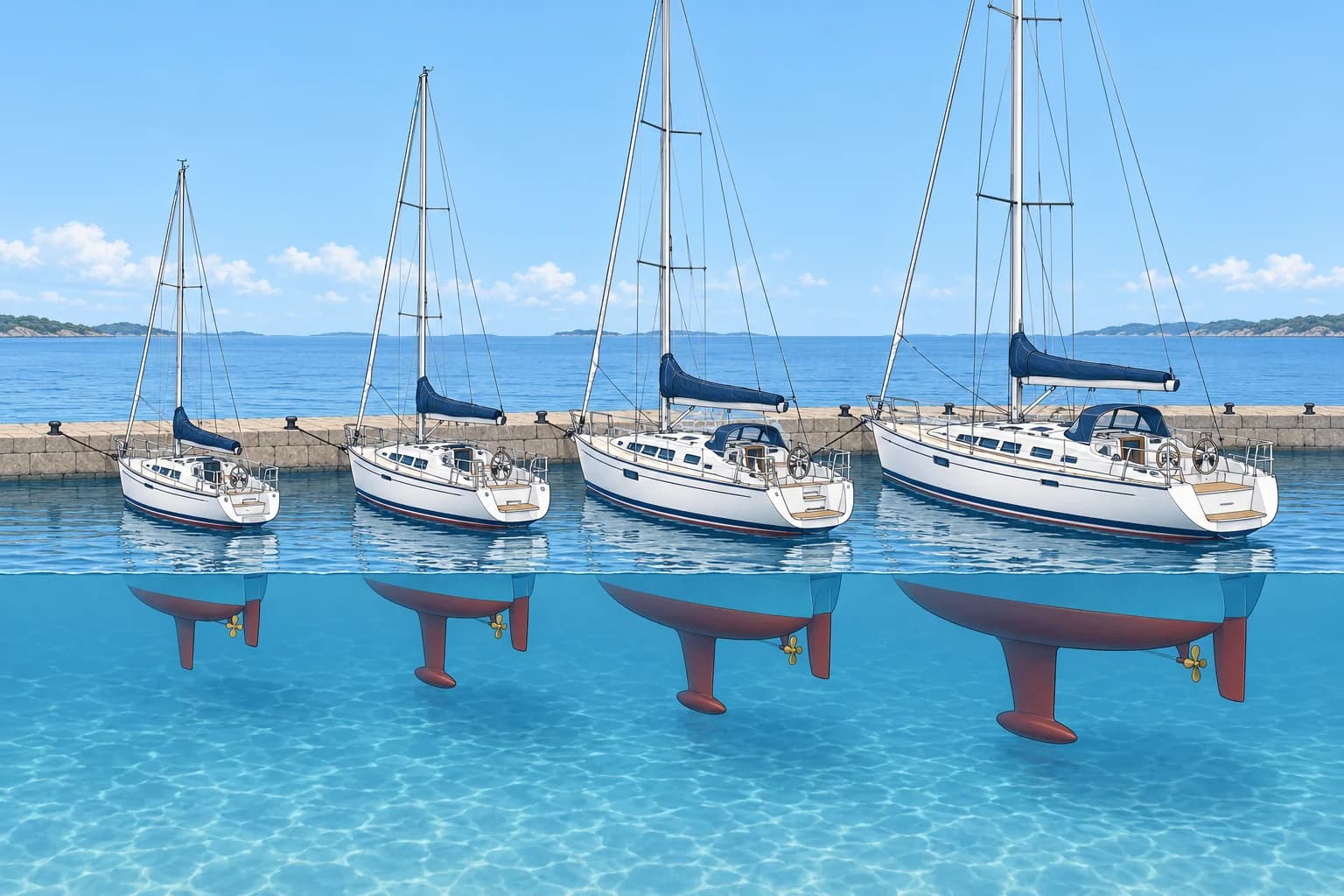
TEPAI (Τέλος Επιβατηγών Πλοίων Αναψυχής και Ημερόπλοιων) is due for every private or professional pleasure boat over 7 m overall, sail or motor, whatever its flag, for each month it is in Greek territorial waters. Rowing boats and boats of 7 m or less pay nothing. The owner, holder or user is liable.
The rates
Over 7 m to 8 m: €16 a month. Over 8 m to 10 m: €25. Over 10 m to 12 m: €33. Over 12 m: €8 per metre per month, counting from the first metre, so a 13.78 m boat pays €110.24 a month. Use the overall length in the boat's papers, to two decimals.
Whole months
You pay by calendar month, before the month starts or on the day you arrive. A month is the minimum, however short the stay. You may leave within 3 days after the end of a paid month without paying the next one. Arrive 19 June and leave 3 August: you pay June and July.
Paying online
Pay through eTEPAI on myAADE, Greece's tax portal. It creates an e-Paravolo (electronic payment voucher) and an RF code linking payment to your boat. Pay in euros through a Greek bank or by SEPA (a euro bank transfer) or SWIFT (an international bank transfer). Keep proof aboard. Full-year payment in December or January qualifies for 10% off. Eligible boats over 12 m may also qualify for 20% off for a certified year-round stay in Greek ports. Confirm eTEPAI's assessed discount before paying.
Fines
If a check finds the fee unpaid or underpaid, you pay the fee plus a fine: €190 (7–8 m), €300 (8–10 m), €400 (10–12 m) or €1,100 (over 12 m). The papers are held and the boat may not leave until you pay. Exemptions include boats ashore, boats detained under a legal order, officially recognised traditional vessels, and boats formally declared out of use.
Key figures
- Over 7 m to 8 m
- €16 per month (fine €190)
- Over 8 m to 10 m
- €25 per month (fine €300)
- Over 10 m to 12 m
- €33 per month (fine €400)
- Over 12 m
- €8 × length (m) per month (fine €1,100)
- Grace period
- Leave within 3 days after a paid month
- Annual payment
- 10% off if paid in December or January
Paying TEPAI for a summer cruise
- Read the overall length on the registration papers. — The band and the fine follow the length to two decimals.
- List every calendar month you will be in Greek waters. — Each month is due in full unless you leave within three days after the end of a paid month.
- Log in to eTEPAI on myAADE and create the e-Paravolo. — It gives the RF code that links your payment to the boat.
- Pay before the month starts or on arrival day. — A check that finds the month unpaid brings a fine and holds the boat.
- Keep the payment proof on board. — Inspectors ask for it, and customs needs it for a Transit Log.
Remember
- TEPAI is due for boats over 7 m in Greek waters, any flag.
- Over 7 m to 12 m: €16, €25 or €33 monthly. Over 12 m: €8 × the full overall length in metres.
- Pay by calendar month in advance; 3-day grace to leave after a paid month.
- Pay online via eTEPAI; 10% off for a full year paid in December or January.
- Fines run from €190 to €1,100, and the boat is held until paid.
Common mistakes
Wrong: I stay only 10 days, so I pay a third of a month.
Right: The minimum is one calendar month, whatever the stay. Ten days spanning two months can mean paying both.
Wrong: A 14 m boat pays €8 for each metre above 12 m.
Right: Above 12 m the €8 is counted from the first metre: 14 × €8 = €112 a month.
Worked case
Your 11.56 m yacht arrived on 19 July. You have paid July and August. You can leave Greek waters on 3 or 4 September. How does that choice change what you must pay, and when?
Show the answer
Leaving by 3 September uses the departure grace: July and August cost 2 × €33 = €66. If you choose 4 September, pay September before it starts; the total becomes €99. The grace is for departure, not an extra payment deadline for a longer stay. If a check finds September due but unpaid, you owe €33 plus a €400 fine and cannot leave until paid.
Practice question
A 9.8 m sailing yacht stays in Greek waters from 10 to 20 June. What TEPAI is due?
- €16.00
- €25.00
- €33.00
- €78.40
Show the answer
Answer: B. The yacht is over 8 m and no more than 10 m. Its stay falls within one calendar month, so €25 is due despite staying only ten days.