
Maritime law, rules and watchkeeping · Level P1 · 6 parts · about 19 min
Personal safety, social responsibilities and preventing violence and harassment (STCW A-VI/1-4)
6 short parts: Safe work · Enclosed spaces · Communication · Fatigue · Harassment · Your rights. Each part explains the idea, then gives the points to remember, the common mistakes, a worked case and a practice question; the Academy unit adds all 37 check questions.
1 · Safe work
Safe working practices, risk and protective equipment
A ship mixes heavy machinery, height, weather and a moving deck. Safe habits, a quick risk check and the right protective gear keep you safe.
Why it matters
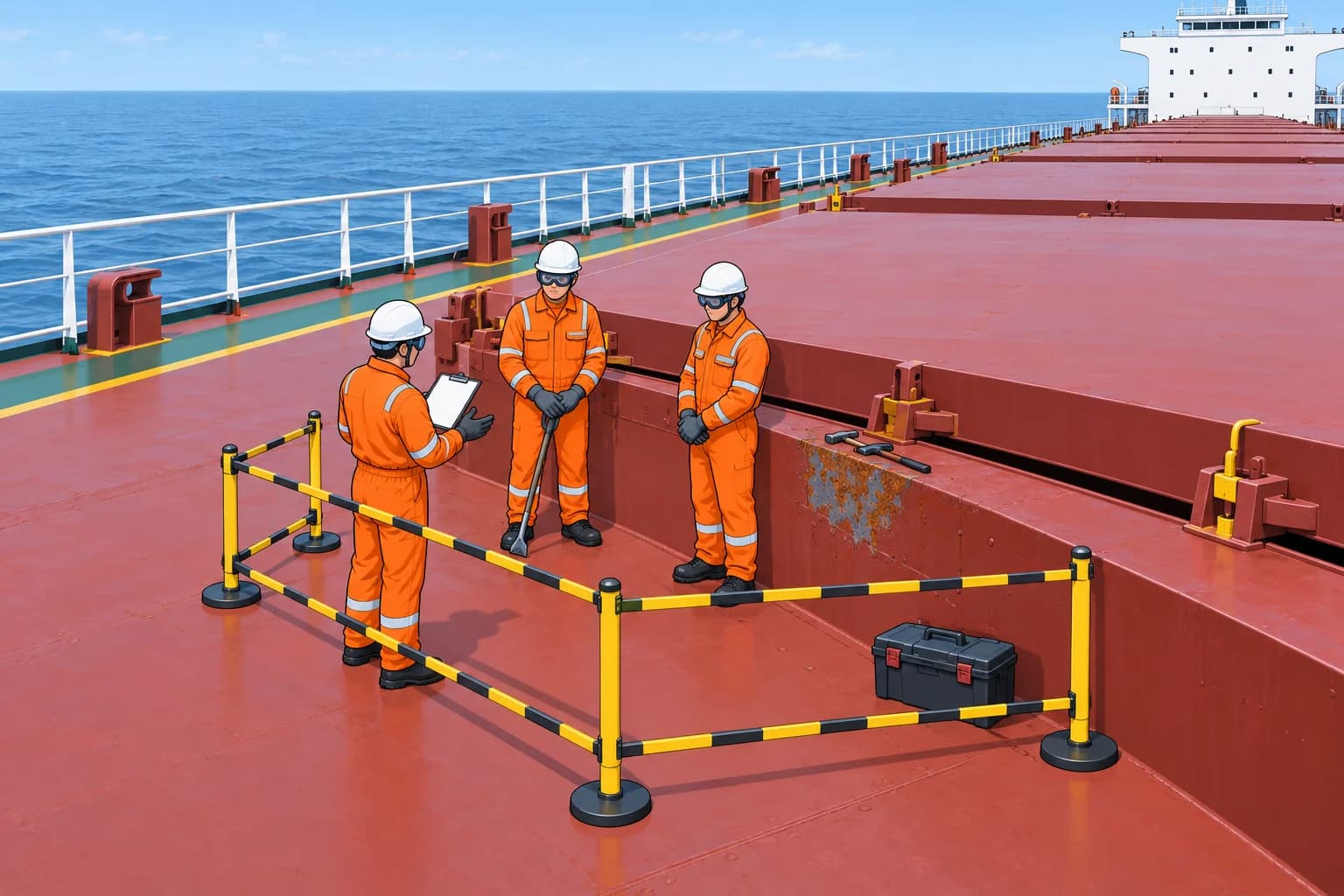
A merchant ship is a factory, a hotel and a vehicle at once. Hazards (anything that can hurt you) are everywhere: moving machinery, wires and ropes under load, slippery and moving decks, heavy weather, hot surfaces, electricity, chemicals, noise and work at height. Most accidents happen during ordinary jobs, not emergencies. That is why STCW asks every seafarer to follow safe working practices at all times. The practical side of this basic training is done in your approved course; these lessons give you the knowledge behind it.
Risk assessment
A risk assessment asks three plain questions: what could go wrong, how likely is it, and how bad would it be? Then it sets controls that make the risk smaller, such as isolating a machine, using a different tool or adding a second person. Before a job starts, the team meets at the work site for a toolbox talk: a short briefing on the task, the hazards, the controls, who does what and how to stop the job.
Stop work
Every person on board has the right and the duty to stop the work if they see a danger that has not been controlled, whatever their rank. Say stop clearly, make the job safe and tell the person in charge. A good company backs you when you do this. Ships run their safety through a safety management system (SMS) under the International Safety Management (ISM) Code, and national codes of safe working practice add practical rules.
Protective equipment
Personal protective equipment (PPE) protects against risks left after other controls. Wear a hard hat where things can fall, safety shoes with toe caps, gloves suited to the job, goggles for chips or splashes; add a face shield when needed. Use ear defenders in noisy spaces and close-fitting coveralls. Work aloft (at height) or over the side also needs a safety harness secured to a strong point, and over the side a working lifejacket. PPE must fit and be in good condition.
Report it
Report every hazard, accident and near miss (an event that could have hurt someone but did not). Near misses are free lessons: if the dropped spanner missed you today, it may not miss the next person. Reports go to the officer in charge and into the SMS so the cause can be fixed.
Key figures
- STCW basis
- Regulation VI/1; Code table A-VI/1-4, personal safety
- Risk
- How likely it is × how bad it would be
- PPE
- The last line of defence, after other controls
- Stop-work authority
- Every person on board, whatever the rank
Remember
- Most accidents happen during routine work; safe working practices apply at all times.
- A risk assessment asks what can go wrong, how likely and how bad, then sets controls.
- A toolbox talk at the job site goes over task, hazards, controls, roles and how to stop.
- Anyone can stop unsafe work. Report hazards, accidents and near misses.
- PPE is the last line of defence and must fit and be in good condition.
Common mistakes
Wrong: PPE makes any job safe, so other precautions can be skipped.
Right: PPE protects against risks left after other controls. Isolate, guard and plan the job first.
Wrong: A near miss is not worth reporting because nobody was hurt.
Right: A near miss reveals a hazard that could hurt someone. Report it so the cause can be addressed.
Wrong: Only officers can stop a job.
Right: Any crew member who sees an uncontrolled danger can and should stop the work.
Worked case
You are chipping rust with an air hammer. Your eye and hearing protection are missing. A crane starts carrying stores directly over your work area.
Show the answer
Stop chipping and move clear of the suspended load. Tell the bosun (deck supervisor) about the missing protection and the lift crossing your workplace. Restart only with suitable eye and hearing protection, after the person in charge confirms that your workplace is safely separated from the lifting operation.
Practice question
What is a near miss?
- An accident that caused only a minor cut or bruise
- An event that could have hurt someone but did not
- A hazard that has already been removed
- A planned drill completed without any incident
Show the answer
Answer: B. A near miss is an unplanned event that could have caused harm but did not. Reporting it lets the ship fix the cause before someone is hurt.
2 · Enclosed spaces
Enclosed spaces and permits to work
The air in a closed tank can kill you in seconds without warning. Never enter without a permit, and never rush in after someone who has collapsed.
What they are
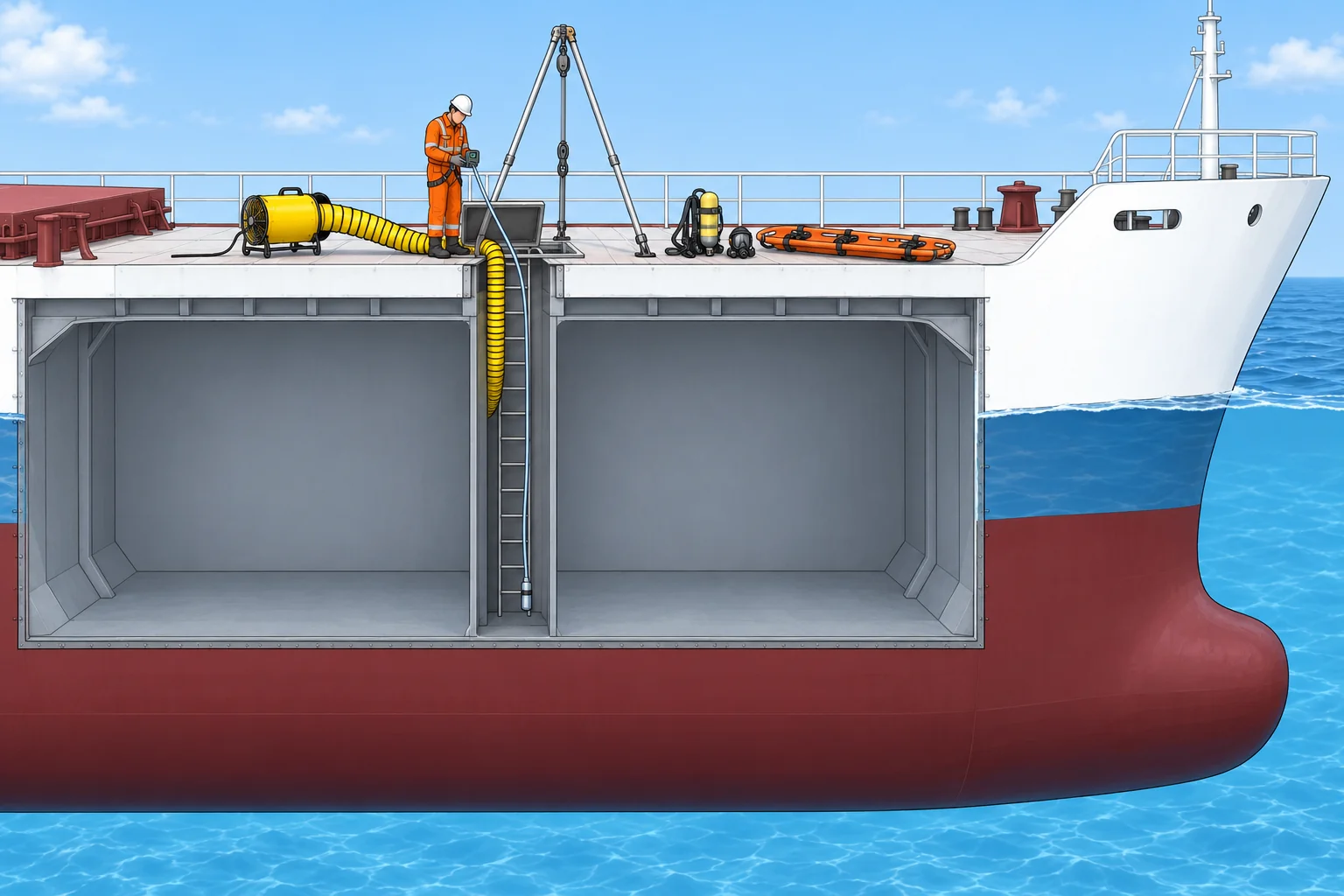
An enclosed space has limited openings, poor ventilation or is not designed for people to work in continuously, and may hold a dangerous atmosphere. Examples are cargo holds, tanks and chain lockers (spaces for anchor chain). A space connected to one of these, even through a closed door, can share its atmosphere.
Why they kill
Rust can use up oxygen, and inert gas, used to prevent fires, can displace it. Too much oxygen makes fires start more easily and burn fiercely. The air can also contain toxic gas, such as hydrogen sulphide or carbon monoxide, or flammable gas from fuel. You cannot rely on sight or smell to detect these hazards. Very low oxygen can make you collapse after one or two breaths.
The rules
SOLAS (the international ship-safety convention) requires a portable atmosphere tester (XI-1/7) and entry and rescue drills at least every two months (III/19). The International Maritime Organization (IMO) issued recommendations MSC.581(110) in 2025, replacing A.1050(27). Never enter alone. Ventilate, then test from outside: oxygen first, flammable gas next, toxic gas last. Some flammable-gas sensors read too low without enough oxygen. Before entry, oxygen must read 20.9 %, with safe flammable and toxic readings. A safe reading alone does not authorise entry.
The attendant and rescue
An attendant stays at the entrance, keeps in contact with those inside and raises the alarm if anything goes wrong. The attendant never goes in. If someone collapses, raise the alarm and wait for the rescue team with breathing apparatus: many enclosed-space victims are people who went in to help.
Permits to work
A permit to work is a signed form from an authorised officer confirming that precautions are in place before a dangerous job. Common permits are enclosed-space entry, hot work (welding, cutting, grinding outside the workshop), electrical isolation with lock-out tag-out (a personal lock and tag on the isolating switch), and work aloft or over the side. Do only the work the permit allows. The deck procedure, signatures and validity are in Ropes: deck work safely.
Key figures
- Required oxygen reading
- 20.9 % by volume (MSC.581(110))
- Testing order
- Oxygen → flammable → toxic
- Entry and rescue drills
- At least every two months (SOLAS III/19)
- Atmosphere tester
- Carried on board under SOLAS XI-1/7
- Entering alone
- Never
Remember
- Enclosed spaces may have too little or too much oxygen, or toxic or flammable gas.
- Never enter without a permit, ventilation and a tested atmosphere: oxygen, flammable, toxic.
- The required oxygen reading is 20.9 %; entry alone is not permitted.
- The attendant stays outside. Raise the alarm; only the trained, equipped rescue team enters.
- Permits cover hot work, enclosed spaces, isolation with lock-out tag-out and work aloft.
Common mistakes
Wrong: The hatch has been open all morning, so the tank is safe to enter.
Right: An open hatch is no proof of safety. Entry needs all shipboard precautions, not just a permit and gas readings.
Wrong: If my mate collapses inside, I go straight in to pull him out.
Right: Raise the alarm and wait for the rescue team with breathing apparatus, or you may be the second victim.
Wrong: Flammable gas can be tested first; oxygen does not matter for the reading.
Right: Test oxygen first: some flammable-gas sensors read too low in low oxygen.
Worked case
You are the attendant while two crew members work inside a ballast tank. One stops answering. From the entrance, you can see the person lying at the foot of the ladder.
Show the answer
Stay outside and raise the alarm immediately. Give the exact location and say someone has collapsed. Tell the other crew member to leave if able. Keep contact and guide the trained rescue team to the entrance. Do not attempt entry yourself.
Practice question
A tank has low oxygen, but its flammable-gas instrument shows zero. What should you conclude?
- The zero proves there is no flammable gas; report only the oxygen
- Only the oxygen reading needs attention before anyone can enter
- The zero may be unreliable; keep out and report both readings
- The zero means further atmosphere testing is unnecessary here
Show the answer
Answer: C. Some flammable-gas sensors under-read in low oxygen. A zero reading does not establish safety, and low oxygen itself prevents entry.
3 · Communication
Communication and working together on board
A crew from many countries must understand each other at once, often over noise. Clear messages and good relationships are safety equipment too.

One working language
Crews often come from many countries. Every ship has a working language, recorded in the log book, that all crew must understand so orders and safety information are clear (SOLAS V/14). On most ships it is English. Use it on duty, even with a friend from home, when others need to follow what is happening.
Closed-loop communication
In closed-loop communication the receiver repeats the message back and the sender confirms it is right. "Stop number two pump." "Stop number two pump." "Correct." This catches mistakes before they cause harm. Use short, plain words, names rather than "you", and say clearly when a job is finished.
What gets in the way
Barriers to communication include noise, wind, radio static, accents and slang, tiredness, stress, and rank: a junior may not dare to question a senior. Speak up anyway when something looks wrong. A good officer wants to hear it, and many accidents happened because someone saw the danger but kept quiet.
Living together
You live and work with the same people for months, far from home, in a small space. Good human relationships matter for safety and health. Respect other cultures, religions and habits, keep shared spaces clean, keep noise down when others sleep, and help newcomers. Teamwork means knowing your role, helping others and telling the team what you are doing.
Handling conflict
Disagreements happen. Deal with them early and calmly: talk in private, listen, stick to the problem rather than the person, and look for a fair solution. If you cannot sort it out, ask your head of department or an officer you trust. Never let a quarrel affect safety-critical work.
Key figures
- Working language
- Set for each ship and recorded in the log book (SOLAS V/14)
- Closed loop
- Send, repeat back, confirm
- Common barriers
- Noise, language, fatigue, stress, rank
Remember
- Every ship has one working language that all crew must understand; use it on duty.
- Closed loop: the receiver repeats the message and the sender confirms it.
- Noise, language, fatigue, stress and rank are barriers; speak up anyway.
- Respect, tidiness and help for newcomers make a safer, happier ship.
- Settle conflicts early, calmly and privately; ask an officer if you need help.
Common mistakes
Wrong: Nodding when you did not understand an order saves time.
Right: If you did not understand, ask for the order again or in simpler words. Then repeat it back and wait for confirmation.
Wrong: A rating should never question an officer.
Right: If something looks unsafe, say so politely and clearly. Rank is no reason to keep quiet.
Worked case
Two numbered pumps are running in a noisy machinery space. An officer radios, "Stop the pump", but does not identify which one.
Show the answer
Do not guess. Ask which pump the officer means. Repeat the clarified order and wait for confirmation. Then stop the named pump and report completion.
Practice question
You order 'Stop pump two.' The receiver reads back 'Stop pump one.' What should you do?
- Say 'Correct' because the message was repeated
- Let the receiver choose after checking the gauges
- Wait for the completion report before correcting it
- Correct the pump number and obtain a new read-back
Show the answer
Answer: D. The sender must check the read-back and confirm it is correct. Correct a mismatch before anyone acts.
4 · Fatigue
Fatigue, hours of rest, alcohol and drugs
Fatigue and alcohol impair your judgement. Meet the rest requirements and follow the ship's drug and alcohol rules.
What fatigue does
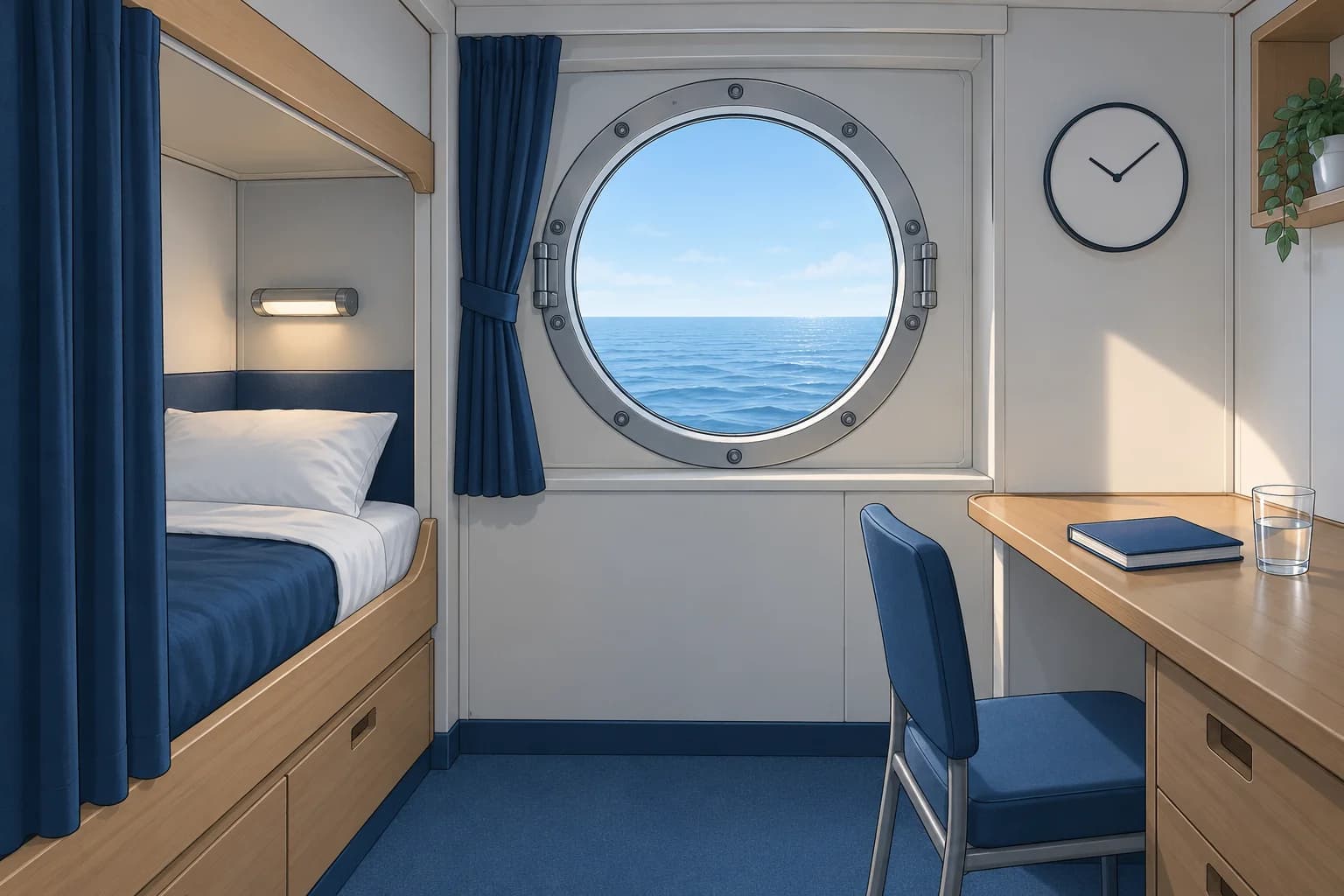
Fatigue is a state of tiredness that lowers your alertness, slows your reactions and makes you take poor decisions. You may not notice it yourself. Causes include too little or broken sleep, night work against the body clock (the circadian rhythm), noise, vibration, heat, ship motion, long hours, stress and changing schedules such as watch changes and port calls.
Hours of rest
STCW (section A-VIII/1) and the Maritime Labour Convention (regulation 2.3) set minimum hours of rest: at least 10 hours in any 24-hour period and 77 hours in any 7-day period. The rest may be split into no more than two periods, one of them at least 6 hours long, and the gap between rest periods must not exceed 14 hours. Drills should disturb rest as little as possible. In an emergency the master may suspend these rules, and you get compensatory rest afterwards.
Records
Your hours of rest are recorded on board and you receive a copy, signed by you and the master or a person he authorises. Fill them in honestly: false records hide fatigue and break the law. If you cannot get your rest, tell your head of department. Rest is off-duty time, excluding short breaks; it is not the same as sleep.
Alcohol
Alcohol slows reactions and judgement and stays in the blood for hours. Under STCW A-VIII/1, flag states must set a limit of no more than 0.05 % blood alcohol (BAC) or 0.25 mg/l in the breath for anyone on watch or on safety, security or pollution duties. Many companies go further with a zero alcohol policy and random tests. Know your company's rules.
Drugs and medicines
Illegal drugs are banned on every ship, and carrying them can bring prison in many countries. Some legal medicines cause drowsiness. Tell the officer responsible for medical care what you take, and do not stand watch if a medicine makes you sleepy.
Key figures
- Minimum rest
- 10 h in any 24 h and 77 h in any 7 days
- Splitting rest
- At most 2 periods, one at least 6 h
- Gap between rest periods
- No more than 14 h
- Maximum STCW alcohol limit
- 0.05 % BAC or 0.25 mg/l in breath
- Rules
- STCW A-VIII/1 and MLC regulation 2.3
Remember
- Fatigue lowers alertness and judgement, and you may not notice it yourself.
- Minimum rest: 10 h in any 24 h and 77 h in any 7 days.
- At most two rest periods, one of at least 6 h; no more than 14 h between them.
- Record your rest honestly; tell your head of department if you cannot get it.
- STCW maximum: 0.05 % BAC or 0.25 mg/l breath; flag-state or company limits may be lower.
Common mistakes
Wrong: Ten hours off duty guarantees that I am fit for watch.
Right: Rest is not the same as sleep. If you are still fatigued, tell the officer and ask for relief. Record your actual rest honestly.
Wrong: Writing the standard hours on the rest record keeps everyone out of trouble.
Right: False records hide fatigue and break the law. Record what really happened.
Wrong: One beer before watch is fine if you feel normal.
Right: Alcohol affects you before you feel it, and your company may allow none at all. Follow the policy.
Worked case
Your ship had a long night of cargo work, then sailed at dawn. You slept only four hours, and now you are due on lookout at noon. You feel heavy and keep yawning.
Show the answer
Tell the officer before watch that you are too tired to work safely. Four hours’ sleep can leave you fatigued even if recorded rest meets the rules. Ask for relief and enough sleep. Record actual off-duty rest honestly; do not record only the hours you slept.
Practice question
You rested 6 h plus 4 h in the last 24 h, but only 72 h in seven days. Are both minimum totals met?
- Yes; ten hours in a day meets both totals
- Yes; the six-hour block meets both totals
- No; the weekly total is below 77 hours
- No; twelve hours are needed every day
Show the answer
Answer: C. Both rolling totals apply: at least 10 hours in any 24 hours and 77 hours in any seven days. The daily total is met, but 72 hours falls short of the weekly minimum.
5 · Harassment
Preventing violence, harassment and bullying
Since 1 January 2026 every basic training course must teach how to recognise, prevent and respond to violence and harassment on board.

What it means
Violence includes physical attacks and threats of physical harm. Harassment is unwanted behaviour that offends, humiliates or intimidates. Sexual harassment is such behaviour of a sexual nature: comments, jokes, touching, messages or pictures. Bullying is repeated hostile behaviour, such as insults or isolating someone. Sexual assault is sexual contact without consent and is a crime. The continuum of harm runs from degrading remarks to assault. All can harm people; behaviour may escalate if unchecked.
Why it matters
Victims suffer stress, fear, poor sleep and loss of concentration, and some leave the sea. Those responsible can damage their careers and face legal consequences. Witnesses may feel unsafe, and teamwork and ship safety suffer. Factors that make it more likely include abuse of power between ranks, discrimination, stress, isolation, fatigue, drugs and alcohol.
What you can do
If it is safe, step in: interrupt, distract or support the target. Report it through the company procedure, to an officer you trust, the master, or the company's designated person ashore. You may also use the on-board complaint procedure under the Maritime Labour Convention. Keep notes of dates and what happened. The joint shipowner and union Guidance on Eliminating Shipboard Harassment and Bullying (ICS and ITF) helps companies write their policy.
Supporting a victim
A trauma-informed response means listening calmly, believing the person, not blaming them, respecting their choices and privacy, and helping them get medical care and support. Offer affected bystanders the same calm support. If you or another witness feels distressed, seek confidential support from a trusted person or a seafarer helpline.
Why it is in basic training
IMO resolution MSC.560(108) replaced STCW table A-VI/1-4, adding a new competence: prevent and respond to violence and harassment, including sexual harassment, bullying and sexual assault. It entered into force on 1 January 2026. Flag states decide how existing certificate holders catch up, so check yours. MLC amendments adopted in 2025, expected in force in December 2027, also strengthen protection against violence and harassment.
Key figures
- New STCW competence
- MSC.560(108), in force 1 January 2026
- Covers
- Violence, harassment, sexual harassment, bullying, sexual assault
- Industry guidance
- ICS/ITF Guidance on Eliminating Shipboard Harassment and Bullying
- Complaint route
- Company procedure and MLC on-board complaint procedure
If you see harassment or bullying
- Step in only if it is safe: interrupt, distract or stand with the target. — A bystander's action often stops the behaviour; your own safety comes first.
- Check on the person afterwards and listen without judging. — Victims often feel alone; support reduces harm.
- Explain the reporting routes and offer support. Follow the ship’s reporting requirements; seek urgent help if anyone is in immediate danger. — Explain what you need to share and with whom. Protect privacy as far as possible.
- Write down dates, places, words and witnesses. — Clear notes help a fair investigation.
- Respect the victim's privacy; do not spread the story round the ship. — Gossip can harm the victim again and discourage reporting.
Remember
- STCW basic training covers violence and harassment since 1 January 2026 (MSC.560(108)).
- Bullying is repeated hostile behaviour; sexual assault is a crime.
- Harm ranges from degrading remarks to assault; respond early rather than waiting for escalation.
- Power imbalance, isolation, stress, fatigue and alcohol make abuse more likely.
- Intervene if safe, report, keep notes, support the victim and respect privacy.
Common mistakes
Wrong: Rough jokes about someone are just part of life at sea.
Right: Jokes that humiliate are harassment and can grow into worse. Say it is not acceptable.
Wrong: If the harasser is senior, there is nothing a rating can do.
Right: Report to the master or the company's designated person ashore, or use the MLC complaint procedure.
Worked case
A new deck cadet tells you quietly that an officer keeps sending her messages about her body and blocking her way in the alleyway. She asks you not to tell anyone because she fears losing her place.
Show the answer
Listen, believe her and say it is not her fault. Do not promise secrecy: explain what the ship's reporting rules require you to share and with whom. Offer to go with her to the master, designated person ashore or MLC complaint route, bypassing the officer. Complaining must not lead to punishment. Help preserve messages and dated notes. Respect her choices where possible, follow reporting duties and protect her privacy. Seek urgent help if anyone is in immediate danger.
Practice question
You see a senior make a sexual joke that humiliates a cadet. What is the safest useful response?
- Confront the senior alone regardless of the risk to you both
- Wait for the cadet to submit a formal complaint before acting
- Treat the first incident as harmless unless it happens again
- Interrupt if safe, support the cadet and use a reporting route
Show the answer
Answer: D. A single incident can be sexual harassment. You can intervene safely, support the person and report through an appropriate route.
6 · Your rights
Your rights under the Maritime Labour Convention
The Maritime Labour Convention is the seafarers' bill of rights: a fair contract, pay, rest, food, medical care and a way home.

What the MLC is
The Maritime Labour Convention, 2006 (MLC) sets minimum living and working conditions for seafarers. The flag state, the country where the ship is registered, checks compliance and certifies ships where required. Port state control means inspections by port authorities of visiting foreign ships. Your rights come with obligations: follow lawful orders, the safety rules and the ship's policies.
Contract and pay
Before you sail you sign a seafarer employment agreement (SEA), and you must have time to read it and get advice. It states your job, wages, leave, repatriation and benefits, and you keep a signed copy. Wages are paid at least monthly, with a monthly account, and you can send part of them home. You earn paid annual leave of at least 2.5 days per month of service.
Hours, food and health
Follow the rest limits in the fatigue lesson. You are entitled to decent accommodation, free food and good-quality drinking water, and medical care on board and ashore, normally free. The 2022 amendments, in force 23 December 2024, require properly fitting PPE and social connectivity (keeping in touch ashore); guidance recommends internet access where reasonably practicable, with reasonable charges if any.
Complaints and going home
Use the on-board complaint procedure to report problems. You may go directly to the master or appropriate outside authorities and have someone accompany or represent you. Victimisation (punishing you for complaining) is prohibited. Repatriation means returning home at the shipowner’s cost, for example after your contract expires abroad or illness prevents work. National rules set a maximum service period below 12 months. Shipowners must arrange financial security (insurance or another financial guarantee) for abandonment and contractual death or long-term disability claims.
What comes next
Amendments adopted in 2025, expected in force in December 2027, add protection against violence and harassment, strengthen shore leave and fair repatriation, and call seafarers key workers. Prevent pollution: use the ship's designated waste collection systems and report spills; see Ocean: pollution.
Key figures
- Wages
- Paid at least monthly, with a monthly account
- Paid annual leave
- At least 2.5 days per month of service
- Maximum service before repatriation
- Less than 12 months
- 2022 amendments
- In force 23 Dec 2024: connectivity, free drinking water, fitted PPE
- 2025 amendments
- Expected in force Dec 2027: harassment, shore leave, repatriation
Remember
- The MLC sets minimum living and working conditions; flag and port states check them.
- Read your employment agreement before signing and keep a signed copy.
- Wages at least monthly; paid leave; free food and drinking water; medical care normally free.
- Use the on-board complaint procedure without fear of victimisation.
- The shipowner pays repatriation and holds financial security for abandonment.
Common mistakes
Wrong: Sign the contract on the gangway; you can read it later.
Right: You have the right to read and understand your agreement before signing, and to keep a copy.
Wrong: If you complain, you will lose your job, so stay silent.
Right: The MLC complaint procedure protects you from victimisation. You can go to the flag state if needed.
Worked case
Your wages are two months late and the company stops answering the master's emails. The ship is in port with little food left, and the crew fear they have been abandoned.
Show the answer
Two months of unpaid contractual wages can constitute abandonment. You may contact the flag state or port state control directly; ask a seafarer welfare or union representative for help. Use the financial-security certificate displayed on board to contact the provider. Abandonment security covers up to four months of unpaid wages and contractual entitlements, repatriation and essential needs, including food and medical care.
Practice question
At joining, you are told to sign your SEA immediately and read it after sailing. What should you request?
- Sign now and rely on the monthly wage account for your terms
- Accept a verbal summary instead of reading the full agreement
- Time to read and seek advice before signing, then a signed copy
- Wait until the contract ends before requesting a signed copy
Show the answer
Answer: C. You must have an opportunity to examine your employment agreement and seek advice before signing. Keep a signed copy.