
Maritime law, rules and watchkeeping · Level R2 · 4 parts · about 13 min
Portugal: navigation areas, safety equipment and documents
4 short parts: Boat types 1–5 · Safety gear · Licences · Boat papers. Each part explains the idea, then gives the points to remember, the common mistakes, a worked case and a practice question; the Academy unit adds all 24 check questions.
1 · Boat types 1–5
Portugal's five boat types and where each may go
Portuguese-registered recreational boats use types 1–5. Your boat's type sets its navigation area.
One law
Portuguese recreational boating is governed by Decreto-Lei 93/2018, the RJNR (legal regime for recreational boating), in force since 1 January 2019. A design category describes the boat's weather capability. The boats are called ER (embarcações de recreio). The DGRM (the maritime administration) issues licences and runs inspections of types 1–3. The AMN (National Maritime Authority) registers boats and runs type 4–5 inspections.
Five types
Type 1: ocean, unlimited (design category A). Type 2: offshore, up to 200 nautical miles (NM) from the coast (A/B). Type 3: coastal, up to 40 NM from the coast (A/B/C). Type 4: restricted coastal, within 25 NM of a porto de abrigo (port of shelter) and 6 NM of the coast (A/B/C). Type 5: sheltered waters, within 3 NM of a port of shelter (A/B/C/D).
Sheltered waters
Águas abrigadas (sheltered waters) are waters within 3 NM of a port of shelter, plus small bays, lakes, rivers, canals and reservoirs. The definition assumes wind no stronger than Beaufort force 4 and significant wave height no more than 0.3 m—the average height of the highest third of waves. Type 5 boats need no navigation lights if they sail only between sunrise and sunset. A rowing-only type 5 boat stays within 1 NM of the coast.
Night and jet skis
Jet skis and motorised boards may not sail between sunset and sunrise unless the local AMN office authorises it in advance. Each port authority (Capitania) lists its ports of shelter and local rules in its edital (local notice), so read it before you sail.
Near the beach
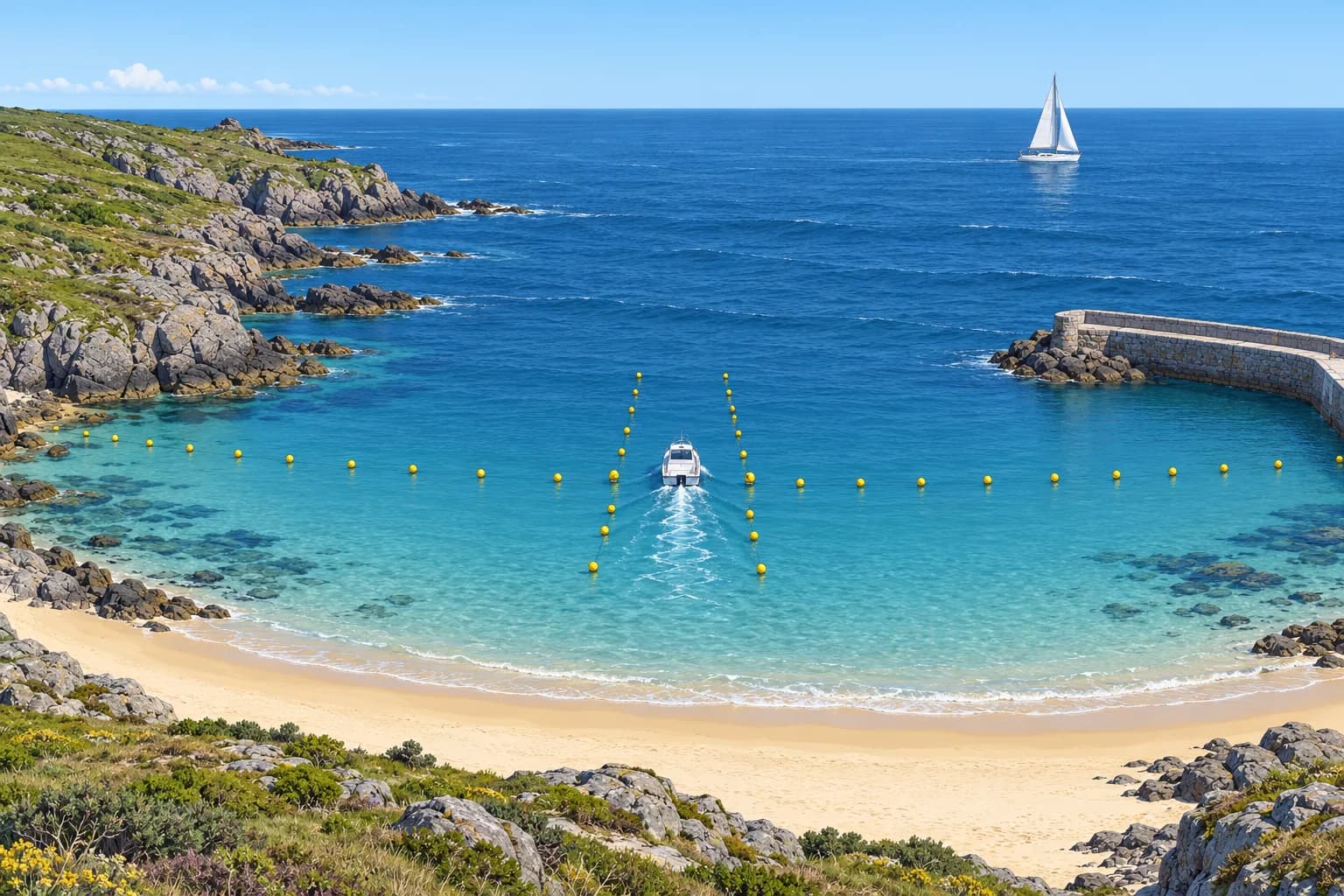
At a bathing beach, the first 300 m from the water's edge are for swimmers only: no boats. Use the marked access corridors, at the minimum speed needed to steer, at right angles to the shore. At other maritime beaches, you may navigate, anchor and practise water sports subject to local notices and area restrictions.
Key figures
- Type 1 / type 2
- No limit / up to 200 NM from the coast
- Type 3
- Up to 40 NM from the coast
- Type 4
- 25 NM from a port of shelter and 6 NM from the coast
- Type 5
- Sheltered waters, within 3 NM of a port of shelter
- Bathing beach
- No boats within 300 m; perpendicular corridors only
- Design categories
- 1: A · 2: A/B · 3–4: A/B/C · 5: A/B/C/D
Remember
- DL 93/2018 classes Portuguese-registered ER as type 1 to 5 by design category and distance.
- Type 4: 6 NM from the coast and 25 NM from a port of shelter. Type 5: 3 NM from a port of shelter.
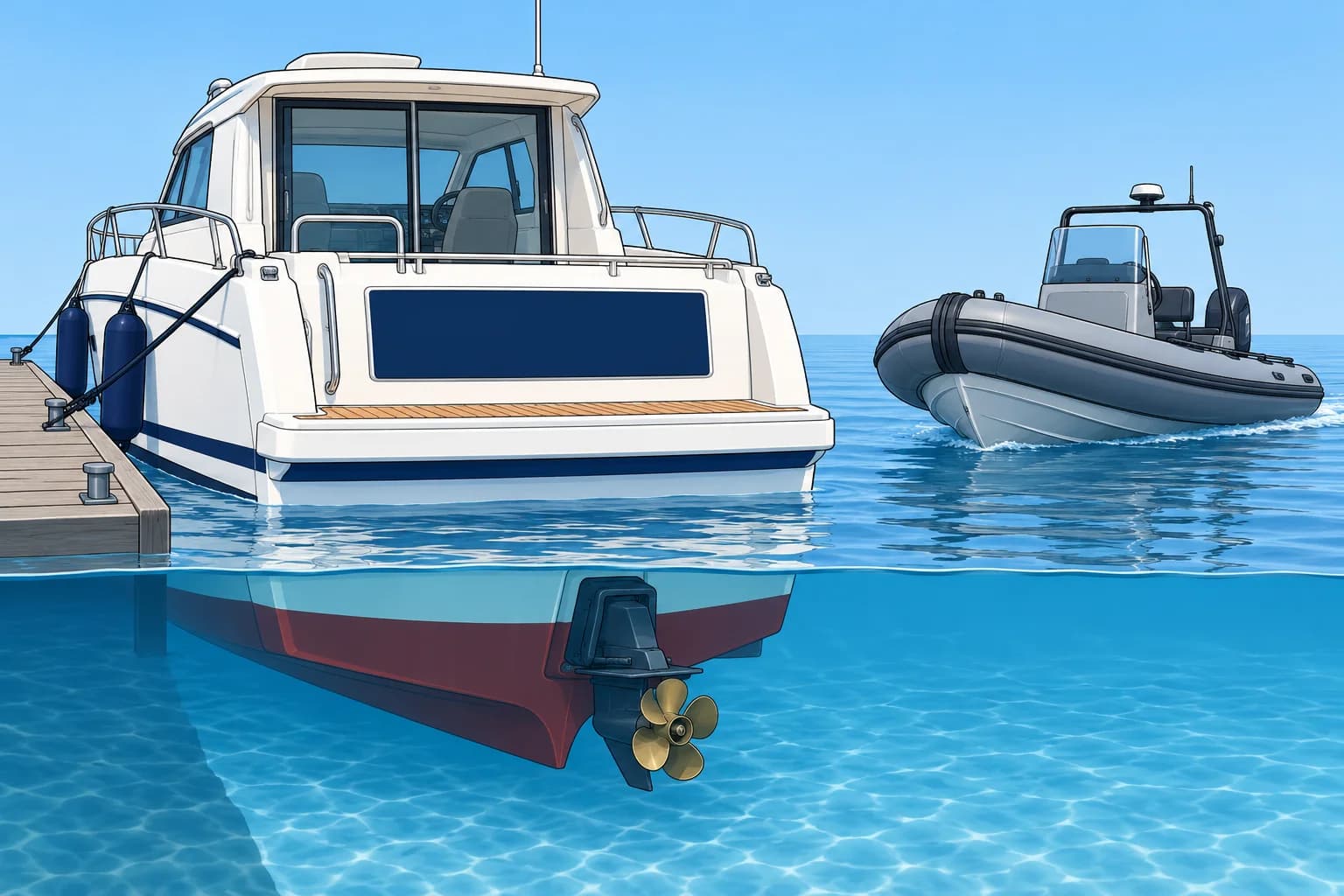
- The type number follows the registration number on the stern, e.g. NAME-123456-4PT.
- No boats within 300 m of a bathing beach; jet skis do not sail at night without permission.
Common mistakes
Wrong: A type 4 boat may go 25 NM offshore.
Right: Type 4 must stay within 6 NM of the coast as well as within 25 NM of a port of shelter.
Wrong: A type 5 boat may never go out at night.
Right: Other type 5 boats may operate at night with navigation lights. Jet skis and motorised boards also need prior AMN permission. The lights exemption applies only by day.
Worked case
Your boat is marked NAME-123456-5PT. In calm daylight your open-coast route, outside bays and inland waters, reaches 5 NM in a straight line from the nearest listed port of shelter. You then plan to anchor 150 m off a bathing beach. Is either plan allowed?
Show the answer
No. The open-coast route is outside the 3 NM shelter limit. Choose a destination within that limit and sheltered-water conditions. Anchoring 150 m off the bathing beach is inside the closed 300 m strip. Stay outside it; use a marked corridor only to approach at minimum steerage speed, perpendicular to shore.
Practice question
How far from the coast may a type 3 boat sail?
- 6 NM
- 25 NM
- 40 NM
- 200 NM
Show the answer
Answer: C. Type 3 is coastal navigation up to 40 NM from the coast. Type 2 reaches 200 NM.
2 · Safety gear
Safety equipment for type 4 and type 5 boats
The equipment list, set by Portaria 1464/2002, grows with the boat's type. Most small boats are type 4 or 5; know both lists.
Where the list comes from
Equipment for recreational boats is set by Portaria 1464/2002, still applied with DL 93/2018. The AMN publishes a leaflet per type, updated in December 2024. Types 1–3 carry longer lists for offshore work. Check the DGRM table before going beyond 6 NM.
Lifesaving gear
Carry lifejackets for everyone, including child sizes. The AMN recommends 150 N for type 4 and 100 N for type 5; N means newtons, a measure of buoyancy. Lifebuoys depend on length: one from 5 to 9 m, two from 9 to 15 m, four from 15 to 24 m. One buoy needs a 30 m line; with two or more, one needs a light. Carry a boarding ladder if the stern or either quarter (rear side) is over 50 cm above water.
Type 5 essentials
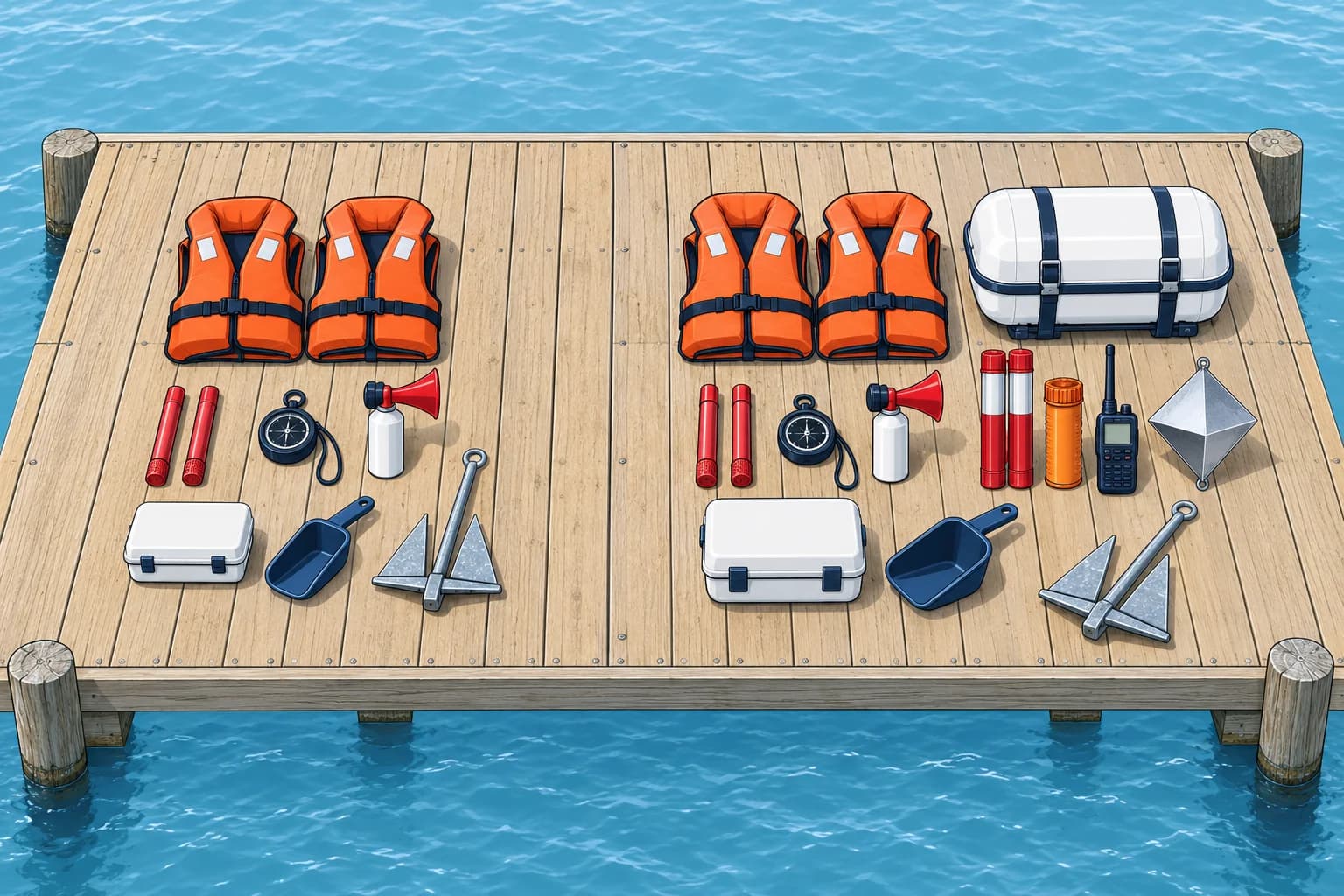
A type 5 boat carries 2 hand flares (not needed inside harbour entrances), a steering compass, a horn or bell, first-aid kit A, an accessible bilge pump to remove water (a bailer, a scooping container, may replace it only on boats up to 5 m), one anchor, a round-tipped knife, mooring and towing lines, and a waterproof torch with spare batteries.
Type 4 requirements
Keep type 5 gear, but replace kit A with B. Two hand flares remain required inside harbour entrances. Add survival craft (rafts or tenders) for the maximum permitted number of people; 2 parachute signals; 1 smoke signal; VHF (very high frequency) with DSC (digital selective calling), handheld allowed; bearing compass; current charts and publications; radar reflector; signalling mirror; two anchors; and two pumps, one manual and operable above water. Motorboats over 15 m need dedicated high-mounted reserve radio power: 6 hours, or 1 hour if other sources can supply it.
Fire extinguishers
Open or partly open outboard boats need a 1 kg powder extinguisher. An inboard boat without fixed extinguishing needs a 2 kg powder extinguisher by the engine. Carry a 1 kg powder extinguisher in the saloon (cabin), plus 1 kg by the cooker when the galley (kitchen) is separate.
Jet skis
Wear a lifejacket or suitable buoyancy aid. Carry two hand flares unless you stay inside harbour entrances; a compass; horn; first-aid kit A; bailer; round-tipped knife; mooring and towing lines; and a waterproof torch with spare batteries. Missing required gear can bring an individual skipper a €300–3,000 fine.
Key figures
- Lifebuoys by length
- 5–9 m: 1 · 9–15 m: 2 · 15–24 m: 4
- Type 5 pyrotechnics
- 2 hand flares (except inside harbour entrances)
- Type 4 pyrotechnics
- 2 hand flares, 2 parachute signals, 1 smoke
- Type 4 radio
- VHF with DSC (a handheld is allowed)
- Lifejackets (AMN advice)
- Type 4: 150 N · type 5: 100 N · all on board
- Fine for missing equipment
- €300–3,000 for an individual skipper
Remember
- Gear is set by Portaria 1464/2002; the AMN leaflets (Dec 2024) list it per type.
- Type 5: lifejackets, 2 hand flares, compass, horn, kit A, pump (bailer only up to 5 m), anchor, torch.
- Type 4: survival craft for maximum permitted capacity, rockets, smoke, VHF with DSC, charts, radar reflector; kit B replaces A.
- Jet ski riders must wear a lifejacket or suitable buoyancy aid at all times.
Common mistakes
Wrong: A type 4 boat needs no radio if everyone has a mobile phone.
Right: Type 4 must carry a VHF with DSC; a handheld DSC set is accepted.
Wrong: A tender cannot count as the survival craft.
Right: On type 4, liferafts, inflatable rafts or tenders need combined capacity for the boat's maximum permitted number of people.
Wrong: Lifebuoys are needed only on boats over 12 m.
Right: From 5 m one lifebuoy is required, two from 9 m and four from 15 m.
Worked case
Your type 4 boat has all required gear except survival craft and VHF with DSC. For five people going 5 NM offshore, the owner offers a phone and two extra lifejackets instead. Do you leave?
Show the answer
No. A phone cannot replace VHF with DSC, and extra lifejackets cannot replace survival craft. Carry liferafts, inflatable rafts or tenders with combined capacity for the boat's maximum permitted number of people, even with only five aboard. Carry VHF with DSC; a handheld DSC set is accepted. Recheck the type 4 list before departure.
Practice question
How many lifebuoys must a 10 m boat carry?
- None
- One
- Two
- Four
Show the answer
Answer: C. From 9 to 15 m, carry two lifebuoys; one of them with a light.
3 · Licences
The carta de navegador de recreio
To command a boat in Portugal you need the right carta de navegador de recreio. EU licences are recognised automatically.
Five categories
The carta de navegador de recreio (recreational navigator's licence) has five categories. Marinheiro Júnior: up to 6 m and 4.5 kW, by day, within 1 NM of the low-water line and 3 NM of shelter. Marinheiro: by day, within 3 NM of the coast and 10 NM of shelter. Patrão Local: coast in sight, within 6 NM of the coast and 25 NM of shelter. Patrão de Costa: within 40 NM of the coast. Patrão de Alto-Mar: unlimited.
Age limits on Marinheiro
From 16 to 18, a Marinheiro may command boats up to 6 m and 22.5 kW, and jet skis and motorised boards of any power. From 18, the limit is boats up to 12 m with engine power within the boat’s certified limit.
Who can apply
Marinheiro Júnior starts at 8, Marinheiro at 16, the others at 18. Under-18s need parental consent. You must read, write and swim, with a medical certificate issued within six months before exam admission. Costa and Alto-Mar candidates also need the compulsory level of schooling. Each carta has theory and practical exams. You can apply directly for Patrão de Costa or Patrão de Alto-Mar without holding another carta.
Validity and radio
Since 2019 a carta stays valid until age 70. It is then renewed every five years, and every two years from 80. Patrão Local, Patrão de Costa and Patrão de Alto-Mar also allow you to operate radio equipment under the Global Maritime Distress and Safety System (GMDSS). In the Azores and Madeira, Patrão Local or Patrão de Costa holders can get approval for inter-island trips beyond their normal limits.
Visitors
Licences issued by EU member states are recognised automatically; no Portuguese carta is needed. The DGRM can recognise a third-country licence issued on similar terms. Recognition does not extend your licence’s limits.
Key figures
- Marinheiro Júnior
- ≤ 6 m, 4.5 kW; day; 1 NM from low water, 3 NM from shelter
- Marinheiro
- Day; 3 NM from coast, 10 NM from shelter
- Patrão Local
- Coast in sight; ≤6 NM from coast and ≤25 NM from shelter
- Patrão de Costa / Alto-Mar
- 40 NM from the coast / no limit
- Minimum ages
- 8 (Júnior), 16 (Marinheiro), 18 (others)
- Renewal
- At 70, then every 5 years; every 2 years from 80
Remember
- Five cartas: Marinheiro Júnior, Marinheiro, Patrão Local, Patrão de Costa, Patrão de Alto-Mar.
- Marinheiro and Júnior: daytime only. Patrão Local: coast in sight, within 6 NM of coast and 25 NM of shelter.
- Candidates must be able to swim; ages 8, 16 and 18.
- EU licences are recognised automatically; renewal starts only at age 70.
Common mistakes
Wrong: You must hold Patrão Local before you can take Patrão de Costa.
Right: Since DL 93/2018, Patrão de Costa and Patrão de Alto-Mar no longer require the category below.
Wrong: A Spanish PER holder needs a Portuguese carta to skipper in Portugal.
Right: Licences issued by EU member states are recognised automatically in Portugal.
Worked case
A 17-year-old with a Marinheiro carta wants to take her family's 7 m motorboat with a 40 kW outboard 2 NM along the coast during daylight. Her 19-year-old brother, also a Marinheiro, offers to skipper instead. Who may go, and when?
Show the answer
She may not: from 16 to 18 a Marinheiro is limited to boats up to 6 m and 22.5 kW. Her brother, over 18, may command boats up to 12 m with engine power within the boat’s certified limit. But Marinheiro is a daytime carta, so he must be back before sunset. He must also stay within 3 NM of the coast and 10 NM of a port of shelter.
Practice question
You plan a trip 35 NM offshore in a suitably classed boat. What is the lowest carta category that covers it?
- Carta de Marinheiro
- Carta de Patrão Local
- Carta de Patrão de Costa
- Carta de Patrão de Alto-Mar
Show the answer
Answer: C. Patrão de Costa covers this trip within its 40 NM limit. Alto-Mar also covers it, but is a higher category.
4 · Boat papers
Registration, documents on board and inspections
A Portuguese boat must be registered before use and carry its livrete. Polícia Marítima officers can check papers, gear and limits.
Registration
Every ER must be registered before it is used. The Capitania (local office of the AMN) records ownership, and the boat receives a livrete, the document that proves registration. The livrete is electronic, with an access code, and a paper copy is optional. An exempt tender supports a main recreational boat and can be carried aboard it. Up to 2.5 m and 4.5 kW, it needs no registration, inspection or fees.
Documents on board
Carry the livrete, the skipper's carta, insurance policy and proof of IUC payment (a circulation tax covering some boats), where applicable. Depending on the boat, add the radio station licence, inspection record and liferaft service record. Documents linked to the electronic livrete need no paper copy: officers check them in the database. Article 61(5) lists a radio-operator certificate for pre-2019 cartas, but article 63(2) lets existing Local, Costa and Alto-Mar holders use their carta instead. These are your documentos de bordo (onboard documents).
Compulsory insurance
Third-party insurance is compulsory for types 1, 2, 3 and 4. For type 5 it is compulsory for boats with an engine and for sailing boats over 7 m. Owners and skippers are jointly liable for damage to third parties, whoever is at fault, unless the injured person alone caused the accident.
Inspections
A vistoria periódica (periodic inspection) is due every 10 years from first registration. It is due every 5 years for boats first registered more than 20 years ago, boats over 24 m and wooden boats over 12 m. CE-marked new boats skip the initial inspection.
What officers check
The Polícia Marítima (AMN's maritime police) checks your livrete, carta, insurance, equipment, type limits, permitted number of people and beach rules. Types 1–3 fly the national flag on port entry/exit and when passing warships or security craft. Fly the national flag whenever you fly another flag. These flag requirements do not apply during regattas (boat races). Sailing beyond the type, without a carta or insurance, or overloaded costs an individual €300–3,000.
Key figures
- Exempt tenders
- ≤ 2.5 m and ≤ 4.5 kW: no registration or inspection
- Insurance required
- Types 1–4; type 5 with engine; type 5 sail over 7 m
- Periodic inspection
- 10 years; 5 if first registered >20 years ago, >24 m or wooden >12 m
- Documents on board
- Livrete, carta, insurance, IUC proof (where applicable)
- Fines (individuals)
- €50–1,500 marking or flag; €300–3,000 serious offences
Remember
- Register before first use; the electronic livrete proves it.
- On board: livrete, carta, insurance policy and IUC proof, plus radio and inspection papers where needed.
- Insurance: types 1–4, every type 5 with an engine, type 5 sailing boats over 7 m.
- Inspections: 10 years; 5 if over 20 years since first registration, over 24 m, or wooden and over 12 m.
Common mistakes
Wrong: A 6 m type 5 sailing dinghy with an outboard needs no insurance because it is under 7 m.
Right: Any type 5 boat with an engine needs insurance. The 7 m threshold applies only to sailing boats without an engine.
Wrong: Without the paper livrete on board you will be fined.
Right: The livrete is electronic. Showing the access code is enough, and documents linked to it need no paper copy.
Worked case
Polícia Marítima officers stop your 8 m type 4 motorboat, first registered 25 years ago. You show the livrete access code on your phone and your carta. The last periodic inspection was seven years ago. The insurance is valid, and eight people are on board; the builder's plate says seven. What is wrong?
Show the answer
The electronic livrete and the carta are fine. But it is more than 20 years since first registration, so its inspection is due every 5 years: seven years is overdue. Eight people where the capacity is seven is overloading. Both are serious offences with fines of €300–3,000. Before another departure, reduce the number aboard to seven and resolve the overdue inspection with the responsible authority; booking alone does not make it current.
Practice question
Which document proves that a Portuguese recreational boat is registered?
- The livrete
- The carta
- The edital
- IUC receipt
Show the answer
Answer: A. The livrete proves registration. The carta is the skipper's licence; the edital is a local port notice.