
Maritime law, rules and watchkeeping · Level P3 · 5 parts · about 19 min
Safe watchkeeping and the bridge team (STCW Code A-VIII/2)
5 short parts: Watch principles · Look-out & master · Bridge team · Rest hours · Handover & port. Each part explains the idea, then gives the points to remember, the common mistakes, a worked case and a practice question; the Academy unit adds all 32 check questions.
1 · Watch principles
Watch arrangements and the officer of the watch (STCW A-VIII/2)
The master sets up the watch for the conditions. You, as officer of the watch, run it and keep the ship safe until you are properly relieved.
Where the rules sit
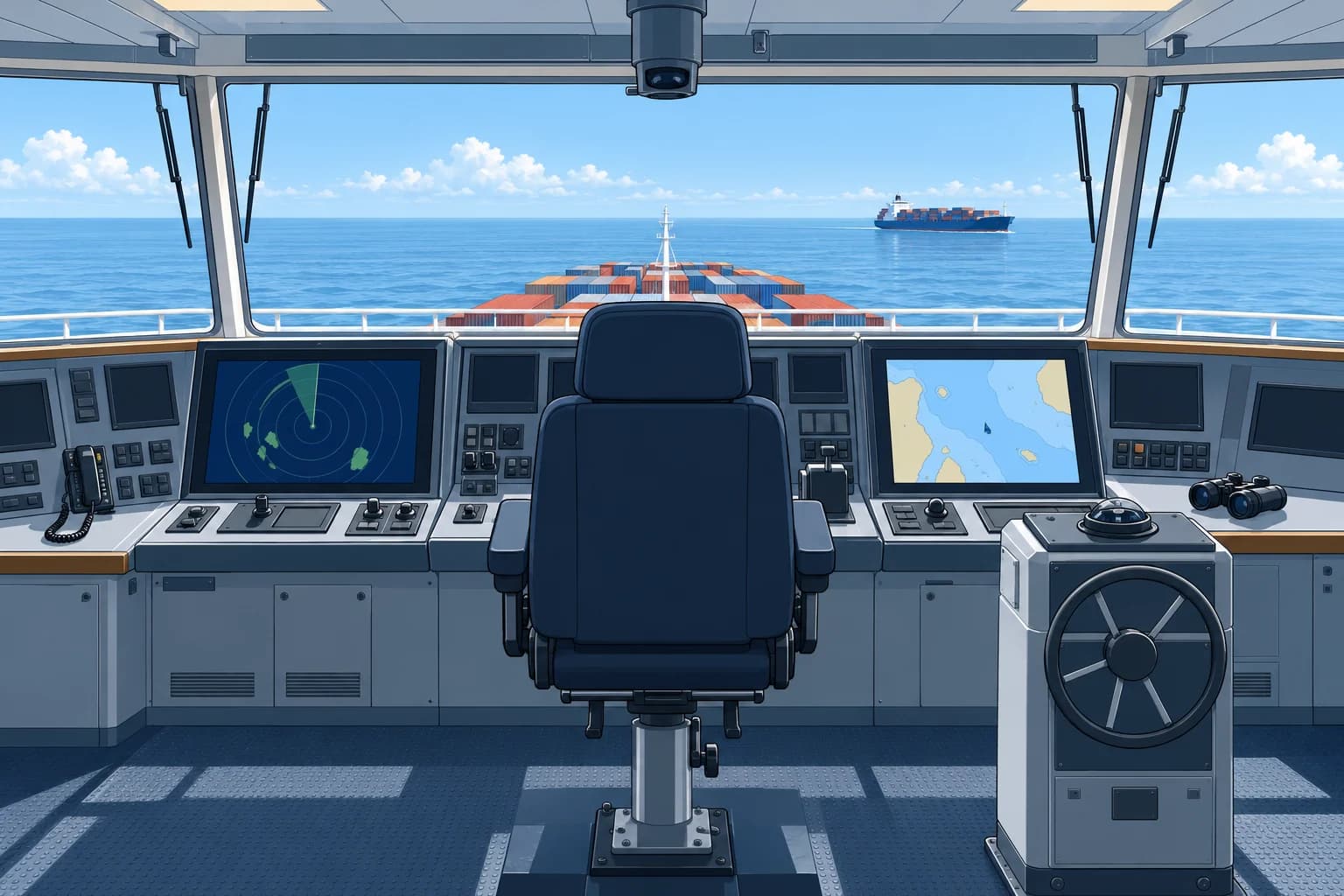
The STCW Code is the detailed part of the international training and watchkeeping convention. Section A-VIII/2 sets the principles for keeping a watch. Its Part 4-1 covers the navigational watch: the bridge watch while the ship is under way. Flag states make these principles national law, and your company adds them to its safety management system. Your master issues standing orders for routine watchkeeping and night orders for the coming night.
Composition of the watch
The master keeps the bridge attended and chooses the watch for the conditions. Consider daylight, visibility, weather, sea state, traffic, routeing and nearby dangers. Assess tasks, manoeuvres, crew fitness, experience, ship familiarity, radio duties and available help. Check bridge layout and the view from the conning position, where you direct the ship. Consider ship size, handling, automatic steering, navigation equipment, alarms and controls for machinery spaces without a continuous watch. Allow for extra workload near a traffic separation scheme, which divides opposing traffic into lanes.
Your core duties
As officer of the watch (OOW), you represent the master and remain responsible for safe navigation until properly relieved. Keep the watch on the bridge and never leave it until properly relieved. A short visit to a separate chartroom must be essential to navigation; first ensure safety and a proper look-out. Check position frequently, using more than one method where possible. Follow the passage plan. Use radar and other aids, knowing their limits. Take no other duty that interferes with your watch.
The master on the bridge
The master's presence alone does not transfer watch responsibility. You remain responsible until the master explicitly assumes that responsibility and you both understand it. Having the con means directing the ship's movements; make watch responsibility explicit. Confirm the transfer aloud, follow the ship's recording procedure and keep monitoring as assigned. Agree the transfer back before the master leaves.
Engines and steering
Do not hesitate to use the helm, the engines and the sound signals. Where you can, give the engine room timely notice of intended speed changes. Know the ship's stopping distance and turning circle from the manoeuvring data on the bridge. Change from automatic to hand steering in good time when traffic, restricted visibility or other hazards require it, so the look-out is never broken for an emergency.
Remember
- The master sets the watch composition from the STCW list of factors, not a fixed table.
- You never leave the bridge until properly relieved.
- You remain responsible until the master explicitly assumes watch responsibility and you both understand it.
- Fix the position often, by more than one method where possible.
- Switch to hand steering early in traffic, restricted visibility or close to danger.
Common mistakes
Wrong: When the master comes to the bridge, the watch passes to the master.
Right: You stay responsible until the master explicitly assumes responsibility for the watch and you both understand it.
Wrong: The same watch composition suits every voyage.
Right: The master adapts each watch to visibility, traffic, hazards, workload and crew fitness.
Wrong: Using the engines without asking first shows poor seamanship.
Right: The OOW must not hesitate to use helm, engines and signals. Give the engine room notice where possible.
Worked case
At 0300 you are OOW in a coastal lane. The master comes up for coffee and stands behind the radar, watching. A crossing vessel's bearing remains steady while range decreases towards 4 nautical miles. The master says nothing. Who remains responsible for the watch, and what do you do?
Show the answer
You retain responsibility. Assess collision risk and take timely action under the applicable rules; tell the master what you are doing. Keep monitoring. You remain responsible until the master explicitly assumes responsibility for the watch and you both understand it. Agree who has the con and who keeps each monitoring duty, and record the transfer as required.
Practice question
Who decides the composition of each navigational watch?
- The chief mate, by rotating officers and ratings each week
- The master, after weighing the conditions and the crew
- The company, through a fixed table in the safety manual
- The flag state, through the minimum safe manning document
Show the answer
Answer: B. The STCW Code makes the master responsible for the composition of the watch, considering visibility, traffic, hazards, workload, fitness and experience.
2 · Look-out & master
The look-out, calling the master and the pilot on board
Keep a proper look-out at all times. Call the master early when the STCW triggers apply, and never let a pilot's presence relieve you of your duties.

A proper look-out
COLREG Rule 5 requires a proper look-out by sight, hearing and all available means. The STCW Code adds that the look-out gives it full attention and takes no other duty. The look-out and the helmsperson are separate jobs. On a small ship, the helmsperson may also keep look-out only with an unobstructed all-round view from the steering position, unimpaired night vision and no other obstacle to keeping a proper look-out.
The OOW as sole look-out
In daylight only, after careful assessment, you may be the sole look-out. Every time, weather, visibility, traffic, nearby dangers and work near a traffic separation scheme must make it clearly safe. Help must be immediately available to be called to the bridge. You cannot use this daylight exception at night. Flag-state rules, company procedures and the master's orders may require an additional look-out even in daylight.
When to call the master
The Code says call the master immediately if: restricted visibility is met or expected; traffic or other ships' movements cause concern; you have difficulty keeping course; land, a mark or a sounding is not found when expected, or found unexpectedly; engines, steering, essential navigation equipment, an alarm or an indicator fail; radio equipment fails; heavy weather may cause damage; you meet any hazard to navigation, such as ice or a derelict (abandoned vessel); or any emergency or doubt arises.
Call and act without delay
Call the master immediately when a listed trigger applies. If safety requires immediate action, take it without waiting for the master. When another team member is available, have them call while you act. Report what you have done and keep monitoring.
The pilot on board
A pilot is a local expert who advises on navigation in a port or channel. The pilot's presence does not relieve the master or the OOW of their duties for the ship's safety. The master and pilot exchange information on the plan, local conditions and the ship's characteristics: the master–pilot exchange. You keep checking the position and movement. If you doubt the pilot's actions, ask for clarification. If doubt remains, call the master at once and act until the master arrives.
Key figures
- Sole look-out
- Daylight only, after careful assessment, help immediately available
- Helmsperson as look-out
- Small ships: all-round view, night vision intact, no other obstacle
- Pilot on board
- Does not relieve the master or OOW of their duties
- Doubt about the pilot
- Ask the pilot; if doubt remains, call the master and act
Remember
- The look-out gives full attention and does no other work; it is a separate job from steering.
- The OOW may be sole look-out only in daylight, after careful assessment, with help at hand.
- Call the master immediately for restricted visibility, worrying traffic, failures, heavy weather or doubt.
- Notifying the master never delays your own immediate action for safety.
- A pilot advises; the master and OOW keep their duties and keep monitoring.
Common mistakes
Wrong: With a pilot on board, the OOW can relax and do paperwork.
Right: The pilot does not relieve you. Keep checking position, speed and heading, and question anything that looks wrong.
Wrong: Call the master only when you are certain there is a problem.
Right: Call when in doubt and when any STCW trigger applies. Early calls give the master time to understand the situation.
Worked case
Inbound with a pilot, the electronic chart display and information system (ECDIS) shows the ship drifting to starboard, 0.1 nautical miles from the channel edge. The pilot is on the phone and has given no correction. The master is in the chartroom. What do you do?
Show the answer
Tell the pilot clearly what you see: 'Pilot, the display shows us drifting towards the channel edge. Please check our track; I recommend a correction towards safe water.' If you get no clear answer or the doubt remains, call the master at once. If danger is close, act yourself with helm or engines until the master arrives. The pilot's presence does not relieve you.
Practice question
Under the STCW Code, when may the OOW be the sole look-out?
- At night in clear weather, if the radar alarms are set
- In daylight, after careful assessment, with help at hand
- Whenever the helmsperson can also watch the horizon
- In open ocean with no ship-identification display targets
Show the answer
Answer: B. The Code allows the OOW to be sole look-out in daylight only, after careful assessment each time, with assistance immediately available.
3 · Bridge team
The bridge team: BRM, closed loops and challenge and response
A bridge team works when everyone shares the plan, repeats orders back, and speaks up when something looks wrong, whatever their rank.
What BRM means
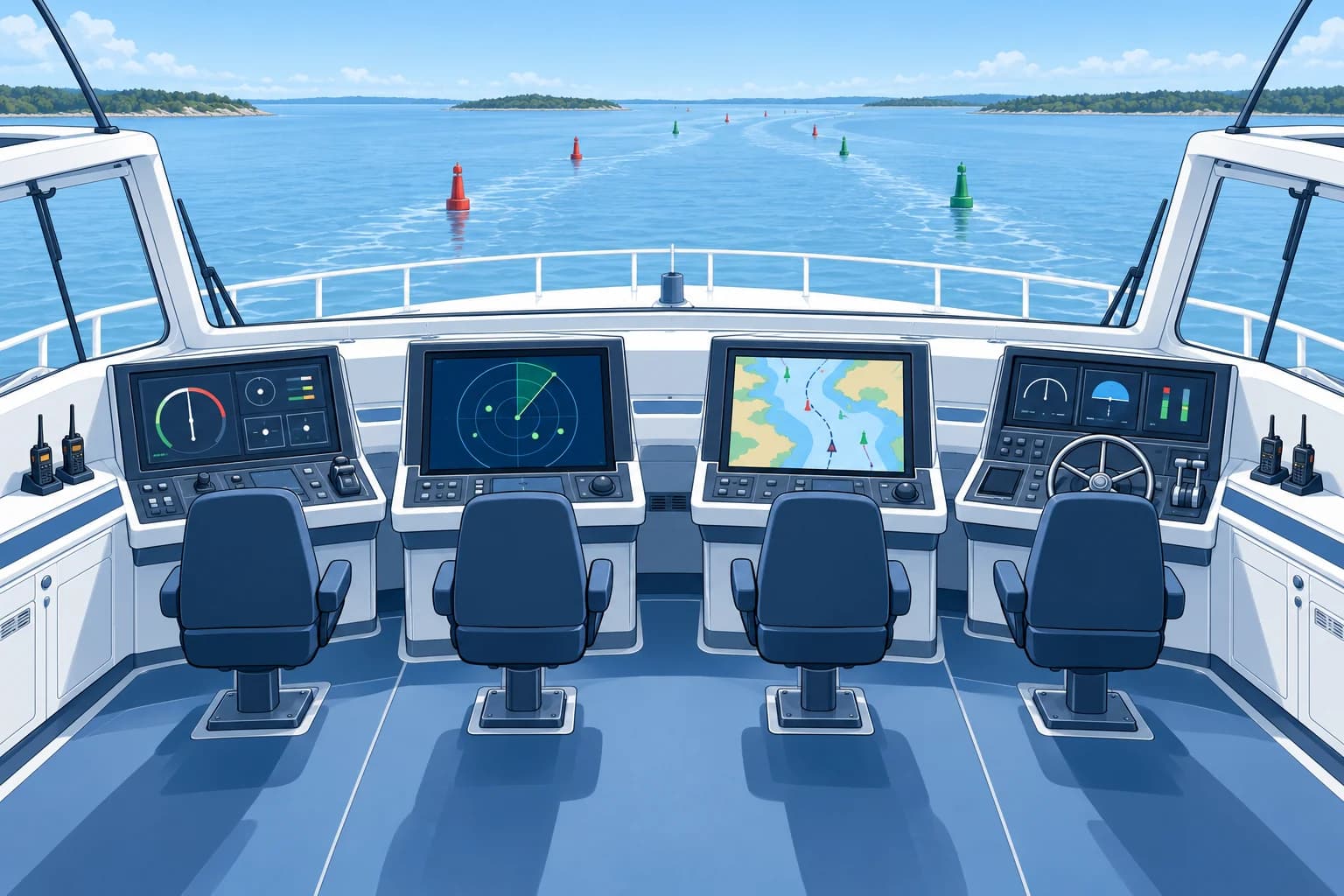
Bridge resource management (BRM), also called bridge team management (BTM), is the use of all resources on the bridge: people, equipment and information. STCW table A-II/1 makes it part of the OOW's competence: allocating and prioritising resources, communicating, being assertive and leading, and keeping situational awareness. Situational awareness means knowing what is going on around you; human factors covers it in depth. BRM aims to catch one person's error before it becomes an accident.
Roles
A typical team in pilotage waters: the master holds the con or oversees; the OOW monitors position and traffic and keeps the log; the helmsperson steers; the look-out reports; the pilot advises. Each role is stated in the briefing before arrival or departure. The navigator role is to monitor the ship's position against the plan and call out any deviation.
Shared mental model
Before a critical stage, brief everyone on the route, turns, traffic and roles. Set limits such as minimum under-keel clearance (water beneath the keel) and maximum cross-track distance (distance sideways from the planned track). Agree abort points, where you stop or change the operation if limits cannot be met. This creates a shared mental model: everyone understands the same plan and can spot deviations.
Closed-loop communication
In a closed loop, you give an instruction, hear the read-back and correct any error. The receiver acts and reports completion; you acknowledge. For example: "Check our position." "Check our position." "Position checked; we are on track." "Understood." Use the IMO Standard Marine Communication Phrases (SMCP) where applicable, with names and short, clear phrases. Never assume an instruction was heard.
Challenge and response
Any team member who sees a problem must speak up: name the person, state the fact, say the risk, propose an action. 'Master, our cross-track distance exceeds the agreed limit. We risk leaving safe water; I recommend following our briefed contingency.' If there is no response, repeat it more firmly. The leader welcomes challenges and answers them. Escalate and take immediate safety action when needed.
Challenge and response, step by step
- Get the person's attention by name or rank. — A challenge nobody hears is no challenge.
- State what you see as a fact, with numbers. — Facts are harder to dismiss than feelings.
- Say the risk you think it creates. — The other person may not have made the link.
- Propose a clear action. — A proposal gives the leader something to accept or reject at once.
- Seek an answer and escalate; take immediate safety action if needed. — Silence is not agreement, and time is short.
Remember
- BRM uses all people, equipment and information on the bridge to catch errors early.
- Brief the plan, limits and roles so the team holds a shared mental model.
- Closed loop: instruction, read-back, correction if needed, action, report, acknowledgement.
- Anyone may challenge: name, fact, risk, proposed action, answer.
- State who has the con and who monitors position and traffic before each critical stage.
Common mistakes
Wrong: Juniors should not question the master or the pilot.
Right: Everyone must speak up with facts. A good leader expects and answers challenges.
Wrong: A briefing is only needed for the pilot.
Right: Brief the whole team on route, limits, abort points and roles before each critical stage.
Wrong: If a team member acts, there is no need to hear the read-back.
Right: Read-back exposes a misheard instruction. Check it and correct any error before action.
Worked case
Departure briefing done. Halfway down the channel the master orders a turn to port. You see on the electronic chart that the planned position for starting the turn is still 0.4 nautical miles ahead. The helmsperson repeats the order. What do you do?
Show the answer
Challenge now: "Master, the planned start of the turn is still 0.4 nautical miles ahead. We are turning early; I suggest stopping the turn." Seek a clear answer and check any revised plan against the position and agreed limits. If unanswered, repeat firmly. If danger becomes immediate, take or ensure the necessary safety action and state it aloud. Keep monitoring; repeated challenges must never delay urgent action.
Practice question
What is the purpose of bridge resource management?
- To reduce the number of officers needed on watch
- To use people, equipment and information to catch errors
- To make the master the only decision-maker on the bridge
- To replace the passage plan with a verbal briefing
Show the answer
Answer: B. BRM uses all available resources, including every team member, so that one person's mistake is caught before it leads to an accident.
4 · Rest hours
Hours of rest: STCW A-VIII/1 and MLC Standard A2.3, with a worked check
Check rest against four limits: 10 h in any 24 h from at most two periods, one ≥6 h; 77 h in any 7 days; no gap over 14 h.
STCW A-VIII/1
Every OOW, watch rating and person with safety, security or pollution-prevention duties gets at least 10 hours of rest in any 24 hours and 77 hours in any 7 days. The required 10 hours must fit into no more than two rest periods, one at least 6 hours long. The interval between consecutive rest periods must not exceed 14 hours. 'Any 24 hours' means any rolling window, not just the calendar day. Rest is off-duty time; short breaks do not count.
MLC Standard A2.3
The Maritime Labour Convention (MLC) lets the flag choose one of two regimes: maximum work of 14 hours in any 24 and 72 hours in any 7 days, or minimum rest of 10 hours in any 24 and 77 hours in any 7 days. The split and the 14-hour rule are the same. For watchkeepers, STCW always sets the rest limits, whichever MLC option the flag chooses.
Exceptions
Only the flag state may authorise STCW A-VIII/1 paragraph 9 exceptions. Weekly rest may fall to 70 hours for at most two consecutive weeks; before another weekly exception, allow at least twice the previous exception's duration. Separately, rest may be split into three periods in at most two 24-hour periods in any seven days: one period ≥ 6 hours, both others ≥ 1 hour; gaps ≤ 14 hours. The 10-hour daily minimum stays. MLC exceptions require collective agreements authorised or registered under flag-state law.
Drills and emergencies
Musters, fire and lifeboat drills are held so that they disturb rest as little as possible and do not cause fatigue. Drill time is work time and is recorded. A seafarer on call, for example for unmanned machinery space alarms, gets compensatory rest if called out during rest. In an emergency, or to help others in distress, the master may suspend the schedule. Afterwards everyone who worked in a rest period must get adequate rest.
Table and records
A table of shipboard working arrangements is posted in an easily accessible place. It shows each position's schedule at sea and in port, in the working language and English. Daily records of hours of rest are kept for each seafarer, in a standard format. You get a copy, endorsed by the master or a person authorised by the master, and by you. False records are a serious offence and hide fatigue.
Key figures
- Minimum rest
- 10 h in any 24 h and 77 h in any 7 days
- Split and gap
- Required 10 h in max two periods, one ≥6 h; rest gaps ≤14 h
- MLC work option
- Max 14 h work in any 24 h and 72 h in any 7 days
- STCW split exception
- Flag approval; ≤2 24 h periods/7 days; ≥6 h + ≥1 h + ≥1 h; gaps ≤14 h
- 4-on/8-off example
- Watch 0000–04 and 1200–16, day work 1100–12: rest 7 h + 8 h = 15 h
- Same example, weekly
- 15 h × 7 = 105 h ≥ 77 h; gap 1100–1600 = 5 h ≤ 14 h
Remember
- Four STCW checks: 10 h/24 h from at most two periods, one ≥6 h; 77 h/7 days; rest gaps ≤14 h.
- 'Any 24 hours' is a rolling window; check across midnight too.
- Drills are work time: plan them to keep the split legal.
- Flag-approved paragraph 9 exceptions keep 10 h/24 h and at least 70 h/7 days.
- Records are signed by you and the master or delegate; you keep a copy.
Common mistakes
Wrong: If total rest is 10 hours, the day complies.
Right: The required 10 h must fit into no more than two rest periods, one at least 6 h long. Also check gaps ≤14 h and weekly rest.
Wrong: Drills do not count, because they are required by SOLAS.
Right: Drill time is work time. Plan drills so they disturb rest as little as possible, and record them.
Wrong: Under an exception the 10 hours in 24 can be reduced.
Right: Paragraph 9 exceptions cover only the 77 h weekly figure and the split. The 10 h in any 24 h stays.
Worked case
You keep 6-on/6-off: watch 0000–0600 and 1200–1800. On Tuesday a fire drill runs 0900–1000. Check Tuesday against STCW A-VIII/1 paragraphs 2 and 3. Then suggest a better drill time.
Show the answer
Tuesday gives 3 h + 2 h + 6 h = 11 h, but the two longest rests give only 9 h: the ordinary split rule fails. Arrange your drill during normal duty with qualified watch cover. Include the cover officer’s hours and all other work. Preserving scheduled rest gives 12 h/day and 84 h/week; totals alone do not prove compliance. Check rolling windows, uninterrupted rest periods and gaps consistently under flag-state guidance.
Practice question
What minimum rest does STCW A-VIII/1 require for a watchkeeper?
- 8 h in any 24 h and 70 h in any 7 days
- 12 h in any 24 h and 84 h in any 7 days
- 10 h in any 24 h and 72 h in any 7 days
- 10 h in any 24 h and 77 h in any 7 days
Show the answer
Answer: D. The basic STCW and MLC rest limits are 10 hours in any 24 hours and 77 hours in any 7 days.
5 · Handover & port
Handing over the watch, and watches at anchor and in port
Take over only when you are fit, your eyes have adjusted and you have the full picture. Never hand over in the middle of a manoeuvre.

Before you take over
Arrive early. At night, let your eyes adjust to the dark first. Read the standing and night orders. The STCW Code says the relieving officer checks: the position, course, speed and draught (depth of the keel below the waterline); the planned track; tides, currents, weather and visibility and their effect; dangers expected during the watch; compass errors; the status of bridge equipment and engine controls; navigation lights; and ships in sight or nearby. Ask until the picture is clear.
When not to hand over
Do not hand over while a manoeuvre or other action to avoid a hazard is in progress. Wait until that action is complete. Do not hand over if you believe the relieving officer is unfit for duty, for example tired, ill or affected by alcohol. In that case, notify the master. You stay responsible until the officer taking over says 'I have the watch' and both understand it.
At anchor
Fix and plot the position after anchoring. Check holding frequently using bearings, transits (aligned fixed marks), radar ranges and GNSS (satellite navigation) anchor alarms. Keep a proper look-out and arrange periodic ship inspection rounds without leaving the watch unattended. Watch weather, tide and sea state. Notify the master and act if the ship drags. Keep engines at the readiness ordered. Show the right lights and shapes and make sound signals. A radar guard zone cannot replace the look-out.
In port
The master arranges a watch suited to the berth and cargo; ships with hazardous cargo need extra care. As deck OOW, you make rounds, tend moorings and the gangway as tide and cargo change the ship's height, and watch the draught and under-keel clearance. You oversee cargo work against the plan, keep lights and signals right and respond to emergencies. Pollution prevention and access control under the security plan are also part of the watch.
Safety margins and team
Confirm your relieving team is fit and their night vision is ready. Check how draught, fore-and-aft trim, sideways heel, water density and squat (settling deeper while moving) affect under-keel clearance, the water beneath the keel. Know bridge engine-control procedures and limitations. Check the safety precautions already in force.
Taking over the navigational watch
- Arrive early, fit and with night vision adjusted. — You cannot judge lights or targets with dazzled eyes or a tired mind.
- Read and sign the standing orders and night orders. — The master's instructions for the watch are part of the picture.
- Check position, course, speed, planned track and dangers ahead. — You must know where the ship is and where she is going.
- Check traffic, weather, tide and current, and their effect. — These change course made good and the risk of collision.
- Check equipment, compass errors, engine and steering status, and lights. — A hidden fault found at handover is a fault you can manage.
- Take over with a clear 'I have the watch' only when no manoeuvre is under way. — Responsibility must change at one clear moment, never mid-action.
Remember
- The relief checks position, track, dangers, weather, traffic, equipment and errors before taking over.
- No handover during a manoeuvre or avoiding action; defer it until complete.
- Do not hand over to an officer you believe is unfit; notify the master.
- At anchor: fix, check holding frequently, look-out, notify the master if dragging.
- In port: rounds, moorings, gangway, draught, cargo plan, signals and security.
Common mistakes
Wrong: The handover happens on the hour, whatever is going on.
Right: If a manoeuvre or avoiding action is in progress, the relief waits until it is complete.
Wrong: At anchor, a radar guard zone is enough to watch for dragging and traffic.
Right: Check bearings, transits and ranges frequently and keep a look-out. Guard zones miss small targets.
Worked case
It is 2358. You are about to hand over, and a fishing vessel is crossing close ahead. You have just ordered 'starboard twenty' to give way. The relieving officer is on the bridge, yawning and complaining he slept badly. What do you do?
Show the answer
Keep the watch. Finish the avoiding action and steady the ship before any handover. Then assess the relief: if you believe he is not fit, do not hand over; keep the watch and notify the master. If he is fit, brief him fully: position, track, traffic, the fishing vessel's movement and the orders. Hand over with a clear 'You have the watch' and an answer.
Practice question
The ship is altering course to avoid a vessel when your relief arrives. What do you do?
- Hand over at once so the relief can finish the turn
- Ask the master to decide who completes the turn
- Complete the avoiding action before handing over
- Hand over the radar first and the helm afterwards
Show the answer
Answer: C. The relief of the OOW is deferred until a manoeuvre or other avoiding action has been completed.