
Maritime law, rules and watchkeeping · Level R2 · 4 parts · about 15 min
Germany: the inland rules (BinSchStrO) where they differ from CEVNI
4 short parts: Which rules · Small craft · Licences · Papers & marks. Each part explains the idea, then gives the points to remember, the common mistakes, a worked case and a practice question; the Academy unit adds all 26 check questions.
1 · Which rules
Which rule book applies on Germany's inland waters
BinSchStrO covers most federal inland waters, including Chapter 28 on the German Danube. The Rhine and Mosel have separate police regulations.
Built on CEVNI
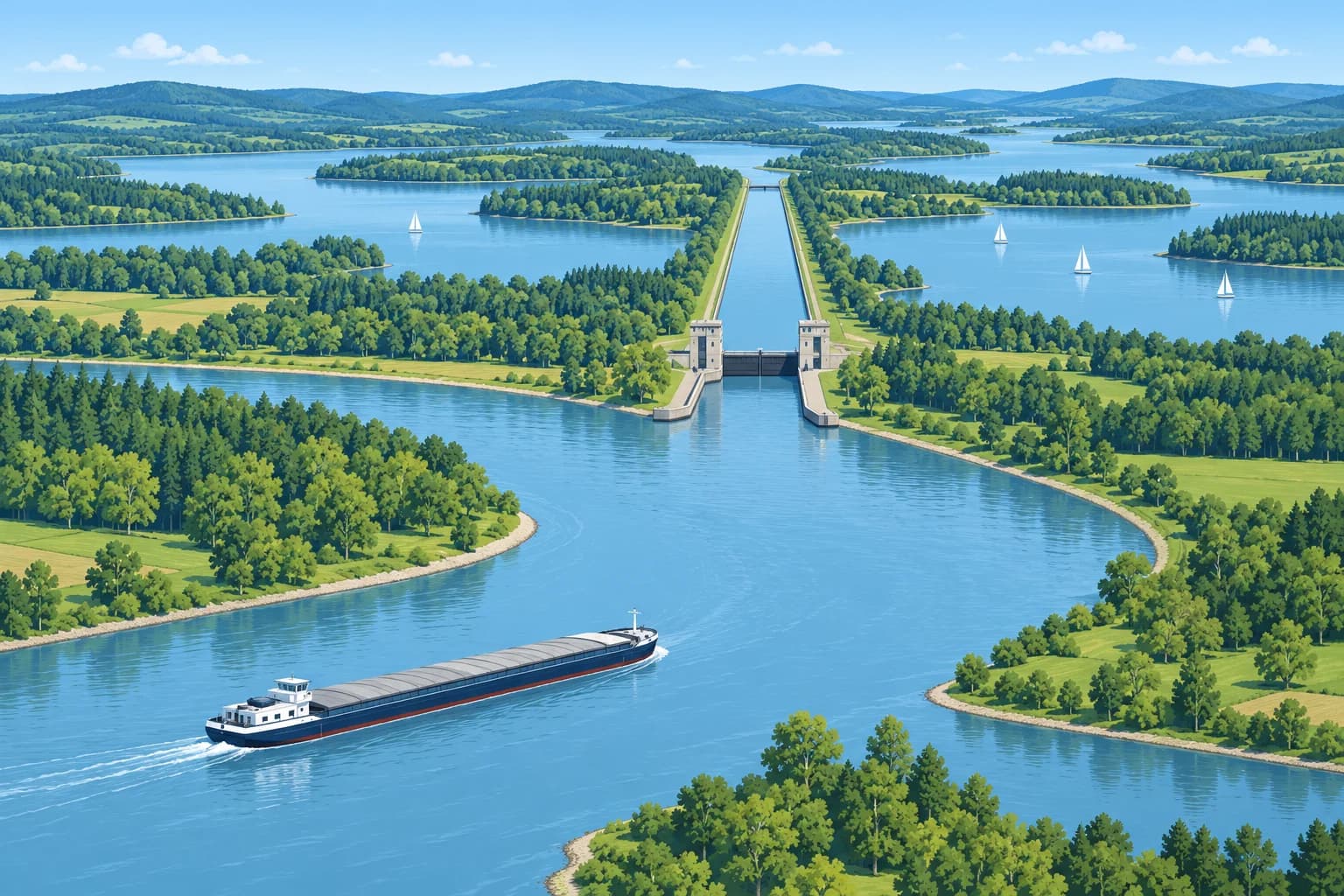
The BinSchStrO (Binnenschifffahrtsstraßen-Ordnung) is Germany’s inland waterways order. Its common part follows CEVNI, the UNECE European inland code. Lights, signs, sound signals and most traffic rules therefore match the basics in Navigation: CEVNI. Here you learn what to check for a trip in Germany.
Regional chapters
After the common part come chapters for each waterway region: Elbe, Berlin and Brandenburg, Mecklenburg, the West German canals, the Oder and more. They set local speed limits, overtaking bans, lock rules and closures. Before a trip, read the chapter for your waters, and check ELWIS (the federal waterways information service) for current notices.
Which regulations
The Rhine follows the RheinSchPV (Rhine police regulations), and the Mosel follows the MoselSchPV (Mosel police regulations). On the German Danube between Kelheim and Jochenstein, read BinSchStrO and its Chapter 28.
Lake Constance and state waters
Lake Constance (Bodensee) has a separate order agreed by Germany, Austria and Switzerland, and its own licence, the Bodensee-Schifferpatent. The SBF Binnen (inland sport-boat licence) is not automatically valid there. Lakes and rivers that are not federal waterways, such as many Bavarian lakes, follow state law. Some ban engines altogether.
Alcohol
You may not act as skipper or steer at 0.5 ‰ blood alcohol or 0.25 mg/l breath alcohol, or above. The prohibition for THC, cannabis’s intoxicating substance, starts at 3.5 ng/ml in blood serum, except for correctly taken medicine prescribed for a specific illness. You must not act as skipper or steer while impaired. On the Oder and Neisse border waters, the skipper’s ban starts at 0.2 ‰. The skipper must prevent impaired crew from steering.
Key figures
- BinSchStrO
- Of 16.12.2011, in force 1.2.2012, last amended 14.10.2025
- Own police regulations
- Rhine (RheinSchPV), Mosel (MoselSchPV)
- Lake Constance
- Own order and own licence (Bodensee-Schifferpatent)
- Alcohol limit
- 0.5 ‰ / 0.25 mg/l; 0.2 ‰ on the Oder border waters
Remember
- The BinSchStrO follows CEVNI in its common part; local rules sit in regional chapters.
- Rhine and Mosel: separate police rules. Danube, Kelheim–Jochenstein: BinSchStrO and Chapter 28.
- Lake Constance has separate licence rules; check which licence your boat requires.
- Non-federal lakes follow state law, and some ban engines.
- Alcohol limit 0.5 ‰ or 0.25 mg/l; 0.2 ‰ for the skipper on the Oder border waters.
Common mistakes
Wrong: The BinSchStrO applies on the Rhine like everywhere else inland.
Right: The Rhine has its own police regulations, the RheinSchPV. They are close to the BinSchStrO, but check the Rhine text for local rules.
Wrong: My SBF Binnen lets me drive a 40 hp boat on Lake Constance.
Right: Lake Constance has its own order and licence. You need the Bodensee-Schifferpatent there, or a licence it recognises.
Worked case
You plan a week from Berlin up the Havel to the Mecklenburg lakes, then a day trip on the Oder. Your crew asks which rules to read. What do you tell them?
Show the answer
Check which stretches are federal waterways. On federal sections, read the BinSchStrO common part and the relevant Berlin/Brandenburg, Mecklenburg and Oder regional chapters. For other lakes, check state rules. Check ELWIS for current notices on federal waterways. On the Oder border waters, the skipper’s alcohol limit is 0.2 ‰.
Practice question
Your regional chapter permits passage, but a current ELWIS notice closes the stretch. What do you do?
- Follow the closure and change your plan
- Continue using the published chapter
- Continue if no other boat is approaching
- Ask another skipper which rule to use
Show the answer
Answer: A. A current closure affects your trip even if the regional chapter normally permits passage. Follow the closure and change your plan.
2 · Small craft
Small craft rules: keep clear of shipping, and who gives way among small boats
A small craft is under 20 m, with exceptions. Leave vessels not classed as small craft room. Blue-board rules do not apply; small boats have their own give-way order.
What counts as small
A Kleinfahrzeug (small craft) is a vessel with hull length under 20 m, excluding rudder and bowsprit, the spar projecting from the bow. Exceptions include vessels authorised to tow, push or carry alongside non-small craft, vessels authorised for more than 12 passengers, ferries, push barges and floating equipment.
Leave room
You must leave vessels not classed as small craft the room they need for their course and manoeuvres. You cannot demand that they give way. You must give way early to starboard to a vessel showing the blue flashing light (police and emergency boats). If you cannot, show clearly how you will give way.
Blue-board meetings
Blue-board meeting rules do not apply to small craft or towards them. Do not treat a blue board as an instruction to you. Keep clear and leave vessels not classed as small craft the room they need.
Among small craft
Power gives way to muscle and sail; muscle gives way to sail. When meeting, the give-way boat turns to starboard early unless nautical conditions prevent it; then make the alternative clear. Two powered boats, or two muscle-powered boats, meet port to port. When two powered boats or two muscle-powered boats cross with collision risk, give way to the boat on your starboard side.
Under sail
Your tack is the side the wind comes from. Windward means nearer the wind’s source; your windward side is opposite your mainsail (main sail). Opposite tacks: port gives way. Same tack: the windward boat gives way. On port tack, give way if unsure of a windward boat’s tack. Under sail, overtake another sailing boat to windward. When beating close-hauled, do not tack across so that a small craft holding its starboard bank must give way.
Speed near people
Near a bathing shore, a campsite or set fishing gear, a small motorboat may go only as fast as it needs to steer. Do not obstruct or annoy other boats by circling them, or cruise around near fishing gear. Leave people enough room to avoid danger from wash or suction. With an engine fitted, the usual minimum helm age is 16; a restricted exception for holders of a qualifying club card starts at 12 (§ 1.09(5)).
Key figures
- Small craft
- Hull < 20 m, excluding rudder/bowsprit; statutory exceptions apply
- Minimum helm age
- Normally 16; restricted youth exception from 12
- Small craft give-way order
- Power gives way to muscle and sail; muscle to sail
- Near bathers and campsites
- Only steerage speed for small motorboats
Remember
- Leave vessels not classed as small craft the room they need; you cannot demand that they give way.
- Give way early to starboard to any vessel with a blue flashing light.
- Blue-board meeting rules neither apply to nor are used towards small craft.
- Among small craft: power gives way to sail and muscle; muscle gives way to sail.
- Under sail: port tack gives way; on the same tack, windward gives way. Overtake another sailing boat to windward.
Common mistakes
Wrong: The barge shows a blue board, so I should pass it starboard to starboard as it asks.
Right: The blue-board meeting rules do not apply to your small craft. Leave the barge room for its course and manoeuvres.
Wrong: Under sail I have right of way over a barge, as at sea.
Right: A small craft must leave vessels not classed as small craft the room they need, whatever their propulsion. Sail-over-power applies among small craft.
Wrong: My 12-year-old can steer our hire motorboat while I watch.
Right: The usual minimum helm age with an engine fitted is 16. Ordinary parental supervision alone does not qualify for the restricted club-card exception from 12 in § 1.09(5).
Worked case
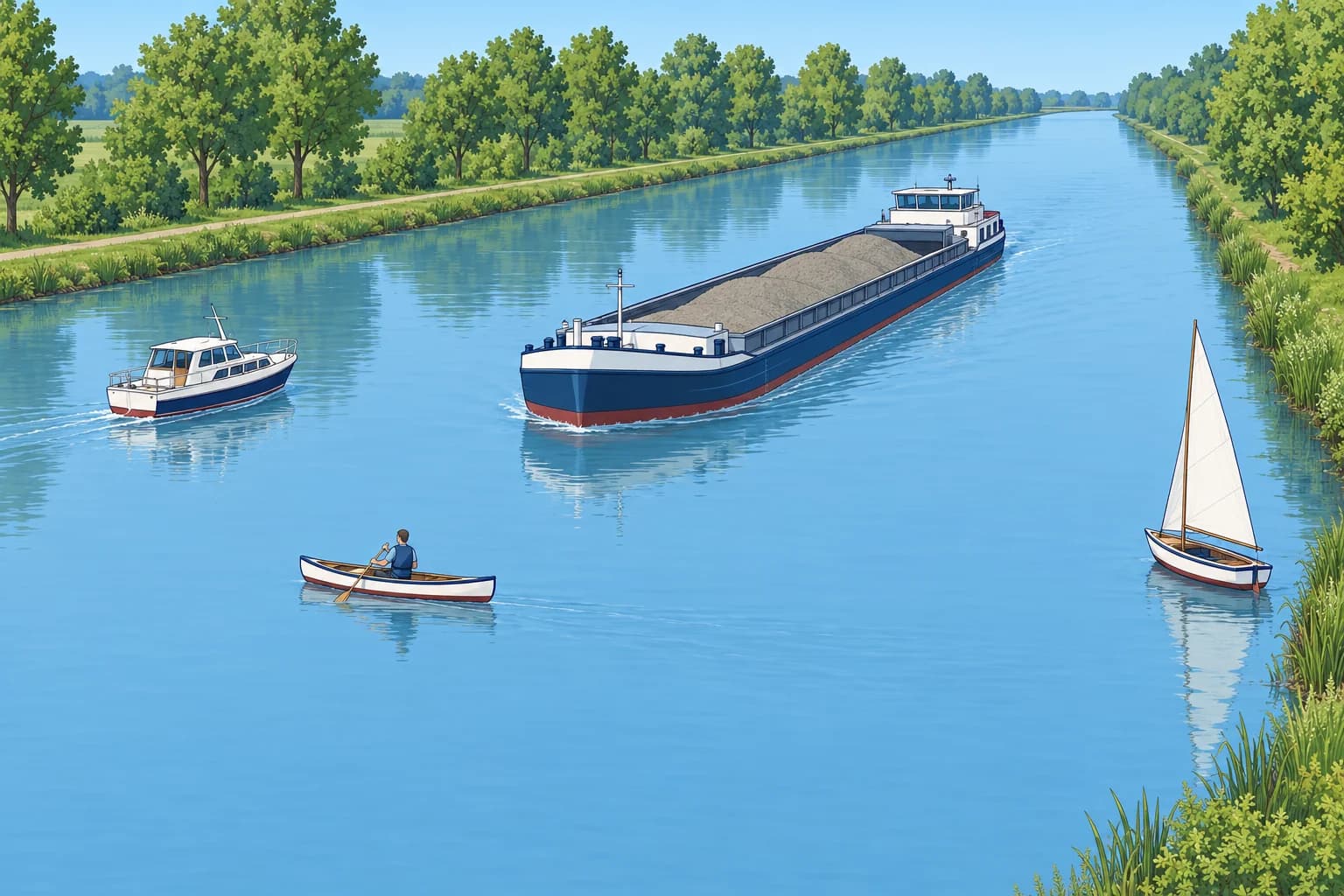
In open water on a lake governed by BinSchStrO, you motor a 9 m cruiser. A canoe crosses from left to right, a laden barge closes from astern, and a sailing dinghy approaches on a collision course. Who gives way?
Show the answer
Leave the barge the room it needs. Among the small craft, your powered cruiser gives way to both the canoe and the sailing dinghy. Slow down or pass astern of the canoe. If the canoe and dinghy risk collision, the canoe gives way to the dinghy. Keep your own manoeuvre clear and early.
Practice question
Under the BinSchStrO, what is a small craft?
- Hull under 20 m, with statutory exceptions
- Hull under 15 m, whatever its authorised use
- Hull under 7 m, including all passenger boats
- Any unpowered boat, whatever its hull length
Show the answer
Answer: A. A Kleinfahrzeug has hull length under 20 m, excluding rudder and bowsprit. Exceptions include vessels authorised to tow, push or carry alongside non-small craft, vessels authorised for more than 12 passengers, ferries, push barges and floating equipment.
3 · Licences
SBF Binnen, motor limits and the charter certificate
On boats under 20 m, you need the SBF Binnen above 11.03 kW combustion or 7.5 kW electric. Sail and charter rules depend on the waters.
Engines
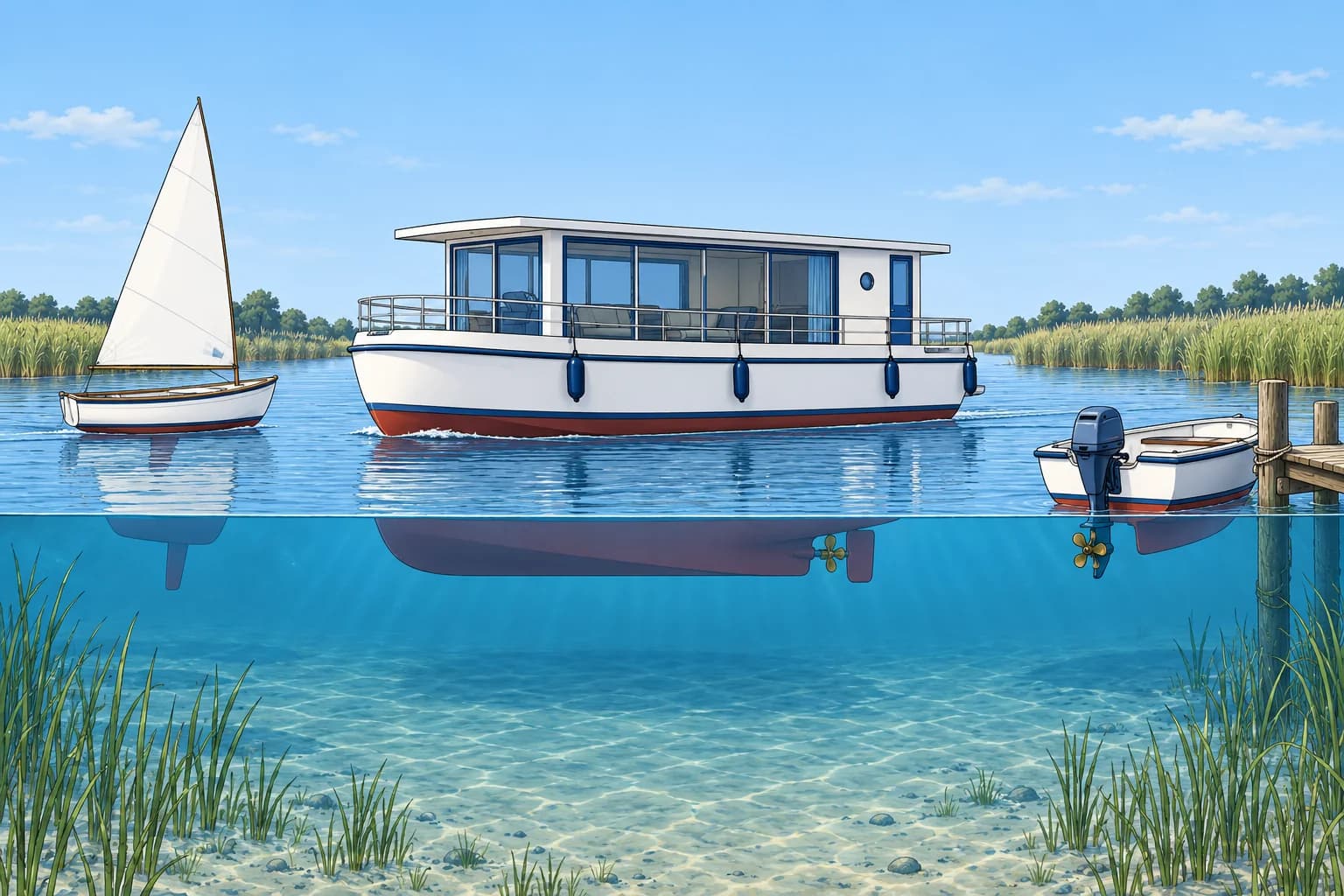
On federal inland waterways, a pleasure boat under 20 m needs the motor entitlement on the SBF Binnen (inland sport-boat licence) if the engine’s maximum power is over 11.03 kW (15 metric hp/PS, combustion) or 7.5 kW (electric, continuous rating). At or under those values the boat is licence-free, but the minimum helm age is normally 16; the restricted youth exception starts at 12. The test is the engine fitted, not whether it runs.
Sail
Under the SpFV (Germany’s pleasure-craft licensing rules), a sailing licence is required only on listed Berlin-area waterways. These include Wannsee, Tegeler See and Müggelsee in Berlin, and Griebnitzsee and Kleinmachnower See in Brandenburg. Sail-only boats with at most 6 m² need no sail licence. A fitted engine can independently require motor entitlement. Windsurf boards need no sail licence. Minimum licence ages: 16 for motor, 14 for sail.
The Rhine since 2023
Until 2023 the Rhine had stricter rules: a licence from 3.68 kW and only boats under 15 m. Since 1 April 2023 the Rhine follows the same thresholds as other federal waterways, and the SBF Binnen covers boats under 20 m there. The SBF Binnen does not cover boats of 20 m or more.
Charter certificate
A hire firm may let you drive a boat under 15 m without a licence on a Charterbescheinigung (charter certificate). It works only on listed waters, such as the Mecklenburg lakes and many Brandenburg waterways. The boat must have fixed berths and have its maximum speed limited to 12 km/h in still water. You get at least three hours of briefing, and no driving at night or in poor visibility. It is not a licence: it covers that boat, those waters and those dates.
Visitors
If you live outside Germany and visit for no more than a year, check your country of residence. If it officially requires a certificate for that boat, or applies UNECE Resolution 40, carry the relevant national certificate or an ICC (International Certificate of Competence) valid for inland waters and your propulsion. Resolution 40 is the international framework for the ICC. Otherwise this visitor exemption requires no German licence.
Key figures
- Licence-free engine
- Up to 11.03 kW combustion or 7.5 kW electric, boat under 20 m
- Minimum licence age
- 16 for engine, 14 for sail
- Sail licence needed
- SpFV: listed Berlin-area waters, sail-only boats over 6 m² of sail
- Charter certificate
- Boat under 15 m; 12 km/h in still water; listed waters; ≥ 3 h briefing
- Rhine aligned
- Same thresholds since 1 April 2023
Remember
- SBF Binnen needed above 11.03 kW (combustion) or 7.5 kW (electric) on boats under 20 m.
- SpFV: sail licence on listed Berlin-area waters; sail-only ≤ 6 m² exempt. A fitted engine can require motor entitlement.
- Since 1 April 2023 the Rhine uses the same thresholds as other federal waterways.
- Charter certificate: hire boat under 15 m, maximum 12 km/h in still water, listed waters, daytime only.
- Visitors living abroad, up to a year: check residence and Resolution 40 rules; certificates must cover inland use and propulsion.
Common mistakes
Wrong: The charter certificate is a licence I can use on my own boat later.
Right: It covers only the hired boat, the listed waters and the dates on it. It is not a licence.
Wrong: On the Rhine any boat over 5 hp needs a licence.
Right: That was the rule until 2023. Since 1 April 2023 the Rhine uses the same 11.03 kW and 7.5 kW thresholds as other federal waterways.
Worked case
A family from Hamburg, none with a licence, wants a week on the Müritz in a 12 m houseboat from a charter base, then a day on the Wannsee in a hired 6 m sailing boat with 10 m² of sail. What can they do?
Show the answer
Hire only if the firm confirms berths, a maximum speed of 12 km/h in still water and charter-certificate cover for your route. Complete at least three hours of briefing; travel by day in good visibility. Ask the firm to explain every route and weather restriction before booking. On Wannsee, the 10 m² sailing boat needs a skipper with SBF Binnen sail entitlement; check any fitted engine separately.
Practice question
Your 9 m boat has an 8.0 kW continuous-rated electric motor fitted. You sail with it switched off. Do you need motor entitlement?
- No, because the fitted motor is switched off
- Yes, because the fitted motor exceeds 7.5 kW
- No, because the boat’s hull is under 20 m long
- Only if the planned voyage includes the Rhine
Show the answer
Answer: B. The fitted motor determines the requirement, even when switched off. Its continuous rating exceeds 7.5 kW.
4 · Papers & marks
Boat marks, papers, water skiing and jet skis
Check your boat’s mark and papers. Water skiing needs E.17; jet skis need E.22, with limited exceptions for access, touring and ski towing.
The official mark
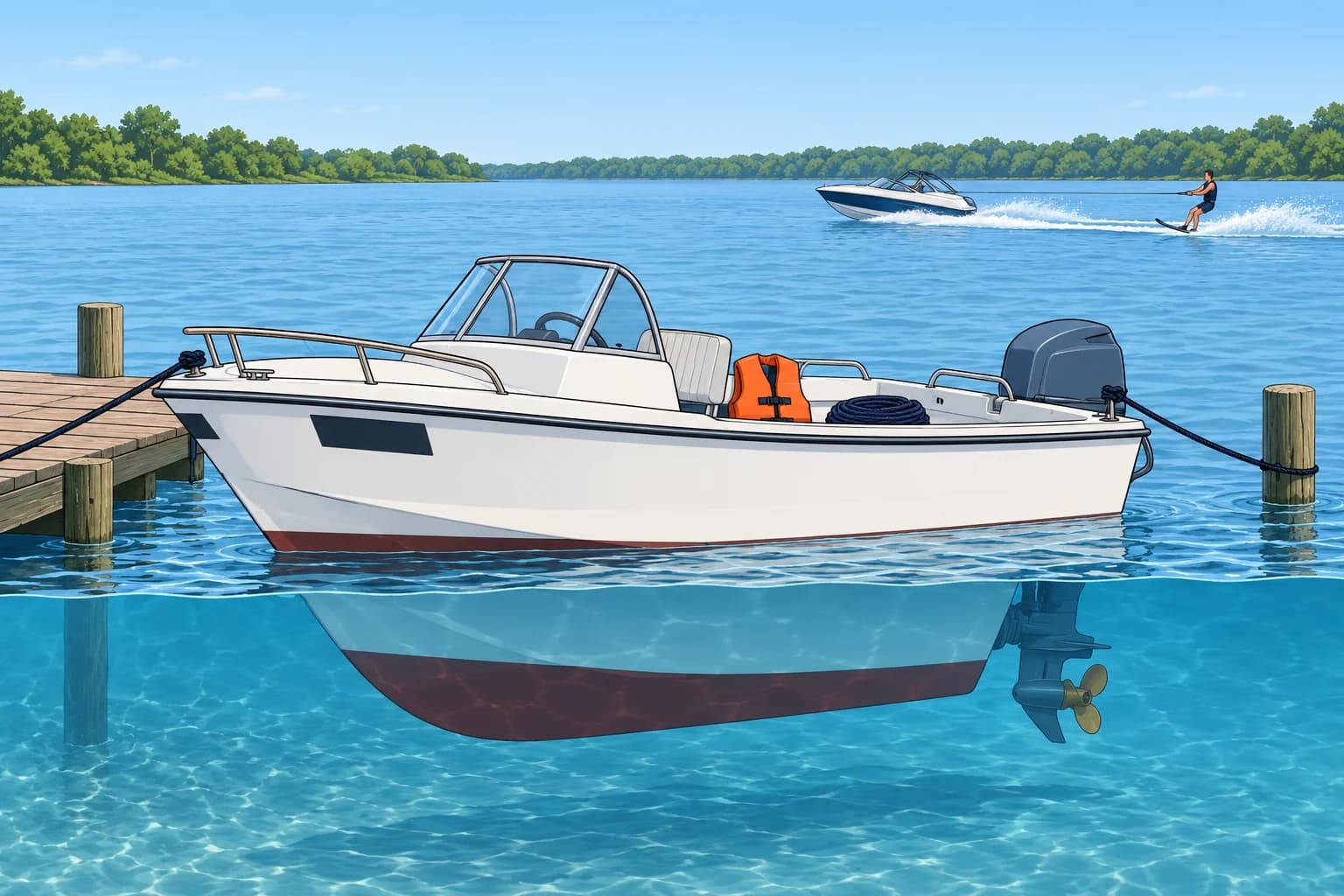
German small craft on federal inland waterways need an official or officially recognised mark (Kennzeichen). Waterways offices issue official marks. A recognised mark is your IBS (Internationaler Bootsschein, international boat certificate) number plus A for ADAC, M for DMYV or S for DSV. Exempt: muscle-only boats, sail-only boats up to 5.5 m, engines up to 2.21 kW, and ship’s tenders, boats serving a larger vessel. Jet skis always need an official mark.
How it is shown
Display the mark on both sides at the bow or stern, or on the transom (the flat stern face). Use contrasting characters at least 10 cm high. Exempt craft need a permanent contrasting name outside, in letters at least 10 cm high, and the owner’s name and address permanently inside or outside. Sailboards and similar craft are excepted. Tenders need only owner identification.
Papers on board
Carry the papers the rules require for your boat: the certificate for its mark and your licence or charter certificate. A motorised hire boat not hired only by the hour also carries the rental-regulation text and a certified copy of its Bootszeugnis, the hire-boat certificate. Show them to the water police on request.
Water skiing and jet skis
Water skiing needs an E.17 stretch; jet-ski riding needs E.22. Outside E.22 areas, a jet ski may take the shortest way from the nearest launch site to a designated area, or make a tour, on a clear straight course. It may also tow a skier on an E.17 stretch. Wait more than one hour before repeating the same or largely the same tour. Check ELWIS for designated stretches.
Gear
There is no universal equipment checklist for ordinary private small craft. Your boat must still be safely equipped under BinSchStrO, including the lights and sound-signalling equipment applicable to it. Hire firms must keep suitable lifejackets in different sizes at their base and provide them free on request, unless the boat certificate already requires them aboard.
Foreign visitors
For up to one year after entry, the exemption requires both a foreign home port and an owner living abroad, with reciprocity: each country accepts the other’s boats on equivalent terms. If home law requires a mark, display it with the nationality identifier. Otherwise show the boat’s name and home port outside in letters at least 10 cm high, and the owner’s name and address permanently inside in a clearly visible place.
Key figures
- Mark exemptions
- Muscle only; sail only ≤ 5.5 m; engine ≤ 2.21 kW; ship’s tenders
- Mark letters
- At least 10 cm high, on both sides or on the transom
- Recognised as a mark
- IBS number plus issuing letter A, M or S
- Water skiing / jet skis
- Skiing: E.17; jet skis: E.22, plus access, touring and E.17 ski towing
- Visiting foreign boats
- Up to one year, subject to foreign-visitor marking conditions
Remember
- Most German motorboats inland need an official or recognised mark; an IBS mark is its number plus A, M or S.
- Mark exemptions: muscle-only boats, sail-only boats ≤ 5.5 m, engines ≤ 2.21 kW, and ship’s tenders.
- Other exempt craft need a name and owner details. Tenders need owner identification; sailboards and comparable craft are excepted.
- Skiing: E.17. Jet skis: E.22, plus permitted straight-course access/touring and ski towing on E.17 stretches.
- No universal checklist: BinSchStrO still requires safe equipment, including applicable lights and sound-signalling equipment.
Common mistakes
Wrong: My 3 kW outboard boat needs no mark because it is below the licence threshold.
Right: Only engines up to 2.21 kW are exempt. With 3 kW the boat needs an official or recognised mark, unless it is a ship's tender.
Wrong: A jet ski may ride anywhere on the river outside the shipping lane.
Right: Jet skis need E.22, except the shortest way from the nearest launch site to a designated area, or touring, on a clear straight course, and ski towing on E.17 stretches. Wait more than one hour before repeating the same or largely the same tour.
Worked case
You buy a used 5 m boat with a petrol outboard rated at 11.0 kW in Brandenburg. You want to tow your kids on a water ski on the Havel. The seller says no mark or paperwork is needed below the licence threshold. Is that right?
Show the answer
No. The 11.0 kW petrol engine is below the licence threshold, but above the 2.21 kW marking exemption. Get an official or recognised mark and carry its certificate. Water skiing is allowed only on stretches marked E.17; check ELWIS for the Havel.
Practice question
You hire a motorboat for a week. Which hire-specific documents must be aboard?
- Hire-boat rules text and a certified Bootszeugnis copy
- Hire-boat rules text only; the Bootszeugnis stays ashore
- Only a certified copy of the boat’s Bootszeugnis
- Neither, if the hire firm keeps both ashore
Show the answer
Answer: A. A motorised boat hired other than by the hour must carry the text of the hire-boat regulation and a certified copy of its Bootszeugnis, the hire-boat certificate.