
Maritime law, rules and watchkeeping · Level R4 · 4 parts · about 14 min
United States: federal rules for small passenger and uninspected vessels (46 CFR, 33 CFR)
4 short parts: Safety gear · Operating rules · Papers · Six-pack. Each part explains the idea, then gives the points to remember, the common mistakes, a worked case and a practice question; the Academy unit adds all 24 check questions.
1 · Safety gear
Federal required equipment
US federal law sets a short, strict list: life jackets, distress signals, fire extinguishers, ventilation and sound signals. Lengths are in feet unless stated.
Where the rules are
Federal recreational-boat equipment requirements appear in several rules, including 33 CFR 175 and 183 (CFR: Code of Federal Regulations). Carry equipment that meets the applicable standard and keep it serviceable. US rules use feet: 16 ft is about 4.9 m, 26 ft about 7.9 m, 40 ft about 12.2 m.
Life jackets
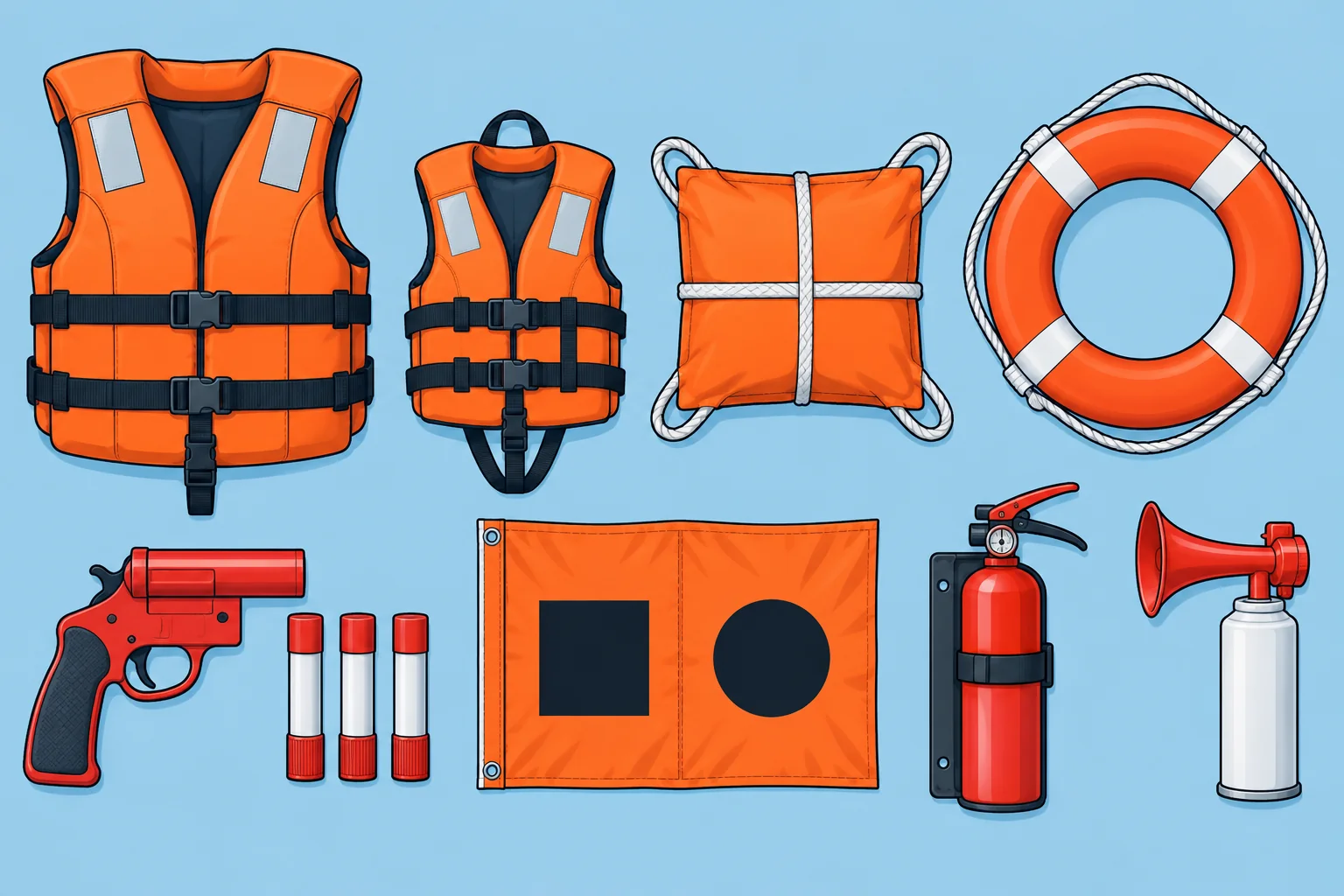
Carry one wearable US Coast Guard (USCG)-approved life jacket for each person, of the right size, readily accessible (not in plastic bags or locked lockers). Boats 16 ft and longer also carry one throwable device (a ring or cushion); canoes and kayaks are exempt from the throwable. Children under 13 must wear a life jacket while under way, unless below deck or in an enclosed cabin; a state's own child rule replaces this on its waters. Keep the throwable immediately available.
Visual distress signals
On coastal waters, the Great Lakes, the territorial sea and connected waters upstream to their first narrowing below 2 nautical miles (NM), carry approved day and night signals. If using pyrotechnics (burning signals such as flares), carry three unexpired signals per period; three dual-purpose flares cover both. Approved non-pyrotechnic alternatives are allowed. Day exemptions: boats under 16 ft, manually propelled boats, open sailboats under 26 ft without propulsion machinery, and boats in organised marine parades, regattas or races. These need night signals between sunset and sunrise.
Fire extinguishers
All motorboats 26 ft or longer need marine Class B extinguishers. Below 26 ft, an open outboard boat may be exempt if it cannot trap fuel vapour and has no permanent fuel tank. For model year 2018 and newer: one 5-B under 26 ft, two from 26 to under 40 ft, three from 40 to 65 ft inclusive. A qualifying fixed engine-space system reduces these counts by one; one 20-B replaces two 5-B. Disposable units expire 12 years after manufacture.
Ventilation, flame arrestors and sound
Ventilation removes explosive gasoline vapour. Enclosed spaces that can trap gasoline vapour need ventilation. On boats built after 31 July 1980, enclosed compartments with permanently installed gasoline engines and electric starters need powered exhaust blowers. Before starting, run the required blower for at least four minutes and check for fuel vapour. A backfire flame arrestor stops backfires igniting vapour; gasoline inboards need one or approved equivalent protection. Carry a sound-signalling device; from 12 m carry a whistle, and from 20 m add a bell.
Key figures
- Life jackets
- 1 wearable/person; throwable ≥16 ft except canoes/kayaks
- Children
- Under 13 on open deck under way; state rule may replace federal
- Distress signals (coastal)
- Day/night required; listed boats and events exempt by day
- Pyrotechnics
- 3 valid for day + 3 for night; 3 dual-purpose cover both
- Extinguishers (2018+ boats)
- 5-B where required: <26 ft: 1; 26–<40 ft: 2; 40–65 ft: 3
- Disposable extinguisher life
- 12 years from manufacture
Remember
- One wearable USCG-approved life jacket per person; throwable from 16 ft except canoes and kayaks.
- Children under 13 wear a life jacket under way unless below deck or in an enclosed cabin.
- Coastal distress signals: day and night; listed boats and organised events are exempt by day.
- 2018+ boats: 1 marine 5-B below 26 ft unless exempt; 2 at 26–<40 ft; 3 at 40–65 ft inclusive, before substitutions.
- Enclosed gasoline engine and fuel spaces need ventilation; gasoline inboards need backfire protection.
Common mistakes
Wrong: Life jackets stowed in their plastic bags are fine.
Right: They must be readily accessible, so out of bags and not under other gear or locked away.
Wrong: Small boats never need distress signals.
Right: On coastal waters, boats under 16 ft need night signals between sunset and sunrise.
Wrong: An old B-I extinguisher is fine on a 2020 boat.
Right: Use serviceable marine-rated 5-B or 20-B extinguishers on 2018+ boats. Disposable units need a legible manufacture date and must be within their 12-year life; rechargeable units need the required maintenance.
Worked case
Your 22 ft gasoline outboard boat (model year 2021) has a cabin and permanent fuel tank. You are the skipper, with four adult passengers and one 10-year-old. You head onto a coastal bay at dusk. What federal equipment do you need?
Show the answer
Six wearable life jackets of the right sizes, and one immediately available throwable. The child wears a jacket under way unless in the enclosed cabin. Carry approved day and night signals: three unexpired dual-purpose flares can cover both. One 5-B extinguisher, as the cabin and fixed tank are fire risks. Ventilation for the gasoline tank space and a suitable sound-signalling device.
Practice question
From what length must a recreational motorboat carry a throwable device?
- 12 ft
- 16 ft
- 20 ft
- 26 ft
Show the answer
Answer: B. 33 CFR 175.15: boats 16 ft and longer carry one throwable in addition. Canoes and kayaks are exempt.
2 · Operating rules
Boater education, alcohol, cut-off switches and accidents
There is no federal licence for recreational boating, but most states demand a boater education card. Federal law covers alcohol, the kill switch and accident reports.
No federal recreational licence
The United States has no federal licence to drive your own boat for pleasure. Each state decides. Most require a boater education card: proof that you passed a NASBLA-approved course (NASBLA: the National Association of State Boating Law Administrators). Many states tie it to your date of birth and engine power. In Florida, unless exempt, you need accepted boater-education proof if you were born on or after 1 January 1988 and operate a boat of 10 hp or more.
Visitors
State rules also apply to visitors. Many states accept a card from another state; some accept proof of a course from abroad. Check the state you visit. In Florida, a rental temporary certificate requires the approved test; a briefing alone is not enough. Carry accepted education proof and photo ID.
Alcohol
Boating under the influence (BUI) is a federal offence. For recreational operators, 0.08% blood alcohol concentration (BAC) is the federal numerical standard. You can also commit BUI below that level if alcohol or drugs impair your operation. Check applicable state law. Avoid alcohol when you operate.
Engine cut-off switch
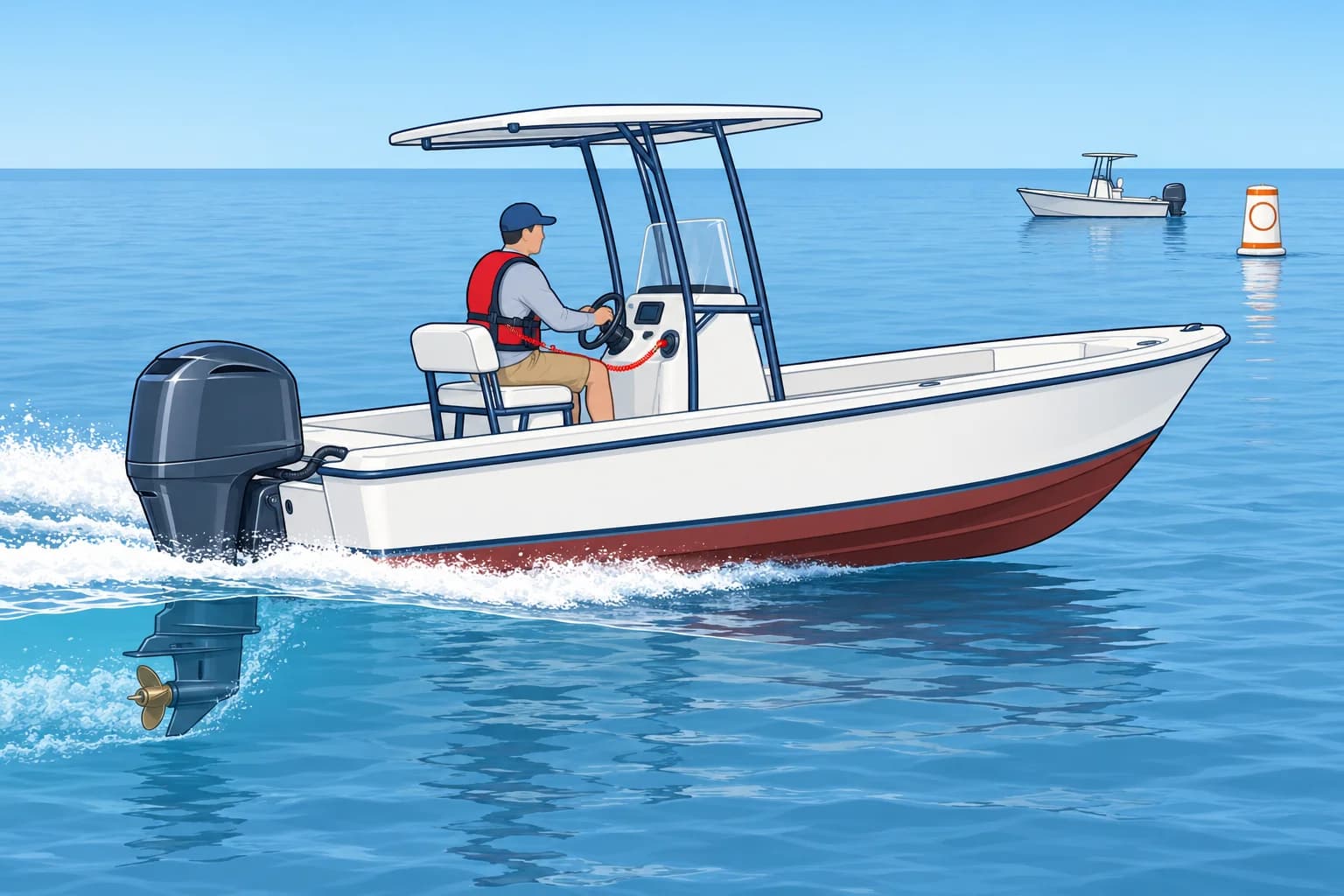
Since 1 April 2021, on a recreational boat under 26 ft with propulsion capable of at least 115 lb static thrust (about 3 hp), use the installed engine cut-off switch link (kill cord or wireless link) when on plane or above displacement speed. Static thrust measures pushing force while stationary. On plane means riding on top of the water; displacement speed is the hull’s normal speed while supported by buoyancy. An enclosed main helm (steering position) is exempt.
Accidents
Notify the authorities immediately of a death or disappearance. File a written boating accident report within 48 hours for disappearance, injury needing more than first aid, or death within 24 hours of the accident. Report other deaths, damage totalling $2,000 or more, or complete loss of the boat within 10 days. States may impose stricter requirements.
Key figures
- Federal licence for own boat
- None; states require boater education cards
- Florida example
- Unless exempt: born on or after 1 Jan 1988, 10 hp or more
- Alcohol (federal)
- 0.08% BAC; impairment below this can also be BUI
- Cut-off switch: <26 ft, ≥115 lb thrust
- Installed link, open helm: on plane or above displacement speed
- Accident report
- Death, missing, injury, $2,000 damage, total loss
Remember
- No federal licence for recreational boating: each state sets its rules.
- Most states require a NASBLA-approved boater education card, often by birth date.
- Federal BUI standard: 0.08% BAC; impairment below this can also be unlawful. State rules apply.
- With ≥115 lb thrust, under 26 ft and an open helm, use the fitted cut-off link on plane or above displacement speed.
- Report a death or disappearance at once; file a report for injury or $2,000 damage.
Common mistakes
Wrong: Without a federal licence, anyone may drive any boat anywhere.
Right: Most states require a boater education card. Check the state's rules before you drive.
Wrong: The kill cord is optional on a small boat.
Right: Under 26 ft, ≥115 lb thrust and an open main helm: use the installed switch link on plane or above displacement speed.
Wrong: Only an injury needing hospital admission must be reported.
Right: Report any injury needing more than first aid, damage of $2,000 or more, a death or a missing person.
Worked case
You visit Florida. Born in 1990, you rent a 19 ft open-helm centre-console with a 115 hp outboard and an installed cut-off switch. You have a European coastal licence. What must you have and do?
Show the answer
You need Florida’s boater education card or an accepted equivalent; check whether your foreign licence qualifies. A rental temporary certificate requires the approved test, not just a briefing. Carry the card or certificate with photo ID. Use the installed cut-off link on plane or above displacement speed: this open-helm boat meets the size and thrust conditions. Avoid alcohol when you operate; being below 0.08% BAC does not excuse impairment.
Practice question
Who sets recreational boater-education requirements in the US?
- The federal Coast Guard licence
- Each state, usually with a card
- The boat's insurance company
- The marina where you launch
Show the answer
Answer: B. There is no federal recreational licence. States require boater education cards, often by birth date.
3 · Papers
State numbering, federal documentation and pollution placards
Most US motorboats need state numbering or federal documentation. Placard duties depend on size; sewage rules also apply to small boats.
State numbering
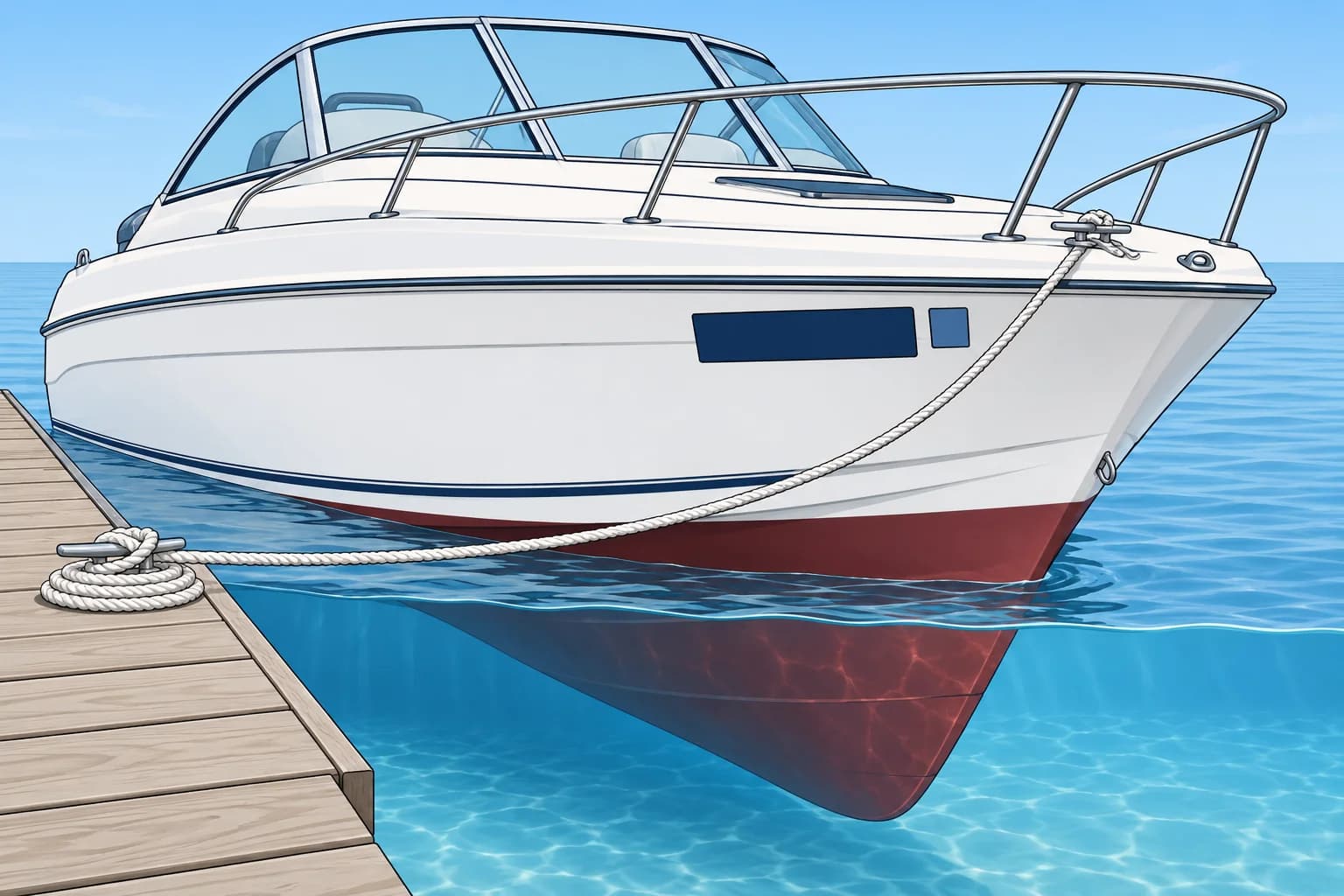
Unless federally documented or otherwise exempt, a recreational boat with propulsion machinery must be numbered in its state of principal use (33 CFR 173). Carry the state-issued Certificate of Number on board. Display the number on both sides of the bow in block letters at least 3 in (7.6 cm) high, with the state’s sticker next to it. Report a sale, an address change or theft within 15 days.
Federal documentation
A US-citizen-owned boat of at least 5 net tons (a measure of internal volume, not weight) may be Coast Guard documented. Carry the original, current Certificate of Documentation. Recreational validity is 1–5 years. Mark the name and hailing port (the place named as the boat’s home port) together on the exterior in letters at least 4 in high. Permanently mark the official number, preceded by NO., on a visible interior structural part in numerals at least 3 in high.
States still apply
A documented boat is not free of state taxes or equipment rules; many states also require registration and a sticker. It does not display state-assigned bow numbers.
Oil and garbage
Boats 26 ft and longer with a machinery space post an oil discharge placard (at least 5 × 8 in). US boats of 26 ft and longer post a garbage placard (at least 4 × 9 in). Ocean-going US boats of 40 ft and longer need a written waste management plan if engaged in commerce or fitted with a galley and berths. Plastic may never be thrown overboard.
Sewage
An installed toilet needs a marine sanitation device (MSD). Certified Types I and II treat sewage; Type III holds it for pump-out and needs no certification label. Boats over 65 ft use Type II or III. Never discharge untreated sewage within 3 NM of shore. Discharge treated sewage only where permitted; inland freshwater restrictions also apply. In No Discharge Zones, retain all sewage for pump-out and secure the system against discharge.
Key figures
- State number on the bow
- Block letters ≥ 3 in, both sides
- Documentation
- ≥ 5 net tons, US owners; 1–5 years (since Dec 2023)
- Oil placard
- Boats ≥ 26 ft with machinery space; ≥ 5 × 8 in
- Garbage placard
- Boats ≥ 26 ft; ≥ 4 × 9 in
- Waste management plan
- Ocean-going US boats ≥40 ft: commercial OR galley and berths
Remember
- Unless exempt, undocumented motorboats need state numbering; carry the Certificate of Number.
- Documented boats (≥ 5 net tons, US owners) carry the original Certificate of Documentation.
- Recreational documentation now lasts 1 to 5 years, as the owner chooses.
- Oil: 26 ft+ with machinery space. Garbage: 26 ft+. Waste plan: ocean-going US boats 40 ft+, commercial or galley and berths.
- Use a compliant MSD; discharge only where permitted. In No Discharge Zones, retain sewage and secure the system against discharge.
Common mistakes
Wrong: A documented boat needs nothing from the state.
Right: Many states still require registration and a sticker, and state taxes and equipment rules apply.
Wrong: A photocopy of the Certificate of Documentation is fine on board.
Right: Carry the original, current certificate. A photocopy is not accepted.
Wrong: Treated sewage may be discharged anywhere within 3 NM.
Right: Never discharge untreated sewage within 3 NM; treated discharge is allowed only where permitted. In No Discharge Zones, retain all sewage and secure the system against discharge.
Worked case
You buy a documented 34 ft cruiser with a galley, berths and a toilet. Your home state requires documented boats to register. Your first overnight stop is in a No Discharge Zone. What must you arrange before departure?
Show the answer
Transfer the documentation to your name; carry the original, current certificate, valid for 1–5 years. Register with your state and show its sticker, without state bow numbers. Post oil and garbage placards. Check the MSD complies and secure the system against discharge. At 34 ft, this boat does not trigger the 40 ft waste-plan requirement; retain sewage for pump-out in the zone.
Practice question
Which boat normally needs state numbering?
- An undocumented recreational motorboat
- A federally documented pleasure yacht
- An unpowered recreational rowing boat
- A federally documented sailing yacht
Show the answer
Answer: A. Unless exempt, an undocumented recreational motorboat needs numbering in its state of principal use. Documented boats may need state registration and stickers, but do not display state-assigned bow numbers.
4 · Six-pack
Paying passengers: the OUPV six-pack and inspected vessels
On a boat under 100 gross tons carrying any passenger for hire, up to six passengers in total needs an OUPV or higher; more than six needs inspection.
Who is a passenger for hire
Under federal law (46 U.S.C. 2101), a passenger for hire is someone whose carriage requires consideration: payment or another benefit. The passenger or someone else may provide it, directly or indirectly. Voluntary sharing of actual trip expenses, such as fuel and food, is excluded. A compulsory fuel contribution counts even without profit. The owner and master (skipper) are excluded. Working crew are excluded only if paid for onboard services and not paying for carriage; unpaid guests count.
The six-pack
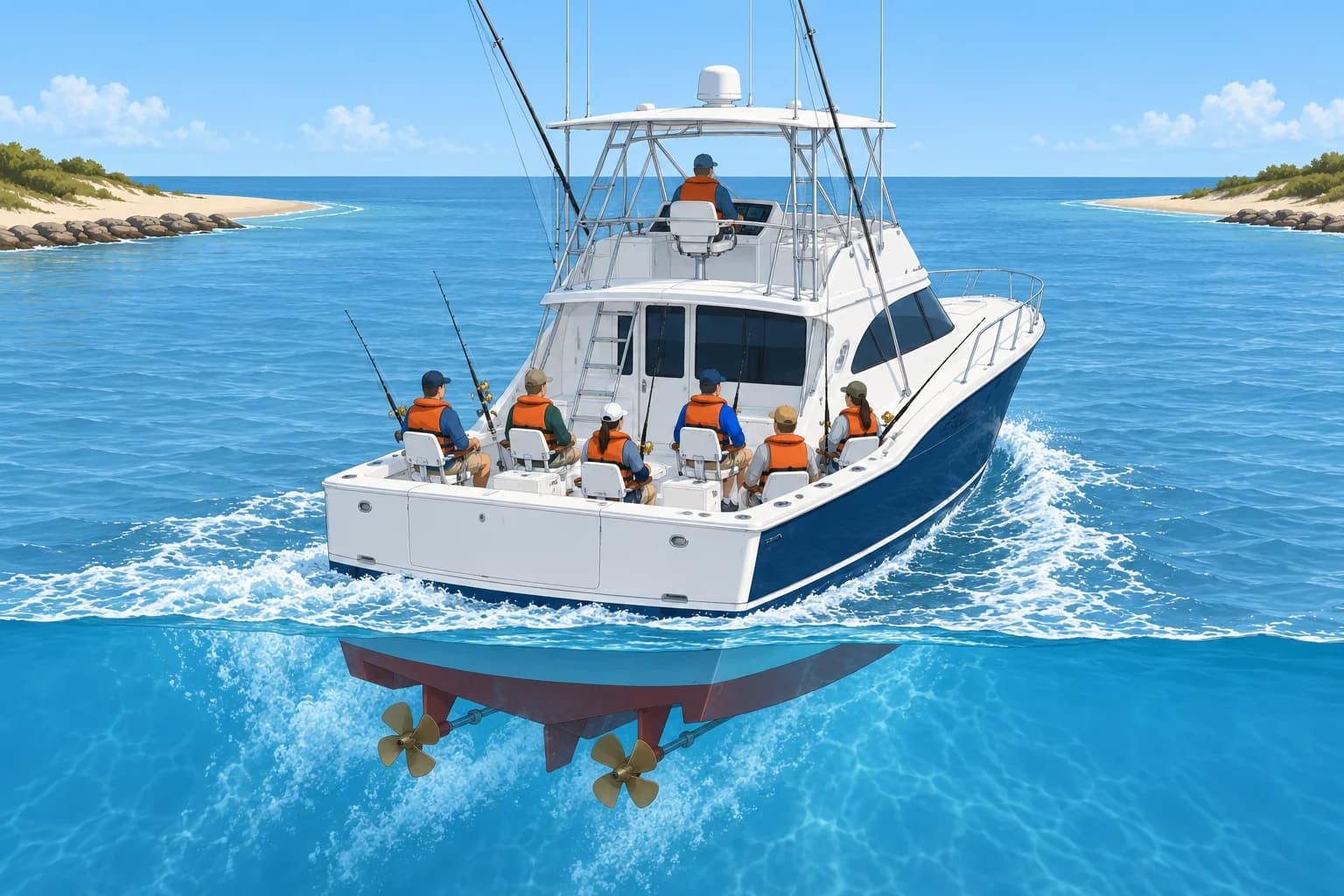
A boat under 100 gross tons (a measure of enclosed volume, not weight) carrying up to six passengers in total, at least one for hire, is an uninspected passenger vessel. The operator needs an OUPV endorsement (Operator of Uninspected Passenger Vessels), the “six-pack” licence, or a suitable higher credential. The boat does not need a Certificate of Inspection, but must meet uninspected-vessel equipment rules and may undergo Coast Guard safety checks.
More than six
An owner-operated boat under 100 gross tons with more than six passengers in total, at least one for hire, is a small passenger vessel. It needs Coast Guard inspection and a Certificate of Inspection (COI) specifying capacity, crew and route. Its operator needs a Master credential. A genuine bareboat charter transfers possession and control to the charterer; the owner neither provides nor specifies crew. Under 100 gross tons, more than 12 passengers requires inspection; the charterer may independently hire crew.
Getting the OUPV
You must be 18 or older, pass medical and drug tests, show first-aid training completed within one year of application and current cardiopulmonary resuscitation (CPR) certification, and pass the exam or an approved course. The near-coastal OUPV needs 360 days’ experience, including 90 on ocean or near-coastal waters and 90 in the last 3 years. It covers domestic voyages up to 100 nautical miles (NM) offshore and inland waters. Inland OUPV covers inland waters only. No OUPV permits international voyages.
Non-citizens
A non-US citizen can hold an OUPV only for boats that are not documented in the US, that is, state-numbered boats.
Key figures
- Uninspected passenger vessel
- <100 GT; ≤6 passengers total, ≥1 for hire; OUPV or higher
- Small passenger vessel
- <100 GT; >6 total, ≥1 for hire: inspected, COI
- Bareboat charter
- <100 GT; no owner-provided/specified crew; >12: inspection
- OUPV near-coastal
- Up to 100 NM offshore; no international voyages
- OUPV experience
- 360 days, 90 near-coastal, 90 in last 3 years
- Minimum age
- 18 for OUPV
Remember
- Payment required for carriage creates a passenger for hire; voluntary sharing of actual trip expenses is excluded.
- Under 100 gross tons: up to six passengers total, at least one for hire, requires an OUPV or suitable higher credential.
- Under 100 GT: more than six passengers total, at least one for hire, needs inspection, a COI and a Master credential.
- Near-coastal OUPV reaches 100 NM offshore, within endorsed routes; no OUPV covers international trips.
- OUPV: 18+, medical, drug test, first aid within one year of application, current CPR and 360 days’ service.
Common mistakes
Wrong: Friends who pay me a fixed fee for the day are just guests.
Right: A fixed fee is payment for carriage. They are passengers for hire, so you need a credential.
Wrong: With an OUPV I can take ten paying guests on my own boat.
Right: The six-pack limit counts all passengers, paying or unpaid. Over six total, with any for hire, needs inspection and a Master.
Wrong: A near-coastal OUPV lets me take paying guests to the Bahamas.
Right: No OUPV endorsement covers international voyages.
Worked case
You charge $150 per person for fishing trips on your uninspected 32 ft boat, under 100 gross tons. Eight guests want to book a trip 20 NM offshore on a domestic route covered by your near-coastal OUPV. What can you legally offer?
Show the answer
Required payment makes them passengers for hire. Carry at most six passengers total, including any unpaid guests. Twenty nautical miles is within the 100 NM near-coastal limit, and your endorsement covers the route. Eight passengers would need a Coast Guard-inspected boat with a Certificate of Inspection and a Master credential. Carry the equipment required for uninspected vessels.
Practice question
Six paying anglers want to bring one non-paying friend on your uninspected boat under 100 gross tons. Is that within the six-passenger limit?
- Yes, only paying guests count
- No, all seven passengers count
- Yes, friends always count as crew
- Yes, if fuel costs are shared
Show the answer
Answer: B. All seven are passengers: unpaid guests count too. The master and qualifying paid working crew are excluded. More than six total, with at least one for hire, exceeds the six-pack limit.