
Maritime law, rules and watchkeeping · Level P4 · 5 parts · about 18 min
The master's business: certificates, port state control, ISM audits and the law
5 short parts: Certificates · PSC on board · ISM audits · Charters · B/L & logs. Each part explains the idea, then gives the points to remember, the common mistakes, a worked case and a practice question; the Academy unit adds all 30 check questions.
1 · Certificates
Ship's certificates, documents and the survey cycle
Keep the required certificates valid. Track each survey window and expiry date so a missed deadline does not stop your ship trading.

Statutory certificates
Carry certificates applicable to your ship's type, size and voyage. SOLAS cargo safety uses Construction, Equipment and Radio certificates, or a combined certificate where permitted. Check International Load Line and Tonnage certificates. MARPOL adds International Oil Pollution Prevention (IOPP), International Air Pollution Prevention (IAPP), International Sewage Pollution Prevention (ISPP) and International Energy Efficiency (IEE) certificates.
Environmental certificates
BWM means ballast water management; AFS, anti-fouling systems; IHM, inventory of hazardous materials. Carry the applicable International Ballast Water Management Certificate, International Anti-fouling System Certificate and International Certificate on Inventory of Hazardous Materials. Under the Hong Kong Convention, new ships comply from 26 June 2025. Existing ships within its scope generally need the inventory and certificate by 26 June 2030, or before earlier recycling. EU requirements may apply sooner.
The harmonized cycle
Under the harmonized system of survey and certification (HSSC), many certificates last five years. Annual windows are ±3 months. Safety Construction, IOPP, IAPP and BWM intermediate surveys replace an annual within ±3 months of the second or third anniversary; Safety Equipment has a periodical survey then. Safety Radio has annual periodical surveys. ISPP has no annual or intermediate surveys. Renewal within three months before expiry normally preserves the expiry anniversary. Cargo bottom inspections: twice in five years, maximum 36 months apart. Passenger Ship Safety Certificates last 12 months.
Management and people
Carry the Safety Management Certificate (SMC), a copy of the company's Document of Compliance (DOC) and the International Ship Security Certificate (ISSC). The Maritime Labour Certificate accompanies the Declaration of Maritime Labour Compliance (DMLC): Part I comes from the flag; Part II, the shipowner. The minimum safe manning document states the minimum crew. The Continuous Synopsis Record (CSR) records flags, names, owners and recognised organisations (ROs). Keep it on board for the ship's life.
Insurance evidence
CLC (Civil Liability Convention) certificates are required for ships carrying over 2,000 tonnes of persistent oil carried in bulk as cargo; Bunkers, ships over 1,000 GT; Wreck Removal, ships of 300 GT and above. GT means gross tonnage, measuring enclosed volume. These state-issued certificates use insurers' blue cards, evidence of cover from a protection and indemnity (P&I) insurer. Carry separate provider-issued MLC (Maritime Labour Convention) evidence for abandonment and for death or long-term disability. Check expiry. Where Athens insurance requirements apply, carry the state-issued passenger-liability insurance certificate too.
Keep it tidy
Keep a certificate matrix listing every expiry and survey window. Check it at every port. Carry originals where required. Missing a required survey can invalidate a certificate despite its printed expiry. If a certificate expires away from a survey port, the flag may extend it in writing by up to three months, only to reach that port. Never assume an extension. Arrange renewal there before sailing again.
Key figures
- Most statutory certificates
- 5 years
- Annual survey window
- 3 months either side of the anniversary date
- Bottom inspections
- Two in 5 years, max. 36 months apart
- Passenger Ship Safety Certificate
- 12 months
- No fixed expiry
- IEE, AFS, Tonnage: no fixed expiry; CSR: retain all entries
- Blue-card thresholds
- CLC >2,000 t persistent oil cargo; Bunkers >1,000 GT; Wreck 300 GT+
Remember
- Check each certificate's survey schedule; annual, intermediate and periodical requirements differ.
- For a five-year certificate, renewal within three months before expiry normally gives five more years from the previous expiry.
- DMLC Part I is written by the flag, Part II by the shipowner.
- MLC: separate provider evidence for abandonment and death or long-term disability, not blue-card certificates.
Common mistakes
Wrong: A certificate is valid until its printed expiry date whatever happens.
Right: A missed required survey or an unapproved alteration can invalidate it despite the printed expiry.
Wrong: For CLC, Bunkers and Wreck Removal, the blue card alone is the required convention certificate.
Right: The blue card is the insurer's evidence of cover. Carry the separate state-issued convention certificate.
Wrong: The CSR is renewed every five years like the others.
Right: The CSR stays on board for the ship's life; the flag issues a new entry for each change.
Worked case
Your bulk carrier's Safety Equipment Certificate anniversary is 10 March. It is 20 May, and its annual survey is outstanding. You can arrange it tomorrow, or sail on a voyage with no survey port until 15 June. The company says the printed expiry is years away. What do you do?
Show the answer
The survey window closes on 10 June. Arrange the survey before sailing; the proposed voyage would run beyond the window. Tell the company that the printed expiry does not protect validity after a missed survey. Confirm attendance and endorsement with the RO, then update the matrix.
Practice question
The annual-survey anniversary is 10 March. It is 12 June, the survey is outstanding, and the printed expiry is four years away. What is the position?
- Valid until the printed expiry date
- Invalid because the survey window was missed
- Automatically extended until the next port
- Valid if the master records the omission
Show the answer
Answer: B. The window closed on 10 June. A printed expiry four years away does not override a missed mandatory annual survey.
2 · PSC on board
Port state control from the master's side
Prepare before arrival, guide the inspector calmly, record findings and arrange prompt rectification.
Before arrival
Check the ship's risk profile and inspection window in the MoU's public database, and the current concentrated inspection campaign (CIC). A CIC is a three-month campaign on one topic, such as cargo securing in late 2026. Run a pre-arrival checklist: certificates and their windows, record books, hours of rest, emergency equipment and drills, and that crew know their duties. Fix what you can and report the rest to the company.
During the inspection
Check the port state control officer (PSCO)'s identity and assign an accompanying officer. The PSCO starts with certificates and a walk through the ship. Clear grounds are evidence of possible non-compliance, such as inconsistent records, defective equipment or crew unable to demonstrate an emergency task. They justify a more detailed inspection, including drills or tests. Answer accurately, demonstrate what is requested and record each finding. Crew must be able to demonstrate their duties in their working language.
Deficiencies and codes
Each finding is written on the report with an action code. Paris MoU codes include 10 (rectified during the inspection), 15 (rectify at the next port), 16 (within 14 days), 17 (rectify before departure) and 30 (ground for detention). A finding can also be marked RO-related if the ship's recognised organisation (RO) should have caught it. Sign the report to show you received it, not that you agree.
Detention
A ship is detained when deficiencies are clearly hazardous to safety, health or the environment. Examples are an inoperative emergency fire pump, lifeboats that cannot be launched, or a crew unable to fight a fire. The flag is informed, and the RO where relevant. Only the port state can lift detention after accepting that the detainable deficiencies have been rectified; re-inspection is normally required. Re-inspections are often charged, and detentions are published and feed the ship's risk profile.
Disagreeing
Discuss disputed findings with the PSCO and PSC office. The owner or operator may appeal through the port state's legal procedure within its deadline. Separately, the flag or RO may request Paris MoU detention review, subject to its eligibility rules and deadline; the master cannot apply directly. An appeal does not suspend detention or repairs. Repeated detentions can lead to refusal of access under applicable criteria; see Law of the sea for triggers.
Key figures
- Code 10
- Rectified during the inspection
- Code 16
- Rectify within 14 days
- Code 17
- Rectify before departure
- Code 30
- Ground for detention
- Detention test
- Clearly hazardous to safety, health or the environment
When the PSCO raises a detainable deficiency
- Ask the PSCO to explain the finding and the legal basis. — You need the exact convention requirement to plan the repair.
- Inform the company, designated person ashore (DPA) and flag at once; involve the RO where relevant. — The RO may need to attend, and the flag must know of the detention.
- Agree a rectification plan with the PSCO and involve the relevant RO where needed. — A clear plan with dates shortens the detention.
- Rectify and record the work, with photos and service reports. — Evidence speeds the re-inspection.
- Request the re-inspection when everything is ready. — A failed re-inspection prolongs the detention and costs more.
- Raise a non-conformity report and look for the root cause. — The ISM system must stop the same failure happening again.
Remember
- Check the risk profile, window and current CIC before arrival.
- Guide the PSCO, demonstrate duties, show evidence and note every finding or disagreement.
- Code 17 means rectify before sailing; code 30 means detention.
- Appeal through the port state's law, and never delay rectification.
Common mistakes
Wrong: Signing the PSC report means you accept every finding.
Right: Your signature confirms receipt. You may still discuss findings, complain and appeal.
Wrong: A code 17 deficiency can wait until the next port.
Right: Code 17 must be rectified before the ship leaves. Code 15 is the one for the next port.
Wrong: Arguing hard with the PSCO protects the ship.
Right: Stay factual, ask for the legal basis and show evidence. Record disagreements and use the formal appeal route if needed.
Worked case
During a PSC inspection the emergency generator fails to start automatically on a blackout test. The PSCO says this is a ground for detention. The chief engineer says it is a sensor fault and wants to sail and fix it at sea. What do you do as master?
Show the answer
Do not sail. Code 30 is a detention, and sailing would breach it. Inform the company, DPA and flag at once; involve the RO where relevant. Let the engineers find and fix the fault, test the start several times and record it. Then request the re-inspection. Finally, raise a non-conformity report so the planned maintenance system checks the start circuit in future.
Practice question
A non-detaining deficiency has code 17. The agent suggests repairing it at the next port. What must you arrange?
- Repair before departure
- Repair at the next port
- Repair within 14 days
- Repair at the next survey
Show the answer
Answer: A. Code 17 requires rectification before departure. The agent cannot substitute a next-port deadline.
3 · ISM audits
External ISM audits and non-conformities
The flag, usually through a recognised organisation (RO), audits the company and each ship. Deal with major non-conformities before sailing.
Who audits
The International Safety Management (ISM) Code (SOLAS chapter IX) requires the company to run a safety management system (SMS). The flag, often through an RO, checks it with external audits. The company holds a Document of Compliance (DOC) listing the ship types its SMS is certified to cover. Each ship holds a Safety Management Certificate (SMC), with a copy of the DOC on board. See Safety management for the SMS, the designated person ashore (DPA) and internal audits.
Audit types
Interim certification supports a new company or ship while its SMS is implemented. An interim DOC lasts 12 months; an interim SMC lasts six months, extendable by six in special cases. An initial audit then verifies implementation for full certification. DOC verification is annual, within ±3 months of the anniversary. SMC intermediate verification is between the second and third anniversaries. Renewal is every five years. Additional audits may follow detention, serious casualties or major non-conformities.
Findings
An observation is a recorded fact supported by objective evidence; it need not indicate a failure to meet a requirement. A non-conformity (NC) is a requirement not met, with objective evidence. It needs corrective action within an agreed time, usually up to three months. A major non-conformity is a serious threat to people, the ship or the environment that needs immediate action. It also covers a lack of effective, systematic implementation of an ISM requirement.
A major NC
Before sailing, the auditor must downgrade the major NC to an ordinary NC. Immediate action must remove the danger, and the auditor must accept a plan for the remaining corrective work. The NC stays open until that work is completed. An additional audit must follow within three months to verify effective corrective action. If the major NC cannot be downgraded, the SMC can be withdrawn and the ship cannot trade. A major NC at the office can put the DOC, and so every ship's SMC, at risk.
The master's role
On audit day, show the system as it really works. The auditor looks at records, drills, maintenance and how the crew follow procedures. Answer accurately, check the evidence for each finding and record any disagreement at the closing meeting. Make sure root causes are found, not only symptoms. The master's review of the SMS reported to the company is often checked too.
Key figures
- Interim DOC
- 12 months
- Interim SMC
- 6 months, extendable 6 in special cases
- DOC verification
- Annual, within ±3 months of the anniversary
- SMC verification
- Intermediate, between 2nd and 3rd anniversary
- Full DOC and SMC
- 5 years
Remember
- The flag or its RO audits the company (DOC) and each ship (SMC).
- Interim DOC: 12 months. Interim SMC: 6 months; only the flag may approve another 6 in special cases.
- DOC annual verification; SMC intermediate between the 2nd and 3rd anniversary.
- A major NC on a ship must be downgraded before she sails.
Common mistakes
Wrong: A non-conformity found at audit can wait until the next audit.
Right: It needs corrective action within the agreed time, usually up to three months, with evidence sent to the auditor.
Wrong: An observation is just a minor non-conformity.
Right: An observation is a recorded fact supported by evidence. An NC means a requirement is not met.
Worked case
At an intermediate SMC audit the auditor finds that the emergency fire pump has not been tested for four months and two crew cannot start it. The SMS says weekly tests. He calls it a major non-conformity. The ship is due to sail in six hours. What must happen?
Show the answer
The ship cannot sail with an open major NC. Test the pump now, train the crew to start it and record it. Show the auditor this immediate action and a plan to find why tests stopped, such as the planned maintenance or the rest-hour pressure. If he accepts, he downgrades it to an NC with a deadline and the ship sails. Report to the DPA. Arrange that additional audit within three months.
Practice question
An interim SMC expires tomorrow. The company says its six-month extension is automatic. What should you do?
- Treat it as valid for another six months
- Replace it with the company’s valid DOC
- Enter the extension in the official log
- Seek flag approval; assume no extension
Show the answer
Answer: D. The extension is not automatic. Only the flag may approve a further six months in special cases; company assurance does not extend validity.
4 · Charters
Charter parties: voyage, time and bareboat
The charter party decides who pays for time and who gives you orders. Your log entries and notices can be worth thousands of dollars.

Three kinds
A charter party is a contract to hire a ship. Under a voyage charter, the owner carries cargo between named ports for freight, the charge for carrying cargo. GENCON 2022 is a standard form published by BIMCO, an international shipping association. Under a time charter, the charterer hires the ship for a period and pays hire, a charge for time, often using NYPE 2015. Under a bareboat charter, the charterer takes the ship without crew and runs her as owner, often using BARECON 2017.
Laytime and demurrage
In a voyage charter, laytime is the time allowed to load or discharge. It usually starts after a valid notice of readiness (NOR): the master's notice that the ship has arrived and is ready in every way. If laytime runs out, the charterer pays demurrage, a daily rate. If cargo work ends early, the owner may pay despatch. The statement of facts records port events and times. Check it against your log; the charter terms determine which time counts.
Off-hire
Under a time charter, hire continues unless an off-hire clause applies. The clause defines qualifying events and how lost time is measured; a breakdown does not automatically stop hire. Fault is not a universal requirement. Record each stoppage's exact start, end and cause. The charterer supplies and pays for bunkers, the ship's fuel, so their quantity and quality on delivery and redelivery matter too.
Safe port
Where the charter includes a safe-port warranty, assess safety for this ship during the expected visit. She must be able to reach, use and leave without danger that good navigation and seamanship cannot avoid, except an abnormal occurrence, an exceptional event outside the port's normal characteristics. Such an event does not by itself establish breach. If an order appears unsafe, notify owner and charterer in writing, explain the risk and seek a safe alternative. Do not proceed into known danger.
Two masters
In a time charter the charterer gives employment orders: where to go and what to load. The owner keeps responsibility for navigation and the ship's safety. You must follow lawful employment orders promptly, but safety comes first under SOLAS and the ISM Code. Under SOLAS V/34-1 nobody may stop you from making a decision you judge necessary for safety. Keep both parties informed and keep copies of everything.
Key figures
- Voyage charter
- Freight per cargo; laytime, demurrage (GENCON 2022)
- Time charter
- Hire per day; off-hire; charterer pays bunkers (NYPE 2015)
- Bareboat charter
- Charterer crews and runs the ship (BARECON 2017)
- Laytime starts
- After a valid notice of readiness, per the charter terms
- Master's authority
- SOLAS V/34-1: safety decisions are the master's
Remember
- Voyage charter pays freight; time charter pays hire; bareboat hands over the ship.
- Laytime starts after a valid NOR; when it runs out, demurrage is due.
- In a time charter, record every stoppage that may put the ship off-hire.
- The charterer orders employment; the master keeps navigation and safety.
Common mistakes
Wrong: Tender NOR as soon as you see the port, even if holds are not clean.
Right: NOR is valid only when the ship has arrived as the charter requires and is ready in every way.
Wrong: A time charterer can order the ship anywhere, so you must go.
Right: Follow lawful orders within the charter terms. Report unsafe orders; navigation and safety remain your responsibility.
Wrong: The statement of facts is just paperwork for the agent.
Right: It fixes the times used to calculate laytime and demurrage. Check it against the log before signing.
Worked case
On a time charter with a safe-port warranty, you are ordered to a river port. The latest notices say a new shoal has reduced the channel to 9.8 m. Your arrival draught will be 10.2 m, and the port has no tidal window. The charterer insists. What do you do?
Show the answer
Tell the charterer and owner in writing at once that the port is unsafe at this draught, giving the notice and figures. Seek a reduced draught or an alternative port. Do not enter. Under the stated warranty, the charterer must nominate a safe port. SOLAS V/34-1 protects your safety decision. Keep records.
Practice question
Under which charter does the charterer provide the crew?
- A voyage charter
- A time charter
- A bareboat charter
- A trip time charter
Show the answer
Answer: C. In a bareboat charter the charterer takes the bare ship and appoints and pays the crew.
5 · B/L & logs
Bills of lading, protests and the official log book
Your bill of lading records the cargo and helps prove the carriage contract. Check delivery rights, sign accurately and keep clear records.
Three functions
A bill of lading (B/L) is a receipt for cargo quantity and apparent condition, and evidence of the carriage contract. A negotiable bill is a document of title: transferring it can transfer the right to claim the goods. Check entitlement, the required original and any endorsement, the holder's signed transfer. If originals are missing, consult the owner and protection and indemnity (P&I) insurer before delivery. A letter of indemnity (LOI) promises reimbursement; it cannot establish entitlement, remove misdelivery liability or guarantee cover. Never release cargo on your own authority.
Clean or claused
A clean B/L has no express reservation about the apparent condition of the goods or packaging. A claused B/L records visible defects, such as wet bags or torn packaging. For visible damage, clause the mate's receipt, your loading receipt, and the B/L. Never sign a clean B/L for damaged cargo in exchange for an LOI. That deceives the buyer and the bank, and the P&I club may refuse to cover it.
The rules on liability
The Hague Rules of 1924 remain in use. Under Hague-Visby with the 1979 Protocol, the limit is 666.67 Special Drawing Rights (SDR), an international accounting unit, per package or unit, or 2 SDR per kilogram of gross weight lost or damaged, whichever is higher. The usual time limit for bringing suit is one year from delivery or the date delivery should have occurred. Hamburg is in force; Rotterdam is not. Check which regime applies to the carriage.
Protests
A note of protest is a sworn statement by the master, made before a notary, consul or other official soon after arrival. It records that the ship met heavy weather or another event that may have damaged the cargo or ship. This account supports later claims; it does not itself establish freedom from liability. An extended protest gives the full details later, from the log, when the damage is known.
The log book
The official log book required by the flag records births, deaths, crew changes, offences, drills and other legal events. The deck log records navigation and weather. Both are evidence in court. Write facts promptly and sign entries. Never remove pages. Keep a mistaken entry readable: strike through once, then initial and date the correction. Retain records for the periods required by the flag.
Key figures
- B/L functions
- Receipt, evidence of contract; negotiable B/L: document of title
- Hague-Visby limit
- Higher of 666.67 SDR/package or unit and 2 SDR/kg gross weight
- Hague-Visby time bar
- 1 year from delivery or when delivery should have occurred
- Hamburg Rules
- In force since 1992, about 35 states
- Rotterdam Rules
- Signed 2009; not in force (needs 20 ratifications)
- Note of protest
- Before a notary or consul, soon after arrival
Remember
- A B/L is a receipt and evidence of the contract; a negotiable B/L also acts as a document of title.
- Clause the B/L for visible damage; never trade a clean B/L for an LOI.
- Check which carriage regime applies; Hamburg is in force, Rotterdam is not.
- Note protest soon after a damaging event, and keep accurate logs.
Common mistakes
Wrong: Signing a clean B/L against an LOI is normal and safe.
Right: For damaged cargo it is a misrepresentation; the LOI may be unenforceable and P&I cover lost.
Wrong: The Rotterdam Rules now govern most container trade.
Right: They are still not in force. Hague-Visby, Hague or Hamburg rules apply, depending on the contract and the states.
Wrong: Wrong log entries should be erased so the book looks neat.
Right: Strike through with one line, initial and date. Erasures look like falsification.
Worked case
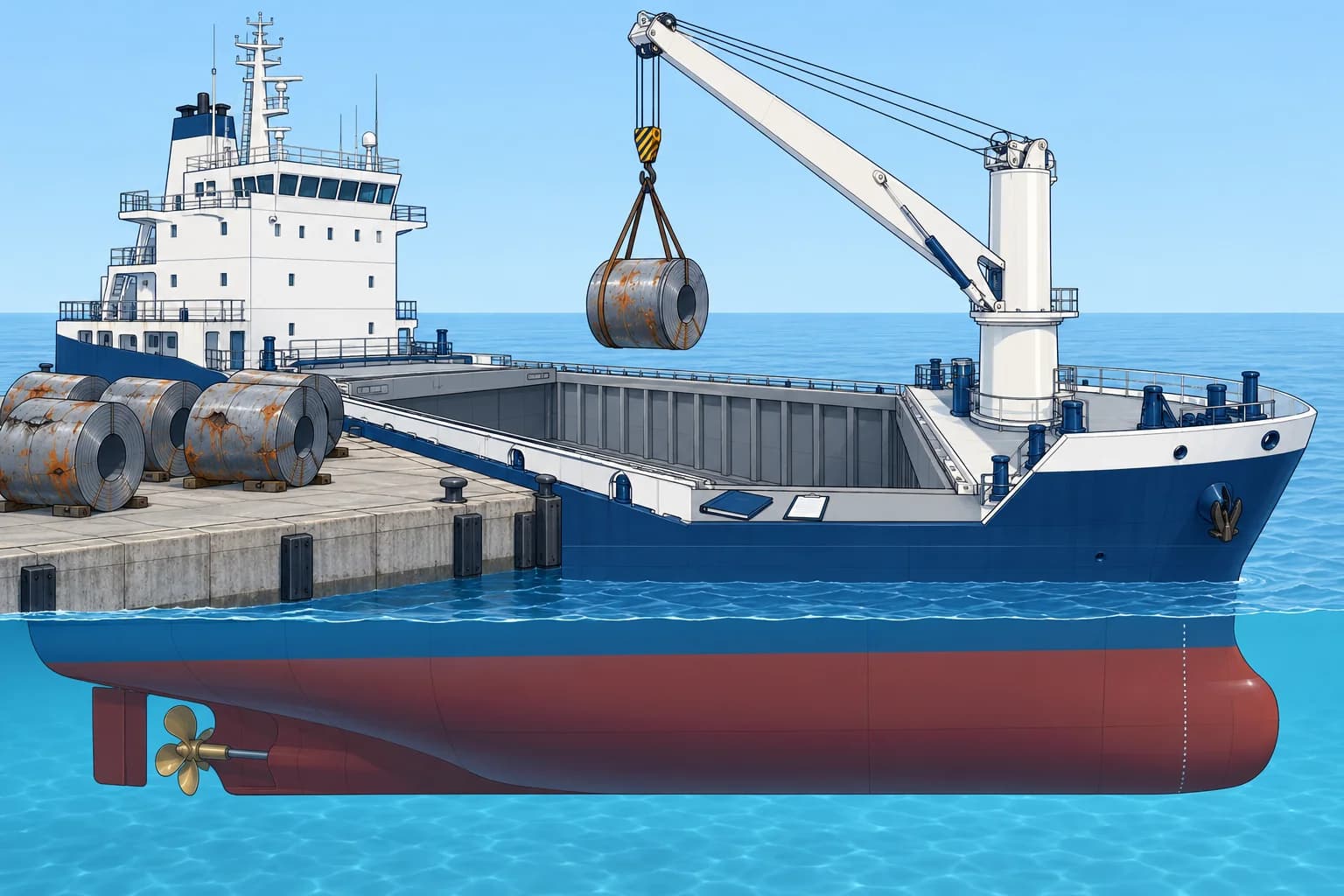
After loading steel coils you notice rust and dents on 14 coils. The shipper asks you to issue clean bills of lading and offers a letter of indemnity. The ship then meets a severe storm on passage. What do you do in each case?
Show the answer
Clause the mate's receipt and the B/L with the coil numbers and the damage seen. Refuse the LOI for clean bills, and inform the owner and P&I club. During the storm, record the weather, ship motion and any actions taken in the deck log. On arrival note protest before a notary or consul, and extend it later when the damage is known.
Practice question
The receiver offers an LOI because the original negotiable B/L has not arrived. What should you do?
- Release against the LOI once the receiver has signed it
- Release after checking the cargo for visible damage
- Release once the agent has been told about the LOI
- Refer to the owner and P&I before delivery
Show the answer
Answer: D. An LOI does not establish entitlement or remove misdelivery liability. Do not release cargo on your own authority.