
Maritime law, rules and watchkeeping · Level R2 · 4 parts · about 14 min
The Netherlands: the inland rules (BPR), right of way and waterway signs
4 short parts: Right of way · Waterway signs · Fast boats · On board & at sea. Each part explains the idea, then gives the points to remember, the common mistakes, a worked case and a practice question; the Academy unit adds all 27 check questions.
1 · Right of way
Right of way under the BPR: starboard side first, then size, then type
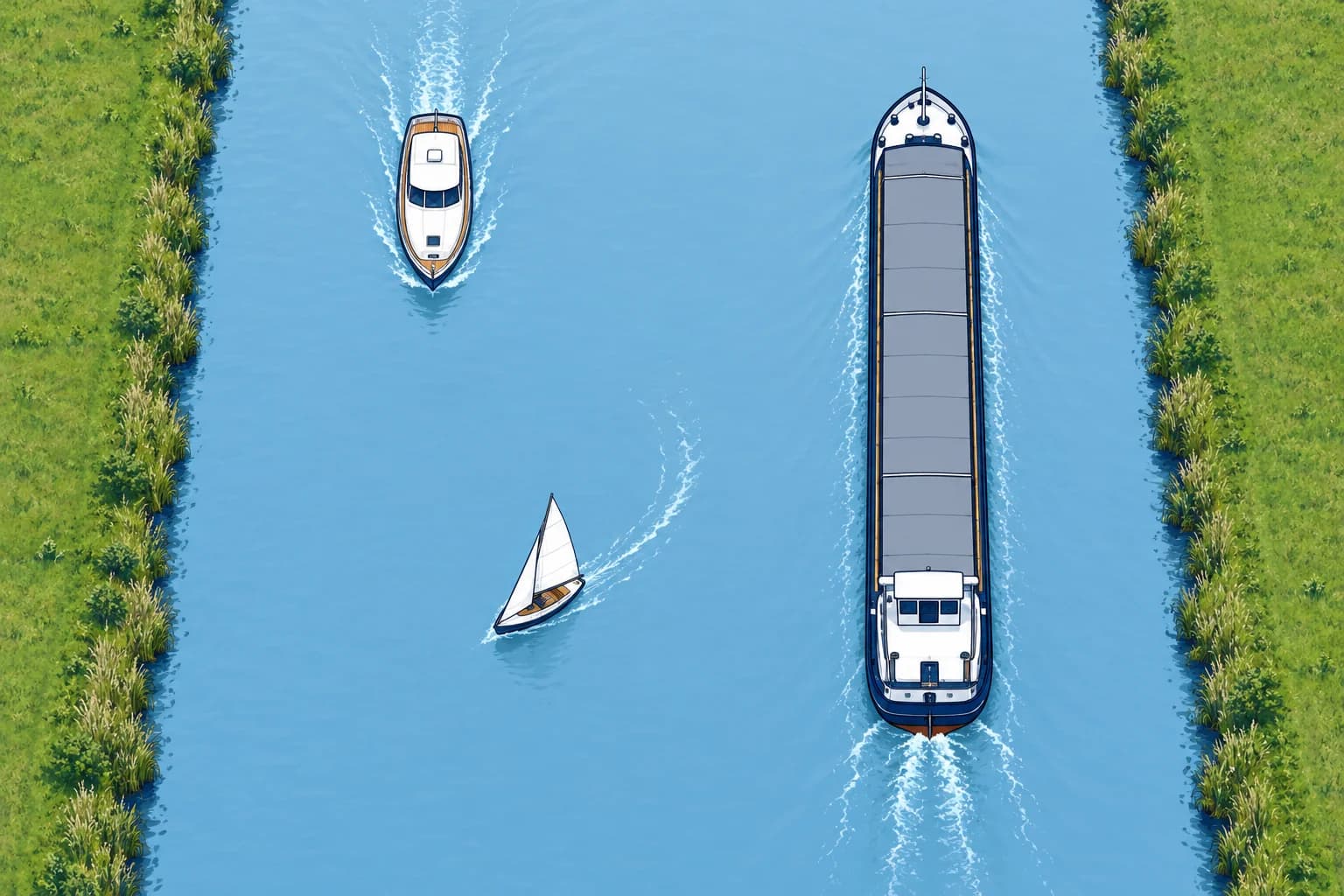
First identify any snel schip, which gives way. For other boats, test starboard side first, then size, then type.
The rule book
Most Dutch inland waterways follow the BPR (Binnenvaartpolitiereglement, inland navigation regulations), based on CEVNI, the European inland navigation code. A klein schip (small craft) is normally under 20 m. Some shorter vessels also count as large. These include ships certified for more than 12 passengers, certain ferries and push barges. They also include fishing vessels whose gear restricts manoeuvring, and vessels towing, assisting, pushing or carrying a large ship alongside. A snel schip, a large motor vessel able to exceed 40 km/h, gives way to everyone.
Step 1: the starboard side
For ordinary head-on and crossing encounters, apart from a snel schip, the boat not following the starboard side of the fairway gives way to the one that is when collision is possible. Keep to starboard: it gives you priority over other ordinary boats and makes you predictable. Crossings involving ferries, turning, leaving a berth or joining a main fairway have separate rules.
Step 2: small gives way to large
A groot schip (large ship) is at least 20 m long or belongs to an exception above. If neither boat keeps to the starboard side, a small craft gives way to a large one. When a large ship shows a light-blue board with a white flashing light, it asks to pass starboard to starboard. A small craft must then give way, preferably by doing as asked.
Step 3: among small craft
If neither keeps to starboard, a small motorboat gives way to small sailing boats and human-powered craft, such as rowing boats and canoes, and a human-powered craft gives way to a sailing boat. Two small motorboats head-on both turn to starboard; crossing, the one coming from port gives way.
Sailing boats and Dutch words
Between two small sailing boats, apply the starboard-side test first. If neither follows that side and collision is possible, the boat with wind from port gives way when tacks differ. On the same tack, windward (nearer the wind) gives way to leeward (farther from the wind). Dutch names the tack by the boom: over bakboord means boom to port, wind from starboard; over stuurboord means the reverse. Remember: "stuurboord wijkt voor bakboord".
Key figures
- Small craft (klein schip)
- Normally under 20 m; certain vessel types count as large
- Order of priority
- Snel schip gives way; others: starboard side → size → type
- Among small craft
- Motor gives way to human-powered craft; both give way to sail
- Snel schip
- Large motor vessel able to exceed 40 km/h: gives way to all
- Light-blue board
- Large ship asks to pass starboard to starboard
Remember
- A snel schip gives way to all. For other boats, test starboard side first, then size, then type.
- If neither keeps to starboard, small craft give way to large ones.
- Among small craft, motor gives way to sail and human-powered craft, and human-powered craft gives way to sail.
- A light-blue board from a large ship: give way, preferably passing starboard to starboard.
- If neither small sailing boat follows the starboard side, over stuurboord gives way to over bakboord when collision is possible.
Common mistakes
Wrong: Sail always has right of way over motor, so I can cut across a barge's bow under sail.
Right: A snel schip gives way to all. For other boats, starboard side comes first, then size. Sail over motor applies only between small craft when neither keeps to starboard.
Wrong: A Dutch sailor 'over stuurboord' has the wind from starboard, so she has priority.
Right: Dutch names the tack by the boom. Over stuurboord means boom to starboard, wind from port. Between small sailing boats on opposite tacks, it gives way if neither follows the starboard side and collision is possible.
Worked case
On a wide Frisian canal you sail a 7 m dinghy close-hauled near the middle. A 9 m motor cruiser comes the other way, keeping to its starboard side of the canal. Behind it, a 110 m barge shows a light-blue board on its starboard side. Who gives way?
Show the answer
Give way to the cruiser because it follows its starboard side. Also give way to the blue-board barge, preferably passing starboard to starboard. These passes may require different tracks. Slow or wait in a safe position until both ships’ intentions and passing room are clear. Do not turn automatically to starboard.
Practice question
Two small motorboats cross with collision risk. Neither follows the starboard side. The other boat is on your starboard side. What do you do?
- Hold course because both use engines
- Give way to the boat on your right
- Turn to port across its bow
- Expect the faster boat to give way
Show the answer
Answer: B. Neither follows the starboard side of the fairway. Between two small motorboats crossing with collision risk, you give way to the boat on your starboard side.
2 · Waterway signs
Dutch waterway signs in five families, and the ones visitors miss
BPR signs come in five families, A to E. Learn the families by shape and colour, then the few that small boats meet every day.
Five families
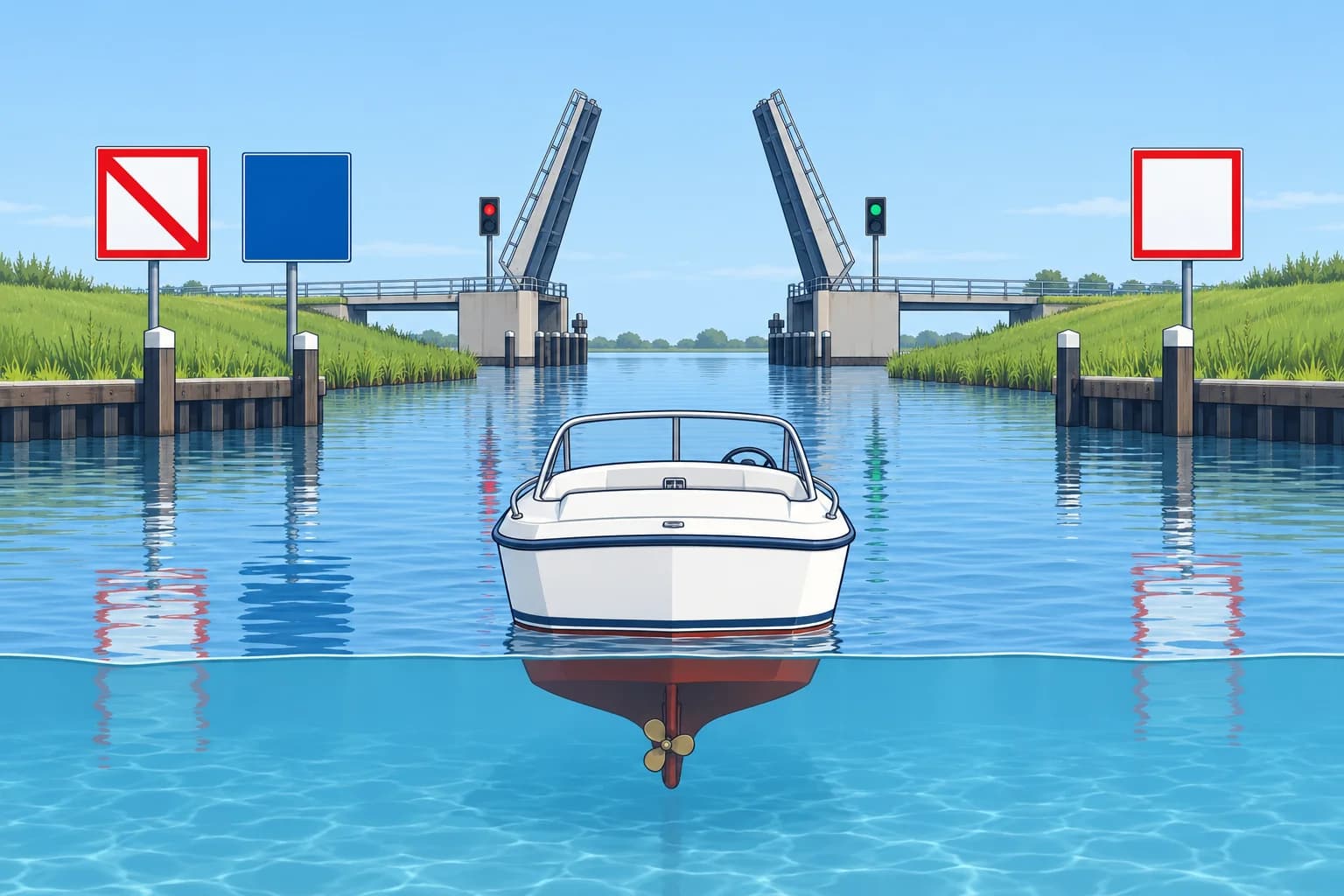
Annex 7 groups BPR signs by purpose. A prohibits: usually white boards with red borders or bars. B commands: usually red-bordered white boards without a slash. C restriction boards have red borders, white backgrounds and black symbols. D recommendations include yellow diamond marks at bridge openings. E informs or permits: usually blue boards, with E.1 using green and white. Learn each symbol as well as its colour.
Stop and go
A.1, a board with red–white–red bands or red lights, means no passage. E.1, a board with green–white–green bands or green lights, permits passage. Steady red and green together normally mean wait: permission will follow shortly. At bridges, yellow lights above the opening can permit boats low enough to pass beneath the closed span despite red signals. Read the complete display and pass safely.
Signs for small craft
A.13 bans small craft, A.15 bans sailing boats, A.14 bans water skiing and A.17 bans windsurf boards. Their E-sign twins allow them: E.16 small craft, E.17 water skiing, E.18 sailing and E.20 windsurfing. B.6 sets a speed limit in km/h, common in canals and towns.
Fast-boating signs
E.21 marks fast-boating water; A.18 marks its end. The normal maximum for fast motorboats is 20 km/h unless the competent authority permits faster boating on that stretch. Check the permitted times, any local speed limit and any lower limit shown by B.6. Times, such as daytime only, appear on boards below the sign.
Local rules on top
Provinces, water boards and towns add lower limits, mooring rules and closures. Check vaarweginformatie.nl for navigation notices and lokaleregelgeving.overheid.nl for local regulations. The Wateralmanak is a commercial guide, not an official publication.
Key figures
- A / B / C / D / E
- Ban / command / limit / recommendation / information
- A.1 / E.1
- No passage / passage allowed
- B.6
- Speed limit in km/h
- E.21 / A.18
- Fast boating allowed / end of fast-boating water
- E.17 / A.14
- Water skiing allowed / water skiing banned
Remember
- A bans, B commands, C limits, D recommends, E informs or permits.
- A.1 prohibits passage; E.1 permits passage when it is safe.
- A.13 bans small craft and E.16 allows them; A.15 and E.18 do the same for sail.
- B.6 shows a speed limit in km/h; check the board below for times and exceptions.
- E.21 opens fast-boating water; A.18 ends it.
Common mistakes
Wrong: A red light at a lock only applies to commercial ships.
Right: A.1 red applies to everyone, small craft included. Wait well clear until the displayed signal permits passage.
Wrong: An E.21 sign means there is no speed limit at all.
Right: E.21 marks fast-boating permission, often only at set times. Check the designation and its conditions. Safe speed and local limits, including B.6, still apply.
Worked case
Leaving Loosdrecht in your 6 m speedboat, you see E.21 with a board 'Mon–Fri 09:00–19:00'. It is Sunday 11:00. Further on, B.6 shows 9. Assume no other designated exception or restriction applies. How fast may you go on the open lake and after B.6?
Show the answer
The E.21 permission is inactive on Sunday. With no other designated exception, the maximum is 20 km/h before the B.6 sign and 9 km/h after it. Go slower if conditions require.
Practice question
Which family of BPR signs gives a command, such as a speed limit?
- A signs
- B signs
- C signs
- E signs
Show the answer
Answer: B. B signs command, for example B.6, the speed limit in km/h. A signs ban and E signs inform or permit.
3 · Fast boats
Fast motorboats, the 20 km/h rule and the Klein Vaarbewijs
A fast motorboat is a small craft able to exceed 20 km/h under engine power. It needs registration, a licence and safety gear; speed permissions still apply.
What a fast motorboat is
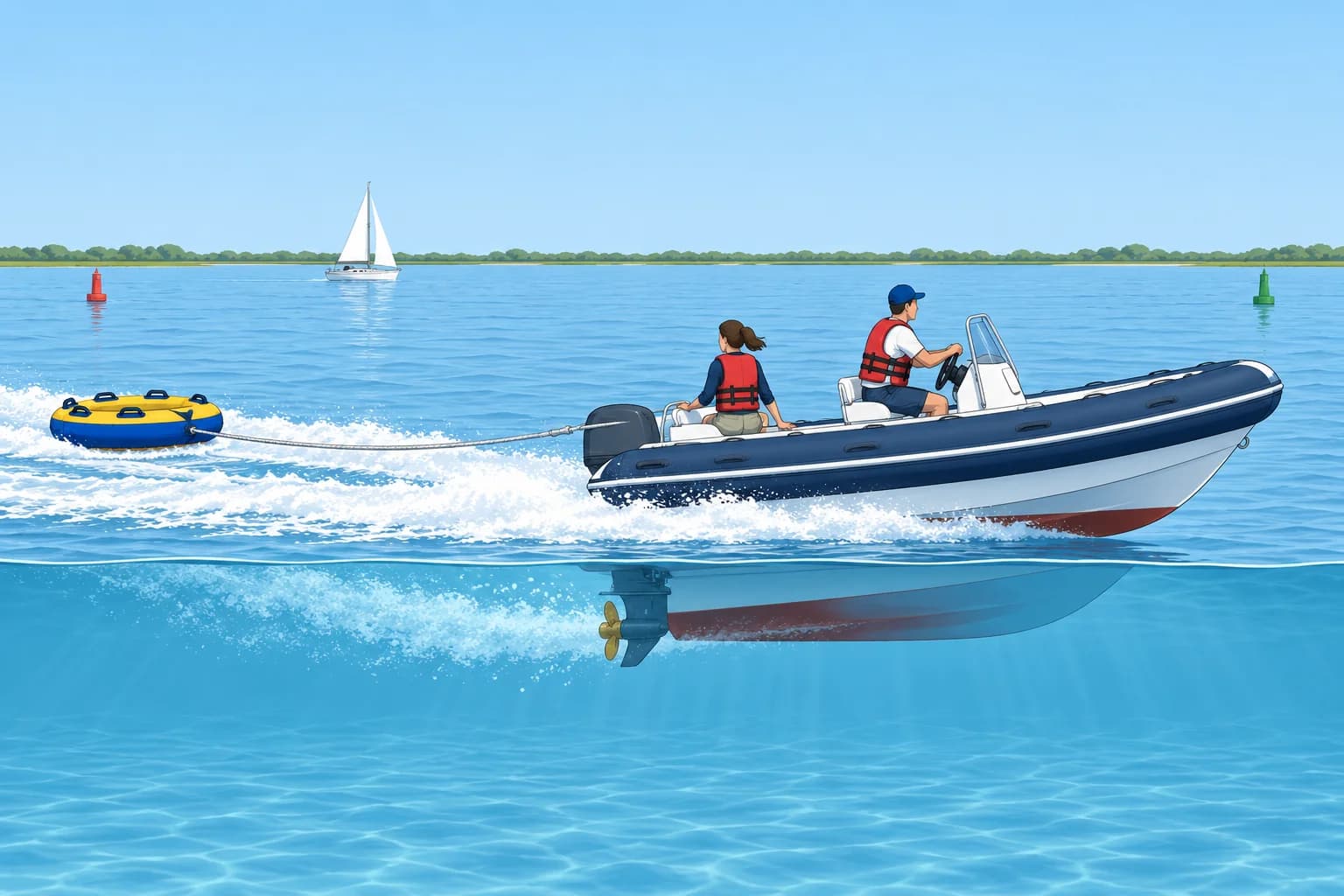
A snelle motorboot (fast motorboat) is a small craft that can go faster than 20 km/h through the water under its own engine. Jet skis count. Its maximum capability counts, even if you always drive slowly.
The 20 km/h rule
The normal maximum is 20 km/h unless the competent authority permits faster boating on that stretch. E.21 marks fast-boating water; check its times and any local speed limit. Water skiing is banned except where E.17 allows it by day, and you need a lookout aged at least 15. Use the designated seat unless your boat permits safe standing control. Wear a lifejacket when standing at an open helm.
Registration and gear
Register with the RDW (Dutch vehicle authority) and carry its registration certificate. Display its mark on both sides, normally at least 150 mm high; 100 mm is allowed if construction prevents the standard size. Keep a lifejacket within reach for everyone and a fire extinguisher aboard. At an open helm, use a kill switch whenever underway. Attach any kill cord to yourself so it stops propulsion if you fall from the helm. Enclosed inside steering is exempt.
The Klein Vaarbewijs
A Klein Vaarbewijs is the Dutch small-craft licence. You need one for a pleasure craft from 15 m to under 25 m, or a motorboat under 15 m able to exceed 20 km/h through the water under engine power. Klein Vaarbewijs I covers most rivers, canals and lakes. II also covers designated large waters, including the IJsselmeer, Waddenzee and Scheldt estuaries. See the boating-licence guide.
Ages
The helmsman of a fast motorboat must be at least 18. For a large ship, a slower small motorboat or a sailing boat of 7 m or more, the minimum is 16. An open motorboat under 7 m with a top speed of at most 13 km/h may be steered from 12.
Key figures
- Fast motorboat
- Small craft able to exceed 20 km/h under engine power through water
- Speed limit
- Normally 20 km/h; designated exceptions and local limits apply
- Klein Vaarbewijs
- 15 to < 25 m, or < 15 m motorboat able to exceed 20 km/h
- Minimum helm age
- 18 fast motorboats; 16 generally; 12 open motorboats <7 m, ≤13 km/h
- Registration letters
- Normally ≥ 150 mm; construction exception ≥ 100 mm
Remember
- A small craft able to exceed 20 km/h through the water under engine power is a fast motorboat. Jet skis count.
- Keep to 20 km/h unless faster boating is permitted here; check E.21 and local conditions.
- Fast motorboats need RDW registration, lifejackets and an extinguisher; with an open helm, use a kill switch underway.
- Klein Vaarbewijs: 15 to under 25 m, or a motorboat under 15 m able to exceed 20 km/h.
- 18 for fast motorboats; normally 16 for others; 12 for open motorboats under 7 m with a top speed of at most 13 km/h.
Common mistakes
Wrong: I never go faster than 20 km/h, so my 60 hp boat needs no licence.
Right: What counts is what the boat can do. A boat under 15 m able to exceed 20 km/h needs a Klein Vaarbewijs, however you drive it.
Wrong: A 12 m sailing yacht needs a Klein Vaarbewijs.
Right: Length alone triggers it only from 15 m. A 12 m sailing yacht that cannot exceed 20 km/h needs none.
Wrong: A 16-year-old with a licence may drive our fast motorboat.
Right: The helmsman of a fast motorboat must be at least 18, unless an exemption for club training or racing applies.
Worked case
At Enkhuizen, you rent a 5 m motorboat capable of 50 km/h for the IJsselmeer. You hold Klein Vaarbewijs I and plan to tow a 14-year-old water skier in daylight in an E.17 area. Only you and the skier are present. What must change?
Show the answer
You need Klein Vaarbewijs II for this fast motorboat on the IJsselmeer. You also need a separate lookout aged at least 15 aboard the boat; the skier cannot fill that role. Keep to 20 km/h unless faster boating is permitted on that stretch. Check E.21, designated exceptions and any lower local limit.
Practice question
Your small motorboat can reach 35 km/h, but you keep below 20 km/h. Is it a snelle motorboot?
- Only while actually exceeding 20 km/h
- Only while travelling in an E.21 area
- Only if the engine exceeds 15 hp
- Yes, because its capability exceeds 20 km/h
Show the answer
Answer: D. It is about what the boat can do: able to exceed 20 km/h through the water under its own power.
4 · On board & at sea
Papers, VHF, alcohol and the switch to sea rules
Carry the required papers, follow VHF rules if fitted, keep within the alcohol limit, and check which rules apply to your waters.
Papers
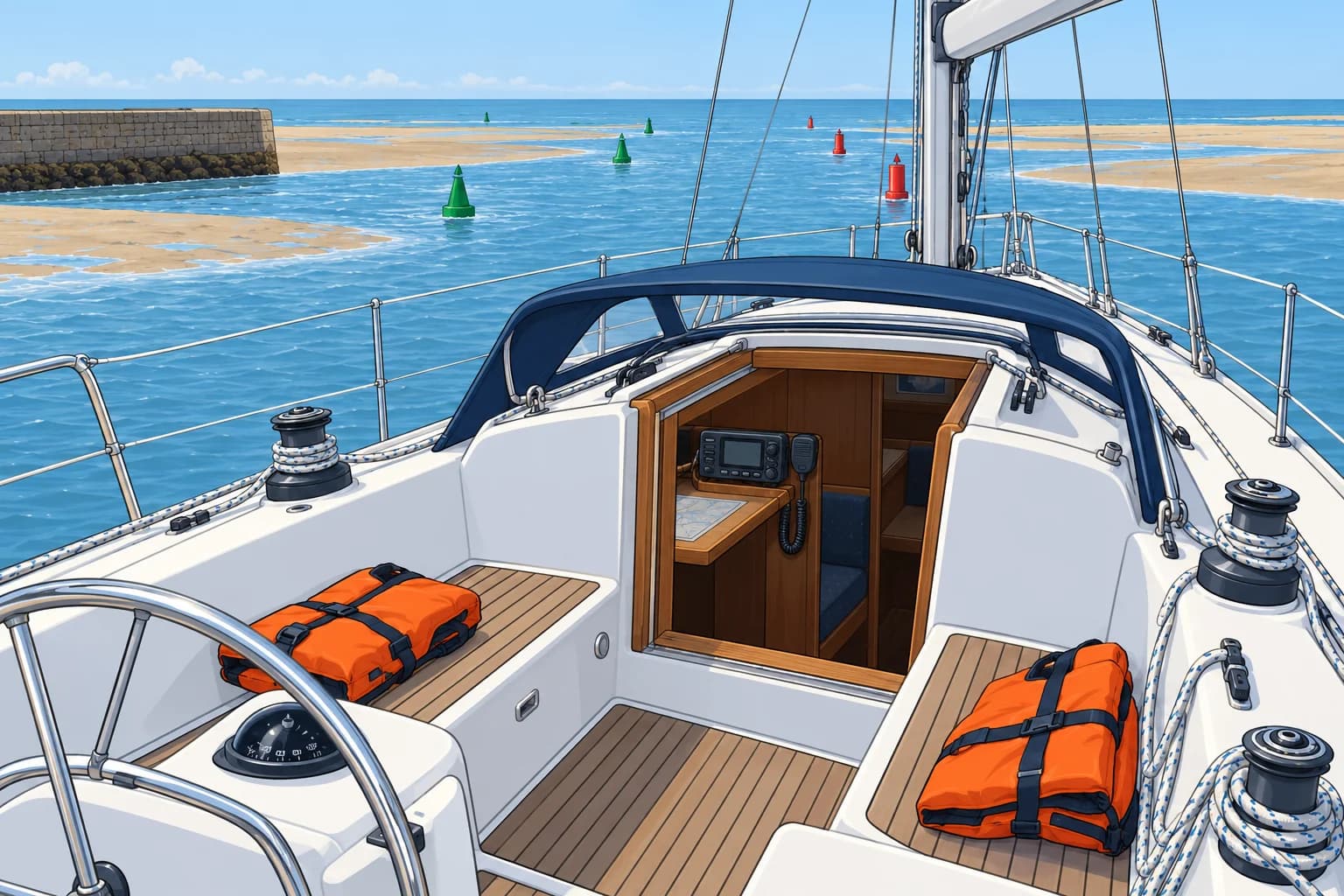
Carry your required vaarbewijs (licence) and fast-boat RDW certificate. With VHF, also carry the original operator certificate and the radio registration document; the latter may be a PDF. Carry an up-to-date BPR, accessible at any time on paper or electronically; small open boats and large ships without crew accommodation are exempt. Show required papers on request.
VHF is optional, rules are not
Under the BPR, a marifoon (VHF radio) is normally optional on small craft; it is required for radar use or AIS (Automatic Identification System) transmission underway. If fitted, keep it on and listen on the channel for your waterway. Use the block channel, the assigned channel for a controlled section, where one applies. Send safety messages when needed. Inland VHF must transmit an ATIS identification code, and someone aboard needs an operator certificate.
Gear
The BPR has no general safety-kit list for private small craft; fast motorboats have specific requirements. The lifejacket-wearing duty in BPR 1.08 concerns commercial transport. For safety, carry a lifejacket for each person, an extinguisher, an anchor and a suitable paddle. Your boat must also show the navigation lights required by the BPR.
Alcohol
You may not steer with more than 0.5 ‰ of alcohol in your blood: 0.5 grams per litre. This applies to pleasure and commercial boating. The water police may ask you for a breath test, and refusing is an offence. Steering under the influence brings a fine and can cost you your licence.
Out to sea
Beyond the line where Dutch inland waters end, the COLREG (International Regulations for Preventing Collisions at Sea) apply, together with the Scheepvaartreglement territoriale zee (territorial sea shipping regulations). The Westerschelde and the Ems estuary have their own regulations. The Waddenzee and IJsselmeer are inland waters under the BPR. Flags, the ICC and EU VAT are in Law: foreign waters.
Key figures
- VHF on a small craft
- Optional unless using radar or transmitting AIS underway
- If a VHF is carried
- Listen on the channel; ATIS code; operator certificate
- Alcohol limit
- 0.5 ‰, pleasure and commercial alike
- BPR copy on board
- Exempt: small open boats; large ships without crew accommodation
- At sea
- COLREG + Scheepvaartreglement territoriale zee
Remember
- Carry required papers. BPR copy: small open boats and large ships without crew accommodation are exempt.
- Under the BPR, VHF is required for radar or AIS transmission underway; if fitted, listen and use ATIS.
- Carry suitable safety equipment even without a general legal kit list; required navigation lights still apply.
- Alcohol limit 0.5 ‰ for pleasure and commercial boating; refusing a breath test is an offence.
- At sea: COLREG plus the territorial sea regulations; the Waddenzee stays under the BPR.
Common mistakes
Wrong: My VHF is on board, but I keep it off to save the battery.
Right: A small craft with a VHF must listen on the channel for its stretch, including block channels. Switch it on and listen.
Wrong: The Waddenzee is sea, so the COLREG apply there.
Right: The Waddenzee is a Dutch inland water under the BPR, although it is tidal and exposed. The COLREG start beyond the inland boundary.
Worked case
Your 10 m yacht has a fixed VHF. You cross the Waddenzee from Harlingen to the North Sea, then enter the Westerschelde at Vlissingen. A friend says the radio can stay off because VHF is optional for yachts. Which rules apply, and is your friend right?
Show the answer
Your friend is wrong. Under the BPR, VHF is optional unless using radar or transmitting AIS underway. Once fitted, listen on the channel for each stretch and use ATIS on inland channels. The Waddenzee is under the BPR. Beyond the inland boundary, COLREG and the territorial sea regulations apply. The Westerschelde has its own regulations and VHF duties: check them before you go.
Practice question
Under the BPR, a 9 m yacht uses neither radar nor an AIS transmitter. With no additional local requirement, must it carry VHF?
- Yes, on all BPR waterways
- Only on the IJsselmeer
- No, carriage is optional
- Only above 7 m in length
Show the answer
Answer: C. Under the BPR, VHF is optional on small craft unless using radar or transmitting AIS underway. In those cases, carry a working ship-to-ship VHF switched on for reception. This yacht uses neither, and no additional local requirement applies.