
Decide
Four situations at sea. Decide first, then read why.
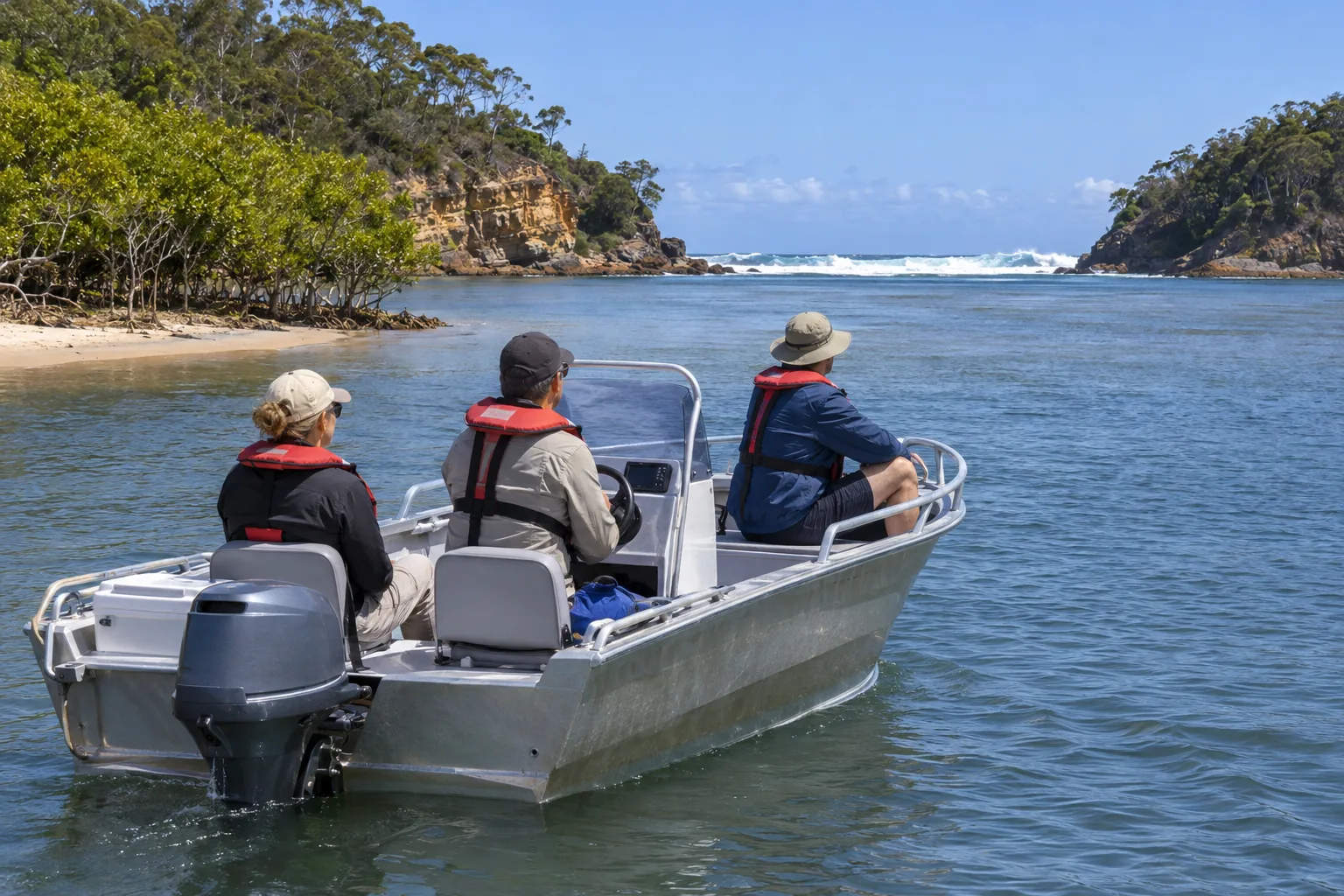
You are waiting safely inside Narooma bar. Breaking waves are building, and you are unsure whether your boat can handle them. What do you do?
Key points
- Check the waterway, not just its appearanceOpen-water boundaries may begin inside an entrance; enclosed water can still hide serious hazards.
- Check boating maps and carry equipment for the waters you will enter. Keep enough power for steerage in waves.
- Look for submerged hazards, currents, low bridges and powerlines. Avoid dam spillways and water-release areas.
- Alpine waters can be cold even in summer. Always wearing a lifejacket is recommended; wear is compulsory on small powerboats and sailing boats.
- For alpine powerboats and sailing boats, follow the stricter reading: everyone wears Level 50S or above up to and including 4.8 metres. The sources differ at exactly 4.8 metres; check the current TfNSW page.
- Decide before committingCheck both crossings and have a safe alternative if you cannot return over the bar.
- Use forecasts, tides, local advice and observations; a webcam alone is not enough.
- Prefer an incoming tide and avoid the ebb, without treating the tide as a guarantee.
- Everyone wears a lifejacket throughout the crossing: Level 100 or above on an ordinary powerboat.
- Log on and off with Marine Rescue NSW as recommended safety practice.
- Outwards and homewards are differentGoing out, control your approach to each wave; coming in, stay on the back of a swell.
- Outwards: near head-on, ease power before waves and accelerate between them; avoid becoming airborne.
- Inwards: do not run down the wave's face; keep ahead of the wave behind.
- If return entry is unsafe, wait safely or seek another safe harbour.
- Leave room on the HarbourKeep right, keep well clear of big ships in channels and know the local exclusions.
- Bridge Transit Zone: maximum 15 knots; no stopping, anchoring or drifting except in an emergency.
- A ferry's daytime orange diamond gives priority over sail, except when it is overtaking a sailing vessel.
- PWC and kiteboards are prohibited on Sydney Harbour; check other restrictions on maps and signs.
- Keep clear of naval vessel zones, restricted port facilities and seaplane take-off areas.
- An empty mooring is not automatic permissionKnow the buoy category and approach slowly with minimal wash.
- Pink: free public mooring for 24 hours; yellow: private; orange: commercial; red: club; blue: emergency.
- Private, commercial and emergency moorings require a licence or authorisation.
- At 6 knots or more in a powered boat, keep 30 metres from moored vessels where possible; otherwise keep a safe distance at a safe speed.
- Stop with the buoy ahead, put the engine in neutral and pick up the mooring.
- Anchor by the bow, then checkChoose shelter and swing room, avoid hazards and sensitive habitat, and confirm the anchor holds.
- Do not anchor in channels, obstruct access or anchor within 200 metres of underwater cables.
- Avoid seagrass, reefs, bomboras and historic wrecks.
- Use the handbook's 3:1 line-to-depth guidance, increasing to 5:1 or more in strong current or deteriorating weather.
- Allow for tides and wind changes; check position against landmarks and recheck in strong conditions.
Lessons
Short lessons, each ending with 2 questions.
- 9.1Know which waters you are enteringOpen waters include coastal and ocean waters.Estimated time: about 4 minutes
- 9.2A coastal-bar crossing starts with the decision to goA coastal bar is a shallow, shifting sandbank at a river or estuary entrance.Estimated time: about 2 minutes
- 9.3Going out and coming back inGoing out, take waves as close to head-on as possible.Estimated time: about 2 minutes
- 9.4Sydney Harbour and areas you must keep clear ofSydney Harbour mixes large ships, ferries, small boats, swimmers and seaplanes.Estimated time: about 3 minutes
- 9.5Pick a mooring or anchorage carefullyMooring areas contain people, dinghies and trailing ropes.Estimated time: about 3 minutes
Check what you have read
Question 1/3
Your planned route stays just inside a river entrance. How do you decide whether open-water equipment is needed?