
Navigation · Level R2 · 4 parts · about 11 min
Steering a compass course and taking a bearing
4 short parts: The compass · Steering a course · Taking a bearing · True and magnetic. Each part explains the idea, then gives the points to remember, the common mistakes, a worked case and a practice question; the Academy unit adds all 24 check questions.
1 · The compass
The magnetic compass: how it works and its types
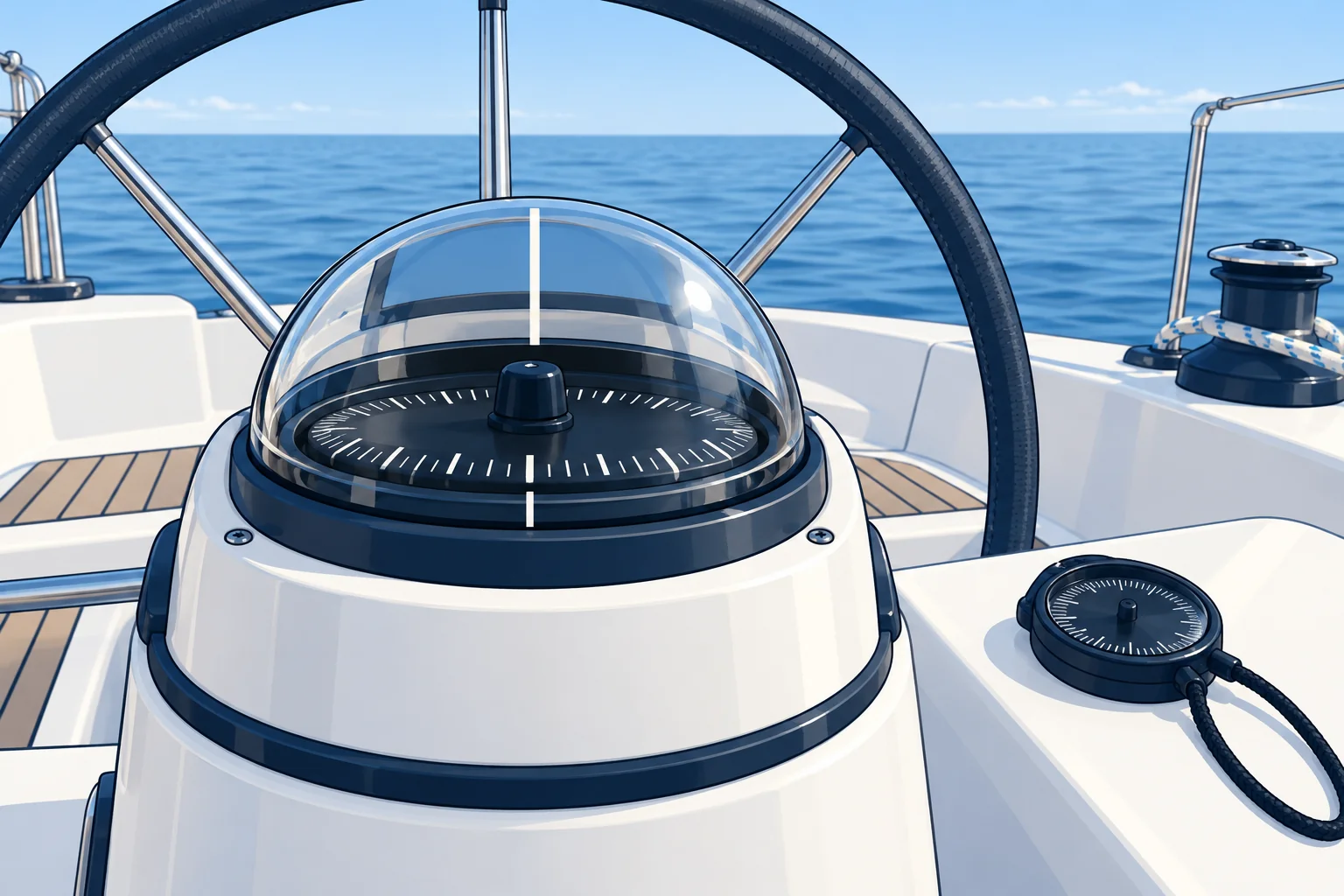
A magnetic compass card lines up with the Earth's magnetic field while the boat turns around it. The figure on the lubber line is your heading.
How it works
A magnetic compass has magnets fixed under a round card marked in degrees clockwise from north. The magnets line up with the Earth's magnetic field, so the card keeps pointing north while the boat turns around it. Liquid supports the pivoted card and slows its swinging in waves. A gimbal, a set of pivoting rings, lets the bowl stay level as the boat rolls and heels.
The lubber line
The lubber line is a fixed mark in the compass bowl, lined up with the boat's fore-and-aft centre line. The card figure against it is your heading: the direction the bow is pointing. The compass must be mounted with the lubber line exactly parallel to the centre line, or every heading you read will be wrong.
Types on board
The steering compass is fixed where the person steering can see it, in a binnacle (compass housing) at the wheel or on a bulkhead (cabin wall). A hand-bearing compass is a small portable magnetic compass for taking bearings of objects. A fluxgate compass is electronic: a sensor measures the magnetic field and sends the heading to other instruments. It needs power and calibration, so keep the magnetic compass as your backup.
Look after it
A large or persistent bubble needs inspection; it may indicate lost liquid. Keep the cover on when the compass is not in use, especially in strong sun. Check the compass light before a night passage. For a check, line up two charted fixed objects: this is a transit. When safe, point the bow along that line. Compare your compass heading with the transit's compass direction supplied by your navigator.
Key figures
- Card
- Degrees clockwise from north, 000°–359°
- Heading
- Card figure against the lubber line
- Cardinal points
- 000° N, 090° E, 180° S, 270° W
- Writing it
- Three digits plus reference: 045°C (compass)
Remember
- The card holds magnetic north; the boat and the lubber line turn around it.
- Heading = the card figure against the lubber line.
- Steering compass, hand-bearing compass and electronic fluxgate compass.
- A fluxgate needs power: keep the magnetic compass as the backup.
Common mistakes
Wrong: The card turns when the boat turns.
Right: The card stays lined up with magnetic north. The boat and the lubber line turn around it.
Wrong: An electronic fluxgate makes the magnetic compass unnecessary.
Right: A fluxgate needs power and calibration. The magnetic compass works when everything electric has failed.
Worked case
On a night passage a battery fault blanks the plotter and the autopilot, and the fluxgate heading is lost. How do you keep navigating?
Show the answer
Hand-steer by the magnetic steering compass: it needs no electrical power. Use its light if power remains, or a dim torch kept clear of the compass. Read the card against the lubber line and hold the ordered compass heading.
Practice question
What does the lubber line show?
- The direction of true north here
- The boat's heading on the card
- The local variation in degrees
- The direction the wind blows from
Show the answer
Answer: B. The lubber line is fixed to the boat's centre line, so the card figure against it is the heading.
2 · Steering a course
Steering a compass course
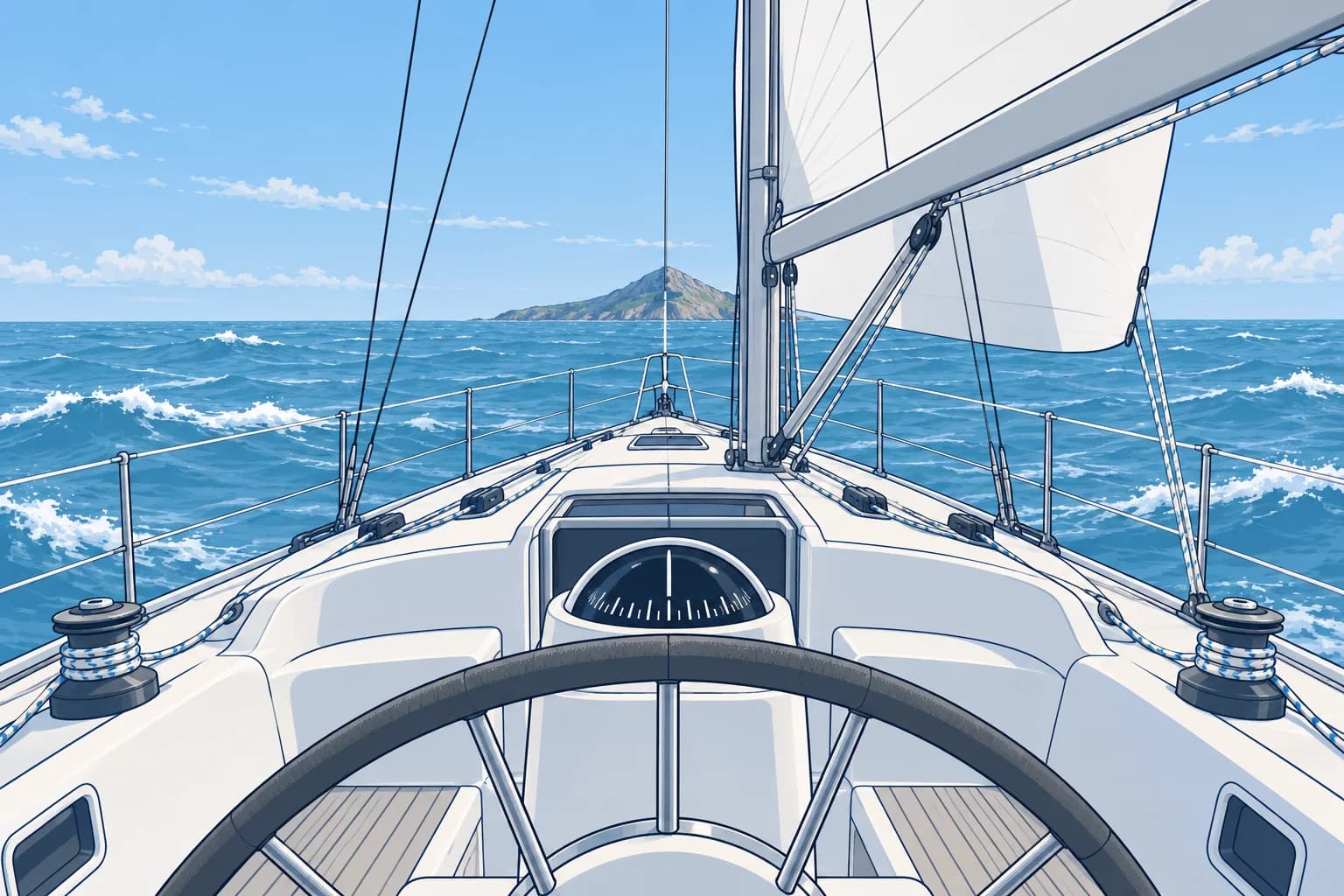
Turn until the course is on the lubber line, then hold a steady average. Figures wrap at north. Steer by a mark ahead and do not chase the card.
Getting on course
To steer a compass course, turn until the course figure sits against the lubber line, then hold it there. Headings increase clockwise as you turn to starboard (right), wrapping from 359° to 000° at north. Turning to port (left) reverses this. From 090° to 100°, turn 10° to starboard. From 350° to 010°, the shortest turn is 20° to starboard.
Don't chase the card
The card lags and swings in waves. If you steer to every flicker you zigzag and tire yourself. Make small, early corrections and watch the average heading over several seconds. In a seaway the card will swing either side of the course; your job is a steady mean heading.
Use a mark ahead
Once you are on course, pick something ahead that lines up with the bow: a distant headland, a cloud, a star at night. Steer by it and glance at the compass now and then. Clouds and stars move, so check the compass and choose a new mark often.
Under sail
When sailing as close to the wind as the boat can, the wind sets the best heading you can make. Steer by the sails and the wind. Note your actual average compass heading and tell the navigator, who needs it to plot your position. Say so at once if you cannot hold the course you were given.
Saying it clearly
Give courses digit by digit with their reference: "steer two-seven-zero compass". The helm, the person steering, repeats it back. Record each course change, the time and the log reading (distance travelled through the water).
Key figures
- Turn to starboard
- Heading increases, wrapping from 359° to 000° at north
- Turn to port
- Heading decreases, wrapping from 000° to 359° at north
- Spoken course
- Digit by digit: "two-seven-zero compass"
- In a seaway
- Hold a steady mean heading, not every swing
Remember
- Headings increase to starboard and decrease to port, wrapping at north between 359° and 000°.
- Do not chase the card: small corrections, a steady mean heading.
- Steer by a mark ahead and check the compass often.
- Give courses digit by digit with the reference, "two-seven-zero compass", and have the helm repeat them.
Common mistakes
Wrong: Follow the card in the direction you want to go.
Right: Headings increase to starboard and decrease to port, wrapping at north between 359° and 000°. Steer by the heading figure.
Wrong: Correct hard every time the card swings.
Right: The card lags. Hard corrections make a zigzag. Steer gently to an average heading.
Wrong: When you cannot hold the course, just do your best quietly.
Right: Tell the navigator the heading you are actually making. A wrong heading in the log gives a wrong position.
Worked case
You take the helm at night: "steer two-one-five compass". The card swings 8° either side in the waves and you keep overcorrecting. What do you do?
Show the answer
Repeat “steer two-one-five compass” back. Ease your corrections: steer small and early, watching the average heading over several seconds rather than each swing. Find a star close to the bow on 215° and steer by it, checking the compass often and picking a new star as it moves. Tell the navigator the mean heading you are holding.
Practice question
You are steering 180° and are told to steer 200°. Which way do you turn?
- To starboard, by 20°
- To port, by 20°
- To port, by 160°
- To starboard, by 160°
Show the answer
Answer: A. 200° is 20° more than 180°: turn 20° to starboard.
3 · Taking a bearing
Taking a bearing with a hand-bearing compass
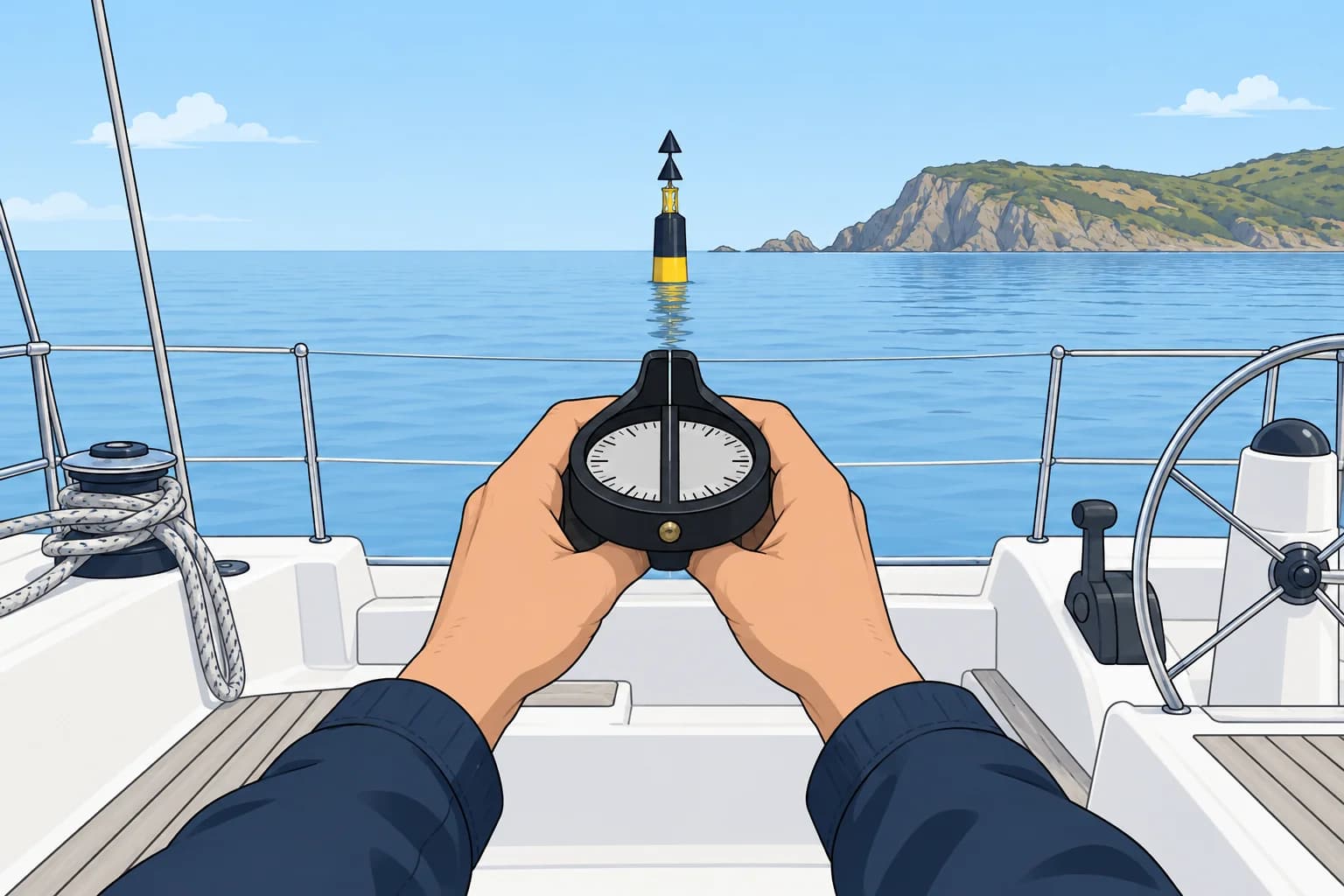
A bearing is the direction from you to an object. Take it clear of metal, write it down with the time, and use repeated bearings to judge collision risk.
What a bearing is
A bearing is the direction from you to an object, measured clockwise from north, from 000° to 359°. It needs a reference. Nearby magnetic material can cause deviation, an error in the compass reading. With negligible deviation, record hand-bearings as magnetic bearings, such as 125°M. For chart plotting, the bearing must first be expressed relative to true north. A line through the charted object then gives a position line: you are somewhere along it.
Taking it
Stand where you can see the object and are clear of steel, electrics and electronics: the engine, loudspeakers, winch handles and your phone all deflect a compass. Hold the hand-bearing compass at eye level, sight the object, let the card settle and read the figure. Read it twice and write it down at once with the time.
Choose good objects
Use objects that are charted and easy to identify: a tower, a headland edge, a beacon. Buoys can be out of position, so prefer fixed marks. Closer objects give better lines. Here M means nautical miles, and a cable is 0.1 M. A 1° error shifts the line about 1 cable at 6 M, or 2 cables at 12 M. Position fixing covers crossing bearings.
Bearings and collisions
Bearings also warn of danger. Take repeated compass bearings of an approaching vessel. If the bearing does not change appreciably and the distance is closing, risk of collision exists (COLREG Rule 7). Risk can still exist with a changing bearing, especially with a very large vessel, a tow, or at close range. The COLREG module says what to do.
Write it down
Record the object, the bearing and the time, for example "Church tower 052°M 14:20". Do not round to the nearest 5°.
Key figures
- Magnetic bearing
- Written with M: 125°M
- 1° error at 6 M
- Position line about 1 cable out
- Collision check (Rule 7)
- Steady bearing + closing range = risk of collision
- Record
- Object, bearing, time
Remember
- Bearings measured from magnetic north use M, for example 125°M.
- Take it clear of metal and electronics, read twice, write it with the time.
- Prefer close, fixed, charted objects: 1° error ≈ 1 cable at 6 M.
- Steady bearing and closing range = risk of collision (COLREG Rule 7).
Common mistakes
Wrong: Take the bearing beside the engine box, where you can brace yourself.
Right: The engine and nearby electronics deflect the compass. Move to a clear spot, even if it is less comfortable.
Wrong: A bearing that changes a little means no risk of collision.
Right: With a big ship, a tow or at close range, risk can exist even while the bearing changes.
Worked case
Crossing a busy channel, you see a ship just to the left of your bow. Your hand-bearing compass reads 300°M at 10:05 and 300°M again at 10:08, and she looks bigger. What does this tell you?
Show the answer
The compass bearing is steady and the ship appears to be getting closer, so risk of collision exists. Record the bearings and times. A changing bearing would not automatically rule out risk, especially at close range. Collision-avoidance action belongs in the COLREG module.
Practice question
Where should you stand to take a hand-bearing?
- Next to the steering compass
- Beside the engine for steadiness
- Away from metal and electronics
- Close to the chart plotter screen
Show the answer
Answer: C. Steel and electrical equipment deflect the compass and spoil the bearing.
4 · True and magnetic
True north, magnetic north and the compass safe distance
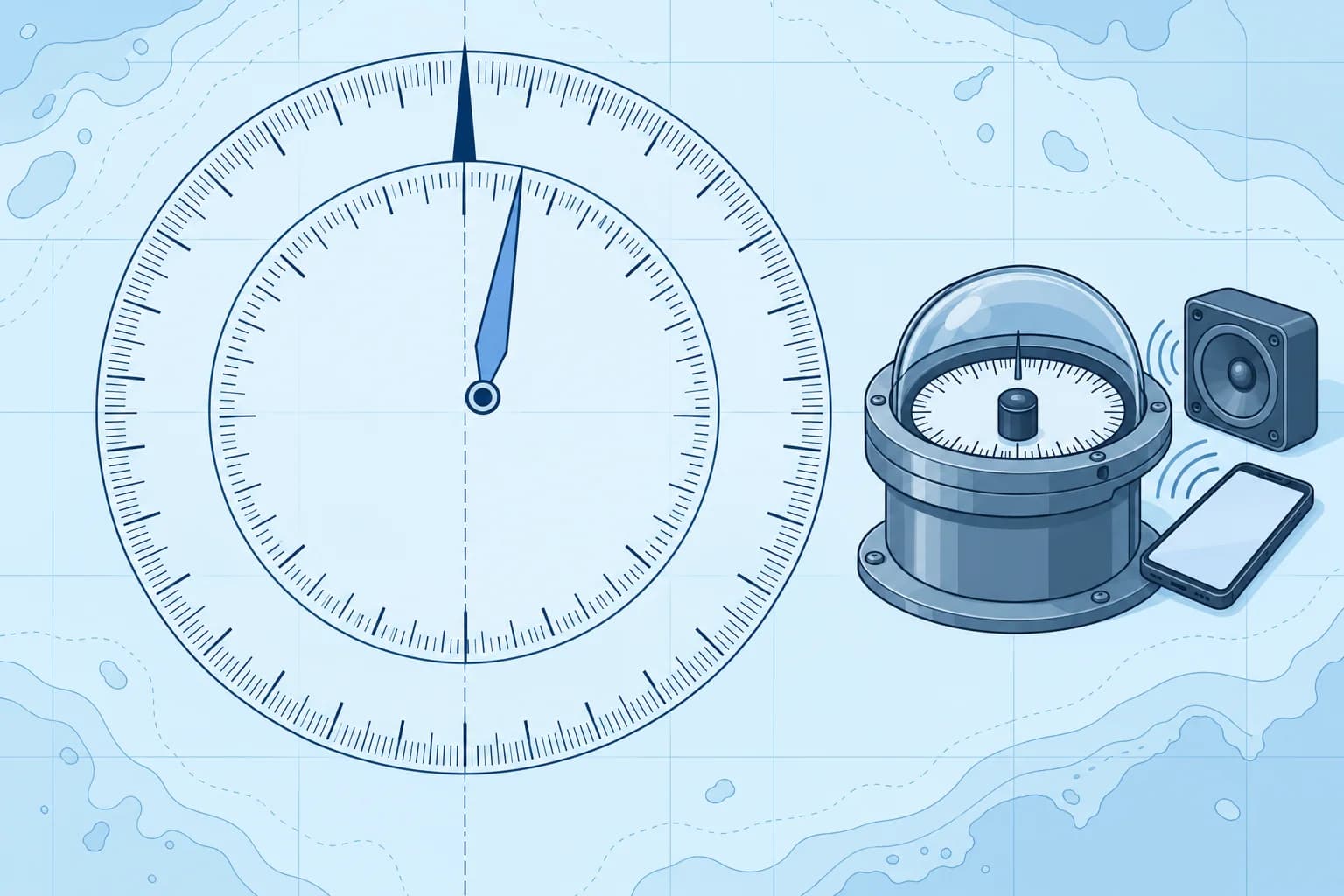
Charts use true north. Variation is the angle to magnetic north. Nearby magnetic items cause deviation: an error in your compass reading. Keep them away.
Two norths
True north is the direction of the geographic North Pole; chart meridians, the north–south lines, point to it. Magnetic north follows the Earth's magnetic field, which is not lined up with true north. Chart directions use true north (°T). Magnetic directions use magnetic north (°M). A raw compass reading uses °C. It equals the magnetic direction (°M) only when deviation is negligible. Allowing for deviation gives a magnetic direction.
Variation
The angle between true and magnetic north at a place is variation (also called declination), named east or west. It changes from place to place and slowly year by year. The chart's compass rose shows it: an outer true ring, an inner magnetic ring and a note such as "2°30′W 2015 (8′E)": 2°30′ west in 2015, changing 8′ eastward each year, so the west variation shrinks.
Deviation
Your boat adds its own error, deviation, caused by iron, steel and electrical equipment near the compass. It differs on each heading. A compass adjuster can reduce it and record what is left on a deviation card. Converting courses between true, magnetic and compass is taught in the unit Compass course, variation and deviation.
Compass safe distance
A manufacturer may specify a compass safe distance on equipment or in its instructions: the minimum gap from a compass. Respect it when fitting gear. If no distance is given, keep the item well away and ask the maker before fitting it near a compass. Keep phones, handheld radios, magnetic tools and power cables away too.
Small figures, big errors
Distance here is in nautical miles (M). An unnoticed 5° error puts you about 1 M off track after 12 M. Always know which north a figure uses.
Key figures
- Chart directions
- True (°T), from the meridians
- Compass reading
- Raw reading: °C; corrected for deviation: °M
- Variation
- True vs magnetic north; changes with place and year
- Deviation
- The boat's own error; changes with heading
- 5° error over 12 M
- About 1 M off track
Remember
- Charts use true (°T). A raw reading is compass (°C); correcting for deviation gives magnetic (°M).
- Variation: true vs magnetic north; it changes with place and year (see the compass rose).
- Deviation: the boat's own error; it changes with heading.
- Keep magnetic items well away and respect any maker's compass safe distance.
- A 5° error puts you about 1 M off track after 12 M.
Common mistakes
Wrong: Variation and deviation are the same thing.
Right: Variation comes from the Earth and depends on place and year. Deviation comes from the boat and depends on heading.
Wrong: The variation printed on an old chart is still right today.
Right: Use the year and annual change on the rose to bring it up to date.
Wrong: A phone on the cockpit seat by the compass is harmless.
Right: Phones, speakers and tools can deflect the compass several degrees. Keep them well away and respect any maker's compass safe distance.
Worked case
After a refit, the steering compass reading changes by 8° when a new portable speaker is placed beside it, although the boat has not turned. What should you suspect and do?
Show the answer
Suspect deviation from the speaker's magnet. Move it well away; respect any maker's compass safe distance. Recheck the compass against a known direction. If the error remains or fixed equipment has changed, have a qualified adjuster check it and its deviation card.
Practice question
What is variation?
- The error caused by the boat's own iron
- The swing of the card in rough seas
- The angle from true to magnetic north
- The angle between heading and track
Show the answer
Answer: C. Variation is the Earth's own difference between true and magnetic north at a place and time.